Search has changed more in the last two years than in the previous decade. 37% of people start their search using AI tools like ChatGPT, Perplexity, Google’s AI Overviews, Gemini, and Claude (Search Engine Land). They are not clicking through ten blue links. They are reading a synthesized answer.
And the issue is…
Your brand is either a part of that answer, or that position is filled by your competitor.
The AI SEO trends rewriting the rules today are not something to plan for next quarter. They are already affecting organic traffic, brand visibility, and purchase decisions right now. The playbook from 2020 does not apply here.
Understanding how AI search differs from traditional SEO is the starting point for everything that follows.
This blog covers what you actually need to know:
- How AI search works and why it breaks traditional assumptions
- The AI SEO trends reshaping brand visibility in AI search in 2026
- What on-page, off-page, and technical tactics actually move the needle
- How to measure AI visibility when old metrics are no longer enough
- Which trends are mostly noise, and which ones deserve your attention
Key Takeaways (TL;DR)
- 37% of users now start searches on AI tools, and brands not appearing in those answers are losing visibility to competitors who are.
- Traditional SEO rankings and LLM visibility are not the same thing. 38% of Google page-one brands are completely invisible in AI-generated answers.
- Brand mentions in trusted third-party sources like Wikipedia, Reddit, and industry publications now carry more weight than backlinks alone.
- Content structure, freshness, and topical depth are the on-page factors that most directly influence whether AI tools cite your brand.
- Measuring AI visibility requires a different framework. Organic traffic and keyword rankings will not tell you whether your brand is appearing in AI answers.
How AI Search Actually Works
To understand AI SEO trends, you first need to understand the mechanics.
Traditional search gives you a list of links. You go through multiple links, visit the pages, and find your answer. With AI search, you can skip that step. AI search tools, like ChatGPT Search, Perplexity, and Google’s AI Overviews, synthesize an answer directly. Your brand goes from being a result to potentially being a reference or not being referenced at all.
Large language models (LLMs) don’t crawl the web the way Google does. They learn patterns, associations, and reputations from vast text corpora. When someone asks an AI-driven search tool a question, the model draws on both what it learned during training and, increasingly, real-time retrieval from current web content.
That process is more nuanced than it looks; how LLMs choose content to reference in answers depends on trust signals, source reputation, and content structure working together. This is meaningfully different from how Google’s crawler works. Google indexes pages and ranks them. LLMs learn from content and develop associations. A brand that has been consistently mentioned in credible, trusted sources gets encoded as familiar and reputable. A brand that only exists on its own website is largely invisible to that process.
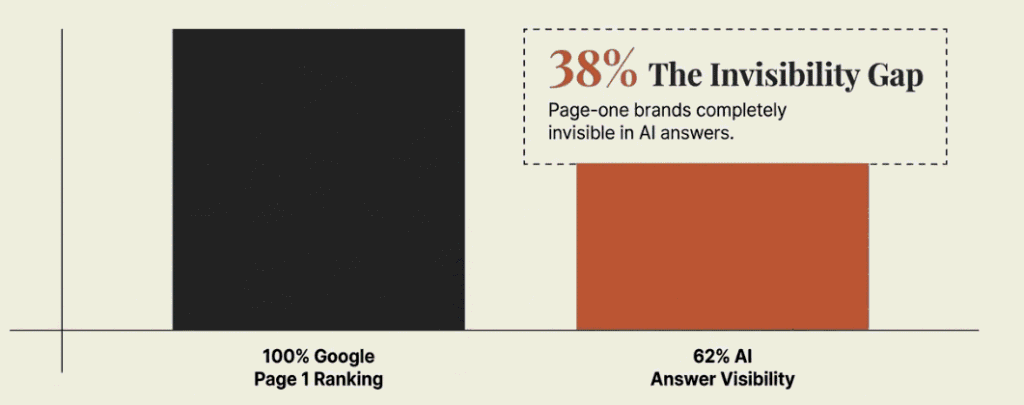
There is also a practical gap worth naming. Research found that brands ranking on Google search’s first page appeared in ChatGPT answers only 62% of the time (Search Engine Land). That means 38% of page-one brands are invisible in AI answers despite strong keyword rankings. Traditional SEO and LLM visibility are not the same thing. Building one does not automatically build the other.
What AI SEO Trends Are Reshaping Brand Visibility in 2026
Here is where things get specific. These are the AI SEO trends 2026 shifts that are already in motion and not in projection.
1. AI Overviews Are Appearing on More Queries, and CTR Is Falling
Google’s AI Overviews have expanded fast. AI Overviews appear on 58% of queries across 9 industries that include healthcare, education, B2B technology, insurance, entertainment, travel, eCommerce, finance, and restaurants (AlmCorp).
The click-through effect is real. And because of this, organic CTR has dropped 61% for queries where an AI Overview is present. But when your brand is cited in the AI Overview, organic CTR is 35% higher (SeerInteractive).
What this means is: your organic traffic numbers may be understating your actual brand visibility or overstating it. A brand can appear in thousands of AI summary answers and receive almost no corresponding clicks. The inverse is also true: a brand not appearing in those answers is losing exposure that never shows up in a traffic report.
If you’re not sure where to start tracking brand mentions in AI search is the clearest first step before you restructure your measurement model.
2. Queries Are Getting Longer, More Conversational, and More Specific
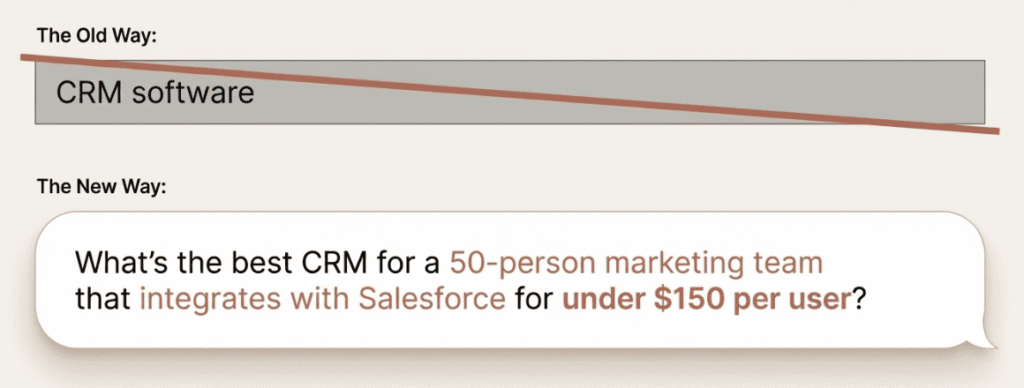
Users are no longer typing “CRM software” into a search bar. They are asking things like “What’s the best CRM for a 50-person marketing team that integrates with Salesforce for under $150 per user?”
This matters for content strategy. AI engines are built to handle complex queries with full context. They reward content that matches intent, not just keyword density. A page optimized around the fragment “CRM software” will lose to a page that directly and clearly answers the specific scenario being described.
So, if you want your brand to rank in AI tools, structure your content around real user scenarios. Use natural question phrasing in headings. Write sections that can stand on their own as complete answers to a specific user’s query. This is what AI search optimization actually looks like in practice.
3. AI Adoption Is Accelerating, Especially Among Younger Users
The demographic data here is worth paying attention to. 64% of US users use AI chatbots, like ChatGPT, Copilot, and Gemini (Pew Research).
So, if your target audience is younger people, then this is not a future concern. These users are forming first impressions of brands through AI-filtered discovery. What a generative AI model says about your brand is their first impression before they even visit your site, and before they even read a review.
Brand authority in AI systems is not just an SEO issue. It is a brand awareness issue.
4. Multimodal Search Is Expanding
AI search is increasingly blending text, image, and voice inputs into single queries. And when AI tools generate answers, they tend to favor content that is organized into structured tables, comparison lists, and clearly segmented sections.
What you can do is:
Add descriptive alt text to every image on your site. Create transcripts for any video or audio content. Structure pages with clear headers so AI systems can segment what each section covers.
These are not new SEO concepts, but they matter more now because AI-generated summaries pull heavily from content that is easy to parse.
5. Brand Mentions Are the New Backlinks
This is one of the most important LLM visibility trends and also one of the least understood.
Google ranks pages partly by domain authority and backlink profiles. LLMs do not work that way. They learn from patterns across text. A brand that gets mentioned repeatedly in sources the model already trusts, such as Wikipedia, Reddit, industry publications, review platforms, and best-of guides, builds familiarity over time.
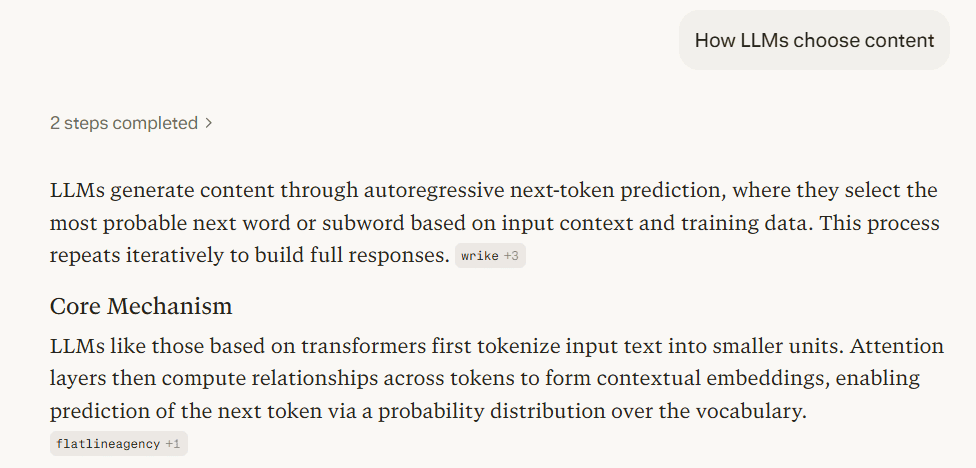
It is worth being precise about the distinction between citations and mentions. A citation is when an AI tool directly attributes information to a source with a link. A mention is when a brand name appears in text without a link.
Let’s understand this with a simple example. I asked Perplexity, “How do LLMs choose content?” and it responded with clickable sources, which are called citations.
Here’s an example of brand mentions, where I asked ChatGPT, “What is GEO?” and it replied with the names of brands without any hyperlinks.
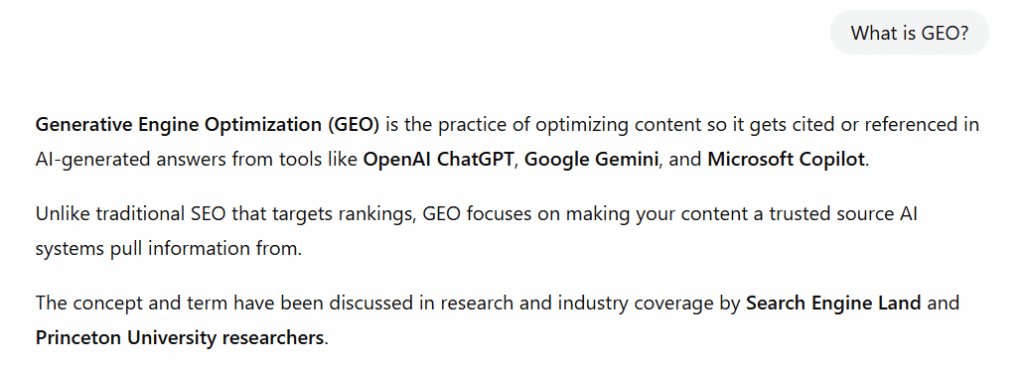
Both matter, but mentions may matter more long-term, because LLMs learn from patterns, not just linked references. Brand mentions embedded in trusted content build associations regardless of whether a link is attached.
“AI search has tipped the scales, making off-site signals, like brand mentions on popular websites, top-tier reviews, and a positive social media reputation, more important than ever. Because large language models rely on these third-party citations to understand a brand’s offerings and reputation, influencing off-site activity is now essential.”
— Lily Ray, VP of SEO Strategy and Research at Amsive
This is where PR teams become directly relevant to AI search strategy. Getting your brand mentioned in the publications LLMs already cite is not a secondary task. It is core off-page work for brand visibility in AI search.
6. Brand Sentiment in AI Answers Is a Reputation Risk
Appearing in AI-generated answers is only part of the challenge. How you appear matters enormously.
LLMs synthesize sentiment from across the web. A pattern of negative reviews, criticism, or consistent complaints will surface in how an AI model describes your brand. Unlike a single negative article that fades over time, LLM associations can persist across millions of queries until the underlying source material changes.
So, what you can do is:
Run a basic audit right now. Search your brand name in ChatGPT, Perplexity, and Gemini with prompts like “What do users say about [Brand]?” and “What are the pros and cons of [Brand]?” Trace the sources. If the sentiment is off, you now know where to focus.
7. AI Hallucination and Brand Accuracy
LLMs can generate confident, plausible-sounding descriptions of your brand that are factually wrong. Wrong product features. Outdated pricing. Incorrect founding date. Misattributed leadership. These are not edge cases; they are common enough that brands need to treat them as a recurring risk.
A user recently shared how his SaaS company kept getting wrong pricing and features mentioned in AI-generated answers. And how they had no way to catch it until prospects started repeating the misinformation on sales calls. If this sounds familiar, you are not alone.
Understanding what AI tools say about your brand is the first step to fixing it.
ChatGPT kept giving wrong info about our product… so we started tracking what AI says about us
by u/Real-Assist1833 in ArtificialInteligence
The fix is in two parts. First, make sure your owned content is accurate, clearly structured, and fully crawlable. Second, establish authoritative third-party references that anchor the factual record.
Wikipedia entries (if your brand meets notability thresholds), press releases on high-authority domains, and structured data markup all help signal what is factually true about your brand to AI systems.
Add a hallucination check to your quarterly AI visibility audit. Prompt ChatGPT and Perplexity with specific factual questions about your brand, such as product features, pricing, leadership, and founding date, and document any inaccuracies you find.
8. Content Freshness as an AI Visibility Signal
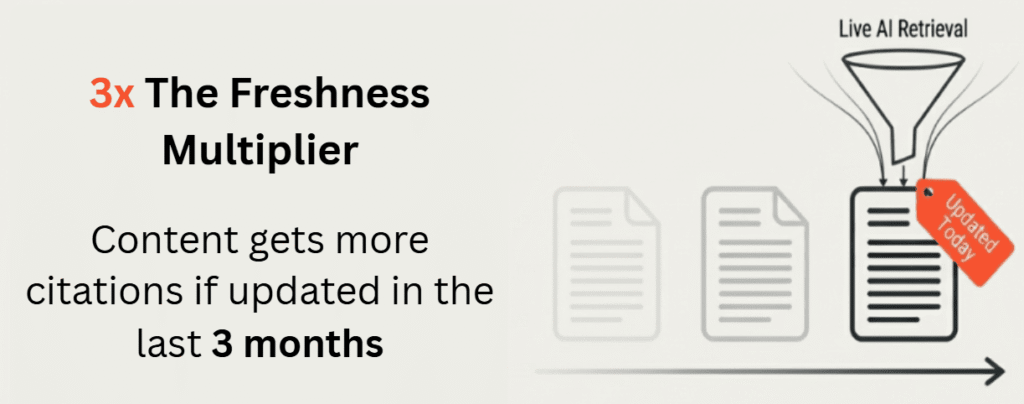
AI models favor sources that are regularly updated. Your content gets 3x more citations if it’s less than 3 months old (Airops). A page that was last touched in 2022 carries lower trust weight than one with a recent datestamp and current statistics. This applies to both trained knowledge and live retrieval.
Include explicit publication and last-updated dates on your key pages, especially product pages, about pages, and any comparison content. Regular press coverage in high-authority publications also functions as a freshness signal. Regular mentions signal to AI systems that your brand is current and active.
Refreshing cornerstone content annually with updated statistics and new examples is more effective than producing large volumes of generic new content. Quality and relevance compound. Generic volume does not.
9. Topic Authority and Content Clusters
One thing that translates cleanly from traditional SEO to AI search is topical depth. A site with thirty pages covering a topic from different angles, like beginner guides, comparison pieces, FAQ content, and specific use cases. Signals domain expertise more clearly than a site with one solid overview article.
AI systems evaluate whether a source knows a topic deeply, not just whether it has a page about it. Building a content cluster around your core category means more surface area for AI-generated answers to draw from, and stronger topical associations in the model’s understanding of your brand.
10. RAG and Live Retrieval
Modern AI search tools do not rely solely on training data. Most now use retrieval-augmented generation (RAG). It means they pull current content from the web at the time of a query and blend it with what the model already knows. Because of this, your historical reputation and your current content are both in play simultaneously.
If your brand has strong older coverage but your current content is thin or stale, the live retrieval layer may pull less favorable or less relevant sources. Keeping active, high-quality content published and indexed matters because AI tools are retrieving it in real time.
11. Comparison and Best-Of Content
AI answers to purchasing questions draw heavily from comparison articles, category roundups, and best-of lists. These formats are some of the most frequently cited sources in AI responses to queries like “best [product category] for [use case].”
Brands should be actively targeting placement in these formats and not just as a PR nice-to-have, but as a deliberate AI search optimization strategy. Identify which comparison articles and category guides rank and appear in AI answers for your space. Then work to be included in them.
How to Optimize for AI Search: What Actually Works
Chasing keywords is no longer the whole game. The major shift now is toward Generative Engine Optimization (GEO), where visibility means being the source an AI model actually pulls from when answering a question.
Let’s look at 3 pillars that you should look into when optimizing for AI search.
Pillar 1: On-Page Tactics for AI Visibility
AI-optimized content is not a separate format. It is well-structured, specific, and direct helpful content that happens to be what AI tools find easiest to work with.
- Lead every section with a direct answer, then expand. AI tools favor the summary-first structure.
- Use natural, conversational language in headings. While writing, think about how people actually phrase questions in AI tools.
- Structure content so each section can stand alone as a complete answer. Self-contained paragraphs are easier for AI to extract and cite.
- Use FAQ sections, comparison tables, and numbered lists. These formats are pulled into AI-generated summaries more reliably.
- Keep statistics current, clearly attributed, and linked to original sources.
- Implement structured data markup (FAQ, HowTo, Article schema) where relevant. It does not guarantee inclusion, but it provides clear contextual signals to AI systems.
If you’re looking for a practical breakdown of how to put this into action. Then go through how to optimize content for AI answers, as it covers the structural and formatting decisions that make the biggest difference.
Pillar 2: Off-Page Tactics (The PR Play)
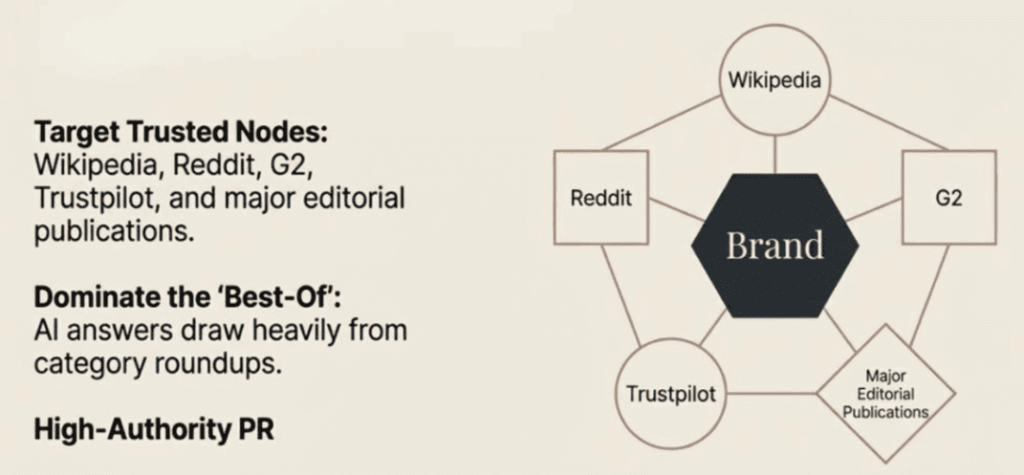
Organic visibility in AI answers depends heavily on what trusted sources say about your brand off your own site.
- Get your brand mentioned in sources LLMs already draw from, such as Wikipedia, Reddit, G2, Capterra, Trustpilot, industry roundups, and major editorial publications.
- Build or claim a Wikipedia entry if your brand meets notability requirements.
- Participate genuinely in Reddit communities relevant to your category. Authentic contributions build an LLM-legible brand presence over time.
- Target best-of and comparison articles in your category. These are among the most frequently cited sources in AI answers.
- PR placements in high-authority publications carry significantly more weight than placements on low-authority sites.
Practical action for PR agencies and in-house communications teams: identify the 10 to 15 publications that appear most often when you query your category in ChatGPT and Perplexity. Those are your priority targets.
Pillar 3: Technical Foundations
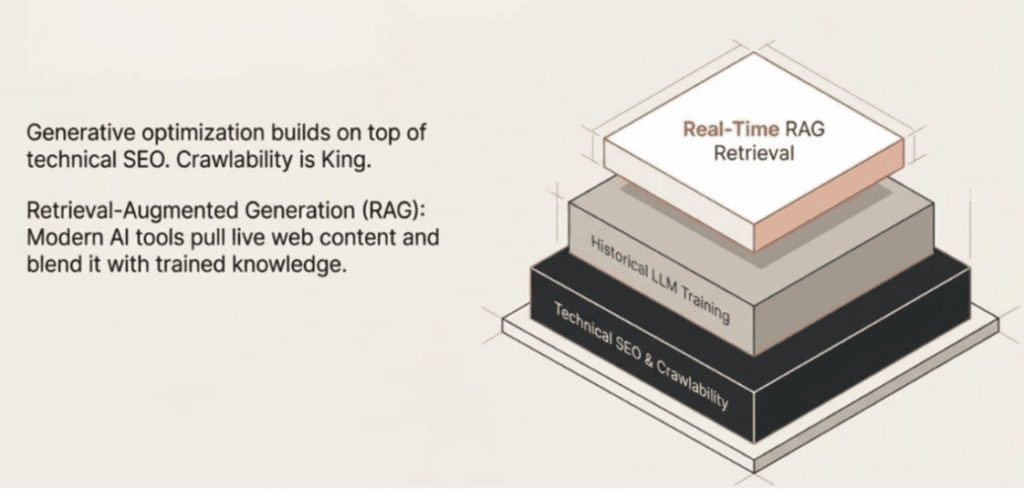
Technical SEO remains the foundation. Everything else builds on top of it.
- Strong SEO performance fundamentals are still important. Brands ranking on Google’s first page appear in ChatGPT search answers 62% of the time (Search Engine Land). Solid fundamentals get you into the conversation.
- Ensure full crawlability and indexability. If Google search cannot access a page, AI systems relying on search data likely cannot either.
- Mobile performance and page speed factor is also important in how AI systems evaluate content quality.
- Clean site architecture with logical page hierarchy helps AI tools understand your topical coverage.
- YouTube-hosted video content increasingly appears in AI-generated results. Transcripts make it crawlable and citable.
 Pro Tip: Do you want to put these tactics into practice without missing a step? You can go through our all-in-one AEO and GEO audit checklist that covers the key signals across AI search platforms.
How to Measure Your AI Visibility
This is the area where most teams are furthest behind, not because the measurement is impossible, but because the tools and frameworks are still catching up.
Traditional SEO metrics are not sufficient on their own anymore. Keyword rankings, referral traffic, and organic traffic do not capture whether your brand is being cited in AI answers. For measuring your brand’s visibility, you need a different approach.
And the mechanics of how to track AI search visibility have matured enough that you can build a real measurement layer alongside your existing analytics. It just requires knowing which signals to monitor.
The metrics that are important now are:
- Share of voice in LLM responses: how often your brand appears across a representative set of queries in your category
- Citation frequency: how often AI tools link to or attribute content from your site
- Brand mention volume: how frequently your brand name appears in AI-generated text, with or without a link
- Branded searches lift in Google Search Console: when LLM visibility grows, users often validate by searching your brand name directly in Google
Let’s look at a simple measurement model:
Define a set of 250 to 500 queries your audience actually uses, run them regularly across AI platforms, and track how often and how favorably your brand appears. Tools like Track My Visibility can help automate this process and give you a clearer picture of digital visibility across multiple AI engines such as ChatGPT, Perplexity, Google AI Overviews, and Google Gemini.

What AI Search Trends Should You Ignore
Not every claim about AI SEO trends deserves your attention or your budget. There is a lot of noise right now, and some of it is genuinely worth ignoring.
The first one is carrying over keyword-obsessed strategies into AI search without any adjustment. AI tools rank topics and intent, not keyword density. The way you optimized for exact-match fragments in 2015 simply does not translate here. If your team is still debating how many times a phrase appears on a page, then it’s better to shift your focus from there.
Then there is the volume trap. A lot of brands responded to the content boom by producing large amounts of generic, AI-generated content and expecting visibility gains. That is not how it works. Google’s index is actively being cleaned up, and thin content that adds no real depth is being filtered out. Content quality is the variable that matters, not output speed.
Also, it is a common assumption that ranking on Google’s first page means your brand appears in AI answers. 62% of page one brands do rank on AI search, which sounds reasonable until you realize that means 38% of page-one brands are completely invisible in LLM visibility terms (Search Engine Land).
Some teams are going the other direction entirely and treating generative engine optimization as a replacement for traditional SEO. But the truth is, it is not. LLM optimization is a layer built on top of strong fundamentals. SEO remains the foundation. Everything else builds on it.
If you think that getting cited by LLMs does not take a lot of time. Then, to be clear, LLM visibility takes time. Most brands that build meaningful presence in AI-generated answers see it develop over six to twelve months. Early signals can appear faster than with traditional search engines, but this is a medium-term investment. If someone is promising overnight results, that is your cue to be skeptical.
Quick recap!
The shift in AI SEO trends is not gradual. It is already changing how brands get discovered, how first impressions form, and how purchase decisions get made, often before a user ever lands on your website.
Brand visibility in AI search is not just an SEO problem anymore. It touches content, PR, and brand leadership all at once. The teams that treat it as a shared responsibility, rather than dumping it on the SEO department, are the ones that will come out ahead.
Keeping up with LLM visibility trends right now is worth the effort, because the brands building that knowledge today will have a real head start as these systems mature. LLM optimization is still in its early days, not unlike where SEO was back in 2005. The best practices are still being figured out in real time.
Start by auditing what AI tools actually say about your brand today. If you want a faster way to do that, Track My Visibility lets you monitor how and where your brand appears across AI search platforms, so that you know where exactly to focus.
Resources:
- 37% of consumers start searches with AI instead of Google: Study
- Ranking in Google doesn’t guarantee visibility in ChatGPT: Study
- Google AI Overviews Surge 58% Across 9 Industries [2026 Data]
- AIO Impact on Google CTR: September 2025 Update
- Teens, Social Media and AI Chatbots 2025 | Pew Research Center
- The 2026 State of AI Search: How Modern Brands Stay Visible
- A Reflection on SEO, GEO & AI Search in 2025 – Lily Ray
Frequently Asked Questions
Which AI trend is most significant right now?
The shift from traditional search to answer engines. Users are getting synthesized responses instead of a list of links, which means brand visibility now depends on being referenced in an answer, not just ranking for a keyword.
What's the new SEO for AI?
It is often called Generative Engine Optimization (GEO) or Answer Engine Optimization (AEO). The core idea is the same as good SEO, be a credible, accurate, well-cited source. But the signals that matter have expanded to include third-party mentions, brand sentiment, and topical depth across AI platforms.
What is the 10-20-70 rule for AI?
In AI content strategy, the rough principle is: 10% of effort on AI-generated drafts, 20% on editing and fact-checking, and 70% on strategy, positioning, and human creativity. The exact split varies, but the point is that AI is a production tool, not a strategy replacement.
What is the future of AI search?
More personalization, more multimodal input (voice, image, text combined), and deeper integration into everyday tasks beyond just information retrieval. AI search optimization will become a standard marketing function alongside traditional SEO.
How do I know if my brand is appearing in AI search answers?
Run your brand name and category queries through ChatGPT, Perplexity, and Gemini manually. For scale, tools like Track My Visibility can track visibility across multiple AI engines and capture visibility data systematically. Google Search Console branded search trends also serve as an indirect signal.
Does Google still matter if AI tools are taking over search?
Yes. Strong Google search rankings are correlated with LLM citations 62% of the time. Technical SEO fundamentals like crawlability, site speed, and clean architecture. Support both Google performance and AI visibility.
What content formats does AI search favor?
FAQ sections, comparison tables, numbered lists, and clearly structured prose with direct answers at the start of each section. Content that is easy to extract and cite as a self-contained answer performs best in AI-generated summaries.
What is the difference between AI SEO and traditional SEO?
Traditional SEO optimizes for ranking in a list of links. AI SEO optimizes for being referenced, cited, or described favorably in a synthesized answer. The technical foundations overlap significantly, but the off-page signals (especially brand mentions in trusted sources) and content structure requirements differ meaningfully.