Google AI Overviews alone now reach 2 billion monthly users (Digiday). That’s not even a total AI search usage figure; that’s just one feature on one platform. And yet most marketing teams are still reporting performance the same way they did three years ago.
Here’s what’s actually happening:
Organic traffic is down across several categories, but visitors arriving from AI search are converting at a 5x better rate than standard organic visitors (DiscoverLabs).
AI search is reshaping organic visibility in ways that traffic numbers alone won’t show you, and this article breaks down exactly what the data says. These are verified AI search statistics across adoption, platform behavior, citation signals, traffic quality, and industry impact, and what they actually mean for how you operate in 2026.
Here’s what you’ll learn:
- How big AI search engines have actually gotten and why the numbers matter for your strategy
- Why zero-click doesn’t automatically mean zero value (and when it genuinely does)
- Which signals determine whether AI models cite your content or ignore it
- Which industries are absorbing the hardest hits, and where the referral opportunity is highest
- What the brands are already spending on this are actually doing with their budgets
How Big Is AI Search in 2026?
Before getting into citation signals and content structure, it is important to understand the scale we’re dealing with because this isn’t a niche behavior anymore.
AI search traffic is growing rapidly, but it still represents a small fraction of total organic traffic. That makes right now the best time to build visibility before the competition catches up.
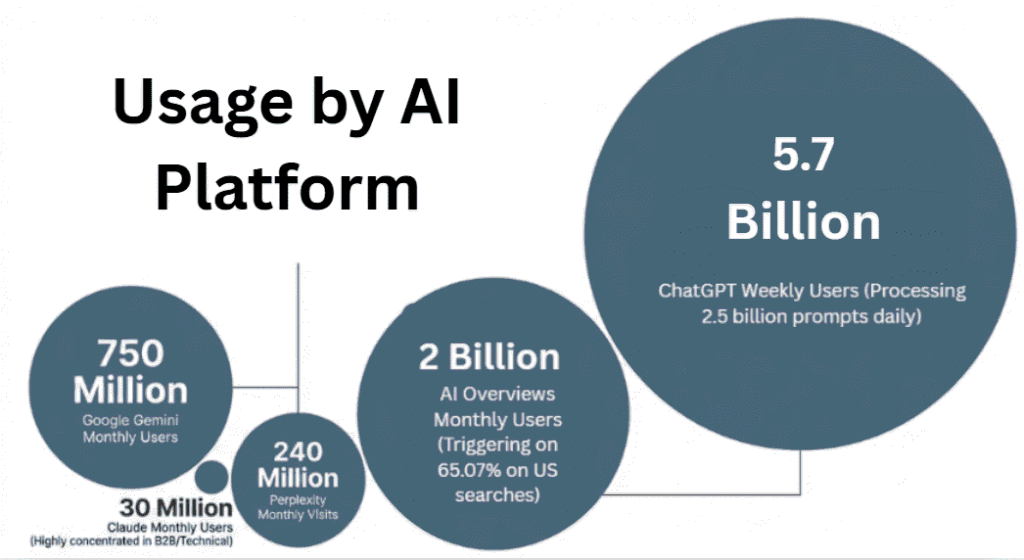
ChatGPT Has 900 Million Weekly Users
Did you read that?
That’s a weekly number, not monthly. Most platforms report monthly active users, but ChatGPT’s weekly figure puts it on par with some of the world’s largest social platforms by engagement frequency.
ChatGPT has over 77.2 million monthly active users in the U.S. alone (Master of Code). The users who are using AI search to find answers, draft queries, and research decisions are not a small fraction of internet users. It’s mainstream, and it has been for a while now.
Also, according to a recent study, 2.5 billion prompts are sent to ChatGPT by users every single day (Demandsage).
Google AI Overviews Reaches 2 Billion Monthly Users
Google AI Overviews is the AI-generated summary that appears above traditional search results on Google. AI Overviews were present in over 1.5 billion monthly searches in early 2025, projected to reach 75% of all searches by 2028 (McKinsey). It’s not a test anymore. It’s the default experience for a massive share of Google searches.
Google AI Overviews now get triggered 65.3% in the US (Advanced Web Ranking). If your target audience uses Google, they’re almost certainly already seeing AI overviews for a significant portion of your keywords. That means your content either gets surfaced in that summary or it doesn’t, and ranking position alone doesn’t determine which outcome you get.
Google Gemini Has Over 750 Million Monthly Active Users
Google Gemini (the standalone app and assistant) and AI Overviews (embedded in Google Search) are separate products with separate user counts. Gemini is a search entry point in its own right, not just a feature inside Google.
Google AI Gemini has over 35 million daily active users. And it has around 15.36% users from the United States alone (Demandsage). Users use Gemini for coding, deep research, reasoning, android assistant, and image and video generation.
The 750 million figure is very important because it shows how much of the search audience has already moved into conversational, AI-generated answers before they ever hit a traditional results page (TechCrunch).
Perplexity Gets Around 240 Million Monthly Visits
Perplexity is built specifically for search, unlike ChatGPT or Gemini. For a closer look at how Perplexity differs from Google Search, the distinction is important for how you approach citation targeting.
Perplexity cites sources aggressively and tends to prioritize research-oriented content. If your content plays in that space, it’s an important platform to optimize for, arguably more important than its traffic share alone suggests.
Users use Perplexity to get accurate answers with sourced links. It also provided users’ data by doing real-time research. As of early 2026, Perplexity has 2 million to 5.6 million daily active users, which is a large number (Techrt).
Claude Has 30 Million Monthly Active Users
Claude is a lower volume compared to the others, but it is worth tracking, especially for B2B and technical audiences.
31.52% of Claude users are from the US alone (Similarweb). Anthropic’s models have been growing quickly, and the user base skews toward professional and research use cases. If that’s your audience, Claude.ai citation probability deserves attention in your AI visibility strategy.
Users use this AI model for research, coding, learning, drafting emails, and generating content, etc. 51.88% of users who use the Claude AI search tool are aged between 18 and 24 (Semrush).
How People Use and Trust AI Search in 2026
The adoption numbers tell you how many people are on these top AI platforms. Behavior data tells you how they’re actually using them, and that’s where the strategic implications get sharper.
Query behavior has shifted noticeably. People aren’t typing two-word keyword strings into AI search engines the way they do in traditional search. They’re asking full questions, providing context, and having multi-turn conversations. That changes what “being discoverable” actually means.
Platform behavior differs significantly by context:
- ChatGPT skews toward tasks, content creation, and general reasoning.
- Perplexity is heavily used for research and fact-checking as users expect cited sources. One user summed up the difference better than most research reports do: User wrote, Google gives me a list of links. Perplexity gives me an answer with the links if I want to verify.
Perplexity vs just googling and where each one wins
by u/PsychologicalAge1055 in perplexity_ai
- Google AI Overviews is passive, and users didn’t choose to see an AI summary; it just appears.
- Google Gemini is used for generating emails, blog drafts, creative ideas, summarizing answers, and finding quick answers.
That passive nature of Google AIO is important. The user didn’t opt into AI search; the experience was inserted into a familiar workflow. That means brand exposure in AIO happens even when users aren’t consciously seeking AI-generated content.
AI search is increasingly the first touch in a research journey, not a one-and-done answer machine. A user might ask a question in ChatGPT, get a summary with your brand mentioned, then come back to Google to search your brand name directly.
The citation didn’t generate a click, but it generated intent that showed up elsewhere. This is why attribution from AI search traffic is genuinely complicated and why the standard traffic metrics miss part of the picture.
Does AI Zero-Click Search Still Create Value?
This is the question everyone’s circling, and the answer totally depends on your business model. So, let’s be precise about it.
What Zero-Click Actually Means in Practice
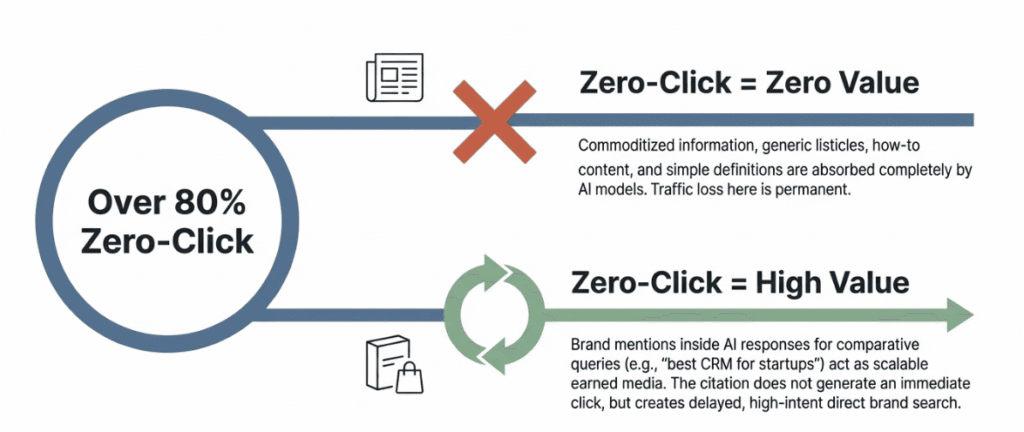
A zero-click result means the user got their answer without visiting a website. That is a traffic loss. There’s no way to frame that as neutral.
More than 80% of searches now end without anyone clicking on a website (LLMrefs). Users get answers from Google AI Overviews or ask queries on different AI search tools.
But zero-click and zero-value are not the same thing, and conflating them leads to bad digital strategy.
Here’s a concrete example: a user asks, “What’s the capital of France?” and never clicks. That’s zero-click and zero-value for any publisher; the query has no commercial relevance.
Now compare that to a user who sees your brand mentioned in an AI response about “best CRM software for startups” and searches your brand name the next day. No click came from the AI response. But real intent did.
That distinction doesn’t make the traffic loss disappear. It just means the traffic loss doesn’t tell the whole story.
Brand Exposure Inside AI Responses and Is It Measurable?
Being mentioned or cited in AI responses is brand exposure at scale. Treat it like earned media, not just an SEO outcome.
The data backs this up. Brand mentions correlate with AI Overview appearances at 0.664, the strongest single citation signal in the current research. That’s a significantly higher correlation than backlinks, which come in at only 0.218 for AI visibility (Onely).
What this means practically: PR outreach, forum participation, review generation, and community presence all now feed into citation probability in ways they didn’t before. The PR team and the SEO team are working on the same problem, even if they don’t know it yet.
Awareness value is harder to attribute than a click, but that doesn’t make it worthless. Particularly for upper-funnel goals where the brand’s visibility matters more than immediate conversion.
When Zero-Click Genuinely Does Mean Zero Value
There’s no soft landing here for publishers running ad-dependent or affiliate-dependent content models: if your revenue relies on informational traffic volume, zero-click is a real revenue problem.
The categories that are most exposed:
- How-to content for common tasks
- Listicles built around generic informational queries
- Comparison pages for well-known, easily summarized products
- Definitional content that AI models can answer in a sentence
The more commoditized the information, the more completely AI search absorbs it. If you’re in this category, the appropriate response isn’t to reframe the problem as an opportunity. It’s to audit which content still requires a click and rebuild toward that.
The Citation Arbitrage Opportunity
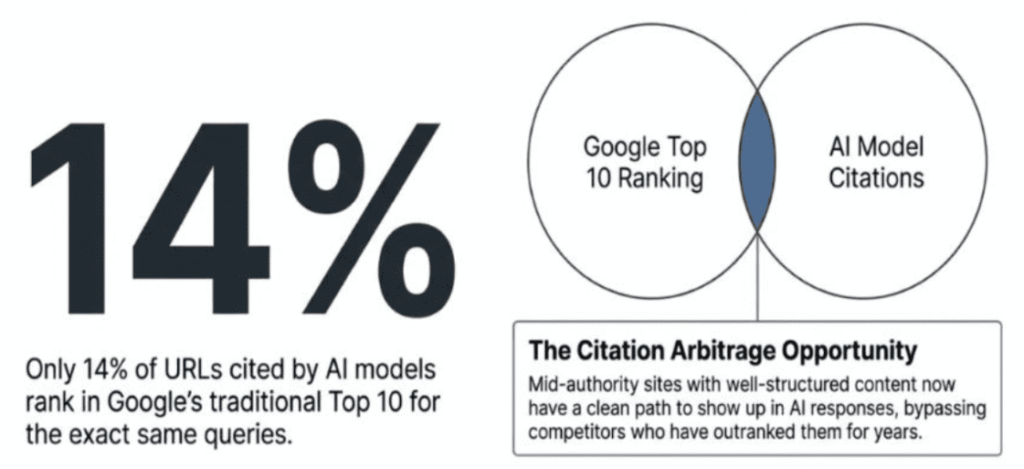
Here’s the most strategically interesting AI search statistic in the current data: only 14% of URLs cited by AI Mode rank in Google’s traditional top 10 for the same queries (Whitehat).
That means AI visibility and traditional organic traffic ranking are increasingly separate games. You don’t need to dominate traditional search results to earn AI citations, and ranking number one doesn’t automatically mean you get cited.
This opens real opportunities for mid-authority sites with well-structured, well-cited content to show up in AI responses despite not ranking in position one organically. It also means brands that have been outranked for years on competitive keywords may have a cleaner path to AI search visibility than they think.
Why Does AI Cite Some Sources and Not Others?
Before diving into the specific signals, it is important to understand how LLMs choose what content to cite at a structural level. The signals differ meaningfully from traditional ranking factors.
1. Domain Traffic as the Dominant Citation Predictor
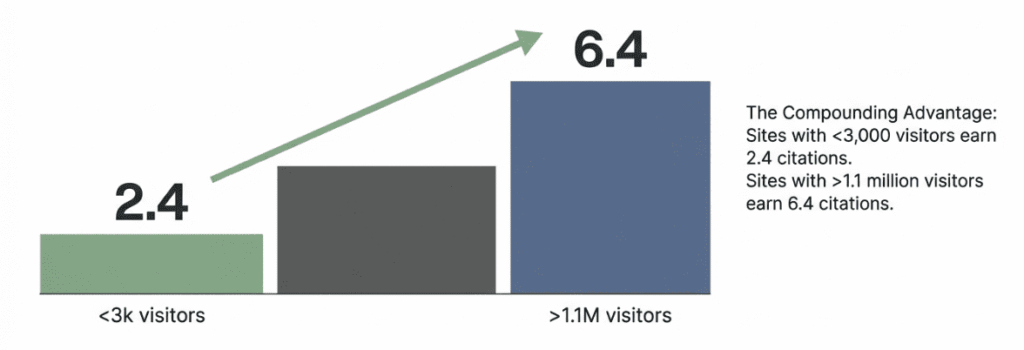
Domain traffic is the number one predictor of AI citations. The websites with over 1.16 million monthly visitors earn an average of 6.4 citations per query, and sites with fewer than 3,000 visitors earn only 2.4 citations (SE Ranking).
In traditional SEO, link equity was the primary driver of authority. For AI visibility, it’s the audience size. That structurally rewards brands that have built real readership rather than just strong backlink profiles.
The implication: growing your direct and branded traffic has downstream effects on citation probability. It also creates a compounding advantage for established publishers that’s worth being aware of; the platforms with the most existing traffic are positioned to earn the most AI citations.
2. Brand Mentions vs. Backlinks: The Signal Shift
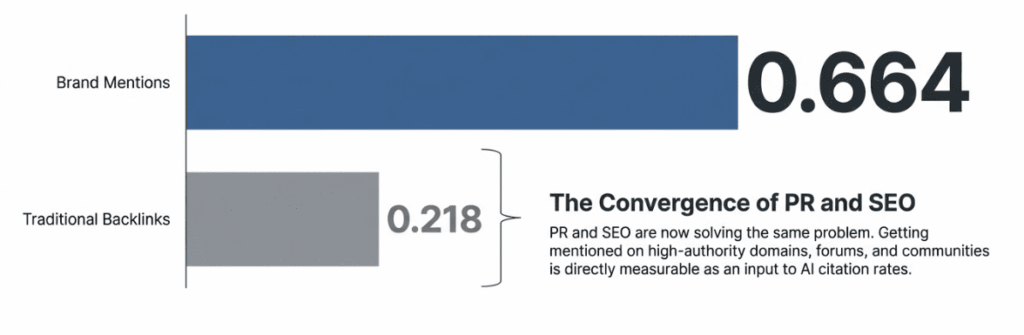
This bears repeating because it changes where effort should go. Brand mentions correlate at 0.664 with AI Overview appearances. Backlinks correlate at only 0.218.
Being talked about matters more than being linked to, for AI visibility specifically. Backlinks still matter for traditional SEO, so don’t drop them from your strategy entirely. But for AI citation probability, the mention signal is pulling significantly more weight.
For agencies, this creates a natural overlap between SEO and PR that genuinely didn’t exist before. Getting your brand mentioned on high-authority domains, forums, and community platforms isn’t a soft win; it’s directly measurable as an input to AI search citation rates.
3. How Content Structure and Formatting Affect Citation Probability
The format of your content has a measurable effect on whether AI models cite it. Listicles have a 25% citation rate compared to 11% for opinion pieces. That’s not a coincidence; AI systems can parse structured content more reliably than unstructured prose.
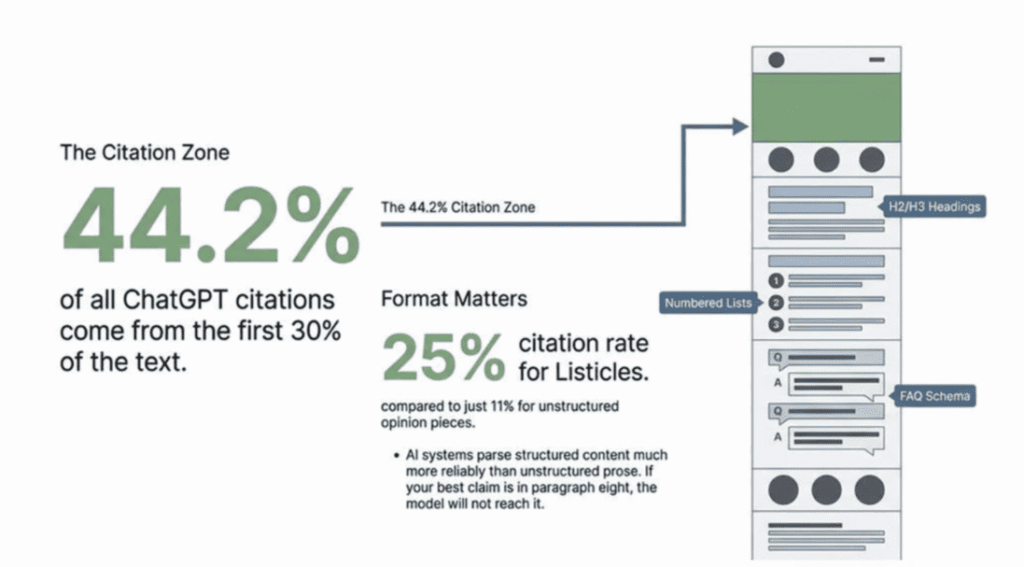
More importantly, 44.2% of ChatGPT citations come from the first 30% of the text (Search Engine Land). So, your introduction is now the most important part of your article from a citation standpoint.
Best-performing formats for AI responses include headings, numbered lists, and FAQ sections. The structural recommendation that follows from this is straightforward: front-load your key claims and definitions. If your most citable sentence is in paragraph eight, most AI systems will never reach it.
4. Presence of Statistics, Original Data, and Expert Quotes
Content with statistics, citations, and expert quotations gets 30–40% higher visibility in AI responses (Rankscience).
Original data is the strongest version of this signal. Proprietary research, surveys, and first-party data are hard for AI search engines to source elsewhere, which makes them highly citable. If you can produce even one original study per quarter, that asset will generate citations long after it’s published.
Expert quotes serve double duty, which means they are credible for human readers, and a distinct signal type that large language model systems appear to weigh independently.
5. Freshness Signals and Schema Markup
Pages updated within 2 months earn 28% more citations than older content. Schema markup improves source citation probability by 30% (SE Ranking).
These are two of the most concrete, implementable levers in the current AI search statistics data. This doesn’t mean rewriting everything constantly. Updating key stats, adding recent data points, and refreshing outdated example counts.
On schema: Article, FAQPage, HowTo, and Organization schema are the highest-value types for citation probability. If you’re not using them, you’re leaving measurable AI visibility on the table.
6. Where AI Is Actually Pulling Its Sources From
YouTube drives more citations than Reddit in 2026. Reddit accounts for 10% of AI Answers. Whereas YouTube accounts for 16% (Superlines). AI systems weigh community-validated, user-generated content heavily.
For brands, this creates a genuine tension. The platforms AI search engines cite most are also the ones hardest to control. Your presence on Reddit and YouTube isn’t optional if AI visibility matters to your digital strategy, and for most categories, it does.
Which Industries Are Being Disrupted Most by AI Search?
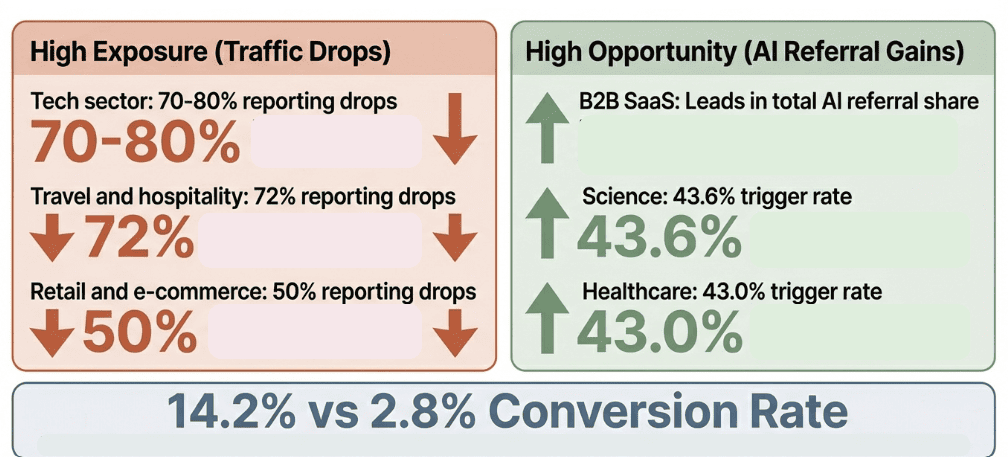
The impact of AI search isn’t evenly distributed. Some sectors are absorbing most of the disruption, and some are seeing a clear referral opportunity emerge.
Where Traffic Losses Are Hitting Hardest
- Tech sector: 70-80% of marketers reporting drops in organic traffic (ABM Agency)
- Travel and hospitality: 72% reporting drops (Digital Defynd)
- Retail and e-commerce: 50% reporting drops (Newrelic)
These sectors share a common vulnerability: they’re heavily dependent on informational and comparison content, which AI overviews absorb most aggressively. Queries like “best hotels in Lisbon,” “how does X software work,” and “compare X vs Y” are going zero-click at high rates.
The query type is the actual exposure variable. Informational and comparison intent is where the AI search impact is most concentrated.
Where the AI Traffic Opportunity Is Highest Right Now
The IT and tech sector currently leads AI referral share, with 2.8% of total website visits now coming directly from AI platforms, the highest of any industry. B2B SaaS companies are seeing the most significant gains from this shift, reporting a 6x to 27x conversion rate premium from AI search traffic compared to traditional organic search.
In highly specialized fields like Science (43.6%) and Healthcare (43%), nearly half of all informational searches now trigger AI Overviews. The opportunity is concentrated in these high-complexity queries where AI gives users a starting point, but the trust barrier keeps them clicking through for validation.
Users arriving via an AI citation have essentially received a warm recommendation from the model itself, which is why they convert at 14.2% compared to just 2.8% for standard Google traffic.
Finance and Healthcare: Why AI Heavily Favors Established Authority
In regulated industries, AI models prioritize institutionally backed, peer-reviewed, and authoritatively cited sources. YMYL (Your Money Your Life) standards apply with extra weight in AI systems.
This creates a moat. Brands that have invested in E-E-A-T signals are better positioned than newer entrants who can’t manufacture years of authoritative content overnight. Building deep content authority over time pays compounding returns in these categories.
E-commerce and AI-Driven Product Discovery
AI is reshaping the top of the purchase funnel. Product discovery and comparison queries increasingly start in AI search, not Google Shopping. 73% of consumers now use AI agents to compare prices or summarize reviews before buying (Business Wire).
Perplexity tends to cite product reviews, Reddit threads, and comparison sites for transactional queries; Google AIO leans on its own Shopping data.
The question for e-commerce brands to audit: are your product feeds accessible to autonomous agents? Do you have FAQ content around common product questions? Brands that appear in AI-driven discovery conversations get in front of buyers earlier, before intent narrows to a specific product.
How Are Brands Responding to AI Search in 2026?
83-93% of marketers report measurable traffic changes from AI search adoption. Websites are already seeing 61% drop in their click-through rate when Google AI Overviews appear (SeerInteractive). That makes AI search impact a present reality, and not a forward-looking concern.
Budget Reallocation Trends
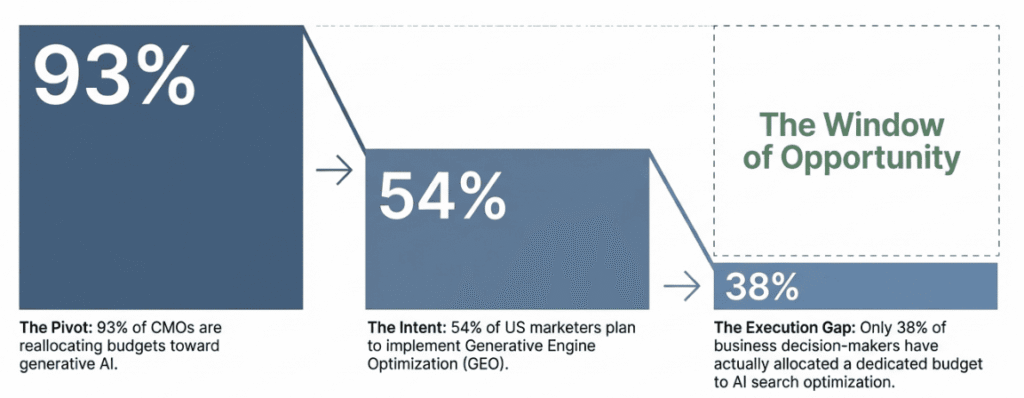
- 93% of CMOs are reallocating budgets toward generative AI (CMOS magazine)
- 38% of business decision-makers have allocated budget specifically to AI search optimization
- 54% of US marketers plan to implement GEO (Generative Engine Optimization) (EMarketer)
The gap between 54% planning GEO and only 38% with a budget actually allocated reveals a lot of stated intent that hasn’t translated to action yet. That gap is a window. The teams that move now are building a measurable head start while most competitors are still in the planning phase.
 Pro Tip: Planning to implement GEO but not sure where to start? Before allocating a budget, it helps to audit what you already have. Our AEO and GEO checklist walks through exactly what needs to shift in your content strategy, so your spend goes toward the right things from day one.
Most organizations are not yet tracking citation frequency or brand mentions in LLM responses. Getting that infrastructure in place is step one. Here’s a practical guide to tracking AI search visibility across platforms.
This is a competitive gap more than a data problem. The tools to track this exist in dedicated platforms, like Track My Visibility, which is built for exactly this. The teams that instrument these metrics now have a clear advantage over teams that are still evaluating whether AI search matters.
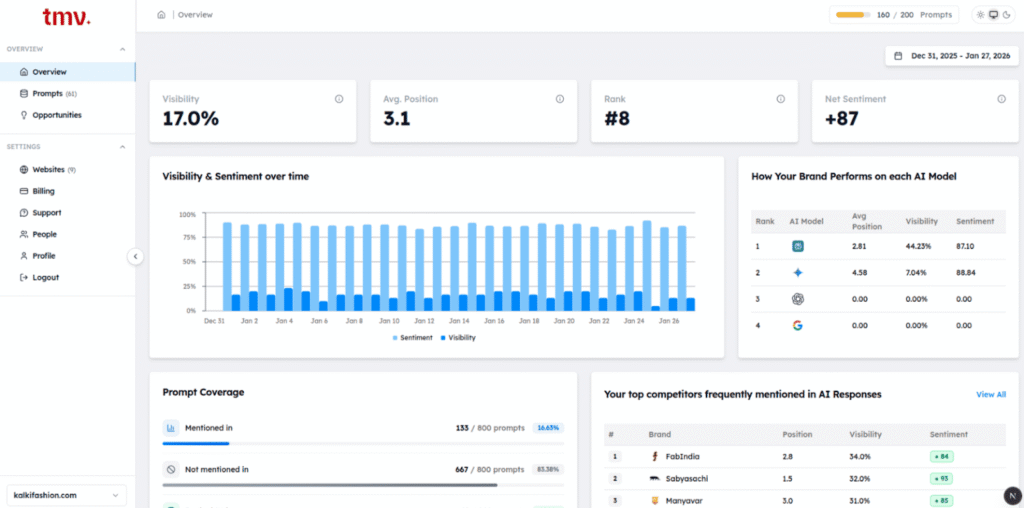
You can’t optimize what you can’t measure. A lack of visibility means your competitors are shaping the narrative in the market. Getting the tracking infrastructure in place is step one before any tactical work makes sense.
New Metrics That Matter in 2026
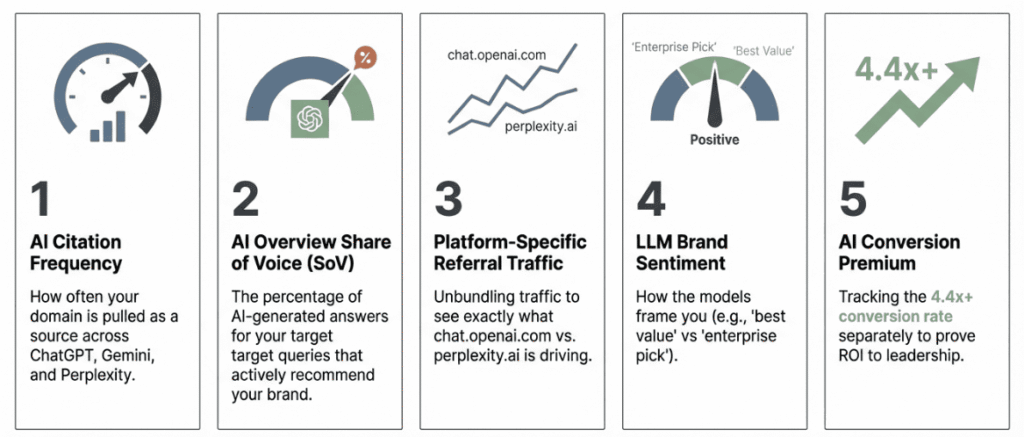
Rank tracking alone is not enough anymore. If you’re still measuring success purely through keyword positions and organic traffic, you’re missing most of what’s actually happening to your brand’s visibility. Measuring AI visibility requires a new generation of tools built for this paradigm.
Here’s what else you can add to your reporting now:
- AI Citation Frequency: How often your domain gets pulled as a source across ChatGPT, Gemini, and Perplexity. This is the most direct signal that AI search engines are treating you as a credible reference.
- AI Overview Share of Voice (SoV): Out of all the AI-generated answers your target queries produce, what percentage actually mention or recommend your brand? This tells you how much of the conversation you own.
- AI Referral Traffic by Platform: Break down your referral clicks by source, such as chat.openai.com, perplexity.ai, gemini.google.com. Grouping them hides which platforms are actually sending you traffic.
- LLM Brand Sentiment: Not just whether you’re mentioned, but how. Are AI models framing you as the best value option? The enterprise pick? The easiest to implement? The framing matters as much as the mention.
- AI Conversion Premium: AI search traffic converts at 4.4x the rate of standard organic visitors. Track this separately so leadership can actually see the value, as it changes the conversation fast.
What the 38% With Budget Are Actually Doing
The brands seeing real results from AI search have moved past the “let’s try something” phase. They’re focused on four concrete areas:
- Content refreshes for AEO: They’re restructuring high-value pages so the first 100 words directly answer the target query. This isn’t about keywords; it’s about satisfying how RAG (Retrieval-Augmented Generation) systems pull and serve content.
- Entity-based schema: Going beyond a basic Article tag. They’re adding Organization, Product, and Author schema in JSON-LD so AI models can accurately map their brand to the Knowledge Graph.
- Reputation seeding through digital PR: Actively getting their brand mentioned on Reddit and YouTube. These platforms now account for nearly 26% of AI Overview citations. This isn’t optional anymore; it’s one of the highest-leverage citation inputs available.
- Multi-model monitoring: Tracking brand mentions across platforms and watching how they correlate with AI visibility. Tools like Track My Visibility are built specifically for this kind of cross-platform tracking.
Want to measure where your brand actually stands in AI search? Check out this guide to get started.
Conclusion
The AI search statistics for 2026 tell a consistent story: the channel is mainstream, the citation signals are different from traditional SEO, and the teams that are measuring and optimizing for it now are building an early advantage.
Visibility no longer equals ranking. AI visibility is its own metric; it’s measurable, and ignoring it doesn’t make it less real. The traffic losses in information-heavy categories are real, too. Don’t talk yourself out of that with false optimism.
The practical path forward is straightforward: get your AI search traffic tracked by a platform, audit your content structure with citation signals in mind, and treat brand mentions as the new link-building analog. None of this requires abandoning traditional SEO, as it runs alongside it.
If you want to start tracking how your brand appears across top AI platforms, the Track My Visibility tool gives you citation frequency, LLM brand mention volume, and AI referral attribution in one place. It’s the baseline you need before anything else makes sense.
Resources:
- Google’s AI Overviews reach over 2 billion monthly users
- Google AI Overviews Traffic Impact: Measuring ROI & Pipeline Attribution | Discovered Labs
- Scaling AI for everyone | OpenAI
- ChatGPT Statistics in Companies [January 2026]
- ChatGPT Users Statistics (March 2026) – Global Growth & Usage
- Google AI Overview Tool
- New front door to the internet: Winning in the age of AI search
- Google’s Gemini app has surpassed 750M monthly active users | TechCrunch
- Gemini Users Statistics (2026) – Growth & Revenue Data
- Perplexity AI Stats Feb 2026: Uses, Users, Market Share, and More. – fatjoe.
- Perplexity AI Statistics 2026: Users, Revenue & Growth • TechRT
- Claude 2026 statistics: performance overview and key trends – Incremys
- claude.ai Traffic Analytics, Ranking & Audience [January 2026] | Similarweb
- claude.ai Website Traffic, Ranking, Analytics [January 2026]
- Zero-Click Search Explained. Why Your Analytics Cannot Track It.
- Perplexity vs ChatGPT vs Gemini: How AI Engines Cite Content
- How to Optimize for AI Mode: Google Visibility Matters 3x More Than Content
- Top Brand Visibility Factors in ChatGPT, AI Mode, and AI Overviews (75k Brands Studied)
- How To Rank in AI Search Results – Onely
- 44% of ChatGPT citations come from the first third of content: Study
- Large Language Model Optimization That Works.
- 70+ AI Search Stats for 2026 (Fully Verified & Up-to-Date)
- YouTube vs Reddit: Which Platform Drives More AI Citations in 2026? | Superlines
- 2026 Top 5 B2B AEO and GEO Agencies for Large and Enterprise SaaS Organizations
- 50 Industries Most Impacted & Disrupted by AI [2026] – DigitalDefynd Education
- Top Trends in Observability: The 2025 Forecast is Here | New Relic
- Global Study: 73% of Shoppers Using AI in Shopping Journey – But Merchants Face New Agentic Commerce Risks
- Marketers report surging ROI as genAI moves from pilot to practice | MarTech
- Seer Interactive Research Featured in Inc. Analysis of CTR and AI Overviews
- New study: GenAI moves beyond hype as over 93% of CMOs see a clear ROI
- Authority Engine Expands AI Authority Engineering Framework to Combat Local and Mid-Market Brand Invisibility in AI Search
Frequently Asked Questions
What percentage of Google searches now trigger AI Overviews?
Google AI Overviews now get triggered 65.3% in the US, and AI Overviews now reach 2 billion monthly users. Which tells you it's showing up across a massive range of queries, not just a select few. If your audience uses Google regularly, they're almost certainly already seeing AI-generated summaries for keywords that matter to your business.
How does AI search traffic conversion rate compare to organic search?
AI search traffic converts at 5–14x the rate of standard organic traffic, and in B2B SaaS, that premium jumps to 6–27x. The reason it converts so well is simple: users arriving from an answer engine have already been pre-qualified by the AI summary. They're not browsing anymore; they're evaluating.
What content format gets cited most often in AI search results?
Listicles consistently outperform other formats, with a 25% citation rate compared to 11% for opinion pieces. Structured content with headings, numbered lists, and FAQ sections makes it easier for reasoning models to extract and serve your content. It's also worth knowing that 44.2% of all LLM citations come from the first 30% of the text, so your intro does most of the heavy lifting.
How do ChatGPT and Google AI differ in what they cite?
Their user behavior and citation logic are quite different. Google AI Overviews leans heavily on its own data sources, including Shopping for transactional queries. ChatGPT pulls from a broader range of sources but doesn't surface citations the way Perplexity does. Perplexity is the most transparent about sourcing and favors well-structured, research-oriented content, which is why tracking AI referral traffic by platform separately is worth the effort.
How do you measure AI visibility and brand citations in LLMs?
The core metrics are AI citation frequency, AI Overview share of voice, referral traffic by platform, and LLM brand mention volume. Tools like Track My Visibility are built specifically for this kind of tracking. Start by separating AI referral traffic from general referral traffic in your analytics; without that baseline, you're optimizing blind.
Does traditional SEO still matter now that AI search is growing?
Absolutely. Traditional SEO still drives real traffic, and that's not going away anytime soon. The smarter move is to run both in parallel. AI visibility and traditional search optimization use different signals, and neglecting either one leaves a gap. Most industry leaders aren't choosing between them; they're building for both.
Why does my brand appear on some AI platforms but not others?
Each platform weights citation signals differently, which is a core finding in recent LLM research. Perplexity prioritizes structured, citable content. Google AI Overviews lean on domain authority and traffic volume. Claude and Gemini follow their own patterns. If your brand is showing up inconsistently across AI interfaces, it's usually a combination of brand mention volume and content structure, rarely a single missing piece.
Is zero-click traffic from AI search actually hurting my business?
It depends on how your business makes money. If your model runs on ad or affiliate revenue from informational content, the traffic loss is real and worth taking seriously. If you're selling a product or service, a brand mention inside an AI response can still drive intent that shows up later as branded search. The honest answer is to audit your most exposed content categories rather than applying one answer across the board.