Your brand just disappeared from the internet. Well, not exactly!
Here’s what’s happening: people aren’t typing queries into Google anymore. They’re asking ChatGPT, Perplexity, and Google AI Overviews.
According to Bain & Company, 80% of consumers now depend on AI-generated responses for at least 40% of their searches. That’s not a trend. That’s a complete transformation happening right now.
The real challenge here is..
Brands are losing narrative control. When someone asks AI models about your products, you don’t control the response. Large language models (LLMs) determine what appears, what gets referenced, and ultimately, what earns trust.
And the most concerning part is that you might not even realize what they’re communicating about your brand.
Your brand could be missing from AI search. Inaccurate or false details might be getting shared about your brand. Maybe your competitor’s brand receives citations, while yours gets completely overlooked. And if this persists, you’ll fall behind.
This is where Adobe LLM Optimizer enters the picture.
In this guide, you’ll discover:
- What Adobe LLM Optimizer is and why it’s important for brand presence
- Core capabilities that distinguish it from other AI SEO platforms
- How Adobe LLM Optimizer operates
- Pricing details and who should consider investing
- Real outcomes from brands already leveraging the platform
Let’s dive into the details!
What Is Adobe LLM Optimizer?
Adobe LLM Optimizer is an enterprise-focused AI SEO tool built for generative engine optimization (GEO). This tool was launched in October 2025 and is now generally available. This platform tracks how a brand shows up across five leading LLM-powered experiences, which include ChatGPT, Gemini, Copilot, Perplexity, and Google AI Overviews.
Beyond surface-level monitoring, the platform studies how AI agents access and interpret your website. It provides clear, prescriptive recommendations to improve your AI visibility. It also helps uncover which types of user search intent cause your brand or pages to appear across different AI tools.
What truly sets Adobe LLM Optimizer apart is its ability to validate accuracy. By linking AI-generated responses back to your official sources, such as your website and approved materials. It can also identify when an LLM presents incorrect or misleading information.
This allows teams to correct issues early, before misinformation shapes customer perception.
What Differentiates Adobe LLM Optimizer From Other AI Search Visibility Tools
Most AI SEO optimization tools focus only on visibility tracking. They can tell you if your brand appears in an AI-generated response, and some go a step further with basic sentiment insights. But the analysis usually stops there.
Adobe LLM Optimizer takes a deeper approach. It analyzes agentic traffic using Content Delivery Network (CDN) log data to understand how AI agents actually move through your site. This matters because AI agents do not behave like real users.
Human visitors typically enter through a homepage or landing page. Whereas AI agents enter through deeper layers of content, such as FAQs, help articles, and blog posts. Their goal is to extract precise information to answer user questions, and this activity is often invisible in standard analytics platforms.
Adobe LLM Optimizer brings this hidden bot traffic into view, clearly identifying which pages influence how AI answers describe your brand.
The final difference lies in execution. Instead of stopping at insights, the platform enables action. Technical improvements can be deployed directly through the CDN layer with a single click. That allows marketing teams to move forward without waiting weeks or months for engineering changes.
Now that you understand what sets this tool apart, let’s take a closer look at its key features.
Core Capabilities of Adobe LLM Optimizer for AI Search Visibility
The platform brings together several key features, but everything is anchored around 3 important pillars: Brand Presence Intelligence, Agentic & Referral Traffic Insights, and Optimization recommendations.
Each pillar addresses a specific gap in how brands understand and improve their visibility in AI-driven search.
Let’s take a closer look at what each capability delivers.
1. Brand Presence Intelligence
This feature offers a combined view of how your brand appears across five major AI search engine platforms and multiple regions. It allows you to track:
- Mentions of your brand across different product categories
- How often your website is cited and in what context
- Sentiment associated with those mentions
- Performance compared to competing brands
The competitive insight is especially valuable. You can see which competitors are showing up alongside your brand, where they are gaining visibility, and where your own presence may be lacking. This makes it easier to spot gaps and opportunities in AI search coverage.
Below is an example from the Adobe LLM dashboard showing how brand presence is visualized.
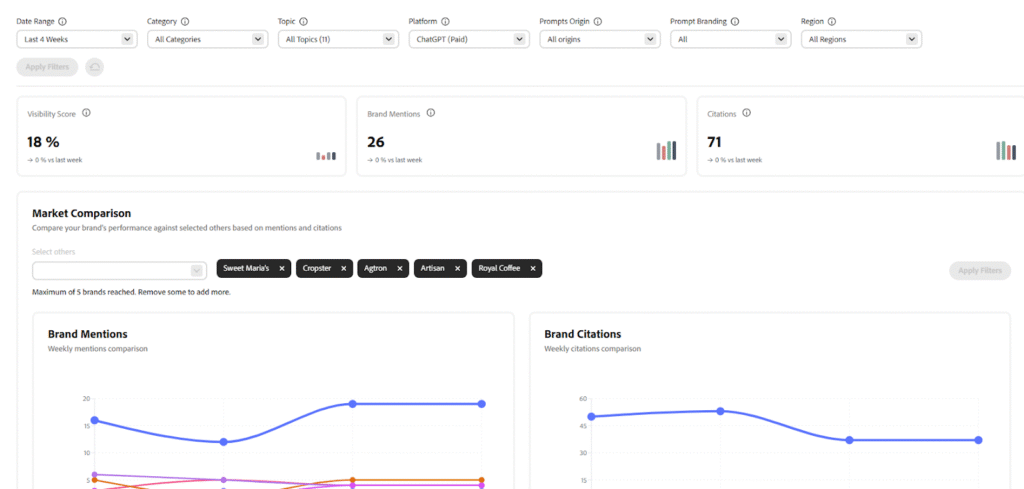
This is important because AI search operates on a zero-sum basis. When an AI system chooses a competitor’s site as a source instead of yours, that visibility is lost.
2. Agentic Traffic Insights (Key Differentiator)
This capability is what truly sets Adobe LLM Optimizer apart from most AI-powered SEO tools.
Agentic traffic represents how AI bots and assistants access your website to gather information. AI agents do not browse or explore pages like human visitors. They extract specific content needed to answer a query and move on.
To capture this behavior, the platform analyzes CDN logs. Traditional analytics tools, such as Google Analytics, miss much of this activity because AI bots do not run JavaScript as users do.
But by collecting data at the CDN layer, Adobe LLM Optimizer can show:
- Which pages AI agents access most frequently
- When and how often those crawls occur
- What content is being used to generate AI responses
- Whether bots are blocked or restricted from key areas
An example below illustrates how agentic traffic is distributed across markets, categories, and page types.
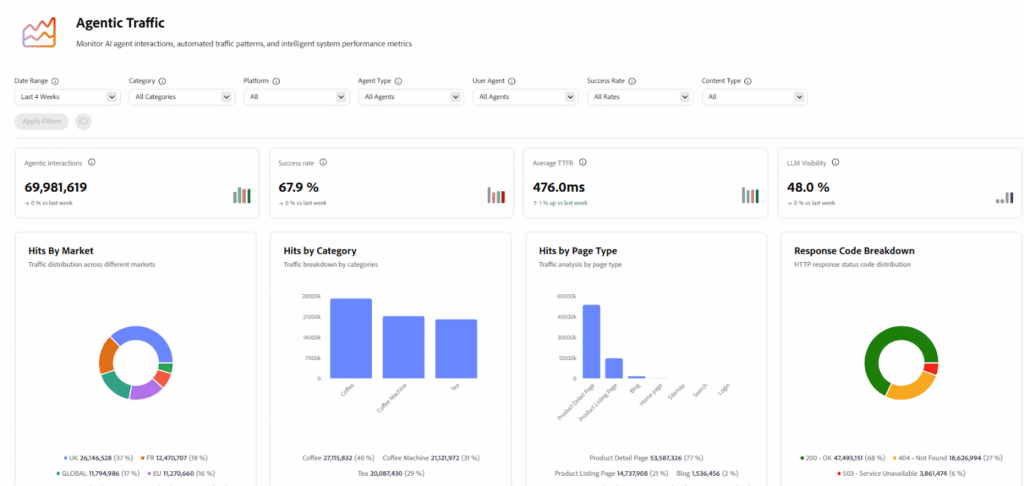
This insight is extremely important. It reveals which assets influence how AI platforms describe and represent your brand. You can identify the markets that receive the most AI attention, the types of pages agents rely on, and the content that attracts the highest level of engagement from AI systems.
For example, if AI agents consistently access your FAQ pages but rarely touch your product pages, that’s a clear signal. Many AI tools struggle to process complex, dynamic pages. When agents encounter content they can’t interpret, they skip it, which directly results in lost citations and reduced visibility.
3. Referral Traffic & ROI Measurement
Knowing that your brand appears in AI search results is useful. But proving that this visibility translates into real business value is far more important.
Adobe LLM Optimizer tracks referral traffic coming directly from AI-generated responses. When a user clicks through from a ChatGPT answer or a Google AI Overview, the platform records that visit and ties it to downstream actions such as conversions and revenue. This makes it possible to see how the AI visibility checker tool contributes to measurable outcomes.
You can view detailed examples showing how users reach your site from external platforms, referral sources, and AI citations:
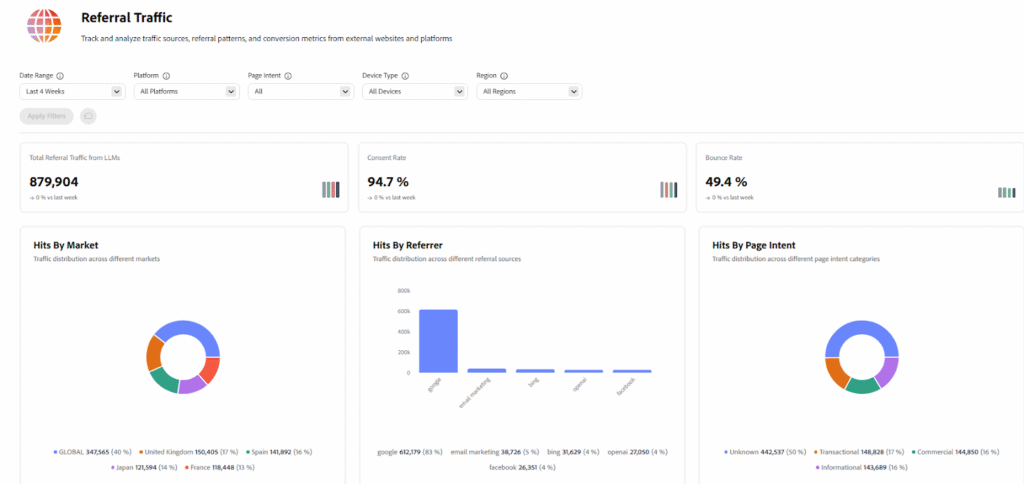
To ensure accurate attribution, the platform also relies on CDN-side tracking. This allows Adobe to associate an “agentic referral” with a session even when traditional browser cookies are blocked.
After general availability, Adobe LLM Optimizer is aligned to integrate with Adobe Analytics and Customer Journey Analytics. These integrations will help teams connect shifts in AI visibility with other marketing channels and evaluate attribution across the entire customer journey.
4. Optimization Engine
This is where analysis turns into execution.
LLM Optimizer automatically identifies factors that limit your brand’s AI visibility and presents clear, actionable recommendations. For each issue, it explains what is happening, why it matters to AI models, and what steps are needed to resolve it.
Below is an example showing how the platform surfaces optimization opportunities based on performance data and emerging topics:
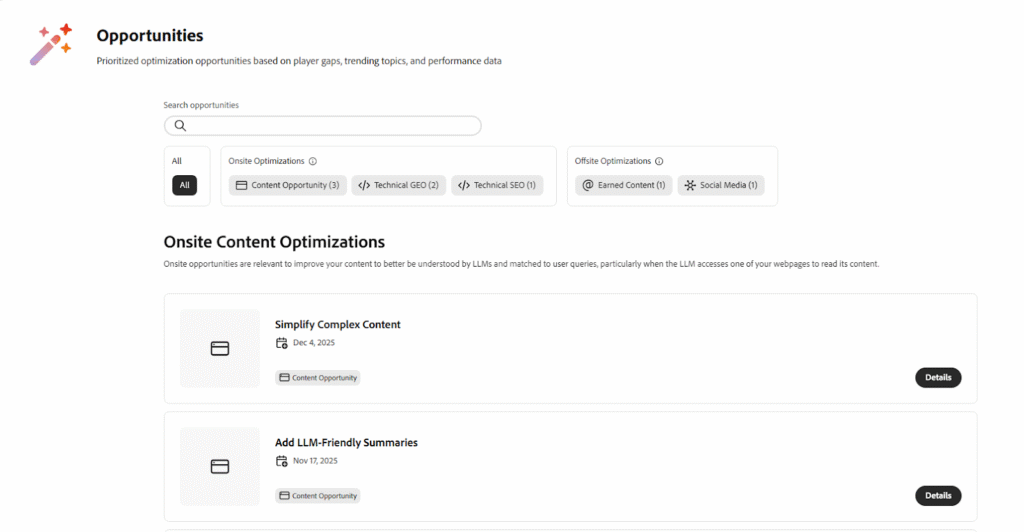
Common optimization includes:
On-site Optimizations: Multiple websites rely on complex JavaScript frameworks. While these work well for users. AI models primarily interpret HTML, which can make such pages difficult to understand.
Adobe LLM tool addresses this by pre-rendering pages, creating simplified versions that AI systems can easily read and cite.
The platform also handles common technical barriers, such as redirecting AI bots away from pages returning 404 errors. It also ensures that friendly AI crawlers are not blocked by robots.txt or CDN rules.
Offsite Optimizations: On the content side, the LLM Optimizer tool recommends structural improvements. This helps AI systems extract information more effectively. This includes adding structured FAQs, which align well with how AI tools process direct questions and answers.
For long-form pages, the tool may suggest summary sections that provide a concise overview for AI-generated responses. It also resolves issues like empty or duplicate headings and meta descriptions. By making it easier for AI systems to navigate and interpret content.
One of the most impactful aspects is deployment. Many of these optimizations can be implemented with a single click at the CDN layer. This removes the usual dependency on engineering teams and significantly shortens the time between insight and execution.
Now that the optimization process is clear, the next step is understanding how the tool operates behind the scenes. Let’s move into that next.
How Adobe LLM Optimizer Operates (End-to-End Workflow)
To use the platform effectively, it is important to understand how everything works behind the scenes.
Let’s look at the complete workflow of the Adobe LLM AI tracker tool:
Step 1: Prompt-Based Monitoring (The New Way to Think About Keywords)
Generative engine optimization doesn’t rely on traditional keywords. It is driven by prompts, which show the actual questions people ask AI assistants.
You start by defining prompts that align with your business goals. These can include:
- Product-related questions, such as “What’s the best CRM for small businesses?”
- Service-focused queries like “How can I optimize a website for AI search?”
- Brand perception prompts, for example, “Is [Your Company] trustworthy?”
Once these prompts are set, the Adobe LLM tool runs them across multiple AI models to evaluate the responses. This gives you a clear picture of how your brand shows up, or doesn’t, within AI-generated answers.
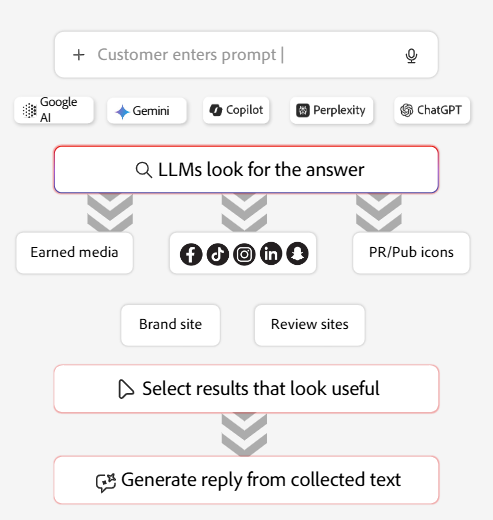
Step 2: Brand Presence Across Multiple Large Language Models (LLMs)
The platform then measures brand visibility across five major language models and different geographic regions. For each prompt, it highlights:
- Whether your brand was mentioned
- If and how your brand was cited
- The reason your brand appears in the response
- Whether competitors are included in the same answer
This comparative view is important. It helps you understand where competitors are gaining ground and which topics are driving their AI visibility over yours.
Step 3: Agentic Traffic and Referral Traffic Insights
At this stage, you begin to see how AI agents interact with your site.
Agentic AI-driven traffic reveals which pages bots attempt to access, how frequently they crawl them, and whether I need to write more helpful content. Many modern sites rely on JavaScript rendering, which often looks flawless to users, but it is invisible to AI agents. This creates a major visibility gap.
Referral traffic tracks actual users who arrive on your site after clicking through from an AI-generated response. This data is essential for tying AI visibility to real business outcomes.
Step 4: Prescriptive Optimization Recommendations
Using the insights, the Adobe LLM Optimizer tool generates clear, targeted recommendations. These are not generic suggestions such as “optimize content quality.” But the platform identifies specific technical and structural issues along with how to fix them.
Here’s a table showing a few examples of how the tool recommends actionable fixes for your brand:

Step 5: Edge-Based Optimization and Deployment
This is where Adobe LLM Optimizer stands apart. All optimizations are applied at the CDN level rather than directly within your site’s source code.
In short, this allows marketing teams to resolve AI visibility issues without relying on engineering resources.
Suppose that if AI agents cannot interpret JavaScript-heavy product pages, the Adobe tool can serve pre-rendered HTML versions at the edge. AI bots receive fully readable content, while human visitors continue to experience the site as usual.
Because these changes occur at the edge, they carry minimal risk and do not impact site performance. After deployment, the platform continues to track visibility shifts and links them to downstream results.
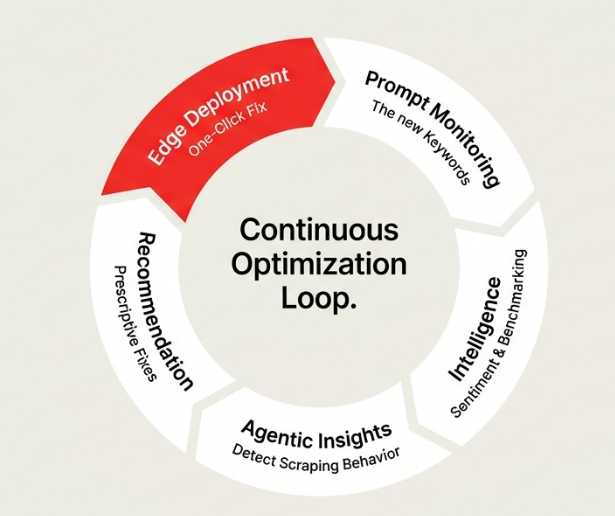
With a clear understanding of how the workflow operates, we can now look at the advantages and how brands benefit from using Adobe LLM Optimizer.
Benefits of Adobe LLM Optimizer
Now that you are aware of how Adobe LLM Optimizer operates, it is important to know what makes this platform worth trying.
So, let’s explore the benefits one by one.
1. Enhanced Brand Presence and Share-of-Voice
Rather than focusing only on rankings, the platform shifts attention to relevance. This helps brands appear and get cited across top LLMs such as ChatGPT, Gemini, Claude, Copilot, and Perplexity.
Using Generative Engine Optimization (GEO) scores, marketers can track how these models surface their brand to high-intent audiences. It also helps them spot areas where competitors are gaining visibility.
This approach can lead to rapid gains in authority. For example, Frescopa saw its citations grow fivefold in just a week.
2. Clear Visibility into Agentic Traffic
Digital discovery no longer follows a single entry point. While human users typically land on a homepage, AI agents tend to access deeper resources like FAQs, documentation, and support content.
Adobe LLM Optimizer tool analyzes CDN logs to uncover this agentic traffic, showing exactly how AI bots navigate and consume site content. This makes it possible to identify which specific assets, whether a blog article or a technical guide, play the biggest role in shaping how an LLM represents your brand.
3. Prescriptive and Automated Optimizations
The platform is built to eliminate analysis paralysis by following a simple workflow: auto-identify issues, auto-suggest solutions, and auto-apply fixes.
Instead of stopping at diagnostics, it provides clear recommendations. Like enabling agent access through robots.txt or resolving 4xx and 5xx errors that can prevent citations.
A standout capability is pre-rendering JavaScript-heavy pages so dynamic content becomes readable to AI agents without altering the experience for human visitors.
Many of these improvements can be deployed quickly using one-click actions through Adobe Experience Manager or custom APIs.
4. Brand Accuracy and Protection
AI-generated misinformation spreads faster than you can correct it. The platform tackles this head-on by tracing every AI response back to your actual source pages. When ChatGPT or Gemini hallucinates facts about your product, you’ll spot it before it becomes a reputation problem.
Beyond catching errors, you get a complete picture of how your brand sentiment looks across different regions and AI models. This gives your PR and communications teams real control over the accuracy and consistency of your brand narrative.
5. Measurable ROI and Business Impact
Gartner predicts organic search traffic will drop by 50% by 2028. That makes proving AI visibility value absolutely critical. The platform doesn’t just show you data. It calculates what your AI citations are actually worth in dollars, so you know exactly which efforts matter most.
And the integration with Adobe Analytics and Customer Journey Analytics takes it further. You can trace the entire path from an AI mention to an actual sale. That means real attribution, real revenue tracking, and a complete picture of what your AI visibility is doing for your business.
6. Built for Enterprise Scale
Adobe offers this as a standalone SaaS product, so using Adobe Experience Manager is not a requirement. It integrates with custom CMS setups through APIs and is designed to support large, complex organizations using secure standards such as Model Context Protocol and Agent-to-Agent communication.
Pricing is structured around prompts, the AI equivalent of keywords, with paid plans starting at a minimum of 1,000 prompts and scaling as needed.
At this point, I’m sure the benefits are clear. Like any platform, it also comes with limitations, which we’ll look at next.
Limitations of Adobe LLM Optimizer
No platform is perfect, and Adobe LLM Optimizer, an AI visibility checker tool also has a few limitations. Before committing to it, it’s important to understand where the platform may not be the right fit for you and why.
So, let’s take a clear look at the areas where it falls short.
1. High Entry Price for Smaller Businesses
Let’s be honest, $115,000 per year is a serious barrier to entry. If you’re running a small business or startup, this price tag makes the Adobe LLM Optimizer tool a non-starter. It’s just not accessible at that stage.
Mid-market companies face a different challenge. You might have the budget, but can you justify spending six figures when you’re still trying to figure out if AI search will even matter for your business? That’s a tough sell internally. This is enterprise software, built for brands with enterprise-level marketing spend.
If your company brings in less than $10M annually, start somewhere else. Use a lighter, cheaper AI visibility tool first. See how you show up in AI responses. Build a case with actual data. Then, when you can prove the value, come back and consider the enterprise option.
2. Prompt-Based Pricing Requires Careful Planning
Calculating the right number of prompts isn’t simple. Unlike traditional SEO tools, where tracking thousands of keywords is relatively inexpensive, each prompt in Adobe LLM Optimizer directly affects cost.
Your teams need to be selective. You should decide whether you want to monitor every product variant, each market, or all competitor comparisons. Without a clear strategy, expenses can grow quickly. This is not a tool you can deploy broadly just to experiment.
Growth adds another layer of complexity. As new products launch or markets expand, prompt requirements increase, making long-term budgeting harder to predict.
3. Best Value Requires Strong Content Foundation
Adobe LLM Optimizer does not create content. It can highlight gaps, missed citations, and technical barriers, but the responsibility for producing strong content still sits with your team.
If your content library is outdated or unstructured, fixing technical issues alone won’t suddenly improve AI visibility. The platform delivers the most value when solid content already exists and simply needs better accessibility and structure for AI systems.
The best way to think about it is: Adobe LLM Optimizer improves distribution. But distribution only works if what you’re distributing is worth citing.
4. Emerging Category with Evolving Best Practices
Generative engine optimization is still in its early stages. The discipline only began taking shape around 2023, and standards continue to evolve as AI models change.
There’s no long-established playbook like there is for traditional search engine optimization (SEO). Investing now means entering a space that is still being defined, which naturally carries uncertainty.
AI platforms frequently update how they crawl content, assign citations, and prioritize sources. Adobe has committed to ongoing updates, but your teams should still recognize that they’re operating early in a fast-moving landscape.
When Adobe LLM Optimizer May Not Be the Right Fit
Adobe LLM Optimizer is a powerful platform, but this isn’t the only solution. In a few situations, it may make more sense to explore other options first:
- If you’re an early-stage company or a small business working with a tight marketing budget, the entry cost can be difficult to justify. This platform is designed for organizations ready to make a meaningful investment.
- It’s also less impactful if organic search is not a major acquisition channel for you. Brands that rely mainly on paid advertising, referrals, or direct traffic are unlikely to see significant gains from AI visibility improvements.
- If your content creation process is still immature, it’s better to strengthen that foundation before optimizing for AI agents.
- The same applies to niche markets with low search demand. If users are not yet asking AI assistants about your category, the return on investment will be limited.
- It’s not a tool for quick or low-cost testing. Adobe LLM tool typically involves an annual commitment, which makes it unsuitable for teams looking to experiment rapidly.
In these cases, starting with affordable monitoring tools can be a smarter first step. Once you have clear data showing demand and opportunity, moving to an enterprise platform becomes much easier to justify.
Challenge: Getting Buy-in from Leadership
Believing in the tool of Adobe LLM Optimizer is one thing. But getting approval from senior leadership is a much harder step.
To make the case effectively, you can start with competitive evidence like:
1. Show competitive analysis: Highlight where competitors are already showing up in AI-generated answers while your brand is missing. This isn’t a hypothetical risk. It reflects real visibility and share being lost today.
2. Demonstrate early wins: Focus on tangible proof. If a “try before buy” option is available, use it to demonstrate early impact. Even a small example that shows a rise in citations can help leaders connect AI visibility with future traffic and revenue.
3. Project ROI clearly: Frame the investment in terms of risk and protection. If your business depends on organic search and industry forecasts point to a steep decline over the next few years, quantify what that loss could mean. Position Adobe LLM Optimizer as a way to offset that decline, not as an optional add-on.
Many executives are still catching up to how AI search actually works. Education often has to come before approval, especially when budgets at this level are involved.
With those concerns addressed, the next logical question becomes whether this tool is the right move for your business. Let’s explore that next.
Who Can Leverage Adobe LLM Optimizer for AI Visibility?
Adobe LLM Optimizer is built for enterprise brands, usually those pulling in $100M+ annually. But let’s see who specifically should be paying attention to this?
- If you’re a CMO or Head of Marketing watching your organic traffic drop month after month, this matters. You need visibility into how AI represents your brand when people search.
- If you’re leading Communications or PR, you’re probably already worried about AI spitting out wrong information about your company. This gives you a way to catch and fix that.
- SEO and GEO specialists are on the front lines here, figuring out how to make traditional search strategies work in an AI-first world.
- And if you’re a Digital Marketing Manager building content, you need to know whether AI agents can even access what you’re creating.
Industries That Benefit Most
1. B2B companies with research-heavy buying cycles: Think SaaS platforms, IT services, financial products, healthcare solutions. Your prospects are asking AI detailed questions before they ever visit your site. If you’re not in those answers, you’ve lost them before the conversation even starts.
2. B2C brands that live on search traffic: Retail, e-commerce, travel, hospitality, consumer packaged goods. If people currently find you through Google, they’re about to start finding your competitors through ChatGPT instead.
Look, I get it. You’re probably thinking, “This sounds good, but does it actually work? Show me proof.”
Fair question. Here’s what happened when real brands started using this.
Real-World Outcomes & Use Cases of Adobe LLM Optimizer
Let’s look at actual results from brands using the platform.
Take Frescopa as an example.
The problem: AI agents couldn’t access their dynamic content like product descriptions, ratings, and reviews. All of it was invisible to AI search, which meant they weren’t getting cited in AI-generated answers.
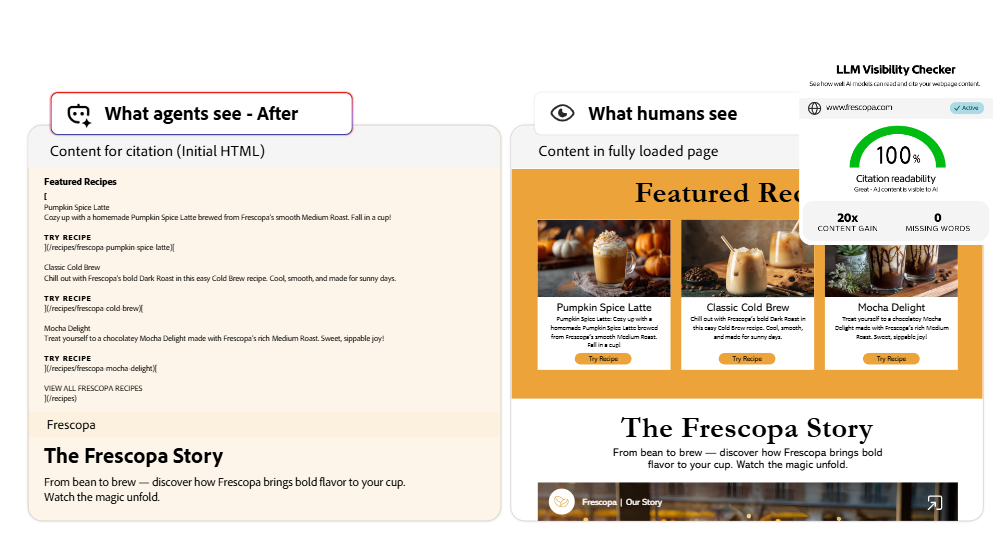
Here’s an example showing LLM visibility with AI optimization:
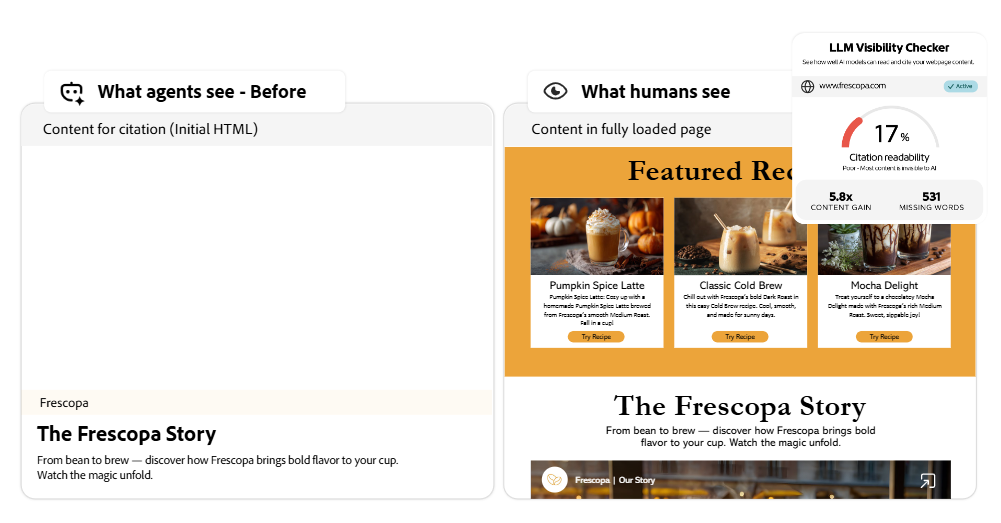
The solution: They used edge-based optimization to pre-assemble content specifically for AI agents. Human visitors still got the normal experience. The whole thing was deployed through the CDN layer without touching any code.
The outcome: Their citations jumped 5x in one week. That’s a 500% increase.
According to Adobe Analytics data, retail sites saw a 4,700% spike in traffic from generative AI sources between July 2024 and July 2025. This isn’t some future prediction. It’s already happening.
Now that you’ve seen the proof, you’re probably thinking: “Okay, this looks solid. But how much does it actually cost?”
Let’s break down the numbers.
How Much Does Adobe LLM Optimizer Cost?
Let’s be direct. This isn’t a low-cost tool you can test on a small budget. It’s designed for large organizations with serious scale and the budget to match.
The platform uses prompt-based pricing. The minimum purchase is 1,000 prompts at approx. $115,000 per year.
Calculating Your Prompt Needs
How do you estimate how many prompts you need? Here’s the formula:
Markets × Products × Topics per Product = Total Prompts
Let’s say you’re a luxury skincare brand expanding into France, South Korea, and the UAE. You have 8 flagship products (like serums and night creams) and want to monitor 15 specific consumer concerns (Topics) for each product, such as anti-aging, ingredient safety, or sustainability.
- 3 markets × 8 products = 24 total product-market combinations
- 24 combinations × 15 topics = 360 total prompts
For a full-scale global tracking program that monitors your entire inventory across these high-competition regions, a sizing assessment would estimate approximately 12,000 prompts annually.
At the $85 per prompt tier, your annual investment would be: $85 × 12,000 = $1,020,000 annually.
Is the Investment Worth It?
Deciding whether to invest in this platform depends on your company’s scale and how much your growth relies on organic search results.
For large enterprises with over $100 million in yearly revenue, search is often a primary way to find new customers. In these cases, losing visibility in AI-generated search results can lead to a major drop in income. For these organizations, a yearly cost of roughly $1,020,000 is not just an extra expense; it is a necessary protection against losing market share.
For smaller businesses or startups are usually not the right fit for this tool. Because they don’t have the same level of massive search exposure, the high cost is difficult to justify. At this stage, simpler and more affordable monitoring tools are typically enough to get the job done.
Companies in the middle, with revenues between $10 million and $100 million, often find that a step-by-step approach works best. By starting with lower-cost SEO or visibility tools, these teams can keep an eye on competitors and test the waters before committing to a full enterprise-scale investment.
Now, let’s look at the future roadmap for this tool and what is coming next.
What Feature Enhancement is Expected in Adobe LLM Optimizer
To move beyond basic monitoring, the Adobe LLM Optimizer is shifting toward full business integration. Here are four key upgrades on the roadmap designed to turn AI insights into measurable results.
1. Connecting AI Visibility to Revenue (AA & CJA)
The most critical upcoming update is the integration with Adobe Analytics (AA) and Customer Journey Analytics (CJA). This will finally bridge the gap between AI presence and your bottom line by allowing you to:
- Track the “Dollar Value” of Citations: You can see exactly how a mention in a tool like ChatGPT translates into an actual purchase or conversion on your website.
- Map the Entire Journey: Marketers can follow a customer from their initial AI-assisted discovery all the way through to the final sale. It will make it easy to prove the real return on investment (ROI) for your GEO efforts.
2. Preparing for the “Agentic Experience”
AI is evolving from a research tool into an “agent” that can perform tasks like booking trips or ordering products. Adobe is updating its Edge-based delivery to help brands prepare for this shift.
These future enhancements will help you structure data so AI agents can do more than just read your site. With this change they will be able to interact with real-time pricing and inventory to complete transactions on behalf of users.
3. Deep-Dive Fact-Checking and Accuracy
As language models become more conversational, maintaining brand truth is important. The roadmap includes more precise tools to fight misinformation by anchoring AI responses directly to your “Source of Truth” documents.
This ensures that the answers generated by AI are based on your approved, current brand facts rather than outdated or incorrect information found anywhere online.
4. Integration with the Adobe Experience Cloud
Although the LLM Optimizer is a standalone product, Adobe is building “Better Together” workflows within the Experience Cloud.
This means the platform will eventually be able to automate your response. For example, a visibility gap identified by the optimizer could automatically trigger a content update or launch a conversational “Brand Concierge” experience to engage users.
Final Thoughts
AI search is no longer experimental. It’s here, and it’s changing how customers discover brands.
If you’re an enterprise brand, losing AI visibility means you’re losing market share. Citations, sentiment, and accuracy now matter more than Google rankings because they directly influence perception of consumers before even visiting your site.
Adobe LLM Optimizer offers one of the best complete enterprise solutions available today. It combines deep visibility into how AI agents access your content, prescriptive guidance on how to resolve issues, and low-risk implementation through the CDN layer.
If you’re ready to invest, start with visibility measurement. Understand where you stand today. Then resolve agent readability issues. Finally, scale with structured content and continuous monitoring.
For ongoing AI visibility tracking and faster iteration, consider pairing enterprise insights with lighter platforms that allow you to test and learn quickly.
The shift to AI search is happening whether you’re ready or not. The question is: will your brand be part of the response?
FAQs
What is the LLM Optimizer in Adobe?
The Adobe LLM Optimizer is an enterprise platform built to manage how your brand appears in AI-generated search results across major models. It goes beyond traditional SEO agencies by using actual server data to track how AI bots crawl your site and what they say about you. The tool identifies gaps in your visibility and provides specific, one-click fixes to ensure your brand is cited accurately.
What LLM does Adobe AI use?
Adobe’s optimizer does not rely on just one single model; it is designed to monitor and analyze performance across the entire AI landscape. Specifically, it tracks your brand’s presence and citations across five major platforms: ChatGPT, Gemini, Copilot, Perplexity, and Google AI Overviews.
By looking at all these models simultaneously, the tool helps you understand how different AI systems interpret your content.
How to optimize LLM performance?
Optimizing for AI performance requires making your content as easy as possible for machines to digest and summarize. You should focus on creating a clear site structure with accurate headings and “summary blocks” that give bots a quick overview of long articles. Implementing technical fixes like “pre-rendering” is also important, as it allows AI agents to read complex code that they might otherwise ignore while you monitor your key metrics to track progress.
How to optimize for LLM search?
To win in AI search, you must treat prompts as the new target keywords and ensure your content directly answers common customer questions. It is critical to unblock AI crawlers in your site’s settings so they can access the deep content, like help docs and blogs, that they prefer to cite. You should also monitor your competitors to see which topics they are winning and adjust your content to fill those gaps.
How to optimize a website for LLM?
Optimization is a continuous cycle of monitoring visibility and deploying technical improvements through the edge layer of your site. Use real-world data from CDN logs to see which pages bots are actually visiting and fix any broken links or server errors that drive them away.
You can use Adobe’s one-click deployment to apply these fixes instantly without needing to wait for your IT team to change the website’s code. This allows you to stay agile as AI models evolve their crawling behavior and citation rules.