



You’ve done the SEO work. You’re running Google Shopping campaigns. But your products still aren’t showing up where buyers are actually searching. The problem isn’t your budget or your bidding strategy. It’s that the discovery layer has shifted, and if you want to boost e-commerce conversions with AI visibility, you need to understand what changed.
Conversational AI tools, like Google AI Overviews, and LLM-powered shopping assistants, have become the new front door for product discovery. And the brands winning there aren’t spending more. They’re feeding AI systems cleaner, richer data. According to Ecommerce News, 58% of consumers now use AI tools specifically to research products before buying.
This isn’t just an SEO shift. It changes how products get discovered. If your structured data is thin, AI systems can’t confidently connect your products to what shoppers are asking for, and your competitors get the recommended instead.
So, understanding how AI search differs from traditional SEO is the starting point for any eCommerce brand trying to adapt. Also, the concepts behind AEO and GEO are also worth understanding here.
By the end of this blog, you’ll understand:
- How to boost eCommerce conversions with AI visibility by optimizing your product data
- Why your product feed is the single most important lever for AI search performance
- How to optimize product feeds for both Google Shopping and conversational AI tools
- What AI search for e-commerce actually looks like compared to traditional search
- Which on-site and technical changes compound your feed improvements
What “AI Visibility” Actually Means for E-commerce
AI visibility is your brand’s ability to appear when buyers search using conversational tools like ChatGPT, Perplexity, and Google AI Overviews. It’s different from traditional SEO because you’re not optimizing for a crawler reading your page copy. You’re optimizing for systems that interpret search intent and match against structured data.
For e-commerce brands, this distinction is very important. Better AI visibility means higher-quality traffic arriving with purchase intent already formed, and that translates into better conversion rates.
How AI Search Differs from Traditional Search
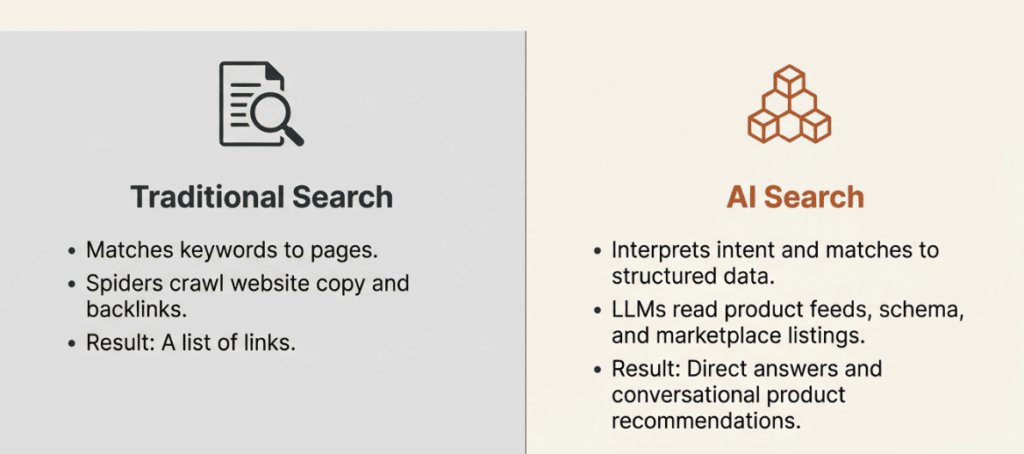
Traditional search matches keywords to pages. AI search for e-commerce interprets what a shopper actually means and pulls answers from structured data sources. The mechanics are different enough that strong traditional SEO doesn’t automatically carry over.
Here’s how it plays out in practice:
- Google AI Overviews surface product information directly in search results, pulling from structured data rather than ranking pages in the traditional sense.
- ChatGPT now has native shopping integrations, making it a direct product discovery channel, not just a research tool.
- Perplexity and other LLMs handle shopping queries conversationally, prioritizing sources with clear, complete product data. Perplexity search handles shopping queries differently than Google does, making structured data the primary requirement for citation.
- Google’s spider crawled your site. AI systems read product feeds, schema markup, and marketplace listings to understand what you sell.
In Short: A strong website alone is no longer enough. If your product data is incomplete, AI can’t confidently match your products to what shoppers are asking.
The New Buyer Journey
Buyers are starting their research with AI search tools and arriving on product pages much later in the funnel, often with a decision already largely made. AI-driven traffic from tools like ChatGPT and Perplexity surged through 2025. The latest AI search statistics show just how fast this shift is accelerating.
Here’s a community reaction from ecommerce professionals discussing how AI-powered discovery impacted their traffic and conversions. A store owner recently shared that ChatGPT-user traffic went from zero to 80-100 log hits daily in under 12 months, with 7-15 engaged sessions per day now making up 1-2% of total engaged sessions on a 7-figure ecom store.
Are you watching the rise of AI traffic to your site?
by u/abc_123_anyname in ecommerce
Based on Adobe Analytics data, Generative AI tools drove a 693.4% increase in traffic to retail sites compared to the prior year.
But here’s the thing. Volume matters less than it used to. Getting in front of high-intent AI-search shoppers is more valuable than broad impressions. That’s why AI visibility is a conversion rate lever, not just a reach metric.
Why Is the Product Feed the Foundation of AI Visibility?
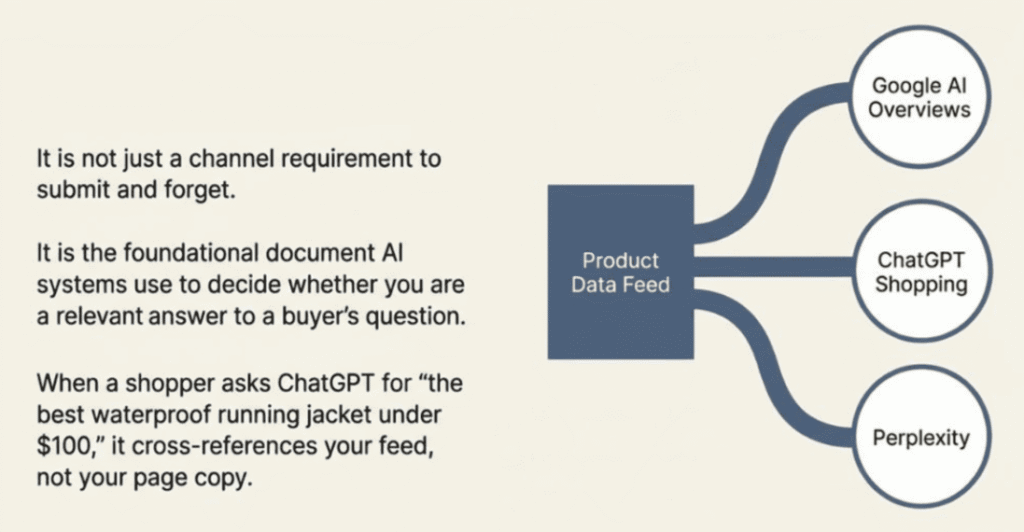
A product data feed is a structured file containing your product catalog’s core attributes, such as titles, descriptions, prices, images, GTINs, availability, and more. It’s submitted to channels like Google Shopping and Meta, and it’s increasingly the primary source AI systems reference when deciding whether your product matches a user’s query.
When a shopper asks ChatGPT for the best waterproof running jacket under $100, the AI isn’t reading your product page copy the way a human would. It’s cross-referencing structured data to understand what you sell and whether it fits.
If your product feed is incomplete, that match doesn’t happen. Every AI shopping tool, from Google AI Overviews to Perplexity, works this way. The feed is what they read first, and in most cases, it’s what they rely on entirely.
That’s what makes the product feed the foundation of AI visibility for ecommerce brands. It’s not just a channel requirement you submit once and forget. It’s the primary document that AI systems use to decide whether you’re a relevant answer to a buyer’s question.
How AI Search Engines Consume Your Feed
AI search engines use your product feed to understand what you sell, match it to conversational queries, and decide whether to surface your products. Unlike traditional crawlers, they don’t rely on page copy in the same way. The feed is the primary signal.
Where a traditional search engine might rank your page based on backlinks and on-page copy, an AI shopping tool is asking a more direct question: Does this product match what the user asked for? To answer that, it needs complete, well-structured product data. It needs to know the material, the size range, the gender fit, the price, and the condition. The more of that information you give it, the more confidently it can recommend your product.
Just make sure that thin titles, missing attributes, and vague descriptions create gaps the AI can’t bridge, even if your site experience is excellent. A clean, complete, optimized product feed improves visibility across Google Shopping, Google AI Overviews, ChatGPT shopping, and Perplexity simultaneously.
Why Most Product Feeds Are Underperforming
Here’s the problem, though. The issues are usually the same across online retailers, as they provide generic product titles, missing Global Trade Item Numbers (GTINs), incomplete attribute fields, stale pricing and availability, and no custom labels. These issues hurt both paid campaign performance and organic AI visibility at the same time.
Part of the reason they’re so common is that they’re invisible until something breaks. A missing GTIN doesn’t throw an error. A vague title doesn’t trigger disapproval. The feed just quietly underperforms, and the gap between what you could be capturing and what you actually are shows up as flat conversion rates or wasted ad spend rather than an obvious error you can trace back to a specific fix.
Most brands don’t audit their feed health regularly, so these gaps increase. You don’t see the problem until conversion rates plateau or ad spend efficiency drops. By that point, competitors with cleaner data feeds have already taken the product placement you should have had.
How to Optimize Your Product Feed for AI Search and Higher Conversions
Feed management for AI isn’t a one-time fix. It’s a set of ongoing practices across titles, attributes, images, and data freshness. The goal is to give AI systems enough clear, accurate information that they can confidently match your products to relevant results.
And before you ask, no, you don’t need to overhaul everything at once. Start with your top-performing SKUs, get those right, and then work outward across the rest of your product catalog.
1. Write Product Titles That AI Can Parse
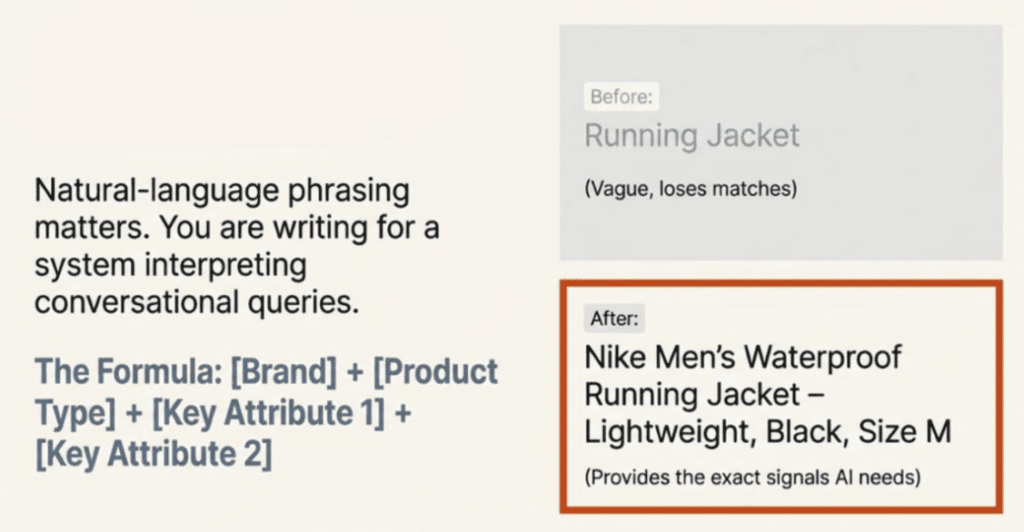
Product titles are the primary signal AI uses to match products to queries. Vague, generic titles lose matches. The structure that works: lead with brand, then key attributes in order of importance: product type, size, color, material, gender.
Example format: [Brand] + [Product Type] + [Key Attribute 1] + [Key Attribute 2]
Before: “Running Jacket”
After: “Nike Men’s Waterproof Running Jacket – Lightweight, Black, Size M”
Natural-language phrasing matters here because you’re writing for a system interpreting conversational queries, not just for keyword matching. A shopper typing into ChatGPT isn’t writing “running jacket.” They’re writing “lightweight waterproof running jacket for men under $150.” Your title needs to reflect those attributes, or the match never happens.
2. Complete and Enrich Your Product Attributes
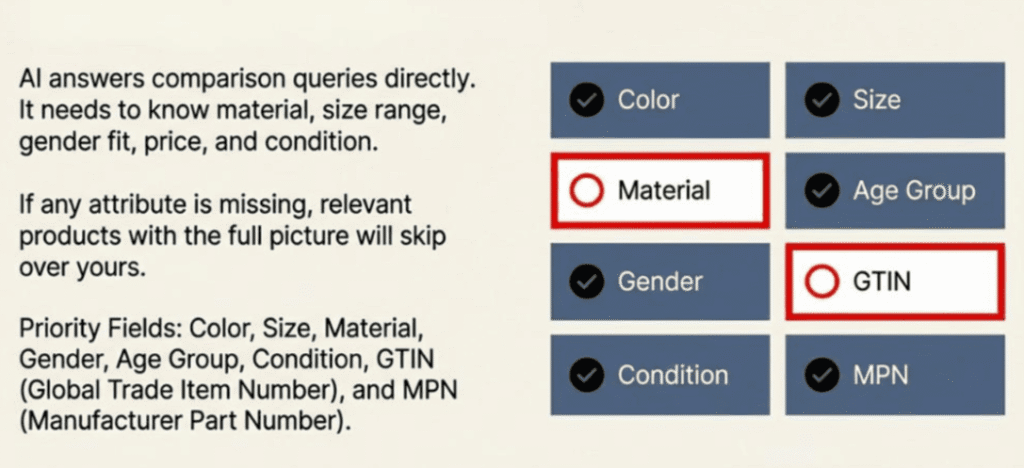
Every empty attribute field is a gap in the AI’s understanding of your product. Priority fields to fill are color, size, material, gender, age group, condition, Global Trade Item Numbers (GTIN), and Manufacturer Part Number (MPN).
Enriched product attributes help AI answer comparison queries directly. When a shopper asks for the best waterproof jacket under $100, AI needs to know your jacket is waterproof, know its price, and know the gender fit. If any of those attributes are missing, your product gets skipped in favor of over products that have the full picture.
Most brands don’t realize how many fields are actually empty until they pull a proper audit. The gaps are less visible than disapprovals, but they cost you just as much in product placement across paid and organic channels.
But the good news is that AI-powered tools can now auto-generate missing product attributes at scale. The main barrier to doing this properly, which used to be time, has also been largely removed.
The same attribute completeness that helps your feed perform in Google Shopping directly affects ChatGPT recommendations.
3. Use Custom Labels Strategically
Custom labels are one of the most underused features in feed management. They let you tag products by margin, seasonality, best-seller status, or promotional priority.
This matters in two ways. First, it informs your campaign bidding logic directly. Second, AI-powered bidding systems use these signals to allocate ad spend more intelligently. A product tagged as high-margin and in-season gets treated differently from one that’s neither.
If you’ve never set these up, start simple. Tag your top 20% of products by margin and your seasonal inventory. That alone gives your campaigns more to work with than most brands are currently providing.
4. Optimize Product Images for Visual AI Search
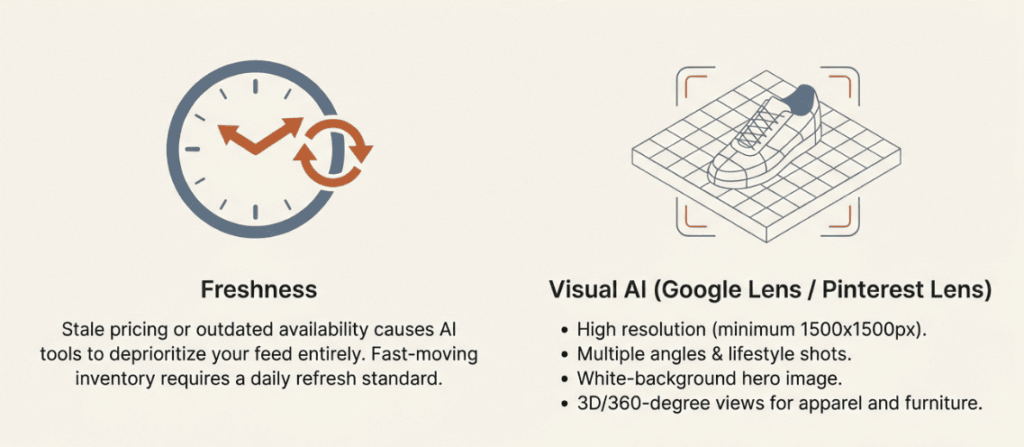
Google Lens and Pinterest Lens use image quality as a matching signal for visual search queries. The requirements for relevant results in visual search are specific: high resolution (minimum 1500x1500px), multiple angles, lifestyle shots, and a white-background hero image.
Better images also do double duty. They improve conversion rates once someone lands on the page, so it’s not purely a feed optimization investment.
3D or 360-degree views are worth considering if your product catalog fits them, particularly for apparel, footwear, or furniture. They future-proof your feed against visual AI capabilities that are still expanding.
5. Keep Product Data Fresh and Accurate
Stale pricing, wrong availability, and outdated descriptions, the very things content freshness signals are meant to catch, cause AI search tools to deprioritize or stop trusting your feed. For fast-moving inventory, a daily refresh is the standard. Dynamic pricing uses AI to automatically adjust prices based on real-time market trends, competitor activity, and demand.
Anything slower creates windows of bad data that cost you product placement in both paid and organic channels.
Consistent data also means your feed matches your website exactly. Price and availability mismatches between the two can trigger disapproval and actively hurt your search results performance.
6. Add Social Proof to Your Feed
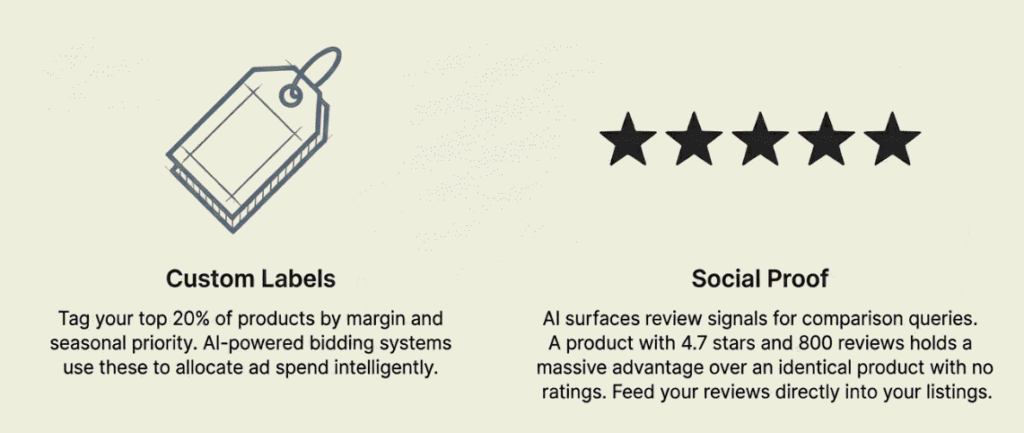
Product reviews and ratings belong in your feed wherever supported. AI systems surface review signals when answering comparison and recommendation queries. A product with 4.7 stars and 800 reviews has a much better chance of being recommended than an identical product with no ratings, all else being equal.
If you’re not actively collecting reviews and feeding them into your product listings, you’re leaving a signal on the table that your competitors are likely already using.
Review schema on product pages reinforces this further, which we’ll cover in the next section.
7. Use Conversational Keywords in Descriptions
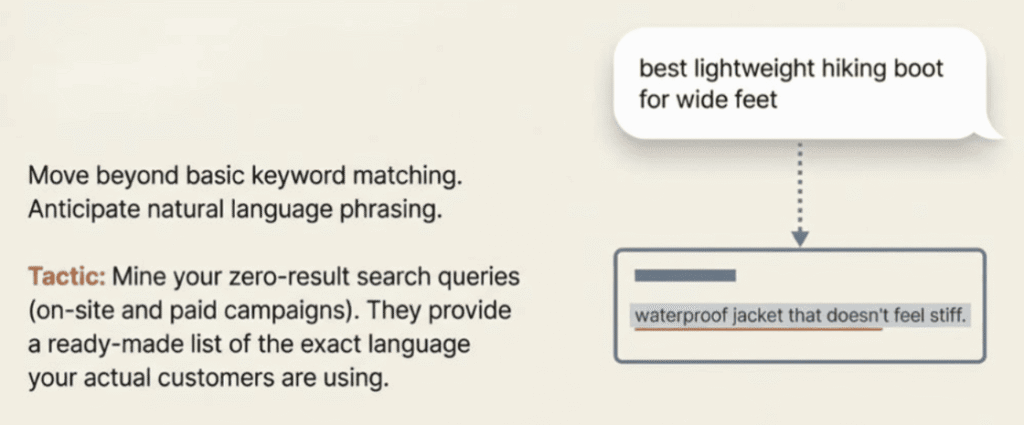
Move beyond basic keyword matching in your product descriptions. Start by thinking about how someone would actually phrase a question to ChatGPT or Perplexity: “best lightweight hiking boot for wide feet” or “waterproof jacket that doesn’t feel stiff.”
These long-tail, conversational phrases in your descriptions give AI systems more surface area to match your products against real search intent. It’s a small change that compounds across a large product catalog.
Your zero-result search queries, both on-site and in paid campaigns, are a ready-made list of the language your actual customers are already using. Start there. To get more information on this approach, see how to optimize content for AI answers.
8. Add Schema Markup to Reinforce Your Feed
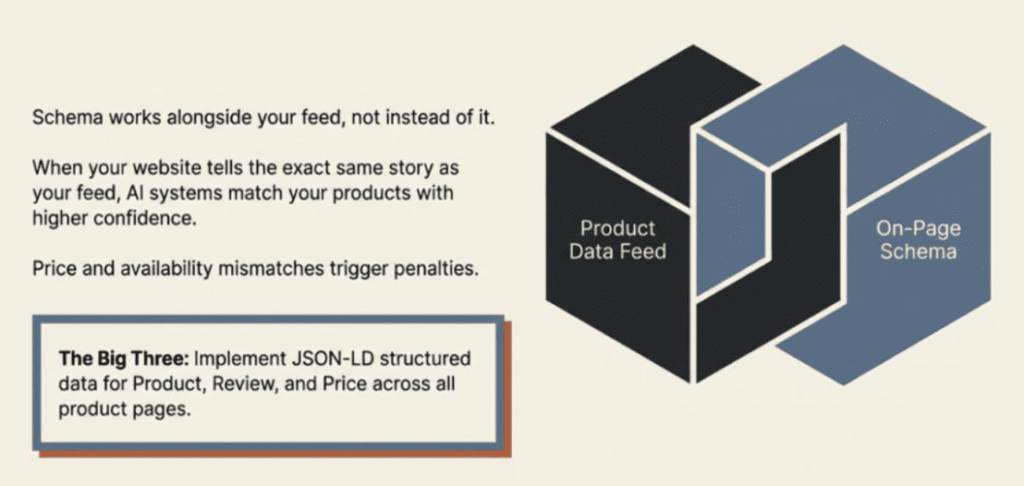
Implement JSON-LD structured data on your product pages so AI crawlers can easily parse information about prices and reviews. Schema works alongside your product feed, not instead of it.
When both say the same thing, AI systems have two consistent signals pointing to the same accurate information, and that builds the kind of trust that gets your products surfaced more often.
Product, Review, and Price schema are the three types that matter most for e-commerce brands. Get those in place across your product pages, and you’ve covered the majority of what AI crawlers are looking for.
9. Keep Feed and Site Data in Sync
The data in your feed, especially price and availability, needs to match your website exactly. When there’s a mismatch between what your feed says and what your product page shows, AI systems and shopping platforms will flag it, and your visibility takes the hit.
For online retailers with large catalogs, automated monitoring is the practical answer here. Manual checks work at a small scale, but once you’re managing thousands of SKUs, you need something running in the background catching discrepancies before they affect your campaigns.
How Do You Manage Product Feed Optimization at Scale?
Feed management gets harder as your product catalog grows. What works manually for 50 SKUs doesn’t hold at 5,000. The automation handles volume, but strategy still has to come from you.
1. AI-Powered Feed Optimization Tools
Modern feed platforms use AI to auto-generate missing attributes, flag disapprovals before they cost you, and suggest title improvements. This category has matured significantly. The gap between doing it manually and using the right tool is now large enough to show up directly in revenue.
AI-powered recommendations within these tools can now process thousands of SKUs and surface the specific changes most likely to improve performance, rather than leaving you to audit everything yourself.
2. API Integration
Direct API connections between your e-commerce platform and feed destinations keep data in sync automatically. This reduces the lag between a product update on your site and that change reflecting across channels.
For brands with frequent pricing or inventory changes, this isn’t optional. Manual data feeds create windows of incorrect information that AI systems will notice and penalize.
3. Dynamic Rules and Transformation
Rules-based logic lets you build product titles, descriptions, and labels automatically from raw catalog data.
For example: a rule that pulls brand + product type + primary attribute into a title field across your entire product catalog.
This is how you get consistent, optimized product feed titles at scale without manually editing each product. The rules run automatically when new products are added or existing ones are updated.
4. Feed Health Metrics to Track
Once you’re managing feed management at scale, you need to know where things are breaking down before it shows up as a revenue problem. The metrics worth tracking regularly are feed approval rate, attribute completeness score, click-through rates, conversion rates, and zero-result search queries in both on-site search and paid campaigns.
Each one tells you something specific. Approval rate tells you what’s being rejected. Attribute completeness tells you what’s being ignored. CTR and conversion data by segment tell you where the feed is working and where it isn’t. Zero-result queries are particularly useful because they show you exactly where shoppers are searching for something you sell, but your feed isn’t making the connection. Standard feed dashboards won’t show you how your products are appearing inside AI-generated responses, though. That’s a different layer entirely, and it’s where a tool like Track My Visibility comes in, giving you visibility into how your brand and products are actually showing up across AI-driven search environments.

 Pro Tip: Standard feed dashboards won’t show you how your products are appearing inside AI-generated responses. To measure that layer, see how to track AI search visibility across the platforms that matter.
What Else Can You Do to Improve AI Visibility Beyond the Feed?
Your feed is the foundation, but it’s not the whole picture. Once your structured data is clean and your feed is performing, on-site improvements close the gap between visibility and revenue.
1. Schema Markup on Your Product Pages
Product, Review, and Price schema on your product pages tells AI systems the same story your feed does. When both sources agree, AI systems trust your data more and match your products with more confidence. When they don’t match, it works against you.
Implement JSON-LD structured data on all product pages so AI crawlers can accurately read your prices, availability, and review signals. This means schema needs regular maintenance, not just a one-time setup. Prices update, products go out of stock, promotions end. The schema that was accurate last quarter might be quietly misleading now.
AI systems notice those gaps and will favor online retailers whose on-page data stays consistent with their feed.
2. AI-Powered On-Site Search and Recommendations
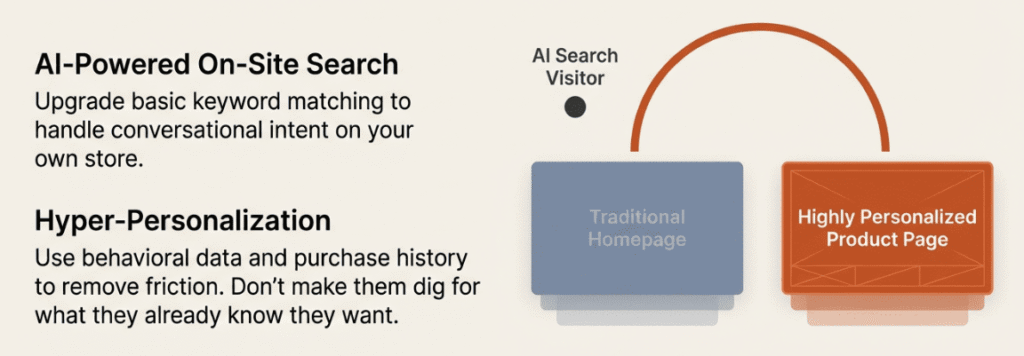
Getting a high-intent visitor to your site is half the job. What happens after they land is where a lot of e-commerce brands lose ground.
AI-powered recommendations that factor in customer behavior, browsing history, and purchase patterns do the work of connecting shoppers to relevant products without making them dig for it. That’s not a coincidence. It’s the compounding effect of showing the right products to the right person at the right moment, at scale.
The same logic applies to on-site AI search. Shoppers who use search on an e-commerce site convert at much higher rates than those who browse. AI-powered personalization can increase conversion rates by 15-30% by showing the right product at the right moment (McKinsey, ECOSIRE).
If your search still runs on basic keyword matching, you’re leaving conversions on the table from visitors who came in ready to buy.
Hyper-Personalization and Conversion Rate Optimization
AI search visitors are different from general traffic. They’ve already filtered their options, compared products, and arrived at a fairly clear idea of what they want. That stronger intent is an advantage, but only if your site experience matches it.
Behavioral data, purchase history, and real-time signals let you put the right products in front of the right audience without making them work for it. Businesses using AI for e-commerce report 5-15% average revenue lifts from personalization (McKinsey), while personalized product recommendations drive up to 31% of total e-commerce revenue (Salesforce).
When personalization is working, the path from landing page to purchase feels frictionless, because the customer isn’t being shown things they don’t care about.
If you’re already pulling in good traffic through AI search for e-commerce, but your conversion rates aren’t moving, the feed isn’t the problem anymore. That gap usually lives in the on-site experience.
A focused approach to conversion rate optimization is where that gets fixed, turning visits from high-intent shoppers into actual completed purchases.
Conclusion
To boost e-commerce conversions with AI visibility, most brands don’t need a bigger budget or a new channel. They need cleaner product data. Complete product titles, filled-in attributes, accurate pricing, and consistent schema markup. That’s what decides whether AI systems recommend your products or skip right past them.
It’s not a separate strategy. AI visibility feeds directly into conversion optimization. Sort the data quality first, and better conversion rates follow.
The brands that stay competitive here aren’t outspending anyone. They’re just making sure their product data is reliable enough that AI systems trust it. That’s a very solvable problem. Start with an audit. See where your feed actually stands, what’s missing, what’s stale, and what’s costing you matches. Track My Visibility shows you exactly where your products are appearing across AI search, and where they’re not. Run a free AI visibility checker to find the gaps that are eating into your conversions.
Frequently Asked Questions
A product data feed is a structured file containing key information about every item in your product catalog: titles, descriptions, prices, images, GTINs, and availability. It’s submitted to shopping channels and increasingly read directly by AI systems to understand what you sell.
AI search engines use your product feed as the primary signal to match your products to conversational queries. Unlike traditional crawlers, they don’t rely heavily on page copy. If the structured data in your feed is incomplete or inaccurate, the AI can’t make a confident match.
Product feed optimization is the ongoing process of improving feed quality through better titles, complete product attributes, accurate pricing and availability, enriched images, and strategic custom labels. The goal is to give AI systems and shopping platforms enough clear information to surface your products for relevant queries.
Traditional SEO optimizes pages for crawler-based ranking algorithms. AI search for e-commerce interprets conversational search intent and pulls answers from structured data sources. A strong website isn’t enough if your product data is thin. The feed and schema markup are the primary optimization levers.
Custom labels are optional tags you add to products in your feed to segment them for campaign management. You can label by margin, seasonality, promotional status, or best-seller ranking. These labels inform bidding logic and help AI-powered campaign systems allocate budget more effectively.
AI-driven traffic tends to arrive with stronger purchase intent because shoppers have already filtered and compared options before clicking through. As a result, conversion rates from AI search visits are meeting or exceeding those from traditional search traffic. Improving AI visibility effectively improves the quality of traffic, not just the volume, which leads to higher revenue per session.
Resources:
- 58% of consumers use AI tools to research products
- Adobe: Holiday Shopping Season Drove a Record $257.8 Billion Online with Consumers Embracing Generative AI Tools
- The value of getting personalization right—or wrong—is multiplying | McKinsey
- What Is a Retail Product Recommendation Engine? | Salesforce
- 25 Statistics of AI in E-commerce in 2026 | Cubeo AI