Semrush predicts that traffic from AI search will overtake traditional search by 2028. The same report shows that businesses using AI in SEO see higher returns than those that don’t.
That shift is already happening.
AI search tools like ChatGPT, Perplexity, Gemini, and Copilot don’t rank pages the same way Google does. They summarize, cite, and recommend brands directly. If your brand isn’t mentioned, it effectively doesn’t exist in those answers.
That creates a new problem for SEO teams: visibility can no longer be tracked solely by keywords. You now have to track prompts, brand mentions, citations, and presence across multiple AI platforms, each with different behaviors and data gaps.
This guide breaks down:
- What is AI search visibility, and why does it matter
- How to track AI search visibility over time
- Which metrics are actually important
- How to use that data to increase brand mentions in AI-generated results
Let’s get started.
What Is AI Search Visibility?
AI search visibility measures how often and how accurately a brand appears inside AI-generated answers.
Often, it includes a combination of the following:
- Brand mentions and citations
- Links and product recommendations
- Callbacks to product names or content resources
These results are produced by tools like Google AI Overviews, Gemini, and ChatGPT when users ask specific prompts.
Here is an example of AI visibility in Google’s AI overviews:

Here is a similar AI search result in ChatGPT for the same question:
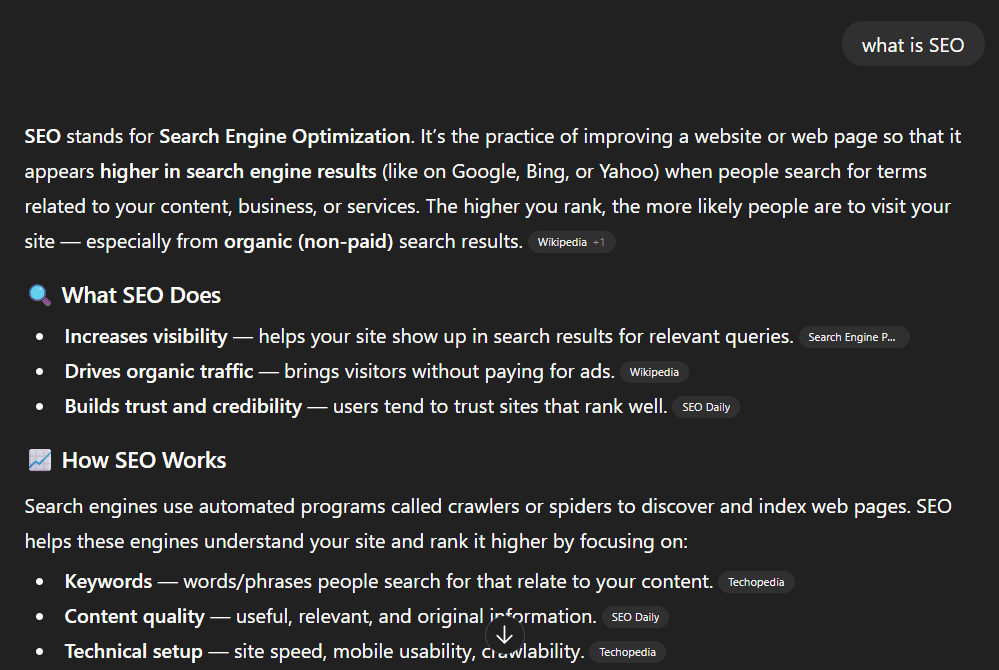
Visibility depends on whether the AI model recognizes your brand as a relevant source for a topic and chooses to reference it in its response. Unlike traditional SEO, this visibility is prompt-driven and context-based. For example, the same brand can appear for one question and disappear for a closely related one.
Tracking AI search visibility is vital for businesses, as users increasingly rely on LLM tools rather than traditional search engines like Google.
It means that you need to:
- Understand how your brand shows as a source and is described
- Monitor AI brand mentions across multiple AI search platforms
- Track which prompts surface your brand and how often
- Check how consistently it appears across different AI platforms over time
Learn More: AI Search vs SEO: Key Differences
How AI Search Visibility Works (and How It Differs From Traditional SEO)
AI search visibility is driven by how AI systems select, synthesize, and cite information inside generated answers.
Unlike traditional search, there is no ranked list to compete in. A brand is either included in the response, or it isn’t.
Here is a table to quickly understand how AI search is different from traditional SEO:
| Factor | Traditional SEO | AI SEO (AI Search Visibility) |
|---|---|---|
| Primary goal | Rank pages on search engine results pages | Get brands mentioned or cited in AI-generated answers |
| Core optimization unit | Keywords and pages | Prompts, entities, and contextual relevance |
| Search output | Blue links and featured snippets | Synthesized answers with limited or no links |
| Visibility signal | Ranking position and click-through rate | Brand mentions, citations, and recommendations |
| User interaction | User clicks results | User consumes the answer directly |
| Source selection | Algorithmic ranking based on many signals | Model-driven relevance and trust assessment |
| Role of backlinks | Strong direct ranking factor | Indirect influence through authority signals |
| Content evaluation | Page-level optimization | Cross-source consistency and factual alignment |
| Stability of results | Relatively stable over time | Varies by prompt, context, and model |
| Measurement method | Rank tracking and traffic analysis | Prompt-based mention and citation tracking |
As you can see here, Traditional SEO focuses on ranking pages for keywords and earning clicks from search results. We measure visibility by position, traffic, and performance over time, and the outcomes remain relatively stable.
AI SEO shifts visibility from rankings to inclusion. Brands appear only when AI-generated answers select, cite, or mention them, and results vary by prompt, context, and platform.
Here is a table showing the impact on paid and organic CTR of Google AI overviews from a study published by Tracy McDonald from Seer Interactive:
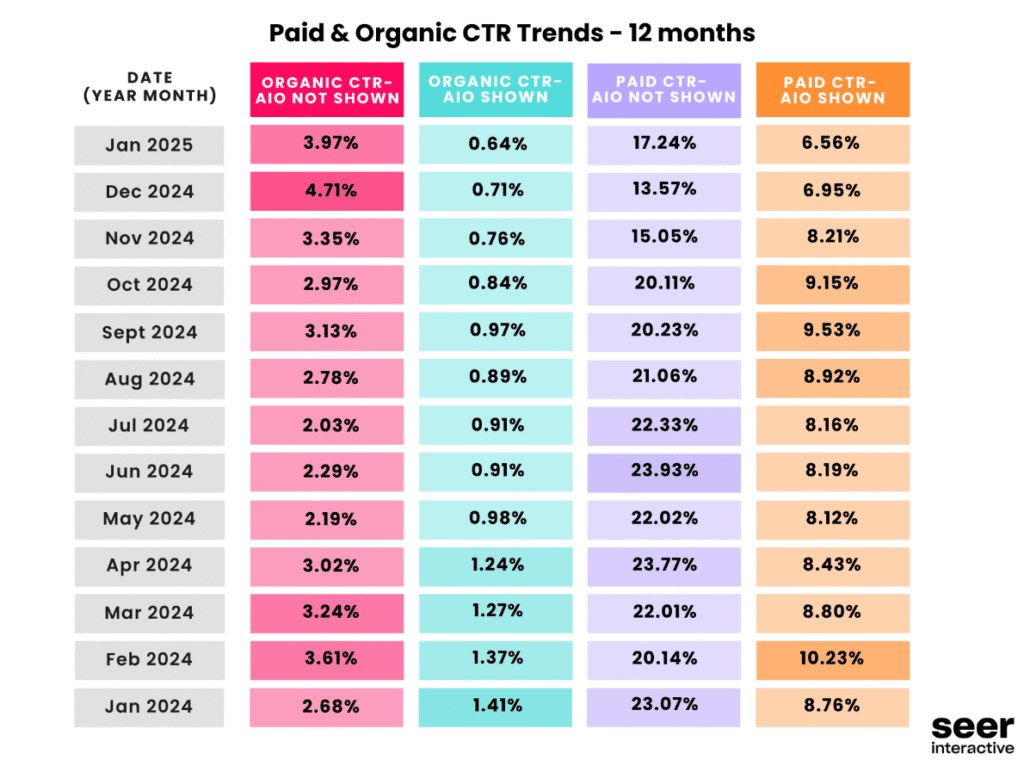
As you can see from the table, brands that understand this quickly will dominate the generative engine optimization space in 2026.
Learn More: Step-by-Step Guide to Rank in Google AI Overviews in 2026
How to Track AI Search Visibility in 2026: A Clear Framework
AI search visibility changes constantly, even when your content doesn’t. A brand can appear in an answer one day and disappear the next for the same prompt. That makes casual checks useless for understanding real performance.
To properly track AI search visibility, you need a repeatable process. Run the same prompts across the same AI platforms at fixed intervals, and record and compare the results over time. This is the only way to separate random variation from meaningful movement.
Here is a framework you can use to check your brand’s AI visibility across AI platforms:
1. Define the prompts you want for tracking brand visibility
AI search visibility is measured at the prompt level. So prompt selection is the foundation of AI search visibility tracking.
Start by identifying questions your audience is likely to ask directly in AI tools. Remember, these are not keywords you normally optimize for in Google.
These should be complete, natural-language queries that reflect intent, scope, and context. When defining prompts, ensure they:
- Are full questions, not keyword fragments
- Have a specific scope (avoid overly broad prompts)
- Are the right prompts with higher chances of brand visibility
- Have clear commercial, informational, or comparative intent
- Have a language that a real user would type into ChatGPT or Gemini
Track My Visibility can pick relevant prompts automatically based on your website. You can also add prompts as needed to monitor your brand’s AI search performance.
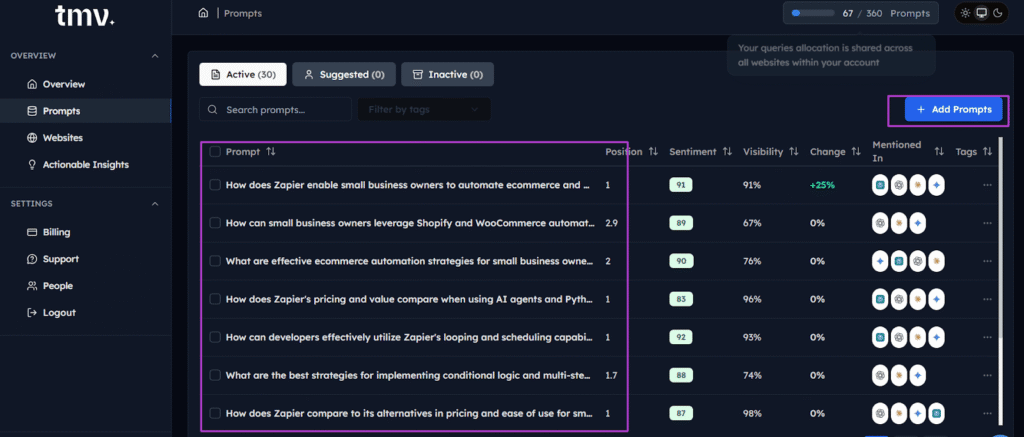
Well-defined prompts make AI visibility measurable, repeatable, and comparable over time. Once selected, prompts must remain fixed. Even minor wording changes can produce different AI responses and break trend comparisons.
Remember that each prompt becomes a tracking unit that helps you monitor how and where your brand appears in AI.
2. Select the AI search platforms to monitor
AI search visibility is platform-specific. The same prompt can produce different answers, sources, and brand mentions depending on where it is run.
Google AI Overviews, ChatGPT, Perplexity, and Gemini use different models, retrieval methods, and citation logic. As such, visibility in one platform does not translate to visibility in another.
To ensure accurate AI search tracking, monitor each platform independently.When selecting platforms to track AI search visibility, focus on:
- Where your audience is most likely to search
- Tools that influence buying or research decisions
- Platforms with frequent model updates that affect visibility
- Platforms that generate citations or brand recommendations
With Track My Visibility, you have the option to track AI search visibility and brand mentions on all top four platforms:
- Google’s Gemini
- Perplexity
- ChatGPT
- Claude
Here is how Track My Visibility shows where a brand appears in AI search

Treat each AI system as a separate search ecosystem with its own rules. With TMV, you can enable cross-platform monitoring from a single dashboard. This also makes it easier to understand your brand’s AI search performance.
3. Establish a baseline snapshot
After defining prompts and platforms, run every prompt across each selected AI system and capture the full responses. This first run becomes your baseline snapshot. It represents your starting point before any optimization, content updates, or visibility efforts.
The baseline is used to measure all future change. Without it, you cannot determine the visibility trends, such as growth or decline in brand performance across AI results.
When recording baseline data, capture:
- Whether a link or citation is included
- Whether your brand is mentioned at all
- How the brand is referenced or described
- The position of the mention within the response
- Any competing brands mentioned alongside yours
Store baseline outputs exactly as generated and monitor brand visibility across generative search to drive actionable insights.
4. Track AI search visibility, brand mentions, and citations using visibility tools
AI visibility exists only if your brand appears in the generated answer. For every prompt and platform, log key elements within AI-generated answers, such as:
- Direction mentions of your brand in AI answers
- Links to your brand as a source or recommendation
However, remember that not all mentions carry the same weight. A brief name drop in AI-generated responses is different from being positioned as a recommendation or cited source. These differences matter when evaluating brand visibility across AI search engines.
As such, when recording the responses, track:
- Direct brand name mentions
- Unlinked citations or source attributions
- Linked citations pointing to your site or linked pages
- Indirect references where the brand appears in AI descriptions
- Context of the mention (recommendation, comparison, or example)
Manual tracking becomes unreliable when monitoring AI brand mentions across AI search platforms. AI visibility tools like Track My Visibility can help you here.
Here is an example of the AI search visibility overview for Zapier.com on TMV:
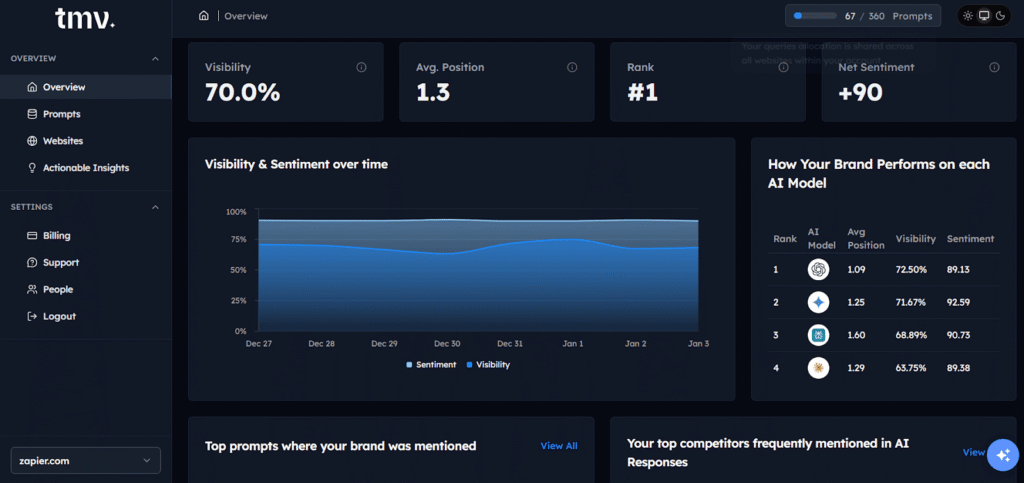
These AI search visibility tools are quite different from traditional SEO tools, focus entirely on major AI platforms rather than traditional search results. Tools like TMV also automatically detect brand mentions and citations, track brand visibility over time, and share live AI visibility data.
5. Measure frequency and consistency over time
Single appearances don’t matter in AI search. A brand appearing once in AI results may be noise caused by phrasing, timing, or model variation. What matters is whether your brand appears repeatedly for the same prompts across multiple runs.
Consistency reveals real AI presence. By running the same prompts on a fixed schedule, you can see whether brand visibility is improving, declining, or fluctuating. This turns raw outputs into usable visibility data instead of isolated screenshots.
When measuring frequency, focus on:
- How often the brand appears across repeated runs
- Which prompts consistently surface the brand
- Changes in brand performance over time
- Visibility trends across different AI platforms
- Gaps between AI visibility and traditional metrics
Manually tracking visibility makes it difficult to spot patterns at scale. Track My Visibility compares repeated runs automatically and highlights the following in each platform:
- The number of models with brand mentions
- Visibility percentage across platforms
- Overall sentiment of the brand
- AI answers on each platform
Here is how Track My Visibility shows prompt-level metrics:
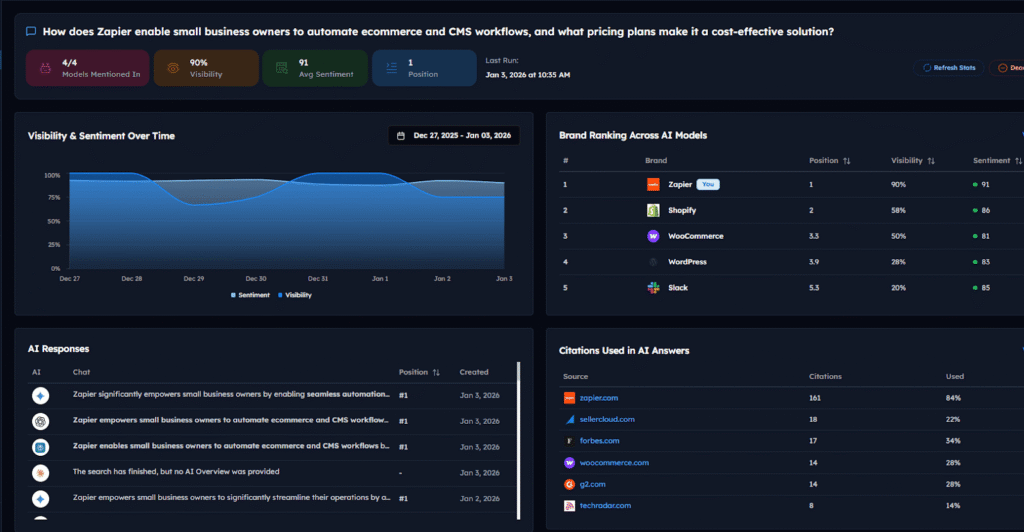
As a result, TMV helps you separate sustained AI visibility from one-off spikes and plan your AI optimization strategy with direct answers from AI engines.
6. Account for prompt and model variations
AI responses are not static. Outputs change due to updates in large language models, shifts in training data, and platform-level adjustments across major AI platforms. Even when prompts stay the same, generative search systems can return different answers on different days.
This variability can distort tracking if it isn’t controlled. A brand may disappear due to model behavior rather than an actual loss of relevance. That’s why prompt-level consistency and repeated runs are important for analyzing long-term visibility.
When accounting for variation, focus on:
- Changes caused by AI model updates, not content performance
- Differences in how platforms interpret the same user queries
- Shifts in positions on the AI platform over time for the same prompt
- Short-term volatility versus sustained visibility loss
- Whether changes affect multiple prompts or only isolated ones
Without normalization, this noise makes trends unreliable. Track My Visibility normalizes repeated runs through the following:
- Prompt-based tracking by running custom or persona-driven prompts to see if AI models mention or cite your brand.
- Cross-model tracking to compare visibility across multiple AI search platforms from one dashboard.
- AI-ready scores with page-level metrics that show how likely content is to be cited by AI.
- Citation and URL-level reporting to see which pages are referenced most often in AI responses.
- Competitor benchmarking to compare how your brand vs competitors is mentioned and cited in AI results.
This ensures that changes in AI responses don’t override real visibility patterns or long-term tracking insights.
Key Metrics to Track in AI Search Engines for Visibility Monitoring
Tracking AI search visibility only works when you measure the right signals. These metrics focus on presence, consistency, and context inside AI-generated answers, not rankings or clicks like traditional SEO.
Here is a table to understand the core AI metrics that matter most, what they measure, and why they are important:
| Metric Name | What It Measures | Why It Matters | Primary Use Case |
|---|---|---|---|
| Brand Mention Rate | How often a brand appears in AI-generated answers across tracked prompts | Indicates baseline AI visibility and brand recognition in AI results | Tracking brand visibility trends |
| Prompt Coverage | How many tracked prompts surface the brand across AI search platforms | Shows the breadth of AI presence across different user queries | Identifying content gaps |
| Citation & Link Inclusion | Whether AI responses include citations or linked pages referencing the brand | Signals authority and trust in AI-generated responses | Evaluating brand authority |
| Consistency Score | Stability of brand appearances across repeated runs in AI results | Separates real visibility gains from short-term fluctuation | Measuring visibility trends |
| Share of Voice | How often your brand appears compared to other brands within the same AI answers | Provides competitive context for brand visibility | Competitive benchmarking |
| Platform-Level Visibility | Brand presence across individual AI platforms and search platforms | Reveals where AI visibility is strong or missing | Platform comparison and prioritization |
Learn More: What Is AEO and GEO | How Does It Change SEO?
How to Use AI Search Visibility Metrics to Optimize Content and Improve Visibility
AI visibility metrics should directly shape how teams write, update, evaluate, and improve content.
When used correctly, they show how AI assistants interpret your brand and how people search in AI tools. Based on the insights, you can also determine the changes needed to achieve full visibility.
Here are a few ways to use AI search visibility metrics to improve AI SEO performance:
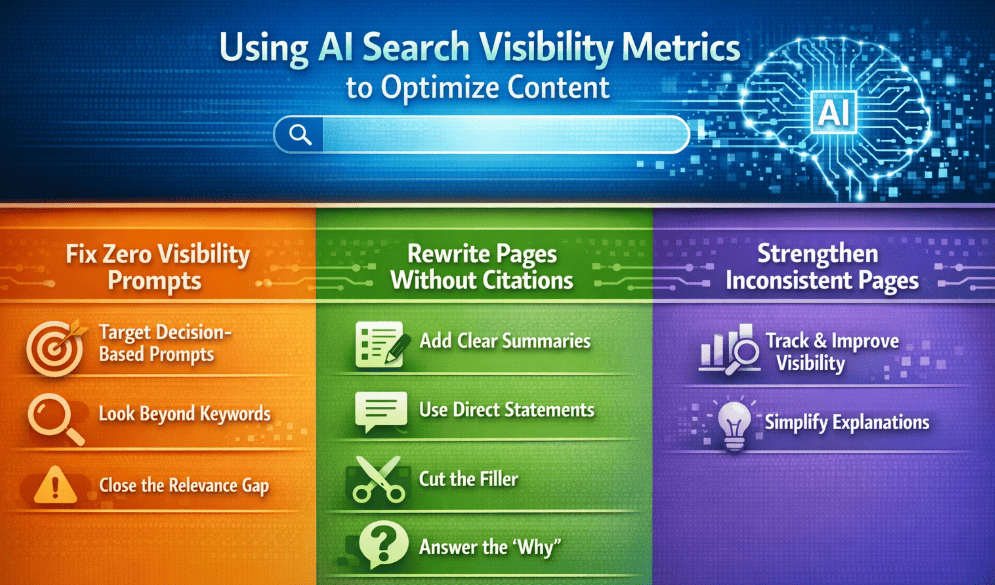
1. Fix content for prompts where visibility is zero
Not all prompts relevant to your niche may bring up your brand in the responses. Use AI visibility metrics to identify prompts where your brand never appears in AI answers.
These gaps show where AI assistants don’t recognize your relevance, even if you perform well in traditional search.
Once you understand the gap:
- Focus on prompts tied to real decision-making, not specific keywords
- Look beyond traditional keyword research and rankings
Use the insights to improve your content and optimize it for AI answers in these tools. And if you are an enterprise brand, zero visibility often signals unclear positioning, not a lack of authority.
2. Rewrite pages that get mentions but no citations
There could be many prompts where your brand appears in AI-generated answers without links or citations. This means that your content is not source-ready.
AI systems may reference you conceptually but avoid citing unclear or verbose pages. While this seems like a loss, this is actually an opportunity. All you need to improve the content on the page and make it more
To improve visibility:
- Add clear summaries and definitions near the top
- Use direct, declarative statements AI can reuse
- Remove unnecessary narrative and filler
- Make it obvious what the page answers and why it matters
This is a core part of answer engine optimization, not traditional SEO tuning.
3. Strengthen pages with inconsistent visibility
Inconsistent appearances across runs indicate weak AI presence. If AI results surface your brand only occasionally, the content likely depends too much on context.
This means your pages need to be more authoritative to appear in AI answers consistently. Use an AI visibility-tracking tool and consistency metrics to improve content.
Here is what you can do:
- Identify pages with fluctuating visibility and improve content to make it more AI search-friendly.
- Simplify explanations of concepts on your page so they stand alone and can be cited in AI answers.
Consistency matters more than one-off wins when trying to stay ahead in AI search.
Learn More: How to Optimize Content for AI Answers in 2026
Choose the Right AI Search Visibility Tool to Improve AI SEO Performance

People no longer search just on Google in the AI search era. They search on ChatGPT, Perplexity, and Gemini and use spaces like Google AI mode.
This means tracking is the first step towards successful AI citings. But manual tracking is inefficient and cannot scale for many reasons.
AI answers change, platforms behave differently, and visibility can fluctuate even when content stays the same. It also makes it hard to connect AI visibility with Digital PR efforts, shifts in search volume, or how AI platforms position content.
This is where dedicated AI performance tracking tools can help. This is especially true in the case of Track My Visibility, which allows you to:
- Run custom or persona-driven prompts to see whether AI models cite your brand or rely on competitor content.
- Execute the same prompts across ChatGPT, Claude, Perplexity, and Gemini for side-by-side comparison.
- Identify which pages from your site are cited by AI engines and how often they are used as sources in AI answers.
- See how your competitors are mentioned and cited in AI answers to spot gaps and build a plan to win AI share of voice.
- Get page-level “AI-ready” scores with recommendations to improve content signals and increase visibility.
With TMV, you can start tracking what actually matters. Try Track My Visibility with 7-day trial and see how your brand shows up in AI search.