According to a study published in October 2025 by Semrush, AI search will surpass traditional search by 2028.
This means businesses must be proactive and build a strategy to ensure their brand appears in AI-generated responses across search engines like Google and other LLM tools such as ChatGPT and Gemini.
One of the crucial problems businesses face when measuring AI visibility is how to do so.
There are too many variables to consider. Results from AI overviews and AI mode from Google, Copilot Search on Bing, and AI answers from tools like ChatGPT, Perplexity, and Bring.
That’s why in this blog we look at the:
- Importance of brand visibility in AI content
- Elements to look for to understand visibility in AI content
- How to monitor your brand’s visibility in AI content and interpret it
- And how Track My Visibility helps track visibility across LLM tools
Let’s get started.
What is AI search visibility?
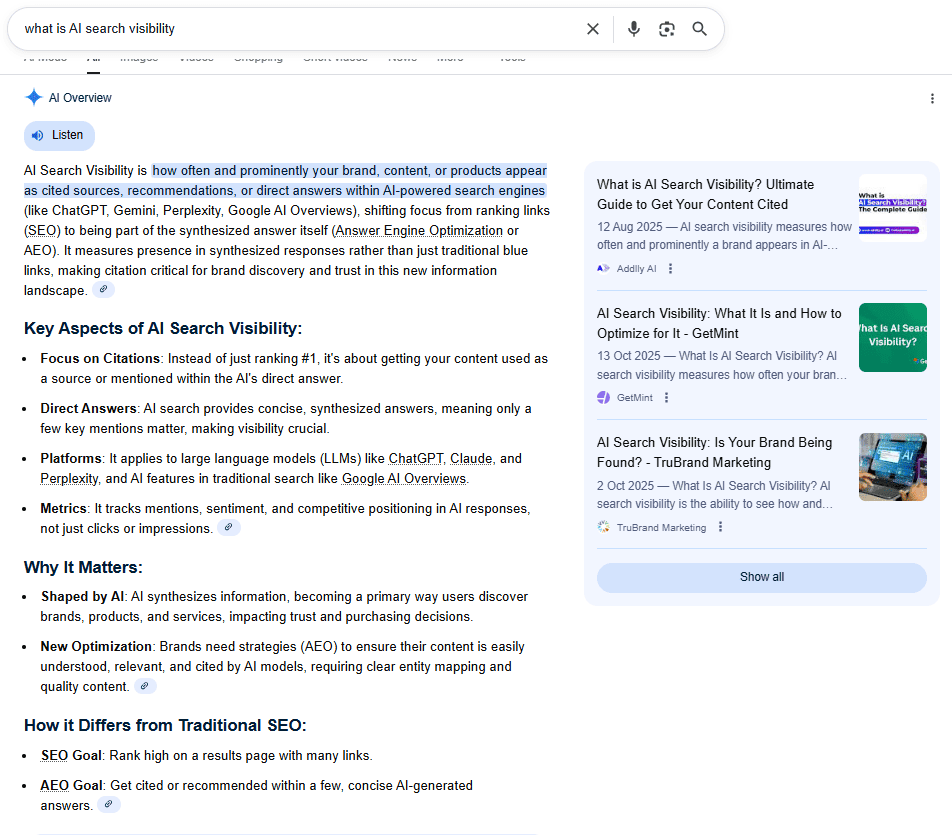
AI search visibility is how often and how accurately your brand shows up in AI-generated answers. This includes tools like ChatGPT, Google AI Overviews, Perplexity, and other AI search engines.
Here is an example of AI search in Google AI overviews:
Let’s look at another example in ChatGPT:
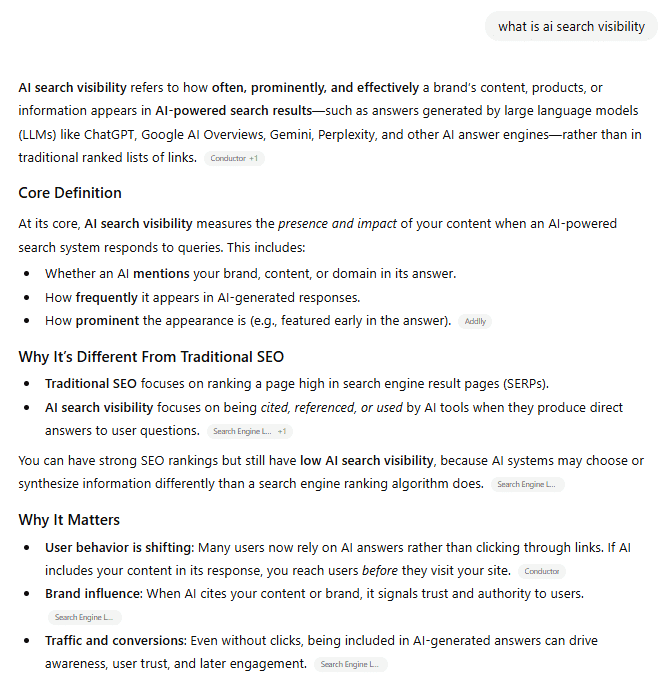
Thanks to AI in search, it is not enough to rank on Google or other search engines. You need to ensure AI systems mention your brand, cite your content, or use your pages as sources. If you look closely, you can see that these AI search results show sources.
Ranking in AI search has also become incredibly important for businesses that want to grow.
High AI search visibility means your content is being found, trusted, and reused by AI when users ask relevant questions.
And it needs to be among the goals of doing SEO for your business in 2026 and beyond.
Learn More: Step-by-Step Guide to Rank in Google AI Overviews in 2026
How to measure AI visibility in content?
Measuring AI visibility requires a different mindset than traditional SEO. Rankings, shown in Google Search Console and analytics tools like Google Analytics, alone don’t show how AI systems use your content. Hence, you need to check for AI search visibility of your brand to strategize your growth.
Here are 5 most practical ways to track where, how, and why your brand appears in AI-generated answers:
1. Track brand mentions inside AI-generated answers
One of the easiest ways to track your visibility is to look for mentions of your brand. You can start by checking whether AI tools mention your brand by name.
Here is how you can do it:
- Use prompts related to your core products, categories, and problems you solve.
- Run the same prompts across tools like ChatGPT, Google AI Overviews, Perplexity, and Claude.
- Log when your brand appears, how often, and in what context.
Track My Visibility lets you do this efficiently and automatically.
The tool automatically chooses the most suitable prompts based on your brand and the services it offers. You can also add custom prompts if needed:
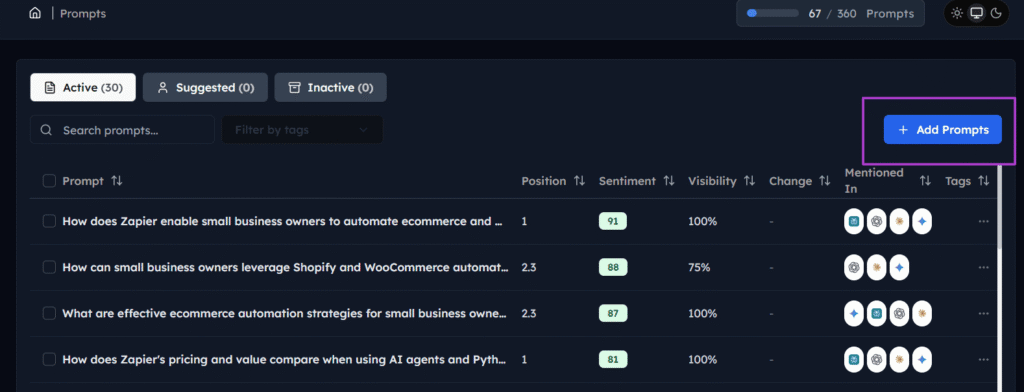
Once added, the automatically generated prompts, along with the custom prompts, will appear on the interface. You can click on any of the prompts to see your brand visibility on ChatGPT, Perplexity, Claude, and Gemini:

You can do this for as many prompts as needed and gather insights, and plan your strategy for search generative engine optimization for better visibility.
2. Analyze prompt-level visibility for your key topics
Prompts are the new keywords that drive AI search performance. Hence, instead of tracking keywords, track prompts.
Here is what you can do to track and analyze prompt-level visibility:
- List the top 20–50 questions your buyers ask during research and evaluation.
- Run those prompts in AI tools and record which brands appear in answers.
- If competitors show up and you don’t, that’s a visibility gap.
- Analyze competitors’ content and improve your own.
Track My Visibility makes this easy by automating prompt creation. Here is what you can do:
- Log in to Track My Visibility
- Add your website to track AI visibility
- TMV will pull the details automatically
- Based on the details, TMV will also create relevant prompts for your brand
- Check and adjust prompts, or add new ones entirely.
Then click each prompt and get the insights needed, as given below:
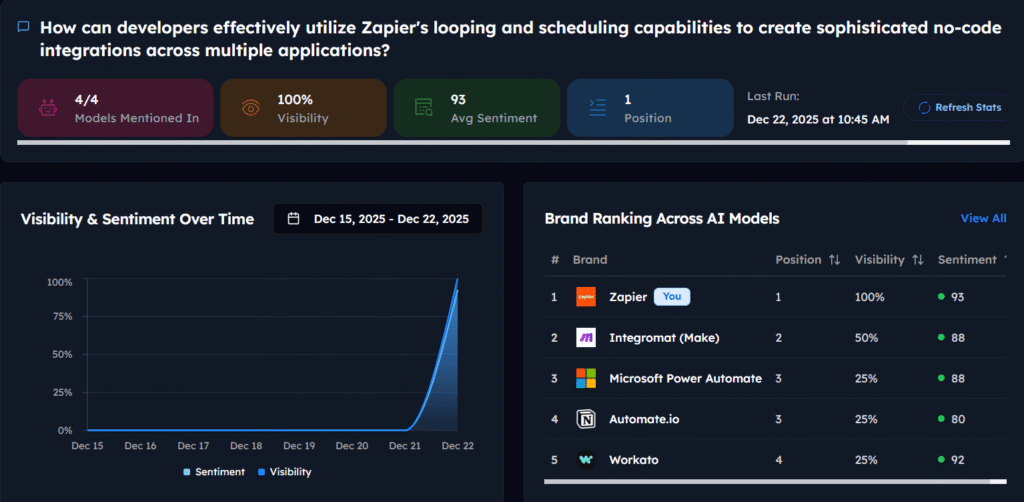
Using these insights, analyze the competitor’s content and presence in AI search, and improve your own to outrank them.
3. Compare AI visibility against direct competitors
AI visibility means very little without comparison. Seeing your brand appear in AI answers is useful, but it doesn’t tell you if you are winning or losing the category.
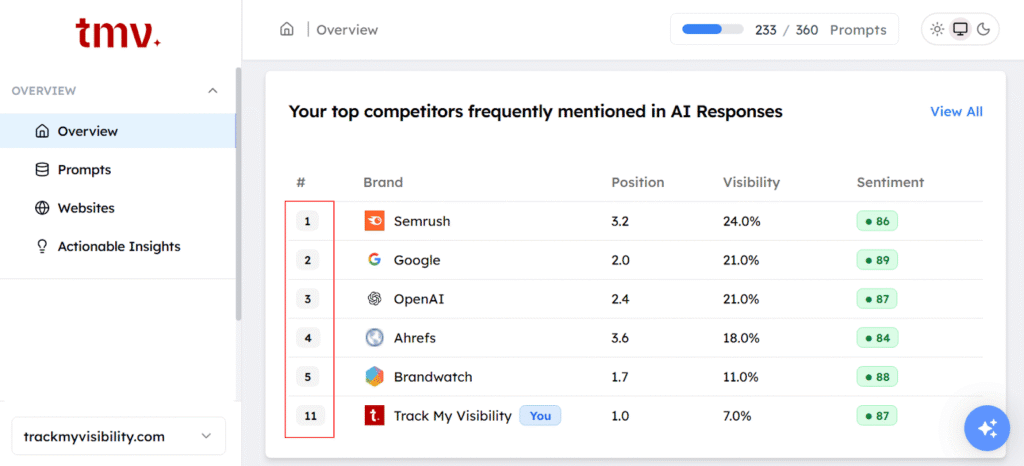
The real signal comes from comparing how often you appear vs your direct competitors.
Start by listing 5–10 competitors with the same target audience as you. Focus on companies your buyers already evaluate alongside you. Then collect a set of buyer-intent prompts covering awareness, consideration, and evaluation questions.
For example: ‘Best tools for tracking AI search visibility’ or ‘How enterprises monitor AI brand mentions.’
Run these prompts across AI platforms and document who appears in the responses. Track three things consistently:
- Position: Are competitors mentioned before you, after you, or instead of you?
- Depth: Are they briefly listed or explained in detail?
- Tone: Are they described as leaders, alternatives, or secondary options?
Patterns show up fast. You may notice certain competitors dominate early-stage questions while others appear only in comparison prompts. This tells you where your content is weak and where competitors are setting the narrative.
Repeat this monthly. AI models change, content gets refreshed, and visibility shifts quickly. Over time, competitive benchmarking turns AI visibility from a vague idea into a measurable competitive metric.
Again, if you’re using any AI visibility tracker, you will get a clear idea of your competitor positions inside AI answers directly.
4. Measure citation and source attribution from AI tools
Citations are one of the strongest signals of AI visibility. When an AI tool links to your content or references it as a source, it’s showing trust. This is more valuable than a traditional ranking because it shows your content is actively used to generate answers.
Here’s how to measure it clearly and repeatably.
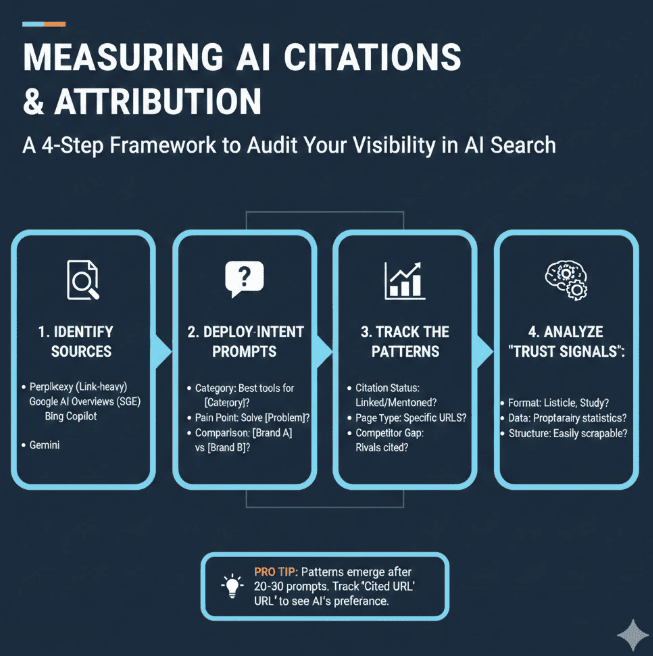
Step 1: Identify AI tools that show sources
Focus on platforms that surface links or citations, such as Perplexity, Google AI Overviews, Bing Copilot, Gemini, etc.
These tools give direct insight into which pages AI relies on.
Step 2: Test high-intent prompts
Run prompts tied to your core topics and buyer questions. Ask things like:
- Which tools are best for [your category]?
- How do companies solve [specific problem]?
- How does your tool compare to your competitor?
Run these prompts in all AI search tools and platforms you want to track. And document which sources appear in the answers.
Step 3: Track citation patterns
Understanding the citation for each prompt is vital to understanding the pattern. Hence, to drive insights from these citations, track the following:
- Whether your content is cited or linked
- Which page is referenced
- How often are competitors cited instead
Over time, patterns will emerge.
Step 4: Analyze what AI trusts
Once you have found the pages that earn AI citations from both you and your competitors, try to understand what is different about these pages.
- Are they educational or sales-heavy?
- Do they include clear definitions or frameworks?
- Are they tightly focused on one topic?
AI typically favors clear, structured, and informational content. Compare the cited pages with other important pages on your website and understand gaps to address them.
Once you have enough data and insights, update ignored pages and expand pages that already earn citations. You can also replicate formats that AI references consistently.
5. Evaluate content reuse and summarization by AI
AI visibility goes beyond links and mentions. One of the strongest signals is whether AI systems reuse your ideas when explaining a topic. When an AI summarizes a subject using your language, structure, or concepts, it means your content is being absorbed and trusted.
Analyze this by asking AI tools to explain topics you already publish about. Use broad, informational prompts like “What is [topic]?” or “How does [process] work?” Then read the response closely.
Remember, your goal is not a citation here but familiarity.
Pay attention to signals such as:
- Definitions that closely match how you explain the topic
- Reuse of your frameworks, naming, or step-by-step logic
- Data points or examples that mirror your content
If the output feels generic or heavily aligned with a competitor’s messaging, that is a visibility gap.
Next, look at who is shaping the explanation instead. If AI consistently uses competitor language or approaches, it tells that they are the ones setting the narrative. This often happens when competitor content is clearer, more structured, or more aligned.
When your content is not being reused, common issues include:
- You use weak or unclear definitions
- Pages are trying to cover too much at once
- Educational content buried under sales copy
Clean structure, tight focus, and original framing enable AI to borrow from your content. When AI starts explaining topics the way you do, your visibility naturally grows.
Learn More: How to Optimize Content for AI Answers in 2026
6. Monitor AI-driven referral traffic in analytics
AI visibility doesn’t always show up as a mention. Sometimes it shows up as a click. AI tools increasingly send users to external pages, and that traffic is one of the most concrete signals you can measure.
Here is how AI answers shares sources that users can click on:
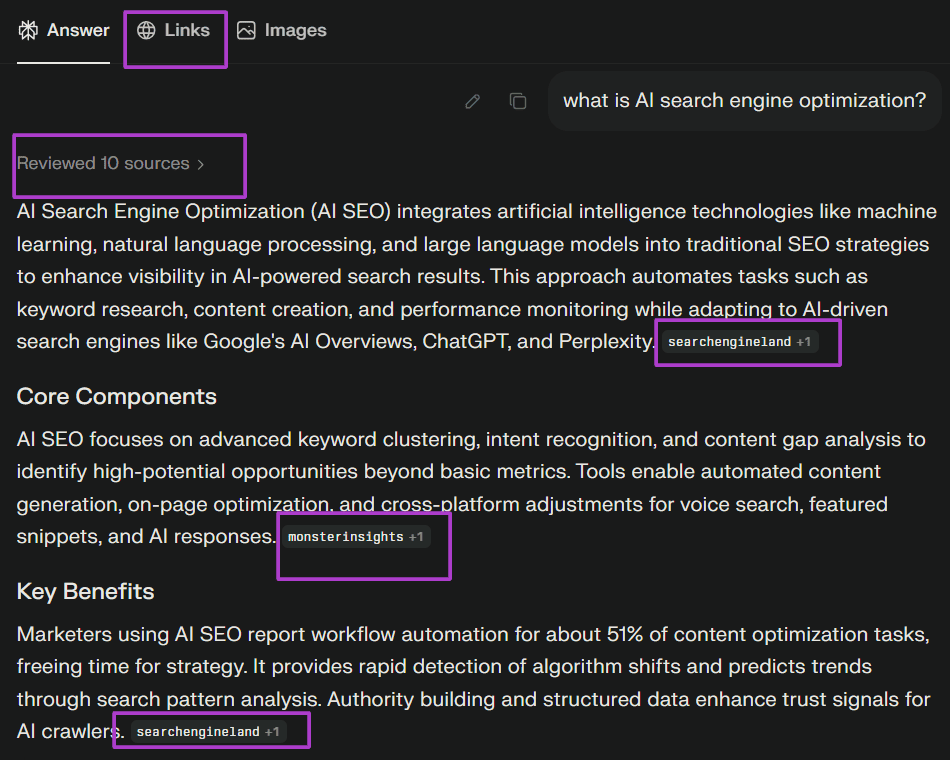
Start inside your analytics platform. Look for referral traffic from AI-driven sources such as Perplexity, Bing Chat, and Google’s AI-powered search experiences. These referrers may be small at first, but volume is not the goal early on. Getting even a single click is.
Once you identify AI-driven traffic, break it down by page. Pay attention to factors, such as:
- Which pages attract AI referrals
- What topics do those pages cover
- Are the pages informational or product-led
This helps you understand what type of content AI is comfortable sending search traffic to your site.
Next, analyze user behavior. Look at engagement metrics like time on page, scroll depth, and bounce rate. AI-referred users often arrive with high intent. If they engage deeply, it is a strong signal that your content matches the questions AI is answering.
A few important points to keep in mind:
- AI traffic may be grouped under “referral” or “organic” depending on the platform.
- Volumes will be inconsistent early on
- Trends over time matter more than daily numbers
Once you have the details, start optimizing the pages that drive traffic and replicate the content style, formatting, framing, etc., across other important pages.
7. Use dedicated AI visibility tracking tools
Manual tracking breaks down fast. Running prompts by hand, logging mentions, and checking competitors across multiple AI tools isn’t sustainable once your content library grows.
This is where dedicated AI visibility platforms become necessary. Track My Visibility is built specifically for this problem. It tracks how your brand appears across AI search engines, monitors prompt-level visibility, and compares your presence against competitors over time.
Instead of snapshots, you get trend data that shows whether your visibility is improving or slipping.
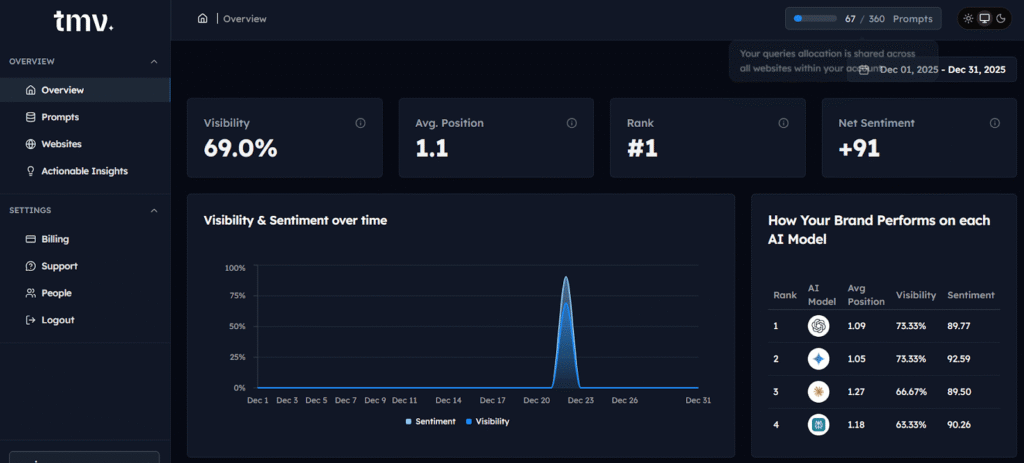
Along with this, using a dedicated tool allows you to:
- Track brand mentions across multiple AI platforms from one place
- Monitor visibility for specific prompts tied to buyer intent
- Compare your performance directly against competitors
- Identify which content contributes to AI visibility gains
This turns AI visibility into a measurable metric rather than a manual exercise. This helps you save a lot of time and use it for more strategic tasks like content gap analysis and improving content optimization efforts.
Learn More: AI Search vs SEO: Key Differences
Importance of AI search performance and visibility: 3 key reasons
“The more you optimize for context and credibility (not just keywords), the more AI pulls your content into answers for 1 billion+ daily ChatGPT queries,” says Neil Patel, the co-founder of Neil Patel Digital.
This means that traditional SEO metrics are not enough to rank on AI results. You need to be more proactive and understand how to optimize for AI responses.
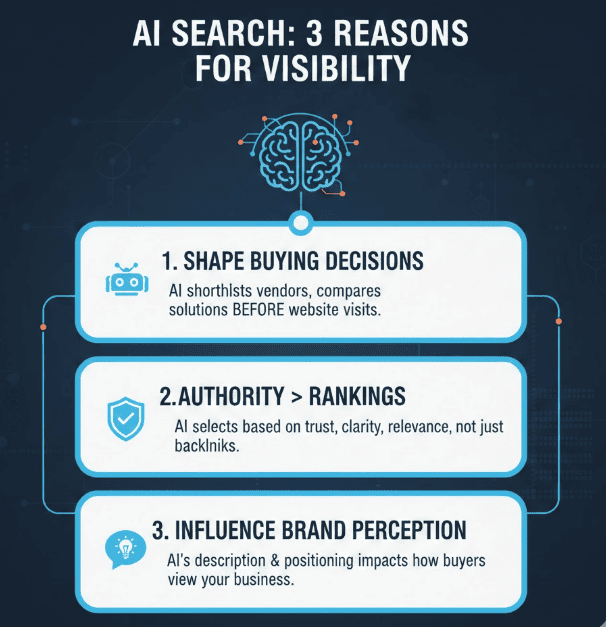
Here are a few reasons why AI search performance and visibility are vital for you:
1. AI tools shape buying decisions before users reach your website
Major AI platforms are becoming the first stop for research. Buyers ask AI to shortlist vendors, compare solutions, and explain categories before they visit a website.
When an AI tool answers a question like ‘What tools should enterprises use for AI search visibility?’, it creates a mental shortlist instantly. If your brand is not mentioned in that answer, you are not just losing both traffic and consideration.
This shift changes how discovery works:
- AI answers often replace multiple search queries
- Buyers trust AI summaries to narrow options faster
- Brands included early are more likely to be evaluated later
By the time a buyer reaches a comparison page or a pricing discussion, AI has already influenced their decisions. And if you want to win the buyer, you must be on the AI’s list.
2. AI search favors authority, not just rankings
AI search systems don’t rank pages the way traditional search engines do. They select content based on trust signals, clarity, and relevance to the question. A page can rank well in Google and still be ignored by AI if it lacks clear explanations or credible signals.
Semrush says that an average AI search visitor to your site is 4.4x more valuable than an organic search visitor.
Hence, if you wish to grow, getting cited by different AI platforms must be a priority. When AI repeatedly pulls your content into answers, it treats your brand as a reliable source.
That visibility reinforces authority and positions you as a reference point in your category.
3. AI responses influence brand perception
AI doesn’t just surface information. It shapes how buyers think about brands. The words AI uses to describe your business. How AI positions you as a leader, an alternative, or not mentioned at all influences perception.
When AI consistently references competitors as examples or recommendations, they become the default choice in the buyer’s mind. In a paper published in ResearchGate, AI’s recommendations influence about 59% of users’ decisions.
And even if your product is stronger, your brand feels less relevant without AI answers.
Visibility in AI responses helps control the narrative and ensures your business is positioned accurately during research.
Learn More: What Is AEO and GEO | How Does It Change SEO?
Know where you stand and improve AI-driven search results with TMV
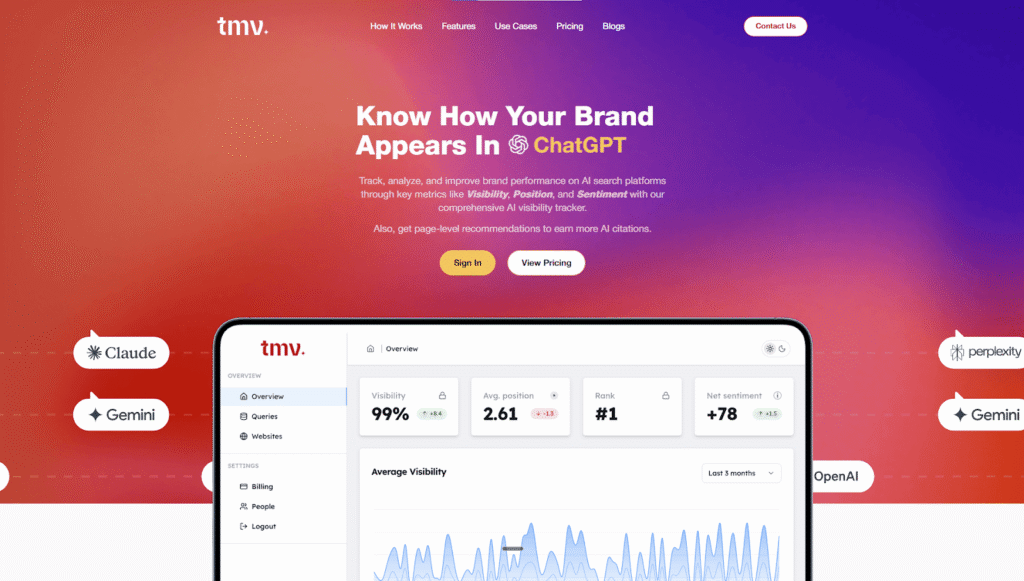
As we have seen above, focusing on traditional metrics will not help you improve your search presence in today’s LLM-driven searches. Features like Google AI mode and tools powered by large language models, like ChatGPT and Gemini, offer specific, often personalized results to individual users.
As a business, you need to understand how users interact with these tools and how your brand appears in these interactions. And traditional SEO tools cannot provide actionable insights into these interactions.
This is where tools like Track My Visibility can help you monitor and track your performance on AI answer engines.
TMV lets you track your search visibility across major AI platforms, like ChatGPT, Gemini, Claude, and Perplexity, thanks to its key capabilities, such as:
- Track visibility on AI searches: Understand how often and where your content appears in AI answers and AI responses.
- See where you are cited: Track brand mentions across AI platforms like ChatGPT, Gemini, Claude, and Perplexity.
- Competitor benchmarking: Compare your AI presence with your competitors to assess your performance for efficient AI optimization.
- Check your brand’s AI readiness: Get an AI visibility score for each page and learn which ones need more attention.
- Get clear next steps: Get recommendations based on historical data to improve answer engine optimization and chances of being cited in AI answers.
Track My Visibility offers you granular details on how your brand performs in AI search and helps you strategize to improve visibility.
Explore our plans here and take the next step to improve your brand’s presence in AI search.
Frequently Asked Questions
What AI search engines does Track My Visibility track?
rack My Visibility tracks major AI answer engines, including ChatGPT, Perplexity, and Google Bing, helping businesses measure visibility and share of voice across platforms
What are some of the best AI search performance analysis tools in 2026?
Leading tools, like Semrush and Ahrefs, focus on measuring success across AI answer engines, tracking brand mentions, share of voice, and competitive advantage. Platforms like Track My Visibility are built specifically for this need.
Can focusing too much on AI search hurt my organic search performance?
No. Optimizing for AI usually improves clarity and authority, which also supports organic search. The key is to prioritize optimization efforts without sacrificing core website traffic fundamentals.
What are the top AI search engines that people use today?
Popular AI search engines include ChatGPT, Perplexity, Google AI Overviews, Bing Copilot, and Meta AI. These tools increasingly replace traditional searches for research and comparisons.
How AI crawlers and LLM bots access my website for answers?
LLMs rely on indexed content, licensed data, and signals from ai crawlers. Techniques like log file analysis help identify how bots access, interpret, and reuse your content in answers.