Not all AI assistants are built the same, and for professionals, that difference shows up fast.
The choice between Claude and Perplexity shapes how you research markets, craft content, and make business decisions. Whether you’re analyzing competitor strategies, writing persuasive product descriptions, or spotting emerging trends, your AI tool becomes an extension of your thinking. The wrong one means outdated information, shallow analysis, or creative output that misses the mark entirely.
There’s a second dimension worth considering. When potential customers ask Claude AI or Perplexity search about solutions in your space, what do they say about your brand? It directly impacts your visibility and authority in AI-powered search.
Therefore, this guide breaks both tools down across real-world use cases, features, pricing, and practical prompts so you can choose the right one for how it actually works.
Key takeaways:
- Quick overview of Claude and Perplexity with key technical differences
- Real-world applications with practically tested prompts
- Detailed comparison with features, pricing, and capabilities
- How to use Claude and Perplexity efficiently, with their own strengths and weaknesses
Let’s compare.
Quick Overview: Claude AI and Perplexity
Before diving into which tool fits your business needs, it helps to clarify what’s actually being compared. While both leverage cutting-edge AI, Claude and Perplexity serve fundamentally different purposes in a professional workflow.
What is Claude AI?
Claude is Anthropic’s conversational AI assistant designed for deep, nuanced work. It functions as a versatile thinking partner capable of drafting long-form content, analyzing customer feedback, brainstorming campaigns, writing code, and handling complex multi-step tasks that require context and judgment.
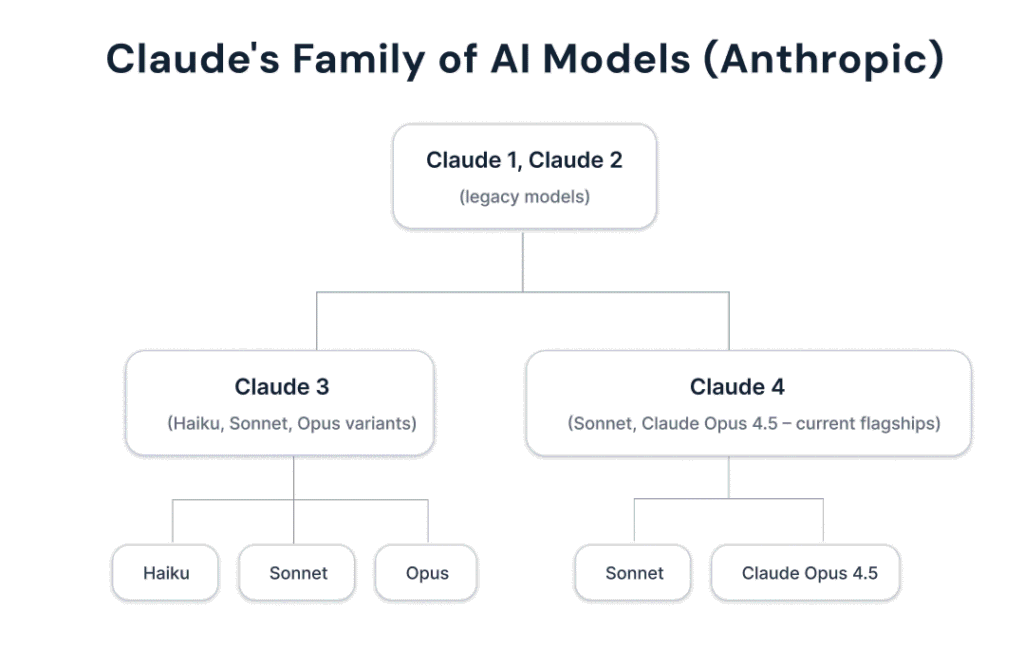
Claude’s family of models (Anthropic):
- Claude 1, Claude 2 (legacy models)
- Claude 3: Haiku, Sonnet, Opus (variants)
- Claude 4: Sonnet, Claude Opus 4.5 (current flagships)
What is Perplexity?
Perplexity is an AI-powered search and answer engine that combines live web search with AI synthesis. Rather than returning a list of links, it searches the internet in real-time and delivers direct answers with citations. It’s built for research, fact-finding, and staying current with information that changes fast.
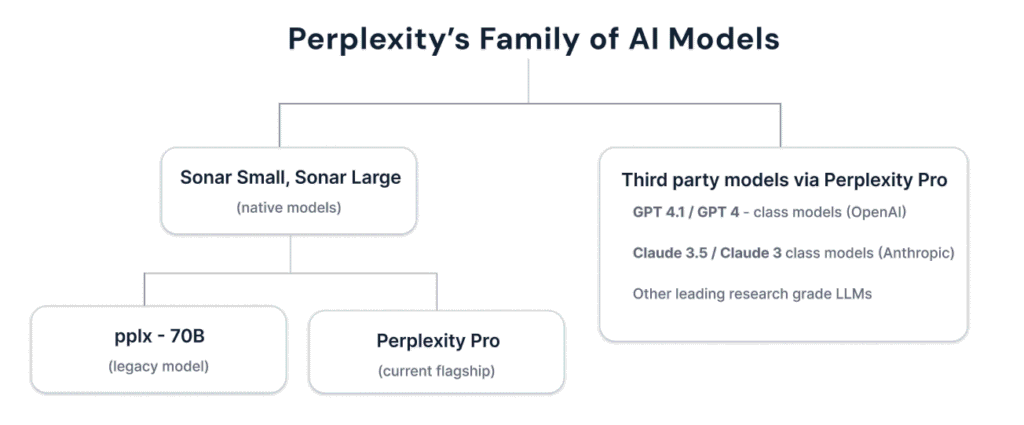
Perplexity’s family of models:
– Sonar Small, Sonar Large (native models)
– pplx-70B (legacy model)
– Perplexity Pro with Sonar Large (current flagship)
Third-party models available via Perplexity Pro
– GPT-4.1 / GPT-4-class models (OpenAI)
– Claude 3.5 / Claude 3-class models (Anthropic)
– Other leading research-grade LLMs (varies by plan and availability)
These third-party models are available via Perplexity Pro: GPT-4.1, Claude 3.5, and other leading research-grade LLMs, depending on plan and availability.
Key Technical Differences Between Claude AI and Perplexity
Understanding how these AI systems work behind the scenes helps in choosing the right tool for the right task. While both are advanced AI systems, they take fundamentally different approaches to training, reasoning, and information processing.
# Model Versions and Architecture
Claude uses proprietary models built on Anthropic’s Constitutional AI architecture, available in three tiers: Claude Opus 4.5 for complex, high-stakes tasks; Claude Sonnet 4.5 for balanced performance and speed; and Claude Haiku 4.5 for fast, lightweight tasks. The architecture prioritizes safe, nuanced conversations with strong context retention and principle-driven behavior.
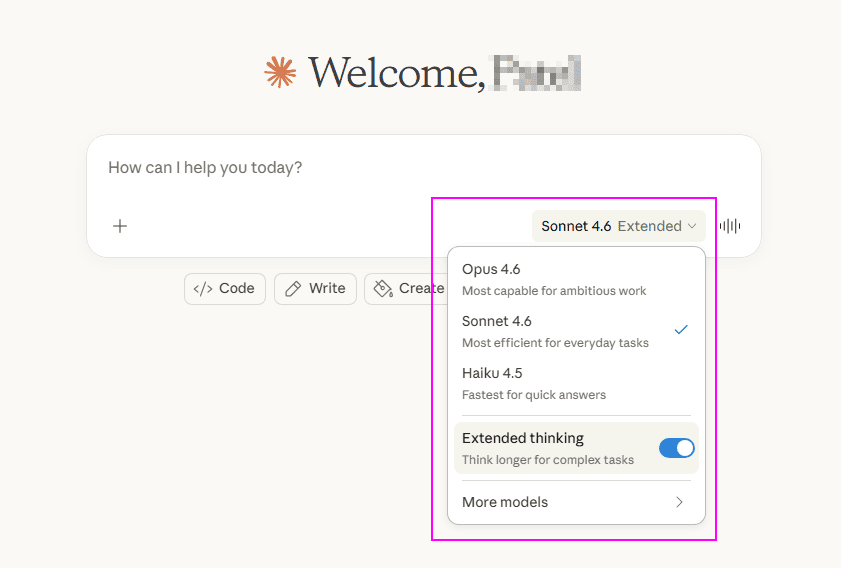
While Perplexity operates as an aggregator platform, routing queries across multiple third-party models.
The available lineup of models can change by plan and availability. In the model selector, users can choose from options like Sonar, Gemini 3 Flash, Gemini 3.1 Pro, GPT-5.2, Claude Sonnet 4.6, Claude Opus 4.6, and Grok 4.1.
This makes Perplexity less of a single “AI model” and more of a search-first interface that lets you run retrieval-backed queries through different LLMs depending on the task.
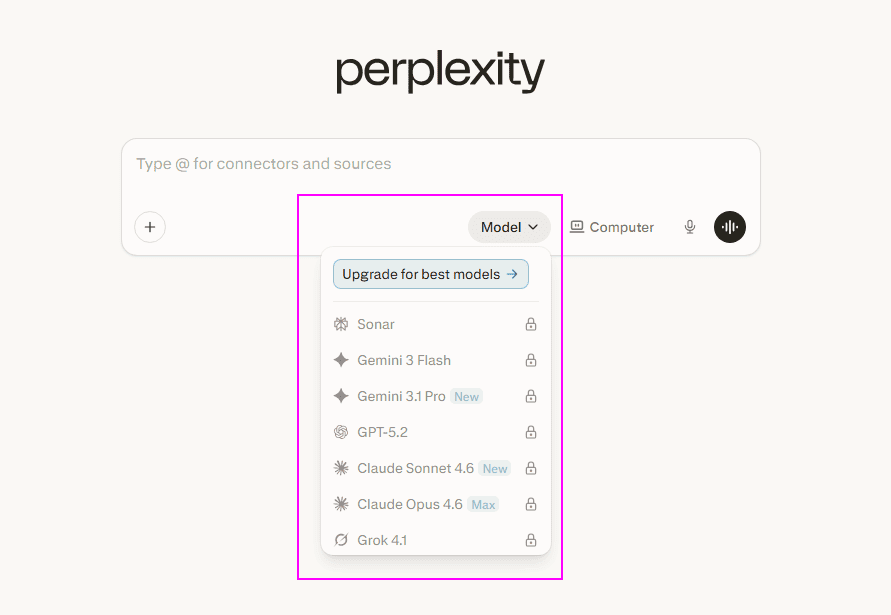
Claude delivers consistent performance across tasks. Perplexity, on the other hand, delivers the best search-focused AI response at any given moment.
# Technical Specifications
Claude supports context windows up to 200,000 tokens, making it well-suited for long documents, complex briefs, and multi-turn projects. It handles text, images, PDFs, spreadsheets, and code files directly, with response times typically between 5 and 30 seconds.
But Perplexity’s context window varies by the underlying model being used. It supports text input natively, with image support available on Pro plans. Perplexity is search-first; file workflows are more limited than Claude for deep doc work, but file features exist (especially on Enterprise).
Claude prioritizes reasoning and analytical depth, while Perplexity prioritizes real-time retrieval and citation-first outputs. Overall, the context windows would vary based on your chosen plan.
# Reasoning Capabilities
Claude handles deep analytical reasoning across complex business problems, multi-step planning, creative problem-solving, nuanced judgment calls, and theoretical analysis. It maintains full context across long conversations, making it effective for iterative, back-and-forth work.
As for Perplexity, its reasoning centers on information synthesis connecting facts across multiple sources, running comparative analysis using live web data, and identifying patterns from search results quickly.
Claude performs better when tasks require careful thought and judgment, but Perplexity excels when tasks require direct answers, fact comparison, and current information.
# Data Processing
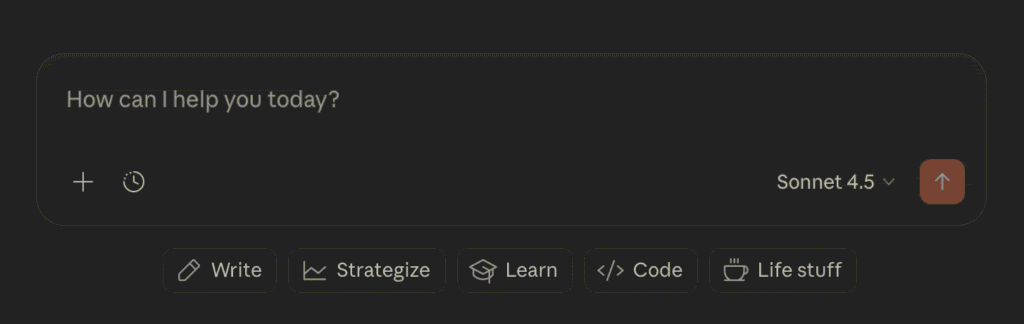
Claude processes information through its internal model knowledge and the context provided within a conversation. It has no real-time internet access by default, but can create, edit, and analyze documents, spreadsheets, and presentations, and execute code for calculations and data analysis in supported plans.
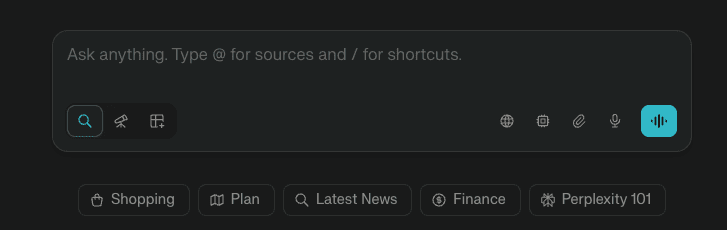
But Perplexity searches the live web with every query, synthesizing results from multiple sources into a single answer with citations. This makes it the stronger choice for any query where recency matters.
Claude analyzes information deeply while Perplexity retrieves information in real time.
# Integrations and Ecosystem
Claude integrates into workflow like Shopify apps and marketing tools with custom integration, while Perplexity supports web-based search suitable for developers and collaborative research.
| Integrations | Claude | Perplexity |
| API access | Full API for custom integrations | Available for developers |
| Browser integration | Claude Code (terminal), Chrome extension, Excel add-in (beta) | Chrome, Firefox, Safari |
| Automation | Works with Zapier and Make.com for workflow automation | iOS and Android with voice search |
| Team features | Shared projects, knowledge bases | Shared spaces for collaborative research |
| Export | .docx, .xlsx, .pptx, PDFs, code files | copy-paste or sharing links |
# User Experience
Claude’s interface is conversational and built for longer, more complex interactions. The Artifacts feature allows users to generate documents, charts, and code directly within the conversation. Projects help organize ongoing work, and style customization supports a consistent brand voice across outputs.
Perplexity, on the other hand, has an interface that is closer to a next-generation search engine: minimal, fast, and optimized for reading. With its Inline citations supporting source previews, follow-up questions, and focus modes for academic, writing, and social tasks make it well-suited for quick research sessions.
# Pricing and Access
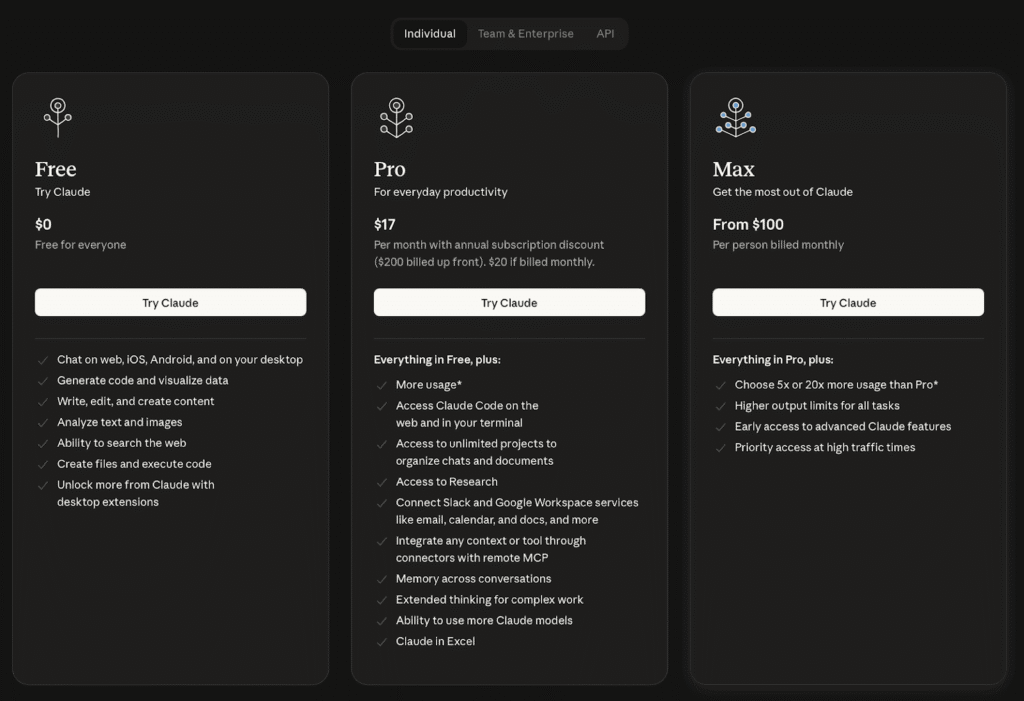
Claude is accessed through tiered plans and API usage, with pricing aligned to context length and compute, making it a natural fit for teams and developers.
As for Perplexity, it follows a freemium model, with a Pro plan unlocking advanced models, deeper searches, and higher usage limits. It’s accessible for everyday researchers and marketers without a technical setup.
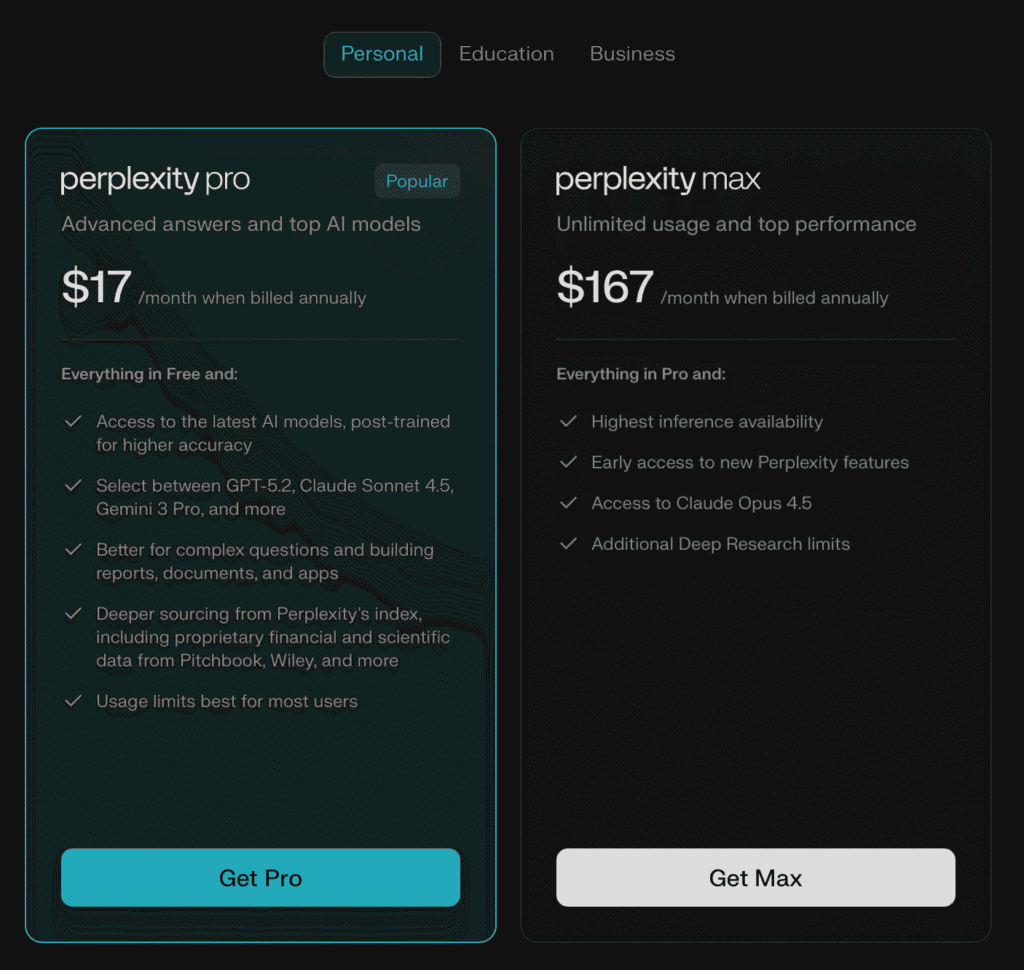
In short, Claude is optimized for thinking, reasoning, and structured work, while Perplexity is optimized for search, verification, and real-time information.
Claude AI vs Perplexity: Technical Comparison Table
| Feature | Claude AI | Perplexity |
| Primary Purpose | Creative work, analysis, execution | Research, search, fact-finding |
| Context Window | Up to 200K tokens (~150K words) | Varies by model |
| Input Types | Text, images, PDFs, code, spreadsheets | Text, images (Pro) |
| Code Execution | Yes | No |
| Citations/Sources | When using a web search | Always included |
| Integrations | API, Chrome, Excel, Claude Code, Zapier | Browser extensions, mobile apps |
| Free Tier | Limited messages, Sonnet access | Unlimited searches, basic model |
| Pro Tier | $17 or $20/month (5x usage, all models)* $200 billed annually | $20/month (600+ Pro searches/day)* $200/year |
| Enterprise | Team – ~$20–$25 per user/month (varies by seat type) | ~$40 per seat/month(Enterprise Pro) ~$325 per seat/month(Enterprise Max) |
| Ideal User | Content creators, analysts, developers | Researchers, marketers, strategists |
* Pricing and other details can vary over time
 Pro Tip: How Claude and Perplexity retrieve and prioritize information behind the scenes plays a key role in which content appears in their responses. Learn how LLMs choose content to form an answer to understand what really drives their responses.
Claude vs Perplexity: Real-World Applications
When both these AI tools perform in real-world applications, it helps to determine which one belongs in which part of a workflow for business use cases. Below are seven common use cases that business teams face daily, covering when Claude performs better and when Perplexity performs better.
# Claude vs Perplexity: Writing Blog Posts and Marketing Content
Claude functions as the content writer and editor. Given a topic, target audience, and brand voice, it produces original, polished content from scratch, maintaining flow, tone, and consistency throughout.
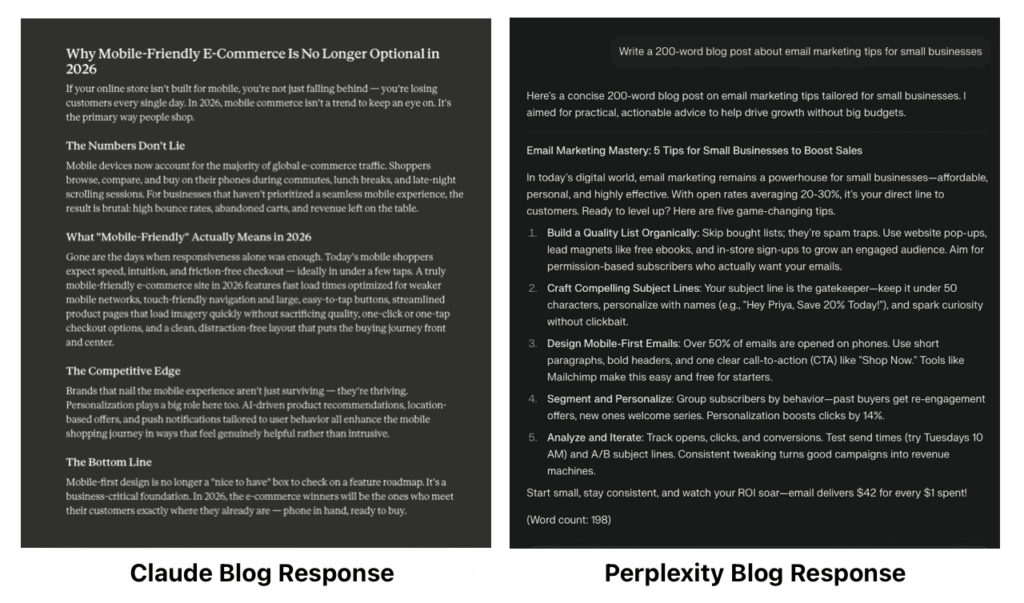
For example, a prompt like “Write a 1,500-word blog post on mobile-friendly ecommerce in 2026” produces structured and brand-aligned content ready for editing and publishing.
But Perplexity functions as the research layer. A prompt like “Write a 200-word blog post about email marketing tips for small businesses” returns a blog with tips for email marketing and the marketing industry.
Let’s see the responses from Claude and Perplexity for blog post generation to understand how they perform on writing tasks.
PROMPT: Write a 200-word blog post about email marketing tips for small businesses
# Claude vs Perplexity – Crafting Stories and Creative Content
Claude excels at original creative work, understanding nuance, emotion, and narrative structure. It develops brand narratives, creates character-driven campaign stories, writes across multiple formats, including scripts and dialogues, and maintains a consistent tone across long-form content.
Perplexity supports research-based work. It surfaces successful storytelling examples in a given industry, identifies emerging narrative trends, and helps to find the competitors’ approaches.
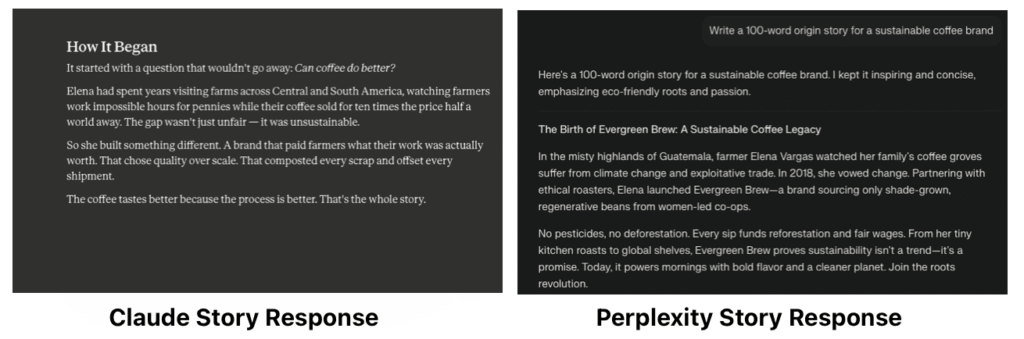
To test, let’s see how Claude and Perplexity write a story.
PROMPT: Write a 100-word origin story for a sustainable coffee brand
# Claude vs Perplexity – Analyzing Data and Creating Reports
Claude processes actual data files and performs sophisticated analysis. A prompt like “Analyze Q4 2026 sales, identify top products, calculate growth rates, and create a report” produces calculations, charts, insights, and actionable recommendations all from uploaded files.
But Perplexity cannot process proprietary data files. It searches public sources for industry reports, market statistics, and benchmarks that provide broader context around internal findings.
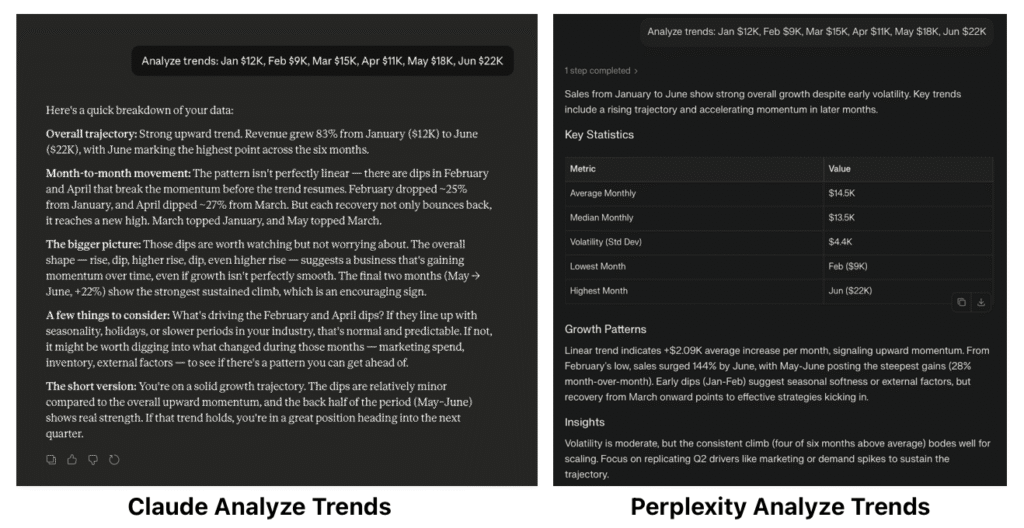
So let’s analyze these trends with Claude and Perplexity.
PROMPT: Analyze trends: Jan $12K, Feb $9K, Mar $15K, Apr $11K, May $18K, Jun $22K
# Claude vs Perplexity – Writing and Debugging Code
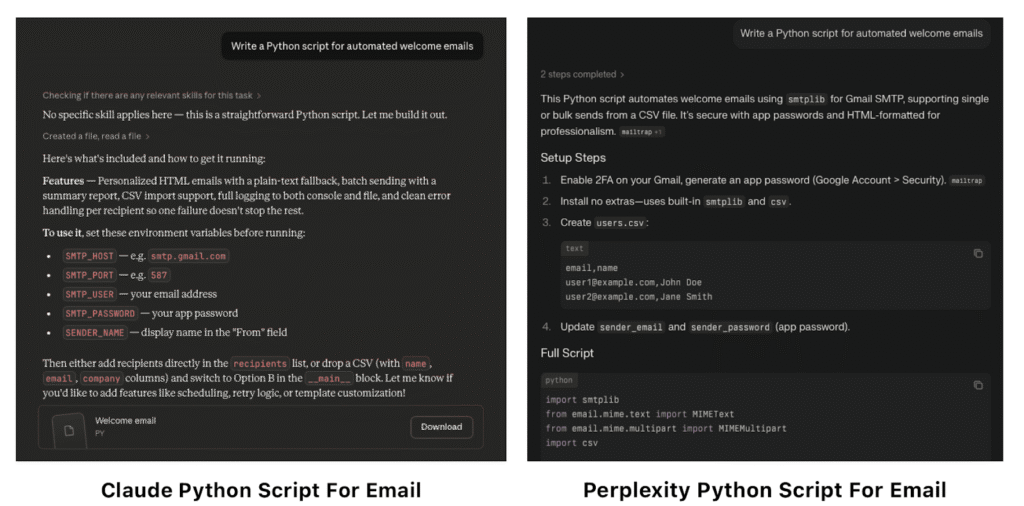
Claude writes, debugs, and explains code across multiple programming languages. It produces complete production-ready code, debugs existing files, creates API integrations, writes technical documentation, and executes code to test functionality.
When it comes to Perplexity finds, it finds code examples and documentation, but does not execute or debug code. It searches for best practices, locates documentation for libraries and APIs, identifies solutions to specific error messages, and surfaces relevant Stack Overflow discussions and GitHub repos.
To get a clear picture, let’s write a script for email automation in Python with Claude and Perplexity.
PROMPT: Write a Python script for automated welcome emails
# Claude vs Perplexity – Understanding User Sentiments
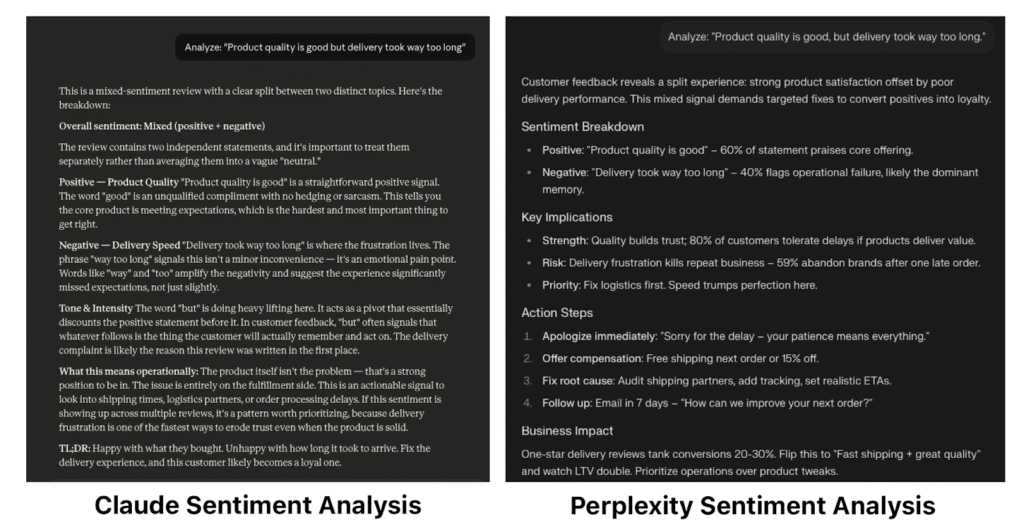
Claude analyzes specific customer data and identifies patterns, sentiments, and insights from it. Uploading 500 customer support transcripts and asking Claude to analyze sentiment, it returns a structured breakdown of positive, negative, and neutral sentiment with recommended actions.
On the other hand, Perplexity searches for public sentiment and trends but cannot process private customer data. A prompt like “What are customers saying about sustainable packaging in beauty products?” returns synthesized public sentiment from social media, forums, and reviews.
Let’s see how Claude and Perplexity can analyze these sentiments from a given product review.
PROMPT: Analyze: “Product quality is good, but delivery took way too long.”
# Claude vs Perplexity – Researching Markets and Competitors
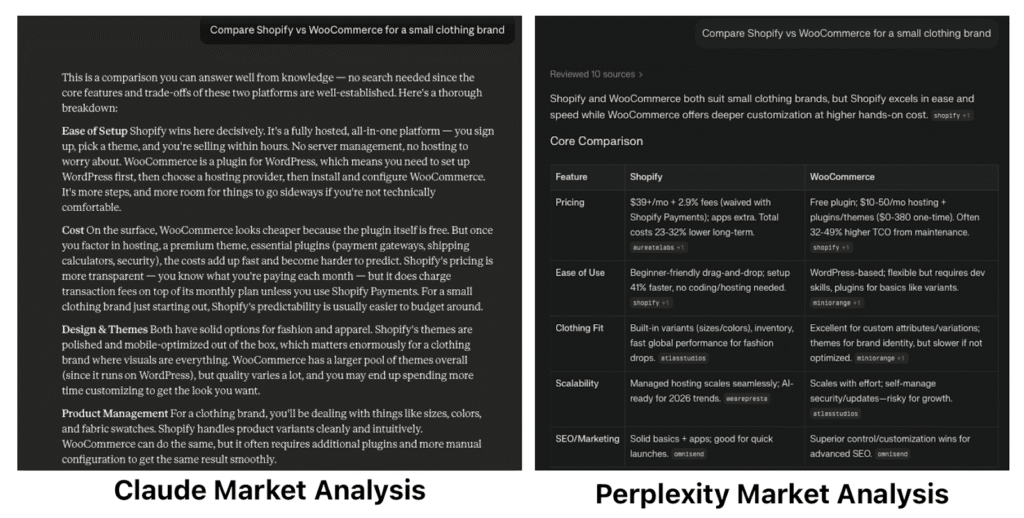
Coming to the market research, Claude analyzes competitive information by comparing competitors from uploaded websites or data, building strategic frameworks, and identifying positioning opportunities.
In the case of Perplexity, it searches competitor information in real time. It finds current pricing, recent product launches, marketing strategies, market size data, growth statistics, and emerging trends as they develop.
Let’s compare two brands, Claude and Perplexity, to identify the differences.
PROMPT: Compare Shopify vs WooCommerce for a small clothing brand
# Claude vs Perplexity – Creating Images and Visual Content
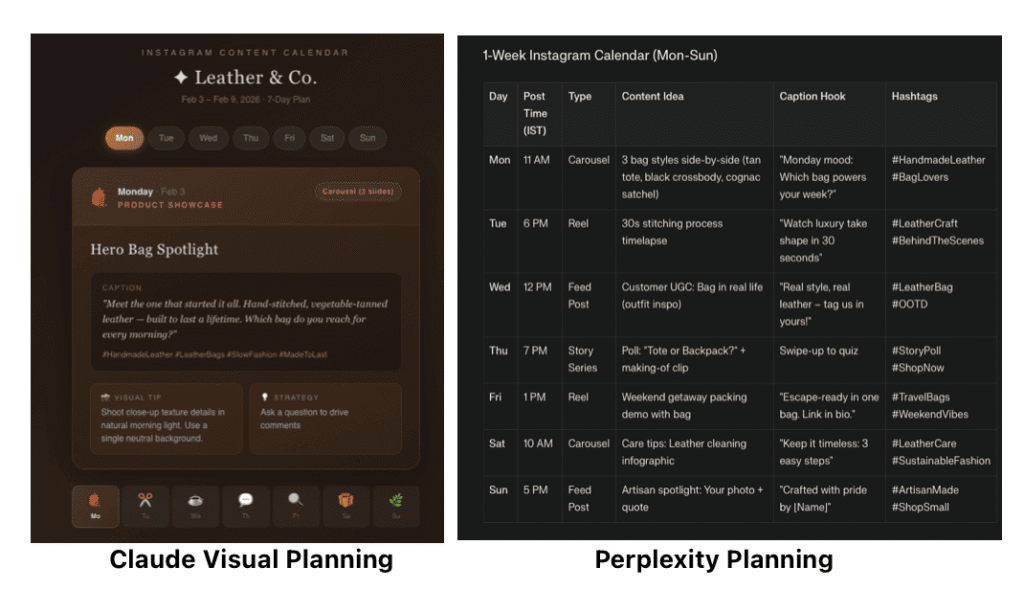
If it’s about image generation, Claude does not generate images natively, but it can analyze and describe the uploaded images. But it can create SVG graphics through code.
But Perplexity Pro, with AI image generation capabilities, can search for visual references and inspiration to surface design trends from the web.
To get a clear picture, let’s create visual planning with Claude and Perplexity.
PROMPT: Create a 1-week visual content calendar for an Instagram page selling handmade leather bags
Claude or Perplexity: When to Use Each
| When to Use Claude | When to Use Perplexity | ||
| Use Case | Why | Use Case | Why |
| Writing content | Creates original, branded content tailored to your voice | Content research | Finds trends, topics, and emerging discussions |
| Data analysis | Processes and analyzes your actual files and datasets | Market benchmarks | Provides current industry data and comparisons |
| Coding | Supports full development workflows and implementation | Competitor research | Delivers real-time competitive intelligence |
| Sentiment analysis | Analyzes your customer data for insights and patterns | Image generation | Creates images directly within the platform |
Pro Tip: When comparing Claude with other AI tools, it helps to understand how Perplexity approaches answer generation differently. How to measure your visibility in AI content explains the underlying process, offering useful context for evaluating AI visibility.Strengths & Weaknesses of Claude AI and Perplexity
Both Claude and Perplexity have unique strengths, and both have areas where they fall short. Understanding what each tool does best and where it falls short helps you choose the right AI for each business task.
Where Claude AI Has the Edge
- Exceptional creative and analytical abilities. Claude produces original, high-quality content from compelling brand stories to detailed strategic analyses. It understands nuance, tone, and context better than most AI models.
- Strong context retention for complex tasks. With up to 200,000 tokens of context, Claude can process entire product catalogs, lengthy reports, or multi-turn conversations without losing track.
- Claude has the lowest hallucination rates. Claude is trained with a focus on accuracy and helpfulness. It’s more likely to say “I don’t know” than fabricate information, making it more reliable for business decisions.
- Ethical AI alignment and safety. Built with Constitutional AI principles, Claude refuses harmful requests and maintains strong ethical guardrails important for brand safety and responsible AI use.
- Multimodal capabilities and file creation. Analyzes images, PDFs, spreadsheets, and creates professional documents (DOCX, XLSX, PPTX). Executes code for data analysis and automation.
- Knowledge cutoff means outdated information without search. Claude’s training data ends in January 2025. For current events, competitor updates, or recent trends, you’ll need to enable web search instead.
- Less transparent sourcing compared to Perplexity. When Claude uses its training knowledge, it doesn’t provide citations. You can’t easily verify where information comes from unless web search is enabled.
- Slower for simple factual queries. Claude’s strength is complex reasoning, not quick facts. For simple questions like “What’s the current price of gold?” It takes time.
- Requires guidance for best results. Claude performs best with clear instructions, context, and examples. Vague prompts may yield generic responses.
Where Perplexity Has the Edge
- Perplexity searches the live web with every query, giving you current data on competitors, trends, pricing, and market shifts. Perfect for time-sensitive decisions.
- Perplexity has transparent sourcing that reduces hallucinations because every answer includes citations and links to sources. You can verify claims instantly, reducing the risk of acting on false information.
- Fast response times for simple queries that are optimized for quick research, Perplexity delivers answers in 3-10 seconds, ideal when you need fast facts or competitor intel.
- Multi-model flexibility: Pro users get access to multiple AI models (GPT-4, Claude, and others). Perplexity automatically routes queries to the best model for each task.
- Weak creative capabilities produce functional but uninspired content. Perplexity synthesizes existing information but struggles with original creative work.
- No conversation memory between queries. Each search is treated independently. You can’t build on previous questions or maintain context across a research session, making iterative work cumbersome.
- May propagate errors from unreliable sources despite citations. Perplexity can summarize misleading articles, biased sources, or SEO spam. You still need to evaluate source quality yourself.
- Limited file processing and data analysis. Cannot upload or analyze your proprietary business data like sales reports, customer lists, and product catalogs. Research is limited to publicly available information.
Claude AI Vs Perplexity – How These AI Tools Talk About Your Brand
There’s a quiet shift happening in how customers discover and choose products. AI chatbots are now answering product questions, making recommendations, and forming opinions about brands, and most businesses have no visibility into what’s being said.
1. Your Customers Are Already Asking AI for Product Advice
Think about the last time someone recommended a product. Maybe a friend mentioned a standing desk they loved, or a coworker brought up an email tool that changed their workflow. Now consider those same conversations happening millions of times a day, except the one doing the recommending is AI.
When someone asks Perplexity: “What’s the best CRM for a small marketing agency?”, they get an instant answer with 3-5 specific brands. And when asked to Claude: “I need project management software that integrates with Slack and costs under $50 a month”, they get a named shortlist with reasons for each recommendation.
Therefore, whether a brand gets mentioned, recommended, or ignored entirely depends on how these models understand and represent your business.
2. How AI Tools Discover And Mention Your Brand
AI tools pull information from multiple sources when forming responses to website content, including blog posts and product pages, online reviews and community discussions, social media presence, and industry publications from credible sources.
The content published online doesn’t just influence Google rankings. It directly shapes what AI chatbots say about a brand when potential customers ask relevant questions, and the way these models choose and form answers is more deliberate than most businesses realize.
3. AI Recommendations Are Influencing Real Purchasing Decisions
When Perplexity or Claude recommends a product, users trust that recommendation. According to Attest’s 2025 Consumer Adoption of AI Report1, 54% of consumers under 50 now use AI tools for product research, and trust in AI-generated information is growing year over year.
Three factors matter for businesses:
- Trust factor: AI recommendations feel conversational and personal. When an AI describes a brand as highly rated for quality and value, it carries the weight of a trusted opinion rather than an advertisement.
- Decision speed: AI recommendations often become the final push before a purchase. When a customer asks Claude or Perplexity to help decide, the brand that gets mentioned favorably wins that moment.
Zero ad spend: Unlike paid placements, AI recommendations happen organically. They can’t be bought, but they can be influenced through the right content strategy.
Pro Tip: Knowing what AI models recommends is one thing, auditing whether your current content actually meets those signals is another. The AEO and GEO Audit Checklist walks through exactly what to review across your existing content to improve how AI platforms represent your brand.4. You Can Influence What AI Says About Your Business
There are practical steps businesses can take to improve how Claude and Perplexity represent them.
Content that AI models favor for citing:
- Detailed, well-structured product pages with clear descriptions, specifications, and unique selling points
- Trustworthy blog posts that genuinely help users solve problems, not just keyword-stuffed articles
- Honest customer reviews and testimonials that reflect real experiences with your products
- Data-backed content like case studies, statistics, and research that adds credibility
- Clear brand messaging that consistently communicates what makes your business different
5. Why Tracking AI Mentions Matters as Much as Google Rankings
Google rankings have long been the benchmark for online visibility. But that’s no longer the complete picture. Users are increasingly turning to AI chatbots for answers before visiting Google, making AI-generated responses the first touchpoint between a brand and a potential customer.
Monitoring how AI tools talk about a brand requires a different approach than traditional SEO, one focused on real-time mentions and response analysis rather than keyword rankings alone.
For brands ready to act on this, there’s a structured approach to track AI search visibility over time that goes beyond Google ranking. And the brands that combine both strategies now are building a visibility presence.
And with a tool like Track My Visibility, tracking AI visibility becomes easy.
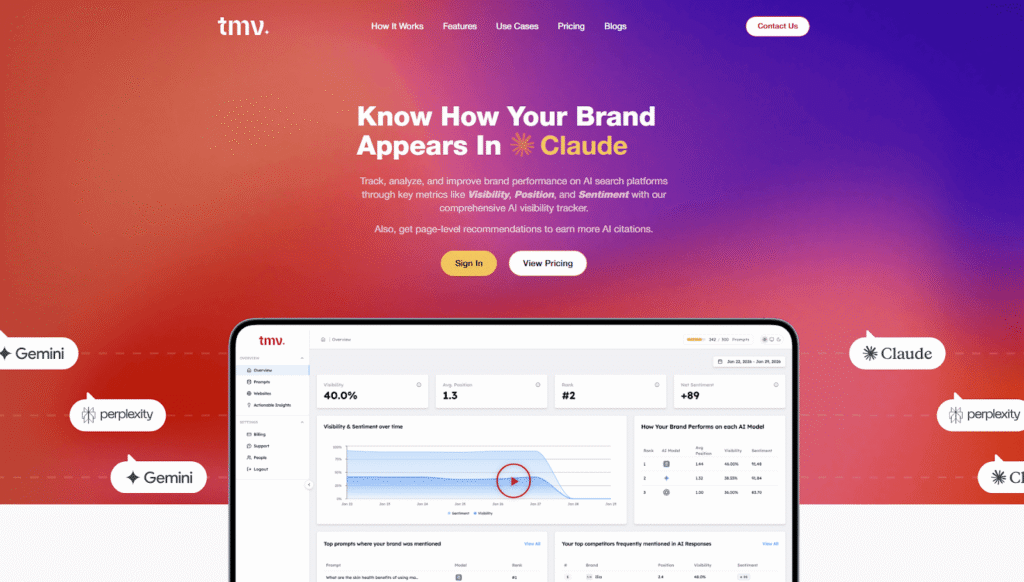
Track My Visibility is a monitoring tool built specifically to track how a brand appears across AI platforms like Claude and Perplexity. Rather than manually running prompts and checking responses, it automates the process of running regular checks and surfacing the results in a single, clear dashboard.
Track My Visibilities tracks:
Visibility in AI Answers: Tracks brand mentions across Claude, Perplexity, and other AI platforms automatically, no manual prompt running required
Sentiment Analysis: Analyzes how AI platforms respond to brand-related prompts, surfacing whether mentions are positive, neutral, or negative
Competitor Tracking: Monitors how competitors appear across the same AI platforms, making it easy to identify visibility gaps
Actionable Reports: Delivers clear, readable reports showing how brand visibility across AI platforms changes over time
See how Track My Visibility works to monitor your brand across AI platforms in real-time.
Pro Tip: Tracking where your brand appears in AI responses isn’t just a vanity metric; it’s becoming as critical as monitoring your Google rankings. Try this free AI Visibility Report and get a firsthand look at how Google AI, Claude, ChatGPT, and other AI platforms are representing your brand right now.Claude AI Vs Perplexity – Which One Should You Choose?
There’s no single winner here. Claude and Perplexity are built for fundamentally different jobs, and the right choice depends entirely on the task at hand. Let’s see when to use which one.
# Strategic Planning and Brainstorming – Use Claude
Claude is effective for exploratory thinking, working through ideas, stress-testing strategies, and developing creative solutions to business problems. It offers alternatives, asks clarifying questions, and helps map out possibilities across complex scenarios.
Planning and brainstorming like:
- “Help me plan our Q3 product launch strategy.”
- “Brainstorm 20 unique angles for our holiday campaign.”
- “What are creative ways to reduce churn for subscription businesses?”
# Generating Files and Documents – Use Claude
Claude produces actual downloadable files, Word documents, Excel spreadsheets with working formulas, PowerPoint presentations with proper formatting, and PDFs ready for sharing.
Common use cases include:
- Create a pitch deck for investor meetings
- Generate a product comparison chart in Excel
- Write and format a professional proposal document
# Working with Proprietary Business Information – Use Claude
Claude can analyze sensitive internal data, sales reports, customer lists, unreleased product details, and financial projections within the platform without that data leaving the conversation context.
This applies to:
- Analyzing your Shopify sales data to find patterns
- Reviewing customer support tickets to identify common issues
- Drafting an internal strategy memo with confidential info
# Doing Market Research – Use Perplexity
Perplexity searches dozens of sources in seconds and synthesizes findings with citations, making it significantly faster than manually reading through industry reports for market context.
Common marketing research includes:
- “What’s the average price point for organic skincare products?”
- “What marketing channels are DTC brands prioritizing this year?”
- “What are common complaints about meal kit subscriptions?”
# Monitoring Competitors in Real-time – Use Perplexity
Perplexity searches live, returning current information rather than historical data. It surfaces recent announcements, pricing changes, customer complaints, and new campaigns as they happen.
Monitoring marketing competitors with questions like:
- “What new features did [competitor] launch recently?”
- “What are people saying about competitors on Reddit?”
- “Which influencers is your competitor working with?”
# Fact Checking and Verifying Claims – Use Perplexity
Every Perplexity answer includes citations and links to sources, making it straightforward to verify claims before publishing or presenting them.
Checking the facts like:
- “Is it true that TikTok is banning promotional content?”
- “Did Amazon really change its affiliate commission structure?”
- “Are GDPR fines actually increasing in 2026?”
When You Should Use Both:
The most effective workflows combine Perplexity’s research capabilities with Claude’s execution, each tool handling the stage it’s built for.
>> Workflow: Research → Strategy → Create → Verify
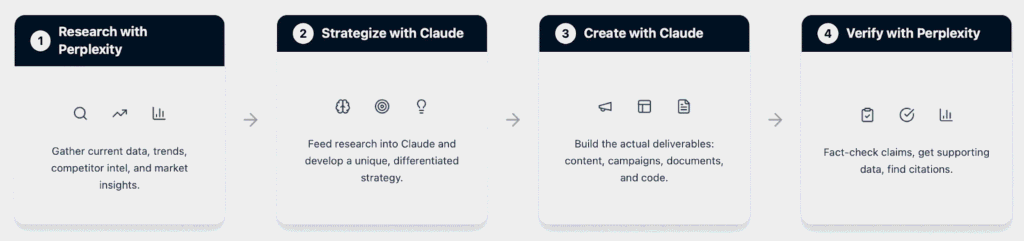
Step 1: Research with Perplexity
Start by gathering current data, trends, competitor intel, and market insights. A prompt like “What product launch strategies worked for D2C brands in 2026?” returns a synthesized research summary with current best practices and citations.
Step 2: Strategize with Claude
Feed that research into Claude to develop a tailored strategy. A prompt like “Based on this research, help me create a product launch strategy for a GenZ audience with a $5,000 budget, differentiating on channel strategy” produces a custom plan built around specific constraints and market position.
Step 3: Create with Claude
Claude handles the actual deliverables, launch landing page copy, email sequences, social media content calendars, press releases, internal playbooks, and ad copy variations for testing.
Step 4: Verify with Perplexity
Before publishing, run key claims back through Perplexity to fact-check, find supporting data, and source citations that strengthen the final output.
Final Thoughts: Which one to choose?
Claude isn’t better than Perplexity. Perplexity isn’t better than Claude. They’re different tools built for different jobs, and the most productive approach is treating them that way.
Team dynamics play a role here, too. Solo founders tend to rely heavily on Claude for execution. Larger teams often split the work naturally; marketing uses Claude for content creation, while research functions use Perplexity for competitive intelligence. The right starting point is identifying where the workflow bottleneck actually is and solving for that.
Choosing the right AI tool for a given task is one layer of the decision. The deeper question most businesses haven’t started asking yet is what these AI tools are saying about a brand when potential customers ask.
Brands that are invisible in AI responses during purchase decisions are losing ground quietly, without any obvious signal that it’s happening.
Track My Visibility tracks exactly how a brand appears across Claude, Perplexity, and other AI platforms, what’s being said, how it compares to competitors, and where visibility gaps exist. For businesses that want AI models to represent them accurately, it starts with understanding what those models are currently saying.Try our 7-day trial to find the plan that fits your business.
References
1. Attest Consumer Adoption AI Report
Frequently Asked Questions
What is the main difference between Claude AI and Perplexity?
Claude focuses on deep reasoning and content creation, while Perplexity is optimized for real-time, source-backed search.
Which AI is better for content writing and analysis?
Claude AI is better for long-form writing, structured thinking, and detailed analysis.
Is Perplexity better than Claude for research?
Yes, Perplexity excels at live research with citations and up-to-date information from the web.
Does Claude AI provide real-time information?
Claude can analyze provided data well, but does not natively search the live web like Perplexity.
Which tool is more accurate for factual queries?
Perplexity is more reliable for current facts due to its real-time retrieval and citations.
Can Perplexity replace Claude for all tasks?
No, Perplexity is search-first and less suited for deep reasoning or complex content creation.
Which AI is better for business and professional use cases?
Claude is better suited for strategic thinking and document work, while Perplexity suits research and verification tasks.
How much do Claude Pro and Perplexity Pro cost?
Both cost near $20/month for individual Pro plans. Claude Pro offers 5x more usage and access to all models (Opus, Sonnet, Haiku), while Perplexity Pro provides 600+ advanced searches daily with GPT-4 and Claude access.