
AI overviews (AIO) offer AI-generated summaries from top-ranking pages and other credible sources. With over 2 billion monthly users, AIO is quickly becoming a major traffic opportunity for businesses.
For users, it makes searching faster and easier. They no longer need to open every link to find what they need.
But for businesses, it is a new challenge. Ranking at the top of Google search is no longer enough. You will also need to optimize your content for AI overviews.
This begs the most important question businesses and SEOs are asking now: how to rank in AI overviews?
In this guide, we show you how to optimize your content to rank in Google AI overviews as we head into 2026.
Let’s get started.
What Are Google AI Overviews?
AI overviews are a new Google search feature that provides summarized answers to search queries with the help of generative AI tools.
Google’s AI overview uses AI to draw from credible blogs, web pages, product pages, YouTube videos, etc., relevant to the search query and presents a summary of the highlights in an easy-to-consume way.
Here is an example of AIO for the search term ‘how to grow on social media‘:
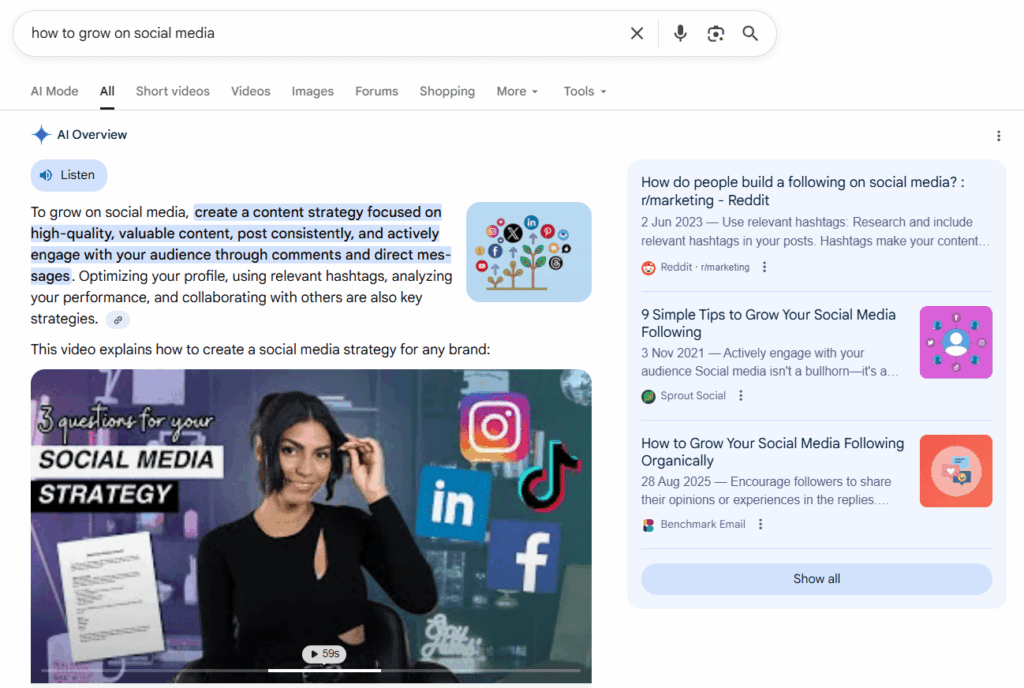
Google’s AI-generated summaries often include relevant links to the sources used to generate them. It also offers a separate panel on the right that users can expand to reach any specific source.
Here is an example of the same.
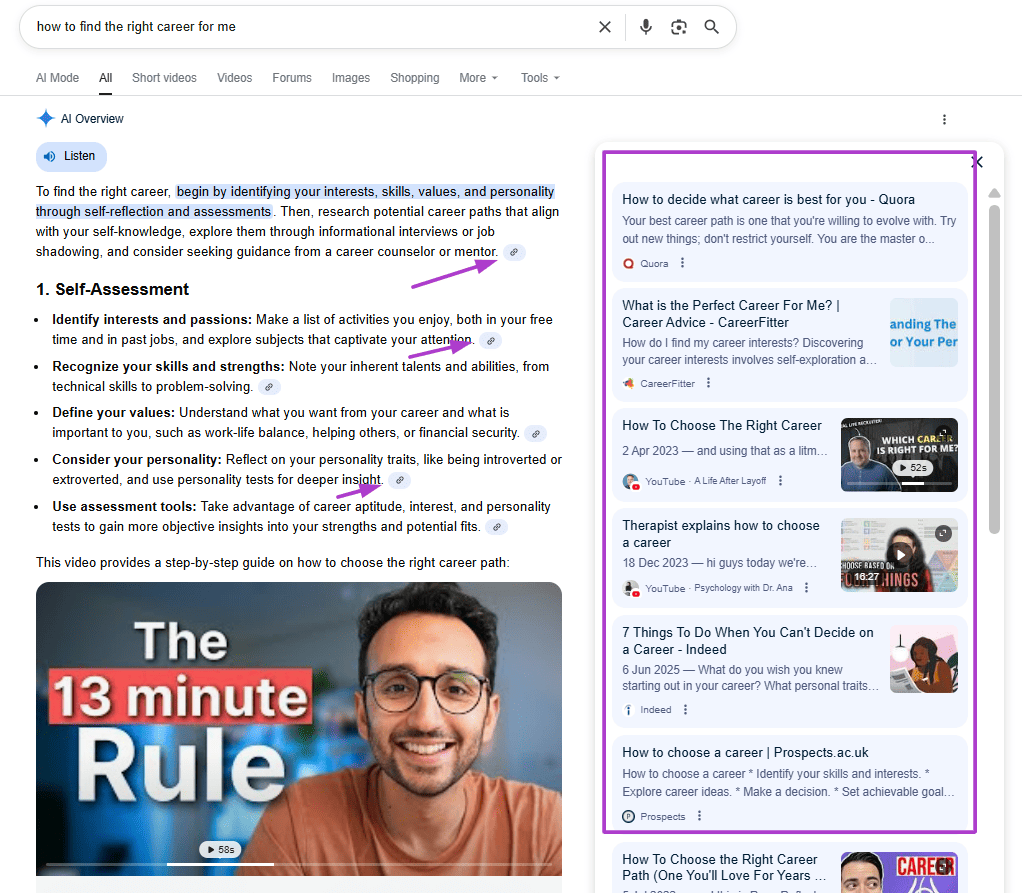
 Pro Tip: AI Overviews are just one piece of the AEO puzzle. Learn how modern SEO has expanded frameworks to it, in our detailed guide on what is AEO and GEO and rank across all AI search engines.
While AI overviews are a more refined & dynamic version of featured snippets, they are not identical.
Let’s quickly understand how they differ in the next section.
Featured Snippets vs AI Overviews: How Are They Different?
Although featured snippets and AI overviews serve the same purpose (give searchers specific answers to their queries), they are fundamentally different.
Here are a few key differences between featured snippets and AI overviews:
| Feature | Featured Snippets | AI Overviews |
| Content source | Extracts a direct, verbatim excerpt from a single webpage | Synthesizes a new answer by combining information from multiple sources |
| Placement on SERP | Formerly known as “Position Zero”, appearing above organic results | Top of the SERP, often after sponsored results but above all other organic results |
| Query type | Typically triggered by simple, direct, factual questions | Triggered by complex, multi-faceted, or comparative queries requiring synthesis |
| Length and format | Concise, like 40–60 words in a paragraph, numbered list, or table format | Tends to be longer with a multi-paragraph summary and can include interactive elements or follow-up questions. |
| Attribution and traffic | Prominent attribution and a single, direct link, leading to a high CTR for the site | Multiple citations are presented as expandable cards, but this may dilute traffic to any single source |
Now that we have explored what makes AI overviews different from featured snippets, let’s examine how the new Google search feature affects your SEO strategy in the next section.
Why Are Google AI Overviews Important in Your SEO Strategy?
Google AI rankings are starting to take up prime real estate in Google search results. Answers that rank in Google AI overviews appear above traditional blue links and answer user queries without requiring a visit to a website.
That means if your content isn’t included in the overview, you might lose search traffic even if you rank on page one. And many times, it leads to more zero-click searches.
But there is also an opportunity here. If your content is ranked in Google AI overviews, you can reach users faster and build authority. It also lets you stay visible even as search behavior shifts.
Google pulls these overviews from trusted, well-structured content. So showing up here signals that your content is reliable and helpful.
It is not just about clicks either. If you are able to rank in Google AI overviews, you can improve your brand recognition and credibility. This is even more vital for businesses in competitive spaces.
As more users rely on summaries instead of browsing 5–10 pages, optimizing to rank in Google AI overviews helps future-proof your SEO.
Ignoring them could mean falling behind while competitors get featured. So, let’s check how AI overviews affect SEO in the next section.
How AI Overviews Affect SEO?
According to Ahrefs, AI overviews result in a 34.5% lower CTR for the top-ranking page on average. In a podcast with Nilay Patel, editor-in-chief of The Verge, Google CEO Sundar Pichai shared an interesting take on AI Overviews.
“In fact, if you put content and links within AI Overviews, they get higher clickthrough rates than if you put it outside of AI Overviews”.
Here are three key ways they affect your SEO strategy:
1. Fewer clicks on Traditional Listings
AI Overviews often answer the user’s question directly. This means fewer people scroll down to the standard blue links now, as they get what they want from the Google AI rankings.
Even if you rank on page one, you might see lower click-through rates if you are not included in the overview.
This shifts the focus from just ranking to being referenced in the summary.
2. Higher Value on Content Structure and Clarity
Google’s AI pulls answers from content that’s easy to parse. That means clear headings, concise explanations, bullet points, and proper formatting matter more than ever.
Content that buries answers or uses fluff is less likely to be selected. Hence, if you want to rank in Google AI overviews, you need to publish content that offers high value to users.
If you publish low-quality content even on top domain websites, you are unlikely to rank in Google AI overviews, despite ranking organically on top.
3. Increased Visibility for Credible & Niche Sites
Often, massive websites with years of trust and an extensive backlink profile had it easy to rank on Google. But AI overviews completely change it.
You don’t need to be a massive site to be featured in Google AI rankings. AI Overview ranking often cites niche pages if the content is relevant and trustworthy. This gives smaller sites a shot at higher visibility and a chance to rank in Google AI overviews.
This means as long as you focus on quality and topical depth, your chances of being cited in AIO are high.
As reported by many SEOs and leading agencies, AI overviews have a massive impact on SEO. And it is time you step into the AI overview game.
So, let’s explore how to rank your content in AI overviews in the next section.
Steps to Rank in Google AI Overviews in 2026
Let’s be blunt right from the beginning. There is no secret hack or ingredient to rank in Google AI overviews. But that does not mean it is impossible to get cited as source in AI summaries.
Let’s check some of the most effective steps you can take to ensure your site appears in AI-generated responses on Google AIO.
Step #1: Follow SEO Best Practices
Google still uses its core ranking systems in AI overviews. That means Google still vets your content, utilizing a combination of the following:
- Core Web Vitals
- PageRank and BERT
- Helpful Content System
- On-page and technical SEO
- Reviews and User-Generated Content
- EEAT and topical authority
- Content Freshness Index
- Mobile optimization
When creating and presenting content on your website, follow these guidelines or systems. It will ensure you have a strong foundation to rank in Google AI overviews.
Here are a few things you can do to build a strong SEO foundation that can help win AI overview rankings:
- Create original, helpful, and fresh content matching user intent
- Include schema markup to present parts of your content
- Structure your content using H1, H2, H3, and H4 tags
- Ensure better search visibility by displaying content well across devices
Step #2: Optimize Content to Help Google Index Specific Areas
The search results from Google’s AI overviews include summaries of specific sections of your page. They do not reproduce the entire page, making well-structured content more likely to be cited.
For example, look at this specific section in the overview search results:
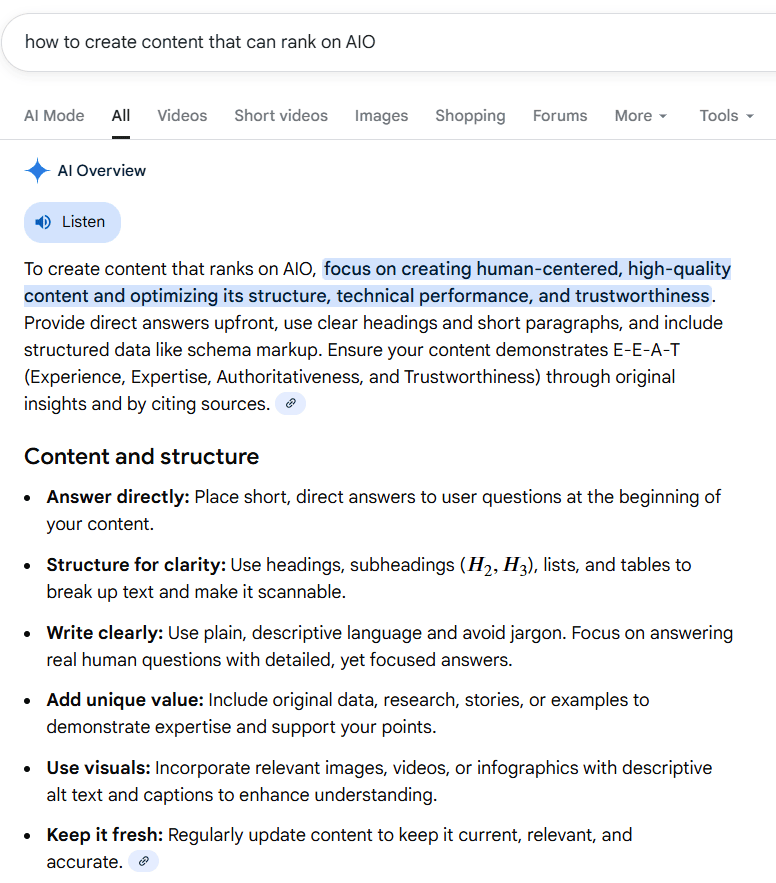
Google AI has summarized the above mostly from a section of another blog, as given in the screenshot below:
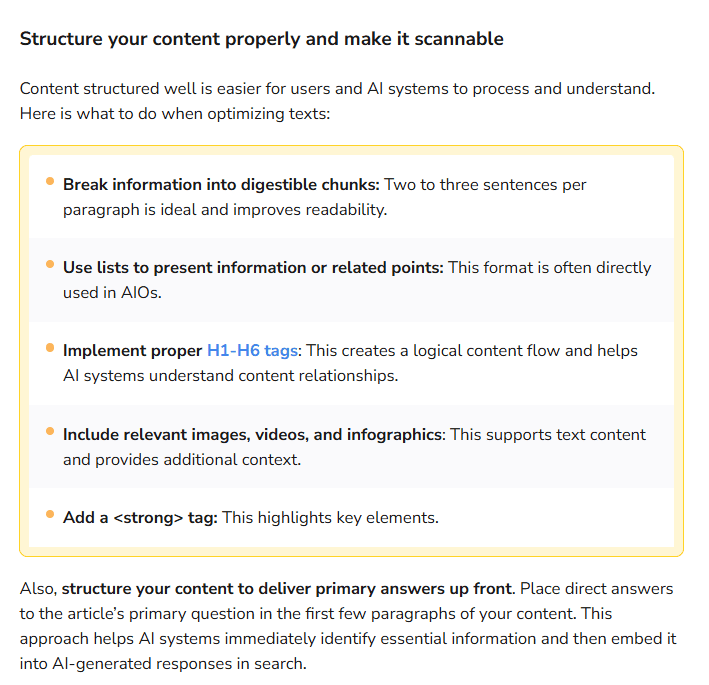
Source: SE Ranking
Optimizing your content with logical structure and flow helps individual sections of your content rank in Google AI overviews.
Here are a few strategies you can use while creating content:
- Write H2s and H3s as standalone questions that answer specific questions. For example, instead of writing ‘Benefits of AI Overviews,’ change it to ‘How Do AI Overviews Help Improve Organic Traffic?‘
- Start the section by directly answering the question of the section. You can expand the content with examples and stats after the answer.
- LLM tools love small blocks of content. Break your content into sections, making it easier for the tools lto extract and parse insights.
- Add bullet points and lists in your content. It makes the AI’s job of finding valuable, relevant information much easier.
- Ensure each section and subsection is clear. One section should focus on a single aspect of the topic, clearly and without overlap.
Step #3: Write Content in Natural Language
How you write is as important in AI overviews as what you write. Create content in natural, easy-to-understand language.
Google uses AI engines and models like BERT and MUM to analyze the context and meaning of words in queries and on web pages. Optimizing your page for NLP factors improves your content being ranked in Google AI overviews.
Here are a few strategies you can use while creating content:
- Use simple language to answer common questions in one or two sentences. This helps Google pull exact answers into AI summaries.
- Write how people speak. Focus on clarity and intent rather than forcing keywords into the content.
- Add definitions, examples, and comparisons. These help Google understand the relationships between concepts and provide context for summaries.
- Break up content with lists and bullet points. Structured formatting makes it easier for AI to extract key points to display them in overviews.
Having content in natural language makes it easy for Google to assess if your content is valuable to users, which can help you rank in Google AI overviews.
Step #4: Create Content That Expands Upon the Information in AI Overviews
Google says AI Overviews link to sources that support the snapshot and explore the topic further. So, your content should do both.
Don’t just repeat what is already in the AI summary. Go deeper. Cover the topic fully, including follow-up questions a user might have next. This will help you rank in Google AI overviews.
While creating content, ask the following questions:
- What would someone want to know right after reading the summary?
- What background info might they need if they are unfamiliar with the topic?
- What related steps or tools might they be searching for next?
Use tools like Answerthepublic to understand what people are asking about a particular topic.
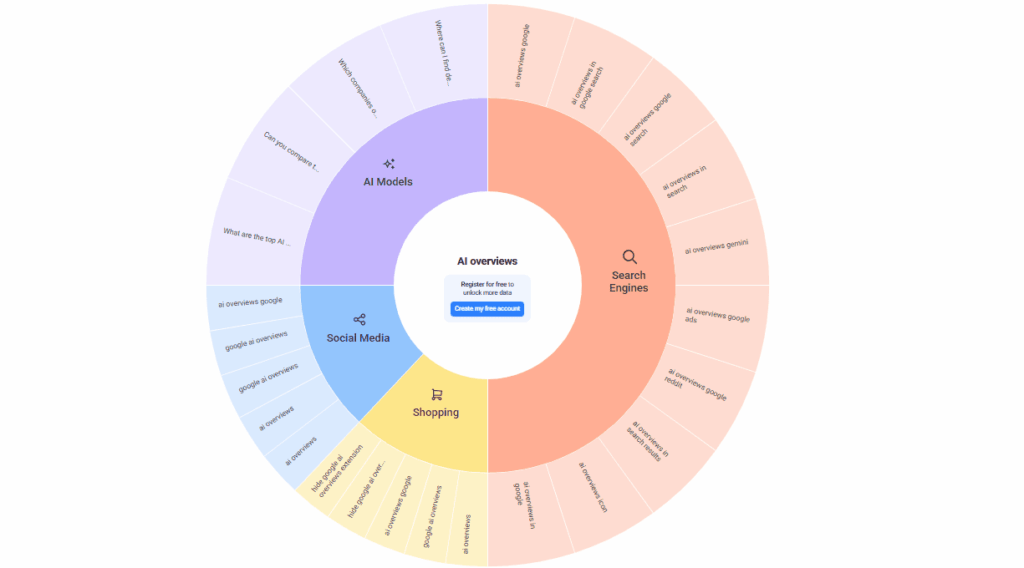
Use the information to find gaps in AI answers or content that’s already ranking and map out the user journey. Once you have enough insights, create content to fill the gap.
The more helpful and complete your content is, the chances to rank in Google AI overviews.
Step #5: Add Relevant Data and Statistics to Boost Authority
AI overviews are more likely to cite content that includes specific, verifiable data. Include up-to-date stats from trusted sources in your content if you want to rank in Google AI overviews.
Reliable stats and data add weight to your content and help it stand out as a credible reference that AIO can pick up.
Here’s how to do it effectively:
- Pull data from reliable sources: Use recent stats (within 2–3 years) from industry leaders, research firms, or government databases. Google favors content that reflects current trends.
- Cite the source: Link back to the original study or report, not just a blog that referenced it. This improves your credibility and aligns with EEAT.
- Format for clarity and extraction: This helps AIO extract data with efficiency.
- Don’t: Many businesses are investing in AI for content optimization.
- Do: 65% of SaaS businesses invest in AI content generation, says Name of the Report, by the Publisher.
- Use bullets, numbered lists, or tables: AI systems scan for structure. Presenting stats in clean formats helps tools like Gemini and AIO extract and display your data clearly.
Step #6: Use Schema Markup to Help Google Understand Your Content
Good content isn’t enough if Google can’t easily read it. Schema markup gives your content structure that AI can understand and trust. It adds machine-readable context, helping Google know exactly what is on your page.
While structured data doesn’t guarantee inclusion in AI Overviews, it improves your chances by making your content easier to parse and categorize.
Here are the top schema types that you can use in your content:
- FAQPage: For pages that answer multiple questions
- HowTo: For step-by-step tutorials
- Article or BlogPosting: Add metadata like author, date, and headline
- Organization or Person: Reinforce site credibility for EEAT
- Product or Review: Useful for comparison or recommendation pages
Make sure your markup is accurate and reflects what’s actually on the page. Don’t overuse or fake it, because Google is smart enough to know the difference.
Step #7: Strengthen Your Content with Visual Media
AI Overviews don’t just analyze text; they also process images and video. Adding relevant visuals makes your content more useful, more understandable, and easier for both users and Google’s AI to interpret.
Here’s how to use visual media effectively to rank in Google AI overviews:
- Use images that support the content: Add screenshots, charts, infographics, or product photos when they can actually help explain something.
- Name files and alt text clearly: Avoid naming images like ‘IMG_0032.jpg.’ Use descriptive names, like ai-overview-faq-example.png, and write alt text describing the photo.
- Include short, helpful videos: A simple walkthrough or screen recording can go a long way. Google often highlights video content that has imestamps or chapters.
- Place visuals near the content they support: If you are explaining steps, include visuals next to each one.
- Keep your images light: Compress them with tools like TinyPNG and use modern formats like WebP so your page loads quickly.
Step #8: Cite Trustable Resources in Your Content
Google’s AI Overviews often pull from multiple sources (sometimes up to eight) to build a balanced response. If your page links to trusted sources, it signals that your content is well-researched and credible.
This matters even more for YMYL (Your Money or Your Life) topics like:
- Financial advice
- Medical or health claims
- News and current events
- Legal or government information
In these cases, Google expects a high standard of accuracy and trust. Citing official sources, like government sites, research papers, or respected industry reports, shows your content meets that bar. This will also help you rank more consistently in Google AI overviews.
Here are a few tips you can use to improve citations in AI-driven search results like AI overviews:
- Link to the source of the data, not a blog that paraphrased it
- Use recent and reputable references (e.g., WHO, CDC, IRS, Gartner)
- Avoid vague statements without backup, AI models ignore them
Even if your own site isn’t cited directly in an AI Overview, citing strong sources makes your page more reliable and reference-worthy.
Step #9: Regularly Update Your Content
AI overviews favor fresh, up-to-date information. If your content is outdated, it is less likely to be cited, even if it ranked well in the past, and you may not rank in Google AI overviews.
In its Media Presence Research, SE Ranking says that more than 50% of the citations in AI search results, like AI, come from articles published in 2025 and 2024:
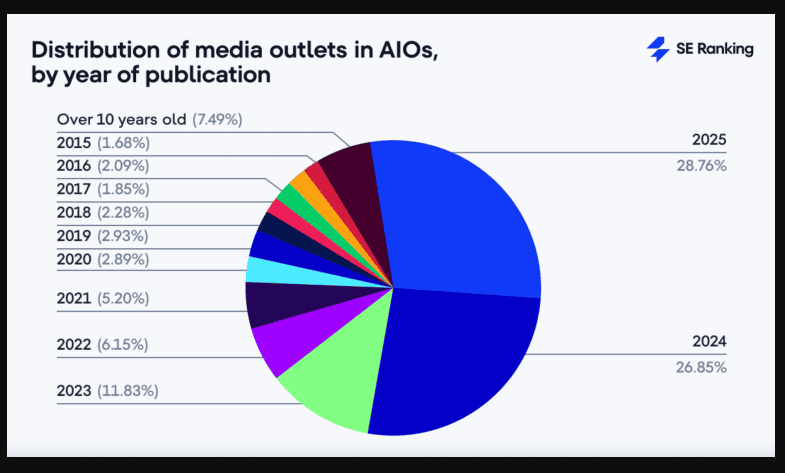
This means that you need to update your blogs and articles regularly with more recent information to improve your presence in the AI-driven search landscape.
Google’s systems consider content freshness as a quality signal. This matters most for topics that change often, like tech and software, marketing strategies, finance regulations, and product comparisons or pricing.
Even a well-performing page can get pushed out of AI overviews if it doesn’t stay relevant. Regular updates help keep your content in rotation and give Google new reasons to crawl and cite it.
Here’s how to keep your content fresh and AI-ready to rank in Google AI overviews:
- Review top pages every 3–6 months
- Replace old stats and broken links
- Add new insights or examples
- Update titles and meta descriptions to reflect current trends
Step #10: Monitor AI Centric Metrics and Trends to Adjust Your Strategy
Google CEO Sundar Pichai has said it himself: AI Overviews now has over 2 billion monthly users across more than 200 countries and territories and 40 languages.
As such, depending on traditional organic search results to stay visible online is not the brightest idea when people are getting comfortable with AI-generated answers from AI search engines.
The best way, hence, is to track AI overviews and adjust your SEO strategy accordingly to rank in Google AI overviews.
Here’s how to do it:
- Stay current: Follow Google updates, SEO blogs, and research on AI in search while following traditional SEO best practices
- Track performance: Use tools like Google Search Console, Ahrefs, or SEMrush to see how your pages are ranking and if they’re showing up in overviews
- Watch what’s working: Look at which formats and topics get cited. Use that to shape future content
- Test and iterate: Try changes in structure, schema, visuals, and content depth. See what helps with AI visibility on Google and build strategies to rank in Google AI overviews.
- Update based on results: If something is not being picked up by AI overviews, refine it. AI ranking signals evolve fast, and there always is the opportunity to rank
AI-driven search is still new and evolving. Staying flexible gives you the best shot at growing traffic from AI overviews and traditional search results.
We Help You Rank in Google AI Overviews
Users across the world are loving the AI-powered experiences in search results.
However, businesses are not loving it as much since AI overviews are causing zero-click searches than ever before.
According to Brain & Company, 80% of searchers use “zero-click” results at least 40% of the time. This means that tracking traditional SEO metrics in Google Analytics isn’t helping you at all to rank in Google AI overviews.
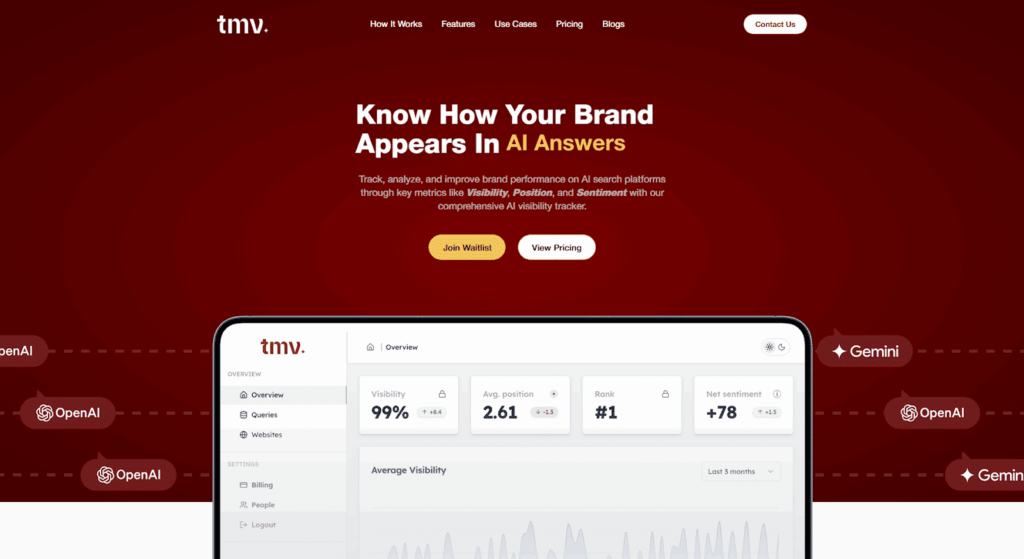
You need details on AI search traffic from reliable AI overview data. This is where AI overviews trackers, like Track My Visibility, can help you with their advanced AI overviews tracking features:
- See where you are cited: Track brand mentions and URL-level citations across major AI platforms like ChatGPT, Gemini, Claude, and Perplexity.
- Measure your AI visibility on Google: Get real data on how often and where your content appears in AI answers and relevant AI responses without guessing.
- Benchmark against competitors: Compare your AI presence with others in your space and uncover visibility gaps.
- Score your content’s AI readiness: Get an AI visibility score for each page for data analysis to see which ones need work.
- Get clear next steps: Follow actionable recommendations to boost your chances of being cited in AI-generated content.
With Track My Visibility, you can monitor brand mentions and analyze citations in AI overviews and other search engines powered by AI, to improve with page-level actions using Track My Visibility.
Explore our plans here and choose the best one to rank in Google AI overviews.