Most businesses still optimize for Google like it’s 2015. They are chasing keywords, rankings, and backlinks. But AI search is changing how content gets discovered. Tools like ChatGPT, Perplexity, Claude, and Google’s AI overviews don’t just list links. Instead, they generate answers.
That means your content is used even if no one visits your site. While that may feel like a threat, studies show that AI search is actually expanding users’ information-seeking behavior. In its research, NN Group has found that users primarily use Google to find answers.
But it is a reality that AI search is reshaping how people search and find answers to queries. Hence, it makes sense to understand the core differences between AI search and traditional SEO.
In this article, we look at:
- What are traditional SEO and AI search
- Key differences between SEO and AI search
- How AI search affects the SEO industry
- How Track My Visibility helps you monitor AI search visibility
Let’s get started.
What Is Traditional SEO?
Traditional SEO is the process of optimizing your website and content to rank higher in search engines like Google.
Here, the goal is to appear in the top results when someone searches for a relevant keyword. It focuses on things like:
- Keyword research and placement
- Backlinks from other websites
- Technical SEO (site speed, mobile-friendliness, etc.)
- On-page structure (headings, meta tags, URLs)
- High-quality, relevant content
The idea is simple: make your site easy for search engines to crawl and understand, so they show it to users searching for answers. Although SEO helps rank in most search engines, SEO strategies are often built around how Google’s algorithm ranks pages in its results.
What Is AI Search?
AI search uses artificial intelligence to understand questions and deliver direct answers, often without showing a list of links.
Instead of just matching keywords, it looks at context, intent, and meaning. Tools like ChatGPT, Perplexity, and Google’s AI overviews (Search Generative Experience) pull content from multiple sources, summarize it, and present an answer right away.
Optimizing your website for AI search visibility has different names that different SEO professionals use, such as:
- Generative Engine Optimization (GEO)
- Answer engine optimization (AEO)
- LLM and AI SEO
However, each of these terms refers to the same thing: improving and optimizing content to secure citations in AI-generated answers.
Here is a result from AI overviews, previously called Google search generative experience or SGE:
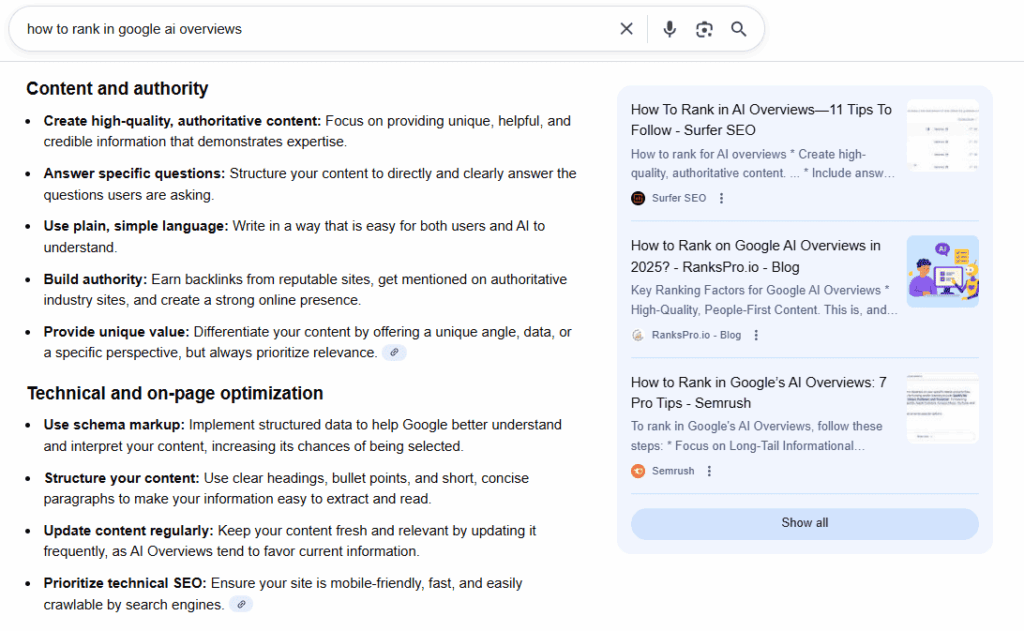
This changes how people interact with search and how content gets discovered. AI search favors clear, structured, factual content that’s easy to quote or summarize. It’s less about ranking and more about being useful to the AI.
What Are the Key Differences You Must Know About AI Search and SEO
Understanding the key differences between AI search and SEO helps you improve your AI SEO strategies.
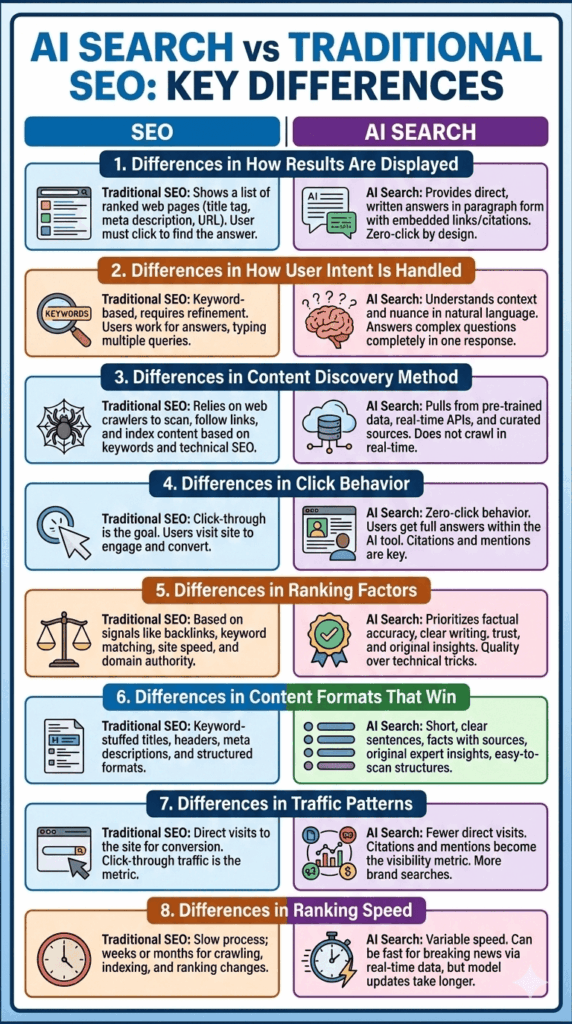
Here is a quick infographic with the key differences explained:
1. AI Search vs SEO: Differences in How Results Are Displayed
The biggest difference between AI search vs SEO is what the user sees after hitting ‘search.’
# Traditional SEO
Search engines like Google show a list of ranked web pages. You usually get:
- A title tag (blue clickable link)
- A short meta description
- The page URL
Here is an example of a traditional SEO search result for the query: ‘Who are the founding fathers of the US?‘:
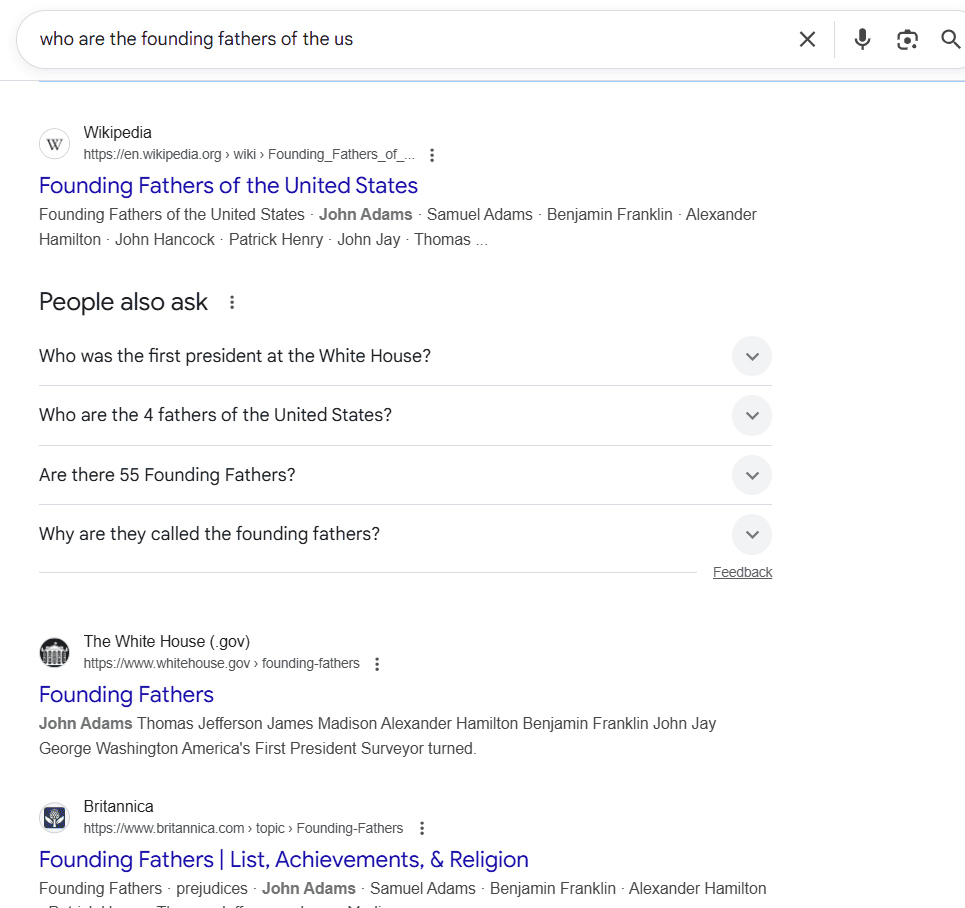
The user must click a link and visit the site to get the full answer. Even featured snippets still lead to a website.
# AI Search
AI search tools like Google AI overview, ChatGPT, or Perplexity give direct answers in the chat. You ask a question and get a written reply often:
- In paragraph form
- With embedded links or citations
- Pulled from multiple sources
You don’t have to click anywhere. It’s a zero-click search by design. Here is an example of an AI search result for the query: ‘Who are the founding fathers of the US?‘
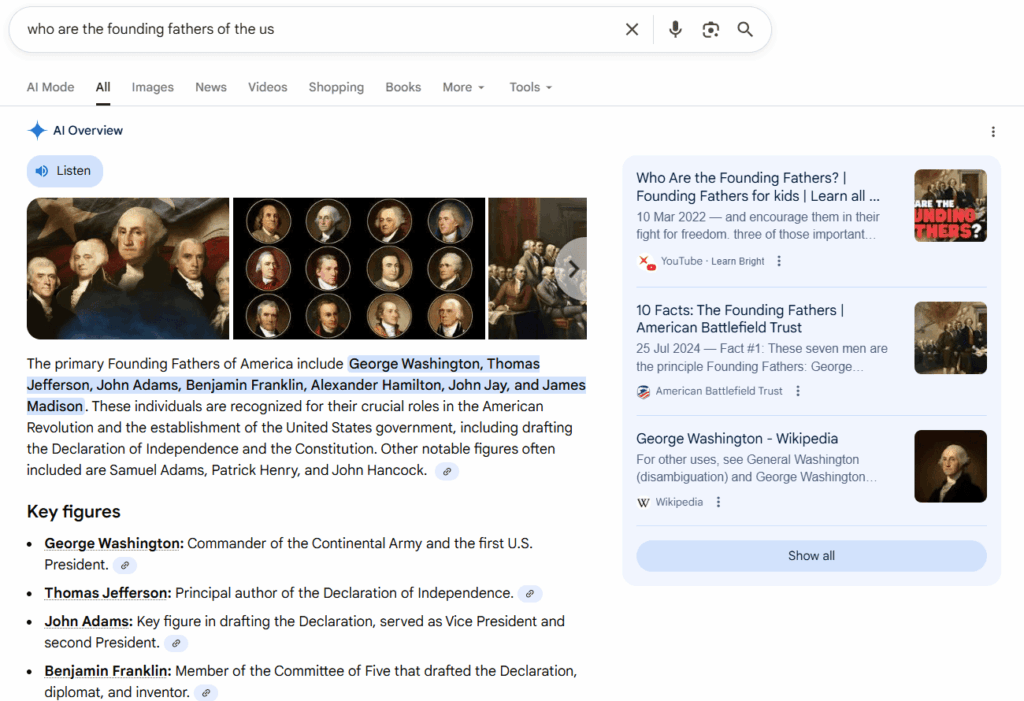
As you can see, in the AI-generated search results, you have more details, including the names and overviews of the founding fathers, right on the SERP page. And the AI tool adds citations at the end or embeds them in the text. But the main thing you see is the answer itself, not a menu of options.
But in traditional search results, you need to open the first link to get the information.
For content creators, this changes everything in two core ways:
- Your goal is not focused on getting clicked anymore
- Your goal now is to get cited in that answer
2. AI Search vs SEO: Differences in How User Intent Is Handled
This is another major difference you need to know when comparing AI search vs SEO. In traditional search, you need to work for answers. When you want information, you type a query, scan the results, refine your search, and try again.
AI search engines handle this differently. You can ask complex questions in plain language and get complete answers.
For example, if you ask ‘What’s the best CRM for small teams under $50 a month with email integration?’, you get exactly that.
This is because, unlike traditional SEO, AI tools:
- Understand context and nuance without keyword matching
- Use follow-up queries and previous answers to improve answers
- Combine different parts of a multi-part query to provide one response
This means that users no longer need to break their thoughts into keyword phrases. You can ask questions the way you ask a person. The AI processes all parts of that question at once.
And you need to consider this right from the beginning of content creation:
- Write with natural language, focusing on answering topics entirely
- Answer complete questions instead of writing in fragments
- Think about the full user journey in one piece of content
This helps ensure that AI search platforms and engines can quickly extract content and cite your website.
3. AI Search vs SEO: Differences in Content Discovery Method
How search tools find and surface information is completely different in AI search vs SEO. This affects what gets seen, shared, and clicked.
In traditional SEO, Google and other search engines rely on web crawlers to find pages. These bots scan the internet, follow links, and index content based on:
- Keywords
- Page structure
- Internal and external links
- Technical SEO (like site speed and schema)
Your content needs to be published online, properly optimized, and linked to get found.
On the other hand, AI systems don’t crawl the web in real time. Instead, they pull from:
- Pre-trained data up to a specific time in the past
- Real-time sources like APIs or search engines
- Curated content that’s included in their training (e.g., Wikipedia, high-authority sites)
And if you are a business aiming to rank in AI search results, you need to focus on both traditional SEO and AI search optimization.
4. AI Search vs SEO: Differences in Click Behavior
Click behavior shows a significant difference in AI search vs SEO.
In traditional SEO, the click is everything. Someone types a query, sees your link on the results page, and clicks through to your site. That visit gives you a chance to engage them, capture their email, sell a product, or build trust.
The entire SEO game is built around getting that click.
Interestingly, AI search flips this. Users now ask a question and get a full answer without leaving the tool.
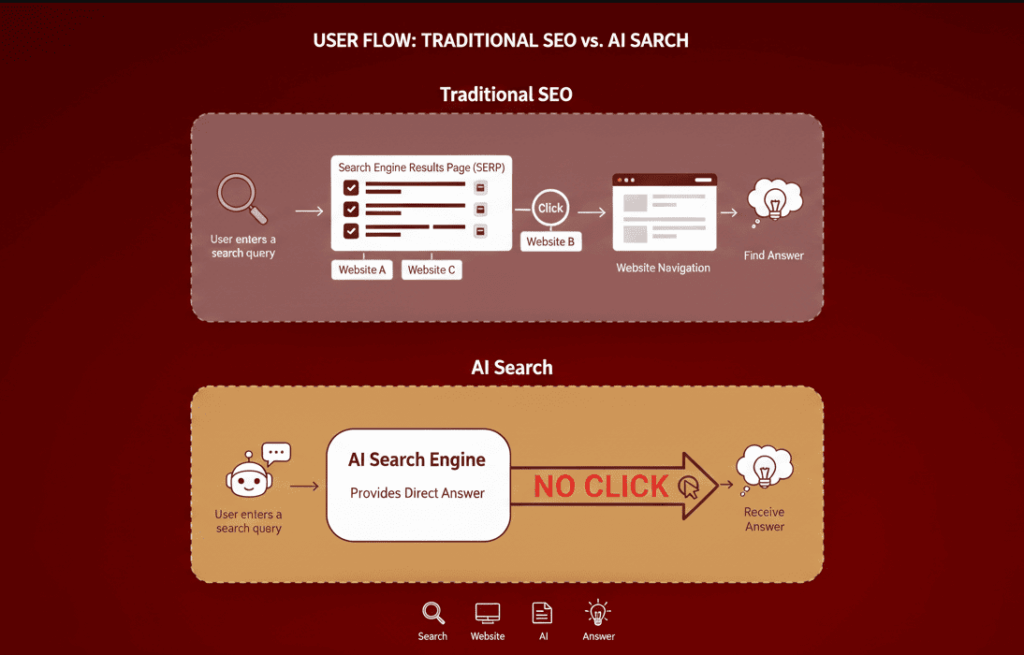
They don’t need to visit your site to learn what you know. This is called zero-click behavior, and it’s growing fast:
- Users stay inside AI overviews, ChatGPT, Perplexy, or Gemini for the full answer
- Your content gets used, but your site doesn’t get the traffic
- Brand awareness matters more than CTR or page views
- You lose direct contact with potential customers
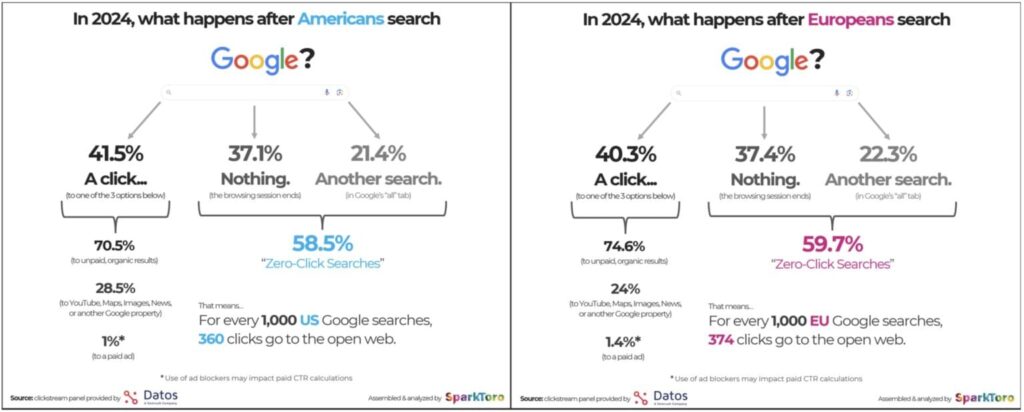
According to a study published on SparkToro using data from Semrush’s Datos, 58.5% searches in the US and 59.7% searches in the EU are zero-click searches.
5. AI Search vs SEO: Differences in Ranking Factors
SEO has always been about signals. Google looks at your backlinks, checks if your keywords match the search, measures how fast your site loads, and weighs your domain authority. The rules are clear, and the tools to track them are everywhere.
AI search doesn’t work that way. There’s no ranked list. Instead, AI models decide which content to pull from based on various factors, most of which aren’t public.
What we do know is that quality, trust, and clarity matter more than technical tricks. What AI models seem to prioritize:
- Factual accuracy and up-to-date information
- Clear writing that’s easy to parse and cite
- Content from recognized, trusted brands
- Original insights, not rehashed fluff
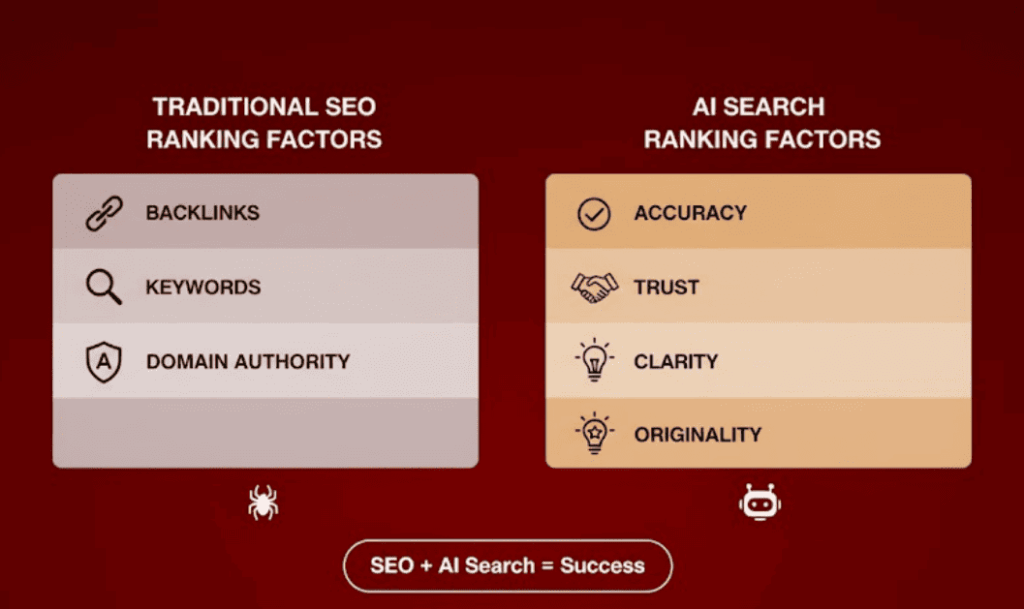
As such, traditional SEO metrics, such as keyword density, meta titles, descriptions, etc., don’t matter as much to AI-powered search engines.
The big shift here is that you can’t game the system. AI models are trained to spot quality. If your content is thin, generic, or built to rank, it won’t get cited.
But if you write with real expertise and add value to users, AI tools will use your content.
6. AI Search vs SEO: Differences in Content Formats That Win
In SEO, even if content creation is aimed at helping users, you play by the rules of search algorithms. You pick a keyword, stuff it in your title and headers, write a meta description, and build internal links. The format is predictable:
- Introduction with the keyword
- Subheadings with keyword variations
- A few images with alt text
- A conclusion that repeats the main points
This works and is still vital for organic traffic from Google AI overviews, ChatGPT, Perplexity, and search engine results pages.
AI-driven search engines do not look at your meta titles or descriptions to understand your page. They don’t care if you have the keyword in the first paragraph.
What they do care about is whether your content clearly answers a question and backs it up with facts. A quick AI search vs SEO comparison of search results will help you understand this. In AI search optimization, what works is how easily you can answer queries.
Hence, keep the following in mind when optimizing content to rank in AI search results:
- Short, clear sentences that get to the point fast
- Facts with sources, data, or real examples
- Original takes or expert insights, not generic advice
- Structure that’s easy to scan, like lists, comparisons, definitions
7. AI Search vs SEO: Differences in Traffic Patterns
Another key difference to know between AI search vs SEO is traffic patterns. As a business, you know that SEO brings people to your door. You rank for a keyword, users click through, and you have a chance to convert them into a customer. This is what businesses intended with all the traditional SEO methods.
But with AI search, it doesn’t work the same way, as it eliminates the visit.
Your content gets used, but users stay inside the AI tool. They get the answer with your insights baked in, see your brand cited, and move on.
No click. No traffic. Just mentions. For businesses like yours, this means:
- Fewer direct visits from search engines to the site
- Citations and mentions become your new visibility metric
- More brand searches as people recognize your name from AI citations
- Less traffic to informational content, but maybe more to product or service pages
But this doesn’t mean your site becomes irrelevant. It means the path to your audience has shifted. If users see your brand cited often enough, they can reach you directly when they are ready to buy.
8. AI Search vs SEO: Differences in Ranking Speed
SEO is slow. You publish a new page, wait for Google to crawl it, then watch your rankings inch up over weeks or months. You also need to build backlinks, tweak your content, fix technical issues, and wait till the results trickle in.
AI search moves at a different pace. Some changes show up fast. If you publish a fresh take on breaking news, AI tools can pull it in within days — sometimes hours. But other changes take longer. If you are trying to shift how your brand is perceived or get cited for a specific topic, it depends on when the AI model gets updated with new training data.
Here are a few elements that affect speed in AI search:
- Real-time data sources: Tools like Perplexity pull from live web results, so fresh content can appear quickly
- Model updates: ChatGPT and others retrain periodically, which means older content might not reflect until the next update
- Brand trust: If you are already cited often, new content from you gets picked up faster by AI search engines and tools
- Content type: Breaking news and timely topics move faster and get cited quickly than evergreen advice
While the uncertainty can be frustrating, the upside is real. When your content does get picked up, it can reach users without the long slog of climbing search rankings.
What Are the Effects of AI-Powered Search in the Industry
In its 2025 Q2 earnings call, Alphabet said that Google’s AI overview has 2 billion monthly users. Another study by Semrush found that over 50% of the links ChatGPT cites point to service or business websites.
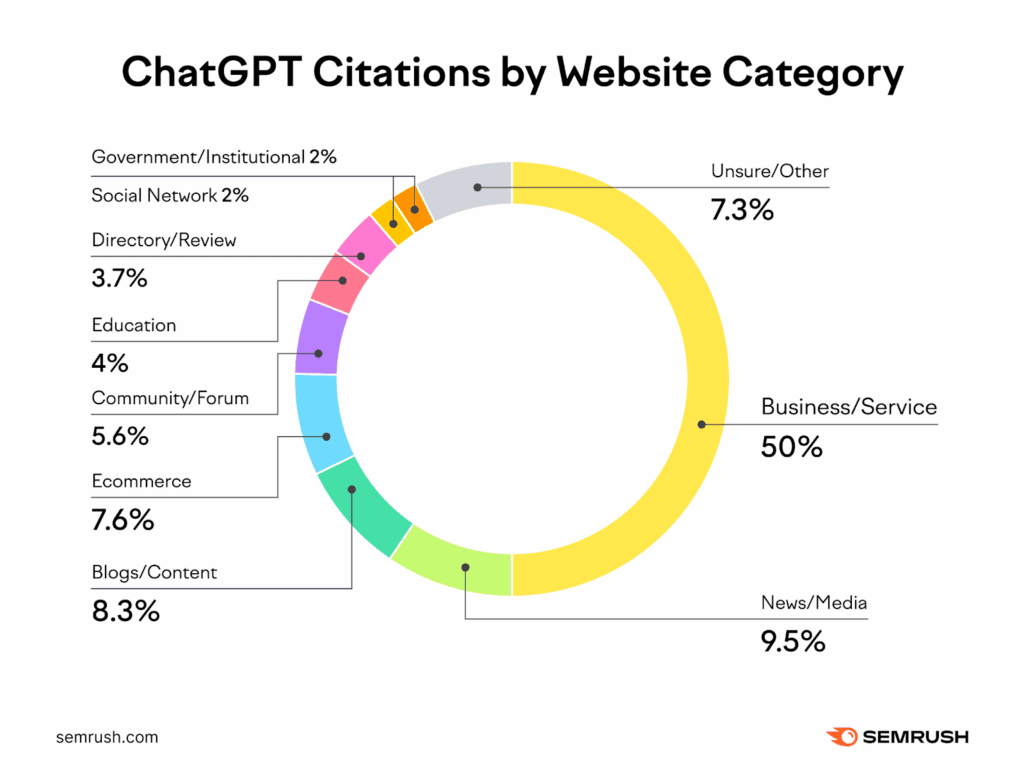
Let’s explore how AI search is impacting businesses in diverse ways here:
1. Users Now Expect Quick, Direct Answers
People don’t want to click through ten blue links anymore. They want answers right on the search page. AI search gives them that.
Pew Research found in its 2025 study that only 8% searchers click on a link when Google shows an AI overview for a query.
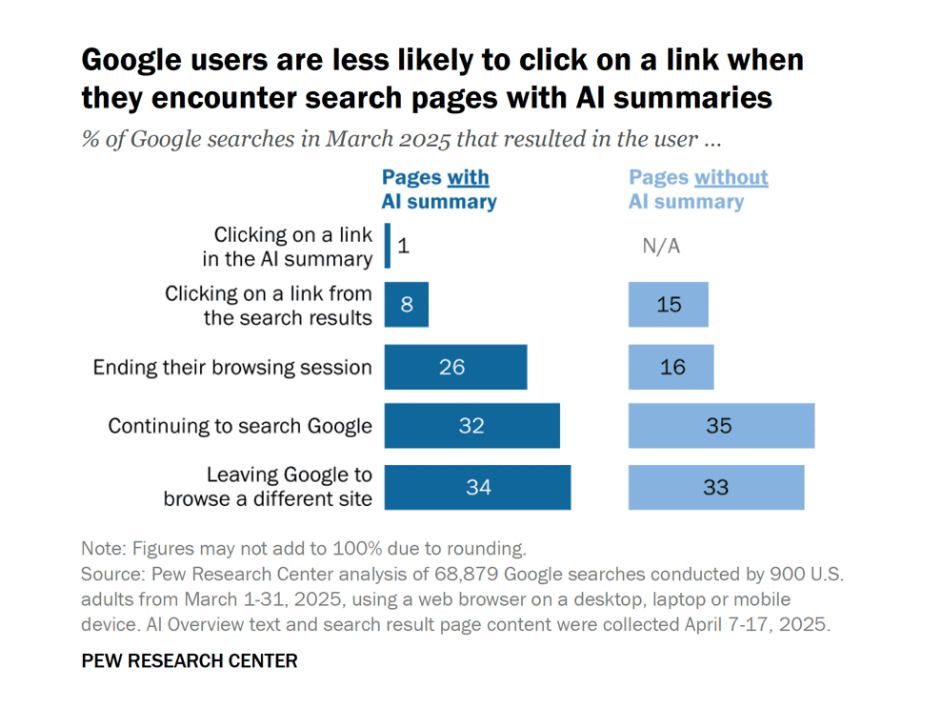
This shift means users spend less time on sites and more time in the search tool itself. For site owners, this is a big change in how traffic flows.
2. SEO Professionals Are Rethinking AI-powered SEO
The old SEO playbook doesn’t work the same way. Ranking at the top of the SERP does not guarantee results now.
If you need traffic with conversion potential, you need to be everywhere, including Google AI Mode, Gemini, and other LLM tools like ChatGPT, Perplexity, Claude, and more.
As such, SEO teams now need to:
- Focus on clear, direct answers rather than just keywords
- Build content that AI can pull from and cite
- Track new metrics like AI-driven traffic and brand mentions
- Test how their content shows up in AI results
3. Traffic Patterns Look Very Different Now in the AI Era
Sites see changes in which pages get views. Blog posts that rank well in search results might not appear in AI tools.
Meanwhile, pages with strong, factual content get more weight. The home page matters less, and deep content pages matter more. Zero-click searches have become common, allowing users to get what they need without leaving the search page.
For example, AI overviews in Google offer in-depth information that almost answers the search queries.
Here is an example:
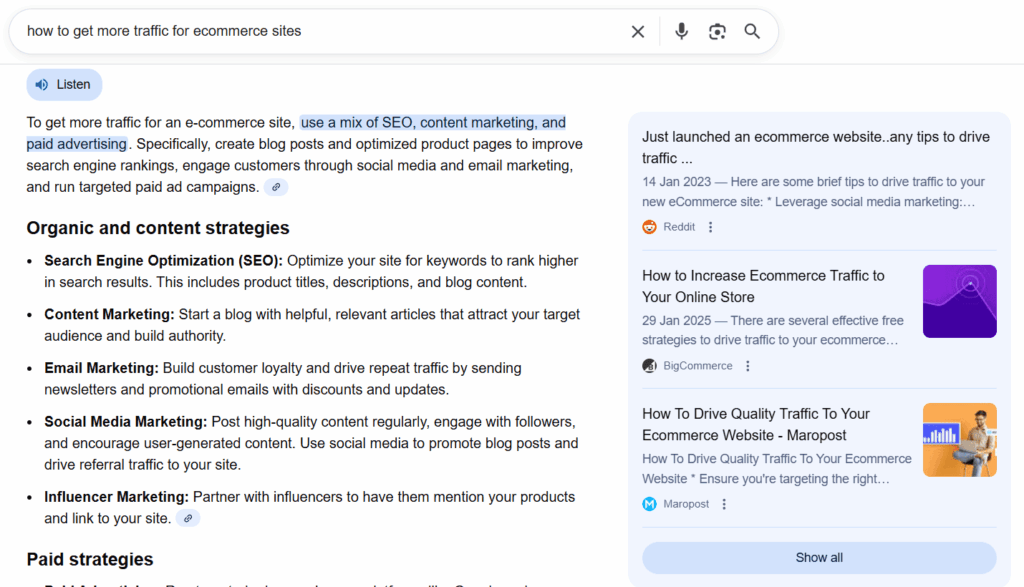
This means blogs that used to drive the most traffic no longer guarantee it. What you really need is topic clusters that answer entire topics. You also need to optimize blogs for section-specific content retrieval for AI search.
4. Brands Must Adapt to AI Optimization or Risk Falling Behind
Companies can’t ignore this shift in search patterns and how users find information online. Sticking to older SEO strategies may not bring you as much traffic as you deserve.
AI search also opens new opportunities for businesses that are new or lack high domain authority. By optimizing content for AI search, they can also appear in AI overviews and receive citations from ChatGPT or Perplexity.
Those who adjust early gain an edge:
- Watch where brand mentions appear in AI results
- Update content to match how AI tools find info
- Create source-worthy content that gets cited
- Build trust through clear, honest writing
How Track My Visibility Can Help You in AI SEO
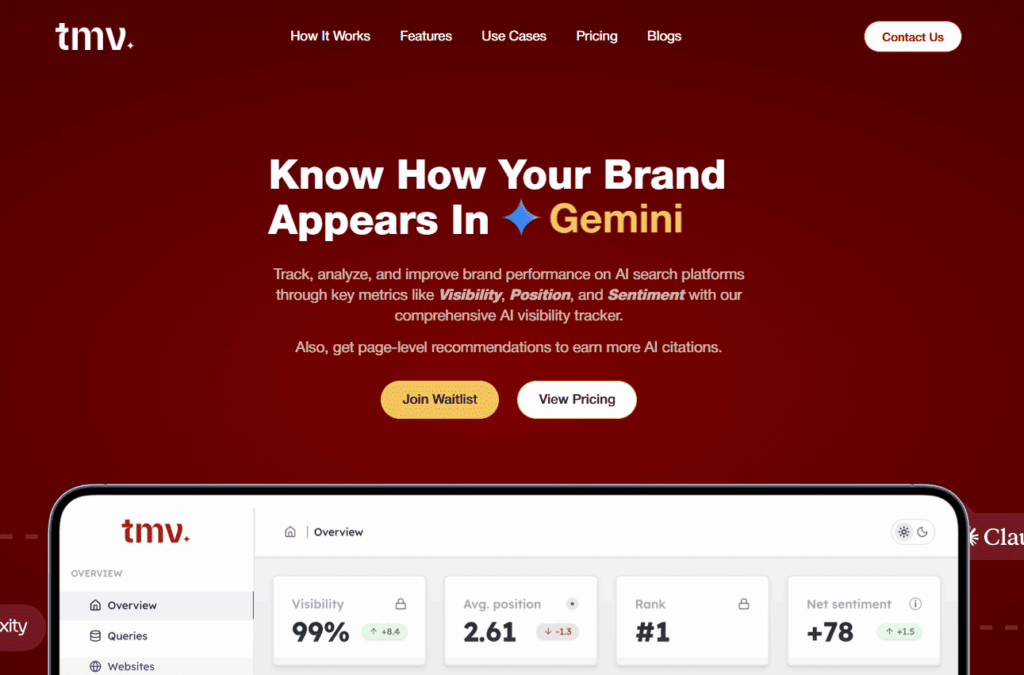
Tools like ChatGPT, Gemini, and Perplexity now answer questions that used to send users to your site. This means you need to adapt your strategies to show up in old search and new AI tools, not just in one of them.
But it’s hard to know if your brand even appears in AI results. You can’t just check a rank as you do with Google. That’s where Track My Visibility helps. It shows you exactly how your brand appears across ChatGPT, Gemini, Perplexity, and AI Overviews, quite unlike other AI-powered SEO tools.
Get clear metrics on visibility, position, and sentiment, and use them with traditional search engine optimization strategies using Track My Visibility’s features, such as:
- Prompt-based visibility checks: Run custom prompts or create persona-driven query sets to see if AI models cite your brand or default to competitors instead.
- Cross-platform tracking: Execute the same prompts across all major AI tools and compare your brand visibility side-by-side.
- URL-level citation reports: See exactly which pages from your site get cited, how often they appear, and which AI engines reference them most.
- Competitor analysis: Track how competitors get mentioned in AI answers, which URLs they are cited for, and where they outrank you.
- AI readiness scores: Each page is scored on its AI-readiness for citations, with recommendations to boost visibility.
Most companies have no idea if their brand appears in AI search results.
Track My Visibility gives you a clear view of your AI search performance. And you also get citation tracking, sentiment analysis, and visibility scoring across major AI platforms.
Be one of the first to check where your brand stands in the top AI platforms.
For a deeper look at how the platform works, you can check the pricing, explore the features, or review practical use Cases.
Happy Tracking & Growing.