Similar to SEO, you can also influence and get a top position in AI responses.
But not the way you did for Google to rank on top of the SERP.
So, how to rank in AI search results? Well, this does not happen by luck. It requires specific optimization strategies designed for AEO and GEO that helps you consistently rank in AI search.
That’s why, in this guide, we’ve picked six powerful strategies that will help you rank your brand in AI search results and maximize your visibility.
But first, let’s start with a basic understanding of what AI search is!
Understanding AI Search
What Is AI Search?
AI search is a new way of finding information on the internet. Instead of giving you ten links to investigate (like traditional search engines), generative AI search engines use natural language understanding and large language models to read the meaning behind a query and provide one direct answer.
The AI response is conversational, context-aware, and often includes key information pulled from multiple sources, including featured snippets, helping content rank in AI answers more often.
How Is AI Search Different From Traditional Search Engines?
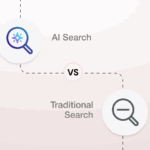
Unlike traditional search engines like Google, which scan pages for keywords and rank results using SEO signals like relevance and backlinks, AI search delivers direct answers.
Instead of clicking through multiple links, users get the information in one AI-generated response.
AI search delivers fast & direct answers featuring your brand; however, it would only be possible when you demonstrate clarity, authority, and relevance to the question being asked.
Here’s how AI search and large language models (LLMs) work:
- Crawling: AI systems read and gather information from many sources online
- Learning: Models analyze that data to understand patterns, facts, and associations
- Generating: Then it produces responses, summaries, or recommendations, and may include source citations
This makes AI search more like an answer system rather than a search engine. The user asks a question and receives an explanation, a summary, or even a recommendation, all inside the same interface where the question was asked.
Here’s a quick difference between traditional search and AI search:
| Feature | Traditional Search | AI Search |
| Query Understanding | Focuses on matching the exact keywords typed by the user | Understands the intent behind the question and reads the meaning, not just the words |
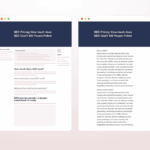
| Result Format | Returns a ranked list of web pages to explore | Delivers a direct, well-structured answer, often with citation links on the side |
| User Input Style | Works best when users type short and specific search phrases | Works naturally with conversational questions and longer requests |
| Analysis | Evaluates relevance at a page level | Extracts information from specific passages or sections across sources |
| User Experience | Forces the user to click and manually gather information | Gives immediate clarity with the answer delivered inside the interface |
| SEO | Optimized by keywords, backlinks, and metadata | Optimized by authority, structure, clarity, and how well the content fits AI summarization |
| Handling Complexity | Useful for simple, direct lookups | Strong at complex questions that need reasoning, comparison, or layered insights |
This transition from link-based listings to AI-generated answers is the reason brands need to be focused on optimizing content, not just for pages but for AI interpretation, if they want to rank in AI search consistently.
 Pro Tip: While SEO focuses on ranking pages, AI search optimization prioritizes appearing in conversational answers. Explore the complete breakdown in our guide on AI Search vs SEO where you understand their key differences with ease.
Current Market Statistics of Popular AI Search Platforms
Here’s the real current market statistics of popular AI search platforms, which emphasize the importance of thorough keyword research:
| Platform | Monthly Active Users (approx) | Market Share(chatbot traffic) | Notes & Sources |
| ChatGPT (OpenAI) | ~ 700 – 800 million | ~ 80 – 82% | Widely cited as the dominant AI chatbot globally. |
| Google Gemini | ~ 350 – 450 million | ~ 3 – 13% (varies by metric) | Growth rapidly; broad exposure via Google ecosystem. |
| Perplexity AI | ~ 15 – 30 million | ~ 6 – 11% | Smaller search-oriented AI model; strong query growth. |
| Claude (Anthropic) | ~ 18 – 30 million | ~ 3 – 4% | Smaller user base relative to larger platforms. |
| DeepSeek | ~ 70 – 125 million | ~ 0.2 – 1.5% | Less global presence but notable traffic in some reports. |
| Microsoft Copilot | ~ 30 – 33 million | ~ 3 – 4% | Often included in broader AI usage charts. |
With this level of usage, these AI platforms are now major discovery channels, and platforms tend to prioritize sources that consistently rank in AI search.
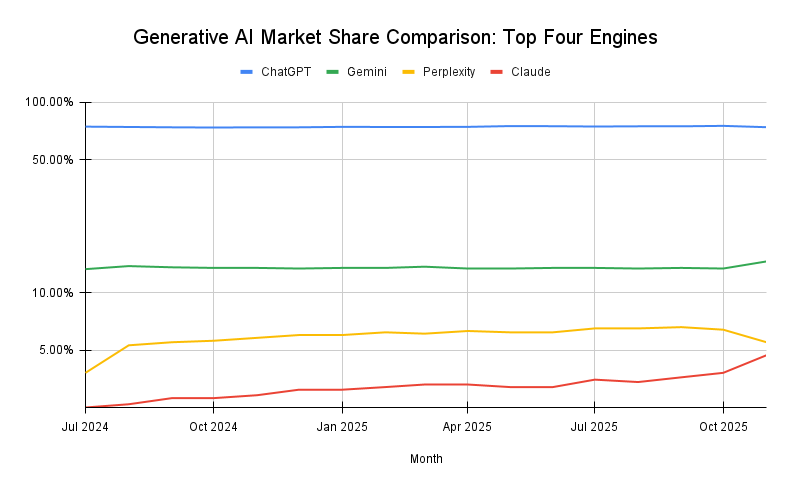
If brands don’t adapt their SEO for AI, they’ll lose visibility and miss out on new opportunities.
Sources considered – DemandSage | Second Talent | Exposure Ninja | First Page Sage
How AI Models Choose and Surface Content?
AI models follow certain signals that help them decide which sources are trustworthy and most helpful for the user. Some of them are:
1. Authority and Trust
AI looks for content that comes from credible sources. If your website shows expertise, strong domain history, and consistent topic focus, AI is more likely to help you rank in AI search and treat it as a trusted authority.
2. Clean Structure and Readability
AI understands content better when it’s well organized. Strong headings, short paragraphs, and straightforward language help the model understand your page faster and rank in AI search. If your content is easy for a human to scan, it is also easier for AI to detect the part that best solves the user’s query.
3. Alignment with User Intent
AI tries to understand what the user really wants. It looks beyond the keywords and tries to understand the goal of the query. When your content responds directly to the underlying goal of the query, such as explaining a concept, guiding a decision, or providing steps to follow, AI recognizes its usefulness and surfaces it.
4. Fresh and Updated Content
AI often prioritizes fresh content that reflects current information. Pages that are updated regularly, include recent data, or show clear modification dates send signals of relevance and reliability. Content that sits untouched for years slowly loses weight in AI output.
5. Answer Ready Formatting
AI looks for content that already feels like a direct answer. When you include short summaries, clear definitions, or concise explanations, the AI can lift these directly and present them to the user. You are essentially making your content “AI-ready.”
6. Schema and Semantic Clarity
Using structured data like FAQ or How-To schema, along with various seo tools, helps AI interpret your content and increases the likelihood your page will rank in AI search. Even if not every model fully relies on schema, it still improves content clarity and discoverability.
Now that you understand how AI selects sources, let’s look at the practical steps you can take to make AI choose your brand more often.
How to Rank in AI Search Results? 6 Core Strategies
Your brand can rank in AI search when you work on sending the right signals to AI platforms through your content, structure, and credibility, which is why having a solid AEO and GEO strategy is essential.
These six strategies show you exactly how to rank in AI search results. Let’s understand each in detail!
Strategy #1. Create Structured and AI-friendly Content
If you want AI platforms like ChatGPT, Gemini, or Perplexity to reference your website, your content needs to read like the best possible answer to a real human question. These models do not reward fluff or generic writing. They reward clarity, usefulness, and demonstrated expertise.
AI crawling systems prioritize content that is structured, detailed, and genuinely helpful.
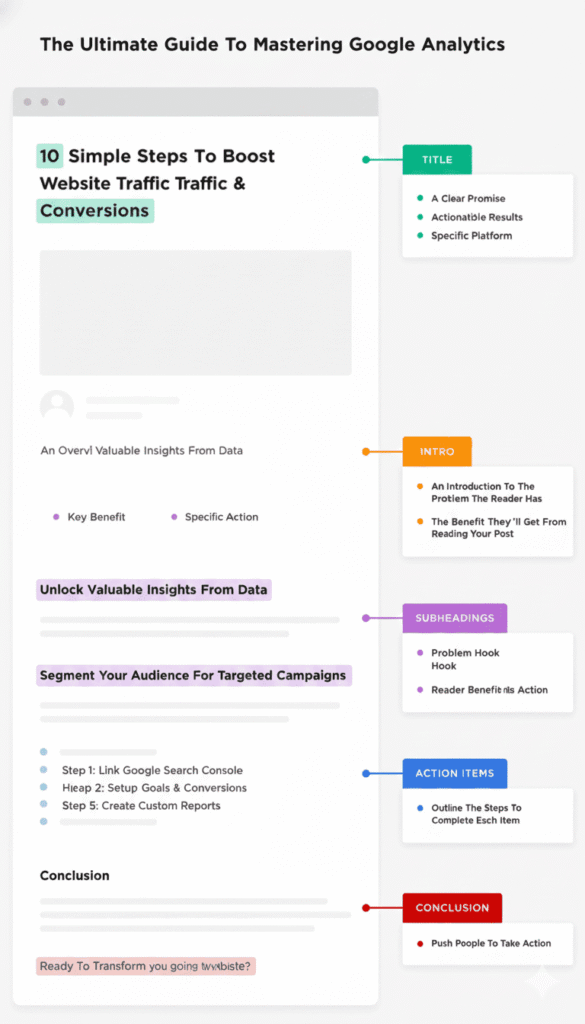
Your goal is to create AI-friendly content that fully answers user questions and presents that information in a clear, well-organized format so models can quickly scan and surface it as an authoritative source.
Here’s how you can implement this approach:
- Write for real user questions: Build your content around natural queries that people actually ask, so your pages can rank in AI search for those prompts.
- Lead with the answer first: Start each section with a direct, concise answer, then add supporting detail beneath it for high rank in AI search.
- Expand from multiple angles: Add explanations, examples, use cases, and FAQs to provide true depth.
- Use question-based headings: Phrase your headings the way a user would when asking an AI tool for help.
- Keep paragraphs short and simple: Use small, readable blocks of text that make information easy to extract.
- Use bullets and numbered lists: Structure information in ways that AI can easily lift and quote.
- Use tables for clarity: Present comparisons or differences visually so models can parse them quickly and more easily choose content that ranks in AI search.
- Include real examples and scenarios: Show practical knowledge rather than generic theory.
If your content stands alone as a clear & complete answer to a real question, AI models are much more likely to select and reference it in their responses.
Pro Tip: From featured snippet optimization to answer-ready formatting and schema implementation, each detail is necessary. Learn comprehensive optimization techniques in our step-by-step guide on how to optimize content for AI answers in 2026 to ensure your content appears consistently across all major AI platforms.Strategy #2. Build Authority and Trust Through Expertise Signals
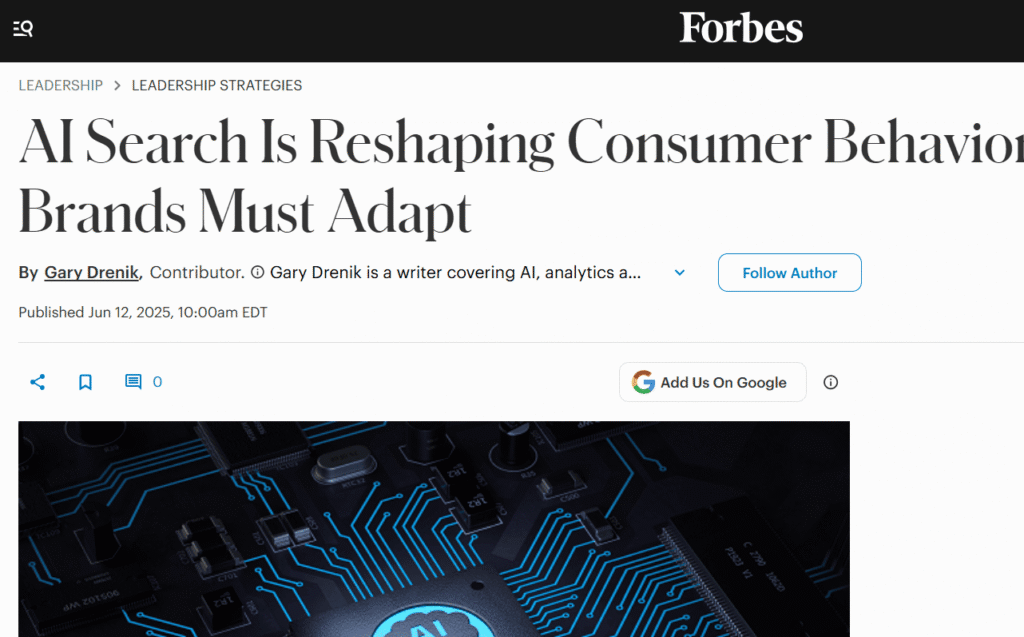
AI systems do not treat every website equally. They prefer sources that are trustworthy, experienced, and credible.
When deciding which content to cite, AI platforms evaluate signals like backlinks, brand mentions, external references, and domain reputation.
This is where many brands fail in their content creation efforts.
They optimize for keywords, but not for authority. And without visible expertise, AI platforms like ChatGPT, Perplexity, or Gemini will simply choose a competitor instead.
So, if you want AI systems to treat your brand as a reliable source, you need to actively build digital authority through effective seo services.
Here’s how to build it in practice:
- Show real author identity: Author bios that state expertise help AI trust your content and increase the chance to rank in AI search.
- Go beyond surface-level information: Provide deep explanations, frameworks, technical detail, and original thinking.
- Publish on authoritative industry platforms: Guest posts and mentions improve brand signals and help you rank in AI search more reliably.
- Use digital PR strategically: Promote research, launches, insights, and meaningful milestones so trusted sources mention your brand and help it rank in AI search.
- Participate in expert ecosystems: Join interviews, webinars, panel discussions, and industry podcasts to establish visible expertise.
- Collaborate with recognized brands: Partnerships and co-authored content increase your perceived authority footprint.
- Track and encourage brand mentions: Respond to community discussions, Reddit threads, forums, and Q&A content where users reference your brand.
- Earn genuine backlinks: Seek quality citations on respected sites rather than cheap link building or irrelevant directories.
In short, the more proof of credibility around your brand, the more likely AI is to use your work as a reference.
Strategy #3. Prioritize Technical SEO
Many brands write great content, but not every brand gets AI attention. Not because the content is weak, but because the site is invisible to AI crawlers.
You need to understand that AI crawlers don’t behave like Google at all. Google builds a giant library of the internet over time. It takes everything, stores it, indexes it, and then serves results from that database.
AI is different and uses the RAG ( Retrieval-Augmented Generation) system. It doesn’t always rely on a stored index.
When a user asks a question, AI often goes and looks for information right now, in real time, from the web rather than pulling it from a static database like Google.
So if your site is slow, blocked, or hard to parse, AI won’t wait. It won’t even try to decode your pages. It will simply choose a competitor whose content is easier to access.
This is why your job is to make your site frictionless for AI to crawl and understand.

Here’s how to make your site easy for AI search engines to read and reference:
- Make your site accessible to AI crawlers: Your robots.txt should allow important AI bots like OAI SearchBot, GPTBot, PerplexityBot, and also Googlebot and Bingbot. If blocked, they will bypass your site entirely.
- Use clean URLs and structured headings: Readable URLs and a clear H1 to H3 hierarchy help AI quickly understand how your content is organized.
- Ensure important content is visible in raw HTML: Many AI crawlers don’t execute JavaScript, so any content loaded dynamically may not be seen or indexed at all.
- Improve site speed and overall performance: Faster pages are easier for AI to evaluate and more likely to rank in AI search. Aim for less than 2.5 seconds LCP and optimize large images so they don’t slow down rendering.
- Build logical internal linking and navigation: Clear internal linking helps AI understand topic relationships, depth, and context between pages.
- Use server-side rendering or prerendering if needed: If your site uses frameworks like React, Next, or Vue, make sure boilerplate and core content are rendered server-side so AI can read it directly.
- Add an llm.txt file: This file guides AI models on what content they may and may not access. It gives you a strategic advantage as AI governance evolves.
Overall, Technical SEO acts like removing roadblocks. If your site is fast, open, and structurally transparent, AI search crawlers can easily understand it, extract useful information, and reference it inside answers.
Strategy #4. Use Structured Data and Schema Markup
They don’t automatically know if they’re looking at a product listing, a blog article, a review, or a question-answer section.
That’s where schema markup solves this problem by telling AI exactly what each part of your content represents.
Schema works like putting clear labels on containers, so AI does not have to guess what is inside.
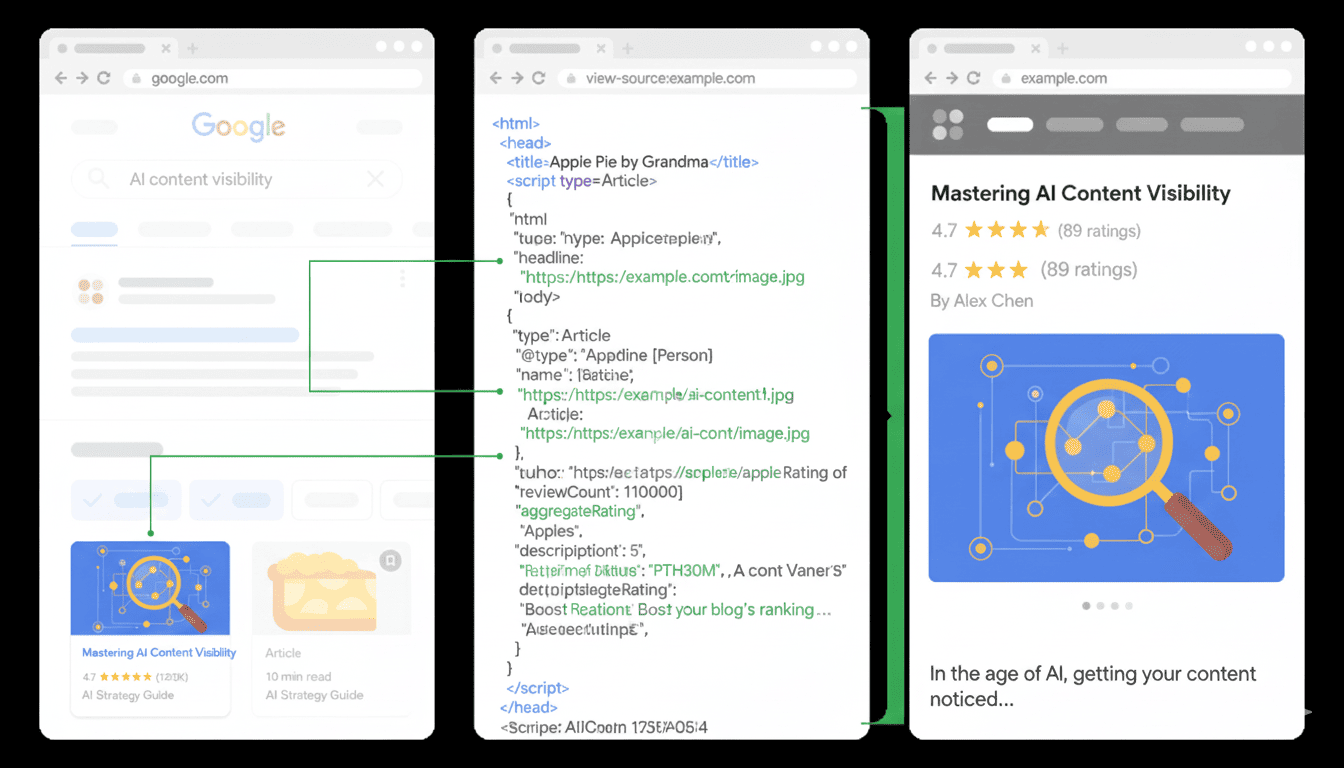
Schema acts as a translator between your content and AI models. It provides structure, meaning, and context, which helps AI extract accurate answers and reference your content inside responses, improving your AI content visibility.
Here are the types of schema that are especially useful:
- FAQPage for Q&A-style content
- Article for blogs and editorial pages
- HowTo for step-by-step tutorials
- Product for service or software offerings
- Organization for brand identity
- Review and AggregateRating for ratings and customer feedback
When AI models know exactly what your content is, they can reference it more confidently in answers.
Tip: Using the FAQ schema is particularly effective because it mirrors the Q&A style AI uses to decide which pages rank in AI search.
Here’s how to use schema effectively:
1. Choose schema types that match your content
Different schema types communicate different meanings to AI. Use the ones that fit your page:
- Article — for blogs, guides, and editorial content
- Product — for tools, services, pricing, and features
- FAQPage — for question answer content
- Organization — business name, logo, links, and social profiles
- LocalBusiness — address, hours, and contact information
- AggregateRating — rating values and review counts
- BreadcrumbList — shows internal page hierarchy
- VideoObject — for video pages with metadata
- Event — for events and schedules
- Review — for individual reviews
- Course — for educational pages
- Dataset — for data sets
- HowTo — step-by-step instructions
- ItemList — for collections like resources, job listings, or product directories
- CollectionPage — container pages holding multiple items
Even though you may not use all of them, choosing the right schema type helps AI know exactly what your page represents.
2. Use JSON-LD when adding schema
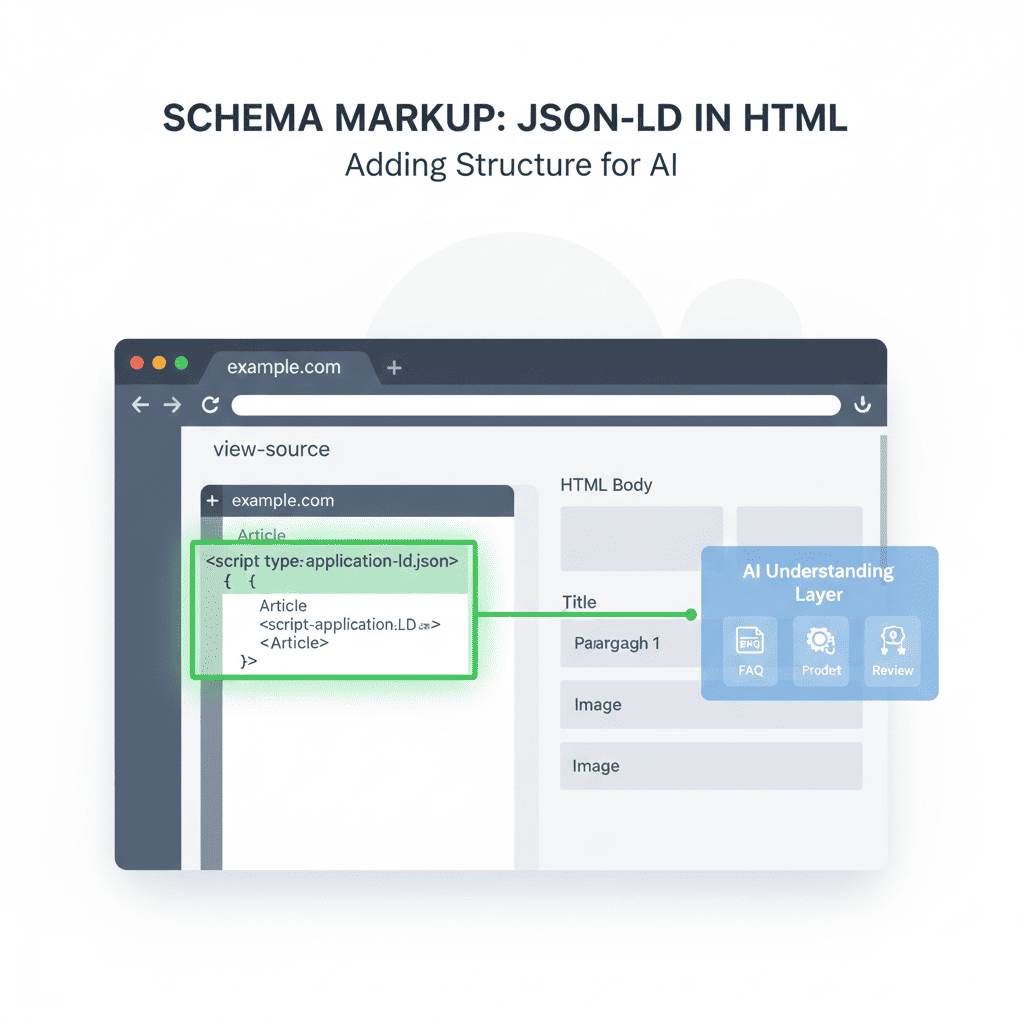
Add your schema markup in JSON-LD format inside the HTML of your page. This is the format preferred by Google and AI models because it’s clean and easy for them to read.
Note: Only use a schema that actually matches your content. If the markup doesn’t reflect what’s really on your page, AI simply ignores it.
3. Test your schema before publishing
Use tools like Google’s Rich Results Test or Schema Validator to make sure your schema is error-free and fully readable by search engines.
4. Monitor performance and fine-tune
Watch how schema affects your visibility over time. If it boosts impressions, click-through rates, rich results, or AI citations, you know it’s working. And since most websites still don’t use schema at all, having it in place gives you a real edge. AI tools naturally prefer clean, clearly labeled content.
Only 30% of websites are using schema markup. That means applying it gives you an instant edge. AI search engines are far more likely to use information from pages that are clearly labeled and structured.
Strategy #5. Keep Content Fresh and Indexed
Most websites don’t understand that AI does not just look for the best content.
It also looks for the most current content.
If your page looks old, even if the information is accurate, AI may treat it as outdated and choose another source that looks more actively maintained, making it harder to rank in AI search.
AI models tend to trust content that shows ongoing updates, revised data, active maintenance, and visible proof of current relevance. When you consistently refresh and optimize your pages, you send a strong signal that your expertise is relevant right now.

So, your goal is to make your website feel alive.
Here’s how to maintain content freshness in a practical way that AI recognizes:
- Schedule regular content audits: Review key pages every 6 to 12 months and locate outdated stats, references, old screenshots, or missing developments to improve your chance to rank in AI search.
- Update with new data and examples: Swap old industry numbers for new ones. Add fresh case studies, updated insights, or emerging trends that reflect the present landscape.
- Ensure linked sources are fresh too: If you link to old research from 2017, it hurts trust. Linking to new 2025 studies boosts your credibility signal.
- Show visible freshness: Include a “Last updated” date on your page. This instantly tells users and AI that the content reflects current knowledge.
- Improve structure with each update: Use better headings, bullets, and summaries so AI can extract answers faster and more accurately.
- Signal updates to search engines: After editing a page, revise the modification date in your CMS and resubmit URLs in Search Console so Google re-crawls and re-indexes the refreshed content.
- Use tools to spot aging content: Platforms like SurferSEO or Clearscope make it easy to identify pages losing rank in AI search or engagement.
- Understand that even small updates count: You don’t have to rewrite entire pages. Sometimes just one new stat, one new example, or a fresh section can push your content back into AI visibility and help it rank in AI search.
Keeping your content updated tells AI systems that your site is active, relevant, and trustworthy.
Because Fresh content builds trust. And in AI search, trust is visibility.
Strategy #6. Enhance Backlink and Citation Profile
If you want AI tools to reference your content as a trusted source, you need more than good writing.
You need external proof that the internet trusts you.
That trust shows up through backlinks, citations, brand mentions, quotes, and references across credible websites and communities that optimize for voice search.
AI models analyze who talks about you, how often you are mentioned, and in what context. They give more weight to brands that are widely referenced by others rather than brands that only reference themselves.
AI is essentially asking a simple credibility question:
“Do real people and real platforms consider you an authority?”
Here’s how you can build that kind of authority that AI responds to:
1. Publish on established industry platforms
When credible sites mention you or link back to you, it acts as a trust badge and makes it more likely you’ll rank in AI search. Publishing expert content on respected industry publications signals legitimacy, increases your reach, and helps AI associate your name with authority in the space.
2. Earn genuine mentions in real communities
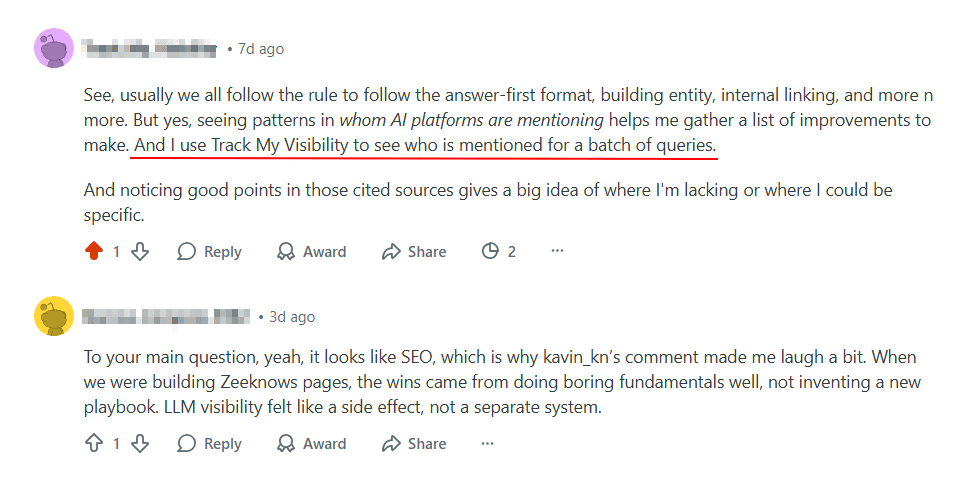
AI models pull heavily from user-generated places like Reddit, Quora, Twitter, Slack communities, Facebook groups, and niche forums. These organic discussions carry real-world authenticity. A genuine mention from a real user often influences AI more than a press release.
3. Use digital PR to create visibility
When you have something worth sharing:
- Original research
- New features
- Milestone achievements
- Industry analysis
- Expert opinions
Turn it into coverage opportunities. Being quoted or referenced in trusted outlets makes your brand more credible in AI eyes.
4. Build strategic partnerships
Collaborate with other reputable brands and appear in interviews together. Partnerships transfer authority through association, which AI picks up as trust signals.
5. Strengthen social proof
AI looks at:
- reviews
- ratings
- testimonials
- platform listings
- marketplace credibility
- user feedback
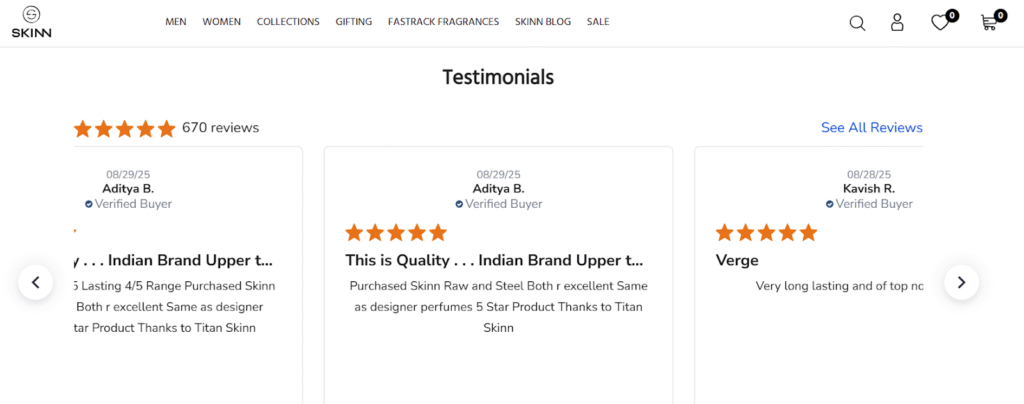
The more positive external proof you accumulate, the more trustworthy your brand footprint becomes.
6. Focus on quality links, not just quantity

One backlink from a highly authoritative site in your industry is more valuable than 50 random directory links. Avoid cheap backlink tactics. AI can detect manipulation and reward authenticity.
7. Monitor your mentions and convert them into citations
If someone references your brand without linking, reach out and request a citation. Each added link strengthens your knowledge graph and association signals.
8. Become a source worth quoting
Your long-term goal is to produce original thinking rather than recycled content. AI prefers the originator over the imitator. When you generate insights instead of repeating others, your visibility multiplies.
The more trusted your brand becomes across the web, the more AI models will recognize you as an authoritative source worth surfacing in answers.
Pro Tip: From People Also Ask optimization to featured snippet targeting and E-E-A-T signals, Google’s AI system requires specific tactics. Master Google-specific optimization in our detailed guide to rank in Google AI Overviews for platform-specific strategies that drive visibility.How Track My Visibility Can Help You Track and Improve Your AI Search Visibility?
You now understand how AI decides which brands to mention.
And now it’s your turn to know if AI platforms are mentioning your brand for user queries.
Track My Visibility gives you the truth through real data.
Learn exactly how it works to track your brand mentions across ChatGPT, Perplexity, Gemini, and Claude in real-time. With TMV, you can instantly see whether your brand appears inside AI responses across top AI platforms, including ChatGPT, Perplexity, Gemini, and Claude.
You’ll also learn if you rank in AI search for your priority queries.
You’ll know in which contexts you are being referenced, how frequently you appear, and whether AI is highlighting your competitors instead.
Once you clearly understand your position in AI answers, you can make smarter improvements.
Check how AI sees your brand with our AI visibility tracker and know where you truly stand today.
Book a demo and start tracking brand mentions in AI search.
Conclusion
AI search isn’t something coming in the future. It’s happening right now.
Millions of people are already asking AI for recommendations, comparisons, solutions, and brand suggestions. And every time they do, AI chooses which brand to present.
That choice determines who gets seen and who gets ignored.
You now understand what AI looks for and what makes a brand worth mentioning. The next step is putting that knowledge into action so your brand can actually rank in AI search for relevant queries.