Search isn’t broken, but user expectations have changed over time. Now, people don’t want to scroll through multiple links just to piece together an answer.
According to Demandsage, Perplexity has over 30 million monthly users, and it has also partnered with Snapchat, powering AI search for nearly 1 billion mobile-native users.
This rapid advancement signifies a bigger change in how search behavior is evolving across the web.
This shift is exactly why the debate around Perplexity vs Google has picked up momentum.
Here’s what you’ll learn from this blog:
- Why traditional search often feels overwhelming
- How Perplexity and Google approach search differently
- When AI search is better than Google and when it isn’t
- What this shift means for brands, content creators, and SEO
The Core Problem With Traditional Search Engines
Traditional search engines’ core job has always been simple: crawl pages, rank them, and show the most relevant results for a query. This model worked best when users had a lot of time to scroll and go through multiple pages.
Google search perfected this model and still dominates global search for good reason. But, as the user experience has changed, we can clearly see the gap.
When users enter complex search queries, they often face:
- Long result pages filled with multiple ads that they have to scroll through.
- Articles that have the same or a similar level of information.
- Users have to go through conflicting explanations across multiple sites.
Instead of getting an answer, people end up managing information. This gap between intent and outcome is where frustration begins.
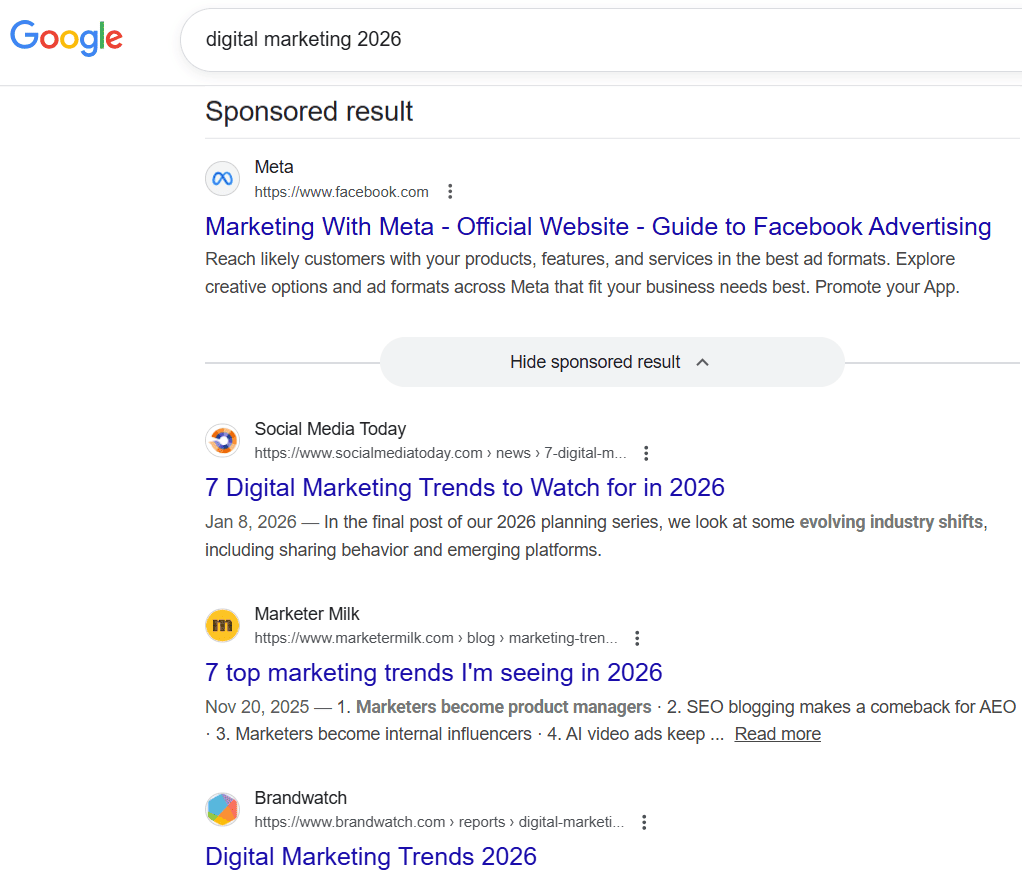
Here’s an example where you can see how ads and similar headlines dominate the page. To get the right information, users will have to compare multiple links before finding a clear explanation.
How Users Experience Search Today?
Most users no longer read pages top to bottom. They skim, scroll, and jump between tabs. A typical session might involve five searches, several clicks, and a growing sense that time is slipping away.
This behavior has made SERP comparison a habit. People compare titles, snippets, and URLs, hoping one link finally explains things clearly. In practice, that means more effort for less clarity.
AI search tools entered into the picture to address this exact pain point.
What Is Google Search and How It Works?
Google search relies on large‑scale crawling, indexing, and ranking. When a user types a query, Google’s system analyzes user intent using machine learning and then returns pages from its index that it believes best match the intent.
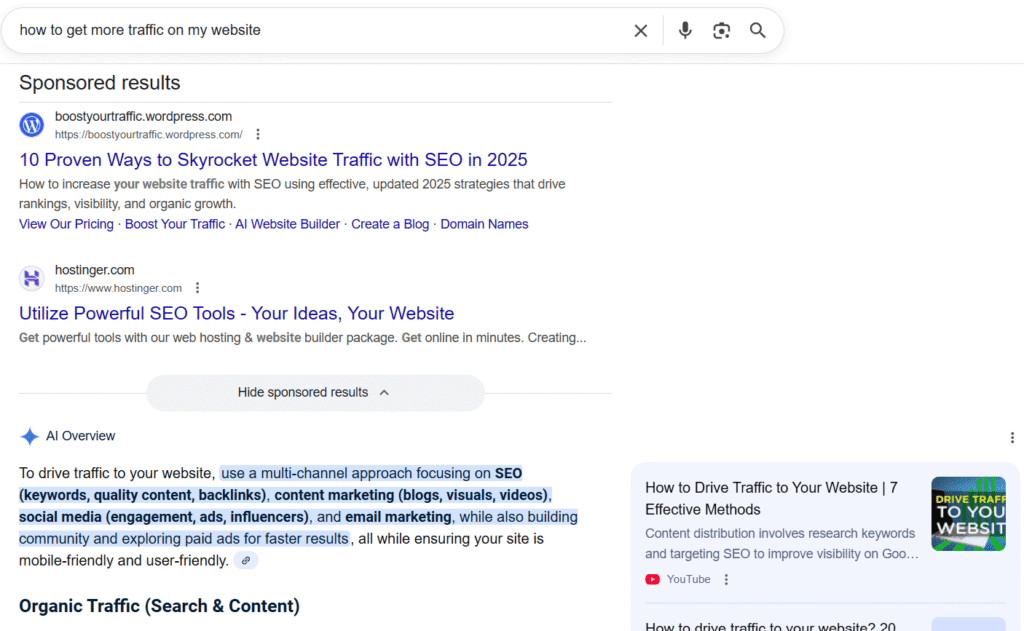
Over time, Google has added multiple layers to this process. These layers serve different purposes, such as organic features including featured snippets, knowledge panels, and Google AI overviews. And for paid elements they have sponsored ads, and shopping ads.
These additions aim to speed up discovery, yet they also reshape how results appear.
Strengths of Google Search
Google remains unmatched in certain areas, which includes:
- Local results: Google includes maps, directions, and nearby services in a unified interface.
- Shopping searches: Users can get direct access to prices and availability of the product.
- Navigation queries: With the help of a knowledge panel, users can go to specific sites or apps.
- Multimodal search: With the help of Google Lens you can do visual search.
Google has also accommodated Gemini AI to enhance user experience. Gemini’s 3 Deep Think mode offers progressive reasoning capabilities and 1-million-token context windows, making it a much stronger competitor for academic research than it was a year ago.
For quick lookups or action‑oriented searches, Google search results are often enough.
Limitations of Google Search
Despite its reach, Google struggles with:
- Ad‑heavy result pages that distract from answers
- Fragmented information spread across multiple pages
- Limited depth for academic research or multi‑step analysis
This is where the Perplexity vs Google discussion becomes relevant. But, first, let’s understand more about Perplexity.
What Is Perplexity and How It Works
Perplexity is an AI search engine that is built around answers, not links. Instead of ranking pages and letting users decide, it reads from multiple sources and produces a single explanation.
It provides users with the unified information along with citations. Now, let’s see how it actually handles a search query:
How Perplexity Handles Search Queries
Perplexity focuses on intent rather than isolated keywords. It:
- First it analyzes the query and tries to find the meaning behind a query.
- Then, it pulls out relevant information from indexed sources such as Reddit, academic databases etc.
- After getting all the information related to the query, it presents each answer with citations.
This approach is especially useful for deep research, learning, and comparison tasks. Learn more about how Perplexity works (link) in detail.
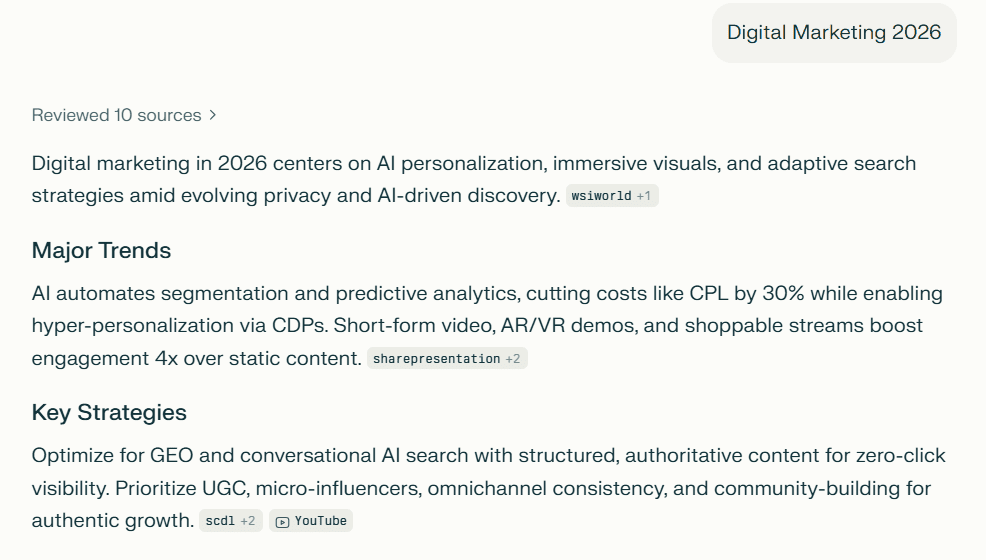
Here’s an example where you can see how Perplexity gathers information from multiple sources and forms it into one structured answer.
Strengths of Perplexity
Key advantages include:
- Clear and structured answers: It provides users with combined answers, rather than providing them with multiple links.
- Visible source links for verification: It provides citations at the end of every answer so that users can verify the information.
- Reduced noise compared to traditional search: It has minimized ads and distractions in comparison to traditional search.
- Strong support for follow‑up questions: Its conversational search allows for deeper exploration of topics.
Many users describe Perplexity as easier to use when exploring unfamiliar topics.
Limitations of Perplexity
Perplexity is not ideal for everything. It can struggle with:
- Doesn’t provide real-time business data and mapping services.
- Doesn’t have any direct relationships with merchants or with inventory tracking systems.
- It cannot provide live and turn-by-turn navigation as Google.
Important Note: Perplexity does provide citations with every answer, but it’s really important to verify critical information.
Understanding these trade‑offs is essential when weighing Perplexity vs Google.
Perplexity vs Google Search: Feature‑by‑Feature Comparison
Before we dive deeper, let’s get a quick overview to frame the comparison. Google Search lets users choose the links, whereas Perplexity helps users reach conclusions.
| Feature | Perplexity | Google Search |
| Primary Output | Direct answers | List of links |
| Citations | Inline source links | Sources via webpages |
| Interaction Style | Conversational follow-ups | New query per search |
| Answer Structure | Single summarized response | Information spread across pages |
| Research Use | Strong for quick research | Strong for broad exploration |
| Ads Presence | No ads | Ads shown prominently |
| Context Handling | Maintains query context | Limited context memory |
| Speed to Insight | Immediate conclusions | Requires comparison |
| Cost | Free (Pro tier available) | Free with ads |
| Privacy | Minimal data collection | Extensive data tracking |
| Up-to-Date Information | Depends on source recency | Real-time crawling |
| Local / Personalized Results | Limited | Extensive (location, history) |
Now let’s explore these differences in context.
1. Search Results Experience
Google presents options. Perplexity presents conclusions.
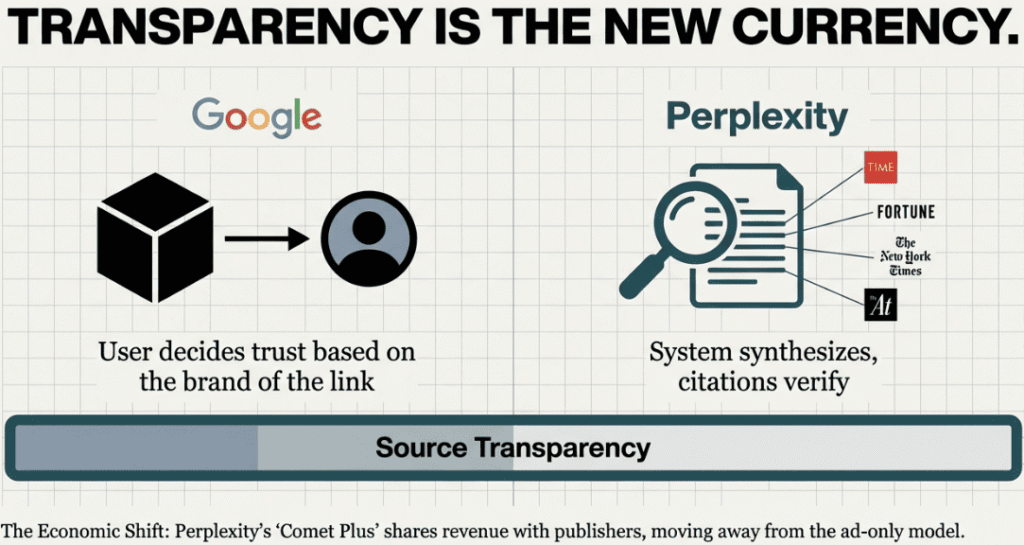
With Google, users choose which link to trust. With Perplexity, the system synthesizes information and explains it directly. This difference defines the modern AI search vs traditional search debate.
2. Ads vs Answers
Google’s business model relies heavily on advertising. Sponsored results often appear before organic ones. Perplexity, by contrast, currently focuses on answers first. In a 2026 pivot to support the open web, Perplexity now shares 80% of revenue from its Comet Plus subscriptions with partner publishers like Time, Fortune, and Der Spiegel, creating a more ethical ‘peace offering’ compared to Google’s traditional ad-model.
3. Accuracy and Context
For complex topics, AI search tools often provide better context. They connect ideas, explain relationships, and reduce repetition.
That’s why many people now ask whether AI is better than Google for learning‑focused searches.
4. Use Cases Comparison
Google works best when:
- You want to see live traffic, pharmacy hours nearby, or a flight status.
- You want a photo in Google Photos, or jump to a specific website.
- You want to identify a plant or search for a specific moment in a YouTube video.
- You want to check the price or use a payment method for an instant checkout from a search result.
Perplexity works best when:
- You want a deep research mode to browse hundreds of sources and write a 2,000-word market report in minutes.
- You need a citation to verify resources when exploring a complex topic.
- You want to use the Comet Browser to automate a multi-step workflow, like “Find the 5 best-reviewed mechanical keyboards, compare their prices, and draft a summary in a new Google Doc.”
- You want a clean, “answer-first” experience without the noise of SEO-optimized “listicles” or heavy banner ads.
Is AI Better Than Google for Search?
The answer is simple: it depends on what you’re trying to do. The longer answer is where the real comparison begins.
AI search tools are built to understand meaning, context, and intent. They aim to explain a topic, not just point you toward pages. When someone wants to learn why something happens or how different ideas connect, AI search tools reduce the load. You can simply ask a question, get a structured response, and move forward without juggling tabs.
Google, on the other hand, still shines when the goal is action. Booking a service, finding a nearby place, checking opening hours, or reaching a specific website all fall into its comfort zone. In those moments, speed and access matter more than explanation.
So when people ask whether AI better than Google, the real issue isn’t quality, it’s the intent. Understanding versus execution and Clarity versus navigation.
AI Search for “Understanding”
AI-powered search tools focus on reasoning and synthesis. They combine information, explain relationships, and often respond to follow-up questions without forcing users to rephrase their query. This makes them especially useful for research-heavy tasks, comparisons, or learning something unfamiliar.
Behind the scenes, these systems rely on structured data, context awareness, and conversational prompts. The experience feels closer to interacting with AI chatbots than browsing a list of links, which explains why many users find them easier to engage with for complex topics.
Google Search for “Action and Navigation”
Google remains the default when users need to do something. Its strength lies in helping people navigate the web, reach destinations, and complete tasks quickly. For transactional searches or location-based needs, its ability to deliver targeted results is still unmatched.
This contrast is a key reason the Perplexity vs Google discussion keeps resurfacing. Each tool solves a different problem, and neither fully replaces the other.
The Future of Search Engines
Gartner’s 2024 report predicted that traditional search engine volume will drop by 25% by 2026, as users are shifting to AI chatbots and virtual agents to gather primary information.
Search engines are gradually moving away from acting as directories and toward becoming decision-support systems. Instead of sending users off to explore on their own, newer experiences aim to summarize, explain, and guide.
That shift has visible effects like fewer clicks across multiple pages, more direct answers on the first screen, and greater emphasis on context over keywords.
Traditional search isn’t going away. It’s adjusting. Google is already introducing AI features and more advanced features into its results, while AI-first platforms continue refining how they present answers. The future isn’t a takeover, it’s a blend.
What This Means for Brands and SEO
For brands, visibility now depends on more than ranking a page. Being understood by AI systems matters just as much as being indexed by search engines.
AI search tools typically reference a smaller set of sources. That means fewer opportunities to appear, but more value when you do. Clear explanations, consistent facts, and credible authorship influence whether a brand is included at all.
Many brands lack visibility into how AI systems surface their content. Unlike traditional SERP tracking, AI search monitoring requires specialized tools. Platforms like Track My Visibility help teams understand their presence across AI-driven search experiences.
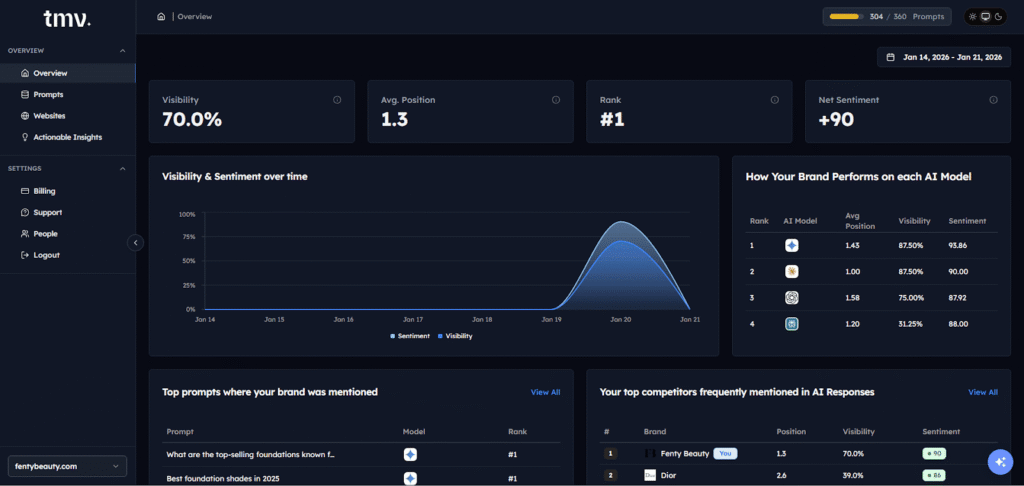
Many brands don’t realize they’re being evaluated by AI systems every day. Content may appear in one answer and disappear from the next, often without any obvious signal.
Unlike traditional SERPs, AI responses draw from a limited pool of sources. If your content isn’t selected, users never scroll past it, they simply never see it.
Monitoring this shift requires new tools and new habits. And Track My Visibility helps teams understand where they show up, where they don’t, and how changes in content affect their presence across AI search tools.
What’s Next?
If you’re wondering, how will everyday users and brands adapt to changing search behavior? To get a clear direction let’s see when to use Google versus AI tools like Perplexity, and how content strategies need to evolve for AI-driven search.
For Everyday Users
Use Google when you need directions, quick facts, or to navigate to a specific site. Turn to Perplexity when you want to understand a topic, explore ideas, or get a summarized answer without extra effort. Knowing when to switch gives users more control and better results.
For Brands and Content Creators
Content needs to do more than attract clicks. It needs the ability to explain clearly, answer real questions, and earn trust. Focus on usefulness first, structure second, and keywords last. Tracking how AI systems interpret and use your content will become just as important as traditional SEO metrics.
Final Thoughts
The Perplexity vs Google debate isn’t about replacing one with the other. It’s about understanding intent.
Search is evolving, not disappearing. AI search and traditional search will coexist, each serving different needs.
Those who adapt early, users and brands alike, will stay visible as the rules continue to change.
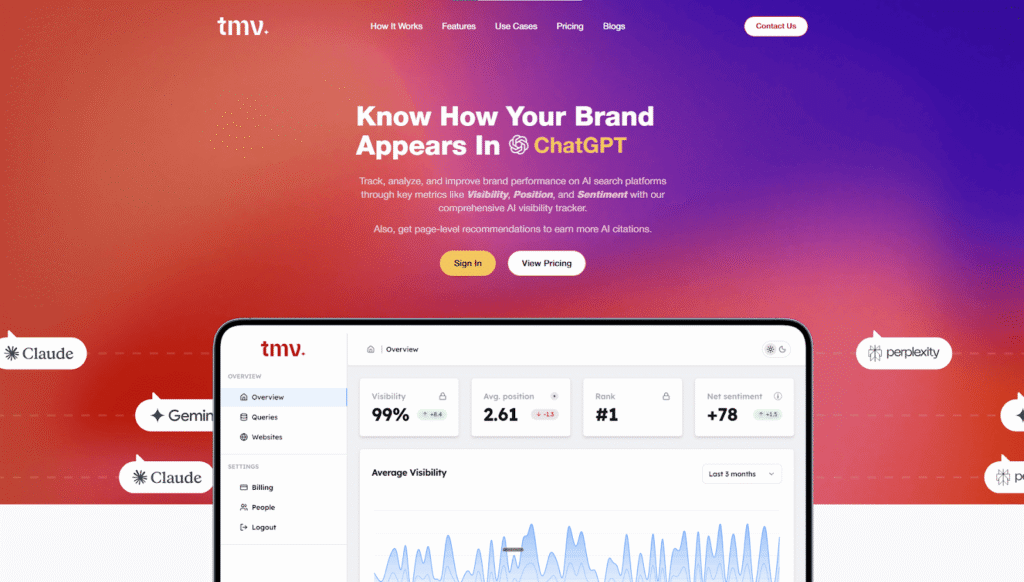
To understand how AI-powered search tools cite and reference your content, specialized tracking is very important. Track My Visibility helps with monitoring your brand’s presence across multiple AI search platforms, helping you optimize for this new search landscape.
Frequently Asked Questions
Will Perplexity Replace Google?
No. Perplexity won’t replace Google because it is still better for navigation and local tasks, while Perplexity is better for understanding and research.
What is so special about Perplexity?
Perplexity AI search gives direct, clear answers instead of links and shows sources for verification. It’s designed to explain topics, not just point to websites.
Which AI is better than Google?
No AI is strictly “better” than Google overall. AI tools like Perplexity or ChatGPT are better for learning and research, while Google is better for actions and navigation.
Does Google own Perplexity?
No, Google does not own Perplexity. Perplexity is an independent AI company and operates separately from Google and its search products.