


Here’s something a lot of site owners are scratching their heads over right now: the rankings are fine. Page one, same as always. But the traffic? It’s been quietly dropping out for months.
You didn’t do anything wrong. Your content didn’t fall. Your backlinks didn’t disappear. What changed is that Google Gemini SEO has become the new battleground, because Google is handing out answers before users ever feel the need to click.
According to Ahrefs data, AI Overviews now reduce click-through rates for the top-ranking result by 58%. That’s nearly double the figure measured just eight months earlier. That’s the Gemini search impact playing out in real numbers. If you are not familiar with how ranking in Google AI Overviews works, that number will only get harder to ignore.
If your pages aren’t being cited inside those AI-generated answers, you’re losing visibility you didn’t even know existed. And most sites have no idea it’s happening.
In this blog post, we will cover:
- What Google Gemini SEO actually means and how it differs from traditional SEO
- How AI Overviews, AI Mode, and the Gemini app work differently
- The signals that actually drive AI visibility (and the ones that barely move the needle)
- A practical Gemini SEO strategy you can start executing this week
Key Takeaways
- AI Overviews now cut click-through rates by 58% for top-ranking pages, and that number is accelerating.
- Ranking on page one no longer guarantees you’ll appear in Gemini’s cited sources.
- Content structure, schema markup, and freshness now outweigh backlink volume for AI citation signals.
- Gemini pulls from the entire Google ecosystem, so your YouTube, GBP, and Knowledge Graph data all feed into it.
- Measuring AI visibility requires different tools and methods than traditional rank tracking.
What is Google Gemini SEO?
Google Gemini SEO means optimizing your content so that Google’s Gemini-powered AI surfaces your pages as cited sources. That includes AI Overviews in standard search results, the newer AI Mode experience, and the standalone Gemini app. Each surface cites differently, serves a different audience intent, and has its own zero-click rate.
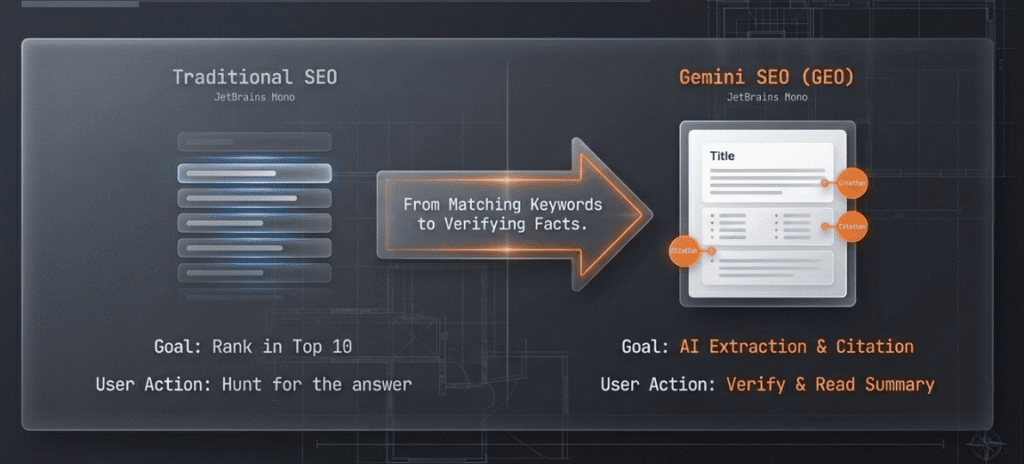
Traditional search engine optimization asked one question: Can I rank in the top ten? Gemini SEO adds a second question: even if I rank, will Gemini cite me? Those aren’t always the same answer. You can sit at position eleven and still get pulled into an AI-generated overview. Even at position one, you can get ignored entirely.
You will often hear people call this GEO, or Generative Engine Optimization. They are essentially the same thing. The strategy is to create content that AI systems can easily extract, trust, and reference. Instead of just writing for a human reader, you are also making sure the “AI” can verify your facts and give you credit for them.
AI Overviews vs. AI Mode vs. Gemini App
Most teams treat these three as one optimization target. They’re not, and conflating them leads to wasted effort.
| Feature | AI Overviews (AIO) | AI Mode | Gemini App |
| Primary Goal | Quick summaries within standard search. | Deep, conversational research. | Open-ended creation & complex tasks. |
| Interaction | One-shot. A static box above blue links. | Multi-turn. Supports follow-ups and “fan-out” searches. | Full Assistant. High-reasoning chat with native app access. |
| Default Model | Gemini 3 Flash | Gemini 3 Pro / Flash | Gemini 3 Pro / Ultra |
| Data Source | Top-ranking web results (pre-indexed). | Real-time “fan-out” across the live web. | Large training set + Google Extensions (Gmail, Docs). |
| SEO Impact | High risk of Zero-Click sessions. | Drives high-intent but lower volume traffic. | Brand mentions & citations are the only “rankings.” |
| Best For | “How to,” “What is,” and comparisons. | “Plan a 3-day trip” or multi-step troubleshooting. | Coding, creative writing, and data analysis. |
Why Gemini Has a Built-In Advantage Over ChatGPT for SEO
This is important only if you’re trying to decide where to focus. Gemini is native to Google’s ranking ecosystem. It draws from the Knowledge Graph, Google Business Profiles, YouTube, and the same index powering traditional search engines. ChatGPT and Perplexity don’t have that direct pipeline.
Now you might be wondering, what does that mean practically?
Your traditional SEO work still counts. It feeds into Gemini’s AI source selection. But the weighting has shifted. Structured data, content clarity, and brand signals now matter more relative to raw link volume.
These signals help the AI understand exactly what your brand does, which makes it much more likely to recommend you in an AI-generated answer. You aren’t starting over; you’re just refining your approach for a smarter engine.
How Gemini Selects Content to Cite
Gemini doesn’t just grab the top-ranking sites from a standard Google search. It looks for content it can trust, but more importantly, content it can easily pull apart and reshape into an answer. Understanding how LLMs choose content at a deeper level helps you structure pages that actually get extracted.
The Signals That Actually Correlate With Citation
The research on this is still going on, and every day we are learning something new. But these are the patterns that are consistent enough to act on:
- Semantic Completeness: Content that fully answers the query and not just mentions the keyword gets cited far more often than content built around exact keyword matches. It wants an answer that covers the “why” and “how.”
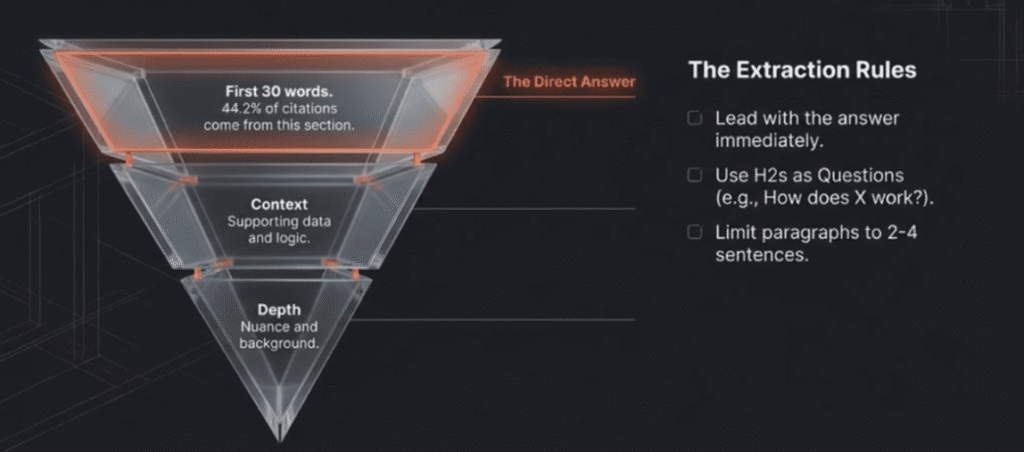
- Front-load the Value: 44.2% of citations come from the first 30% of content (Search Engine Land). So, it is very important not to answer the main information at the end.
- Schema Markup: Pages with structured data show a strong correlation with AI Overview selection. Schema acts as a map for the AI, telling it exactly what a piece of data represents so it can cite it with confidence.
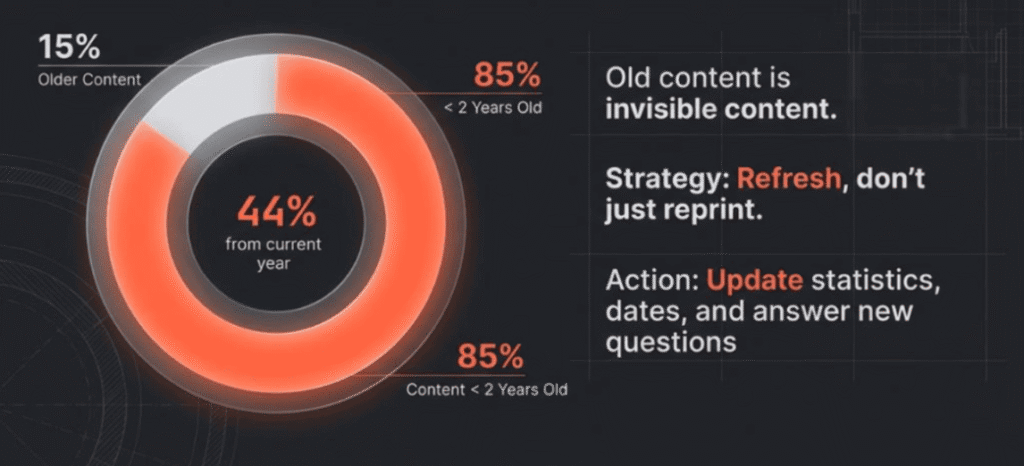
- Prioritize Fresh Content: Freshness counts more than most teams realize. 85% of AI Overview citations come from content published in the last two years, and 44% from 2025 alone (Sheer Interactive).
- Multi-modal Content: Using text, images, and structured data together makes your content more attractive for extraction across multiple formats.
- Q&A Format and Structured Headings: Q&A sections and clear headings perform much better than long, dense blocks of text.
What Doesn’t Matter as Much as You Think
Carly Steven, Director of SEO at Daily Mail, put a hard number on it: click-through rates fall 80-90% on ranking pages when an AI Overview is present versus when one isn’t. Holding position one means far less than it did when the click was almost guaranteed.
Traditional SEO focuses heavily on backlinks and Domain Authority, but for AI citations, those correlations are surprisingly weak.
That doesn’t mean links are useless; they still support your overall search engine presence. But if you’re spending most of your budget on link acquisition while ignoring content structure, schema markup, and freshness, you’re misallocating.
Brand mentions, YouTube citations, and clean on-page optimization outperform link volume as AI visibility signals. The shift isn’t dramatic overnight, but it’s consistent.
Gemini SEO Strategy: What to Actually Do
This is the practical section. Each item below is something you can execute, not a vague direction to ‘produce better content.’ Start with the foundation and build from there.
1. Get the Technical Foundation Right
Before anything else, before schema, before content rewrites, before any of the more interesting Gemini SEO strategy work. Your technical house needs to be in order. Gemini’s AI still draws from Google’s index.
If your pages aren’t crawlable, indexed, and loading fast, nothing else here will matter. Technical SEO isn’t the exciting part of this guide, but it’s the foundation that everything else sits on.
Here’s what to check:
- Core Web Vitals: Focus on LCP and CLS specifically. These affect both your search engine ranking and your citation probability. Google consistently prioritizes pages that load well and don’t jump around on the user, and that preference carries into how Gemini’s AI selects sources.
- Clean Crawl Paths: Broken links, long redirect chains, and accidental “noindex” tags are citation killers. If a crawler gets stuck or confused navigating your site, the AI never sees your content in the first place.
- Canonical Tags: Use them properly, and verify with a canonical tag checker. If you have multiple versions of the same page floating around, Gemini doesn’t know which one to trust. Pick one, signal it clearly, and be consistent.
- Indexing: Open Google Search Console and actually verify your important pages are in the index. Don’t assume. It’s a five-minute check that catches problems teams miss for months.
- Mobile: Most people interact with Google search results on their phones, and AI users on mobile are no different. If your mobile experience is clunky, slow, or hard to navigate, you’re leaving citations on the table before the content conversation even starts.
2. Structure Content So Gemini Can Lift It
Gemini extracts answer-shaped passages. It’s not reading your page like a human would; it’s pulling citable units. Keep that in mind while writing content.
The most effective format for AI-generated answers is one where each section leads with a direct answer, then supports it. Use an inverted pyramid style: answer immediately, then provide the context.
Apply this structure:
- Open with the Answer: Lead every major section with a 50-70-word direct answer before adding any supporting detail.
- Use Headers as Questions: Use question-based H2/H3 headers that mirror how users search: ‘How does X work?’, ‘What is Y?’
- Keep it Brief: Keep paragraphs to 2-4 sentences long. Tight, scannable, extractable.
- Lean into FAQs: Natural Q&A formatting is one of the most effective ways to get your content picked up for AI-generated answers. It provides a clear prompt-and-response structure that the model can easily recognize.
- Break up dense blocks: Walls of text are hard to parse. Use lists, bold text for key terms, and white space to create clear entry points for the AI.
3. Implement Schema Markup
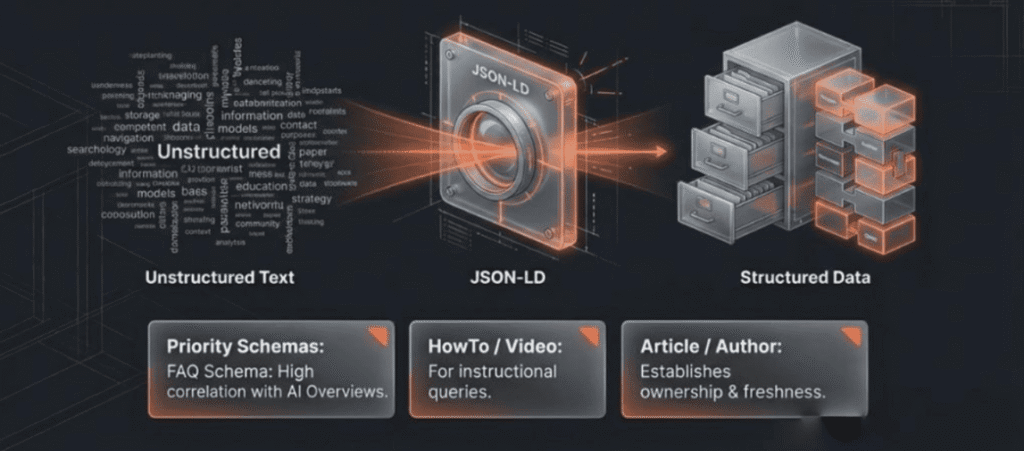
It’s a way to tell Google’s AI exactly what it’s looking at, so it doesn’t have to guess. While it won’t magically teleport you to the top of the page, it makes your content much easier for Gemini to cite and summarize. Implement using JSON-LD and validate with Google’s Rich Results Test.
Priority schema types for Gemini SEO:
- FAQ Schema: Google may not display FAQ rich results as prominently as it once did, but the markup still does quite well behind the scenes. It helps AI models quickly parse your questions and answers when building AI-generated summaries.
- HowTo and Video: Teaching someone a process? These tags help Gemini’s AI pull out specific steps or video timestamps when handling instructional conversational queries, the kind that are increasingly common in AI Mode.
- Article and Author: Marking who wrote the piece and when it was last updated gives Google’s AI a way to verify both the credibility and freshness of your content. This directly supports your E-E-A-T signals.
- Organization/Person Schema: This is what helps the Knowledge Graph connect your brand to your experts across the web. It builds the kind of digital identity that AI systems can recognize and trust when deciding what to cite.
If you’re not sure where to start, add the FAQ schema to your top informational pages this week. It’s the highest-return implementation for most sites.
4. Build E-E-A-T Signals Gemini Can Actually Verify
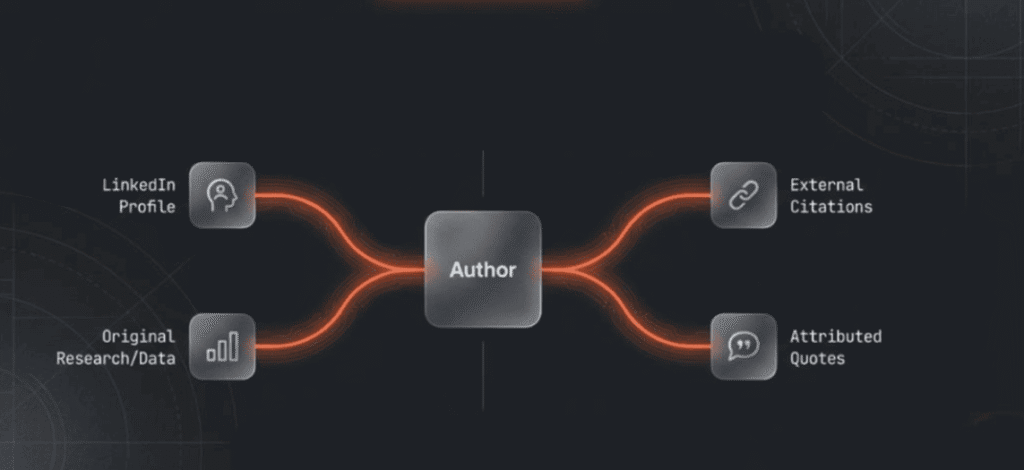
E-E-A-T (Experience, Expertise, Authoritativeness, and Trustworthiness) isn’t a box you tick on your About page and forget about. For Gemini to treat your content as a reliable source, it needs to find evidence of real-world expertise, not just read your claim that it exists.
Here’s what verifiable authority looks like in practice:
- Detailed Author Profiles: A name in a byline isn’t enough. Link it to a real author page that proves the writer’s background and connects to their LinkedIn or published work elsewhere. If someone can’t verify who wrote your content, Gemini can’t either.
- External Citations: When you make a claim, show where it came from. Linking to credible third-party sources signals that you’re part of a real professional conversation, not just publishing into the void.
- Original Research and Data: Gemini and other AI models are looking for the best answer, not just a familiar one. If you publish original data, proprietary case studies, or unique research, you become a primary source, and that makes your content far more likely to appear in AI-generated content.
- Attributed Expert Quotes: A quote from a recognized expert adds a layer of “Experience” that’s genuinely hard to replicate. Include their full name, role, and organization so the model can actually connect that person to the claim being made.
- Consistent Footprint: AI models cross-reference. If your brand or authors show up across multiple reputable sites, it reinforces the signal that you’re a trustworthy source, not a one-off publisher that appeared last month.
5. Target Conversational and Long-Tail Queries
Gemini is designed to handle conversation, not just keywords. The principles behind optimizing content for AI answers apply directly here, especially when it comes to matching the intent behind long-tail and conversational queries. When people use AI-powered search, they stop typing fragmented phrases like “best cast iron pan” and start asking full questions like, “Which cast iron pan is easiest for a beginner to maintain?”
This changes how you should approach content. Instead of just targeting high-volume head terms, you need to focus on the intent behind long-tail queries.
How to capture conversational traffic:
- Analyze “People Also Ask” Blocks: These are one of the most underused tools in keyword research. Each question in that box represents a gap, something the initial search didn’t fully resolve. If Google keeps surfacing it, real people keep asking it. Answer those questions directly in your content.
- Predict the Follow-up: AI Search is built around multi-turn conversations. Someone asks a primary question, gets an answer, then immediately asks something related. If your content addresses both the main question and the most likely follow-up queries, you’re not just a good source, you’re a complete one. That’s exactly what AI models are looking for when building a response.
- Use Autocomplete for Context: The search bar suggestions aren’t just a convenience feature. They show you how real users search, the specific phrasing, and the exact words people use when they have a particular problem. Match that language in your content, and you naturally align with conversational queries without forcing it.
- Focus on “Why” and “How”: Definitions and basic facts are easy for AI-generated answers to summarize from almost any source. Your edge is in the depth, the nuance, the practical execution, the “here’s what actually happens when you try this” layer that a surface-level summary can’t replicate. That’s where traditional search engines have always rewarded good writers, and it’s even more true now.
6. Leverage Google Ecosystem Integration
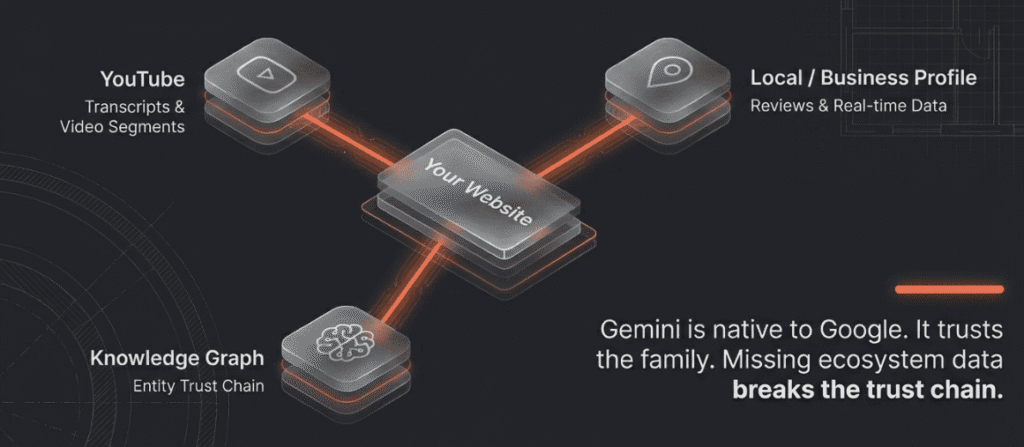
If you want to rank in Gemini and AI Overviews, you have to look beyond just the text on your page. Because Gemini is built into Google’s existing architecture, it leans on the data Google already trusts. Here is how to make that work for you.
- Claim Your Local Space: If your Google Business Profile is outdated, you’re invisible in local AI Overviews. When someone asks Gemini for a recommendation, it pulls from your reviews, photos, and service listings. Keep your hours accurate and post occasionally. Stale data gets skipped, and the AI won’t recommend what it can’t verify.
- Connect the Dots with the Knowledge Graph: Your brand should look the same everywhere Google looks, a core part of entity optimization. Your site, your Wikipedia page, your social profiles, and a consistent name, description, and category across all of them. When your entity data lines up, Google’s Knowledge Graph can identify you as a trusted source and feed that signal into Gemini’s AI source selection.
- Prioritize YouTube: Google’s ecosystem integration extends to its own products, and YouTube is a big one. Embedded videos on your pages and a consistent YouTube presence both correlate with higher AI visibility. Video transcripts are easy for AI models to extract answers from, which means video content gives you another citation pathway that pure text doesn’t.
- Monitor Performance in Search Console: There’s no dedicated Gemini tab yet, but the Search Console AI Overview filter under Performance → Search Results gets you close. Check which of your pages are being cited and which queries trigger AI Overviews. Pages already earning featured snippets or position zero are your best candidates for AI search optimization.
7. Publish Original Data and Insights
AI models like Gemini aren’t looking for another page that rehashes what’s already out there. If your content is pulling from the same sources as ten other sites, there’s no real reason for the system to pick yours. Gemini prioritizes information gain, meaning proprietary research, original case studies, or benchmark data that can’t be found elsewhere.
You don’t need a big budget for this. An internal audit with real numbers works. So does an anonymized client story. The bar is originality, not scale. And as a bonus, when you publish original data, other sites start citing you, which quietly builds your AI visibility and authority over time.
8. Keep Content Fresh
Freshness is a real signal, not just an SEO cliché. The majority of sources cited in AI Overviews come from content published or updated within the last two years. Older pages risk being skipped entirely, even if they rank well.
Refreshing a strong existing page is almost always faster than writing a new one. One user on Reddit described going through this adjustment in real time: “We tried adjusting. More specific long-tail content. Different formatting. Adding original data that AI overviews couldn’t replicate. Some of it helped. Some didn’t.”
Built our growth on SEO. Then AI overviews started answering our keywords.
by u/Over_Tart9425 in SaaS
Update the stats, address questions that didn’t exist when you first published, and make sure your metadata reflects the new date.
A simple rule: audit your top pages every six months. Anything older than 18 months that still pulls search traffic is a priority refresh candidate.
How to Measure Gemini and AI Overview Visibility
Most teams don’t know whether they’re being cited in AI-generated answers or not. Without a measurement system, you’re optimizing your website blindly. So, let’s look at what you should look for and track.
What to Track and Where
- Google Search Console: Go to Performance → Search Results → Filter by ‘AI Overview’ search appearance. This shows you impressions, clicks, and which pages are being cited. Set this up and document your baseline before doing anything else.
- Track My Visibility: A dedicated AI visibility tool for monitoring your presence across multiple AI platforms. It tracks how often your brand or content appears in AI-powered answers across Gemini surfaces, something Google Analytics alone can’t tell you.
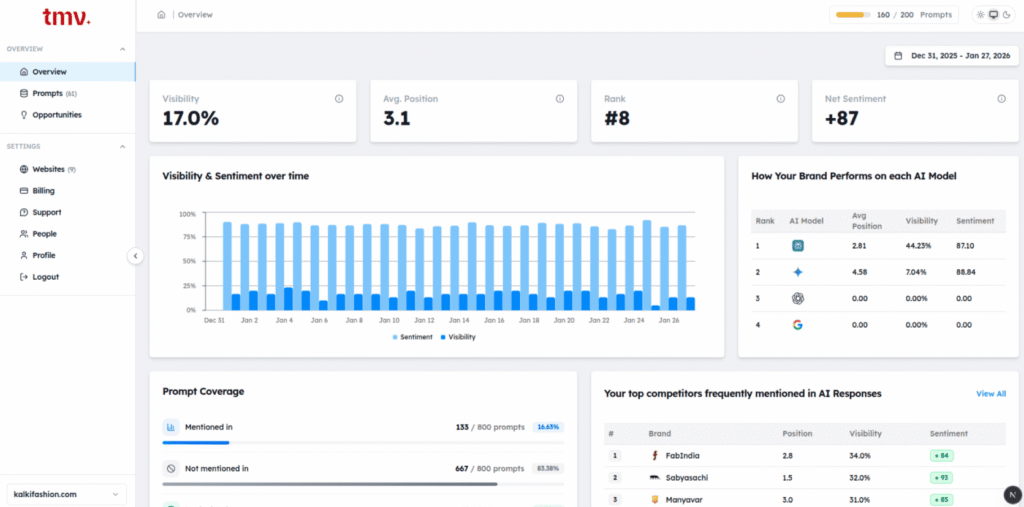
- Manual Prompt Testing: Run your core queries in Gemini, AI Mode, and standard Google search results. Document which sources get cited. Do this weekly and track in a spreadsheet. It’s low-tech, but it reveals pattern changes that automated tools miss.
- Google Analytics (GA4): Look for traffic from ‘googleother’ referrers. This can signal AI Overview click-throughs that don’t show up under standard search referrals. It’s imperfect, but it’s one of the few direct traffic signals currently available.
 Pro Tip: Manual tracking across multiple Gemini surfaces quickly becomes inconsistent. Learn how to track ai search visibility over time so your measurement doesn’t rely on weekly manual spot checks alone.
KPIs That Matter for Gemini SEO
Traditional rankings are losing their “top spot” status. To measure success in an AI-first world, focus your reporting on these three areas:
- Citation Share: The percentage of target queries where your brand is used as a primary source in an AI response.
- AI-Referred Traffic: The volume of sessions coming from AI platforms, tracked via your custom GA4 segments.
- Brand Sentiment in AI Responses: Does the AI describe your product or service accurately? Tracking how the LLM “talks” about you is just as important as the link itself.
Common Mistakes to Avoid
Most of the errors people make with Google Gemini SEO come down to one thing: assuming it works like the search engine they’ve been optimizing for the past decade. It doesn’t, and that gap in thinking is expensive.
1. Treating all AI tools as the Same
AI Overviews in standard Google search results, AI Mode, and the Gemini app are three different surfaces with different audiences and different citation behavior. What earns you a mention in a standard Google search result won’t automatically get you featured inside the Gemini app. If you’re not thinking about which platform you’re targeting, you’re probably optimizing for the wrong one.
2. Prioritizing Backlinks over Structure
Backlinks built SEO careers for twenty years. They still matter for your overall authority, but their correlation with AI visibility is weak. Gemini’s AI cares far more about on-page optimization and how cleanly it can parse your content. Dense, unstructured pages don’t get cited, regardless of how many sites link to them.
3. Writing for Keywords Instead of Answers
Exact keyword matches won’t carry you in AI search. Gemini is built to understand user intent and surface direct answers, so if your content is loaded with keywords but doesn’t actually answer the question clearly, it gets skipped. Write for the person asking, not the algorithm counting.
4. Letting your Content Grow Stale
Freshness is a real signal. Gemini heavily favors recent content, so it often excludes pages that teams haven’t updated in a couple of years from its AI citations, especially in fast-moving industries. If your best-performing pages are aging out, they need a refresh, not a replacement.
5. Ignoring the Rest of the Google Family
Gemini pulls from Google’s ecosystem, which means your Google Business Profiles, YouTube presence, and Knowledge Graph entity data are all inputs. People consistently overlook this. Google ecosystem integration is one of the clearest competitive advantages available right now, and most sites aren’t using it.
6. No Measurement System
If you’re not tracking AI Overview impressions in the Track My Visibility tool, one of several dedicated AI brand monitoring tools, and running manual tests to see where you appear in AI-generated answers, you’re guessing. You need to know what’s actually moving before you can double down on it.
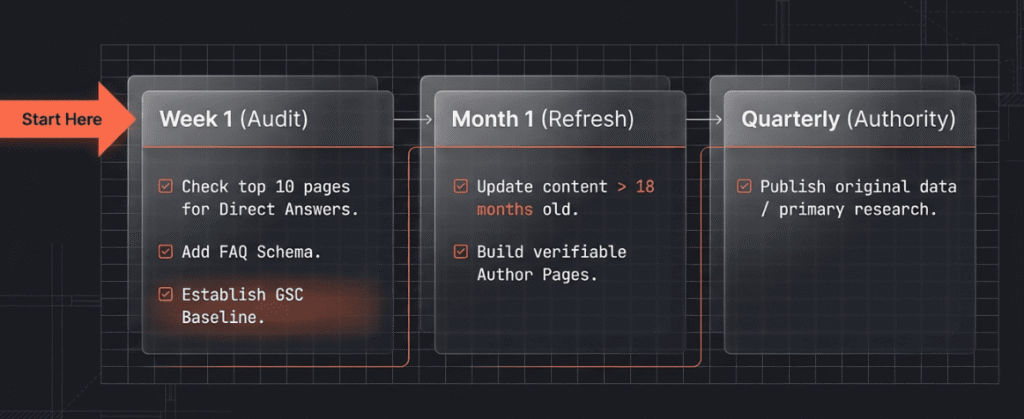
Google Gemini SEO Action Plan (Quick Reference)
Here’s a prioritized list you can act on immediately. Short-term moves build the foundation; medium-term and ongoing work compound the results.
Conclusion
Google Gemini SEO isn’t a replacement for what you already do; it’s an extension of it. The fundamentals still matter: technical SEO, search engine optimization basics, and producing content that actually serves user intent. What’s changed is that doing those things well is no longer enough on its own. Gemini now uses a second layer of selection criteria, and most sites haven’t optimized for it yet.
That gap is worth paying attention to. Gemini search impact on search traffic will only grow as AI Overviews expand and AI Mode matures. Most of your competitors are still treating this as a future problem. That gives you a real window right now.
The priorities are straightforward: front-load your answers, add schema markup, build verifiable E-E-A-T signals, use the Google ecosystem, and track your AI visibility consistently.
If you want to see whether it’s actually working, Track My Visibility gives you a dedicated dashboard for monitoring your presence across AI platforms, including how often you appear in Gemini’s AI answers over time. It’s one of the few tools built specifically for this.
Frequently Asked Questions
Google Gemini SEO is the practice of optimizing content so that Google’s Gemini-powered AI surfaces your pages as cited sources in AI Overviews, AI Mode, and the Gemini app. Traditional search engine optimization focuses on ranking in the top organic results. Gemini SEO adds a second goal: getting cited inside AI-generated responses, which can drive brand exposure and referral traffic even from zero-click searches.
No, Gemini’s AI source selection doesn’t strictly follow organic ranking order. You can rank at position eleven and still appear in an AI Overview if your content is well-structured, semantically complete, and matches the query intent. Conversely, the top-ranking page can be passed over if it’s not formatted for AI extraction.
Not exactly. Only 13.7% citation overlap between AI Overviews and AI Mode (Vertu). AI Mode is a deeper research experience with different citation behavior. Optimizing for both requires attention to content structure and conversational queries across both surfaces, not just one.
FAQ schema has the strongest correlation with AI Overview citation for most content types. After that: HowTo schema for instructional content, Article schema (with author and dateModified) for editorial content, and Organization/Person schema for entity-level E-E-A-T signals. All should be implemented in JSON-LD and validated via Google’s Rich Results Test.
The fundamentals haven’t changed: solid technical SEO, relevant content that matches user intent, and authoritative signals like backlinks and brand mentions. What’s evolving is that those same signals now also feed into Google’s AI citation logic. Traditional SEO is still the foundation. It just needs to be layered with structured content, schema, and freshness signals to also perform in AI search.
Resources:
- Zero-Click Search 2026: AI Overviews Cut Clicks by 58% | PikaSEO
- 44% of ChatGPT citations come from the first third of content: Study
- Study: AI Brand Visibility and Content Recency
- Daily Mail says Google AI Overviews have killed click-throughs
- Google AI Overviews vs. AI Mode: Data Study & Citation Analysis