


Search has changed. AI-generated answers from Google AI Overviews, ChatGPT, and Perplexity now dominate, with zero-click behavior reaching 65% of all Google searches and climbing to 80%+ for queries that trigger AI Overviews (Similarweb, 2025). For most brands, the difference between publishing content and actually getting cited comes down to structured data.
Schema markup for AI tells these systems what a page is about, who created it, and why it should be trusted. In March 2025, Microsoft’s Fabrice Canel confirmed at SMX Munich that schema markup helps their LLMs understand content. Google’s Ryan Levering stated at Search Central Live NYC that “a lot of our systems run much better with structured data.” For brands serious about ranking in AI search results, schema markup is the foundation of an AI-ready content strategy.
TL;DR
- Schema markup translates website content into machine-readable structured data, giving AI systems like Google AI Overviews, Perplexity, and ChatGPT the clarity needed to accurately extract, trust, and cite brand content.
- The most impactful schema types for AI visibility are Organization, Person, Article, Product, FAQPage, and LocalBusiness, each serving a distinct role in how AI systems understand and attribute content.
- Choosing the right schema starts with the business model: service-based, local, ecommerce, and publisher sites, each having a distinct schema priority stack that maps to how AI interprets their content.
- Implementation follows a clear sequence: identify the page entity, generate JSON-LD markup, connect related entities, validate with testing tools, and maintain accuracy as content changes.
- Schema alone doesn’t guarantee AI citations consistent implementation, regular updates, and active monitoring of how AI platforms are citing the brand are what convert structured data into measurable visibility.
Why Schema Markup is Critical for AI Search Visibility
Schema markup transforms your content from plain text into machine-readable structured data using the standardized vocabulary from Schema.org. This gives AI systems clear context, relationships, and key details, such as who authored it, what the entity is, product specs, FAQs, or how-to steps.
AI search engines, including Google AI Overviews, Perplexity, and ChatGPT, rely on this structured data to generate factual, citable answers. Without it, these systems have to guess what your content means. With it, you tell them explicitly.
Research from SERPs.io found that 65% of pages cited by Google AI Mode include structured data. For ChatGPT, Growth Marshal’s study of 730 citations puts that number at 71%. BrightEdge reported a 73% boost in AI Overview selection rates for pages with structured data compared to those without.
One important nuance: a 2026 empirical study by Growth Marshal found that a generic schema (Article, Organization, BreadcrumbList alone) produced no measurable citation advantage. Pages with attribute-rich schema (Product or Review with populated pricing, ratings, and specifications) were cited at 61.7% compared to 41.6% for generic types.
The takeaway: how you implement schema matters more than whether you have it.
Can Schema Markup Improve AI Visibility?
Yes. Schema markup for AI can improve your visibility by turning content into clear, machine-readable signals that AI platforms can parse, trust, and prioritize when generating answers.
Here is how it works:
Increases chances of structured extraction: Schema.org vocabulary labels key elements (articles, products, FAQs, events) precisely; therefore, it allows AI to pull accurate facts directly without relying on ambiguous plain text.
Improves citation probability in AI-generated responses: Pages with proper structured data appear more frequently in AI summaries. The effect is strongest when the schema includes concrete attributes like pricing, aggregate ratings, and product specifications rather than generic type declarations alone.
Strengthens entity connections (Brand to Author to Article): Schema creates semantic links between your brand, authors, content, and related entities; consequently, this helps AI build accurate knowledge graphs, attribute ownership correctly, and reinforce authority signals.
Improves eligibility for featured answers: FAQPage, HowTo, and Article schema signal that your page is formatted for quick extraction, increasing the chance of surfacing in rich results, direct summaries, and AI answers. This matters especially when you are optimizing content for AI answers.
Schema markup acts as an infrastructure that reduces friction for AI systems; as a result, it makes your brand more discoverable, accurately represented, and more frequently cited in AI search.
Which Schema Types are Relevant for AI Visibility?
Several Schema.org types stand out for improving AI visibility. Here are the ones that matter most, based on citation data and AI platform behavior.
Organization schema
Defines your brand as a verifiable entity, including name, logo, address, contact info, and sameAs links to social profiles or Wikipedia. This anchors your identity in AI knowledge graphs and helps AI systems disambiguate similar names.
Where to implement: Homepage or site-wide footer to connect all content back to your brand.

Local business schema
Provides consistent business info: name, address, phone (NAP), opening hours, geo-coordinates, and services. This helps AI deliver accurate location-based answers, maps integrations, and voice search results.
Where to implement: Location and contact pages. Use a specific subtype (Restaurant, Store, Medical Clinic) for better precision.

Person schema
It structures author or expert details: name, job title, photo, bio, social links, and affiliations; as a result, this builds authorship credibility and entity connections (linking a Person to an Article or Organization), making AI more likely to attribute content correctly.
Where to implement: Author bylines on blog posts to establish E-E-A-T (Experience, Expertise, Authoritativeness, Trustworthiness).

Article & blog schema
Marks up content elements like headline, author, publish date, modified date, image, and publisher. This helps AI understand blog and news pages as authoritative sources, improving summarization accuracy and eligibility for inclusion in AI responses. This is especially important when considering how LLMs choose content to form answers.
Where to implement: Every blog post and guide.
Product schema
Details products with name, brand, description, price, availability, reviews, ratings, and offers. This is where schema delivers its strongest AI citation advantage. Growth Marshal’s research showed that attribute-rich Product schema (with populated pricing and aggregateRating) was cited at 61.7%, compared to 41.6% for generic types.
Where to implement: Every product page. Include price, availability, and aggregateRating for maximum AI extraction value.
FAQ schema
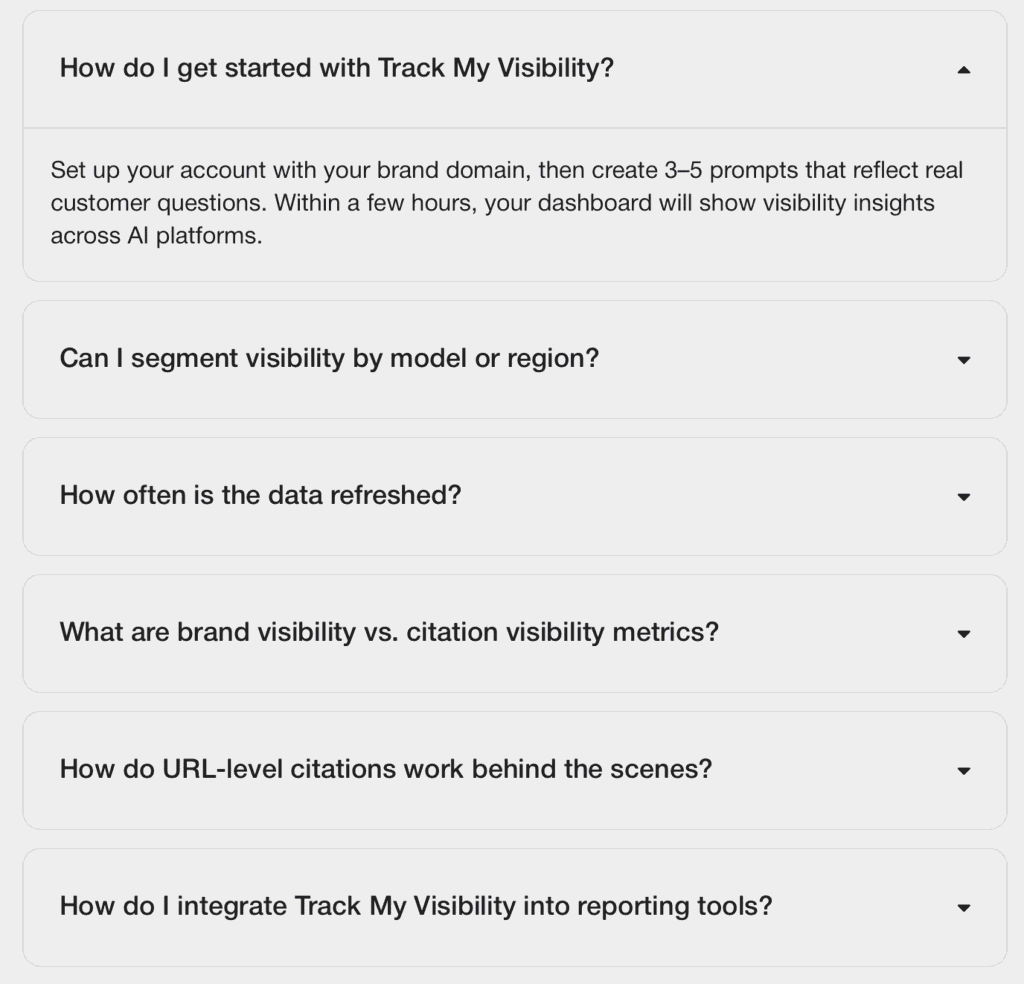
Structures question-answer pairs explicitly, making Q&A content machine-readable. The FAQPage schema has the highest single-type impact on AI citations. Citedify’s data shows pages with FAQPage markup are 3.2x more likely to appear in AI Overviews.
Where to implement: Any page with customer questions or informational Q&A sections.
How to Choose the Right Type of Schema for Your Business Needs
Choosing the right schema starts with understanding what your business does and what AI systems need to represent it accurately.
Identify your primary business model, then match it to the schema stack below.
Service-based (consulting, agencies, SaaS, professional services)
| Primary focus | Brand trust, expertise, and content |
| Recommended Schema type | Organization + Person + Article |
| Where to implement | Homepage/About: Organization Author bios/by lines: Person Guides/blogs/case studies: Article |
| Why these matters | Builds entity connections (brand → expert → content) Boosts E-E-A-T signals Helps AI attribute and cite accurately |
Local store / Brick-and-mortar (retail shops, restaurants, clinics with physical presence)
| Primary focus | Location accuracy, local relevance |
| Recommended Schema type | LocalBusiness + Product |
| Where to implement | Location/contact pages: LocalBusiness (use specific subtype e.g., Restaurant, Store) Inventory/service listings: Product |
| Why these matters | Provides consistent NAP, hours, and geo-data for local AI answers, maps, and voice. Enables precise product extractions |
E-commerce / Online store (pure digital sales, product-focused)
| Primary focus | Product details, brand authority |
| Recommended Schema type | Product + Organization |
| Where to implement | Product pages: Product (name, price, availability, reviews)Homepage/Footer: Organization sitewide |
| Why these matters | Allows AI to pull exact product info for comparisons and recommendations. Attribute-rich Product schema delivers the strongest AI citation advantage for lower-authority domains |
Publisher / Blog / Content site (news, informational blogs, educational content)
| Primary focus | Content structure, authorship, Q&A |
| Recommended Schema type | Article + Person + FAQ |
| Where to implement | Every post/guide: Article/BlogPostingBylines: PersonQ&A sections: FAQPage |
| Why these matters | Makes content easily summarizable and citable. Strengthens authorship links. The FAQ format aligns with direct AI question answers |
This framework keeps your schema targeted and effective. It acts as clear instructions for AI systems to understand and prioritize your content.
 Pro Tip: Choosing the right schema types is a starting point, but a full AEO and GEO audit reveals deeper gaps in how AI systems currently interpret and cite the site. Before moving forward, review this comprehensive AEO GEO audit checklist to identify overlooked gaps that may be limiting your AI search presence.
How to Implement Schema Markup for AI Optimization
Implementing schema markup for AI means structuring your website data so search engines and AI systems can clearly understand the entities, relationships, and context within your content. Here is the full process.
Step 1: Identify the Primary Entity of the Page
Before writing any schema, determine what the page represents. AI systems try to identify the main entity associated with each page, so your schema should define it clearly.
Ask yourself:
- Is this page about a business, person, article, or product?
- What is the main topic?
- Which entity should AI systems connect to this page?
Getting the entity right ensures your structured data aligns with the page’s purpose; moreover, it helps AI link the content to the correct knowledge entities.
Step 2: Choose the Relevant Schema Type
Once the page entity is clear, select the most relevant schema type from Schema.org.
Use the audit table above as a guide:
- Service-based: Organization + Person + Article
- Local store: LocalBusiness + Product
- Ecommerce: Product + Organization
- Publisher/blog: Article + Person + FAQ
Start with one high-value page and expand. Prioritize types like FAQPage, HowTo, and Article for direct AI extraction.
Step 3: Generate the Schema Markup Code
Schema markup is typically written in JSON-LD format, which is recommended by Google. There are several ways to generate schema markup:
Manual creation: Write JSON-LD directly using Schema.org documentation for the required properties.
Schema generation tools: Use structured data generators, CMS plugins (Yoast SEO, Rank Math for WordPress), or markup builders that convert form inputs into JSON-LD.
CMS-native options: Shopify, WordPress, and most modern platforms have built-in or plugin-based schema support. For custom sites, add JSON-LD directly in script tags in your HTML head.
Step 4: Add Key Properties to Your Schema
Every schema type has properties that describe the entity. Including the right ones improves clarity and AI extraction value.
- For Article Schema: headline, author, datePublished, dateModified, image, publisher
- For Organization Schema: name, logo, url, sameAs (links to social profiles)
- For LocalBusiness Schema: address, telephone, openingHours, geo coordinates
- For FAQPage schema: mainEntity with Question + acceptedAnswer pairs
Focus on populating concrete attributes (pricing, ratings, dates, specifications) rather than just declaring the type. This is where the real AI citation advantage comes from.
Step 5: Add the Schema to Your Website
Embed JSON-LD inside a script tag on each relevant page:
| <script type=”application/ld+json”> { “@context”: “https://schema.org”, “@type”: “Article”, “headline”: “How to use schema markup for AI”, “author”: { “@type”: “Person”, “name”: “Author Name”, “url”: “https://example.com/author” }, “datePublished”: “2026-04-11”, “dateModified”: “2026-04-11”, “publisher”: { “@type”: “Organization”, “name”: “Track My Visibility” } } </script> |
Place the script in the <head> section or near the end of the <body> tag. Make sure the schema data matches the visible page content.
Step 6: Connect Related Entities
Schema should not exist in isolation. Connecting entities strengthens context and authority signals for AI.
Build these relationships:
- Organization to Author to Article
- Organization to Product
- Person to Organization
These connections help AI systems understand how entities interact across your website; consequently, they help build a more complete knowledge graph for your brand.
Step 7: Implement Consistently Across Your Site
Structured data should follow a consistent pattern across pages.
- Organization schema on the homepage (site-wide)
- Person schema on author pages
- Article schema on every blog post
- Product schema on product pages
- FAQPage schema on Q&A sections
Consistency helps AI systems build a clearer knowledge structure around your site. Inconsistent or conflicting schema across pages can confuse both search engines and AI models.
Step 8: Validate Your Schema Implementation
Test every schema implementation before publishing. Even small syntax errors can prevent AI systems from reading your structured data.
Validation tools:
- Schema Markup Validator checks syntax and structure.
- Google Rich Results Test verifies eligibility for rich search results.
- Google Search Console monitors structured data errors over time.
Testing catches missing required properties, incorrect nesting, and mismatches between the schema and visible content.
Step 9: Maintain and Update Your Schema
Schema markup is not a one-time setup. Update it whenever page content changes.
This includes: updating author details, changing product prices or availability, adding new FAQs, and refreshing publication or modification dates.
Keeping the schema accurate ensures AI systems continue to trust and use your structured data; therefore, it’s important to monitor how those updates affect AI citation patterns over time to confirm the changes are being picked up.
Pro Tip: Schema implementation tells AI systems what a brand is, but it doesn’t reveal whether AI platforms are mentioning it, how accurately, or in what context. The more important question is: what is AI saying about the brand when no one is watching? Explore why tracking brand mentions in AI search matters more than most brands realize.How to Test Your Website’s Schema Markup
After implementing schema markup, testing is the next step; moreover, even small syntax errors or missing properties can prevent AI systems from interpreting your structured data correctly.
# Schema markup validator
This tool validates the technical structure of your schema markup and ensures that your JSON-LD, Microdata, or RDFa code follows Schema.org standards.
- Go to the schema markup validator.
- Choose “Fetch URL” and enter your page’s live URL, or select “Code snippet” and paste your JSON-LD or HTML code.
- Click “Run test.”
- Review results: Fix red errors first, as these prevent proper parsing by any AI or search system.
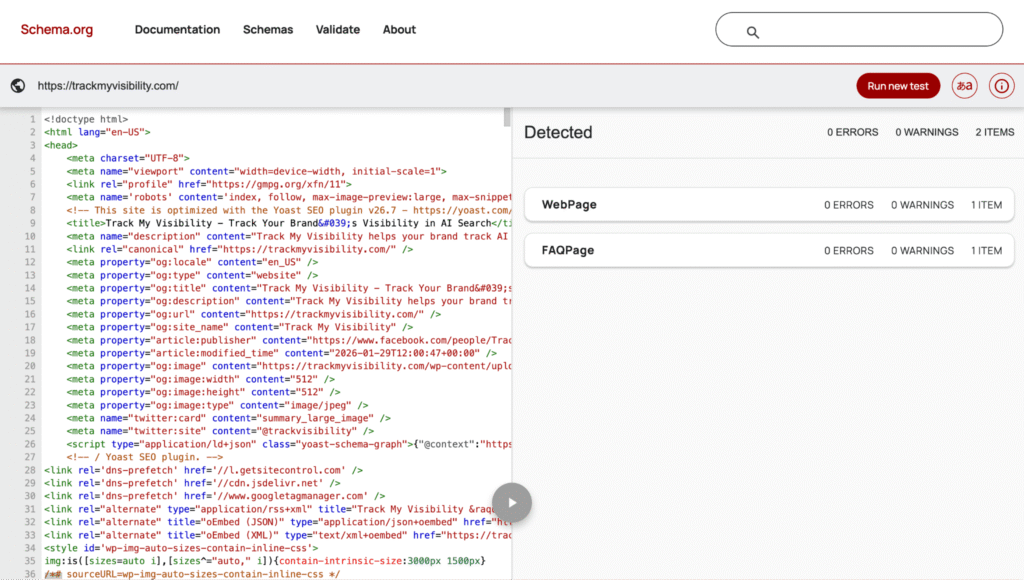
Best for: Catching structural issues across all schema types, including non-Google-supported ones.
# Google Search Console
Google Search Console monitors schema performance over time and identifies structured data issues across your website.
- Log in to Google Search Console and verify your property.
- Navigate to the “Enhancements” section (under Reports). Look for reports like “Rich results,” “FAQ,” “Product,” etc.
- Review valid items, warnings, errors, and how many pages are eligible for rich results.
- Use the URL Inspection tool to test individual pages in real time.
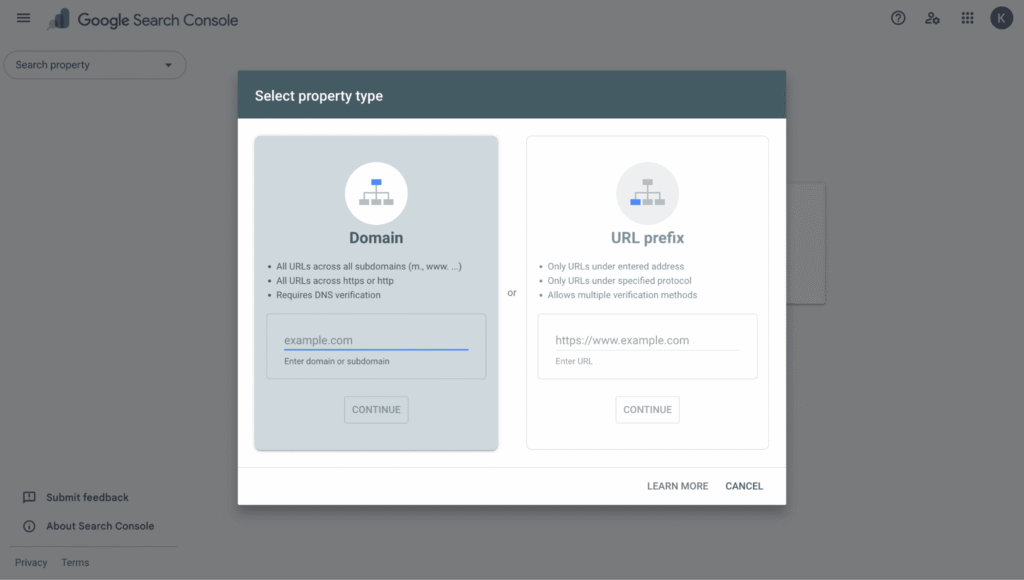
Best for: Long-term monitoring, spotting crawl issues, and tracking improvements over time.
# Google Rich Results test
The Rich Results Test shows whether your schema is eligible for rich search results, like FAQ accordions, product snippets, and review stars.
- Go to the Google Rich Result
- Enter your page URL (must be publicly accessible) or paste the code snippet.
- Click “Test URL” or “Test Code.”
- Review detected types, eligibility for rich results, errors, and warnings.
- Fix red errors (missing required fields) and yellow warnings (optional improvements).
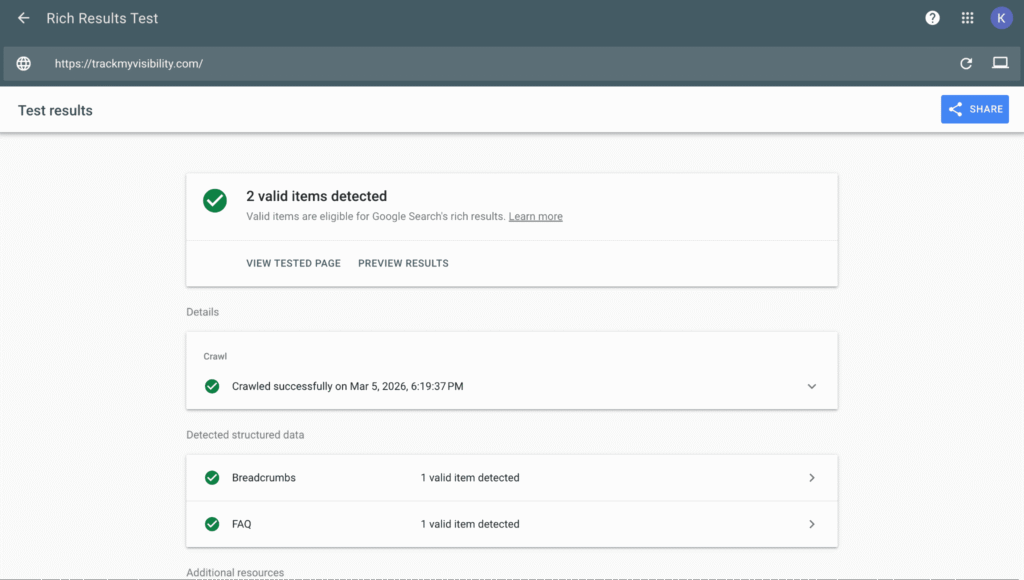
Best for: Confirming Google interprets your markup correctly and previews potential SERP enhancements.
Pro Tip: Validation tools confirm whether the schema is technically correct, but a passing score doesn’t mean AI platforms are actually citing the content. Run a quick audit with our free ai visibility checker and get your AI visibility report to identify hidden visibility gaps.Tips on Optimizing Your Schema for AI Search
Implementing a schema is one thing. Optimizing it so AI systems actually use it is another. These practices improve the chances of ranking in AI-generated responses across ChatGPT and Google AI Overviews.
- Keep schema consistent across pages: Use the same structured data patterns on similar pages. Consistency helps AI systems build a clearer model of your site’s entities and relationships.
- Prioritize attribute-rich schema over generic declarations: To begin with, populate concrete fields like pricing, aggregateRating, availability, and specifications. In addition, research shows that the attribute-rich Product and Review schema outperforms the generic Article and Organization schema by 20 percentage points in AI citation rates. Therefore, implementing detailed structured data can significantly improve visibility and credibility in AI-driven search results.
- Update publish dates and product prices regularly: Outdated schema reduces trust signals. Update dateModified, prices, availability, and business hours whenever the page content changes.
- Connect related entities: Link entities within your schema so AI systems understand relationships. Connect an author (Person) to a company (Organization) and link both to the article they published.
- Avoid duplicate or conflicting markup: Furthermore, multiple schema types describing the same entity differently can confuse AI systems. Therefore, each page should have clear, non-conflicting structured data that consistently matches the visible content.
- Focus on entity clarity, not keyword stuffing: The schema should define entities (brand, author, product, location) accurately. Adding unnecessary keywords in structured data fields hurts more than it helps.
- Stack multiple schema types per page: A blog post can carry Article + FAQPage + BreadcrumbList + Organization. Each type goes in its own JSON-LD script tag. The more context you provide, the easier AI systems to parse and cite your content.
Final Thoughts
Schema markup for AI is now core infrastructure for visibility in AI search; in fact, it delivers the clarity AI systems need to understand, trust, and cite your content accurately.
Start with a foundational Organization or LocalBusiness schema, add Article or FAQ on key pages, connect entities, and validate regularly. Consistent, up-to-date, attribute-rich implementation keeps your brand discoverable in AI citations.
Track these efforts with Track My Visibility to see whether your schema work is translating into actual AI citations.
To see how it works in practice, watch this walkthrough on measuring AI visibility:
Track My Visibility Demo (Ver. 1.0) | How to Measure AI Visibility
Frequently Asked Questions
Schema markup isn’t mandatory, but it significantly helps search engines and AI systems understand your content. Clearly defining entities like your brand, author, or product, you increase the chances that your content is correctly interpreted and surfaced in AI-driven responses.
Start with the schema that matches your core content. For most websites, Organization, Article, and Person schema provide a strong foundation because they clearly define your brand, authors, and published content.
Schema doesn’t guarantee citations, but it improves how clearly AI systems understand your content. When your entities and relationships are structured properly, it becomes easier for AI models to extract and reference your information.
You can test and monitor it using tools like Google Rich Results Test or Schema Markup Validator. These tools show whether your structured data is valid and eligible for enhanced search results.
You should update the schema whenever the page content changes. For example, update publish dates, product prices, or business details so search engines and AI systems always receive accurate information.
References
- Similarweb: Zero-Click Searches and How They Impact Traffic (2025)
- Google: Introduction to Structured Data
- Microsoft: Mastering AI-Powered Search Strategies for Marketers (April 2025)
- Search Engine Land: Microsoft Bing/Copilot Use Schema for LLMs (March 2025)
- Growth Marshal: Does Schema Markup Predict AI Citation? (2026)