


According to Demandsage, in the US, 50% of queries trigger Google AI Overviews response. And it will likely rise in the coming years.
Your brand might be mentioned thousands of times in AI search tools today. Or it might not show up at all. You won’t know unless you’re tracking it. If you’re new to this, then knowing how to track AI search visibility is a good place to start before diving into tool comparisons.
This leads to a practical choice: Track My Visibility vs Profound AI. Profound is an enterprise powerhouse, with a starting plan of $99 per month. Track My Visibility is a streamlined alternative starting at $50 per month.
The real question isn’t which is “better,” but which fits your specific budget and goals.
Here’s what you’ll learn in this guide:
- What each AI visibility tracking tool offers and how they work
- Which AI platforms does each tool monitor, and what you actually get
- Performance differences in reporting, ease of use, and reliability
- Honest recommendations based on your budget and company size
Let’s get started!
Key Takeaways
- Track My Visibility starts at $50/month with actionable page-level recommendations. Profound AI starts at $99/month but only covers ChatGPT at that tier.
- Both tools track AI search visibility across platforms like ChatGPT, Perplexity, and Google AI Overviews, but platform breadth varies significantly by pricing tier.
- Track My Visibility suits startups, agencies, and SMBs that want clear optimization guidance without enterprise overhead.
- Profound AI is built for Fortune 500 and mid-market companies that need multi-platform coverage, compliance standards, and a dedicated strategist.
- Neither tool guarantees AI search appearances. They surface where you stand and what to fix. Strategy still requires human judgment.
What Is Track My Visibility?
Track My Visibility was built by Aureate Labs. The platform focuses on teams spending $50 to $400 per month, not $10,000 and up. Their main selling point is the AI-Ready Score, which tells you how well your content is positioned to appear in different AI search platforms.
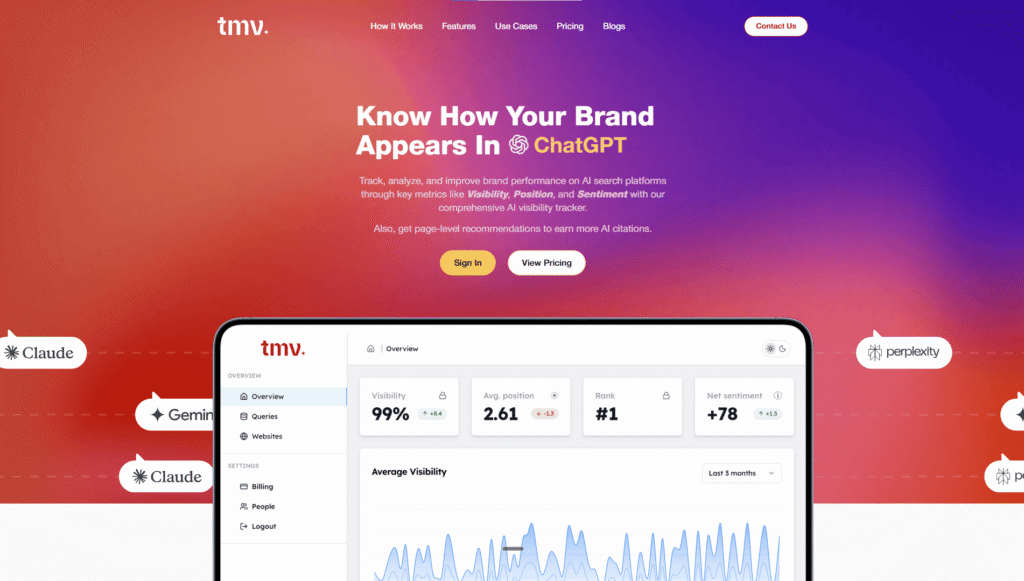
They target startups, agencies, SMBs, and eCommerce brands under $50M in revenue. If you’re testing different brands’ AI visibility tools for the first time. Or you are managing multiple small clients, Track My Visibility was built with you in mind.
 Pro Tip: Want a quick read on your current AI presence? The free AI visibility checker shows you how your brand appears across major AI platforms before you invest in any tool. A good first step, especially if you’re evaluating whether AI tracking is even worth it for your business right now.
Key Features of Track My Visibility AI Tracking Tool
Track My Visibility keeps things relatively simple. You get:
1. AI-Ready Score: You get an AI ranking score for each page. This helps you know if your website is prepared to be cited in AI search engines. With the help of this, you’ll know which page is already trusted by LLMs and which page needs improvement.
2. URL-level Citation Tracking: This shows you how many pages are cited from your website. How often do they appear in AI search models? And which AI search engine is referencing your tool the most?
3. Prompt-based AI Visibility Check: You can run custom prompts. Or you can even create a persona-driven query. This will help you see if top AI tools are citing your brand or if they are just relying on your competitors’ content.
4. Multi-Model Monitoring: You can compare your brand visibility side-by-side by executing prompts in top AI platforms such as ChatGPT, Google Gemini, Perplexity, and Google AI Overviews. This helps you understand where your brand is lacking and where your competitors are leading.
5. Competitor Benchmarking: With the help of this, you can see how your competitors are mentioned in top AI search tools. You will also be able to see for which URLs they are getting cited and where they are outranking you. With this information, you can find visibility gaps and make a clear plan accordingly.
How Does Track My Visibility Work?
Setup is simple. You don’t need a technical background.
You add your domain and set up your brand mentions tracking. After that, the system automatically runs prompts across different AI search engines such as ChatGPT, Gemini, Perplexity, and Google AI Overviews. The platform executes these searches daily and updates your dashboard with new visibility data every 24 hrs.
The AI-Ready Score shows up for each URL. It gives you specific recommendations on how to improve your chances of appearing in AI-generated answers. Instead of just showing you data, Track My Visibility points you exactly to what you need to change.
Track My Visibility Pros and Cons
Pros
1. AI-ready score: It helps you prioritize which pages to optimize first based on their potential to appear in AI responses. And with this, you’ll not be guessing where to start.
2. Entry Cost. A 7-day trial is available for just $5, giving you full access to all features. After that, plans start at $50 per month. That’s accessible for most businesses testing AI search visibility tools.
3. URL-level Recommendations: It doesn’t just show domain-level data. This will actually help you with actual content optimization rather than providing vague suggestions.
4. Transparent Pricing: There are no hidden tiers or surprise charges. Unlimited team seats mean your whole marketing team can access the platform without any additional costs.
Also, they offer an annual discount with 2 months free when you choose yearly billing on any plan.
Cons
1. New Platform: It’s a newer platform, so documentation is still growing. You might find fewer AI search tools and guides compared to more established AI SEO tools.
2. Language Support: It has smaller language support than other enterprise AI tools. If you operate globally in multiple languages, this might matter.
3. Integrations: You won’t find the same API access or third-party connections that larger AI SEO platforms offer.
4. Analytics: The reporting is less mature when compared to AI visibility platforms that have been around for two years. The data is accurate, but the depth of reporting doesn’t match enterprise tools yet.
Pricing and Accessibility
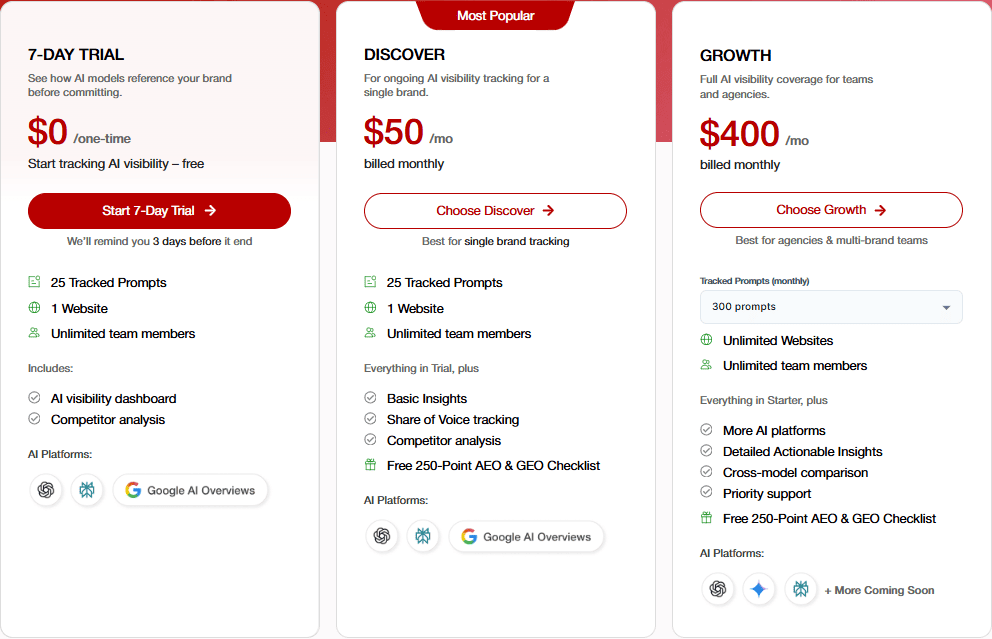
This tool currently has 3 pricing plan options for you.
Trial: Free for 7 days
- 25 tracked prompts
- 1 website
- Unlimited team members
- Competitor Analysis
- AI Visibility Dashboard
- 3 AI platforms (ChatGPT, Perplexity, Google AI Overviews)
Discover Plan: $50/month
- 25 prompts per month
- 3 AI platforms tracked (ChatGPT, Perplexity, Google AI Overviews)
- Unlimited users
- Basic Insights
- Share of Voice tracking
- Competitor analysis
- Free 250-Point AEO & GEO Checklist
Grow Plan: $400/month
- Up to 300 prompts per month
- 4 AI platforms (ChatGPT, Perplexity, Google AI Overviews, Gemini)
- Unlimited websites
- Unlimited team members
- Detailed Actionable Insights
- Cross-model comparison
- Priority support
- Free 250-Point AEO & GEO Checklist
Also, Track My Visibility is adding new AI tools soon.
They offer an annual discount with 2 months free when you choose yearly billing on any plan.
Note: Pricing may change over time, so it’s best to check their official page for the most up-to-date information.
What Is Profound AI?
Profound AI operates in a different tier entirely. It is based in Manhattan with over $58.5M in total funding, including a $35M Series B led by Sequoia Capital with participation from Kleiner Perkins and Khosla Ventures. They position themselves as the enterprise solution for AI visibility tracking.
Their client list includes Fortune 500 companies. The value proposition is comprehensive analytics with white-glove service. You’re not just buying software; you’re getting a dedicated AI search strategist as part of the package.
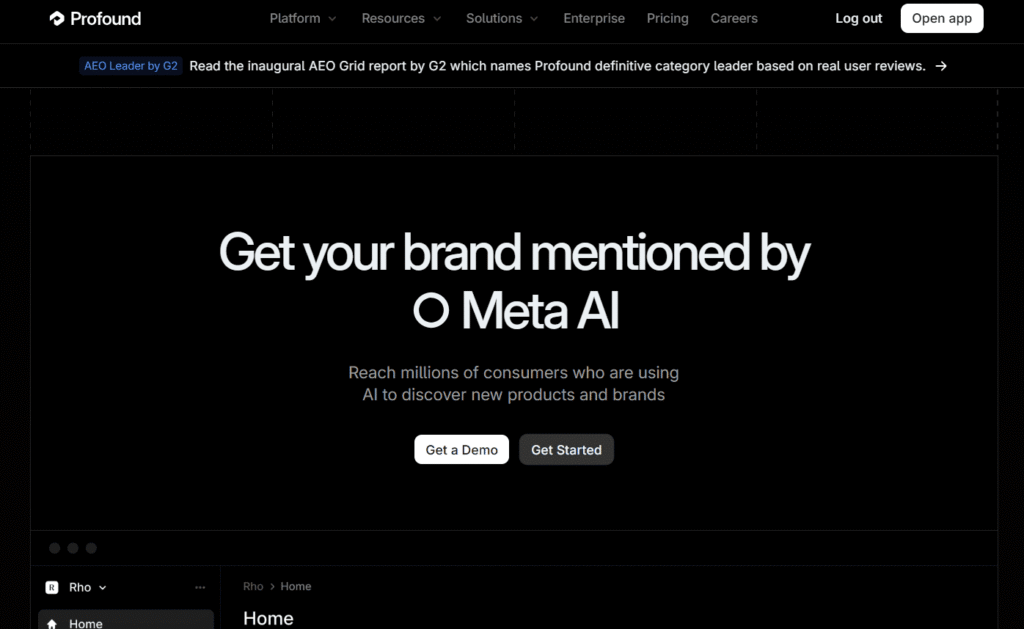
They target mid-market to enterprise companies with $50M+ in revenue who need comprehensive AI visibility data across every platform and can justify the investment.
Key Features
1. Market Share & Visibility: You can see your “share of voice” across the major answer engines. It will let you know exactly how often your brand is recommended compared to your competitors.
2. Deep Technical Insights: Through “Agent Analytics,” the tool shows you how AI crawlers are indexing your site. It also tracks “Prompt Volumes,” which is essentially the AI version of keyword search volume.
3. Data Attribution: They offer a Google Analytics integration that helps you attribute actual website traffic to specific AI mentions.
4. Shopping & Conversation Tracking: You can monitor how your products appear in ChatGPT Shopping. And you can use the “Conversation Explorer” to see the context of how people are asking about you.
5. Enterprise Standards: The platform is SOC 2 Type II compliant and provides a dedicated strategist to help you interpret the data.
While they track over 10 platforms such as Meta AI, Perplexity, and Google AI Overviews. But full access across every AI tool requires moving up to their Enterprise plan.
How Does Profound AI Work?
Onboarding includes white-glove setup. A team walks you through integration and configuration.
The platform monitors in real-time across all connected AI answer engines. If you’re on the Enterprise tier, you can integrate with CDN providers like Cloudflare or Akamai for deeper analytics.
The dashboard gives you enterprise-level reporting with sentiment analysis, regional breakdowns, and detailed competitive intelligence. Everything connects back to your Google Analytics setup for traffic attribution.
Profound AI Pros and Cons
Pros
1. Track Record: This is a proven enterprise platform. Their Ramp case study highlights significant growth in AI visibility, consistent with the 700% increase in AI referrals Profound has reported for some customers.
2. Brand Tracking: You get coverage across 10+ AI platforms. Such as Perplexity, Google AI Overviews, Meta AI, and Claude. This is important if your audience uses a variety of AI search engines.
3. Granular Data: The analytics suite is advanced. Sentiment analysis, regional tracking, traffic analytics, and visibility trends all come standard. The depth here exceeds what newer platforms offer.
4. The Human Element: A dedicated strategist is included. You’re not figuring this out alone. Someone with expertise in AI SEO is actively working with your team.
5. Compliance: SOC 2 compliance matters for enterprise buyers with strict security requirements. And API access on Enterprise plans allows for custom integrations and automated reporting.
6. Shopping Insights: They track visibility in ChatGPT Shopping, which is increasingly important for e-commerce brands.
Cons
1. The “Starter” Trap: Pricing starts at $99 per month, but that only gets you ChatGPT tracking. One platform. That’s not particularly useful for most businesses.
2. The Growth plan: It costs $399 per month and only covers three engines: ChatGPT, Perplexity, and Google AIO. You’re paying significantly more than competitors for limited coverage at this tier.
3. The Big Leap: Full platform access requires the Enterprise plan. Pricing isn’t transparent on the website, but user reports suggest $2,000 to $5,000+ per month.
4. Stability Issues: User reviews on G2 mention bugs, slow support response times (up to a week), and platform instability issues. Duplicate prompts and crashes have been reported.
The platform is 4-6x more expensive than competing AI visibility solutions at comparable feature levels.
Pricing and Accessibility
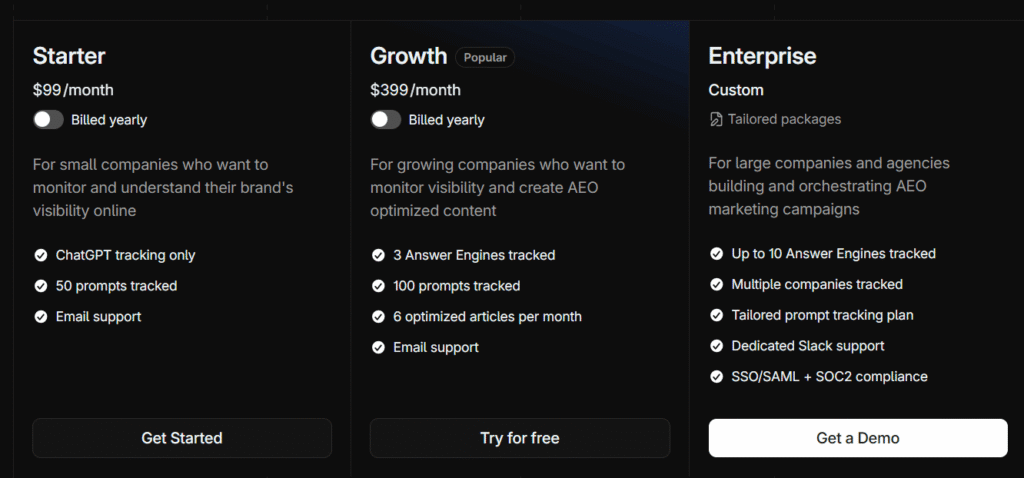
This tool offers three pricing tiers.
- Starter: $99/month. You get ChatGPT tracking only with 50 prompts per month. Data covers one region, and you can access two months of search history. For most brands, this plan has limited practical use given the price and feature restrictions.
- Growth: $399/month. This expands to three AI platforms: ChatGPT, Perplexity, and Google AI Overviews. You get 100 prompts monthly plus six optimized articles. This is where the tool starts to become genuinely useful for content teams.
- Enterprise: Reports suggest this runs between $2,000 and $5,000+ per month. You get access to all 10+ platforms they track, complete feature access, dedicated support, and API access for integration with your existing tools.
The gap between Growth and Enterprise is significant. There’s no middle option for brands that need more than three platforms but don’t require full enterprise features.
Track My Visibility vs Profound AI: Head-to-Head Comparison
Let’s compare Track My Visibility vs Profound AI across the factors that actually matter.
| Feature | Track My Visibility | Profound AI | Winner |
| Starting Price | $50/mo | $99/mo (ChatGPT only) | Track My Visibility |
| Real Entry Price | $50/mo (3 platforms) | $399/mo (3 platforms) | Track My Visibility |
| AI Platforms | 4 platforms, expanding | 10+ (Enterprise only) | Profound (if budget allows) |
| Prompts/Month (Base) | 25 prompts | 50 prompts (Starter) | Profound |
| Primary Strength | AI-Ready Score + optimization | Comprehensive analytics | Tie |
| Unique Feature | URL-level recommendations | Dedicated strategist | Tie |
| Reporting | Basic, growing | Enterprise-grade | Profound |
| Actionable Recommendations | Built-in | Manual strategy needed | Track My Visibility |
| Multi-Language | Limited | Extensive | Profound |
| Team Members | Unlimited (all plans) | Per-seat pricing | Track My Visibility |
| Integration Options | Limited | Extensive (Enterprise) | Profound |
| Customer Support | Standard | Slow (per G2 reviews) | Track My Visibility |
| Best For | Startups, agencies, SMBs, small businesses | Enterprise, Fortune 500 | Depends on budget |
| Trial | 7-Day Trial | Not advertised | Track My Visibility |
Limitations of Both AI Visibility Tracking Tools
Both tools face similar constraints because of how AI visibility works fundamentally.
Where Both Tools Have Constraints
- Simulated vs. Real Behavior: They use synthetic prompts (pre-written questions), not real user queries. The platforms simulate what people might ask, but they can’t capture every possible question users actually type into AI answer engines.
- Visibility ≠ Traffic: Neither can guarantee actual traffic volume. They track visibility data and brand appearance frequency, but that doesn’t directly translate to clicks or conversions.
- Constant Volatility: Multiple AI platforms change their algorithms frequently. What works today might shift next month as AI models evolve.
- Data Needs a Human Lens: Human review is still needed. The tools provide data and recommendations, but strategy development requires expertise and judgment.
Risks of Over-Reliance:
The main risk is treating the data as the whole story. These tools show you what’s happening with your visibility, but they won’t tell you why it’s happening. You’re getting a diagnostic readout, not a strategy.
Context matters more than raw numbers. If a competitor ranks higher than you, the tool won’t explain whether it’s because of their site structure, content depth, or domain authority. You still need someone who understands search and content to interpret what the data actually means.
AI models change constantly. What works today might stop working next month as these systems evolve. You can’t set this up once and walk away. Treating AI visibility as an ongoing process makes more sense than thinking of it as a problem you solve and forget about.
Future of AI Brand Visibility Tools
AI search is growing rapidly. Google’s AI Overviews now appear in nearly 50% of searches in the US (Heroic Rankings). The shift is happening at every level.
OpenAI CEO Sam Altman recently said he can’t remember the last time he used Google search.
ChatGPT launched SearchGPT. Perplexity is gaining users. Meta AI is integrating across Facebook and Instagram.
This means search visibility strategies need to evolve. Traditional SEO metrics don’t capture how people find information through AI-powered search. The differences between AI search and traditional SEO are significant enough that treating them as the same thing will cause you to miss what’s actually happening.
A user on Reddit raised a frustration that many marketers are quietly dealing with: their pages rank in the top 3-5 on Google, yet ChatGPT, Gemini, and Perplexity rarely cite them, while competitors with weaker rankings show up consistently.
Why is my site never cited in ai search even with top rankings?
by u/Altruistic-Meal6846 in GrowthHacking
Content quality matters more than ever. AI systems prioritize authoritative, well-structured content. Gaming the system doesn’t work the way it sometimes did with traditional search engines.
Citation and source transparency are becoming critical. AI-generated answers increasingly show where information comes from. Being cited as a source builds trust and authority.
Brands need both visibility tracking and optimization. Knowing where you appear is step one. Understanding how to improve those appearances is step two.
Track My Visibility vs Profound AI: Performance Analysis of Brand AI Visibility Tools
Let’s look at both the platforms’ dashboards. And see how both the AI visibility platforms perform.
1. AI Platform Coverage
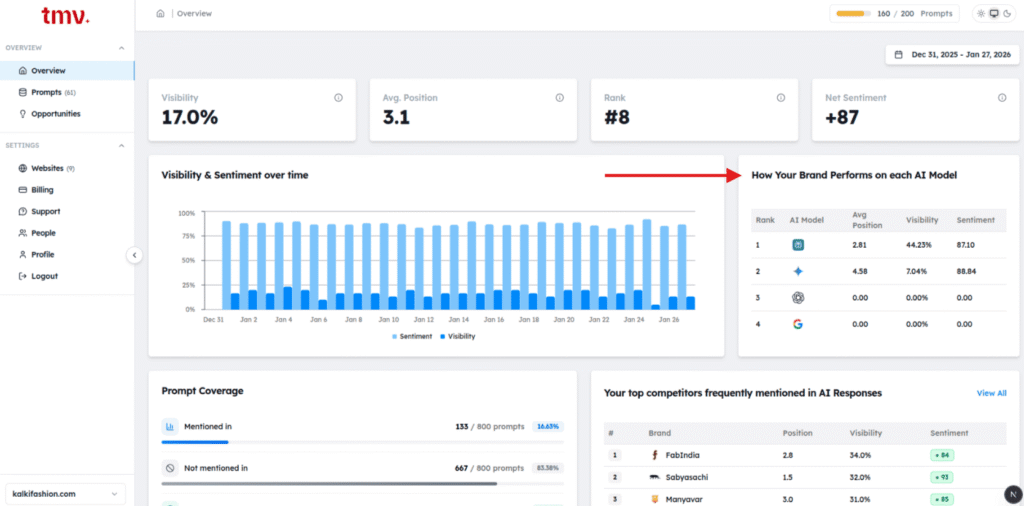
Track My Visibility covers four major AI platforms, such as ChatGPT, Perplexity, Google Gemini, and Google AI Overviews. It is also expanding its reach to other AI tools.
If you’re going to try this platform, you can go for a 7-day trial, where you’ll get access to ChatGPT and Perplexity. If you are choosing a Discover plan, then you’ll get access to ChatGPT, Perplexity, and Google AI Overviews. And in the Growth plan, you’ll get access to ChatGPT, Google Gemini, Perplexity, and Google AI Overviews.
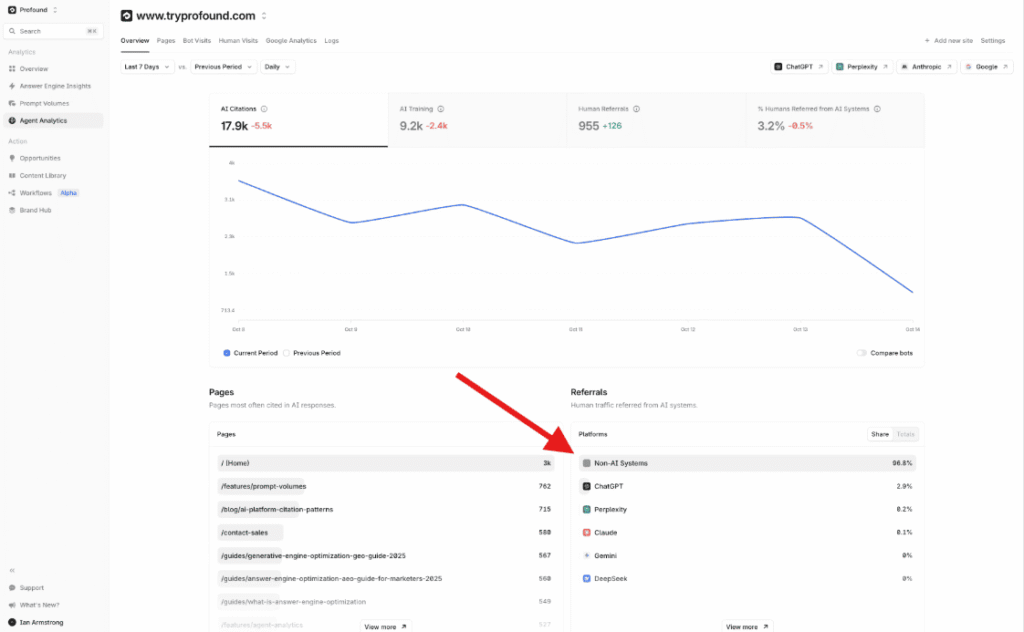
When it comes to Profound AI, you get access to 10+ platforms. But only if you pay for Enterprise. If you choose the Starter plan, you’ll get access to only ChatGPT. If you’re choosing the Growth plan, you’ll get access to 3 different answer engines.
2. Ease of Use
Now that you know, how many AI search tools do both platforms use? Let’s look at how to set up these AI SEO tools.
When it comes to Track My Visibility, it has a very simple process. And for setting up, you don’t need any technical skills. First, you’ll have to log in. After that, you will have to add your website name.
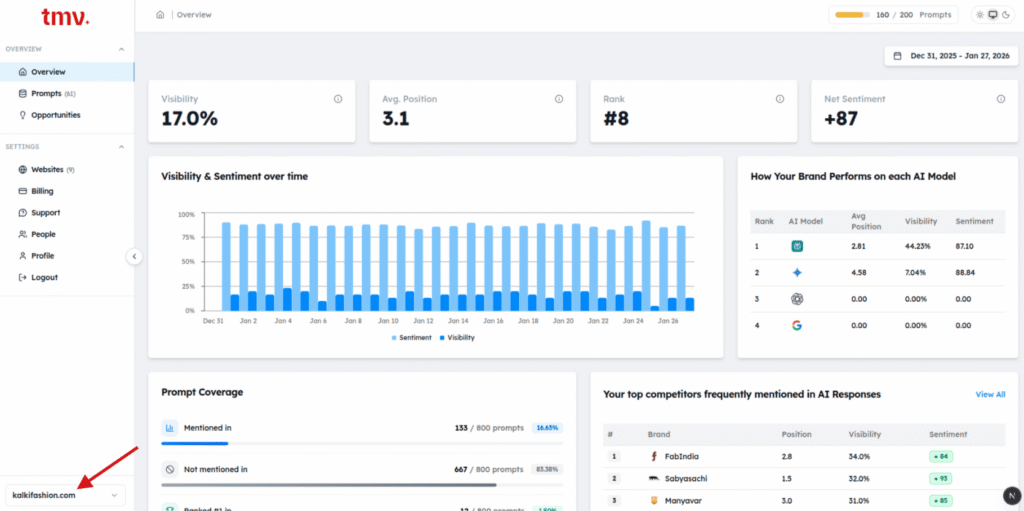
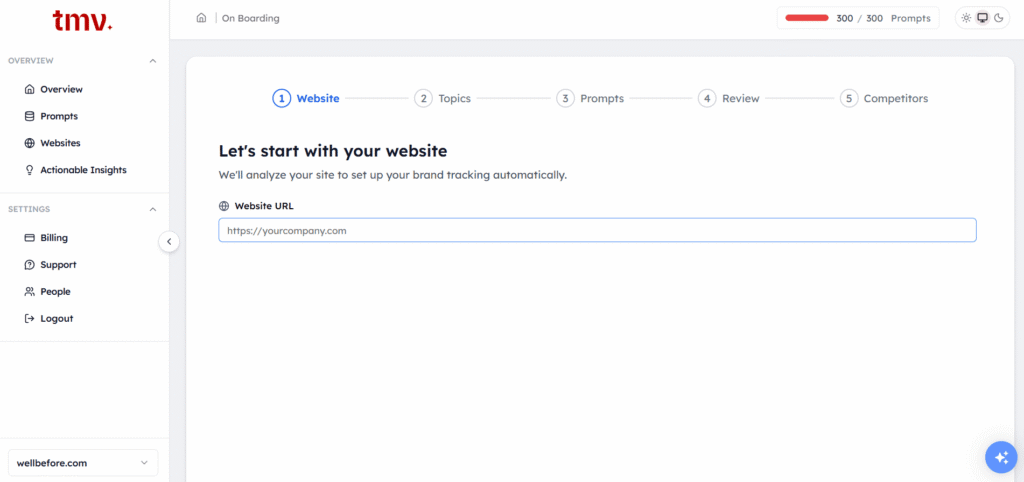
As soon as you add the name of your website, it will start generating the topics on its own. You can select and deselect the topics accordingly. After that, it will suggest a few prompts. You can obviously add your own prompts also. Then, you will be able to see reviews, and the tool auto-monitors prompts every 24 hours.
Setting up Profound AI takes more effort. You won’t just fill out a quick form and jump straight into a dashboard.
To get started with Profound AI, you first book a demo so their team can verify your data scale and requirements. Next, you enter your domain into the dashboard, which automatically identifies your hosting provider.
You then sync your server logs via a lightweight integration to track real-time AI bot activity. After selecting the specific AI models you want to monitor, you finalize the setup by enabling SSO and connecting Google Analytics for full attribution.
3. Reporting & Analytics
Now, let’s move forward and see how both the AI visibility software reports and analyzes your data.
Track My Visibility focuses on making the data actually useful. You get a clear breakdown of how you’re performing across different AI models. This helps you spot where you’re winning and where you’re lagging.
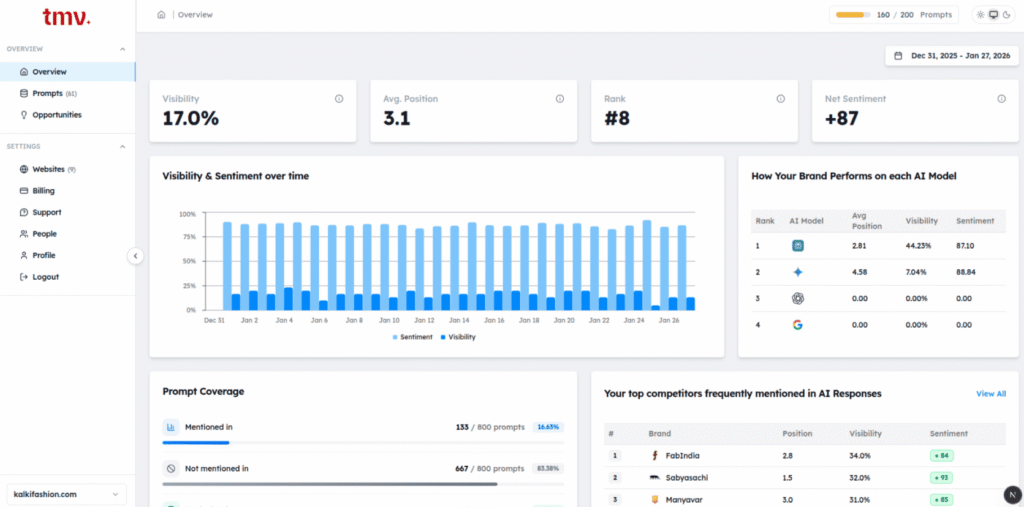
Their AI-Ready Score is particularly helpful because it doesn’t just give your pages a rating. It also tells you exactly what to fix to perform better.
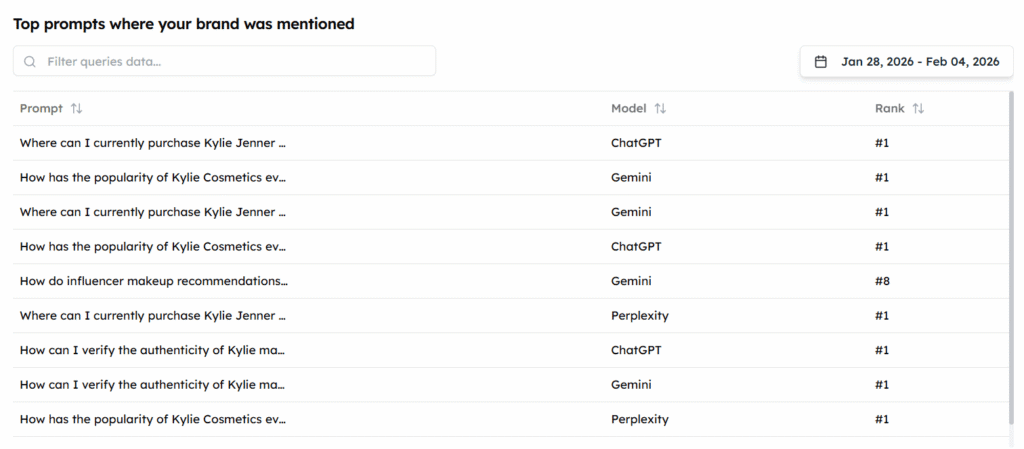
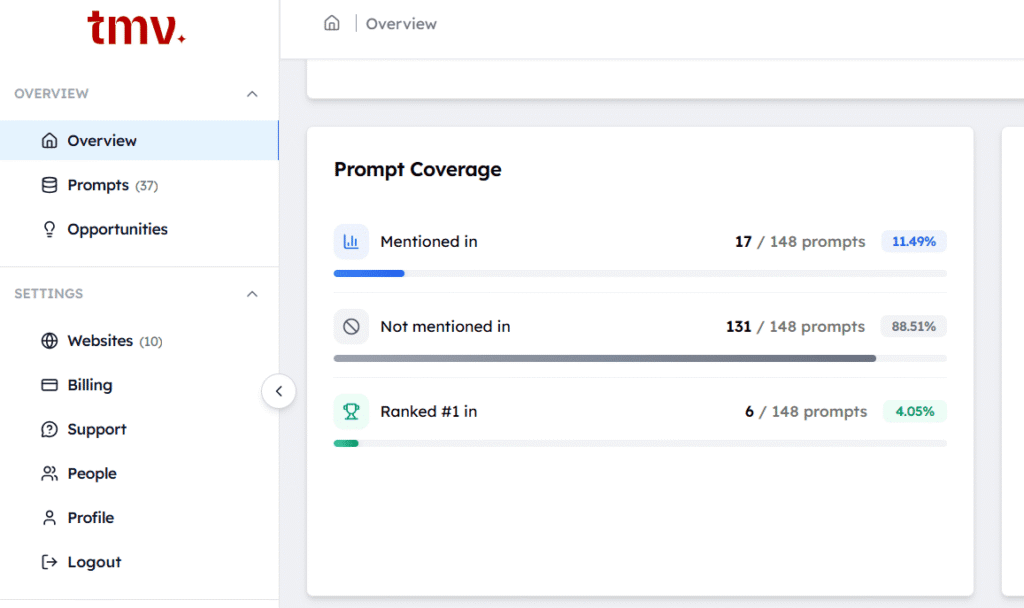
You can also see the specific prompts where your brand popped up and which of your URLs are getting cited the most. It also shows a full prompt coverage breakdown, including how many prompts your brand was mentioned in, how many it was absent from, and how many times it ranked first.
It also includes competitor benchmarking, which is great for seeing how your share of voice stacks up against everyone else in your space.
If you want to act on those recommendations immediately, this guide on optimizing content for AI answers covers the practical steps.
When it comes to Profound AI, its reporting is built for enterprise complexity. It offers a view across 10+ different AI engines. Their Answer Engine Insights move beyond simple mentions, providing exact snapshots of how your brand is cited and your overall share of voice.
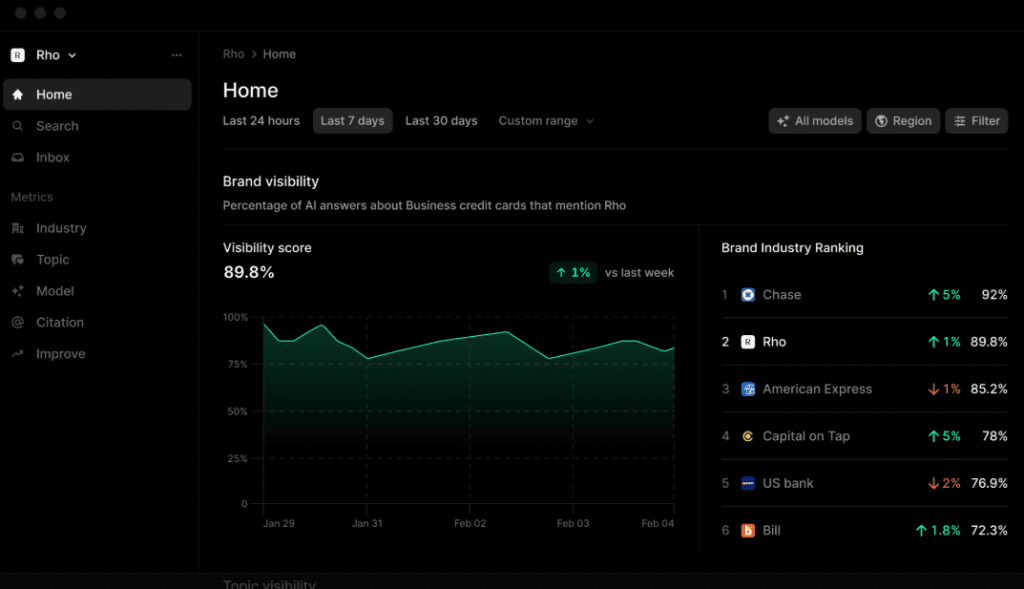
A standout feature is Agent Analytics, which uses server logs to show you exactly how AI bots crawl and interpret your site in real-time. You also get access to Prompt Volume data to see what people are actually asking, plus a Google Analytics integration that ties these AI mentions directly to website conversions and revenue.
4. Actionable Insights
Track My Visibility gives you page-level optimization recommendations. The AI-Ready Score tells you what to fix first. This is built into the platform. Instead of guessing, you get specific tips for each page to help it perform better with AI models. It also points out content gaps, showing you the topics and questions you should be showing up for but aren’t yet.
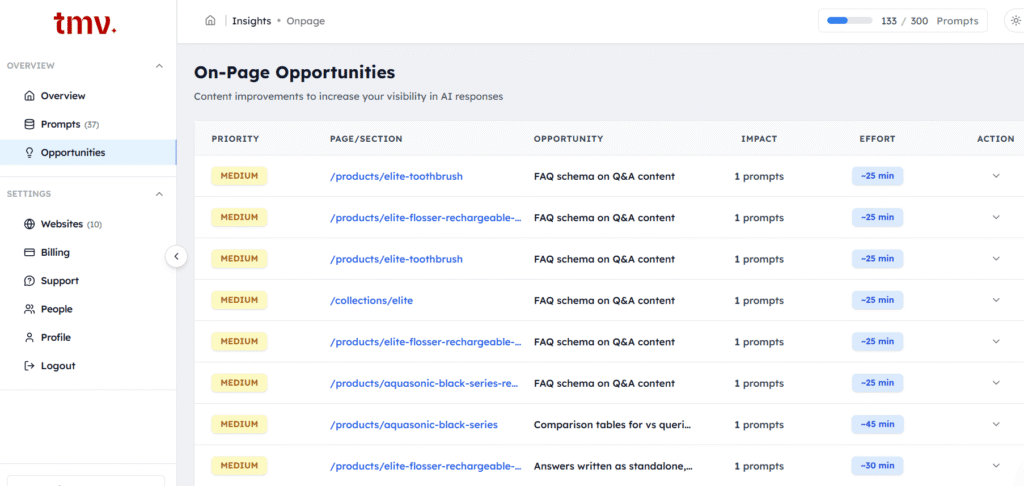
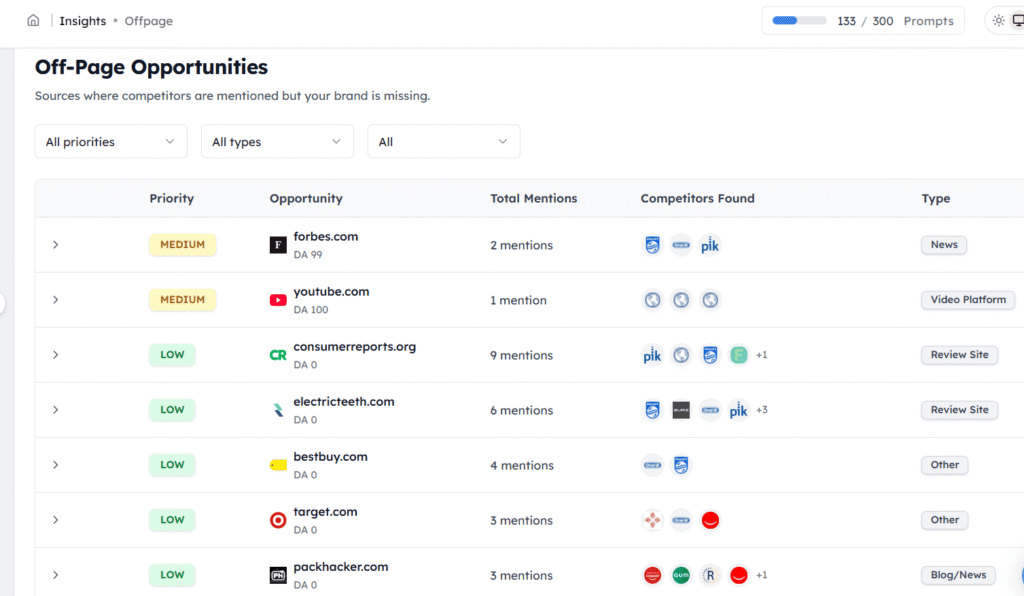
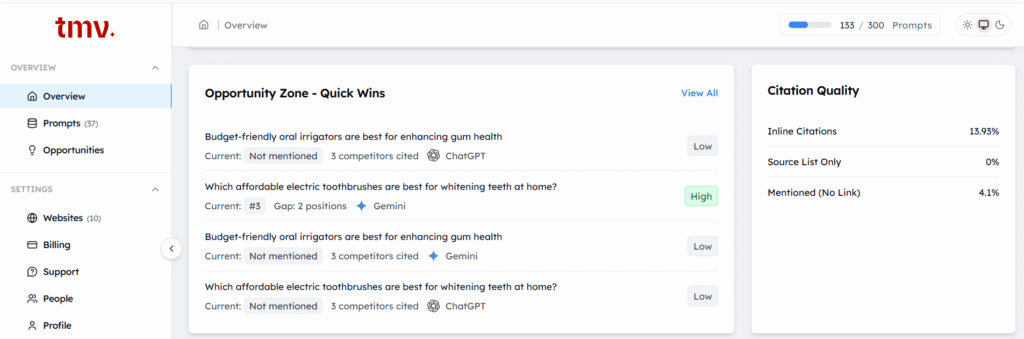
The Opportunity Zone shows you exactly which prompts to prioritize, with High or Low urgency labels, which AI platform has the gap, and how many competitors are already being cited there.
It also breaks down citation quality, showing whether your brand is getting inline citations, source list mentions, or name drops without a link. Each type carries a different weight in terms of how AI models perceive your authority.
Beyond just tracking, the tool gives you clear advice on how to tweak your content so you’re more likely to get cited across all the major AI platforms.
Whereas Profound AI takes a high-scale, technical approach to optimization. Instead of a simple score, it uses its “AEO Content Score” and “Agent Analytics” to show exactly how AI crawlers like GPTBot index your site in real-time. The platform identifies content gaps by analyzing millions of AI responses, highlighting where competitors are being cited while you’re missing out.
It then generates research-backed briefs and automated templates to help you fix those gaps before you even hit publish. Ultimately, it’s a complete system built to turn raw data into a data-backed strategy that scales across your whole organization.
5. Reliability & Performance
Because Track My Visibility is a newer player, its documentation is still a work in progress, though users haven’t reported any major stability issues so far.
On the other hand, some Profound users have noted technical hurdles like interface bugs, occasional crashes, and slow data exports on G2. There have also been a few mentions of longer support wait times, sometimes stretching up to a week, which is something to keep in mind if you need immediate help.
6. Competitor Tracking
With Track My Visibility, you get competitor benchmarking as a standard feature, whether you’re on the 7-day trial or a paid plan. It keeps an eye on your brand mentions and tracks your “share of voice” so you can see exactly where you stand.
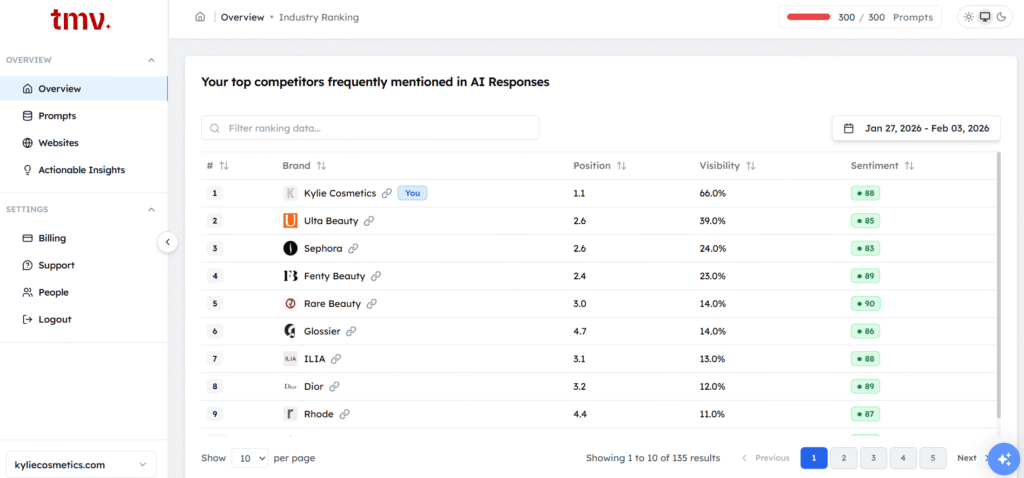
You can even run side-by-side comparisons to see which competitors are getting cited for specific prompts, making it easy to spot and fill any content gaps. Beyond the basics, it also helps you find backlink opportunities and hidden areas in your content where you could be gaining more traction.
Profound AI also includes competitor benchmarking across its plans, though the level of detail depends on your tier. Whether you’re on the $99 Starter plan or a full Enterprise setup, you can monitor brand mentions and track your share of voice to see how you stack up against others.
The platform goes deep into side-by-side analysis, showing you exactly which competitors are being cited for specific high-value prompts. This helps you spot “visibility gaps” where you’re missing out on a conversation your rivals are winning.
Beyond just tracking, Profound uses its data to highlight content opportunities and technical fixes, ensuring your site is structured to stay ahead of the competition.
Which AI Visibility Tracking Tool Should You Choose?
The decision between Track My Visibility vs Profound AI comes down to your specific situation.
Choose Track My Visibility If
- Your budget is tight: You’re looking for a cost-effective entry point, with plans starting at $42 per month.
- You have a lean team: It’s built for smaller groups (1–20 people) who need to move fast without enterprise complexity.
- Want source-level citation clarity: The Sources tab shows whether AI is citing your pages, competitor sites, or third-party domains, so you know exactly where to focus.
- You want actionable scores: You need the AI-Ready Score and specific page-level tips to quickly improve how bots see your site.
- You’re in “test” mode: It’s ideal if you’re exploring AI visibility for the first time and don’t need a massive contract.
- You focus on the US market: The tool is highly optimized for US-based search results and agency clients.
- You value transparency: You want clear, upfront pricing without having to sit through a sales demo first.
Choose Profound AI if
- You have a major budget: You can justify an investment ranging from $99 for the “lite” version to $5,000+ per month for full enterprise scale.
- You need total coverage: You want to track 10+ platforms, including Gemini, Claude, Grok, and Meta AI (mostly locked behind the Enterprise tier).
- You’re a large organization: You are a Fortune 500 or mid-market company with strict SOC 2 security and compliance needs.
- You want a consultant: You value having a dedicated AI search strategist to help you interpret the data and build a roadmap.
- Global reach is a priority: You need to monitor how your brand is appearing in different regions and languages worldwide.
- Shopping is your business: You need deep visibility into how your products are recommended within ChatGPT Shopping and other commerce bots.
Final Verdict
The best AI visibility tool depends entirely on where you are as a business. When comparing Track My Visibility vs Profound AI Keywords, the answer comes down to your resources and goals.
For most startups, agencies, and small-to-medium businesses, Track My Visibility offers better value. You get the core functionality you need at a price that makes sense. The AI-Ready Score provides clear direction, which is often more valuable than comprehensive data when resources are limited.
For enterprise companies where AI search visibility directly impacts multi-million dollar revenue streams, Profound’s investment makes sense. The comprehensive multi-platform coverage, dedicated strategist, and enterprise-grade analytics justify the cost.
The middle ground is trickier. If you’re a growing B2B SaaS company or mid-market eCommerce brand, start with Track My Visibility. Test the waters. See what impact AI visibility has on your business. You can always upgrade to an enterprise solution later if the ROI justifies it.
One thing is certain: ignoring AI visibility tracking isn’t a viable strategy anymore. Nearly half of Google searches show AI Overviews. Your competitors are already thinking about this. The question isn’t whether to track AI visibility, but which tool fits your current reality.
Frequently Asked Questions
AI visibility tracking monitors how often your brand, products, or content appear in responses from AI search engines like ChatGPT, Perplexy, Google AI, and others. It’s similar to traditional SEO tracking, but for AI generated answers instead of standard search results. If you want a deeper breakdown, this guide on how to measure your visibility in AI content walks through the mechanics.
Track My Visibility offers a trial for seven days. After that, pricing starts at $50/month for the Discover plan (25 prompts) and $400/month for the Growth plan (300 prompts). Both plans include unlimited team members. They also offer an annual discount with 2 months free when you choose yearly billing on any plan.
Profound AI’s Starter plan is $99/month (ChatGPT only). The Growth plan is $399/month for three engines. Enterprise pricing is custom but reportedly ranges from $2,000-5,000+/month. Full platform access requires the Enterprise tier.
Track My Visibility currently monitors four major AI platforms: ChatGPT, Perplexity, Google AI Overviews, and Gemini. They’re expanding coverage over time.
Profound AI monitors 10+ AI platforms, including ChatGPT, Perplexity, Google AI mode, Meta AI, and others. However, full platform access requires the Enterprise plan. The Growth plan only covers three engines.
The AI-Ready Score is Track My Visibility’s unique metric that evaluates how well your content is positioned to appear in AI responses. It provides URL-level recommendations on what to optimize to improve your chances of being cited by AI systems.
Resources:
- 50 AI Overviews Statistics 2026 (Latest Data & Reports)
- Google AI Overview Statistics: 2026 Trends and Impact | Heroic Rankings
- OpenAI CEO Sam Altman: I don’t use Google anymore, I cannot tell you …