


You have done the SEO work. Your pages rank well, and the traffic is steady. But you have probably noticed a shift: a huge part of your audience isn’t even landing on Google anymore. They are asking AI tools like ChatGPT or Perplexity query, getting the answer immediately, and moving on with their day.
If they don’t click a link, they don’t see your site. That’s why learning how to rank in AI search results has become just as important as traditional SEO for any business that relies on organic discovery.
40% of U.S. adults have adopted Generative AI, with one-third logging in daily or weekly to get work done (Master of Code).
That’s the problem this guide addresses. Appearing in AI search results isn’t about finding a new way. It’s about making your content genuinely useful in a way that AI systems can find, extract, and confidently cite.
Here’s what you’ll walk away with:
- A clear picture of how AI search actually works and why it’s different from traditional search
- A phased roadmap to optimize content for AI search across all major platforms
- The technical fixes that most sites are missing
- How to build the kind of authority that earns citations, not just rankings
- A measurement framework that shows real progress
Key Takeaways
- AI search tools like ChatGPT and Perplexity often answer queries without sending users to any website, making citation share your new ranking metric.
- AI systems extract short, self-contained content chunks of 100 to 300 words, so your content structure matters as much as what you write.
- Third-party mentions carry roughly 6.5x more weight than content on your own site when AI systems evaluate credibility.
- 92 to 94% of AI Mode searches end without a click, which means visibility now lives in the answer itself, not just on your page.
- Most sites are already blocking AI crawlers by accident, and fixing robots.txt is the fastest win available.
Understanding the AI Search Result Landscape in 2026
AI search has moved well past the experimental phase. Roughly 37% of consumers now start searching for information with an AI-powered search tool rather than a traditional search engine (Search Engine Land). That’s not a prediction anymore, it’s the current reality.
The platforms driving this shift include Google’s AI Overviews and AI Mode, ChatGPT Search, Perplexity AI, and Gemini. Each has its own citation logic and content preferences, but they share a common foundation: they pull from trusted sources, synthesize answers, and present them directly. Users often get what they need without ever hitting a search engine results page.
For businesses, that creates a visibility gap. You can rank on page one of Google Search and still be completely absent from the AI answers your audience is reading every day.
How AI Search Differs from Traditional Search Engines
With traditional search, people type short keyword fragments, usually two or three words. AI search users write full questions, often 15 to 20 words, phrased the way they’d ask a knowledgeable colleague. That shift in query format alone changes what kind of content performs well.
Results work differently, too. Traditional search hands you a list of links. AI generated responses give you a synthesized answer, sometimes with citations and sometimes without, which means the user may never see your page, even if your content was the source.
That changes how you measure success. Traditional search is tracked through clicks and rankings. In AI search, the equivalent metric is citation share, which means how often your brand actually gets mentioned in AI search answers.
92 to 94% of AI Mode searches end without anyone clicking through to an external site (Semrush). Users tend to take the answer they get and move on.
There’s also a fundamental difference in what these systems are optimizing for. Traditional search engines rank pages. AI search engines extract chunks: short, self-contained passages that can independently answer a question without the surrounding context.
Let’s understand it with a simple example. Here, I asked Google a question, and as you can see, in order to give an answer, it showcased multiple links.
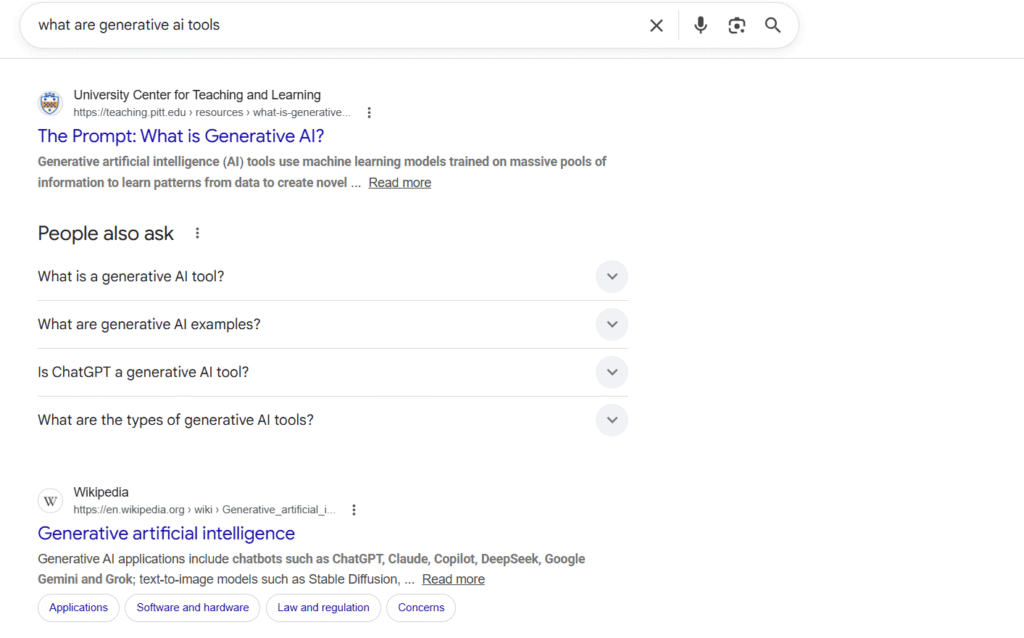
Here’s an example of AI search tools and how they respond to a particular query.

None of this means traditional SEO is obsolete. You still need both. AI search optimization just requires a separate layer of thinking on top of what you’re already doing for organic search.
Major AI Search Engines You Need to Optimize For
Not all platforms behave the same way, and understanding their preferences matters.
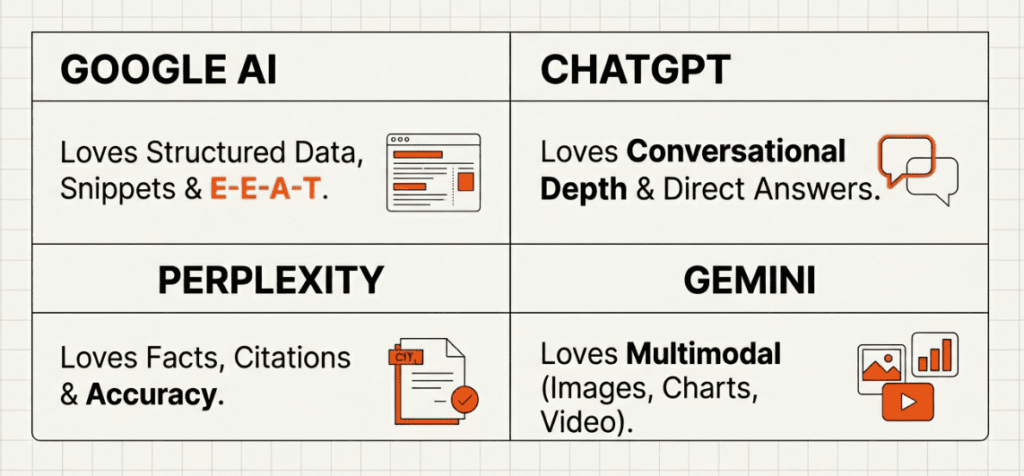
1. Google AI Overviews & AI Mode: Google remains the dominant force. It favors structured data, content that already appears in featured snippets, and pages with strong E-E-A-T signals. AI Mode is now showing ads alongside organic AI answers, which tells you how seriously Google is taking this. If you want a deeper breakdown, our guide on how to rank in Google AI Overviews covers the specifics.
2. ChatGPT Search: It has over 900 million weekly active users (OpenAI). It leans toward conversational, in-depth content and cites sources directly. If your content reads like a knowledgeable person explaining something, ChatGPT tends to pull from it. Understanding how ChatGPT chooses which sources to cite gives you a real edge here.
3. Perplexity AI: It attracts research-oriented users who actively check the citations. If you want to understand how Perplexity compares to Google Search in terms of how they retrieve and surface content, the differences matter for how you structure your pages. Transparent sourcing and factual accuracy matter more here than anywhere else.
4. Claude and Gemini: These AI search tools are growing fast. Claude gravitates toward detailed, well-organized explanations. Gemini, on the other hand, is built to be multimodal. It doesn’t just look at your text. It looks at your images, charts, and videos too, so using a variety of formats gives you an edge there.
How AI Retrieval Actually Works
Understanding the mechanics helps you write content that actually gets cited. When someone asks a complex question, AI models don’t just search for a matching page. They perform what’s called query fan-out by breaking the question into five to ten sub-queries and running them in parallel. Each sub-query looks for the best available answer.
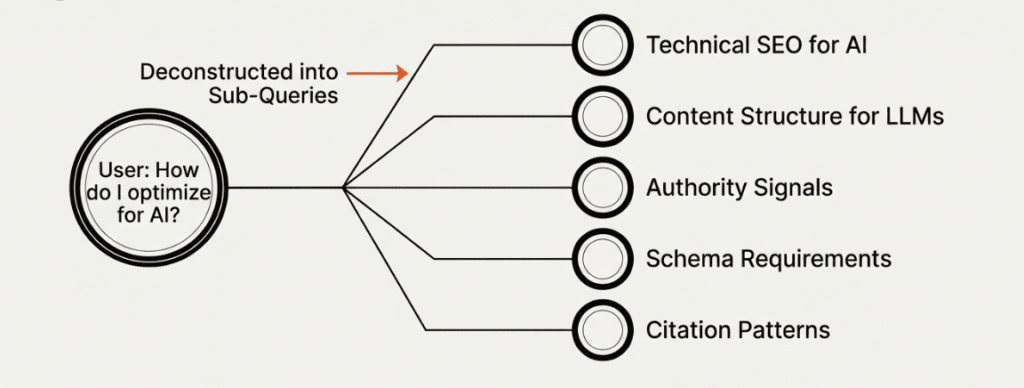
From there, AI systems extract chunks and passages of roughly 100 to 300 words that independently answer a specific question. The AI doesn’t read your whole page; it reads segments. If your content requires context from five paragraphs earlier to make sense, it won’t get cited.
Finally, the AI synthesizes these chunks from multiple sources into a coherent response. The sources that are clearest, most authoritative, and most directly on-point earn the citation.
This is why structured formatting, concise answers, and topical authority aren’t optional. They’re the mechanism by which content gets surfaced.
 Pro Tip: AI doesn’t retrieve content the way Google does. Understanding how LLMs choose content helps you structure pages that actually get extracted, not just indexed.
AI Search Optimization Roadmap: A Phased Approach
Getting your site to show up in AI summaries starts with a basic question: can the bots actually read what you’ve built? Before anything else, you need to clear the technical roadblocks that might be hiding your content from them entirely.
Phase 1: Build Your Technical Foundation (Weeks 1–2)
Before you think about your writing, make sure you’re not accidentally invisible. A lot of websites block AI crawlers without the site owner ever realizing it. Pull up your robots.txt file and check whether bots like GPTBot, Google-Extended, Meta-ExternalAgent, and OAI-SearchBot are explicitly allowed in. If they can’t get past the front door, they can’t cite you.
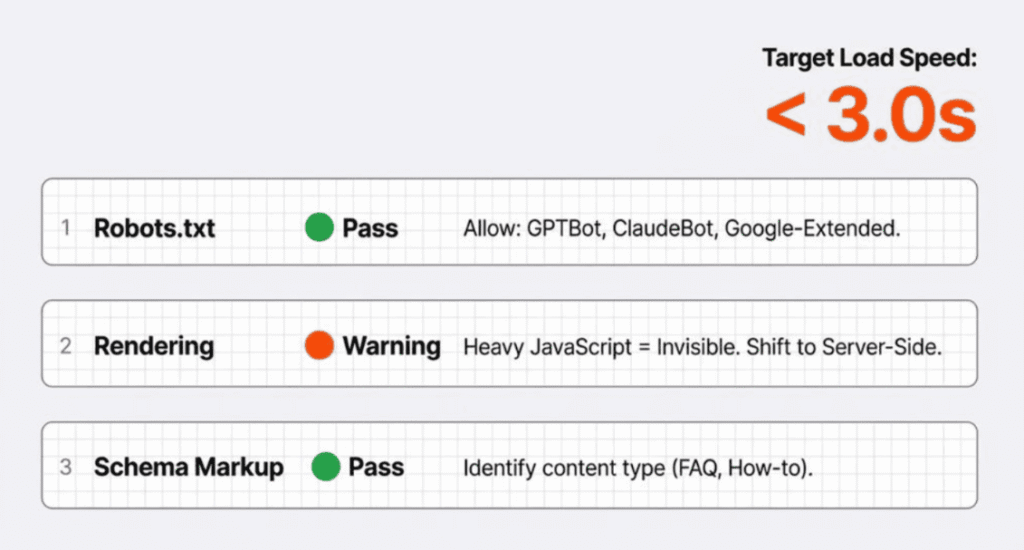
Once access isn’t an issue, think about how easy your content is to actually digest. A lot of AI crawlers don’t handle heavy JavaScript well. If your best content only appears after a browser renders it, the bot might land on what looks like a blank page. Clean, server-rendered HTML solves this. The text should be right there the moment the crawler arrives.
Next up is schema markup. It tells the bot exactly what it’s looking at: an FAQ, a product review, a how-to guide. If your schema is messy or wrong, the AI gets confused and usually just moves on. Also, it’s important to check your page speed. If a page takes more than three seconds to load, it creates friction for crawlers and pulls your standing down.
Phase 2: Optimize Content for AI Search (Weeks 3–6)
Once AI crawlers can access your site, the next question is whether they can actually use what they find. The principles behind optimizing content for AI answers go deeper than formatting alone, but structure is where you start.
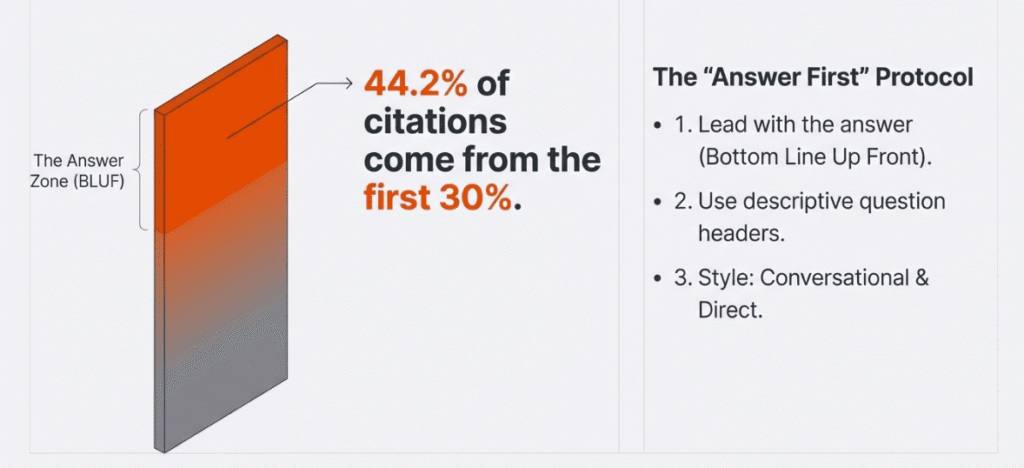
Write in chunks, not essays. Every section should stand alone. A reader or an AI model should be able to drop into any paragraph and immediately understand what it’s about, no context needed. That’s what makes content extractable.
Put the answer first. Instead of building up to your point, lead with it. ChatGPT AI citation patterns shows 44.2% of citations come from the first 30% of a page (Search Engine Land). Your opening paragraphs carry disproportionate weight, so use them.
Make your headers descriptive, not clever. “How This Works” tells nobody anything. “How AI Search Engines Extract Content from Web Pages” is actually useful. Specific headers help AI systems know what each section covers and when to pull from it.
A few practical ways to structure content for AI search results:
- Use FAQ sections with questions people actually ask. Add definition boxes or quick-answer callouts at the start of complex topics. Keep paragraphs to three to five sentences. Cut vague language and filler sentences that don’t add real information.
- Forget keyword density. AI systems understand synonyms, context, and related terms. Writing naturally for user intent works better than repeating exact phrases. Keyword stuffing actively hurts the quality signals AI models rely on.
- Write for conversational queries. People ask full questions in AI search, so your content should match that. Take every real question your customer has ever asked and write a page that answers it completely. These specific, conversational pages tend to get cited more consistently than broad overview content.
- Use formatting where it helps. Bullet points, numbered lists, and comparison tables make it easier for AI systems to extract specific information. Just don’t overdo it. A wall of bullets is just as hard to parse as a wall of text.
Phase 3: Build Topical Authority (Weeks 7–12)
Getting cited once is good. Getting cited consistently, across a range of related questions, is what actually builds AI visibility over time.

AI engines use query fan-out to answer complex questions, which means they’re simultaneously looking for the best answer to five to ten related sub-questions. If your site has relevant content across that whole topic area, you have multiple chances to show up. If you only cover the core topic shallowly, you’re competing for a single slot.
The hub-and-spoke model works well here. Build a comprehensive pillar page on a core topic, then create supporting cluster pages that go deep on specific subtopics. Internal linking between these pages signals semantic relationships to both search engines and AI systems, telling them this site knows this subject thoroughly.
Content freshness matters too. Stale content gets deprioritized, and AI systems favor sources that are up to date, especially for fast-moving topics. Build a refresh schedule into your content calendar. Even small updates to statistics, examples, and dates signal active maintenance.
Supporting content types to build out:
- Glossary pages for key terms in your space
- FAQ hubs organized by topic
- Comparison pages that address specific decision-stage questions
- Case studies and real examples, since these add the depth AI favors
Phase 4: Build Authority and Citation Worthiness (Weeks 13–24)
AI search engines weigh third-party mentions roughly 6.5x more heavily than owned content. Writing great content on your own site is necessary, but not sufficient. You need people outside your site talking about you.
That’s where digital PR comes in. Getting your brand mentioned in industry publications, news outlets, and authoritative blogs creates the external citation signals AI models use to validate credibility. A single mention in a well-regarded trade publication does more for your AI search visibility than five self-published blog posts. The user raised an interesting point, which is worth noting: Reddit citations in Google AI Overviews grew 450% in just three months, and Reddit is now the most cited domain in AI Overviews at 21% of all citations. If your brand is showing up authentically in relevant Reddit threads, you’re building exactly the kind of external citation presence that AI search rewards.
Reddit citations in Google AI Overviews grew 450% in just 3 months (from 1.3% to 7.15%). Here’s what this means for your brand.
by u/Fine_Doubt_4507 in GEO_optimization
E-E-A-T signals (Experience, Expertise, Authoritativeness, and Trustworthiness) matter across all AI platforms, not just Google. In practice, that means bylines with real credentials (not just “Staff Writer”), author pages that establish who wrote what and why they’re qualified, clear contact information and company ownership, citations linking out to credible sources, and user feedback in the form of reviews, testimonials, and Q&A sections.
Google’s own documentation on helpful content puts trust at the center of E-E-A-T. But trust is what the system is ultimately optimizing for. That means author bylines, clear sourcing, and demonstrated first-hand knowledge aren’t optional extras. They’re the signals Google’s systems are specifically designed to identify.
Original research is one of the best citation magnets available. Survey data, proprietary analysis, or a well-organized dataset that doesn’t exist elsewhere gives other writers something to reference and gives AI systems a factual anchor to cite. If your brand produces the stat, your brand gets mentioned every time someone uses it.
Brand mentions also function as authority signals even without a link. Monitor for unlinked mentions and reach out to get links added where appropriate. Tools that track brand mentions across the web make this manageable at scale.
Phase 5: Platform-Specific Optimization
Once the fundamentals are in place, you can fine-tune for individual platforms.
a. For Google AI Overviews and AI Mode: Focus on featured snippet optimization. Pages that already appear as featured snippets in Google Search have a strong head start for AI Overview inclusion. Structured data, especially FAQ and HowTo schema, increases your chances significantly.
b. For ChatGPT Search: Write conversationally. Long, thorough answers to specific questions tend to get cited. ChatGPT’s citation behavior rewards directness because it pulls from pages that confidently answer the question, not pages that hedge extensively. For a deeper look, see our guide on strategies to rank in ChatGPT.
c. For Perplexity AI: Accuracy and sourcing matter most. Perplexity users actively verify citations, so content that’s factually solid and clearly sourced performs better here. Avoid making claims you can’t back up.
d. For Claude and Gemini: Claude favors structured, well-organized explanations. Gemini’s multimodal approach means having charts, images with proper alt text, and varied content formats, which helps your pages cover more ground.
Measuring, Monitoring & Tracking AI Search Visibility
Traditional SEO metrics only tell part of the story now. Before setting up your tracking infrastructure, it helps to understand how to measure your AI search visibility across platforms, not just within a single tool.
AI driven search introduces a different layer of visibility that those numbers don’t capture. Citation share, brand sentiment, and referral quality are the metrics that actually reflect how AI platforms perceive and reference your brand.
The challenge is that AI visibility is harder to measure than traditional search. Zero-click answers mean users get what they need without ever visiting your site, so traffic alone won’t show you the full picture. But tracking the right signals reveals your true impact on brand awareness and authority.
The brands doing this well track two categories of metrics simultaneously. Setting up your tracking infrastructure early gives you a baseline to measure against, as AI search optimization is important.
Set Up Your AI Visibility Tracking Infrastructure
Start with GA4. Create a custom channel group that captures traffic from AI platforms, specifically from ChatGPT, Perplexity, Google Gemini, and others. This separates AI-referred traffic from organic so you can see exactly how much visibility you’re getting from these platforms over time. For citation monitoring, tools like Track My Visibility are built for this. They help you see where and how often your brand surfaces in AI-generated answers, giving you a clear picture of your AI search results presence.
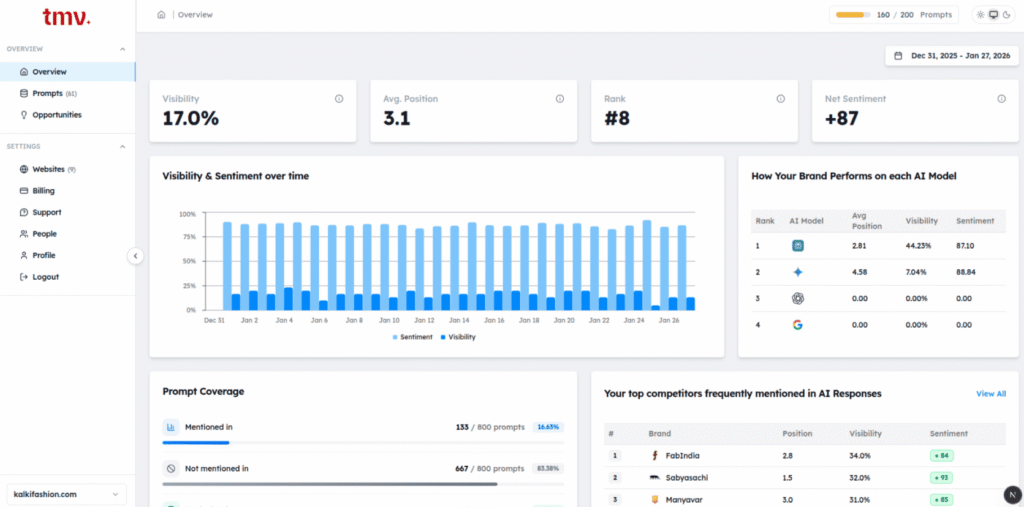
For brand mention tracking, build a list of 20 to 30 core queries relevant to your business and test them monthly across the major AI platforms. Each time you run a test, log whether your brand was mentioned, where it appeared in the response, the context around the mention, whether a link was included, and whether competitors showed up instead. This becomes your visibility record over time.
Competitor benchmarking works the same way. Pick 5 to 10 direct competitors, track how often they get cited, compare share of voice, and pay attention to what types of content or claims tend to get referenced. That last part often reveals gaps in your own content strategy.
Key Performance Indicators for AI Search
Leading indicators tell you whether your foundation is solid:
- How frequently and deeply are AI bots crawling your site
- Schema validation errors (the goal is zero)
- Page speed (under 2 seconds)
- Content freshness and how well your site covers relevant topics
Lagging indicators tell you whether that foundation is producing AI results:
- Citation frequency and your share of citations within your category
- Visibility consistency across platforms
- Where in responses your brand typically appears
- How diverse your platform coverage is
- AI referral traffic volume, growth rate, and conversion rate from that traffic
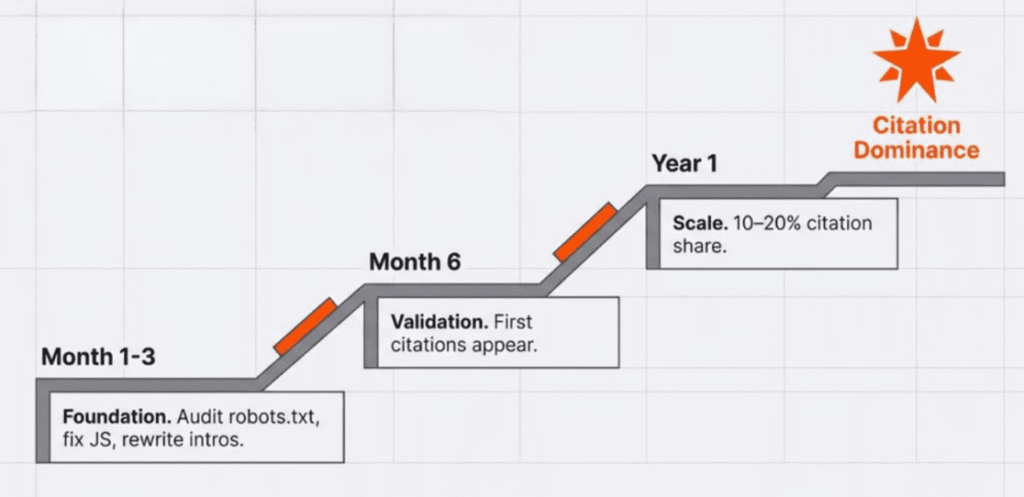
On realistic goal-setting: months 1 through 3 are about establishing a baseline. Months 4 through 6 are when you should start seeing first citations appear. By months 7 through 12, a reasonable target is 10 to 20 percent of your tracked queries showing your brand. By year two, a strong position looks like a 25 to 40 percent citation share in your core topic areas.
These ranges shift by industry. SaaS and B2B brands tend to build citation authority faster through research and thought leadership. Local services and e-commerce work differently and often rely more on review signals and structured data.
Monitor AI Crawler Behavior and Technical Performance
Your server logs contain more useful information than most people use. Access them and run them through tools like Screaming Frog, Splunk, or GoAccess to understand how AI bots are actually interacting with your site.
The key things to track: how often each bot visits, which pages they’re crawling, what status codes they’re hitting (200 is good, 404 and 500 are problems), what time-of-day patterns look like, and which pages bots consistently skip.
Red flags worth watching for: a high 404 rate from AI bots, a sudden drop in crawl frequency, bots hitting URLs you’ve marked as disallowed, elevated 500 error rates, or bots not reaching your most recently updated content.
Each issue has a corresponding fix. Shallow crawl depth usually means your internal linking needs work. Pages being skipped should be added to your sitemap. High 404 rates need broken links cleaned up. Low crawl frequency is often a signal to publish fresh content more consistently.
Build a Measurement Dashboard That Actually Gets Used
The goal is a dashboard that gives you the right information at the right cadence without requiring manual work every time.
- Weekly: AI referral traffic (sessions and users), top landing pages from AI sources, conversion events, bot crawl activity, and any new citations discovered.
- Monthly: Citation share broken down by query category, brand sentiment, competitor comparison, content refreshes completed, schema validation status, and overall technical health scores.
- Quarterly: Year-over-year citation growth, platform diversity, content hub completion, third-party mentions earned, competitive positioning, and a full ROI analysis with strategy adjustments based on what the data is showing.
For stakeholder reporting, structure it around business impact first. Lead with the executive summary and ROI metrics, then follow with progress against goals, technical status, content performance, and competitive analysis.
Most stakeholders don’t need to see crawl logs. They need to see whether the investment is moving the right numbers.
Implementation Roadmap by Team Size & Resources
Implementation timelines and priorities look very different depending on your team size, technical resources, and budget. A solo founder and a 10-person marketing team are not running the same playbook, and they shouldn’t be.
The most effective approach across all team sizes is phased implementation: get the technical foundation right first, then optimize content, then build authority. That order matters. And the good news is that success doesn’t require a massive budget. Strategic focus and consistent execution will outperform a large budget with no clear direction every time.
1. Solo Founder / 1-Person Team (Limited Resources)
Reality check: You have roughly 5-10 hours per week, a budget under $500/month, and you’re handling everything yourself. That means ruthless prioritization. Focus only on what is more important and what will have a greater impact.
Month 1 is about laying the groundwork without overcomplicating it. Get your technical basics sorted: robots.txt, basic schema markup, a speed check, and GA4 setup. Do a quick content audit of your top 10 pages. Set up free tools and Google Alerts, and build a simple tracking spreadsheet so you know what’s working.
Month 2 shifts to optimization. Rewrite the introduction on your top 5 pages, add FAQ schema, and clean up your headers. Create 2-3 new FAQ pages targeting questions your audience is already asking.
Month 3 is when you start building content depth and earning outside mentions. Launch one content hub with a pillar page (1,500-2,000 words) and outline 3-5 cluster topics around it. Start showing up externally through Quora answers and expert networks like Connectively.
What success looks like at 90 days: Your first AI citation appears, 2-5 queries are surfacing your brand, AI referral traffic is visible in GA4, and your top 5 pages are fully optimized.
2. Small Team / Growing Business (4-10 People)
Reality check: You have a dedicated marketing person or small team, 20-30 hours per week to commit, and a budget in the $500-2,500/month range. You can move faster and go deeper than a solo founder, but you still need to stay focused.
Month 1 is a comprehensive audit. Do a proper technical deep-dive, audit 50-100 pages of content, and analyze 5 competitors to understand where the gaps are.
Month 2 is an optimization sprint. Get 15-20 key pages tightened up, build out a content hub framework for 2-3 hubs, and set up technical monitoring so you catch issues early.
Month 3 kicks off authority building. Launch a digital PR campaign, publish 3-5 cluster pages, and carve out 3-5 hours per week for community engagement in spaces where your audience already hangs out.
Months 4-6 are about expanding and validating. Complete your first content hub, launch a second, secure 3-5 external citations, implement more advanced schema, and run monthly competitive benchmarking to track your position.
3. Enterprise / Large Organization (10+ People)
Reality check: You have a dedicated SEO team, 100+ hours per week across contributors, and a budget ranging from $5,000 to $25,000+ per month. The challenge here isn’t resources. It’s alignment, coordination, and moving fast enough despite organizational complexity.
Month 1 is strategy and alignment. Run an enterprise-level audit (expect 40-50 hours), get stakeholders on the same page, define team roles, procure tools, and build a resource plan that everyone agrees on.
Months 2-3 focus on building the foundation at scale. Deploy schema site-wide, tackle Core Web Vitals across the full site, develop 5-10 content hubs, launch a major research initiative, and get executive thought leadership content into production.
Months 4-6 are about scaling output and sophistication. You’re publishing 20-30 articles per month, running A/B tests, implementing personalization, releasing quarterly research, and putting your executives on conference stages.
Months 7-12 are where you establish category leadership. That means being the go-to authority in your space, expanding to emerging AI platforms, building proprietary measurement models, and creating competitive moats that are genuinely hard for others to replicate.
4. Agency Managing Multiple Clients
Managing AI search optimization across a portfolio of clients comes with its own set of challenges: varying levels of AI maturity across accounts, different budgets, diverse industries, and the constant pressure to demonstrate ROI at scale without reinventing the wheel for every client.
The solution is standardized processes with room for customization. Build scalable service packages with clearly defined deliverables:
- Basic ($1,500-3,000/mo): Core technical setup, foundational content optimization, basic reporting
- Standard ($3,000-7,000/mo): Deeper content strategy, content hub development, authority building
- Premium ($7,000-15,000+/mo): Full-service execution, digital PR, advanced schema, competitive benchmarking
Process templates are what keep delivery consistent without burning out your team. Build a client onboarding checklist, a technical audit template, a content optimization checklist, a schema implementation guide, and a monthly reporting template. Use them every time.
On the tools side, white-label reporting, project management platforms, content collaboration tools, and SEO platforms with multi-client dashboards are what make this manageable at scale.
Client education is also part of the job. Quarterly strategy reviews, regular landscape updates, case study sharing, benchmarking reports, and transparent reporting all help clients understand what they’re getting and why it matters. When clients understand the strategy, they stay longer and trust your recommendations more.
Common Mistakes to Avoid
Most visibility issues in AI search aren’t caused by bad content. They’re caused by simple, preventable mistakes that keep the bots from doing their job.
1. Technical Implementation Errors
The most common mistake is accidentally blocking the bots you actually want. A single “Disallow” line in your robots.txt can make you invisible. Beyond the usual suspects like GPTBot and ClaudeBot, you also need Meta-ExternalAgent (which powers the Llama ecosystem) and OAI-SearchBot on your allow list. If you want Gemini citations without your data being used for training, the Google-Extended tag handles that specifically.
2. Over-complicating with JavaScript
Heavy JavaScript means many AI crawlers see a blank page. Googlebot has improved at handling this, but most newer AI search tools still prefer clean, server-rendered HTML. If a bot can’t read your text on the initial page load, it won’t cite you.
3. Content Strategy Mistakes
Shallow content kills citations. AI models look for expert signals, and pages under 300 words rarely give enough context to be trusted as a source. Original insights and data that can’t be found elsewhere will always outperform broad, surface-level summaries.
4. Authority & Credibility Errors
Publishing only on your own site limits your authority. AI models rely on external signals like Reddit mentions, industry news quotes, and third-party features. That earned media is what convinces an AI that your brand is a credible leader in its field.
5. Measurement & Strategic Errors
Standard SEO dashboards won’t give you the full picture. Set up Custom Channel Groups in GA4 using regex for AI referrers, and monitor your unlinked brand mentions. If the numbers look small early on, that’s normal. AI search is about quality leads and high-intent citations, not raw traffic volume.
Future of AI Search: What’s Coming in 2026-2027
The shift from “searching” to “doing” is happening faster than expected. To stay relevant over the next year, you need to look beyond keywords and focus on how AI systems actually interact with your data.
We’re entering the era of Agentic AI, where tools complete tasks like booking a dental appointment or ordering a restock of office supplies. To be the business an AI agent chooses, you need more than good blog posts. Your product and service data needs to be clean, structured, and accessible via APIs so these agents can read your inventory or availability in real time.
The way AI platforms make money is also becoming clearer. Google has fully integrated sponsored placements into its AI Overviews, and OpenAI is now testing ads for free ChatGPT users. Perplexity, on the other hand, has pulled back on ads to focus on subscriptions and maintain “answer integrity.” Keep a small portion of your budget flexible to test these new placements as they evolve, but don’t expect a one-size-fits-all ad model yet.
The idea of a single “Position One” is officially dead. AI will increasingly use location, past behavior, and stated preferences to customize every response, meaning two people asking the same question will see different sources cited. Success now means becoming the go-to authority for your specific audience segment rather than chasing a generic keyword ranking.
Also, while generic AI handles general questions well, specialized fields like healthcare, law, and finance are moving toward Vertical AI, which are search tools built specifically for regulated industries with much higher bars for verification.
If you operate in one of these fields, getting your data into these niche citation pools now is a real opportunity. It’s far easier to become a trusted source while these platforms are still in early growth phases.
Conclusion: Show Up in AI Search Results Starting Now
The shift is already underway. 37% of consumers starting their searches with AI is not a small trend; it’s a structural change in how people find information and make decisions.
The fundamentals of AI search results optimization aren’t complicated. Make your content technically accessible, write in a way that directly answers user queries, build genuine topical depth, earn external citations through quality work and digital PR, and measure what matters.
You don’t need a massive budget or a large team. A solo founder who spends five focused hours a week on this can see their first AI citations within 90 days. What you do need is consistency and a willingness to stop writing for algorithms and start writing for people who have real questions.
Traditional search isn’t going anywhere. AI search isn’t replacing it; it’s layering on top of it. The businesses that figure out how to optimize for AI search results while keeping their existing SEO foundation intact will be the ones with compounding visibility advantages as these platforms mature.
Tools like Track My Visibility can help you monitor where you’re showing up in AI search results and stay ahead as the landscape evolves.
Frequently Asked Questions
Focus on technical accessibility (allow AI bots in robots.txt), write content that directly answers specific questions in clean, structured formatting, build schema markup, and earn external citations through digital PR and third-party mentions.
For most sites with a solid technical foundation and decent domain authority, first citations appear within 90–180 days of focused optimization. Building a consistent citation share across platforms typically takes 9–12 months.
Yes. AI search optimization builds on top of traditional search best practices, but it doesn’t replace them. Strong content, good technical health, and authoritative backlinks benefit both channels.
Focus on answering very specific, well-defined questions thoroughly. Smaller sites often perform well in AI Overviews for niche queries where there isn’t much authoritative competition. Schema markup, clean structure, and direct answers are your best tools.
Generative engine optimization (GEO) focuses on earning citations in AI generated responses rather than ranking pages in traditional search results. The underlying content quality principles overlap, but GEO emphasizes chunk-level extractability, conversational query coverage, and external citation building more heavily than classic SEO.
AI search results are generally reliable for well-established facts, but they can occasionally get things wrong, especially for niche topics or very recent events. These results are powered by large language models that pull from vast amounts of valuable content across the web, so the quality of what you get depends heavily on how well a topic is covered online. It’s always worth cross-checking anything important before acting on it.
Resources:
- 350+ Generative AI Statistics [January 2026]
- 37% of consumers start searches with AI instead of Google: Study
- Google AI Mode’s Early Adoption and SEO Impact
- Scaling AI for everyone | OpenAI
- 44% of ChatGPT citations come from the first third of content: Study