
For 20 years, Google decided what people found online. Now, ChatGPT is deciding what people understand. And that changes everything for marketers.
Google used to be the sole search engine for information, but that has changed with the rise of artificial intelligence and large language models. Whether it’s researching new market trends, diagnosing performance issues, or shaping a go-to-market strategy, Google has long been the default source for these insights.
Now, that behavior is shifting. Tools like ChatGPT are no longer just experimental AI assistants. They are becoming a primary place where people ask complex, strategic, and decision-level questions.
And it is forcing businesses to question if ChatGPT is better than Google for grabbing visibility in this moving era.
In this article, we’ll break down:
- How ChatGPT works and how it differs from traditional Google search
- The limitations of ChatGPT compared to Google
- When to choose ChatGPT and when Google remains the better choice
- How can we help your business stay visible in AI search results
Let’s get started.
How does ChatGPT work?
When you give a prompt to ChatGPT, a human-like response is generated. Behind those responses, ChatGPT uses NLP techniques to understand your intent and respond to it throughout the pre-trained conversational LLM models trained on large text datasets.
As you instruct ChatGPT with your prompts, it analyzes the user intent from them to generate a relevant response. Also, it stores your previous conversations as memory for future responses. With a conversational AI engine, it transforms your raw data into meaningful insights, helping to boost your customer engagement. If you’re curious about the technical side, you can explore more about how ChatGPT generates an answer.
For example, if you prompt “best camera for photography”, ChatGPT provides a summarized list of top camera options with buyers’ concerns and feature comparison. Following up on the suggestions like “tell me the camera under $1000”, ChatGPT understands your intent without needing further explanation.
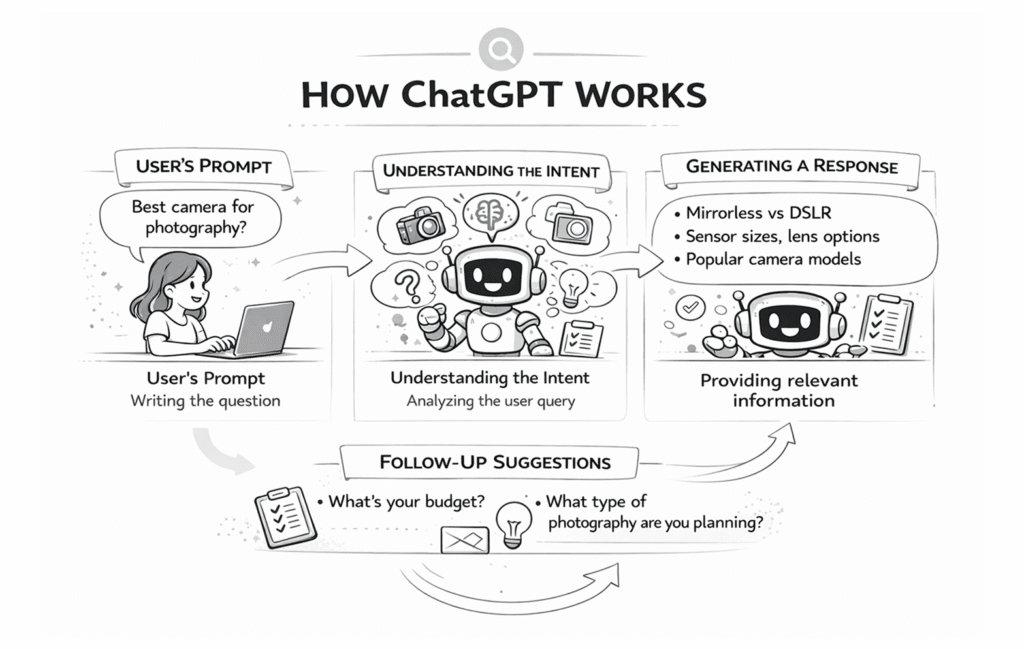
Analyzing such large data and insights, alongside tasks such as marketing campaigns, personalized ad copy, eCommerce product recommendations, shopping assistance, and boosting your communication, makes ChatGPT a powerful tool for your business.
How does Google search work?
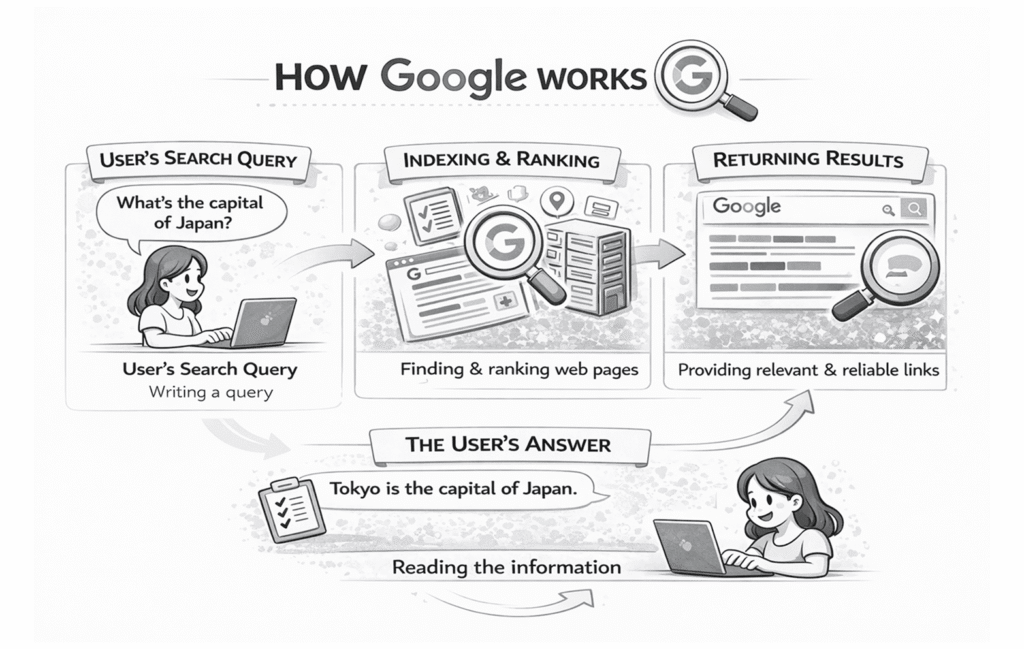
As you are aware, Google’s traditional search engine gives direct answers to your queries. To deliver the relevant results, Google uses algorithms and page ranking systems to understand the relationship between phrases in your queries. Google’s search engine uses crawling, indexing, and ranking to deliver the most relevant results to you.
With AI mode, Google introduced zero-click results, making it easy to get the answers without going through multiple pages. For this, LLM models like Google Gemini are used to fetch real-time data from the web to synthesize direct answers with citations.
If you are searching for the “best laptop to buy in 2026, Google returns the top laptops from the most popular buying and selling platforms. Recommending personalized results, Google understands your queries and the relationship between those phrases.
Here’s an illustration of how Google provides results for your asked query:
 Pro Tip: Google AI Overviews pull from pages that are structured, credible, and up-to-date. Learn exactly how to get there with the Step-by-Step Guide to Rank in Google AI Overview.
 Key difference between ChatGPT and traditional Google search
Knowing how ChatGPT and traditional Google search work will help you in your content strategies.
1. ChatGPT Vs Google Search – User Interface and Experience
The core difference between ChatGPT and Google Search starts with how you interact with each platform. Google delivers the familiar search experience you know: a straightforward interface where you enter queries and receive suggestions, relevant links, images, and personalized ads.
ChatGPT transforms this entirely, offering an uninterrupted, single-screen conversational experience. Simply ask your question, and ChatGPT responds with tailored answers and intelligent follow-up questions with no additional typing required.
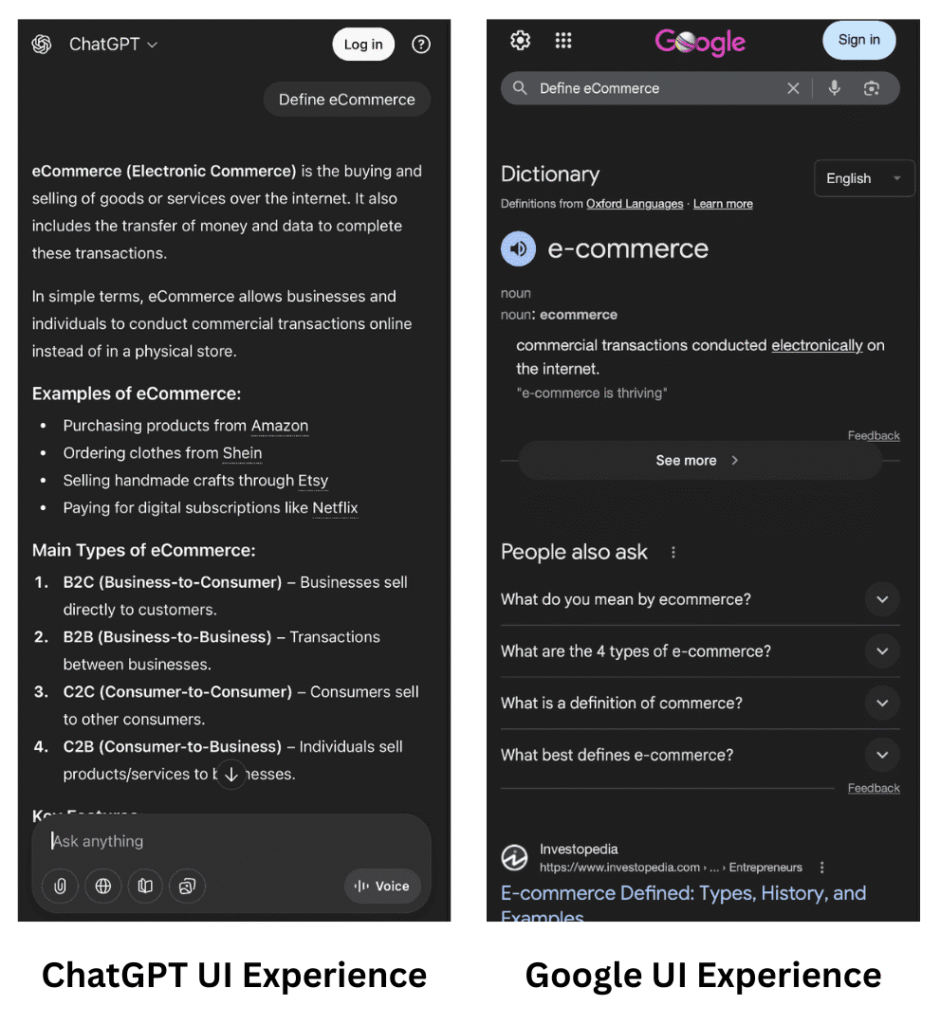
User Interface and Experience With ChatGPT:
- Conversational format delivers outcome-focused results through natural dialogue
- Distraction-free, single-screen interface keeps you productive
- Proactively suggests follow-up questions based on your previous queries, deepening exploration
User Interface and Experience With Google:
- Clean, familiar search interface with seamless toggling between traditional and AI modes
- Comprehensive layout featuring multiple sources, images, and targeted ads
- Delivers diverse, relevant results informed by extensive user data
ChatGPT becomes your strategic conversation partner with focused interactions, while Google remains your comprehensive research engine, combining traditional search power with AI capabilities.
2. ChatGPT Vs Google Search – Technology used to generate responses
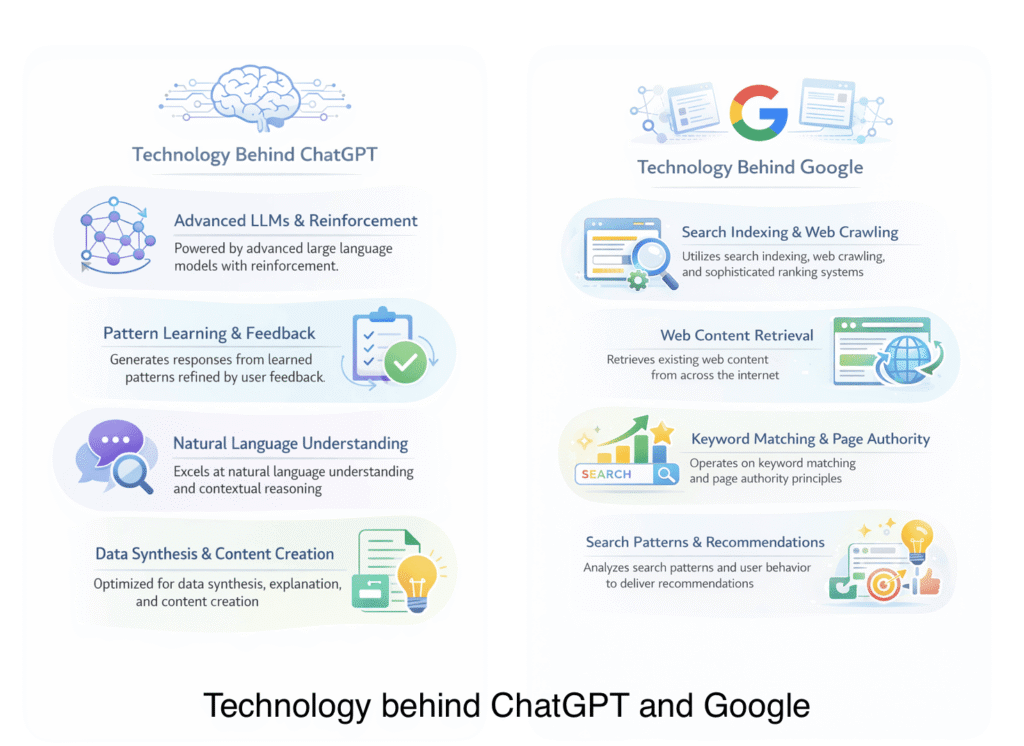
Traditional Google search relies on indexing and crawling to rank pages, matching keywords in your query to display results. ChatGPT leverages powerful transformer models and reinforcement learning to synthesize responses naturally, as if drawing from memory.
ChatGPT- AI-Powered Generative Language Model:
- Powered by advanced large language models (LLMs) with reinforcement mechanisms
- Generates responses from learned patterns refined by user feedback
- Excels at natural language understanding and contextual reasoning
- Optimized for data synthesis, explanation, and content creation
Google – Web Crawling & Search Indexing Engine:
- Utilizes search indexing, web crawling, and sophisticated ranking systems
- Retrieves existing web content from across the internet
- Operates on keyword matching and page authority principles
- Analyzes search patterns and user behavior to deliver recommendations
When you need context optimization and strategic reasoning, ChatGPT delivers. For precise query matching and discovering existing content, Google remains unmatched.
3. ChatGPT Vs Google Search – User Query and Intent Understanding
Google interprets your exact wording, but requires clear language and specific phrases for optimal results. ChatGPT understands your queries beyond surface-level wording, grasping intent even when you haven’t articulated every detail.
Here’s an example of query understanding:
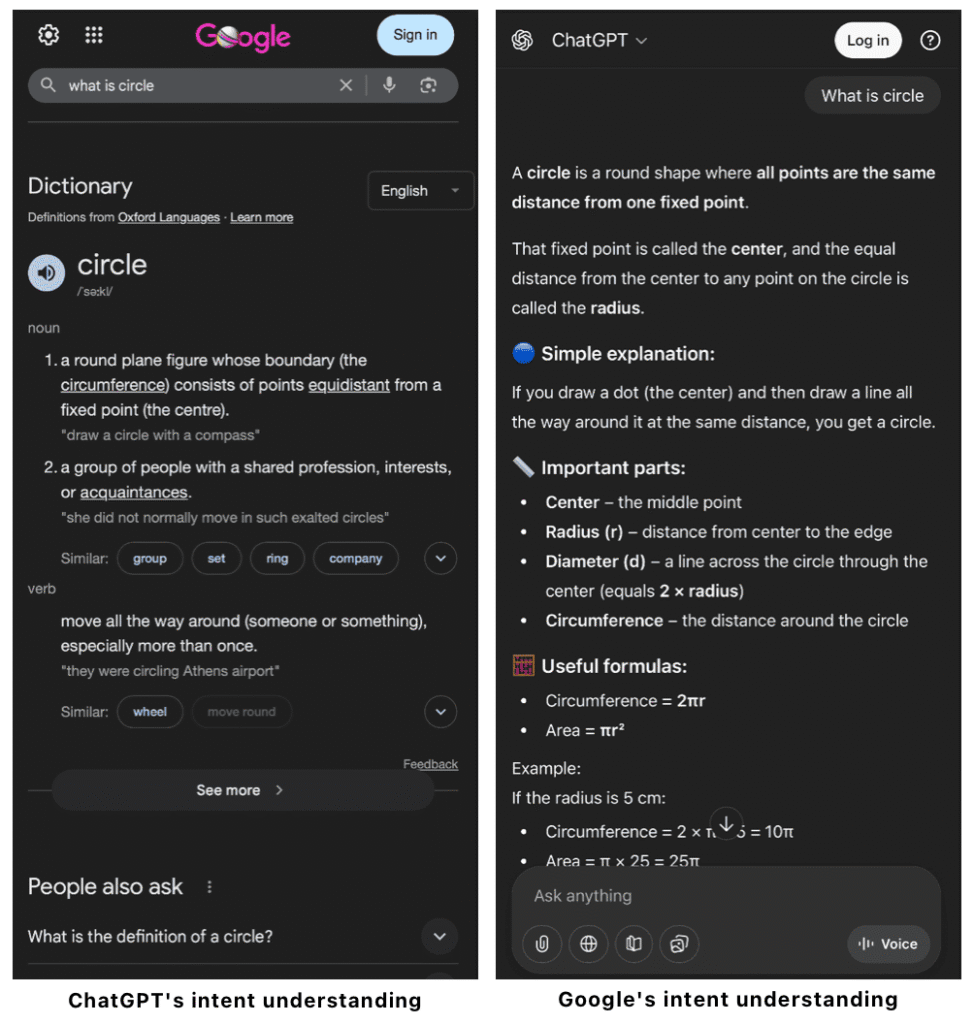
ChatGPT – Context-Aware Conversational Intelligence:
- Comprehends intent beyond literal prompt wording
- Efficiently handles multi-step processes and follow-up questions
- Responds best to complex, strategic prompts for superior results
Google – Query-Based Search & Retrieval System:
- Understands relationships between queries for effective information retrieval
- Treats each query independently for fresh perspectives
- Fundamentally keyword-focused and intent-driven
ChatGPT excels at understanding strategic intentions behind your prompts, while Google masters the art of connecting phrase relationships in your queries.
4. ChatGPT Vs Google Search – Supported Output Format
Here’s a game-changer for busy marketers: Google doesn’t provide ready-to-use structured formats you’ll need to extract and organize information manually. ChatGPT functions as your personal assistant, delivering content in exactly the format you need, whether that’s paragraphs, PDFs, tables, or lists.
ChatGPT Supported Structured Content Generation & Conversational Output:
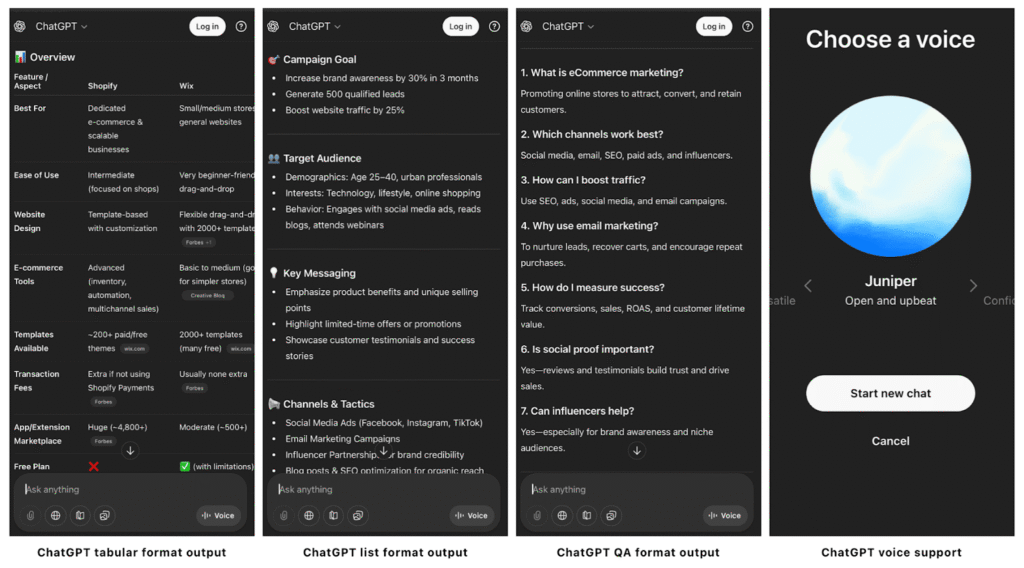
- Generates structured formats including paragraphs, lists, tables, and more
- Supports extensive long-form conversational outputs
- Offers voice interaction with customizable tone options
- Provides content in ready-to-use formats.
Google Supported Multi-Format Search Results & Information Retrieval :
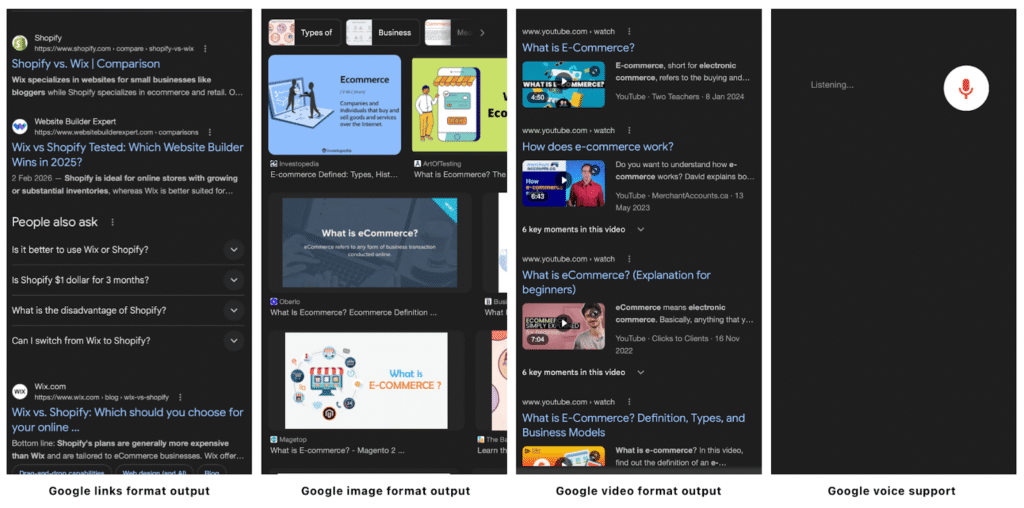
- Provides images, links, snippets, and videos
- Offers multiple structures optimized for readability and SEO
- Enables voice search via Google Assistant (with limited tone customization)
- Requires manual extraction for practical information usage
ChatGPT hands you campaign-ready outputs instantly, while Google directs you to source material across the web.
5. ChatGPT Vs Google Search – Form of Content
Google operates with keywords and phrases; each query must follow this format.
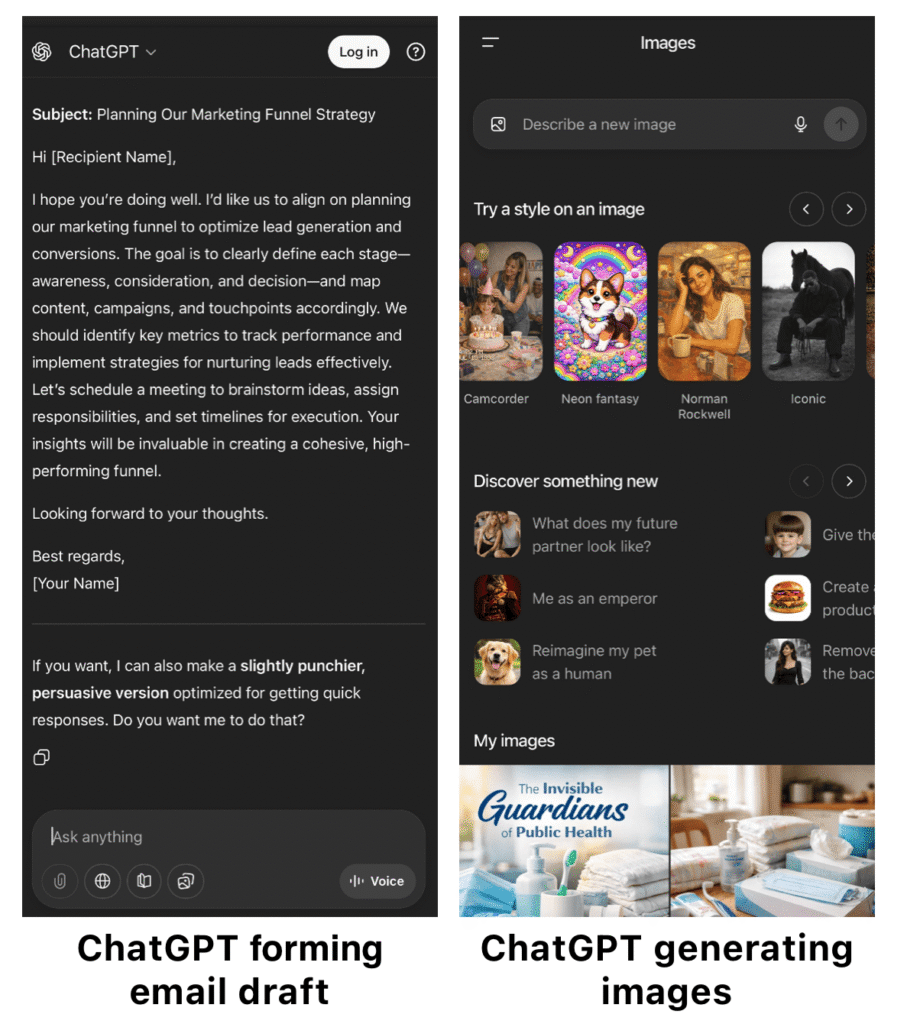
ChatGPT supports virtually any content type: emails, charts, blog posts, and audio conversations, giving you unmatched flexibility in how you communicate and create.
AI-Driven Content Creation With ChatGPT:
- Creates blogs, ads, emails, PDFs, videos, infographics, and social media posts
- Invaluable for brainstorming, ideation, and content development
- Supports multiple tools, reducing platform dependence
Research & Information Discovery With Google:
- Doesn’t create content directly but provides comprehensive guidelines
- Delivers references essential for research and discovery
- Requires manual writing and editing efforts
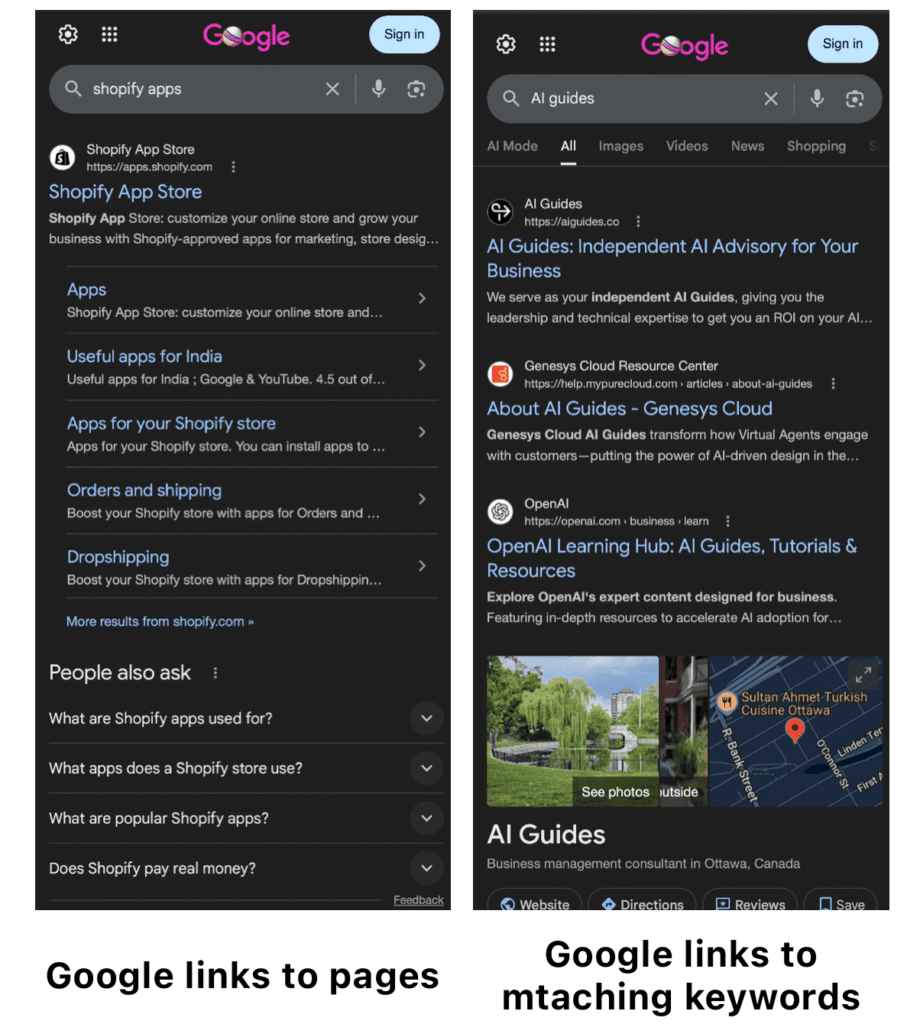
ChatGPT produces publication-ready long-form content, while Google supports your content research and strategy development.
6. ChatGPT Vs Google Search – Real-time Information Updates
Traditional Google continuously crawls for the latest information matching your query, delivering real-time updates automatically. ChatGPT requires web access configuration and verification of authoritative sources to provide current information.
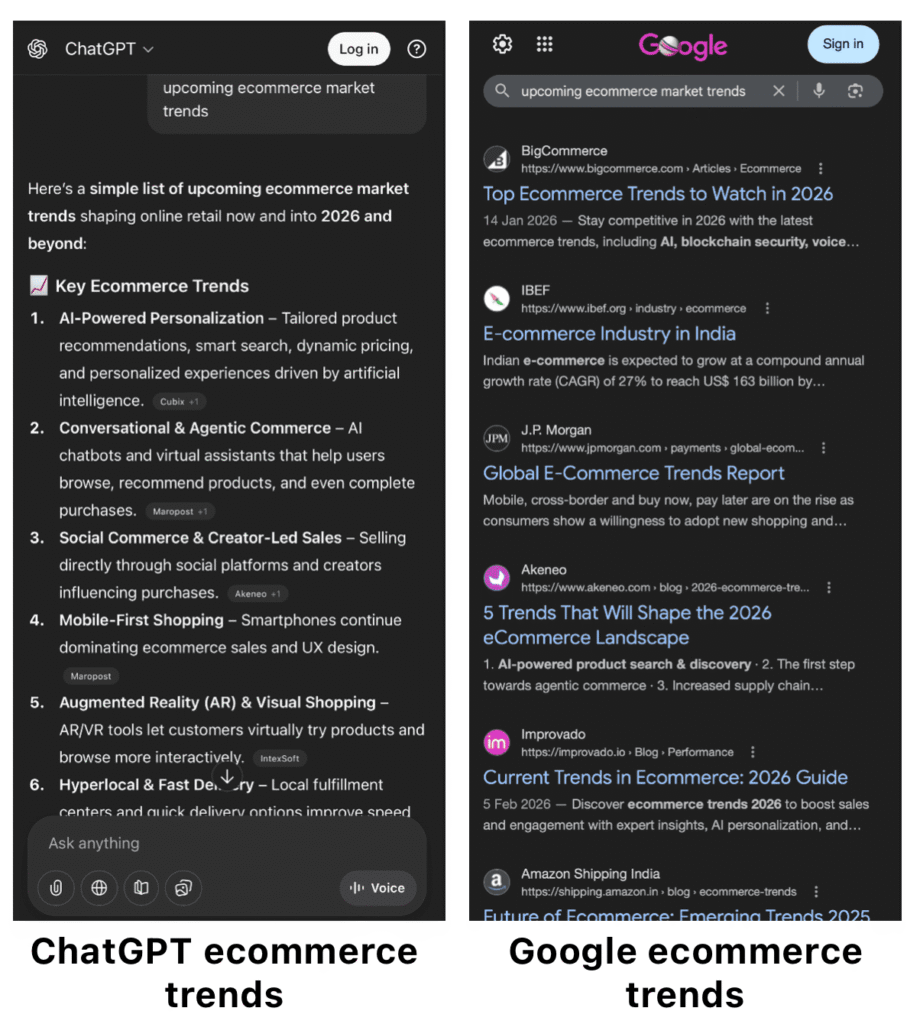
As from the results above, ChatGPT shows responses from the past year (2025), while Google shows the latest eCommerce trends from this year(2026).
ChatGPT With Contextual Response System:
- Pre-trained on extensive text data with limited real-time access by default
- Requires additional configuration and access permissions for the latest updates
- Works best with context-rich prompts and detailed explanations
- Ideal for general queries like “laptops for kids.”
Google With Real-Time Search & Updated Information:
- Provides immediate access to live, current information
- Continuously crawls and updates search indexes for freshness
- Offers advanced filtering options (time, region, duration) for refined searches
- Perfect for queries like “latest MacBook Pro review.”
ChatGPT serves as your strategic partner for general intelligence and planning, but Google dominates when you need current data for time-sensitive campaigns.
Pro Tip: AI platforms select content based on its structure, freshness, authority, and trustworthiness. Learn more about how to optimize content for AI Answers to get better brand visibility in the era of AI. 7. ChatGPT Vs Google Search – Personalize Suggestions from Search Query
Personalization depends heavily on interaction history. Google delivers personalized content based on your past activity and search patterns. ChatGPT uses conversation memory to provide increasingly relevant responses.
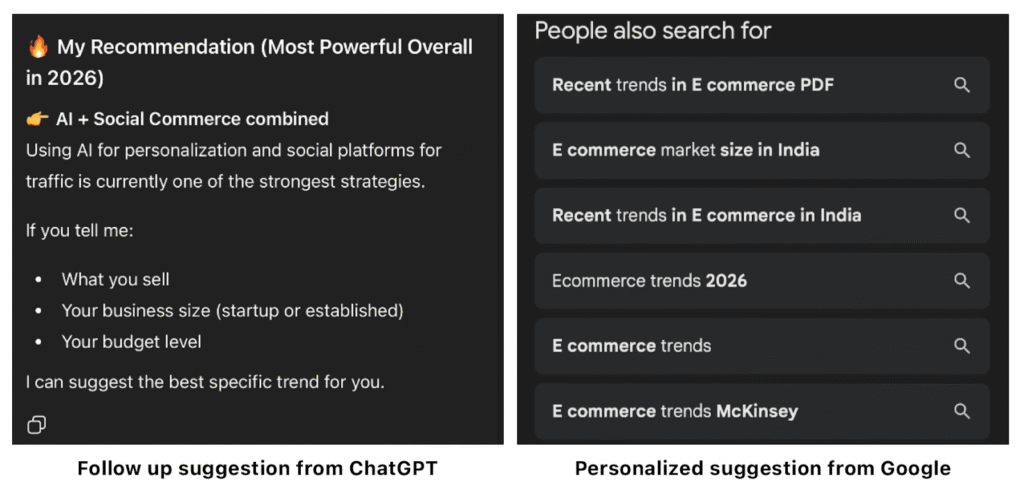
ChatGPT – Adaptive Conversational Personalization System:
- Delivers increasingly personalized responses as conversations deepen
- Tailors responses precisely to your stated goals and instructions
- Enables customized experiences through specific prompts and detailed instructions
Google – Behavior-Based Search Personalization Engine:
- Personalized based on past activity and geographic location
- Results reflect your keyword usage patterns
- Offers limited direct control over personalization settings
ChatGPT is personalized based on conversational context and prompt instructions, while Google leverages your historical search behavior and patterns.
8. ChatGPT Vs Google Search – Pricing
Pricing structures of Google Search and ChatGPT differ significantly based on your chosen subscription plan.
ChatGPT – Subscription-Based AI Access & Emerging Ad Model:
- Offers both free and paid plans with defined usage limits
- Pricing structured around specific use cases and productivity gains
- Subscription-based model for predictable budgeting
- ChatGPT also offers paid advertising, yet it is in the testing phase as of now
Google – Ad-Supported Search Platform with Monetization Programs:
- Free to use with an ad-supported model
- Paid programs available for marketing and ad monetization
- Revenue opportunities through advertising campaigns
If you prefer subscription-driven predictability for business applications, ChatGPT fits seamlessly. For monetizing advertising campaigns with pay-per-performance models, Google remains your ideal partner.
9. ChatGPT Vs Google Search – Authenticity and Result Accuracy
Regarding accuracy and authority, Google delivers superior reliability by providing legitimate, properly sourced links for your queries. ChatGPT can occasionally hallucinate, generating illogical or unverified information without sources, requiring you to cross-check data validity.
ChatGPT – AI-Generated Responses with Contextual Limitations:
- May occasionally hallucinate, producing inaccurate information requiring cross-validation
- Sometimes generates responses based on opinions and reasoning when online sources aren’t available
- Not recommended for precision-critical research and data insights
Google – Source-Linked Search & Authoritative Information System:
- Links to original, published sources for maximum accuracy
- Prioritizes authentic, authoritative sources in results
- Ideal for research and real-time data insights with proper source citation
ChatGPT offers exceptional reasoning capabilities but requires data verification, while Google validates facts through transparency and credible source attribution.
10. ChatGPT Vs Google Search – eCommerce Integrations and Marketing funnels
ChatGPT helps to integrate content workflow by generating SEO optimized descriptions, FAQs, and blogs that attract organic traffic to your platform. Google supports full-funnel marketing campaigns with Google Shopping and advertising platforms.
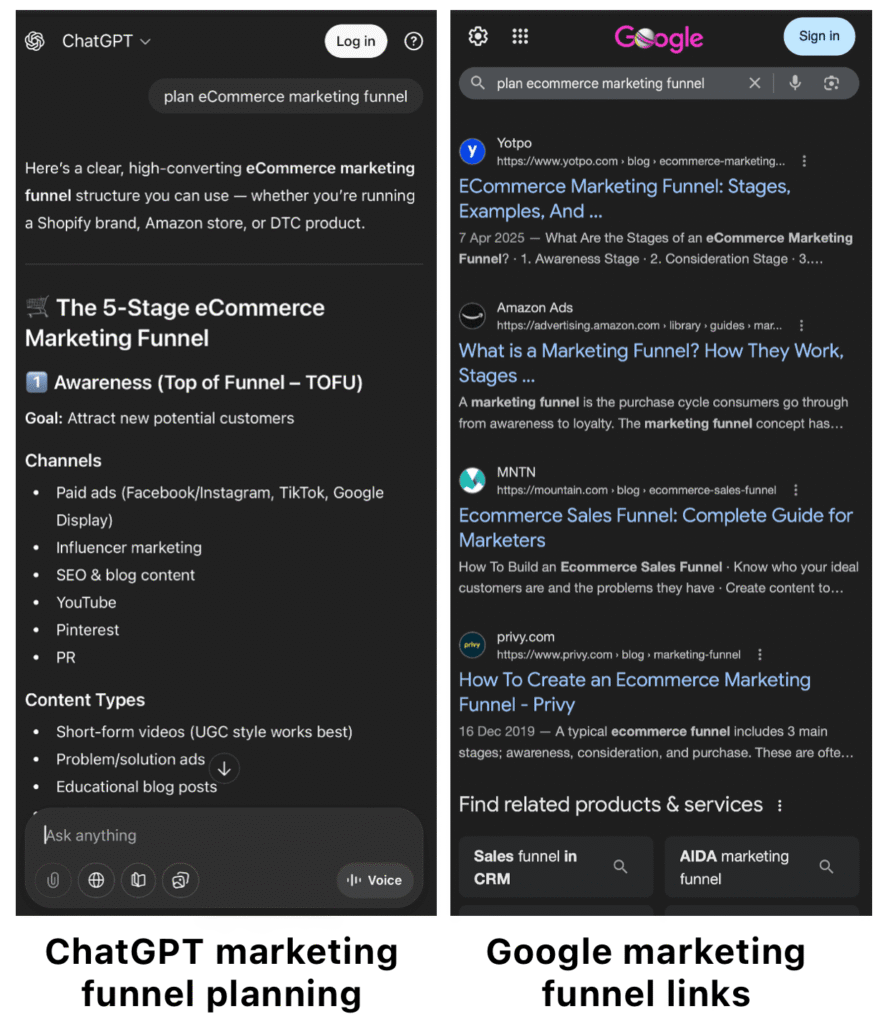
ChatGPT With AI-Powered Marketing Strategy & Funnel Development:
- Supports comprehensive marketing funnel planning and content creation
- Ideal for creating sophisticated workflow strategies for campaigns
- Assists in product messaging optimization and conversion rate optimization (CRO)
Google With Integrated Advertising & Performance Marketing Ecosystem:
- Seamless integration with Google Shopping and advertising platforms powers brand marketing
- Supports full-funnel marketing campaigns from awareness to conversion
- Provides robust analytics and conversion tracking that drives direct traffic and sales
ChatGPT assists in strategic funnel planning and content development, while Google directly powers the analytics, traffic generation, advertising, and conversion optimization that drive revenue.
Comparison: ChatGPT and Google Search
Here is the quick comparison between them for you to get a quick idea:
| Feature | ChatGPT | Google Search |
| User Interface & Experience | Conversational, focused, distraction-free | Link-based, ad-driven interface |
| Technology Used | Generative AI, large language models | Search indexing, ranking algorithms |
| Query & Intent Understanding | Intent-aware, context-driven | Keyword-based, query-specific |
| Supported Output Format | Structured text, conversational voice | Links, snippets, voice results |
| Form of Content | Generates blogs, emails, and ads | Discovers existing web content |
| Real-Time Information | Limited real-time access | Continuous real-time indexing |
| Personalized Suggestions | Goal and context-based personalization | Behaviour and history-based results |
| Pricing Model | Free, subscription-based | Free search, ad monetized |
| Authenticity & Accuracy | Needs validation for facts | Source-backed, verifiable results |
| eCommerce & Funnels | Strategy, copy, funnel planning | Traffic, ads, conversion tracking |
Pro Tip: AI platforms select content based on its structure, freshness, authority, and trustworthiness. Learn How to Rank in AI Search for Maximum Visibility. ChatGPT vs Google For Real Life Use Cases
To know the real difference, let’s give the queries to ChatGPT and Google to see how they respond to it with search results.
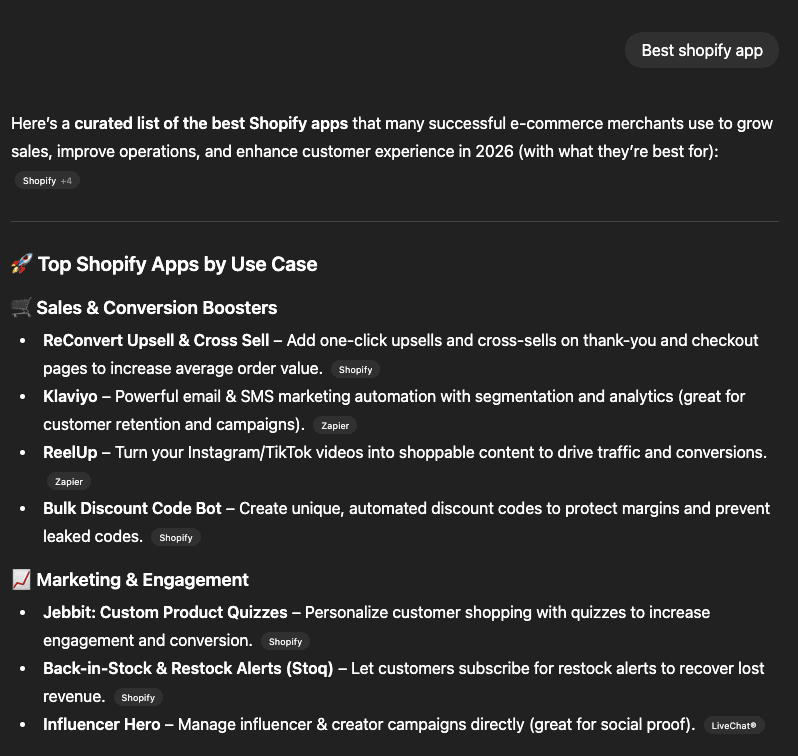
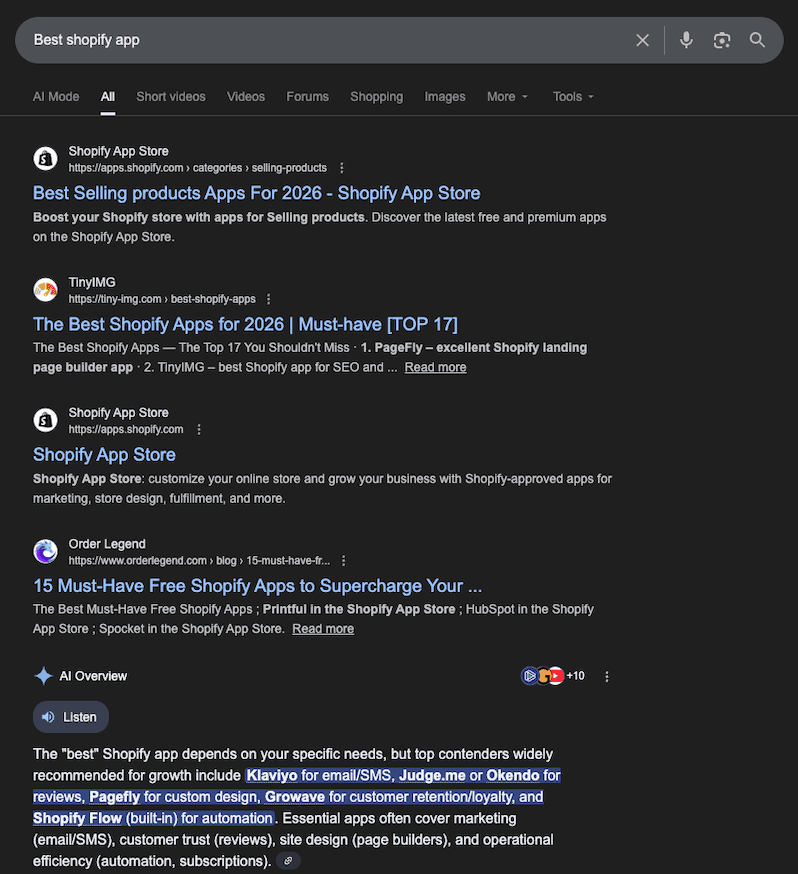
Query #1 – “Best Shopify App”
ChatGPT responds with a list of the best Shopify apps with their use cases.
Google shows a list of high-ranking web pages from the internet.
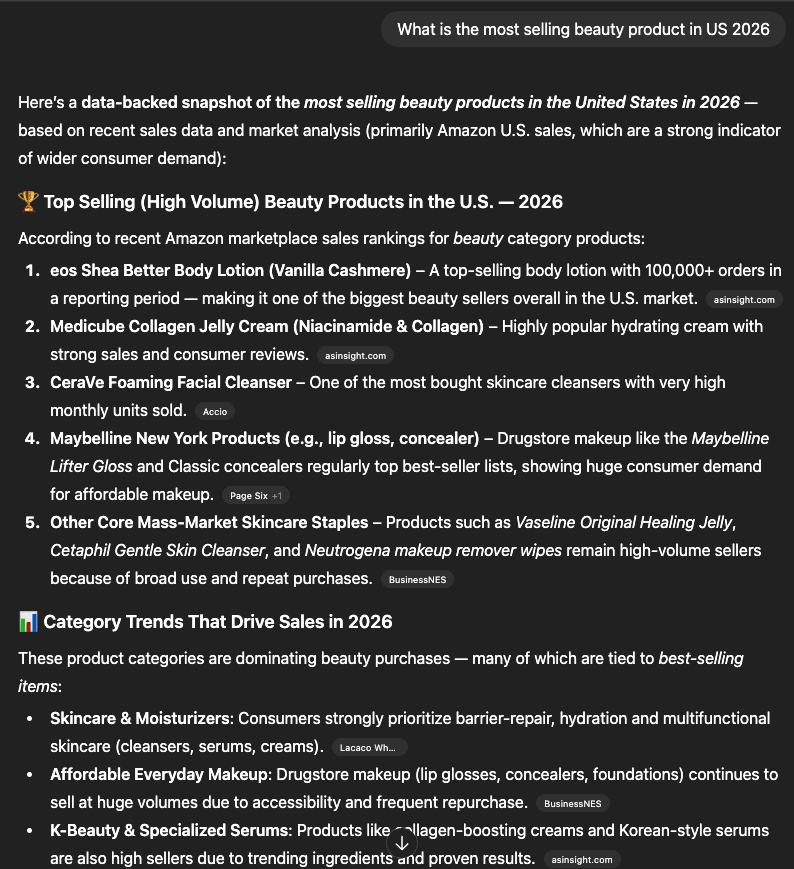
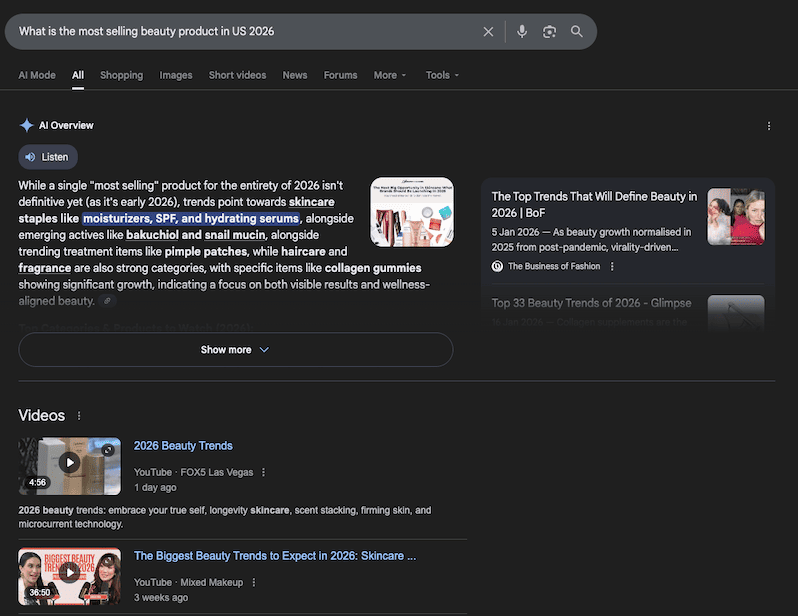
Query #2 – “What is the most selling beauty product in the US 2026?”
ChatGPT shows the highest top 5 selling products that sell the most in 2026.
Google displays the overview with AI mode results for the best-selling beauty products in the US in 2026.
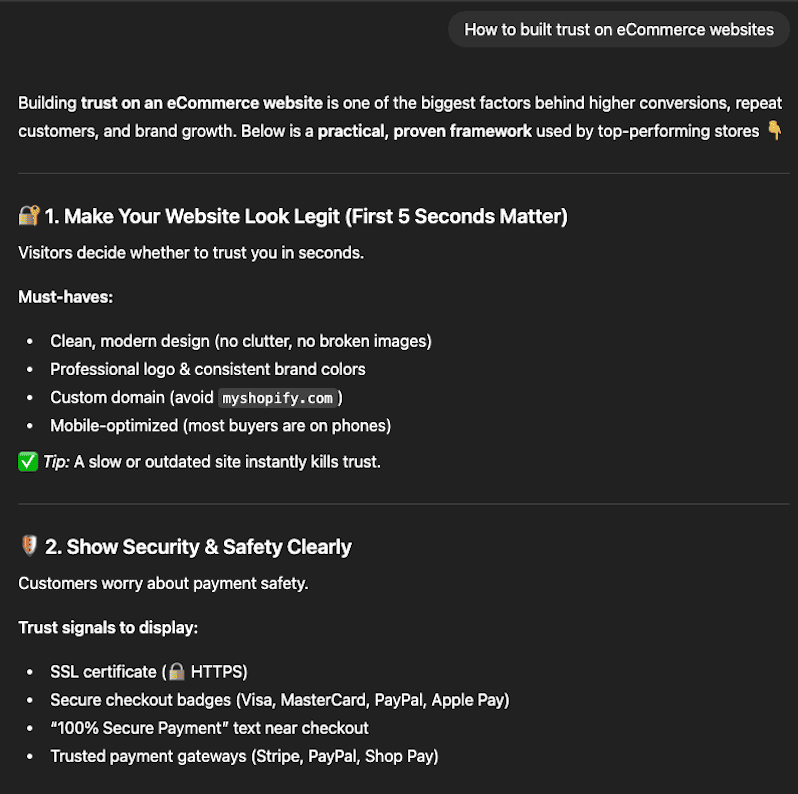
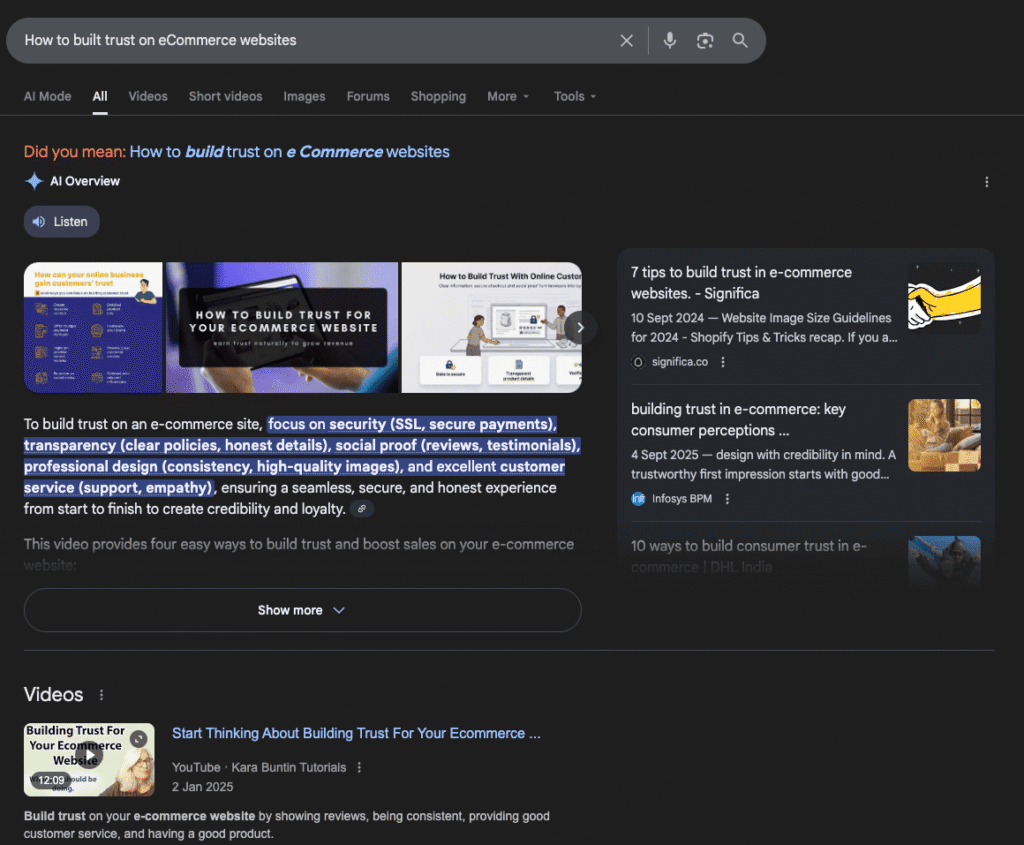
Query #3 – “How to build trust on an e-commerce website”
As ChatGPT has good reasoning capabilities, it will respond with a strategic framework and planning to build your users’ trust.
Google demonstrates high-ranking pages and links that match your search intent.
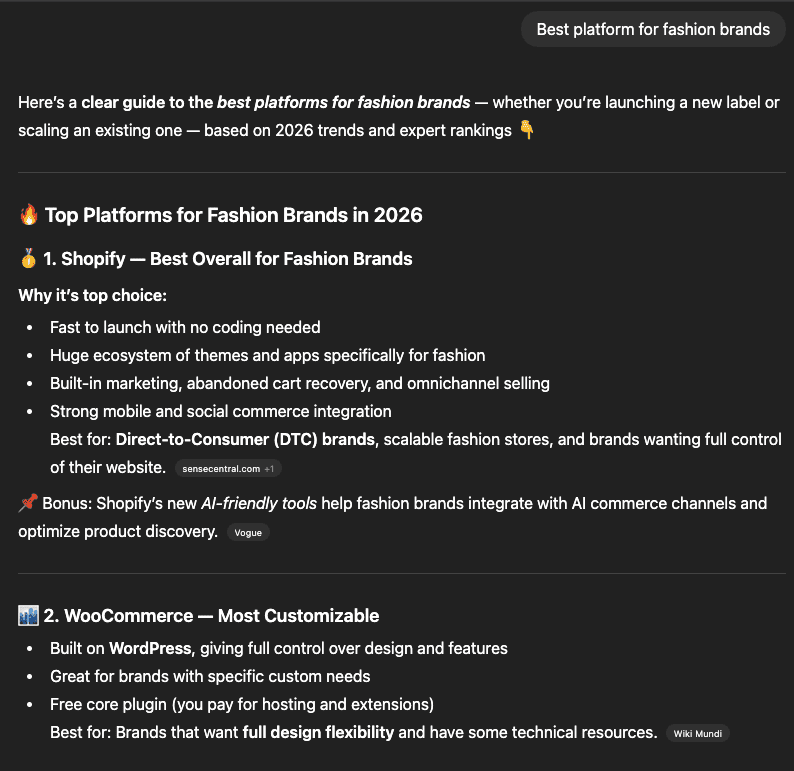
Query #4 – “Best platform for fashion brands”
ChatGPT responds with top fashion brands with its features and best answers.
Google shows the direct links to the platforms of fashion brands.

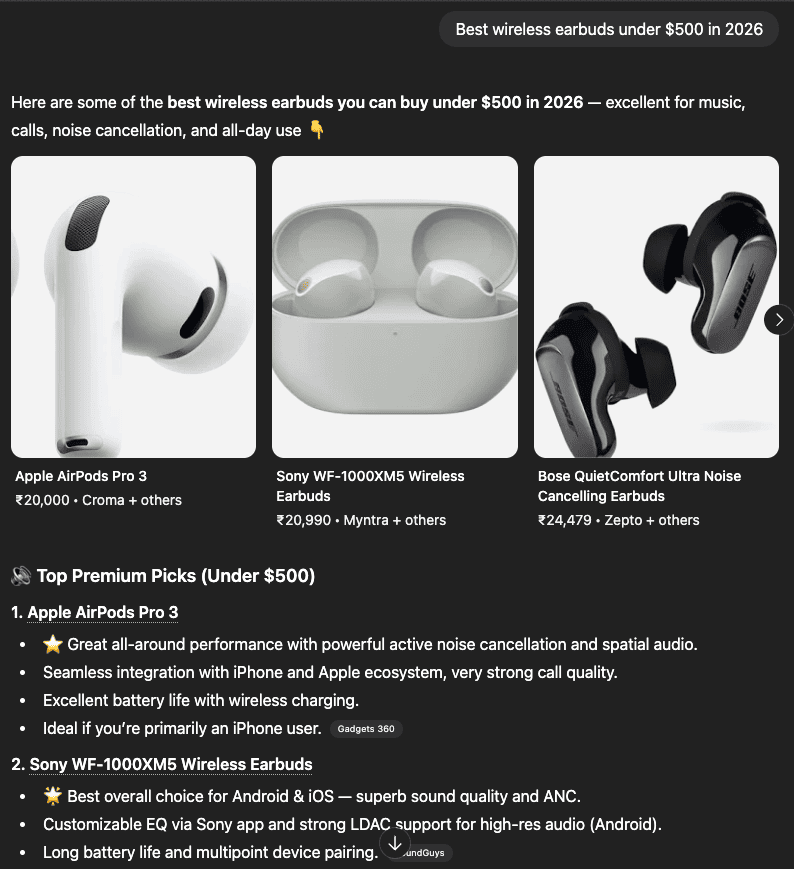
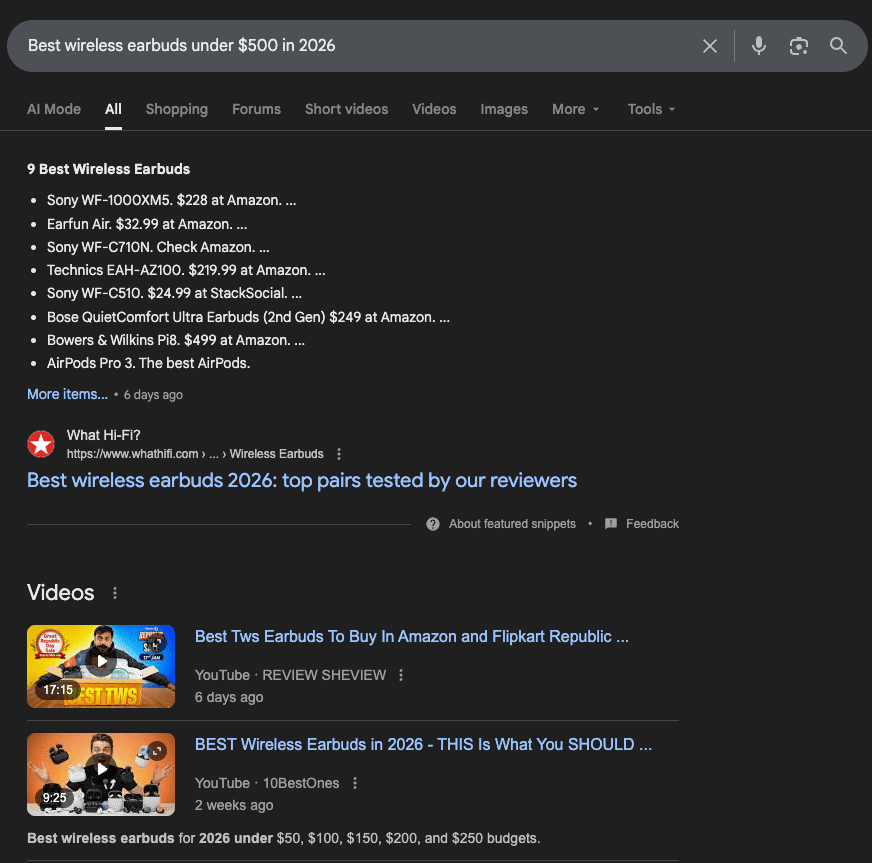
Query #5 – “Best wireless earbuds under %$500 in 2026”
ChatGPT directly shows you the products with go through clicks, and its features.
Google fetches the results from top-ranking pages matching your intent.
Limitations of ChatGPT When Compared to Google
Even with advancements, ChatGPT faces several limitations when compared to the Google search engine.
1. Real-time information
ChatGPT does not give you the updated, real-time answers as it’s pre-trained on text datasets, while Google has access to the vast amounts of internet data, from indexing pages to give you the updated, real-time answers.
2. Source transparency
When compared to Google, ChatGPT cannot source the citations; you have to manually verify, check, and compare the responses generated by the model.
3. Not for Navigational searches
ChatGPT is not optimized for queries like: “Email login”, “ABC bank service number”, and “Customer care number”. Google, on the other hand, directs you instantly to a page or website.
4. Regional-based searches
ChatGPT has limited information on local searches like “restaurants near me”, “working hours of Z hospitals”, as it can provide incomplete or outdated information. Google provides you with accurate information with Google Maps, reviews, and photos.
5. Buying and Selling
As ChatGPT cannot track live prices and access live local deals, buying and selling is challenging, as Google Shopping offers you price comparison and selling offers for the live deals.
6. No access to platform threads and niche websites
For finding long-form obscure content, Reddit deep threads, and niche blogs, ChatGPT is not good. Google is excellent at finding you specific, obscure, and niche websites.
7. Financial, Legal, and Medical Restriction
ChatGPT cannot provide you with consultations on behalf of financial advisors, lawyers, and doctors, but it is easy to find official government sites, documents, and doctors’ information on Google.
8. Verification challenges
Even though ChatGPT responds with confidence, answers can be outdated, incorrect, and lack depth. While Google can judge credibility, check multiple sources for authentications and see the publication dates to give you the results.
So… Is ChatGPT Better than Google?
The answer depends on what you want to search for. Both ChatGPT and Google have their own functionalities and features.
“ChatGPT provides answers, and while Google tries to do that, it also has to present links. Answers are what we generally want, and since ChatGPT also now provides sources, we can dig in deeper whenever we want. That’s a major positive, and it’s probably something we’ll see more from Google as Gemini gets more embedded into Google search.”
– John Koetsier, Forbes
But Google still dominates the search market as internet users still prefer the Google search engine, because it serves users’ needs effectively. Even with large training datasets and advancements, ChatGPT cannot match Google’s internet access in real time. For the past two decades, Google, with its search capabilities, has been the default search engine to find information.
That does not mean ChatGPT is not good. ChatGPT is your go-to partner for conversation and reasoning tasks such as “tell me how to plan this strategy” and “what would be the answer to this puzzle”. So ChatGPT is useful for thinking, brainstorming, reasoning, communicating, and assisting partners.
Your business needs ChatGPT as well as Google, because they both offer value to your reach.
What Does ChatGPT’s Rise Mean for Your Brand?
ChatGPT has become a primary place people turn when they have questions. Instead of browsing multiple websites, users now expect clear, direct answers in one response. That shift changes how discovery works. If your brand is not showing up in AI answers, you are missing visibility at the exact moment decisions are being shaped.
This is similar to the early days of SEO. Brands that optimized for Google gained traffic and authority.
Today, optimizing for AI visibility is the next layer. When ChatGPT recommends certain brands in comparisons, product suggestions, or solution-based queries, it influences perception before a user even visits a website. Improving your presence in AI answers requires structured, intent-focused content and strong topical authority.
But visibility alone is not enough. You also need to measure it.
That is where Track My Visibility helps brands monitor how often they appear in AI-generated answers, which prompts trigger mentions, and where competitors are gaining ground. It turns AI visibility into something measurable and actionable, just like SEO tracking did for search.
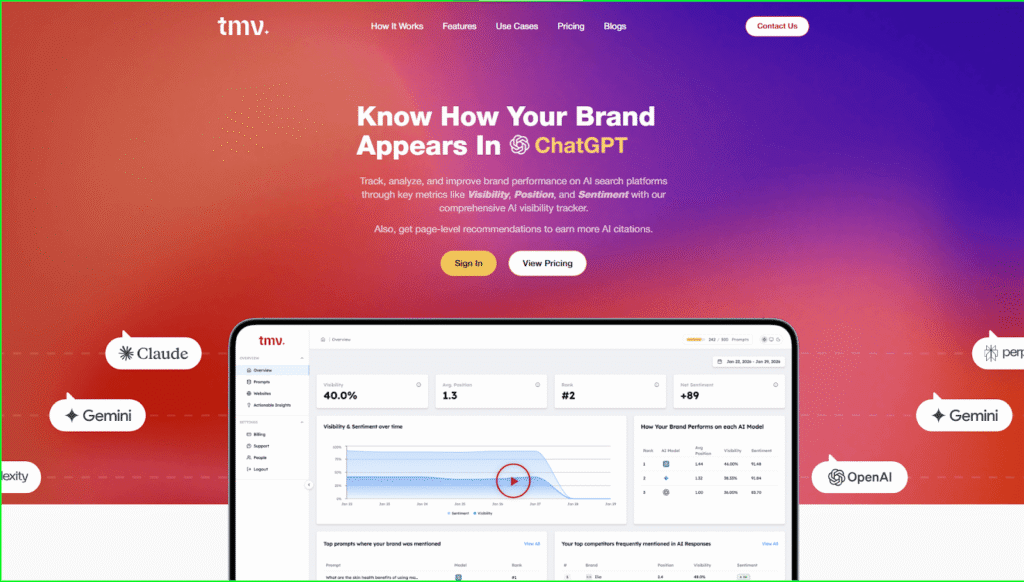
Get a clear view of your AI visibility, citation tracking, and AI readiness score, and use them with traditional search engine optimization and major AI platforms. To know more about how the platform works, you can check the pricing, explore the features, or review practical use cases.
Pro Tip: AI search visibility measures how often and how accurately a brand appears inside AI-generated answers. Learn how to track AI Search Visibility Over Time with this step-by-step guide. Final Thoughts!
ChatGPT Search and Google Search offer e-commerce brands and marketers unprecedented flexibility to discover, create, and optimize. The real competitive advantage doesn’t come from choosing one over the other; it comes from strategically leveraging both platforms to amplify your market presence and drive measurable growth.
For forward-thinking marketers and e-commerce brands, competitive advantage lies in the strategic integration of both platforms. Use ChatGPT for productivity, planning, brainstorming, and workflow design while leveraging Google for performance marketing, ad monetization, validation, and customer acquisition.
Frequently Asked Questions
1. Why do people use ChatGPT instead of Google?
People use ChatGPT for quick, summarized answers, explanations, and decision help. It saves time by giving direct responses instead of multiple links.
2. Who is the best, Google or ChatGPT?
Neither is “best” overall. Google is better for finding sources and live information, while ChatGPT is better for explanations, reasoning, and guidance.
3. Is Google 100% truthful?
No. Google shows information from many websites, and some sources can be inaccurate or biased. Users must verify credibility themselves.
4. What percentage of people use ChatGPT instead of Google?
Based on data from 2025, approximately 24% of U.S. consumers prefer to use ChatGPT over Google when looking for information online. Google remains the dominant search engine, with over 90% market share.
5. Who is more accurate, ChatGPT or Google?
Google is more accurate for real-time facts and sources. ChatGPT is more accurate for explanations, but it can be wrong if the information is outdated.
6. What is the #1 search engine?
Google is the world’s #1 search engine.
7. Should I ask Google or ChatGPT?
Use Google for live data, websites, and local info. Use ChatGPT for understanding topics, comparisons, and step-by-step help.
8. Can I combine ChatGPT and Google?
Yes. Many people use Google to find sources and ChatGPT to summarize, explain, or apply the information.