


According to the study, ChatGPT has over 900 million weekly active users worldwide, making it one of the fastest-adopted consumer AI tools in history.
But while using ChatGPT, if you also think that “This exactly sounds like something I just read on Google,” then you’re not the only one. So many users wonder if ChatGPT uses Google results or pulls answers directly from a search engine.
This confusion makes sense as AI search provides clear and well-structured replies that are similar to top-ranking articles.
In this article, we’ll break that down in simple language. We will clearly explain how ChatGPT works, where its information comes from, and how it compares to a search engine.
Also, you’ll learn:
- How ChatGPT generates human like text without searching the internet
- Why ChatGPT responses often look similar to Google results
- The truth about ChatGPT data sources and training data
- When ChatGPT may use search tools and when it does not
Let’s get started!
What Is ChatGPT and How Does It Work?
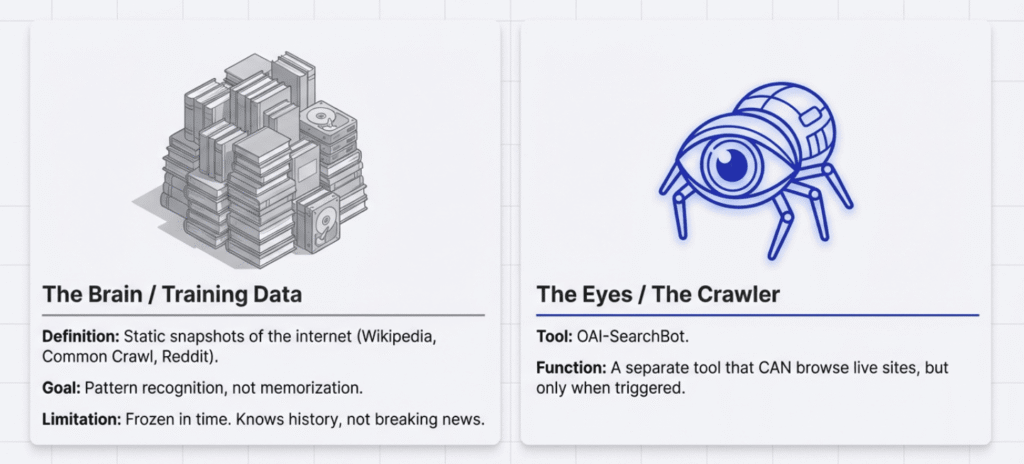
ChatGPT is an AI language model designed to understand conversation and generate text that sounds natural. It has a native search engine that browses the web with its own OAI-SearchBot crawler. When you ask for current information and you use advanced ChatGPT, then it browses live websites.
At its core, ChatGPT is also trained to predict the next word in a sentence based on context. That might sound simple, but when repeated billions of times across a large dataset, the result feels surprisingly human.
There are times when, rather than performing a search, ChatGPT looks at your prompt, analyzes the words, and builds a response using learned patterns. This is why the model can answer follow-up questions, remember details within a chat, and adjust tone based on context.
So, while the answers may feel current or search-based, the process is fundamentally different from how a search engine works.
What Is a Language Model?
A language model fundamentals are a system trained to understand how words relate to one another. It does not store facts the way a database does. Instead, it learns structure, meaning, and relationships through exposure to vast amounts of written text.
You can think of it like this:
A language model doesn’t remember a sentence. It learns how sentences are usually formed.
When you ask a question, the model predicts what words are most likely to come next based on probability. That’s how it can generate human-like text that feels natural in conversation.
For example:
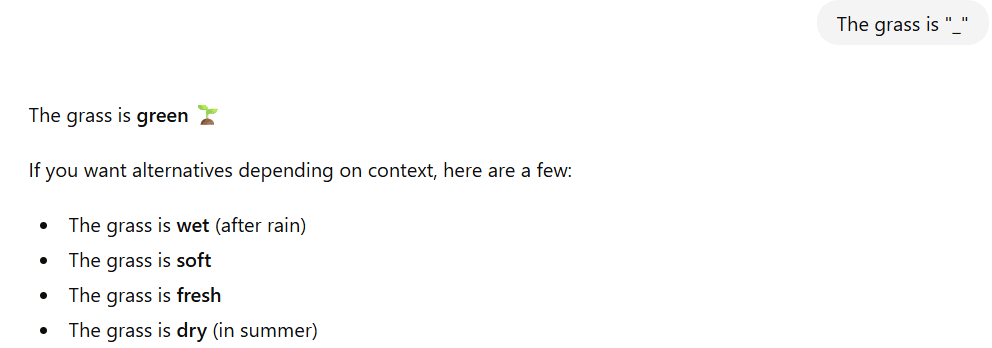
If you write, “The sky is usually…”, the model predicts words like blue because it has seen that pattern many times during training.
This prediction process happens word by word, forming complete answers that sound intentional, even though they are generated step by step.
Does ChatGPT Search Use Google Results Directly?
Answer: No. ChatGPT Search does not use Google results directly. It relies on a mix of licensed data, publicly available web content, and search providers such as Bing, rather than pulling from Google’s search index.
OpenAI uses its own proprietary crawler, OAI-SearchBot, and a direct partnership with Microsoft Bing and other licensed data providers to build its index, a setup covered in depth in set up Bing Webmaster for AI.
In some configurations, it can use search tools indirectly when a user enables browsing or tool access. That distinction is where most confusion begins.
From a technical standpoint, ChatGPT is not connected to Google search. From a user perspective, though, answers may feel similar to what you see on Google. That overlap causes many people to assume the model is searching the web in real time.
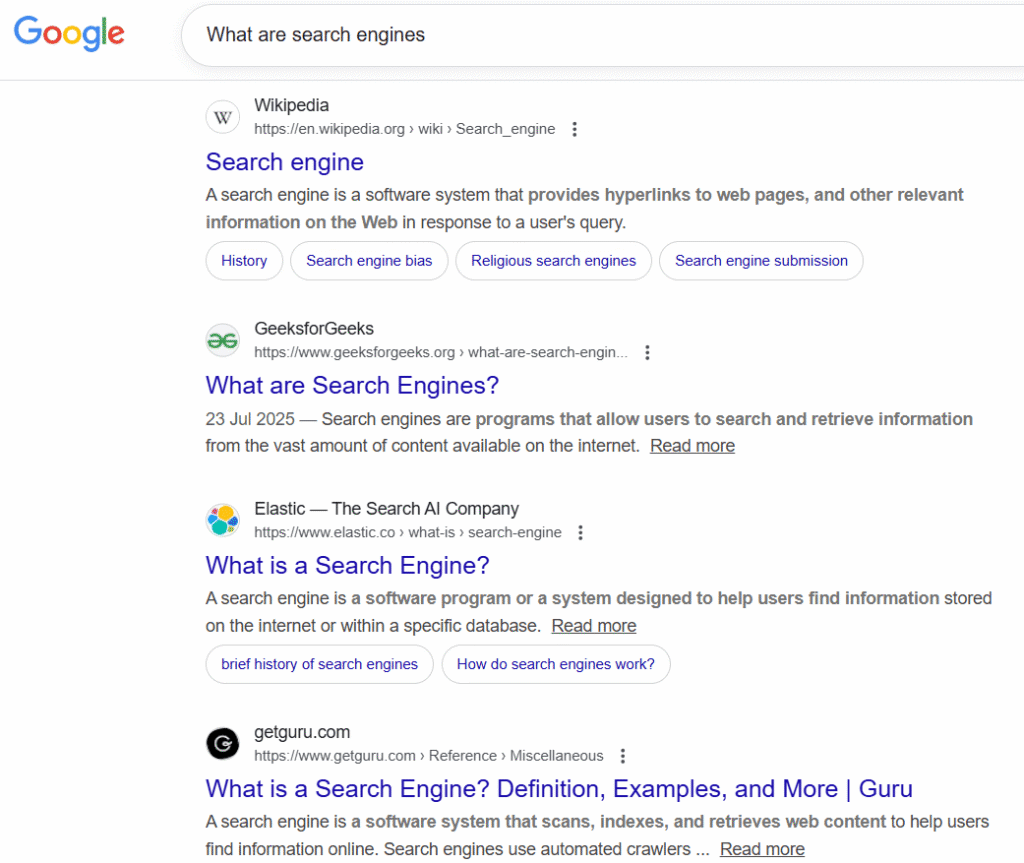
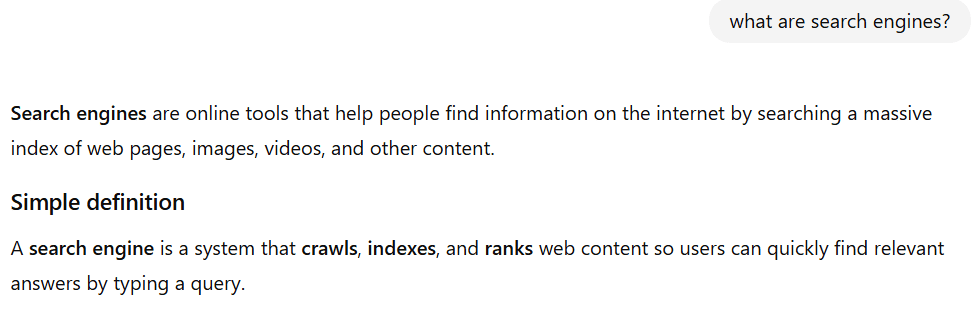
The key difference lies between training data and live search. ChatGPT was trained on large datasets that include public links, written content, and structured language examples. It does not perform a live search unless a specific tool is activated.
Why People Think ChatGPT Uses Google?
There are a few reasons this assumption keeps coming up.
- ChatGPT often gives clear, direct answers instead of a list of links. That makes it feel smarter than a traditional search page.
- Many responses closely match common explanations found in top-ranking articles. Since Google surfaces similar material, the overlap feels intentional.
- There’s confusion between search engines and AI tools. A search engine finds existing pages. ChatGPT generates new text based on learned patterns.
The results may look similar, but the process is not the same. So, now let’s understand its data sources.
What Data Sources Does ChatGPT Use?
ChatGPT uses various data, such as information provided by human trainers, websites, articles, and licensed datasets.
This training helps the model understand language, facts, and structure. Other than this, the Retrieval-Augmented Generation model retrieves snippets from the web and uses them as “context” to generate a more accurate answer.
What is Training Data?
Training data refers to the text used to teach the model how language works. This includes books, articles, news articles, and other written material available before the model’s cutoff date.
The goal of training is not memorization. It’s pattern recognition.
A large and diverse dataset helps the model respond to many types of questions, understand tone, and generate helpful replies across topics.
Still, because training data is static, it has limits. If something happened recently, the model may not know unless a search tool is involved.
Does ChatGPT Have Access to Live Data?
Yes, but it totally depends on the mode you’re using.
If you’ve enabled web search mode (live), then ChatGPT uses its own crawler called OAI-SearchBot, and it partners with Bing. It can tell you breaking news, stock prices, and the weather forecast a few minutes ago.
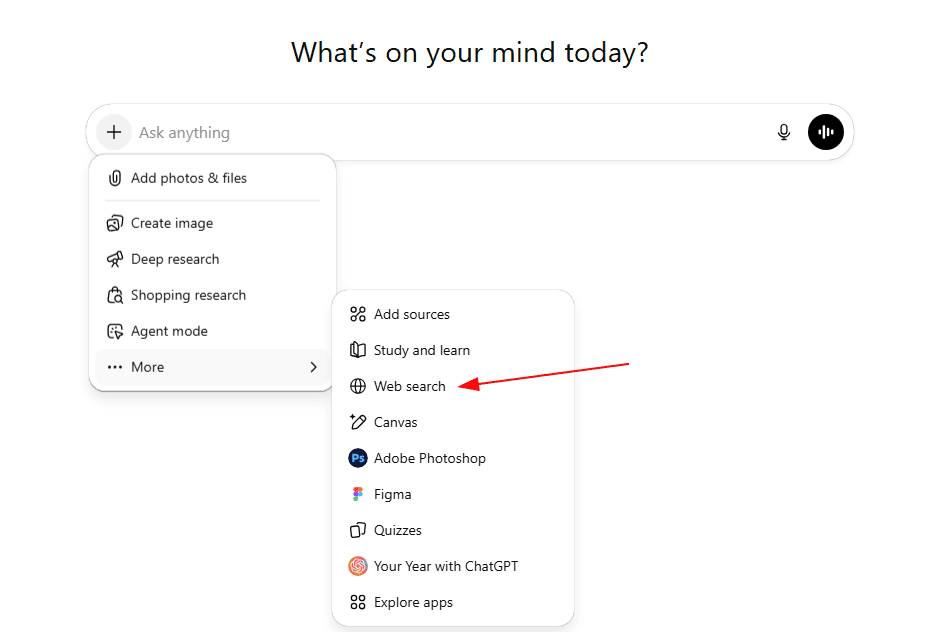
And if the base model mode is off, then it completely relies on its training data and uses patterns it has already learned to answer your query. Because of this, answers may sometimes feel outdated or incomplete.
When accuracy matters, especially for current data, it’s important to verify details through trusted sources, or it’s better to use the advanced version of the tool.
Difference Between Google Search and ChatGPT Responses
Although both tools help users find information, their goals are different.
Google search is designed to locate pages, show links, and rank results based on relevance. ChatGPT focuses on creating a direct answer in natural language.
One finds information. The other explains it.
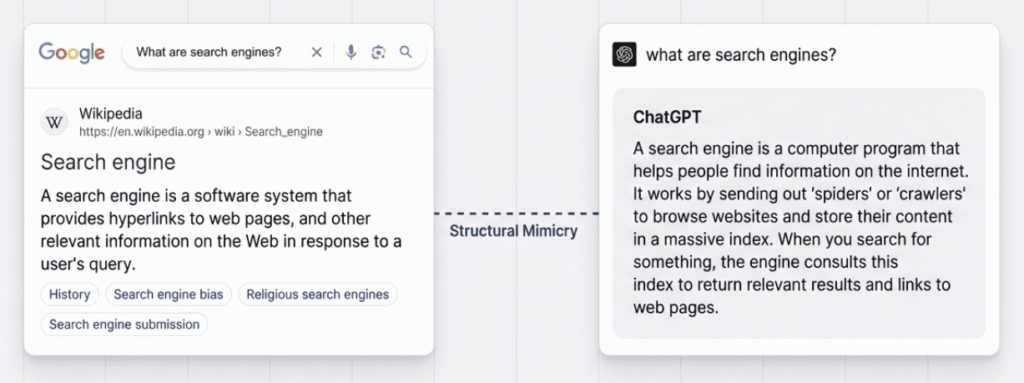
Here’s a simple comparison:
| Aspect | ChatGPT | Google Search |
| Best for | Explaining, summarizing, drafting, brainstorming, step-by-step help | Easy to see sources immediately |
| Output style | Direct answers in conversation form | List of links/snippets you choose from |
| Finding exact webpages, official sources, latest news, and local results | Fast for understanding and synthesis | Fast for locating sources and verifying facts |
| Up-to-date info | Can be outdated unless it browses the web | Usually very current (especially news/trends) |
| Sources & citations | Sometimes included (depends on settings/tooling) | You repeat the context in new searches |
| Accuracy | Great for reasoning, but can make mistakes confidently | Depends on the sources you click; easier to cross-check |
| Depth of explanation | Strong: can teach and adapt to your level | Varies by result; you assemble the explanation yourself |
| Complex questions | Very good (multi-step, comparing options, combining info) | Harder; requires multiple searches + synthesis |
| Simple fact lookup | Good, but best when you still verify | Excellent (definitions, dates, specs, “official” answers) |
| Personalization | Can tailor tone, examples, and format | Limited personalization; mostly generic results |
| Follow-up questions | Very strong, remembers context within the chat | Searches are logged; ad tracking is common (settings vary) |
| Writing help | Excellent (emails, resumes, code, reports) | Not designed for writing; you copy/patch info yourself |
| Learning & tutoring | Strong: interactive explanations + practice | Good, but you must find good learning resources |
| Local intent (near me) | Limited unless connected to live location tools | Strong: maps, reviews, hours, phone numbers |
| Shopping/product research | Good at comparing and narrowing options | Great for prices, reviews, availability, official specs |
| Bias/SEO impact | Less driven by SEO, but can reflect training bias | Results can be influenced by SEO/ads |
| Privacy | Depends on platform settings; conversations may be stored | Great for prices, reviews, availability, and official specs |
| When to choose it | “Help me understand/do this” | “Help me find the most reliable/official/latest source” |
So, Google helps users explore multiple viewpoints. ChatGPT helps users understand a topic quickly.
Neither replaces the other. They serve different needs.
How ChatGPT and Search Engines Work Together?
When web search is enabled, ChatGPT can use search tools. In these cases, the model retrieves information through approved search tools and then explains it in plain language.
This only happens with user permission and feature availability. It is not the default setting.
Understanding the difference between tool-enabled mode and standard mode helps avoid confusion about where answers come from.
How Reliable Are ChatGPT Answers Without Google?
ChatGPT can be very helpful for explanations, examples, and general understanding. It excels at summarizing ideas and walking users through concepts step by step.
That said, it has limitations.
Because it does not verify answers against live data, mistakes can happen. The model may produce confident-sounding responses that contain outdated or incomplete details.
This is why verification matters, especially for high-stakes topics.
When Should You Double-Check ChatGPT Answers?
You should always confirm information related to:
- Medical or legal topics
- Financial decisions
- Latest news or statistics
- Technical instructions that affect safety
In short, ChatGPT is a helpful assistant, not a replacement for professional advice or verified sources.
Why ChatGPT Matters for SEO and Visibility?
For brands and publishers, understanding how ChatGPT works is becoming increasingly important. Users now ask questions in chat tools instead of typing queries into a search bar.
This shift affects how content is discovered and summarized.
1. Search is Turning Into “Answer Engines”
Users increasingly want a single, clear response instead of 10 blue links. When ChatGPT (and similar tools) generates an answer, it may summarize sources and recommend specific brands/tools/pages.
You’re not just competing for rankings. You’re competing to be the recommended option in an AI-written answer.
2. Visibility can Happen Without a Click
Even if users don’t visit your site, your brand can still be mentioned, described, compared, or recommended. Brand awareness and trust can be built inside the chat interface itself.
A user might ask, “What’s the best email marketing tool for small ecommerce brands?” and make a decision based on the assistant’s output alone. That means your content may influence the outcome even if your analytics show no click.
For brands, this introduces a new goal: earn AI brand visibility, not just website traffic.
3. “Best Answer” Content Wins More than “Keyword” Content
ChatGPT is designed to respond in a helpful, structured way. It naturally favors content that is:
- clear and structured
- specific (steps, examples, definitions)
- complete (covers the whole question)
- trustworthy (consistent info, real experience, evidence)
In other words, thin content written purely for rankings becomes less effective. Helpful content that genuinely explains and solves problems becomes more valuable.
4. Authority Signals Matter More
AI systems don’t want to recommend unreliable information, especially for important decisions. That means reputation and authority matter more than ever.
To confidently include a brand or page, AI systems tend to lean on signals like:
- strong reputation and reviews
- consistent mentions across the web
- expertise signals (credentials, original research, case studies)
- clear authorship and updated content
This is where SEO and digital PR start to overlap. It’s not only about optimizing a page. It’s also about building a presence that makes your brand hard to ignore.
5. Search Queries are Becoming Longer and More Specific
When people talk to ChatGPT, they use natural language, often similar to what a target prompt generator would suggest testing. They write full questions like:
- “What’s the best CRM for a small agency under $50 per month?”
- “How do I fix Core Web Vitals on Shopify?”
- “Which laptop is best for video editing on a budget?”
These are high-intent searches. The user already knows what they want. They’re trying to make a decision.
For SEO, this creates a major opportunity, especially once you understand the right prompts to track AI visibility. If your content targets specific use cases and answers them in full, you can win traffic and visibility from people who are ready to act.
6) Conversion and Trust are Shifting Earlier
In the past, users might have compared 10 different options by opening multiple tabs.
If a user asks ChatGPT, “best X for Y,” they’re often already close to choosing. The assistant’s shortlist shapes what they even consider. That means the “consideration stage” is moving earlier.
If you’re not showing up in AI responses, you may not even make it into the set of options a customer is considering. Platforms like Track My Visibility focus on helping brands understand where and how their content appears across search and AI-driven tools.
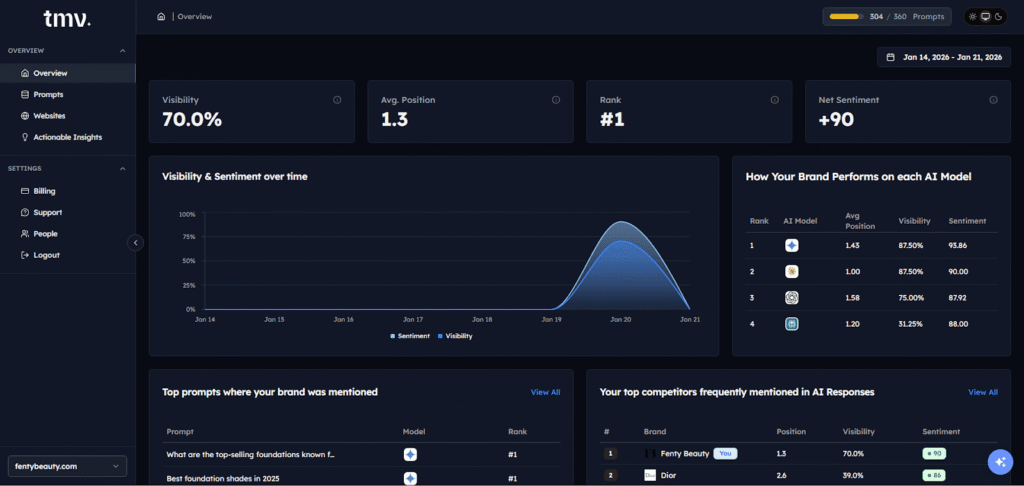
Knowing how AI generates answers helps teams create clearer, more helpful content that aligns with how users ask questions today.
Want to be part of AI answers??? Explore actionable tips on how to optimize content for AI answers.
Common Myths About ChatGPT and Google
Let’s clear up a few common misunderstandings.
Myth 1: ChatGPT Pulls Data Directly from Google
No, OpenAI has no direct contract with Google. But both engines prioritize well-structured, expert-led content. So, a site optimized for Google’s ‘Helpful Content’ standards is highly likely to be selected by OpenAI’s search algorithms as a primary source, especially when it follows Google’s E-E-A-T guidelines closely.
Myth 2: ChatGPT Tracks User Searches
ChatGPT does not store personal search history across sessions if you disable the data storage. And if you want your data not to be saved, then you can use temporary chat.
Myth 3: ChatGPT Replaces Search Engines
It is best for getting quick answers with explanations, but it cannot replace search engines. It complements them. But each serves a different purpose.
Final Thoughts
So, does ChatGPT use Google results to generate an answer?
No, at least not by default.
ChatGPT does not search Google directly or access live websites unless specific tools are enabled, though this can be checked further with an AI search crawler inspector. It definitely partners with Bing to provide answers with citations to live sources. It also generates responses using learned language patterns from its training data.
Search engines and ChatGPT work best when used together. One helps you find sources. The other helps you understand them.
If you want to understand how your brand or content appears across search engines and AI-driven tools, platforms like Track My Visibility help you monitor, analyze, and improve your visibility in this evolving landscape.
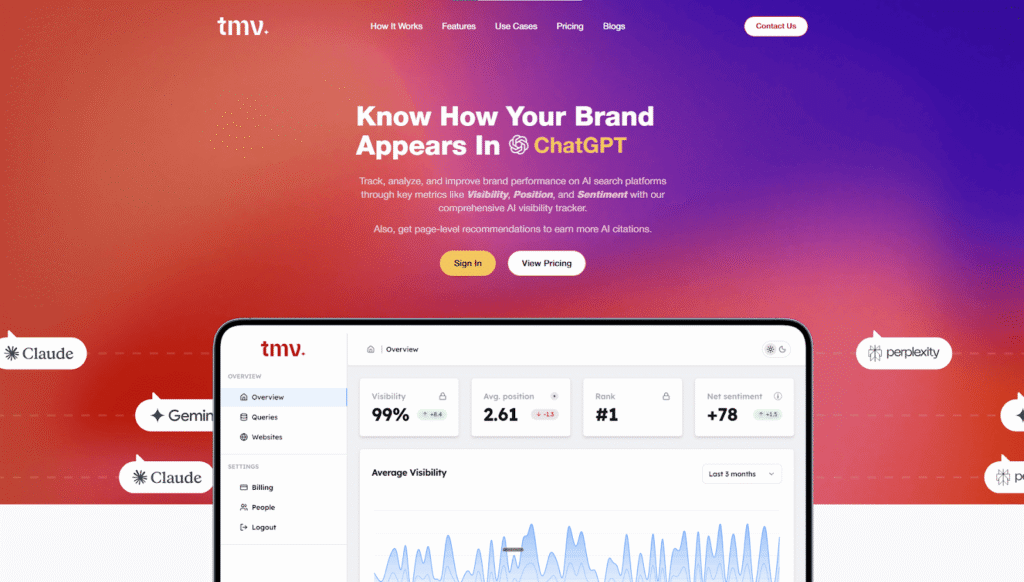
Because in a world of AI-generated answers, being accurate isn’t enough; you also need to be discoverable.
Frequently Asked Questions
Is ChatGPT a search engine?
No. ChatGPT is an AI language model that generates text. It does not index or rank web pages like a search engine.
Can ChatGPT content appear in Google results?
Yes. Content written by humans using ChatGPT can appear in Google results if it meets quality standards and provides value to users.
What Datasets does ChatGPT use?
ChatGPT is built from large collections of publicly available text, partner data, and human-generated examples that help the model learn how language works. Additionally, it integrates real-time datasets from OpenAI’s proprietary web index and strategic partnerships with major news and data providers.
What Sources does ChatGPT use the most?
ChatGPT’s core information comes from high-authority repositories like Wikipedia, Common Crawl, and Reddit, which provide the foundation for its general knowledge. For current events, it relies heavily on its live search feature to pull from real-time news outlets and trusted domains across the web.
While it does not “use Google” as its backend, it frequently indexes the same high-ranking web sources that appear in Google’s top results.