


Consumers are increasingly starting their product journeys with conversational search queries instead of traditional keyword searches. In response, these systems extract relevant information from product pages and present it as answers.
This shift is already influencing which products get discovered, evaluated, and purchased. It is part of a broader change in how AI search and traditional SEO now operate differently from each other.
For e-commerce brands, product pages now serve a dual role. Pages that clearly define product details, maintain consistency, and include verifiable signals are more likely to be surfaced. Optimizing product pages for AI visibility, therefore, depends on how effectively product information is organized and understood by these systems.
This guide explains how AI systems evaluate product pages, the signals that influence visibility, and the practical optimization strategies that improve product page discoverability in AI-driven search.
TL;DR
- Product pages are now sources of answers. Clear, structured, and context-rich information increases the chances of being extracted and surfaced.
- Visibility depends on consistency and consensus. Product data must align across pages, feeds, and external sources to be considered reliable.
- Accessibility matters as much as content. If crawlers cannot properly access or render product pages, the information is not processed, which limits visibility regardless of quality.
- Key elements that drive visibility include use-case-driven descriptions, real-time pricing, review patterns, structured data, and third-party validation.
- Optimization goes beyond a single page. PLPs, external mentions, feeds, and supporting content all contribute to overall discoverability.
- Optimization alone is not enough. Tracking how products appear in AI-generated answers is essential to identifying gaps and improving visibility.
How AI Pulls Information from Product Pages
AI systems like ChatGPT, Perplexity, Claude, and Gemini pull information by reading multiple layers of a product page at once, including structured data, attributes, on-page text, product images, and reviews. They extract key facts from these layers and then validate them before using them in responses.
The process is driven by two signals: consistency and consensus.
AI first relies on structured data and clearly defined attributes to capture clean, factual details. It then checks supporting elements such as descriptions, images, and reviews to confirm and enrich that information. Facts that appear consistently across these layers are prioritized, while conflicting or isolated details are treated as unreliable.
Consistency ensures that product details match across schema markup, page content, and other sources. Consensus strengthens trust when the same information is reinforced through reviews, external platforms, and third-party mentions.
Tools like Track My Visibility help identify which sources are being cited and how consistently product information is represented. This makes it easier to spot gaps, align signals, and improve the likelihood of being surfaced in AI-generated responses.
How to Make Product Pages Accessible to AI Crawlers
AI systems use crawlers like GPTBot, ClaudeBot, and similar agents to find and process product pages. If these bots cannot access or properly read a page, the content rarely makes it into AI-generated answers.
Start by allowing access. Check robots.txt and server rules to confirm that product pages are not blocked for AI crawlers. If access is restricted, the page is effectively invisible to them.
Make product information easy to retrieve when designing content optimization strategies. Keep key elements like descriptions, pricing, technical specifications, and availability directly in the HTML or ensure they load quickly. When critical content depends heavily on JavaScript or delayed rendering, crawlers often miss or skip it.
Keep URL structure clean and stable. Avoid unnecessary parameters and duplicate variations that create multiple versions of the same page. This helps crawlers focus on the primary version of the product.
Guide discovery through internal links and sitemaps. Link important product pages from category pages and ensure they are easy to reach. When pages are accessible, clearly structured, and free from friction, AI crawlers can find, process, and use the information more reliably.
6 Product Page Elements That Drive AI Visibility
AI systems do not evaluate product pages as a whole. They break them down into specific elements and signals that can be extracted, validated, and reused in responses. LLM visibility depends on how clearly these elements communicate product information and how consistently they align across sources.
The following six elements are what AI systems consistently extract and rely on when forming product recommendations.
1. Product Descriptions Built Around Use Cases
Product descriptions work better when they explain who the product is for and when it is used, not just what it does. Scenario-led narratives make this clearer, such as describing products in real contexts like themed events, environments, or specific user needs.
Using natural, question-style language helps align with how users interact with AI. Phrases like “best for travel,” “easy to clean,” or “works with X” mirror real search queries and improve matching. Structuring content as a clear problem-to-solution block also makes it easier for AI systems to extract and reuse information as standalone answers.
When a shopper asks ChatGPT for formal interview shirts, ChatGPT answers not by scanning for the word “shirts.” It is matching your product description to the full context of the query, including theme, use case, and intent.

 Pro Tip: A well-written use-case description does more than improve product page visibility. The same principles that make a description extractable on a product page are what drive rankings in AI responses. Before writing another product description, it is worth exploring how to rank in Google AI Overviews and ChatGPT responses to see how both surfaces evaluate content.
2. Real-Time Pricing and Inventory Signals
AI systems increasingly filter product recommendations based on pricing presentation, availability, and discount status in real time. This means product data is not just evaluated for accuracy, but also for freshness. When pricing or stock information is outdated, or when values differ between the product page and merchant feeds, the product is often excluded from filtered results.
Maintaining alignment across all sources becomes critical. Price, discounts, and availability need to match across on-page content, structured data, and external feeds. AI systems prioritize products where this data is consistently updated and clearly presented, especially when queries include budget or urgency.
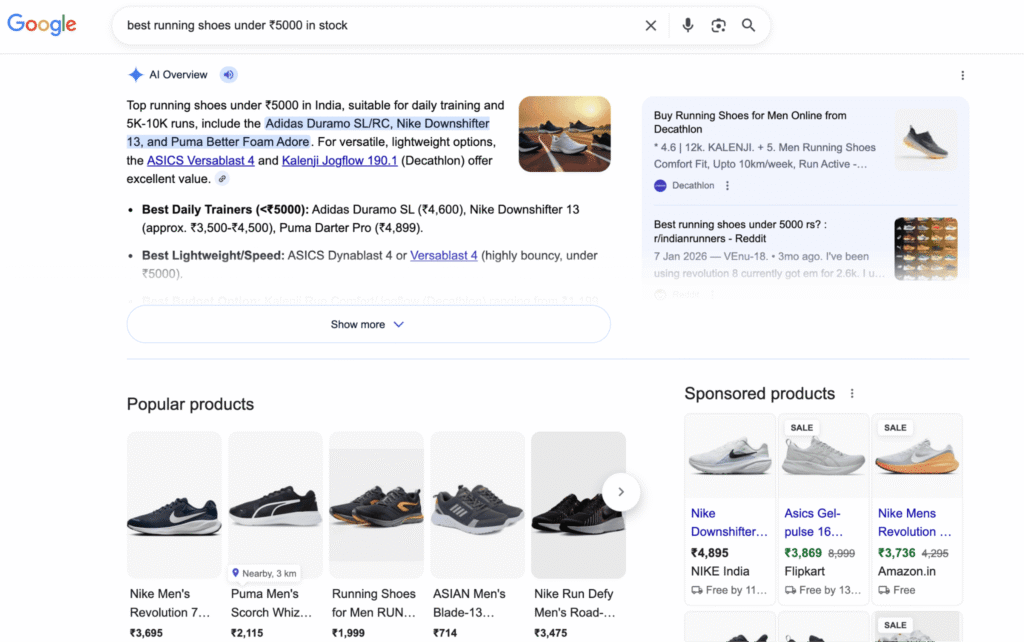
When a user asks for “best running shoes under ₹5000 in stock,” the system filters options based on both price range and availability. If a product shows ₹4,999 on the page but ₹5,499 in the feed, or appears out of stock in one source, it is likely to be ignored in favor of a product with fully aligned, real-time signals.
3. Reviews That Reveal Patterns
AI systems do not rely only on star ratings. They analyze online reviews to understand how a product performs in real-world use. When specific use cases, benefits, or attributes are mentioned repeatedly across real customer reviews, those patterns become signals that AI can extract and reuse in recommendations.
This makes review quality and specificity more important than volume alone. Consistent mentions of certain outcomes or user needs help AI systems associate the product with those contexts, even if the product description does not explicitly highlight them.
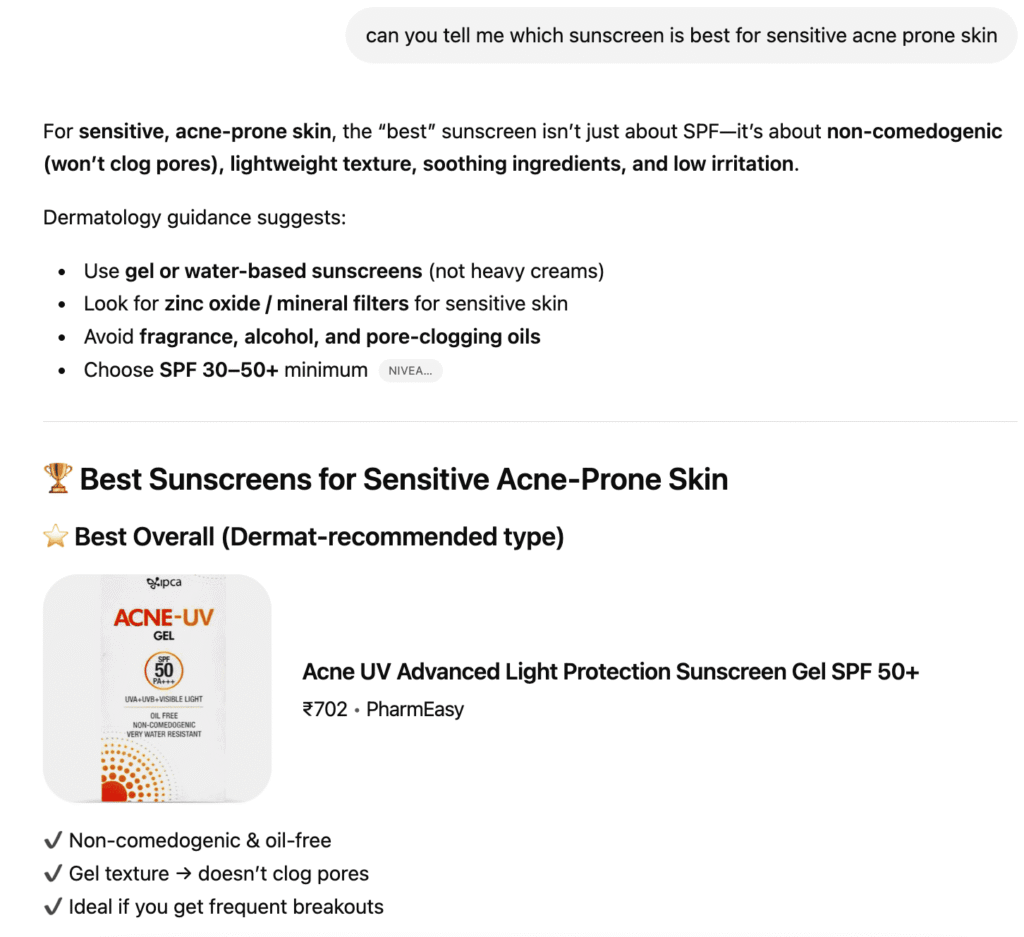
When a user asks for the best sunscreen for sensitive, acne-prone skin, AI systems look for products where reviews repeatedly mention outcomes like “non-comedogenic,” “gentle on sensitive skin,” or “did not cause breakouts.” Products with strong, consistent review patterns around these use cases are more likely to be surfaced, even if the product page itself does not emphasize those terms.
4. Awards, Certifications, and Third-Party Validation
AI systems aim to reduce the risk of recommending unreliable products. Third-party validation, such as industry awards, safety certifications, editorial recognition, and test results, provides the external signal proof needed to build trust. These signals act as proof points that extend beyond brand-controlled content.
Products that clearly display credible validation are easier for AI systems to verify and cite. Certifications and recognitions function as trust anchors, especially when they are specific, recent, and tied to known standards or organizations.
AI systems are more likely to surface products that highlight certifications from recognized health or safety authorities, along with strong user generated content in form of customer feedback. When both expert validation and consistent user trust signals align, the product becomes easier for AI systems to evaluate and recommend in LLM citations.

5. Structured Data That Matches Every Visible Element
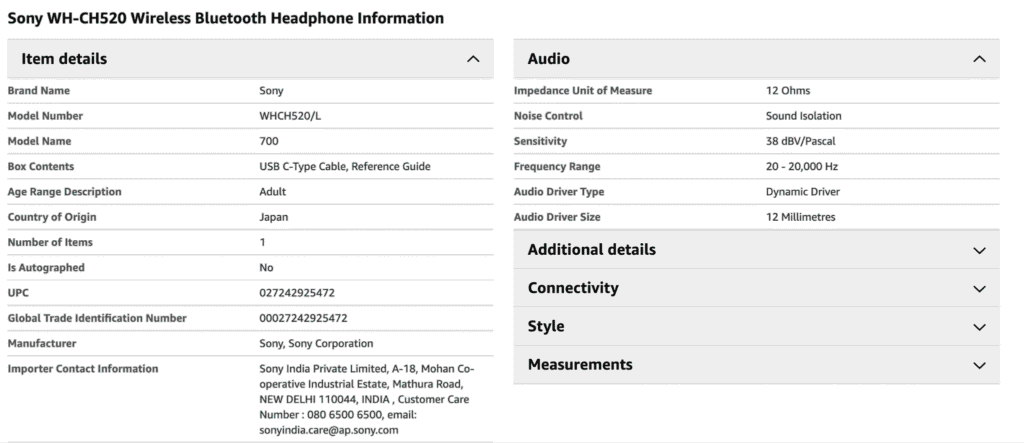
Structured data acts as a direct communication layer between product pages and AI systems. Product schema types such as Product, Offer, Review, and FAQ provide machine-readable signals that help confirm key features like price, availability, ratings, and attributes.
AI systems rely on this structured layer to validate the information they extract. When the schema markup aligns perfectly with what is visible on the page, it strengthens trust and improves the chances of being used in responses. When there is a mismatch, such as a price in the schema that differs from the page or outdated availability data, the signal is treated as unreliable.
Consistency across all fields is critical. Every attribute defined in structured data needs to reflect exactly what the user sees at that moment.
 Pro Tip: How many of your product pages have schema markup fields that do not match what is visible on the page? Most teams assume the markup is clean until a gap shows up in AI recommendations. The AEO GEO audit checklist is a practical way to find out what AI evaluates before deciding what to cite.
6. Crawl Budget Precision: Ensuring Your Best Pages Are Seen First
AI crawlers operate with limited resources, which means they do not process every page equally. They prioritize pages that are easier to access, clearly structured, and signal higher value when forming answers. If crawl effort is wasted on duplicate, low-value, or parameter-heavy URLs, important product pages receive less attention.
Focusing crawl activity on high-priority pages improves visibility. This involves reducing duplication from variants and faceted navigation, keeping URL structures clean, and ensuring key product pages are strongly linked within the e-commerce site. Clear architecture and updated sitemaps help crawlers identify which pages matter most.
When a large catalog contains multiple URL variations of the same product, crawlers may spend time indexing those duplicates instead of the main product page. In contrast, a site that consolidates signals into a single, well-linked page makes it easier for AI systems to find, process, and surface that product in responses.
What Does a Good Product Page Actually Look Like?
A well optimized product page presents information in a way that is easy to understand, verify, and extract. The product title clearly reflects how users search, using natural, descriptive language rather than internal naming conventions. The description goes beyond listing features and instead explains how the product is used, who it is for, and in what situations it fits best.

The page includes high quality product images from multiple angles that are supported by descriptive context, allowing both users and systems to understand what is being shown. Specifications are organized in a structured format, making key features easy to scan and interpret without being buried in long paragraphs.
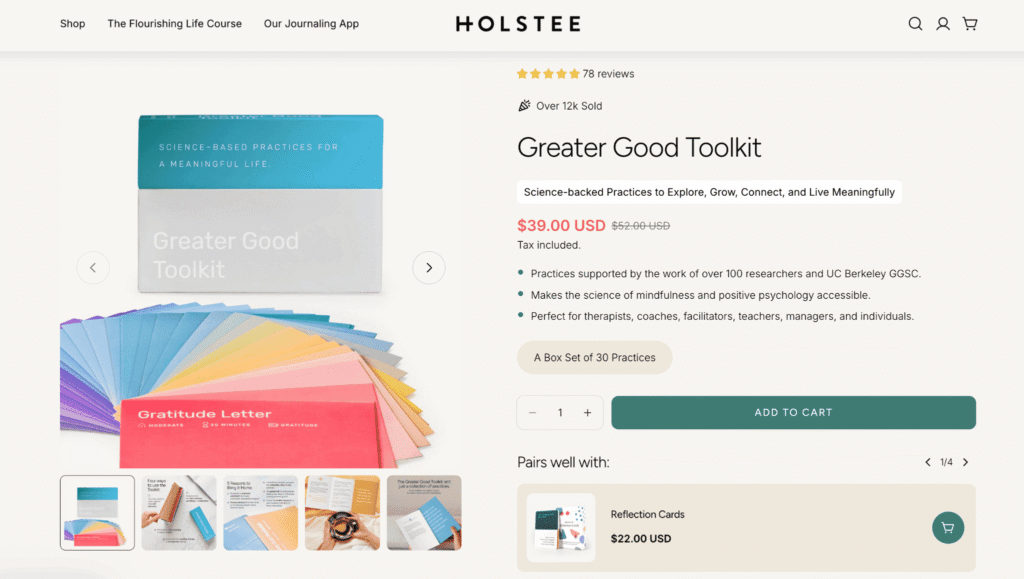
Review content adds another layer by reflecting real user experiences. Patterns in feedback, such as repeated mentions of comfort, durability, or specific use cases, help reinforce how the product performs in practice. FAQ sections further support this by addressing common questions, comparisons, and concerns that typically arise during purchase journey.
In practice, this creates a page where every element, from title to reviews to structured details, contributes to a consistent and complete representation of the product. This clarity helps the page rank in AI search, as the information can be extracted confidently, validated across layers, and reused in responses without ambiguity.
Why Your Product Pages Can’t Win Alone
Product pages do not operate in isolation when it comes to AI visibility. AI systems evaluate information across multiple sources to determine what is reliable and worth recommending. Even a well-optimized product page can be overlooked if supporting signals from other channels are weak or inconsistent.
A product page may clearly describe use cases, specifications, and benefits, but AI systems still look for confirmation beyond it. Reviews on external platforms, mentions in third-party content, and consistency across product feeds all contribute to how confidently a product can be surfaced. If these signals do not align, the page is treated as incomplete.
This is why tracking brand mentions in AI search matters beyond standard analytics. Category pages, comparison content, external reviews, and distribution channels all reinforce the same product narrative. When these signals work together, AI systems can validate the information more effectively and are more likely to include the product in recommendations.
Pro Tip: Not sure which product page is currently earning AI citations and which is being skipped? Run a quick audit with our free AI visibility checker to see how your product is performing across AI search platforms, which citations are being earned, and where visibility gaps exist.Common Mistakes Killing Your Product Pages’ AI Visibility
Many product pages lose visibility not because they lack information, but because the signals are unclear, inconsistent, or hard to validate. When content fails to provide structured, trustworthy, and contextual details, it becomes difficult for intelligent search platforms to extract and recommend it.
The following mistakes often limit how effectively product pages are interpreted and surfaced in conversational search results.
# Mistake 1: Thin product descriptions
Pages that only list basic features lack the depth needed for interpretation. Without use cases, scenarios, or a clear problem-solution context, the content becomes difficult to extract and reuse. This limits the chances of being surfaced in responses.
# Mistake 2: Overly promotional language
Generic claims like “best quality” or “top-rated” do not provide concrete signals. AI models prioritize specific, verifiable details over marketing-heavy language. Without substance, such content is often ignored.
# Mistake 3: Missing structured data
When schema markup is absent, key details remain unstructured and harder to validate. Information like price, availability, and ratings becomes less reliable. This weakens overall trust and reduces visibility.
# Mistake 4: Inconsistent naming
Variations in product names across pages, feeds, and platforms create ambiguity. LLMs struggle to connect these as the same entity. This breaks consistency and impacts discoverability.
# Mistake 5: No comparison or contextual content
Pages that lack comparisons or supporting context fail to match decision-based queries. AI platforms like ChatGPT, Gemini, Perplexity, and Claude look for signals like alternatives, trade-offs, and use cases. Without this layer, the product is less likely to be recommended.
Ready for the next step
Optimizing product pages is no longer limited to improving rankings. It is about making product information clear, structured, and consistent so it can be extracted, validated, and surfaced in conversational search. From use-case driven descriptions and real-time data to reviews, structured signals, and crawl accessibility, each element contributes to how products are interpreted and recommended.
However, optimization alone does not guarantee visibility. What matters is how that information actually appears across AI-generated answers and which sources are being referenced. Without tracking AI visibility, it is difficult to understand whether your efforts are translating into real exposure.
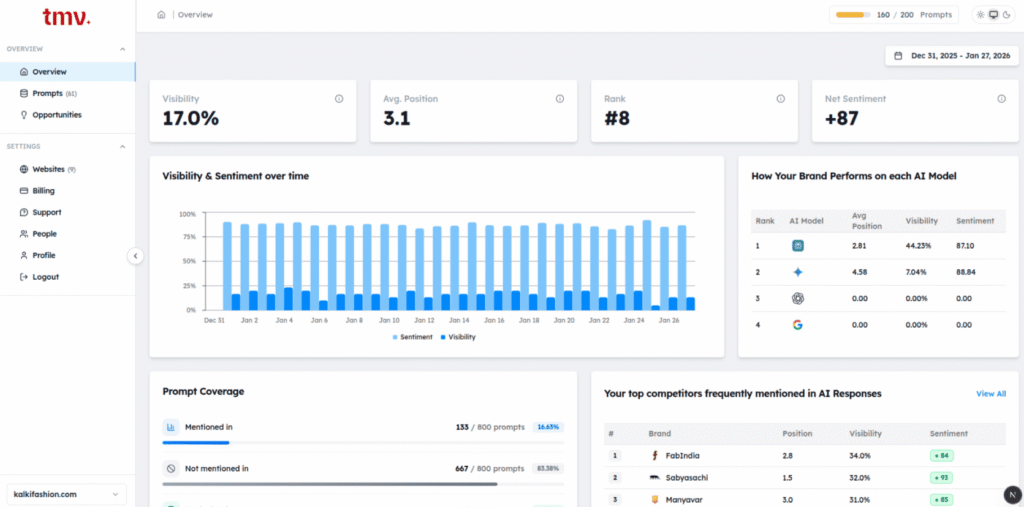
Tools like Track My Visibility help you with this. Track My visibility helps monitor how products are being surfaced, which sources are cited, and where gaps exist in consistency or coverage. By combining optimization with ongoing tracking, it becomes possible to improve not just how product pages are built, but how they perform in AI-driven search.
Try our 7-day trial to see where you stand.
Frequently Asked Questions
A product page is optimized when it presents clear, structured, and context-rich information. This includes defined product attributes, use-case-driven descriptions, consistent data across sources, and elements that are easy to extract and validate.
Consistency allows systems to verify product information across multiple sources. When details like pricing, specifications, and availability match everywhere, the data is considered more reliable and is more likely to be used.
Reviews contribute by revealing real-world usage patterns. Repeated mentions of specific benefits or use cases help associate the product with those contexts, improving its chances of appearing for relevant queries.
Structured data provides a machine-readable format for key product details. It helps confirm information such as price, ratings, and availability, making it easier to interpret and use accurately.
Visibility can be tracked with tools like Track My Visibility, which tracks where your products appear in AI-generated answers, which sources are referenced, and how consistently product data is represented across platforms.