


AI chatbots now handle hundreds of millions of queries every day. Yet most brands have zero strategy for how they appear in those answers.
Users are no longer just searching Google for a list of links. They’re asking ChatGPT, Perplexity, and Gemini direct questions and trusting a single summarized response. At that moment, only a handful of brands are mentioned. The rest don’t exist.
This is the problem LLM visibility is designed to solve, and platforms like Track My Visibility help brands measure and improve how they appear in AI answers.
LLM visibility refers to how often your brand is cited, mentioned, or recommended inside AI-generated answers, rather than just ranked on a search results page. In other words, it’s a new layer of discoverability that sits on top of traditional SEO, and one that, unfortunately, most brands are completely unprepared for.
In this guide, you’ll learn exactly:
- What LLM visibility means
- How large language models decide which brands to mention
- How to measure your AI search visibility
- Which tools to use
- And what you can do right now to improve it using generative engine optimization (GEO) techniques.
Let’s get started.
What Is LLM Visibility and How Does It Differ from SEO?
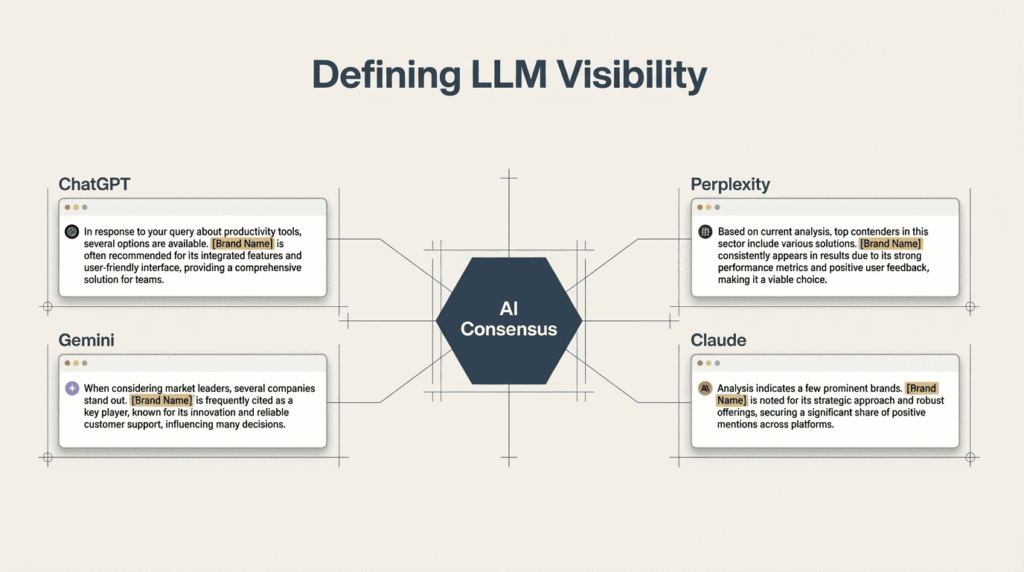
LLM visibility describes how frequently and favorably your brand appears inside AI-generated responses across platforms like ChatGPT, Perplexity, Gemini, and Claude.
The most common way to measure it is through Share of Model Voice (SoMV), the percentage of AI responses in your category that mention your brand, compared to competitors. It’s the AI equivalent of Share of Voice in traditional marketing.
AI search visibility is a closely related concept; it specifically refers to whether your brand is cited or linked inside those answers, rather than appearing as a clickable blue link on Google.
 Pro Tip: Most brands assume they’re visible in AI because they rank on Google. But in AI search, are you mentioned at all? Learn more about AEO & GEO, and how it differs from SEO to keep up with this shift.
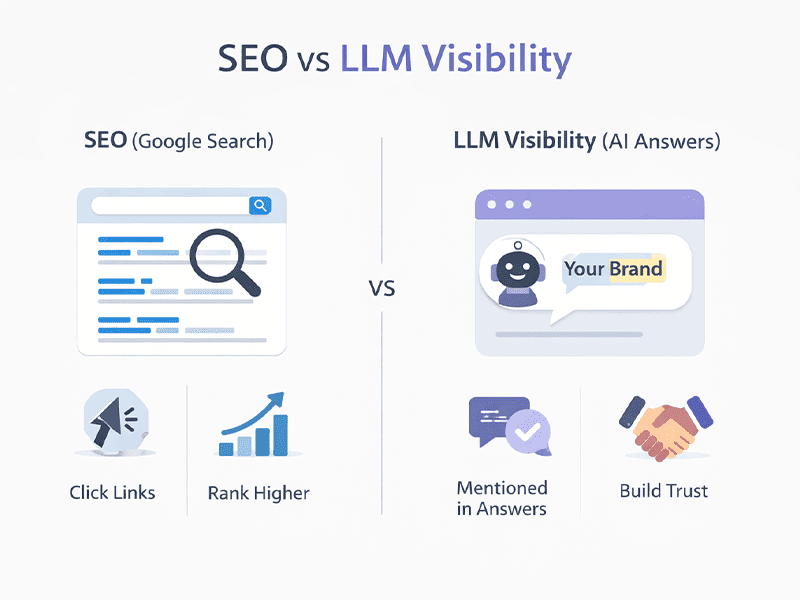
SEO vs LLM Visibility (Simplified)
| SEO (Google Search) | LLM Visibility (AI Answers) |
| Your website shows up as a link in search results | Your brand is mentioned directly inside the answer |
| Users choose which link to click | Users often don’t click; they trust the answer |
| You compete to rank higher than others | You compete to be included at all |
| More links to your site help you rank | Being talked about across the web builds trust |
| Success = getting clicks to your website | Success = being recommended by AI |
Why Google #1 Does Not Guarantee AI Visibility
Most AI tools use Retrieval-Augmented Generation (RAG) – a process where the model pulls live information from the web to support its answer. The sources it prefers are not necessarily the ones ranking on Google. If you’re unsure how this mechanism works in practice, understanding how LLMs choose content can clarify why rankings alone are insufficient.
RAG-powered AI tools tend to favor Reddit threads, Wikipedia entries, industry publications, and trusted editorial content over corporate websites. AI often avoids citing your own product pages because it considers them biased.
A brand can rank #1 on Google and still be completely invisible in AI answers if it lacks the right external signals.
This is the core shift: SEO optimizes your website for a search engine. LLM visibility optimizes your brand’s entire digital footprint for an AI recommendation engine.
How Do Large Language Models Decide Which Brands to Mention?
AI models don’t rank websites the way search engines do. They generate answers by selecting information they consider reliable, relevant, and consistent. When a user asks a question, the model evaluates what it knows and decides which brands deserve to be in the answer.
Based on research into how LLMs surface brands, five core signals determine whether you get mentioned, and not all of them carry equal weight.
Pro Tip: Most brands check this once and stop. The real insight comes from tracking it every month. Run the same prompts, watch what changes, and you’ll quickly see where you’re gaining or losing visibility. Learn how to measure your visibility in AI content.The 5 Ranking Signals for LLM Visibility (With Weights)
If you want your brand to show up in AI answers, these are the five things that matter most.
| Signal | Weight | What It Means |
| Entity Authority | 35% | How well-established your brand is across trusted third-party sources: Wikipedia, major publications, industry directories, and knowledge graphs. |
| Content Clarity | 25% | How clearly does your content communicate what you do? Schema markup, structured tables, stats, and direct answers help AI parse your brand correctly. |
| Semantic Relevance | 20% | How closely your content matches the intent of the user’s query – not just keywords, but the meaning behind the question. |
| External Mentions | 15% | How often your brand appears across independent sources: Reddit, YouTube, forums, PR coverage, and review platforms. |
| Technical Access | 5% | Whether AI crawlers can access your content, controlled via robots.txt settings and the emerging llms.txt standard. |
A Real-World Example
HubSpot ranks #1 on Google for CRM-related queries. Yet in many AI responses, tools like Notion or Monday.com appear instead – because they have stronger Reddit communities, more active forum discussions, and denser third-party editorial coverage.
The lesson: AI doesn’t reward the brand that ranks highest. It rewards the brand that is most consistently and credibly talked about across the web.
Brands with weak external presence get ignored, or worse, hallucinated incorrectly. If AI can’t find reliable information about you, it fills the gap with whatever pattern fits.
How Is LLM Visibility Measured? Key AI Visibility Metrics
LLM visibility isn’t measured like SEO. There’s no Position 1-10. You can’t check a dashboard and see your “AI ranking.” Instead, performance is evaluated across five core metrics that together tell you whether your brand is present, prominent, and positively portrayed in AI answers.
These AI visibility metrics help measure how frequently and prominently your brand appears in AI-generated answers.
| Metric | What It Measures | Where your brand appears in the answer | Good Benchmark |
| Citation Rate | How often does your brand appear in relevant prompts | (Prompts where brand appeared ÷ Total prompts tested) × 100 | 25%+ = category leader |
| Mention Rate | Raw frequency of your brand name across queries | Total brand mentions across the prompt set | 15%+ = competitive |
| Share of Voice (SoMV) | Your mentions vs. all competitor mentions | Brand mentions ÷ Total category mentions | 20%+ = leader |
| Sentiment | Whether AI describes your brand positively | % of responses with positive/neutral framing | 80%+ positive |
| Position | Where your brand appears in the answer | Average rank position in the response list | Top 25% of answers |
What is The LLM Visibility Score Formula?
Individual metrics are useful. But a composite score lets you benchmark overall performance against competitors and track improvement over time.
Visibility Score = (Citation Rate × 0.4) + (SoMV × 0.3) + (Sentiment × 0.2) + (Position × 0.1)
# Example Calculation
| Brand | Citation Rate | SoMV | Sentiment | Position | Visibility Score |
| Brand A (Leader) | 38% | 29% | 91% | 22% | 79/100 |
| Brand B (Competitive) | 22% | 18% | 78% | 35% | 55/100 |
| Brand C (Invisible) | 8% | 6% | 62% | 55% | 22/100 |
Want to see your actual LLM visibility score?
Stop guessing. Measure your citation rate, SoMV, and sentiment automatically.
👉 Run your AI visibility analysis
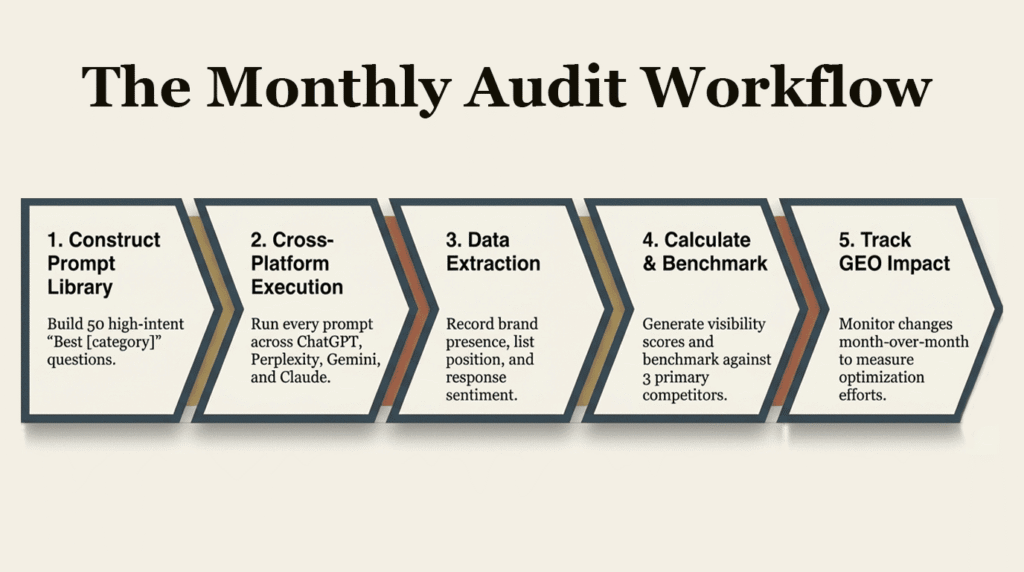
How to Run Your Monthly Audit for AI Visibility
- Build a prompt library of 50 high-intent ‘Best [category]’ questions
- Run every prompt across ChatGPT, Perplexity, Gemini, and Claude
- Record whether your brand appears, its position, and the sentiment
- Calculate your scores and benchmark against 3 competitors
- Track changes month-over-month to measure GEO impact
Quick test: Run ‘What are the best [your category] tools?’ across ChatGPT, Perplexity, and Gemini right now. If your brand doesn’t appear in at least two of the three, you have a visibility gap that needs fixing. To go deeper, use this AEO and GEO audit checklist to systematically evaluate your AI visibility.
What Are the Best Tools to Track LLM Visibility in 2026?
Tracking AI visibility manually is not practical. You need tools that simulate real user questions and analyze how AI responds across platforms like ChatGPT, Perplexity, and Gemini.
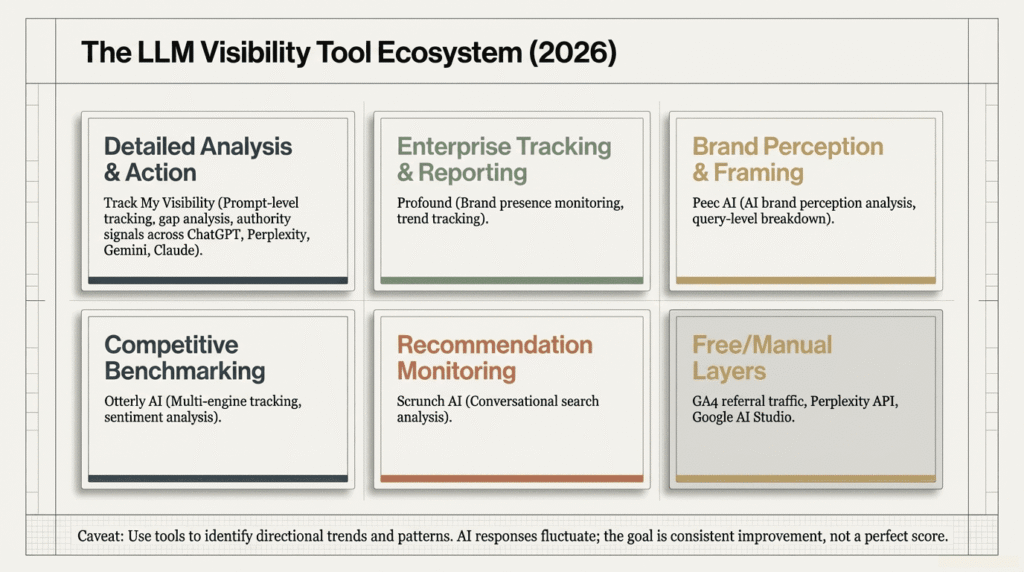
These tools don’t just tell you if you appear. They help you understand why you don’t. Most tools also help improve AI search visibility by identifying gaps in content, authority, and relevance. This is why tracking brand mentions in AI search has become a core capability for modern marketing teams.
Top LLM Visibility Tools Comparison
| Tool | LLMs Tracked | Key Features | Best For |
| Track My Visibility | ChatGPT, Perplexity, Gemini, Claude | Prompt-level tracking, content gap analysis, and authority signals | Detailed analysis & clear action points |
| Profound | ChatGPT, Perplexity, Gemini, Claude | Brand presence monitoring, trend tracking, enterprise reporting | Enterprise tracking & reporting |
| Peec AI | All major LLMs | AI brand perception analysis, query-level breakdown | Understanding how AI frames your brand |
| Otterly AI | All major LLMs | Multi-engine tracking, competitor benchmarking, sentiment analysis | Competitive benchmarking |
| Scrunch AI | ChatGPT, Perplexity, Gemini | AI recommendation tracking, conversational search analysis | AI recommendation monitoring |
* Pricing and features as of Q1 2026 – verify on each platform before purchasing.
Skip manual tracking and get real visibility data across all AI platforms.
Track mentions, benchmark competitors, and identify gaps in one place.
Free and Manual Options
- Manual prompt testing across ChatGPT, Perplexity, and Gemini (free, time-intensive)
- GA4 referral traffic reports – track sessions from chatgpt.com, perplexity.ai, etc.
- Perplexity API for developer-level prompt testing
- Google AI Studio for Gemini-specific visibility checks
An Honest Caveat
No tool has perfect accuracy yet. In fact, AI responses change frequently, and the same prompt can produce different answers across sessions. Because of this, use these tools to identify patterns and directional trends rather than obsessing over exact numbers. Ultimately, the goal is consistent improvement, not a perfect score.
Is LLM Visibility Replacing SEO?
No. LLM visibility is not replacing SEO. But it is fundamentally changing how users discover brands, and ignoring it creates a dangerous blind spot.
Why SEO Still Matters
Without strong SEO, your brand has a limited presence across the web. That means fewer third-party mentions, less domain authority, and weaker signals for AI systems to draw from. SEO builds the foundation that LLM visibility runs on.
SEO still drives:
- Direct organic traffic from Google and Bing
- Long-term domain authority and trust
- The external content ecosystem that AI systems actually cite
Where LLM Visibility Changes the Game
AI search has now become a second layer of discovery, one where decisions happen without clicks. Instead, a user asks a question, gets a synthesized answer, and makes a decision. As a result, users don’t click any links, don’t visit websites, and largely ignore your Google ranking.
At that moment, only visibility inside the answer matters.
Data point: Brands with strong Google rankings are approximately 3x more likely to appear in AI citations, but only if they’ve also built entity authority and external mentions. Google #1 alone is not enough.
The Right Mental Model

Understanding LLM visibility becomes easier when you look at it alongside SEO. Both serve different roles, but together they define how your brand gets discovered today. This mental model shows what SEO builds and how GEO activates that visibility within AI systems.
| SEO Builds… | GEO Activates… |
| Backlinks and domain authority | Entity recognition across AI models |
| Keyword rankings | Semantic relevance to query intent |
| Technical site health | AI crawler accessibility (llms.txt, schema) |
| Content volume | Citation-worthy content AI wants to quote |
Think of it this way: SEO helps users find you. LLM visibility helps AI recommend you. Brands that ignore either one are leaving significant discovery on the table. The emerging discipline combining both is called Generative Engine Optimization (GEO), and it’s fast becoming the core skill set for modern SEO professionals.
How to Improve LLM Visibility with Generative Engine Optimization (GEO)?
Generative Engine Optimization focuses on increasing your chances of being included in AI-generated answers. It is a key part of AI search optimization, helping brands improve their presence in AI-driven search systems.
These tactics help improve how often your brand appears in AI recommendations across different queries.
- Define your brand clearly across all content
- Answer real user questions directly
- Put key information at the beginning of the content
- Cover topics fully, not partially
- Build mentions on third-party platforms
- Use structured data like the FAQ schema
- Create comparison and “best of” content
- Keep messaging consistent across pages
- Improve readability and structure
- Track performance and update regularly
Conclusion and Action Plan
Visibility in AI answers determines whether your brand is part of the decision-making process.
This shift is already underway. As users increasingly move from searching to asking, improving AI search visibility has become essential for staying competitive in today’s evolving landscape.
Action Plan
- Identify high-intent questions in your category
- Test how AI responds to those questions
- Measure your visibility using key metrics
- Find gaps where competitors appear, and you do not
- Create content that fills those gaps
- Build authority through external mentions
- Track and improve continuously
If your brand is not part of the answer, it is not part of the decision. That is why LLM visibility is quickly becoming one of the most important growth levers in modern search. If you’re ready to actively track, benchmark, and improve your visibility over time, Track My Visibility helps you measure and optimize how your brand appears in AI answers. You can also explore our pricing to get started.
Frequently Asked Questions
It is how often your brand is mentioned, cited, or recommended inside AI-generated answers when users ask questions in your category. If your brand isn’t mentioned, you’re invisible to that user at the most critical moment.
A growing share of product research, comparisons, and purchase decisions now happens inside AI tools – without users ever visiting a traditional search results page. If your brand isn’t in those answers, you’re missing an increasingly large portion of your potential b
Yes, and it happens frequently. AI systems prefer external validation from independent sources like Reddit, industry publications, and review platforms – not corporate websites. High Google rankings help, but don’t guarantee AI visibility.
LLM visibility is the broader concept – how your brand appears across all AI-generated responses. AI search visibility specifically refers to citation and link presence inside AI tools that pull live web results, like Perplexity.
No. SEO builds the foundation – domain authority, external links, and content volume – that LLM visibility draws from. The two disciplines work together. Neglecting either one creates a significant gap in your discoverability.
Directionally, yes, but not perfectly. AI responses vary between sessions, and no tool captures every LLM comprehensively. Use them to identify patterns, track trends, and prioritize improvements – not to obsess over exact scores.