



In AI search, AI citation optimization is what separates data-rich content from content that gets ignored. AI platforms prioritize information they can verify, extract, and reuse, which is why data-rich content consistently outperforms opinion-based writing. Research confirms that product and data-driven content accounts for 46% to 70% of AI citations, while generic blog content receives as little as 3% to 6%1.
Looking at AI platform citation patterns, one trend is clear: content with specific statistics, structured formats, and credible sources is far more likely to surface when AI answers. In one analysis, content strategy improvements alone increased citation rates by up to 42%2.
This guide covers how to use statistics strategically to increase your chances of being cited across AI platforms.
TL;DR
- AI citation optimization starts with sourced data that earns citations up to 40% more citations.
- Strong statistical content follows the 30% factual rule and 10-20-70 structure: lead with data, cite clearly, and front-load key facts.
- Each AI platform uses different citation logic, so understanding ChatGPT, Perplexity, Gemini, Google AI Overviews, and Claude patterns is key.
- Citation gains come from answer-first formatting, exact figures, clear attribution, structured data, and regular updates, not more content.
- Tracking which stats earn citations on each platform turns content into a compounding visibility asset.
Why AI Platforms Prefer Statistics Over Qualitative Content
AI platforms use algorithms that evaluate content based on clarity, verifiability, and ease of extraction. Statistics meet these criteria better than qualitative content, making them more likely to be selected and cited.
- Easier to extract: Statistics are clear, self-contained, and easy for AI to pull into AI-generated answers
- More verifiable: Numbers can be cross-checked across multiple authoritative sources
- Higher precision: Data removes ambiguity compared to vague statements
- Better for direct answers: AI prefers facts that directly answer user queries
- Stronger trust signals: Cited data with sources increases credibility and domain authority
- Structured format friendly: Stats in lists, tables, or short lines are easier for AI crawlers to process
AI Rules for Citation Evaluation
AI models evaluate and cite the sources based on a few consistent rules. These rules help brands build an effective AI search strategy across AI platforms.
The 30% Factual Rule
AI platforms classify content authority by factual density, the ratio of verifiable claims to narrative within a passage. Below roughly 30% verifiable facts, citation frequency drops sharply.
Numerical claims are easier for AI systems to cross-validate, so they contribute more toward factual density than qualitative assertions. Every section should contain at least one attributed data point. Sections built entirely on narrative are less likely to be selected as citation sources, regardless of surrounding authority signals.
The 10-20-70 Structure for AI
A practical content strategy aligned with how AI platforms retrieve information:
- 10% Context. One framing sentence establishes what the section addresses.
- 20% Statistics and evidence. Sourced figures and attributable data points. This is the extraction layer AI platforms pull first.
- 70% Analysis. Interpretation and supporting examples that substantiate the lead evidence.
GEO validation
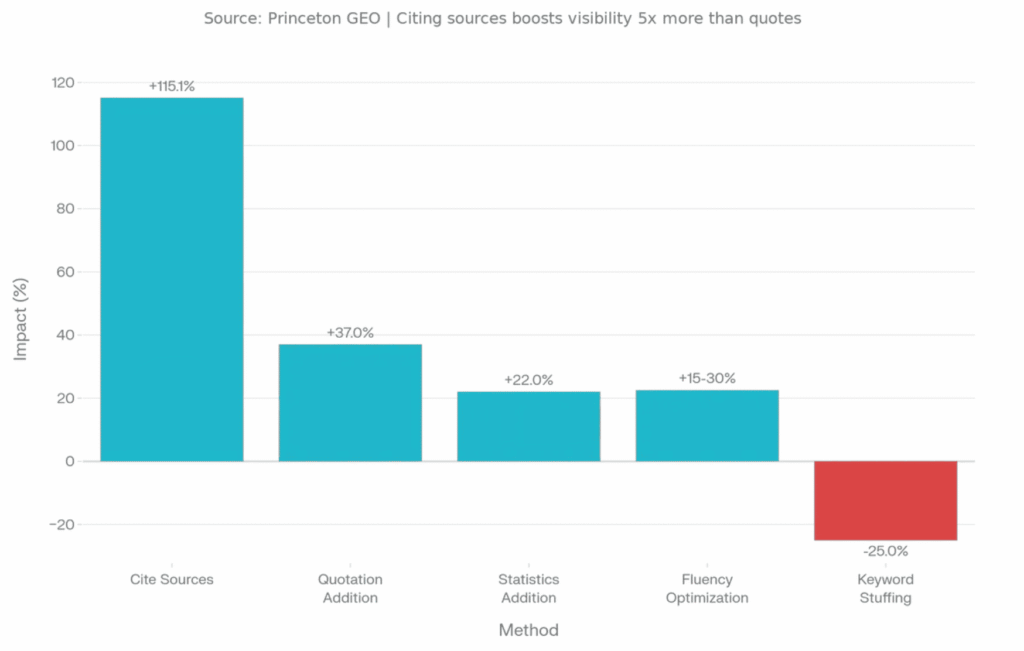
“We found that augmenting content with statistics and citing sources improved performance the most, with a 40% and 37% improvement, respectively.” – Aggarwal et al. (Princeton University)3
AI citation optimization through GEO frameworks weights source authority, recency, statistical context, cross-referencing, and markup clarity. Content optimised for GEO performs differently across platforms. The research identifies a clear hierarchy of signals influencing citation selection across both disciplines:
- Source authority and recency drive most citation weighting, meaning well-structured statistical content still underperforms if the domain lacks authority or the data is outdated.
- Schema markup matters: Article, FAQPage, and Dataset schema, including ‘measurementTechnique’ and ‘datePublished’ properties, signal to AI crawlers that data is structured and traceable.
 Pro Tip: Fresh statistics improve citation eligibility, but do you know which AI platforms are actually citing your content right now? Run a quick audit to check your AI visibility and see how your brand currently shows up across major AI platforms.
How to Use Statistics for AI Citation Optimization: A Practical Framework
AI platforms select specific data points that directly answer a query. To increase your chances of earning a citation, your content needs to present statistics in a way that is clear, verifiable, and easy to extract.
1. Use an Answer-First Format With Clear, Citable Statistics
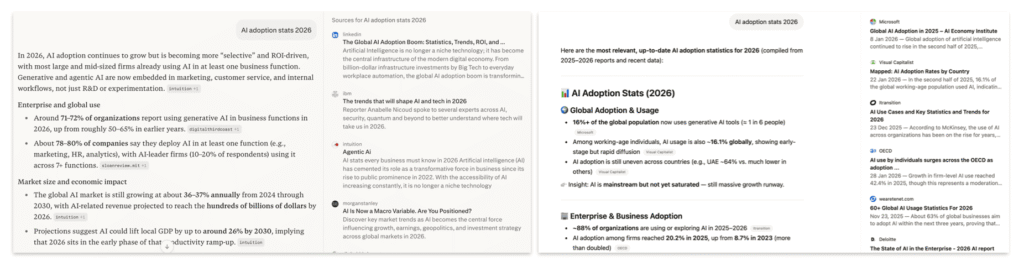
AI systems scan content for direct answers they can reuse instantly. When a statistic appears at the beginning of a sentence or paragraph, it becomes easier for the model to extract, interpret, and include in responses.
This improves citation likelihood because the data is clear, self-contained, and aligned with user queries. Lead with a precise statistic, mention what it represents, and follow with a short explanation and source attribution.
Example:
Weak: “AI adoption is increasing across industries due to growing interest in automation.”
Strong: “According to Track My Visibility, 65% of companies use AI in at least one business function, showing widespread adoption across industries.”
2. Back Every Statistic With a Named, Verifiable Source
AI systems prioritize data that can be trusted and cross-checked across citation sources. When a statistic includes a clear source, it increases confidence and makes it easier for AI to validate and reuse the information.
Named attribution also strengthens authority signals, improving the chances of citation. Place the source name directly with the statistic and keep it consistent across the post.
“Data-rich content generates 4.31x more citations per URL than generic equivalents. Structured statistics provide the verifiable anchors AI systems crave for risk-minimized responses.” – Yext AI Research Team, AI Citation Behavior Across Models
Example:
Weak: “70% of businesses plan to increase AI spending.”
Strong: “According to Deloitte, 70% of businesses plan to increase AI spending in 2026.”
3. Use Precise Numbers and Definitive Language
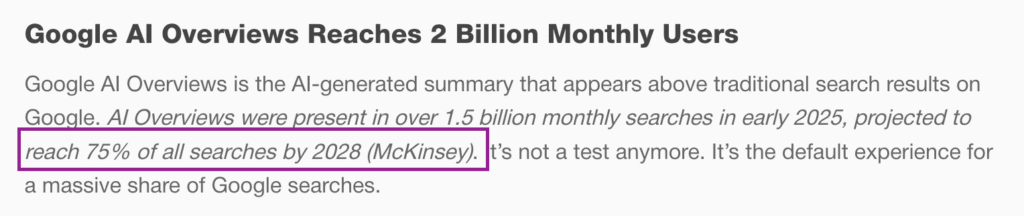
AI models rely on specific, unambiguous data to generate accurate AI-generated responses. Exact numbers are easier to interpret and reuse compared to vague phrases. Clear language reduces uncertainty and improves AI citation extraction accuracy.
Use specific percentages, values, and timeframes instead of general statements. Precision signals extend beyond citation probability, which helps to rank in AI search across ChatGPT, Perplexity, Gemini, Claude, and Google AI Overviews.
Example:
Weak: “Many users prefer mobile shopping.”
Strong: “68% of users prefer mobile shopping over desktop, based on Statista data.”
4. Structure Data for Easy AI Extraction
AI systems process content more efficiently when it is well-structured and clearly formatted. Lists, tables, and short data points make it easier to identify and extract key information from community platforms and official documentation alike. Structured presentation improves readability for both AI and users. Break down statistics into clean, scannable formats.
Example:
Instead of a paragraph: “Most users prefer mobile, while some still use desktop, and a few use both equally.”
Use:
- 68% prefer mobile
- 24% prefer desktop
- 8% use both equally
5. Update and Refresh Statistics Regularly
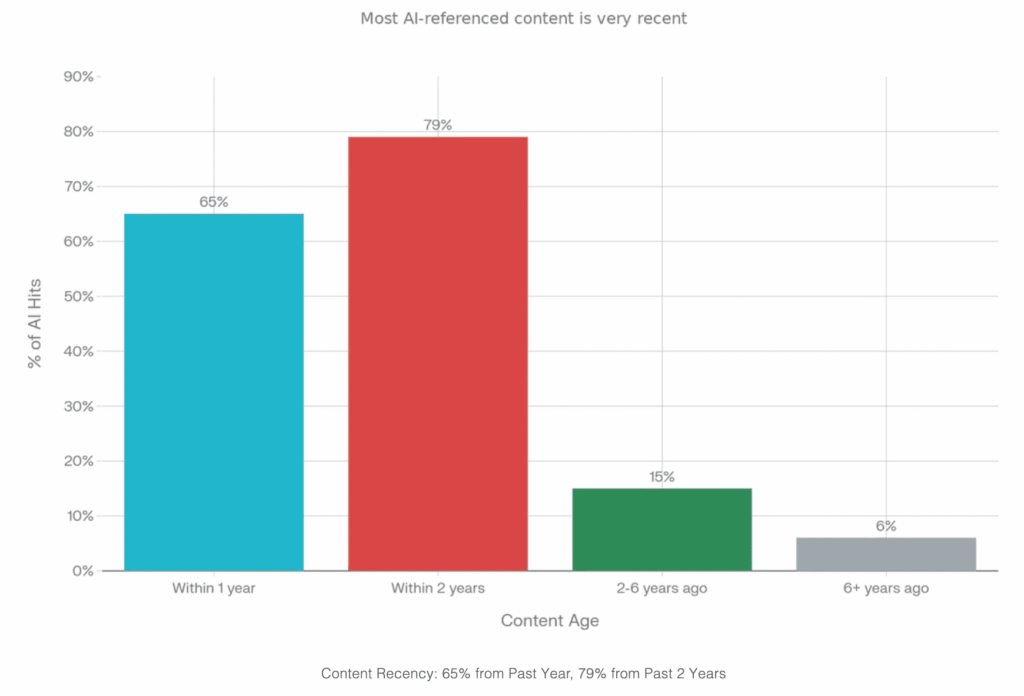
AI platforms favor recent and relevant data, especially for fast-moving topics. Updated statistics signal that the content is current and reliable. Fresh data improves search visibility and increases the likelihood of being selected for citations. Replace outdated numbers and include recent timeframes where possible.
Example:
Weak: “In 2020, 50% of businesses used AI.”
Strong: “As of 2025, 65% of businesses report using AI (source).”
Pro Tip: AI platforms update how they evaluate and select sources more frequently than most content teams realize. Explore these AI search statistics to see the numbers behind AI citation trends and platform growth across AI platforms.6. Use Original or First-Party Data Whenever Possible
AI systems favor data that is unique and directly attributable to a cited source. First-party data stands out because it is less duplicated and provides clear ownership, which improves trust and citation share. Present findings from your own research, surveys, or internal analysis with clear context and scope.
Example:
Weak: “AI improves conversion rates for many businesses.”
Strong: “Based on an analysis of 1,000 campaigns, conversion rates increased by 32% after AI adoption.”
7. Use Comparative Data (Benchmarks, “X vs Y”)
AI models often answer search queries that involve decisions, comparisons, or performance differences. Comparative statistics directly address these queries, which makes them highly useful and more citation-worthy. Present data in a way that clearly shows differences between options.
Example:
Weak: “AI campaigns perform better than manual campaigns.”
Strong: “AI-driven campaigns achieve 28% higher conversion rates than manual campaigns, based on internal benchmarks.”
8. Combine Definitions With Supporting Data
AI systems prefer high-quality content that includes both clear explanations and supporting evidence. Pairing a definition with a statistic improves understanding and makes the information easier to reuse in AI responses.
Example:
Weak: “AI citation analysis helps track visibility.”
Strong: “AI citation analysis refers to tracking how AI platforms reference sources, and studies show data-driven content is cited significantly more often than qualitative content.”
9. Align Statistics With Search Intent
AI platforms decide which data to surface based on how closely it matches the intent behind a query. Statistics that closely match user behavior are more likely to be extracted and cited by AI platforms like ChatGPT, Perplexity, Claude, and Google Gemini. Identify the query type and place the most relevant data point as the primary answer.
Example:
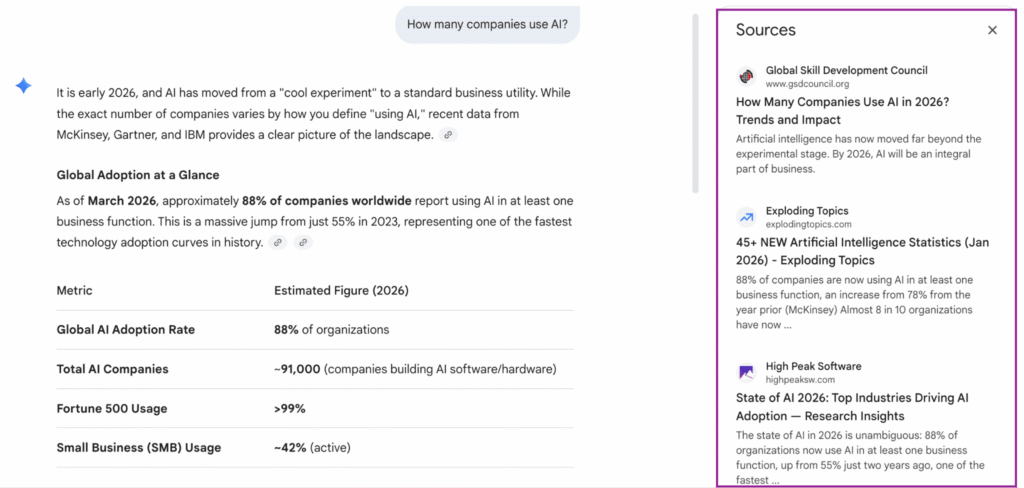
Query: “How many companies use Artificial Intelligence?”
Weak: “AI adoption is growing steadily across industries.”
Strong: “88% of companies use AI in at least one business function (source).”
10. Clearly Attribute Data to Your Brand or Source
An AI platform looks for clear ownership of data when selecting citation sources. Consistent attribution helps connect the statistics to a recognizable entity, which is exactly why tracking brand mentions matters across every platform where citations are being generated. Make sure your brand or source is clearly mentioned alongside the data.
Example:
Weak: “Conversion rates improved by 30%.”
Strong: “According to [Your Brand], conversion rates improved by 30% after implementing AI-driven personalization.”
Pro Tip: Refining AI visibility strategy is easier when there is a clear picture of which sources are cited in AI-generated answers. Review this comprehensive AEO GEO audit checklist for citation signals to identify which prompts are worth tracking.AI Citation Analysis: How to Track Which Data Gets Cited
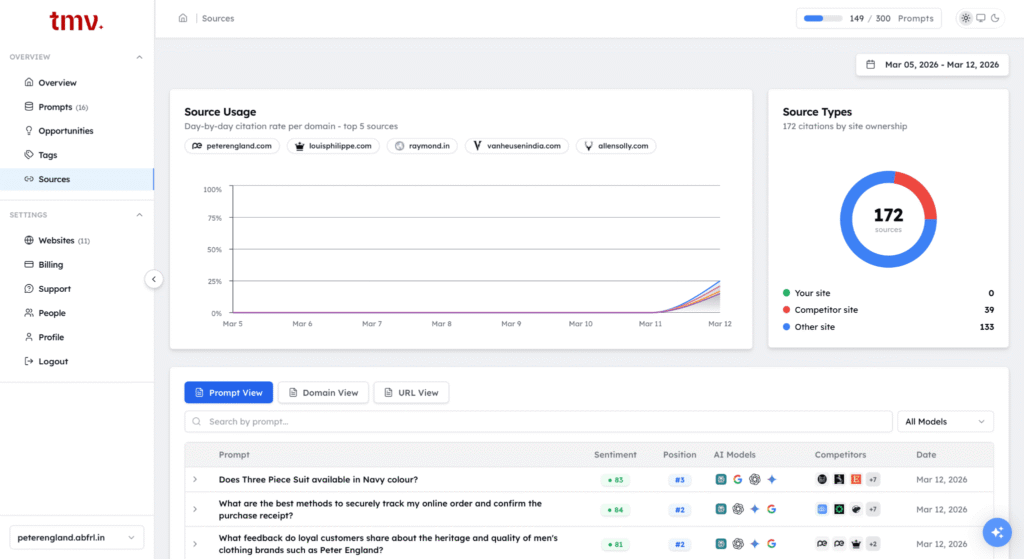
Effective AI citation optimization requires knowing which statistics are earning citations and on which platforms. Each system follows different selection patterns, which makes platform-by-platform monitoring essential for any AI visibility strategy.
Tracking AI search visibility helps identify which data gets cited, what formats and sources are being picked up, and where gaps exist.
Key Performance Indicators
To measure AI citation performance effectively, focus on a few core indicators:
- Citation frequency: how often your content or data appears in AI answers.
- Platform coverage: which major AI platforms are citing your content?
- Data-level visibility: which specific statistics are being picked up.
- Source attribution: whether your brand is correctly credited.
Tracking these KPIs helps you understand what is working and what needs improvement.
Long-term Strategic Planning
Building a sustainable AI citation optimization strategy requires a long-term approach because platforms continuously update how they select and present information. For most teams, this means building a content strategy that consistently produces reliable, data-driven insights rather than one-off articles.
To plan strategically, focus on:
- Creating content around recurring data points (industry stats, benchmarks, trends).
- Publishing original or updated statistics regularly.
- Structuring content so key data is easy to extract and reuse.
- Expanding topics where your data already gains AI visibility.
Tracking plays a critical role in this process. Without visibility into which statistics are being cited, it is difficult to refine or scale what works. Measuring your brand’s AI visibility helps identify high-performing data, platform citation patterns, and content gaps.
Tools like Track My Visibility support this kind of long-term execution. The platform tracks which data points are cited across Google AI Overviews, ChatGPT, Perplexity, Gemini, and Claude, measures citation gaps and brand mentions, and surfaces actionable insights to increase your AI citation rate.
Common Mistakes That Prevent Your Data From Being Cited by AI
Even well-researched, authoritative content can fail to get cited if the data is not presented in a way AI systems can extract, verify, and trust. Avoiding these common mistakes can significantly improve your chances of appearing in AI search results.
- Using vague language: General terms like “many” or “most” reduce precision and AI citation likelihood.
- Missing source attribution: AI systems struggle to verify and trust statistics without a clear source.
- Burying key data: AI crawlers are less likely to extract important statistics placed deep in content.
- Poor structure: Unorganized content makes it difficult for AI tools to parse and reuse data.
- Outdated statistics: Old data lowers relevance and reduces chances of being cited.
- Conflicting data points: Inconsistent statistics create uncertainty and reduce trust.
- Lack of context: AI systems may misinterpret or ignore data without explanation.
- No clear ownership: Unattributed data weakens credibility and citation volume.
Conclusion
AI citations are driven by how data is presented, not just the quality of content. Statistics that are clear, structured, and backed by credible, authoritative sources are far more likely to be selected and reused by AI platforms.
Understanding AI platform citation patterns and applying AI citation optimization strategies turns content into a reliable source for AI-generated answers. This requires a shift from general writing to precision, structure, and verifiability disciplines that compound in value as AI search continues to displace traditional discovery channels.
Consistent tracking and refinement make that shift sustainable. Tools like Track My Visibility give content teams the platform-level intelligence to identify which statistics are earning citations, where performance is declining, and where the next opportunity lies across ChatGPT, Perplexity, Gemini, Google AI Overviews, and Claude simultaneously.
Try our 7-day trial to see which platform cites you and where you stand.
Frequently Asked Questions
Focus on using clear, data-backed statements, structured formats, and credible sources. AI platforms prefer content that is easy to extract, verify, and directly answer user queries.
AI platform citation patterns refer to how different AI systems select and cite sources. Understanding these patterns for AI citation optimization helps you structure content in a way that aligns with how each platform evaluates data and trust.
Precise statistics, original or first-party data, and clearly structured comparisons are most likely to be cited. Data that is recent, well-attributed, and easy to understand performs best.
Track which pages and data points appear in AI-generated answers across platforms. Analyze patterns in structure, sources, and formats to understand what is being cited and optimize accordingly. Tools like Track My Visibility help to track AI citation patterns across major AI platforms with actionable insights.
AI platforms prioritize extractable, verifiable data over rankings. Content without clear statistics, structure, or source attribution may rank in search but still be ignored for AI citations.
Reference
1. AI Search Study: Product Content Makes Up 70% Of Citations
3. GEO: Generative Engine Optimization, Princeton University
4. AI Citation Behavior Across Models: Evidence from 17.2 Million Citations
5. 2025 AI Citation & LLM Visibility Report