


Content has been restructured for AI retrieval. Schema markup has been implemented. Brand mentions have been built across third-party sources. Strategies for answer engine optimization and generative engine optimization are in motion. But there is one critical step most business teams skip entirely: auditing whether any of it is actually working.
Without a structured audit, optimization efforts run blind. There is no way to confirm whether AI platforms are retrieving and choosing the right content, citing the brand accurately, or surfacing it at all for the queries that matter.
This guide covers each layer of a structured AI search visibility audit and what to evaluate at each stage from brand citation tracking to technical schema readiness.
TL;DR
- AI search visibility requires a dedicated audit framework: brand citations, content retrievability, authority signals, platform-specific gaps, competitor share-of-voice, and technical foundations each need separate evaluation.
- Citation context matters more than citation frequency; whether a brand is recommended, listed as an alternative, or ignored entirely determines actual influence in AI-generated answers.
- Trust Hubs, Wikipedia presence, and third-party brand mentions are the signals AI models weigh most heavily when deciding which brands to cite.
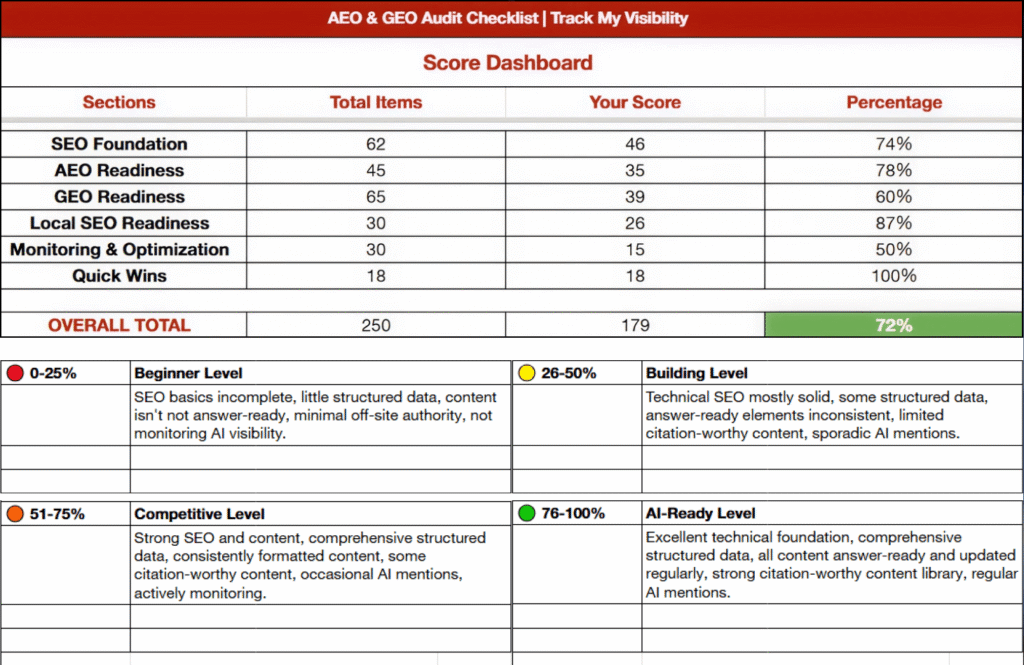
- The AI Search Optimization Readiness Checklist: SEO foundation, AEO readiness, GEO readiness, local SEO, and monitoring help to evaluate whether the overall strategy is prepared for AI-driven search.
Why This Audit Matters And How to Use It
Traditional SEO audits addressed rankings, backlinks, and crawlability, the factors that determined visibility in a link-based search environment. AEO and GEO shift those priorities. Audit criteria now include content retrievability, structured data coverage, and third-party brand mention footprint.
Auditing matters because:
You have no idea how AI perceives your brand. AI systems summarize information from multiple sources, and content you don’t control may shape your brand narrative.
Your competitors might be dominating, and you wouldn’t know. Brands can appear in AI answers and citations even when they are not ranking traditionally.
Each AI platform is different. Visibility can vary across Google AI Mode, chat-based search, copilots, and answer engines, requiring platform-specific evaluation.
You cannot improve what you cannot measure. Without auditing AI citations, prompt coverage, and entity signals, optimization efforts remain guesswork.
Use this audit as a diagnostic framework to evaluate your AI visibility gap, identify prompt and citation gaps, and prioritize improvements that can increase your chances of appearing in AI-generated answers.
Core AI Search Visibility Audit Framework
AI visibility is not determined by rankings alone. AI systems retrieve, interpret, and synthesize information from multiple sources before generating answers.
Use the following six-layer framework to systematically evaluate how visible and influential your brand is across AI-powered search environments.
1. Brand Mention & Citation Audit
AI systems frequently reference external sources when choosing content to form answers. This audit evaluates whether your brand is being mentioned, cited, or used as a reference across AI-generated responses.
Run Priority Queries Across All Major AI Platforms: Test branded, category, comparison, and high-intent queries across ChatGPT, Perplexity, Claude, Gemini, and Google AI Overviews. Each query type surfaces different citation behavior.
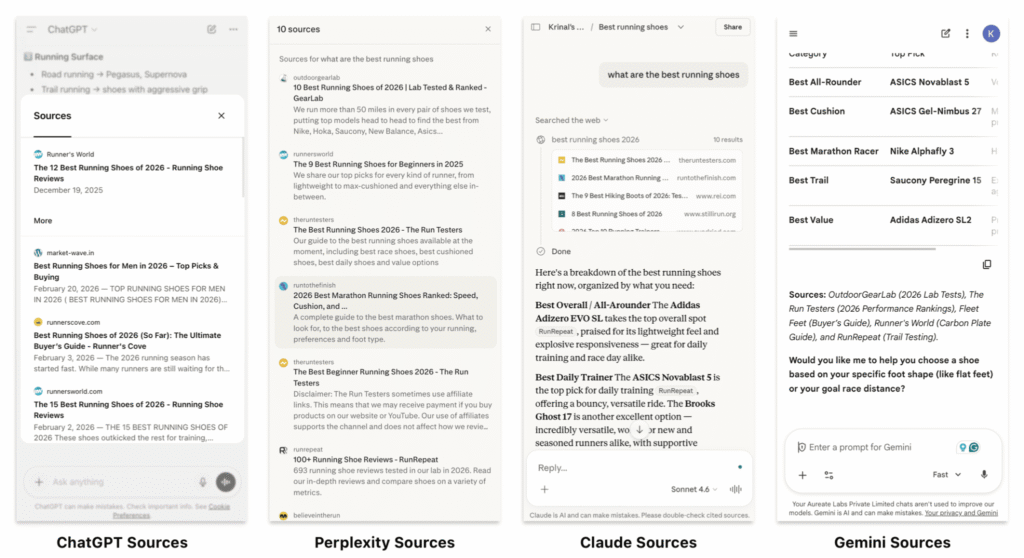
 Pro Tip: Running queries manually across five platforms quickly becomes unsustainable at scale. But the pattern of which query types surface the brand and which don’t is where the most actionable audit findings come from. Explore how to rank in Google AI Overviews to understand exactly what signals each query type is evaluating.
Audit Citation Context, Not Just Frequency: Identify whether the brand is recommended, listed as an alternative, or ignored entirely. A single primary recommendation outweighs five buried mentions.
Map Sentiment Framing: Note whether AI platforms describe the brand positively, neutrally, or with qualifications. This framing traces content and reputation gaps, not visibility gaps.

Flag Competitor Citation Gaps: Identify queries where competitors appear and the brand does not. These are the highest-priority gaps in any AI visibility audit.
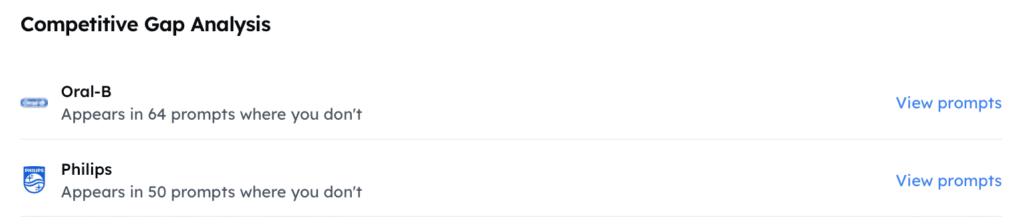
Check Entity Consistency: Brand name, description, and positioning must match across the website, LinkedIn, Crunchbase, G2, Wikipedia, and press. Inconsistency fragments AI entity recognition.
Monitor for Hallucinations: Audit whether AI platforms are stating incorrect pricing, features, or positioning. Hallucinations require source-level fixes, not content edits.
2. Content Structure & Retrievability Audit
AI systems retrieve information in content chunks rather than entire articles. This audit evaluates whether your content is optimized for AI answers in a way that makes it easy for AI search engine to extract and interpret.
Lead Every Section With the Answer: The first 2–3 sentences after every H2 should directly answer the question the heading implies.
Audit Heading Structure for Parseability: Every H2 and H3 should read as a clear, standalone topic signal, not a creative label. Vague headings reduce citation accuracy.
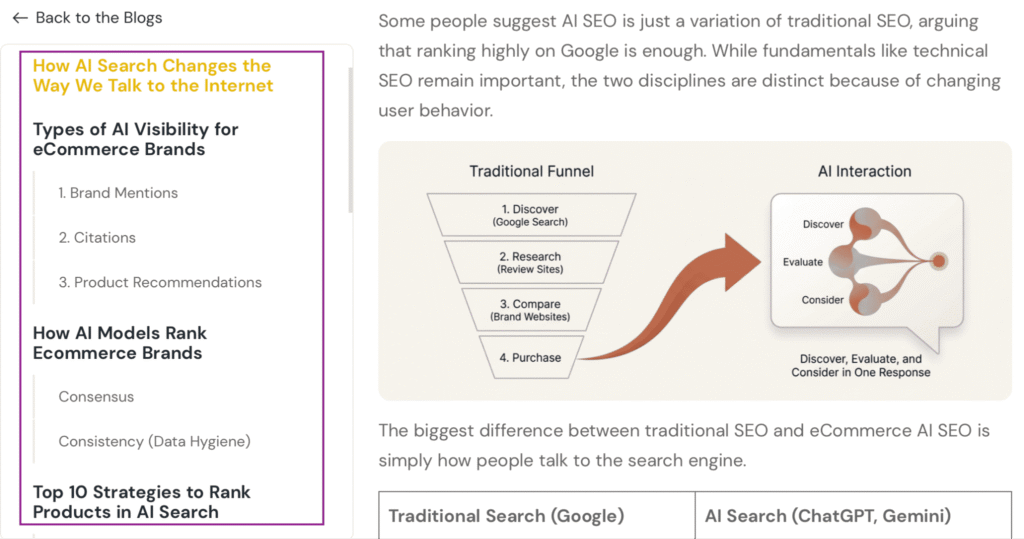
Close Topical Gaps on Priority Pages: AI favors single-source answers. A page that covers a topic shallowly loses the citation to one that covers it fully.
Corroborate Key Claims Across Multiple Sources: Core metrics and positioning statements need to appear across the website, case studies, reviews, and press, not just on one page. A claim that exists only on the brand’s site reads as marketing to an LLM, not fact.
Remove Promotional Language From Indexed Pages: Neutral, factual, balanced content earns stronger citation confidence than sales copy. Pages that acknowledge limitations perform better in AI retrieval than pages that don’t.
Verify Freshness Signals on All Key Pages: Publication dates and last-updated timestamps directly affect Google AI Overviews inclusion. Confirm they are visible, accurate, and reflect the most recent content update.
3. Authority & Trust Signal Audit
AI models prioritize sources that demonstrate strong credibility, expertise, and trustworthiness. This audit evaluates the authority signals associated with your content and brand.
Audit Third-Party Brand Mentions: Review presence across industry publications, press coverage, review platforms (G2, Trustpilot, Capterra), and community forums (Reddit, Quora). These are the sources AI models draw from when forming recommendations. For a deeper look at how LLM citation decisions work, see the guide on how to get LLM citations.
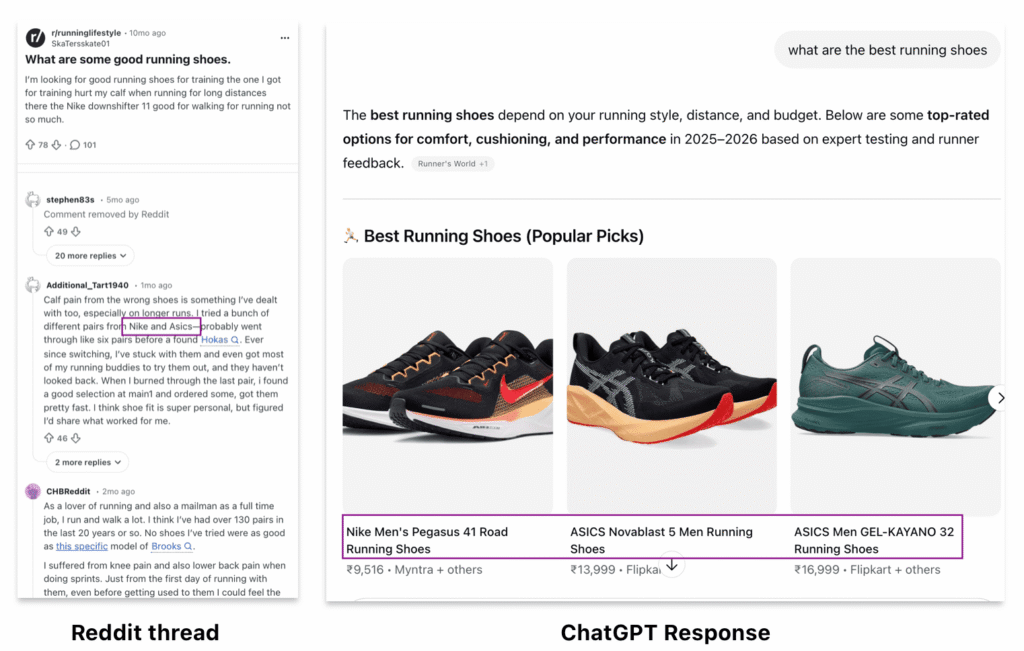
Discover Your Trust Hubs: Run 30–50 commercial queries across ChatGPT, Perplexity, and Claude. The domains cited repeatedly are the Trust Hubs for the category. Getting mentioned on those pages delivers faster citation gains than building new content.
Audit Wikipedia and Knowledge Graph Presence: Wikipedia and Wikidata entries are among the strongest trust signals for LLMs. Confirm entries exist, are accurate, and reflect current brand positioning.
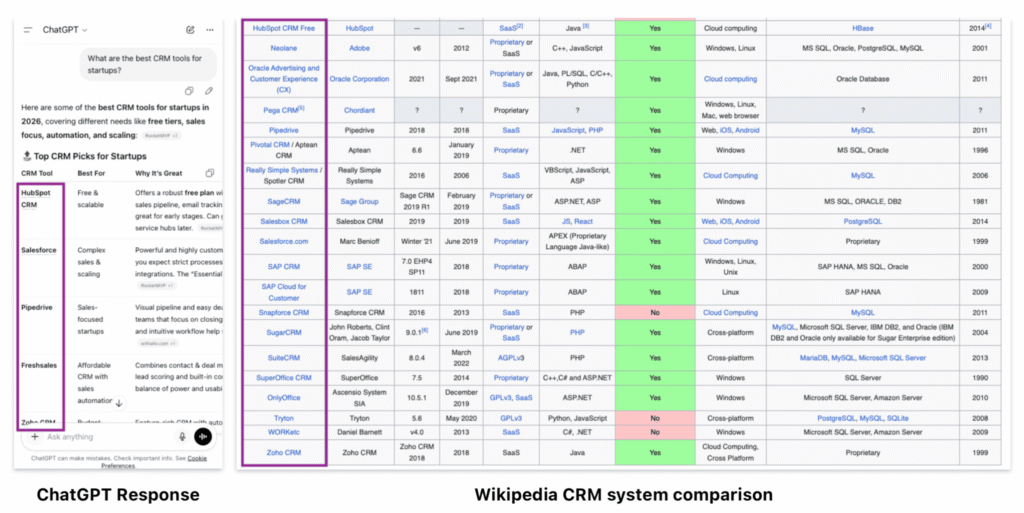
Implement SameAs Schema for Entity Disambiguation: Organization schema should explicitly link the website to LinkedIn, Crunchbase, Wikidata, and other knowledge graph profiles. This tells AI models these sources refer to the same entity.Example: Organization schema with `sameAs`
| <script type=”application/ld+json”> { “@context”: “https://schema.org”, “@type”: “Organization”, “@id”: “https://www.example.com/#organization”, “name”: “Example Technologies”, “url”: “https://www.example.com”, “logo”: “https://www.example.com/images/logo.png”, “description”: “Example Technologies provides AI-powered marketing analytics tools for businesses.”, “sameAs”: [ “https://www.linkedin.com/company/example-technologies”, “https://www.crunchbase.com/organization/example-technologies”, “https://www.wikidata.org/wiki/Q123456”, “https://twitter.com/exampletech”, “https://www.youtube.com/@exampletech”, “https://github.com/exampletech” ] } </script> |
Publish Original Research and Data: Original research earns citations from journalists, bloggers, and AI systems. A single data study with specific, quotable statistics builds citation authority that generic content cannot.
Target Zombie Stats in the Category: Identify outdated statistics still circulating in AI responses. Publish updated data and pitch the sites still citing old numbers. When multiple Trust Hubs link to the new data, AI platforms adopt it as the source of truth.
4. Platform-Specific Visibility Audit
AI visibility varies across different platforms. Your brand might appear in one AI interface but not another. With tools like Track My Visibility, you can run automated checks across these AI platforms.
This audit evaluates how visible your content is across major AI search environments.
| Platform | What to Audit |
| Google AI Overviews | • Does the brand appear in AI-generated answers for commercial and informational queries • Are FAQ, HowTo, and Article schema implemented and validated on priority pages • Are any high-priority pages missing structured data that should be surfacing |
| Perplexity | • Is the brand being cited in live Perplexity searches for category and comparison queries • Is PerplexityBot blocked anywhere in robots.txt • Is content indexed and retrievable in real-time searches |
| ChatGPT | • Are recent product updates, positioning changes, and new claims reflected in responses • Is the brand being described accurately or using outdated information • Are third-party citations strong enough to accelerate the training update cycle |
| Claude | • How is the brand framed in comparison and recommendation-style prompts • Does the brand surface in “best for [use case]” queries • Are neutral, authoritative third-party sources referencing the brand |
| Gemini | • Is brand information accurate and consistent in Google’s knowledge graph • Does the brand appear in product and category recommendation queries • Is Google Business Profile data consistent with what Gemini surfaces for local queries |
5. Competitor Share-of-Voice Audit
AI search visibility is often competitive. This audit identifies whether competitors are dominating AI-generated responses for the queries that matters most.
Map Competitor Citation Frequency: Run identical queries across all major AI platforms and record how often each competitor is cited. This establishes a share-of-voice baseline to measure against over time.

Identify Competitor Trust Hub Presence: Audit which Trust Hubs industry publications, review platforms, and comparison pages are referencing competitors but not the brand. These are the highest-priority outreach targets.
Build a Gap Matrix: Map findings across three dimensions: query type, platform, and cited competitor. This turns audit findings into a prioritized action list rather than a general observation.
Analyze the Content Earning Competitor Citations: For every query where a competitor appears and the brand does not, examine what content, format, and authority signals are driving that citation. The gap is rarely about SEO.It is usually content depth, third-party mentions, or entity authority.
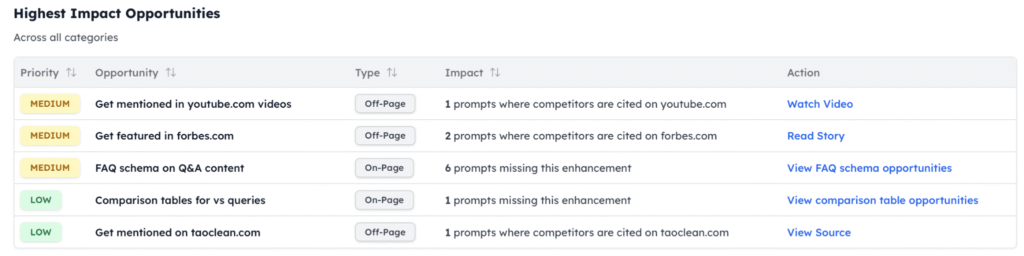
Monitor Competitor Co-occurrence Patterns: Note which brands consistently appear alongside yours in AI responses. Co-occurrence reveals how AI platforms are categorizing the brand within its competitive set and whether that positioning is accurate.
Pro Tip: Competitors co-occurrence patterns often reveal surprising shifts in how AI platforms are categorizing brands and the data behind those shifts tells a bigger story. Explore AI search statistics for 2026 to see what the numbers actually reveal about how brands are winning and losing visibility in AI-generated answers.6. Technical & Schema Audit for AI Indexability
AI systems rely on machine-readable signals to interpret context and relationships within content. This audit evaluates whether your technical foundation supports AI retrieval.
Verify AI Crawler Access in robots.txt: Confirm GPTBot, ClaudeBot, PerplexityBot, and Anthropic-AI are explicitly allowed. Many sites accidentally block these alongside spam crawlers, a common issue found in audited sites.
Example: AI-friendly robots.txt
| # Allow AI crawlers User-agent: GPTBot Allow: / User-agent: ClaudeBot Allow: / User-agent: PerplexityBot Allow: / User-agent: Google-Extended Allow: / |
Test JavaScript Rendering for AI Crawlers: AI crawlers often skip JavaScript execution. Disable JavaScript in the browser and check whether the key page content disappears. If it does, AI bots are likely reading a blank page.
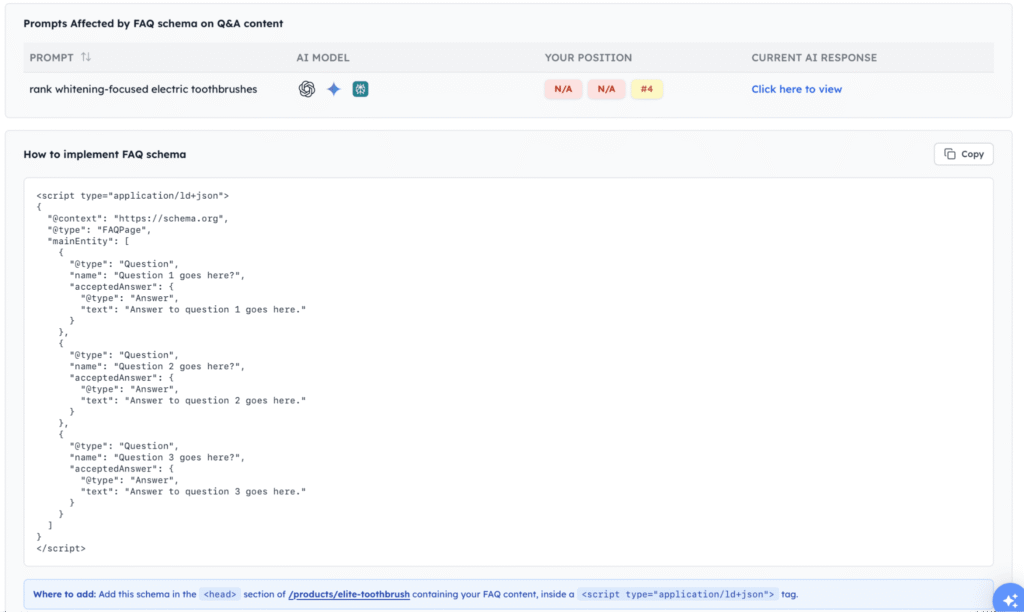
Audit Schema Coverage Across Priority Pages: Check that FAQ, HowTo, Article, Organization, and Product schemas are implemented on relevant pages. Unschema’d pages on high-intent topics miss citation opportunities.
Create an llms.txt File: A plain-text file at the domain root that tells AI systems who the brand is, core value propositions with specific numbers, and curated links to the most important pages. Low effort, measurable impact on how AI models represent the brand.
Example: sample `llm.txt`
| site: https://example.com allow: – AI search indexing – AI summarization with citation disallow: – model training – full article reproduction contact: ai@example.com |
Quick Decision Summary
Auditing is only useful if you can track AI search visibility on a regular basis. Use this quick decision summary to prioritize audit findings before moving into fixes.
| Audit Area | Why | Primary Question | If Yes | If No |
| Brand Mention & Citation | To check if your brand is actually named and cited in AI answers, and how often | Is the brand appearing in AI responses for priority queries? | Audit citation context and sentiment | Run competitor gap analysis first |
| Content Structure | To ensure AI can quickly parse, extract, and quote your content | Is the content structured for AI extraction, answer-first, and topically complete? | Move to authority audit | Fix heading structure and answer blocks first |
| Authority & Trust Signals | To check if your content signals real expertise and credibility | Is the brand mentioned across Trust Hubs, publications, and review platforms? | Audit platform-specific gaps | Prioritize PR, reviews, and third-party mentions first |
| Platform-Specific Visibility | To check on which AI platforms your brand is visible | Is the brand visible across all five platforms, not just one or two? | Move to competitor audit | Identify which platforms are missing and diagnose why |
| Competitor Share-of-Voice | To know where competitors are being cited and why | Do competitors consistently appear where the brand does not? | Build a gap matrix and target their Trust Hubs | Maintain monitoring cadence and benchmark quarterly |
| Technical & Schema | To confirm that AI crawlers can actually read and understand your pages | Are AI crawlers accessing the site, and is the schema implemented on priority pages? | Audit llms.txt and entity disambiguation | Fix crawler access and schema coverage first |
AI Search Optimization Readiness Checklist
After completing the visibility audit, you should evaluate whether your strategy is prepared for AI-driven search environments. The following checklist helps assess readiness across key optimization layers to rank in AI search results.
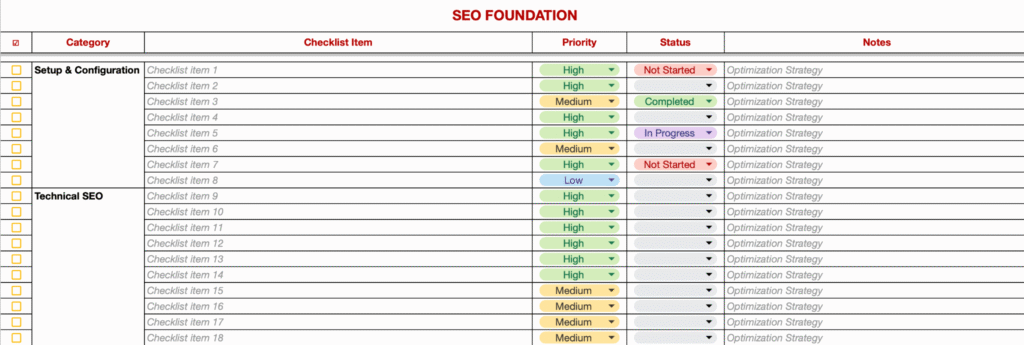
1. Build the Base Layer with SEO Foundation
Without a solid SEO foundation, AI platforms struggle to crawl, index, and extract content reliably. Auditing this layer ensures the site has a structurally sound foundation before you layer any AEO or GEO optimization on top.
Checklist item:
- HTML sitemap created and linked in footer
- Image compression enabled across all pages
- Core Web Vitals pass threshold across all priority pages
- Canonical tags implemented correctly with no conflicting signals
- Internal linking reflects topical cluster structure across all key content areas
2. Structure Content for Direct Answers with AEO Readiness
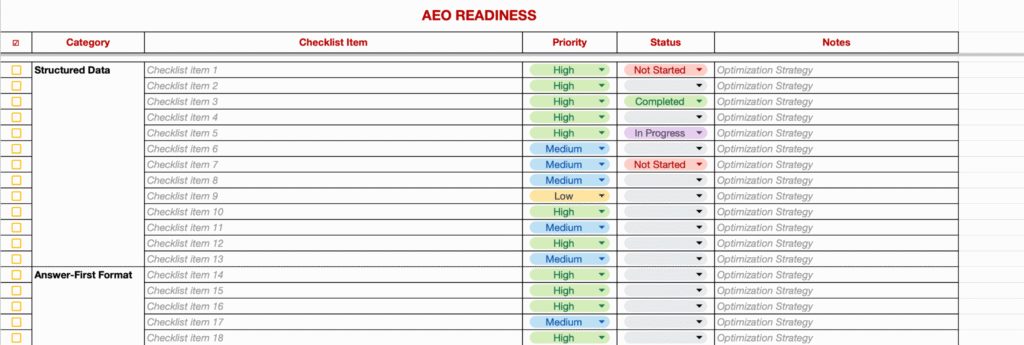
Answer Engine Optimization determines whether answer engines extract and cite content as a direct response. Auditing AEO readiness identifies where content structure, schema, and formatting are failing to meet the extraction standards AI platforms expect.
Checklist item:
- FAQ sections exist on key landing pages
- Comparison tables used for product and service comparisons
- FAQ, HowTo, and Article schema implemented and validated on priority pages
- Heading hierarchy follows a logical, question-answering structure across all key pages
- Publication dates and last-updated timestamps visible and accurate on all key pages
3. Build Generative AI Visibility with GEO Readiness
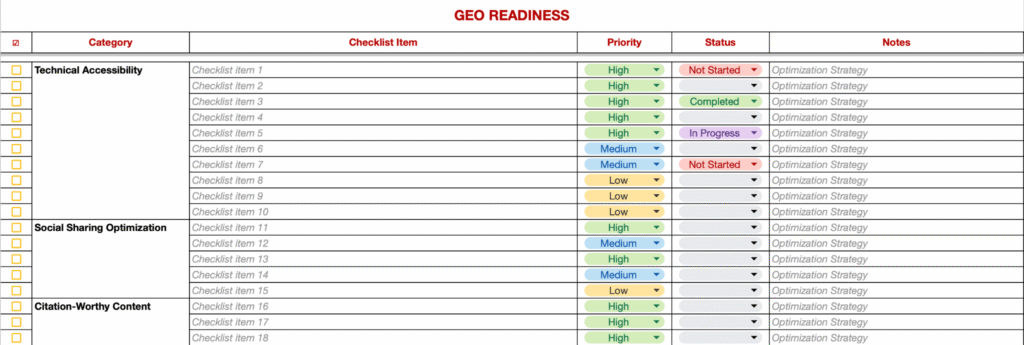
Generative Engine Optimization goes beyond the website and focuses on how the brand presents itself across the entire web. Auditing GEO readiness surfaces gaps in third-party authority, entity consistency, and the trust signals AI models rely on when forming recommendations.
Checklist item:
- Author bios link to consistent profiles across all published content
- Person schema implemented for all authors
- Brand mentioned across at least 3–5 Trust Hubs relevant to the category
- llms.txt file exists at the domain root with an accurate brand description and curated page links
- Brand name, description, and positioning consistent across website, LinkedIn, Crunchbase, G2, and Wikipedia
4. Capture Location-Based AI Queries with Local SEO
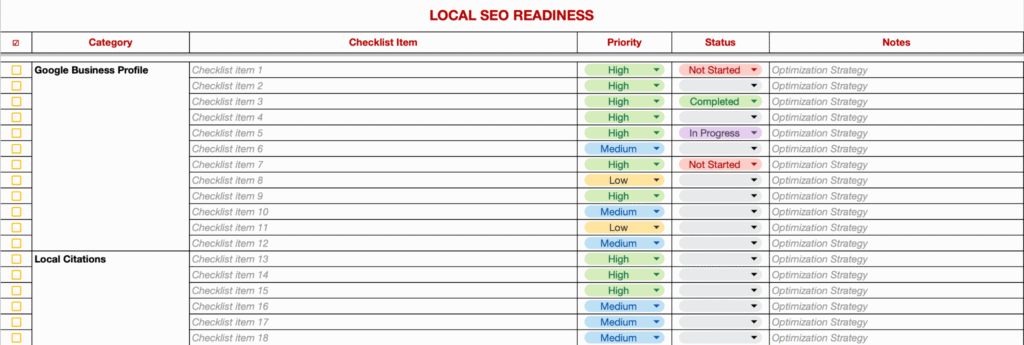
Local signals increasingly influence AI-generated responses for location-based and near-me queries. Auditing local SEO ensures the brand surfaces accurately in AI platforms that pull from Google Business Profile, local citations, and review platforms.
Checklist item:
- Google Business Profile is complete, accurate, and actively maintained
- Listed on industry-specific directories relevant to the category
- LocalBusiness schema implemented on all location pages
- Review volume and recency meet competitive benchmarks on Google, G2, and Trustpilot
- Location-based AI queries tested across ChatGPT, Perplexity, and Google AI Overviews
5. Monitoring to Measure What Is Actually Working
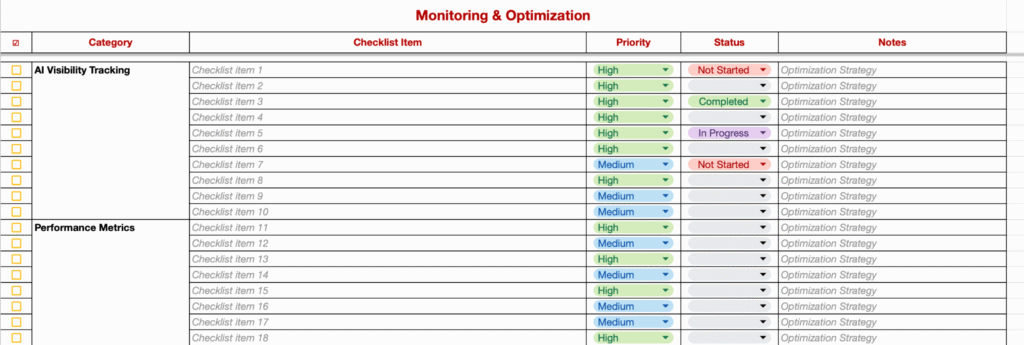
AI visibility without measurement is optimization without direction. Auditing the monitoring infrastructure confirms whether the system tracks the right queries, platforms, and competitors and captures changes in visibility over time.
Checklist item:
- All five platforms tracked: ChatGPT, Perplexity, Claude, Gemini, and Google AI Overviews
- Competitor content analyzed to identify citation patterns and content gaps
- Best practices documented and updated as platform behavior evolves
- Visibility trends reviewed quarter-over-quarter to measure optimization impact
- Competitor share-of-voice included in the monitoring workflow
 Pro Tip: Setting up a monitoring workflow raises an immediate question: What does AI visibility actually look like for the brand right now? Run this quick audit and get your free AI visibility report, which helps you to start with your monitoring strategy.
Conclusion
AI search visibility is no longer a passive outcome of good SEO. Structured content, consistent authority signals, and a clear understanding of how each platform retrieves and cites information earn it.
The six audit layers in the Core Framework address every dimension of that equation: from the technical foundation that supports AI crawlers, to the third-party trust signals that influence whether AI systems cite or ignore a brand. The five-layer readiness checklist then tells you whether your optimization strategy is positioned to act on those findings.
Start with the Brand Mention and Citation Audit to establish the baseline, then work through each layer in order: SEO foundation, AEO readiness, GEO signals, local visibility, and monitoring infrastructure.For a structured walkthrough of all audit dimensions, download the AEO GEO audit checklist and know your AI readiness score.
Frequently Ask Questions
A traditional SEO audit focuses on rankings, keywords, and backlinks. An AI search audit evaluates citations, entity recognition, content extractability, and visibility across AI-generated answers.
Structure your content with clear answer blocks, data points, expert insights, and lists. Content that is concise, authoritative, and easy to extract has a higher chance of being cited.
AI systems commonly extract definitions, step-by-step guides, comparison tables, statistics, and concise explanations. Structured content makes it easier for AI models to summarize and cite.
AI systems prioritize authority, clarity, and consensus across sources rather than just rankings. Competitors with stronger entity signals or citation-ready content may be selected instead.
Conduct an audit periodically, especially after publishing new content or when major AI search updates occur. Regular monitoring helps identify visibility gaps and emerging opportunities.