


Search visibility today is built on credibility. Google’s algorithms have grown sophisticated enough to distinguish between content that demonstrates real-world experience and content that merely simulates it, and that distinction now determines what ranks, what surfaces in AI Overviews, and what earns citations across platforms like ChatGPT, Gemini, Claude, and Perplexity.
The E-E-A-T framework: Experience, Expertise, Authoritativeness, and Trustworthiness is Google’s quality standard for making that call. For marketing teams, SEO strategists, and brand managers, it has shifted from a background consideration to an active optimization discipline.
This guide breaks down the E-E-A-T checklist, explains what each signal requires in practice, and maps the actions brands can take to build the kind of authority that performs across both traditional and AI search.
TL;DR
- E-E-A-T stands for Experience, Expertise, Authoritativeness, and Trustworthiness, Google’s standard for evaluating content credibility across both search and AI platforms.
- Google’s core updates extended E-E-A-T scrutiny beyond YMYL to all content types, making author credentials and original research a baseline requirement.
- Strong E-E-A-T signals directly improve citation eligibility across ChatGPT, Perplexity, Gemini, and Google AI Overviews, not just traditional search rankings.
- Trust is the anchor pillar; without transparency, accurate sourcing, and technical credibility, all other E-E-A-T signals are discounted by Google and AI retrieval systems.
- Regular audits across all signal areas, at a minimum quarterly for content and monthly for AI citation monitoring, are what keep E-E-A-T performance stable through algorithm updates.
What is E-E-A-T?
E-E-A-T stands for Experience, Expertise, Authoritativeness, and Trustworthiness. It is the framework Google uses to assess whether content is credible, accurate, and genuinely useful to the people searching for it.
Derived from Google’s Search Quality Rater Guidelines, a document human evaluators use to assess search result quality, E-E-A-T is not a direct ranking factor but a quality benchmark that informs the signals Google’s algorithms use to rank content.
| EEAT component | Definition |
| Experience | The content creator has direct, first-hand engagement with the topic. |
| Expertise | The creator possesses deep, verifiable knowledge in the subject area. |
| Authoritativeness | The brand or creator is recognised as a credible source within their niche. |
| Trustworthiness | The content and the site are accurate, transparent, and reliable. |
E-E-A-T Updates: What the Google E-E-A-T Guidelines Say?
Google’s E-E-A-T guidelines have evolved significantly. Here is how the EEAT framework has developed from its origins to today.
- December 2022: Added “Experience” to E-A-T, forming E-E-A-T; stresses first-hand knowledge for all content, especially YMYL.
- Feb 2023: Rewards reviews with genuine experience/expertise; aligns with new E-E-A-T signals like testing details.
- March 2024: Integrates helpful content system into core rankings; reduces unhelpful/low-E-E-A-T results by large margins.
- Dec 2025: Extends E-E-A-T beyond YMYL to all competitive niches (e.g., reviews, SaaS); demands author credentials, original research.
- March 2026: Tightens E-E-A-T checks with AI detection, authorship focus; volatile shifts reward strong signals.
Ongoing refinements via Quality Rater Guideline docs emphasize trustworthiness as foundational, with 2026 focusing on AI-proof authenticity.
The E-E-A-T Checklist: Experience Signals
Experience is the most recently added pillar of the E-E-A-T framework and arguably the hardest to fake. It requires content that reflects genuine, first-hand engagement with the topic rather than repackaged research or AI-generated summaries, especially when LLM models generate answers by prioritizing personal testing, specific timelines, and measurable outcomes over fabricated narratives.
1. Demonstrate First-Hand Experience
First-hand experience signals to Google that your insights come from real-world application, which matters in 2026 as algorithms prioritize authentic voices amid AI-generated content.
Use “I” statements with specific, verifiable details: timelines, challenges, metrics from your actual work. Link to author bios that showcase real SEO or e-commerce projects. Avoid vague claims. Quantify your efforts (“tested across 15 campaigns”) rather than gesturing at expertise. Embed this naturally throughout, especially in intros and conclusions, so there is a coherent personal narrative that quality raters can trace.
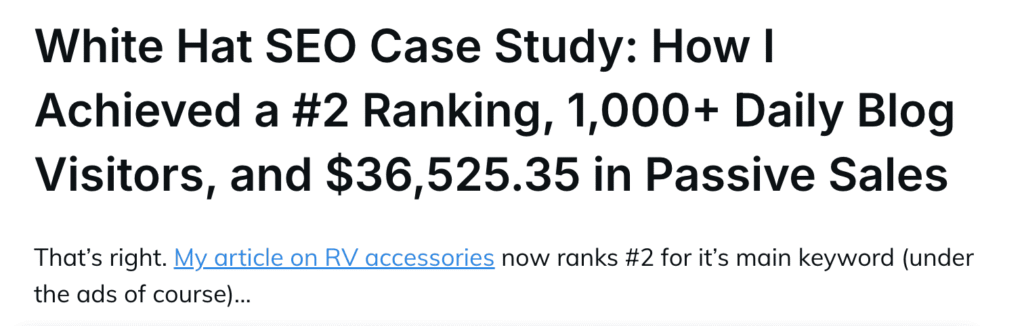
Example: A case study written from personal experience: “How I achieved a #2 ranking, 1000+ daily blog visitors, and $36, 525.35 in passive sales”
2. Include Original Visuals and Screenshots
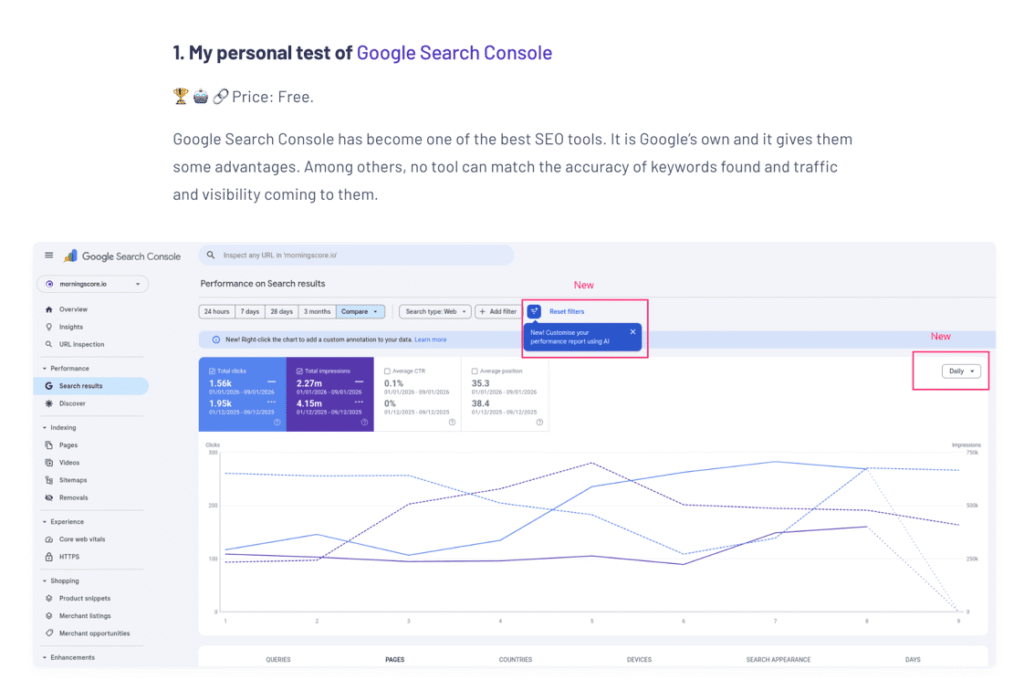
Original visuals and screenshots are among the clearest differentiators between content that earns citations and content that gets passed over. AI-generated content alone cannot match the authenticity that an unedited screenshot from your own tools conveys.
Capture screenshots from your tools directly. Annotate with branded callouts to highlight key metrics. Avoid stock photos, and always credit your own work (“Screenshot from my campaign, March 2026”). As part of any content strategy optimized for AI answers, original visual evidence has moved from nice-to-have to non-negotiable.
Example: A blog post with screenshots and annotated callouts: “My personal test of Google Search Console”
3. Publish Case Studies and Real Outcomes
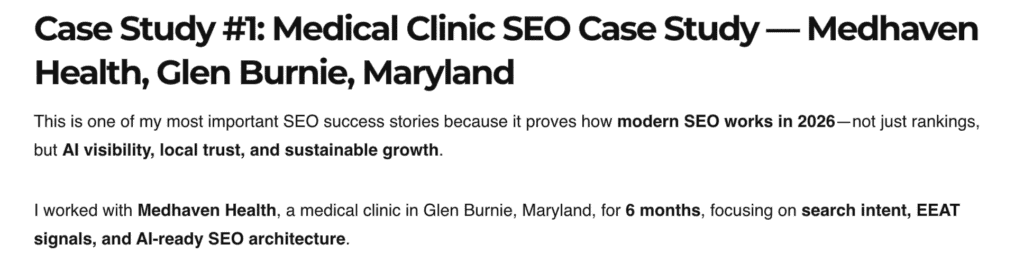
Case studies and real outcomes anchor E-E-A-T’s experience pillar by transforming claims into evidence-based narratives, proving tangible impact from your strategies as Google’s update favors content with authoritative sources over hypotheticals.
Structure chronologically: Problem (“Traffic dropped 40% post-update”) → Actions ( A/B tests, content changes) → Results (metrics with charts) → Lessons.
Anonymize client data where needed, but include timelines, tools used, and raw metrics. Publish as standalone pages or embeds, linking back to main content for SEO flow, update annually for freshness.
Example: A case study success story backed with experience: “SEO Case Studies 2026: Real Success Stories That Work”
4. Source Data from Primary Research
Primary research elevates E-E-A-T’s experience signals because it provides original, unfiltered insights. Google’s algorithms detect and discount aggregated or AI-generated content that lacks original data.
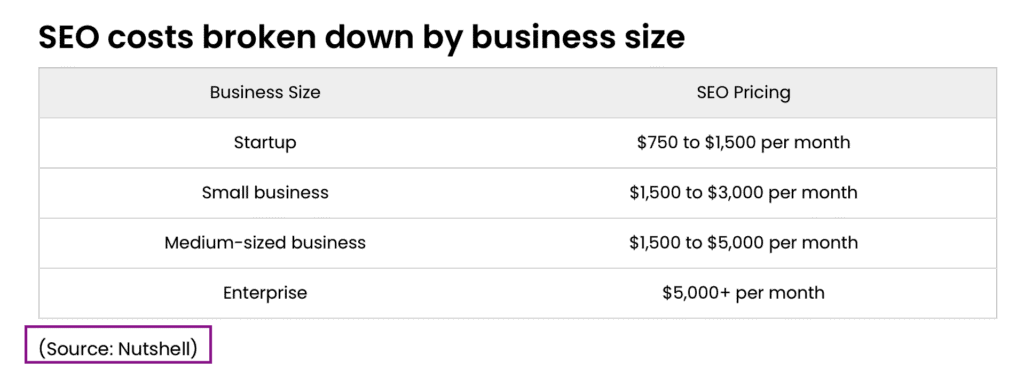
Run your own experiments: surveys via Google Forms, analytics exports, Python-scraped trends. Document methodology clearly. Present raw findings first (tables, CSVs) before analysis. Cite as “Our Q1 2026 study of 50 e-stores” with downloadable artifacts.
Example: A blog post mentioning SEO cost analysis with a source mentioned.
 Pro Tip: Curious about how AI search is actually performing across platforms in 2026? Explore this AI search statistics data, which breaks down the numbers behind AI citation trends, platform growth, and what the data reveals about where brand visibility is shifting.
The E-E-A-T Checklist: Expertise Signals
Expertise signals communicate that your content comes from a source with verifiable, deep knowledge in the subject area. As AI platforms increasingly evaluate author credentials and content depth before selecting citation sources, expertise is a direct visibility strategy, not just a credibility badge.
5. Showcase Author Credentials
Author credentials form the backbone of E-E-A-T’s expertise pillar as per Google quality rater guidelines, directly signaling to Google that your content quality reflects proven knowledge rather than speculation, as quality raters and algorithms prioritize verified skills amid AI content.
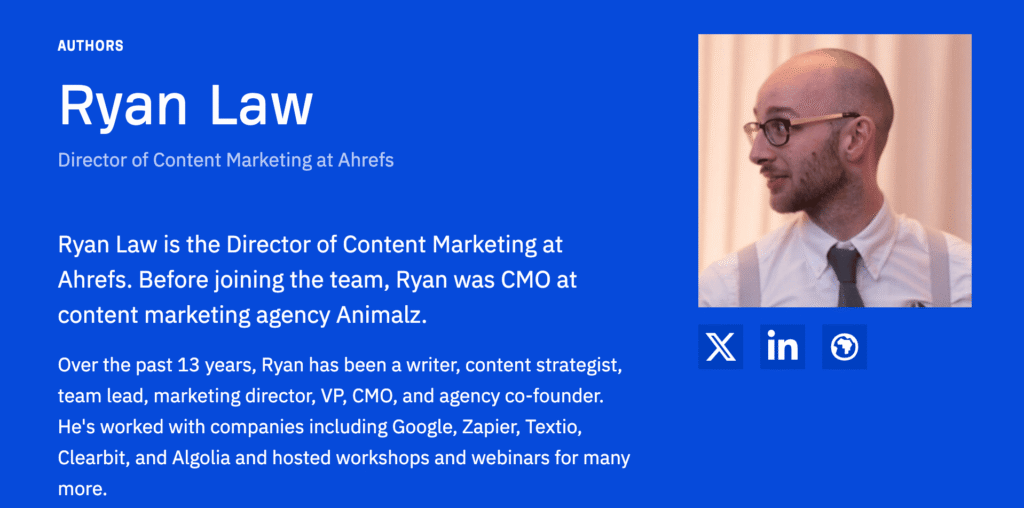
Include detailed bylines with credentials: degrees, certifications, and years in the field. Link to LinkedIn, portfolio, or publications. Embed inline via schema markup for rich snippets and keep them updated with your latest achievements.
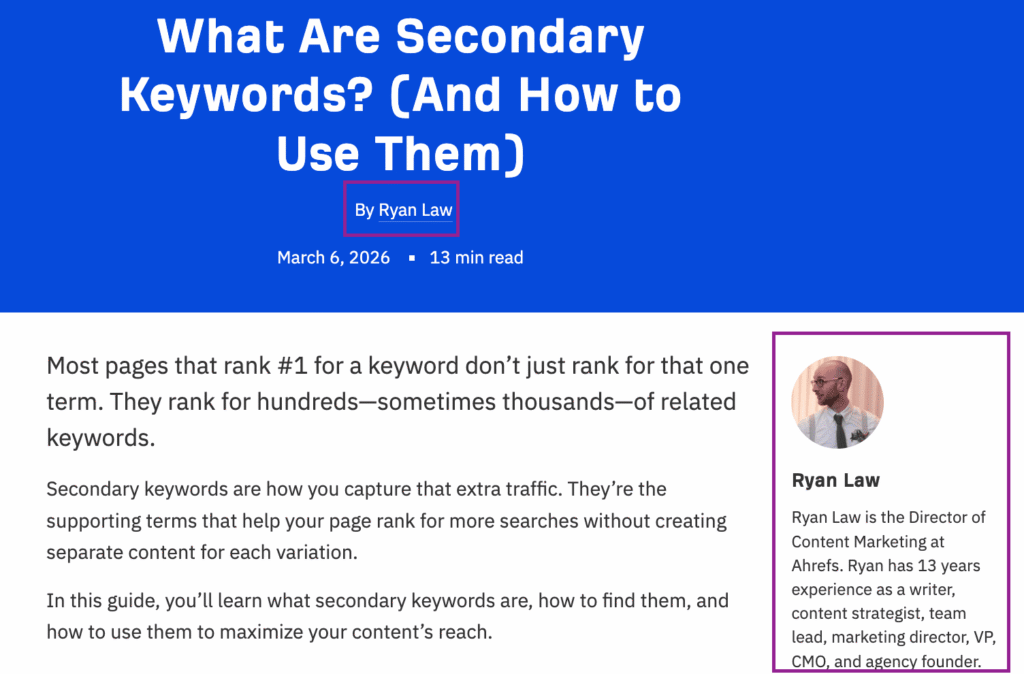
Example: “Ryan Law, Director of content marketing expertise with 13+ years of experience scaling content strategy for SaaS brands (portfolio: [link]).”
6. Add an “About the Author” Section
An “About the Author” section reinforces E-E-A-T’s expertise by humanizing content with a clear creator profile, helping Google’s quality raters confirm you’re a legitimate expert rather than an anonymous or AI source.
Place it directly below the content or in a sidebar: Include a professional photo, a 100 to 150-word bio highlighting relevant experience (years, key projects, certs), and links to LinkedIn, portfolio, and socials.
Example: A blog with author photographs and credentials gives quality raters clear evidence that the content was written by a real, qualified person.
7. Support Claims with Expert Citations
Expert citations strengthen E-E-A-T by linking your content to established authorities, showing you’ve synthesized credible sources, as Google penalizes unsubstantiated claims amid AI-generated misinformation.
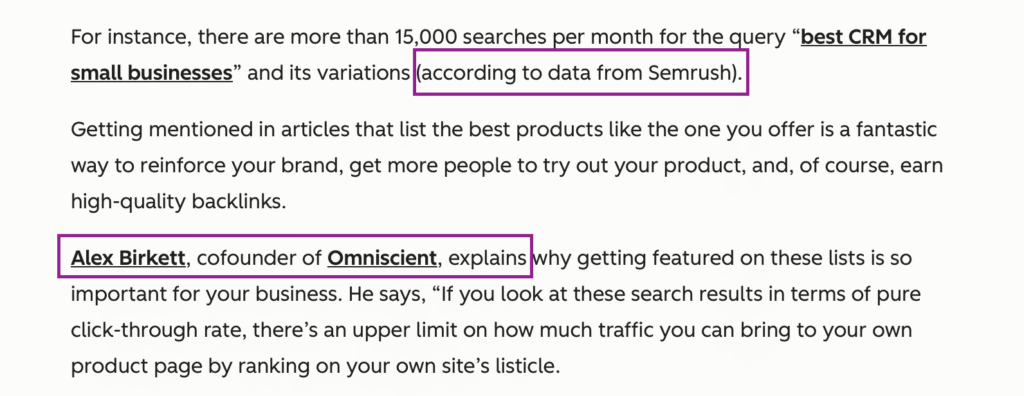
Cite studies, papers, or official documents from reputable sites (.gov, .edu, named experts) inline. Use hyperlinks with descriptive anchor text (“Google’s 2026 Quality Rater Guidelines state…”). Limit to 3 to 5 per post, prioritizing primary sources, and pair citations with your own analysis to add value.
Example: A query “best CRM for small business” backed with source and claim support with expert opinion.
8. Have Content Reviewed by Subject Matter Experts
Expert review adds a layer of professional scrutiny that assures both Google and readers that your claims hold up under peer evaluation.
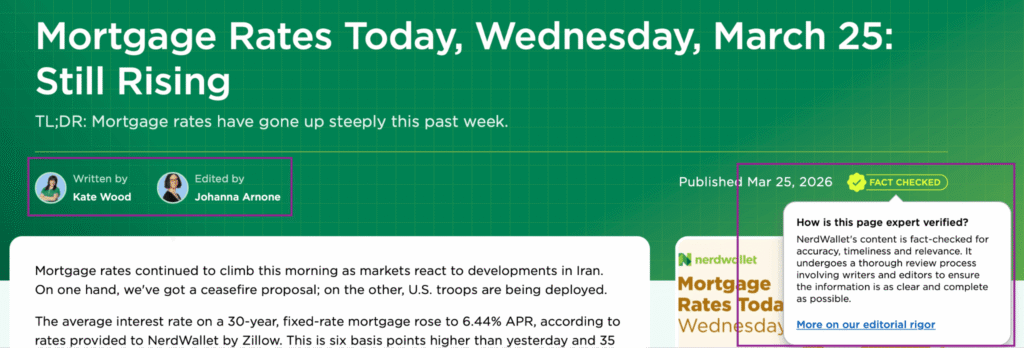
Collaborate with one or two peers in your field. Share drafts via Google Docs with tracked changes and include a sign-off quote (“Reviewed and approved by [Expert Name], 10+ years in e-commerce”). Mention in bylines or footers: “Fact-checked by certified analysts.”
Example: An article written and fact-checked by verified subject matter experts with mentioned bylines.
The E-E-A-T Checklist: Authoritativeness Signals
Authoritativeness is not self-declared; it is recognised. It is built through how the brand is treated externally: which publications reference it, which sites link to it, and how consistently it is cited as a credible source within its niche.
9. Earn Backlinks from Topically Relevant Sources
Backlinks from topically relevant sources are the core of E-E-A-T’s authoritativeness signal. They act as votes of confidence from peers in your niche, elevating your website’s authority in Google’s eyes.
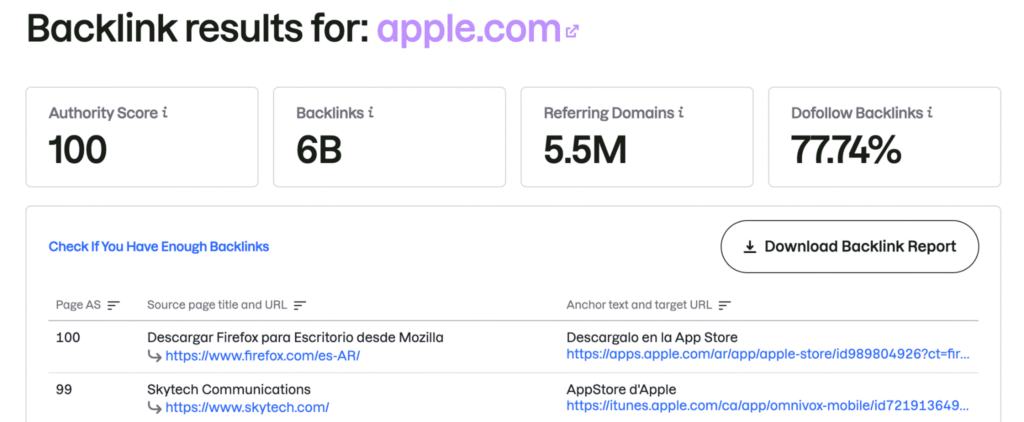
Create link-worthy assets: original research, free tools, or comprehensive guides. Guest post on aligned blogs with do-follow links. Collaborate on roundups or expert quotes. Monitor via SEO tools and prioritize mid-authority industry sites (Domain Authority 40+) and .edu or industry publication links over directories.
Example: Established sites like Apple have earned millions of backlinks from reputable, authoritative sources across the web.
10. Build Third-Party Mentions and Press Coverage
Third-party mentions and press coverage provide independent validation from reputable outlets. This matters because tracking brand mentions in AI search directly determines whether a brand is recognized as a credible source during AI retrieval, when AI platforms select citation sources.
Track My Visibility is an AI visibility tracker that helps brands monitor mentions and citation frequency across Google AI Overviews, ChatGPT, Perplexity, and Claude, while uncovering actionable insights to improve AI search visibility.
To earn third-party mentions, pitch newsworthy stories (research findings, unique campaigns) to industry publications, journalists, or PR tools. Leverage podcasts and webinars. Compile an “As Seen In” footer with logos and hyperlinks. Unlinked mentions count too, since Google tracks brand searches via its mention database.
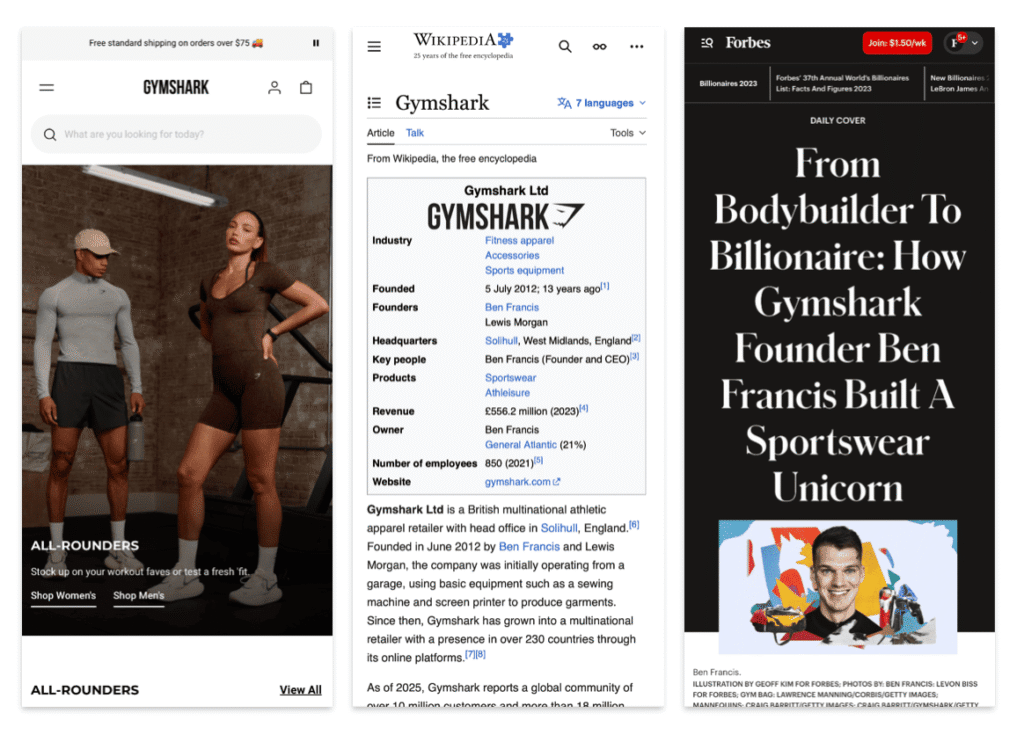
Example: A brand such as Gymshark is being mentioned on Wikipedia and Forbes.
 Pro Tip: Don’t want to lose AI visibility for your brand? See where your brand already appears in AI responses and where it doesn’t. Those gaps often reveal the biggest opportunities. Run a quick audit to check your AI visibility and see how your brand currently shows up across major AI platforms.
11. Develop Topical Authority Through Content Clusters
Content clusters build E-E-A-T’s authoritativeness by creating an interconnected ecosystem of in-depth resources around core topics, signaling to Google that you’re a comprehensive authority rather than a one-off writer. LLM prioritizes this structural topic coverage, which also helps to rank in AI search visibility.
Identify pillar content (broad guides like “E-E-A-T 2026”) and create 5 to 15 supporting cluster pieces on specific tactics. Interlink aggressively with contextual anchors. Use schema (Breadcrumb, Article) for structure; update clusters quarterly with fresh data, measured via organic traffic growth to pillars.
Example: Pillar: “AI SEO Ranking”; Clusters: “Ranking Signals,” “How to rank,” Ranking strategies”.
![Example topics under similar cluster]](https://trackmyvisibility.com/wp-content/uploads/2026/05/topical-cluster-example-1024x714.png)
12. Maintain Consistent Publishing in a Defined Niche
Consistent publishing in a defined niche cements E-E-A-T’s authoritativeness by demonstrating sustained commitment and deep domain knowledge, showing Google you’re a reliable go-to source as Google algorithms track publishing cadence and topic focus to filter out off-topic content.
- Commit to a schedule (weekly posts, monthly deep dives) on focused topics.
- Use a content calendar tied to niche trends. Promote via email lists/newsletters.
- Track via Google Analytics for session duration spikes, repurpose top performers into series for compounding effect.
Example: “Weekly newsletter of AI news on Artificial Intelligence and Machine Learning”

The E-E-A-T Checklist: Trust Signals
Trust is the anchor pillar of the E-E-A-T framework. A brand can demonstrate experience, expertise, and authority, but without the transparency, accuracy, and technical credibility that trust requires, Google’s algorithms and AI platforms will discount the rest.
Brands that consistently demonstrate trust signals across their content are also more likely to meet the credibility threshold when measuring their search visibility in AI content.
Trust signals span both on-site technical elements and content-level transparency, making them the most operationally broad pillar of the E-E-A-T checklist to audit and maintain.
13. Secure the Site with HTTPS
HTTPS encryption is a foundational trust signal in E-E-A-T, assuring Google and users that data transmissions are protected from interception as browsers flag HTTP sites, algorithms demote insecure pages, and quality raters explicitly check for it.
- Install a valid SSL certificate or hosting provider; force HTTPS redirects in .htaccess/CMS settings.
- Verify with SSL Labs test (aim for A+ grade); display padlock icons and “Secure” badges.
- Renew auto before expiry, monitor via Google Search Console for mixed content errors.
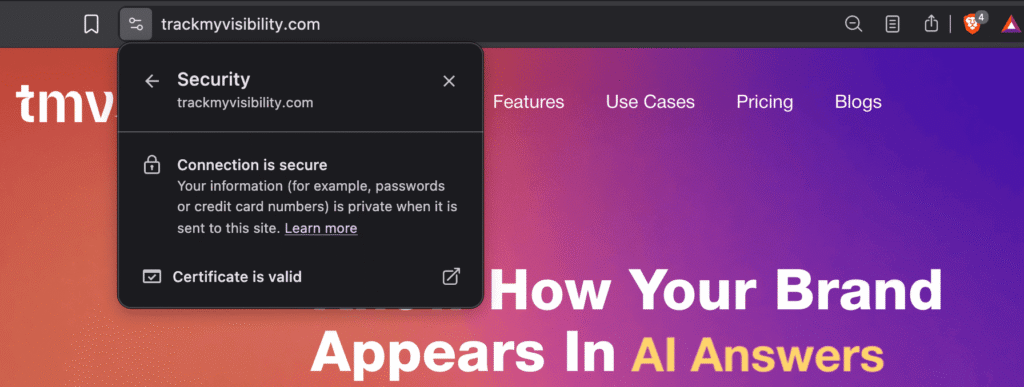
Example: The site shows secure connections and valid certificates.
14. Implement Author and Organization Schema
Author and Organization schema markup enhances E-E-A-T’s trustworthiness by providing structured data that helps Google explicitly connect content to verified entities, making your expertise machine-readable as rich results and AI overviews favor marked-up sites.
Add JSON-LD schema to page headers: Person schema for authors (name, bio, sameAs links to socials) and Organization for sites (name, logo, contact). Use Google’s Structured Data Testing Tool to validate; implement site-wide via plugins or functions.php. Tie the author to posts via ‘rel=” author”’ and ‘aggregateRating’ for social proof.
Example:
| { “@context”: “https://schema.org”, “@type”: “Person”, “name”: “Jean Dawn”, “jobTitle”: “Digital Marketing Specialist”, “url”: “https://yoursite.com/author/jean”, “sameAs”: [“https://linkedin.com/in/jean”] } |
15. Collect and Display Third-Party Reviews
Third-party reviews offer unbiased social proof from real users. Google aggregates review signals for ranking in Google AI Overviews, so this is not just a conversion tool.
Gather reviews via Google Business Profile, Trustpilot, or G2. Embed star ratings and widgets with schema (Review/AggregateRating). Display selectively in sidebars or footers with reviewer quotes and dates. Respond publicly to all feedback.
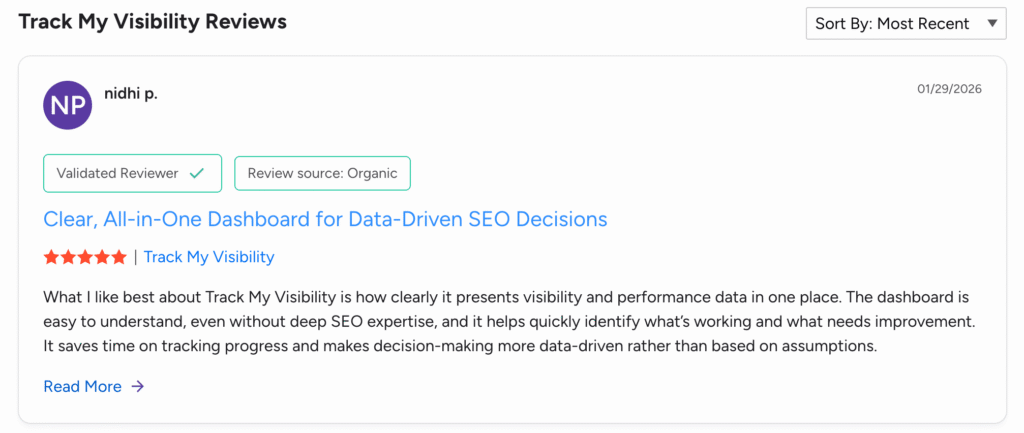
Example: G2 review: “Clear, All-in-one Dashboard for SEO Decisions” – Verified User, January 2026.
16. Establish a Clear Editorial and Corrections Policy
An editorial and corrections policy shows Google and users that you proactively maintain accuracy standards rather than ignoring errors.
Create a dedicated “/editorial-policy” page outlining your process: sourcing standards, fact-checking steps, disclosure rules, and correction procedures (e.g., “Errors updated within 48 hours with notices”). Log changes with “Updated [date]: Clarified [Z] based on new data.” Enforce via team checklists for every published post.
Example: Nerdwallet editorial guideline: “The editorial team at NerdWallet is committed to giving you accurate information and ideas for clear next steps in a way that helps and inspires all readers.”

How to Audit Your E-E-A-T Signals
Auditing your E-E-A-T signals turns vague content quality guesses into actionable fixes, which directly affects rankings and AI citations. The checklist below maps each signal area to audit actions, giving teams a repeatable framework to identify gaps, prioritize fixes, and track improvement over time.
Pairing the audit with ongoing AI search visibility tracking ensures that signal improvements are measured against real citation data, not just assumed to be working.
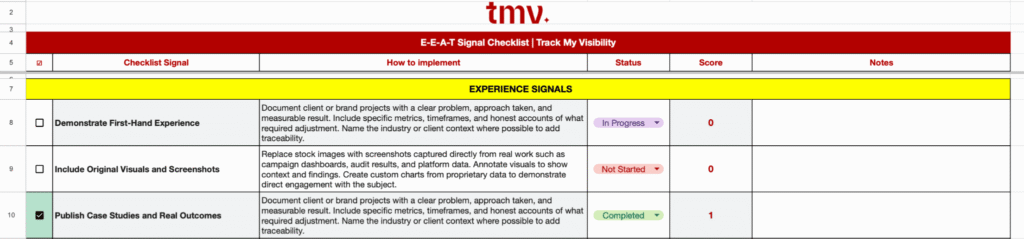
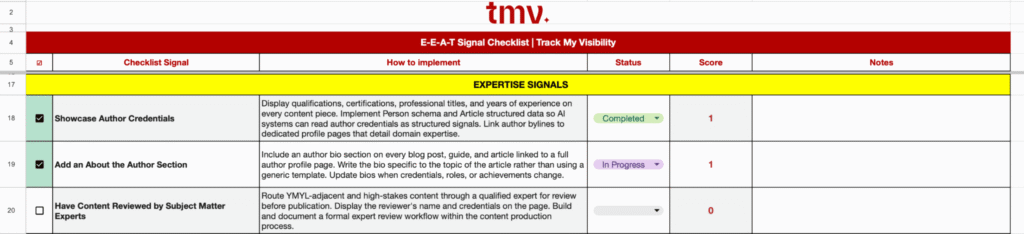
1. Audit Experience Signals
Experience is the newest pillar Google added in 2022, and it is the one most content teams underinvest in. Weak experience signals mean instant demotion by quality raters and algorithms. Fixing them delivers visibility gains and AI Overview citations.
Checklist:
- All published content carries named authorship with a first-hand perspective
- Original visuals and brand-created screenshots are present on all topic-specific pages
- Case studies published with specific metrics, timeframes, and campaign context
- Data-driven content references primary research rather than third-party statistics only
- Author attributions link to full profile pages detailing direct subject matter experience
2. Evaluate Expertise Signals
Auditing expertise signals confirm whether Google views you as a credible authority rather than a hobbyist. Credentials directly influence YMYL rankings and AI source selection. Missing bios, citations, or peer review make content look AI-generated and reduce trust scores.
Checklist:
- Author credentials, qualifications, and professional titles displayed on every content piece
- Dedicated author profile pages live and are linked from all published content
- Key claims supported by citations from credible external sources with direct links
- Content covers topics comprehensively with follow-on questions addressed within the same page
- Proprietary guides, frameworks, or methodologies published as standalone citable resources
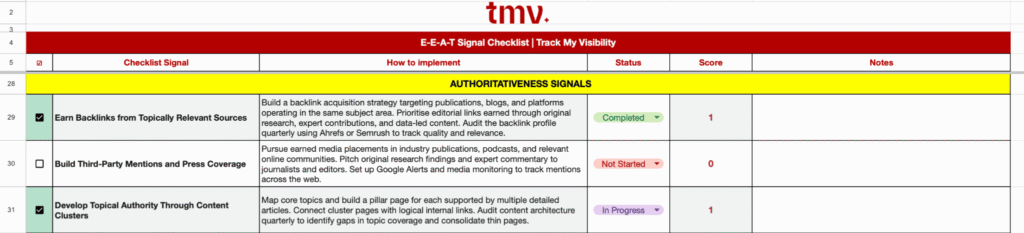
3. Analyze Authority Signals
Authority signals prove to Google that you are a recognized source in your niche. Third-party validation drives most topical authority scores in ranking algorithms. Weak backlinks or scattered publishing dilute entity recognition, while strong clusters signal dominance to AI platforms, too.
Checklist:
- Backlink profile audited for topical relevance and domain authority
- Editorial links earned from industry-relevant publications, blogs, and media outlets
- Brand mentioned and cited across third-party platforms, podcasts, and online communities
- Content organised into topic clusters with a clear pillar page and supporting articles
- Key authors maintain active, authoritative profiles on LinkedIn and relevant industry platforms
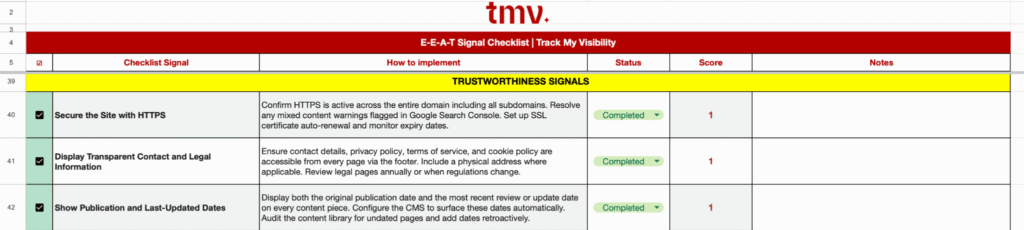
4. Review Trust Signals
Trust signals form E-E-A-T’s foundation; without them, even a perfect experience/expertise gets ignored by Google raters and AI platforms. Valid HTTPS, schema, or transparency policies trigger instant credibility flags, signaling rich results and citations. This final audit confirms your site feels professional and secure to both algorithms and users.
Checklist:
- HTTPS active and verified across the entire domain, including all subdomains
- Contact details, privacy policy, terms of service, and cookie policy accessible from every page
- Publication date and last-updated date displayed on every content piece
- Author and Organization schema implemented and validated across all key pages
- Editorial and corrections policy published and referenced in content footers
5. Monitor and Measure E-E-A-T Performance
Tracking E-E-A-T performance turns subjective quality guesses into data-driven decisions, revealing which signals drive rankings, traffic, and AI citations in real time.
Checklist:
- Trust and technical signals reviewed and corrected on a bi-annual schedule
- Backlink profile and third-party mention growth tracked quarterly
- Schema implementation re-validated after every site migration or CMS update
- High-value content refreshed and performance reviewed every 90 days
- Audit trust and technical signals regularly every six months
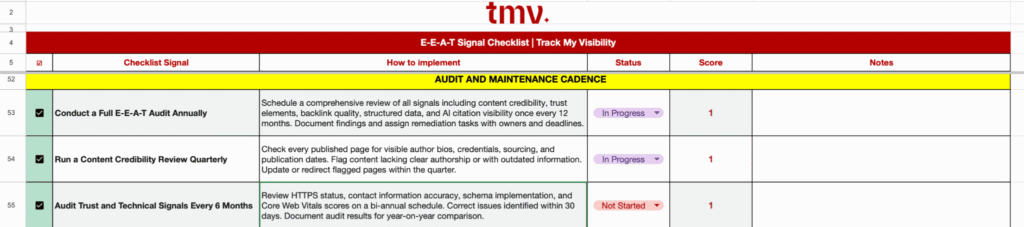
For a complete audit across all four signal areas, use the TMV Google E-E-A-T Audit Checklist covering all 40 signal items with performance rating to track improvement over time.
Pro Tip: E-E-A-T auditing covers the credibility foundation, but visibility across AI platforms requires a broader optimisation framework. The AEO and GEO audit checklist extends the audit across answer engine and generative engine signals, giving a complete picture of AI readiness beyond E-E-A-T alone.EEAT Beyond Google: How AI Platforms Use the Same Signals
E-E-A-T signals extend beyond Google to AI platforms like ChatGPT, Perplexity, Claude, and Gemini, which prioritize the same quality markers for citations and responses.
These systems evaluate content using identical pillars: firsthand Experience (personal anecdotes), Expertise (credentials/citations), Authoritativeness (mentions/backlinks), and Trustworthiness (transparency/schema).
Google’s AI Overviews pull sources from the top 10 results, inheriting E-E-A-T via rankings, while others scan directly for entity clarity, structured data, and verifiable claims, favoring content with author bios, primary data, and press.
Strong E-E-A-T ensures citation eligibility across SEO, AEO and GEO, and LLMO in AI-driven ecosystems.
Platforms filter low-signal content, amplifying trusted voices; focus on schema, founder POV, and frequent updates for multi-platform dominance.
Conclusion
E-E-A-T is no longer a background consideration for the ranking system; it is the foundation on which both Google rankings and AI search visibility are built. Brands that consistently demonstrate Experience, Expertise, Authoritativeness, and Trustworthiness are more likely to rank in traditional search results as well as in the sources AI platforms select when generating answers and citations.
The E-E-A-T signal areas covered in this guide address it, from first-hand experience and author credentials, to off-site authority, technical trust signals, and AI-specific content structure. Auditing these signals on a structured, recurring basis helps brands maintain visibility through algorithm updates.
Start with a content credibility review, check authorship, sourcing, and publication dates across the most trafficked pages. Identify the highest-priority gaps using the signal sections in this guide and address them in order of impact.
Try our 7-day trial to know where your content gets credibility across major AI platforms.
Frequently Asked Questions
Use a structured checklist to audit experience, expertise, authority, and trust signals. Review content quality, author credibility, and site transparency.
Start with trust and expertise, clear author information, accurate content, and transparent policies, then strengthen authority and experience signals.
Add first-hand insights, showcase author credentials, earn quality backlinks, and keep content updated with accurate, well-structured information.
It’s not a direct ranking factor, but it strongly influences visibility. Higher E-E-A-T increases trust, rankings, and chances of being cited by AI systems.
Conduct audits quarterly or after major updates. Regular reviews help maintain accuracy, trust, and competitive visibility. Tools like Track My Visibility help track which content gets cited to see where to begin the EEAT audit.