


Search is no longer just about links and rankings. The digital discovery journey is rapidly shifting from traditional search engines to AI-generated answers.
Instead of clicking through results, your customer now reads a single synthesized answer. When a buyer asks an AI tool, “What’s the best email marketing platform?”, the answer arrives in seconds with no traffic to anyone’s website. The brands inside that answer enter the consideration set. The brands left out simply don’t exist for that buyer.
Smart brands are now asking one question: “Is our brand visible to AI?”
AI citation tracking is how you answer that question. It’s the practice of monitoring when, where, and how AI platforms mention your brand, cite your content, or recommend your products. Without a way to track AI visibility systematically, you’re marketing blind in the fastest-growing channel for customer research.
This guide covers:
- What AI citation tracking is
- Types of content AI models choose to cite
- How AI citation tracking works
- The advantages of tracking citations early
TL;DR
- AI platforms are answering customer questions without sending traffic to websites. AI citation tracking monitors when and how these platforms mention your brand in their generated answers.
- Unlike traditional SEO that tracks rankings and clicks, AI citation tracking measures inclusion, positioning, and share of voice inside AI-generated responses, revealing whether your brand appears when customers ask for recommendations.
- Structured and well-organized information, frequently updated data, authoritative sources with original research, and query-aligned content that directly answers specific questions are more likely to get cited.
- Two tracking methods: Manual tracking helps with tracking with sheets and a manual track record, while Automated tracking helps monitor with easy integration and real-time updates.
- Without tracking, brands could lose months of visibility before noticing declining awareness while competitors quietly dominate the AI answers shaping buyer decisions.
What is AI Citation Tracking
AI citation tracking is the process of monitoring and measuring when AI platforms mention your brand, reference your content, or recommend your products inside their AI-generated answers.
In traditional SEO, you track rankings and clicks. In AI citation tracking, you track whether you’re part of the conversation when potential customers ask AI tools for advice or recommendations.
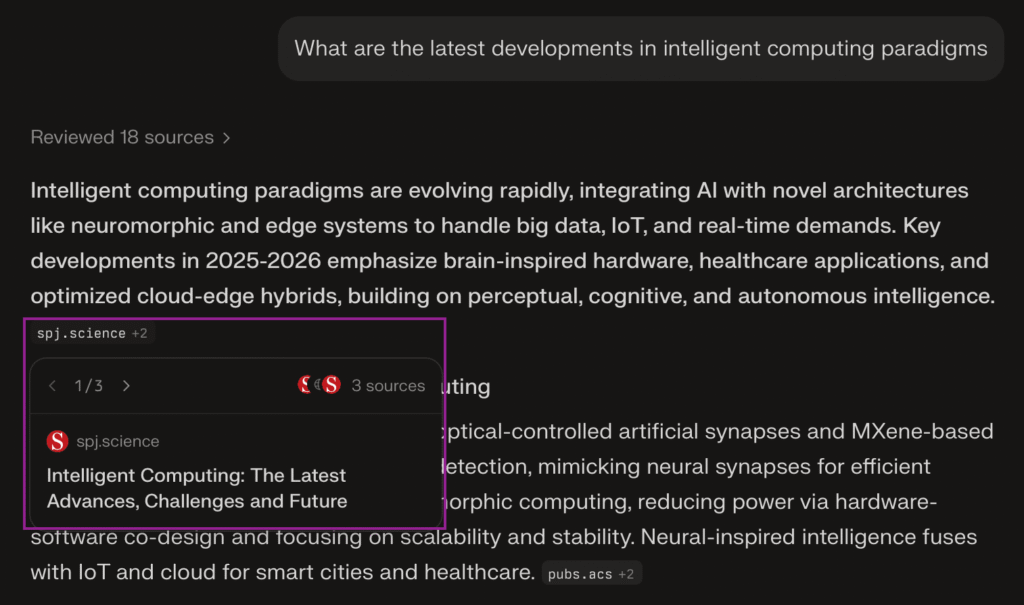
Here’s a concrete example. When a user searches Perplexity for “What are the latest developments in intelligent computing paradigms?” it synthesizes an answer by pulling from multiple sources. AI citation tracking reveals whether your content was selected as one of those sources, how prominently it was featured, and how it appeared next to competitor content.
Let’s look at the key components.
1. Brand Mentions in AI Responses
The most fundamental metric: does the brand appear in AI-generated answers at all? Beyond simple presence, this measures citation frequency across queries and whether the brand is referenced as a primary source or a supporting mention.
2. Source-Level Citations and Linked References
AI platforms sometimes provide clickable links to specific pages, blog posts, product pages, and research reports, which drive direct referral traffic and signal stronger authority. This component tracks whether citations include attribution links or remain text-only mentions, and whether third-party sources are citing the brand instead of the platform citing it directly.
3. Query-Level Tracking
AI visibility varies dramatically by query type. Your brand might dominate informational queries like “What is marketing automation?” but stay invisible in high-intent commercial searches like “Best marketing automation for B2B SaaS.”
Query-level tracking identifies which keywords, questions, and search intents trigger brand citations and which represent visibility gaps.
4. Competitor Citation Analysis
This measures the share of voice. How often is your brand cited compared to competitors across tracked queries? Who dominates specific topics or product categories? Where do competitive gaps exist?
5. Context and Positioning
Context tracking captures how your brand is framed: positively, neutrally, or comparatively. It also captures whether you appear in curated lists like “top tools” or “best solutions,” which directly influence buyer perception.
6. Platform-Specific Tracking
Different AI platforms behave differently. Platform-specific tracking monitors performance across Google AI Overviews, ChatGPT, Perplexity, Gemini, and other major systems. The goal is to know exactly where your visibility is strong and where it needs work.
How AI Citation Tracking Is Different from Traditional SEO Tracking
Understanding how AI search is different from SEO is critical here. AI citation tracking is a different measurement strategy from the ground up. The metrics that mattered in traditional SEO, including rankings, clicks, and traffic, don’t carry over cleanly.
→ Traditional SEO:
Traditional SEO has always been about one thing: driving traffic to a website. Content is optimized to rank higher, earn more clicks, and convert visitors into customers.
Keyword rankings tell you where you stand for specific search terms. Whether a site sits third or sixth for “best CRM software” informs your strategic adjustments.
SERP position drives visibility. Ranking first gets more clicks. Ranking tenth gets fewer. Every position matters because it directly shapes traffic volume.
Click-through rates measure how compelling title tags and meta descriptions are. A 5% CTR means 95% of searchers saw your listing and kept scrolling.
Ranking comparisons reveal where competitors outrank you, exposing content gaps and opportunities to capture traffic.
→ AI Tracking:
AI citation is not about driving clicks to a website; it’s about being the answer AI platforms trust and recommend in AI search results.
AI mentions are your new currency. When a customer asks Perplexity, “What’s the best inventory management system for Shopify?”, the brands that appear in the AI answer have already shaped the customer’s consideration set. Whether the buyer clicks through to any website is almost beside the point.
Inclusion matters more than position. In traditional search, ranking fifth is clearly worse than ranking first. With AI citations, being mentioned alongside two competitors might be more valuable than ranking first in a SERP.
Trust and authority become visible metrics. Traditional SEO measures authority through domain metrics and backlinks. AI citation tracking shows you something more direct: how often AI platforms consider your brand authoritative enough to cite. When Claude references your research, or ChatGPT recommends your product, that’s algorithmic validation of expertise.
Citation comparisons reveal share of voice, not just share of rankings. Instead of “third place for this keyword,” you measure “40% presence in AI responses about project management software, compared to competitors’ 25%.” That number captures how often your brand actually participates in buying conversations.
Summary: Traditional SEO Tracking vs AI Citation Tracking
| Aspect | Traditional SEO Tracking | AI Citation Tracking |
| Primary Focus | Ranking in search engine results | Inclusion in AI-generated answers |
| Core Metric | Keyword position | Brand/content mention in AI responses |
| Visibility Model | 10 URL links (SERP-based) | Single synthesized answer with limited citations |
| Click Measurement | Click-Through Rate (CTR) | Citation presence & referral potential |
| Competitive Analysis | Ranking comparison | Citation share comparison |
| Positioning Logic | Position 1st vs 5th matters | No positions, inclusion vs exclusion |
| Authority Signal | Backlinks & domain authority | Trust, authority, structured content, entity clarity |
| Impact on Brand | Drives traffic | Drives authority, influence & AI visibility |
| Risk Factor | Ranking drop reduces clicks | Not being cited makes the brand invisible in AI answers |
Type of Content AI Models Choose to Cite
AI platforms don’t pick citations at random. They have clear preferences based on structure, quality, authority, and relevance. Once you understand what AI models actually look for, you can build a content strategy that earns citations consistently.
# Structured and well-organized content
AI models favor content that’s easy to parse, logically structured, and clearly formatted. Optimizing content for AI means organizing information with proper headings, short paragraphs, and scannable sections so the model can quickly extract and cite the relevant parts.
Example that gets cited:
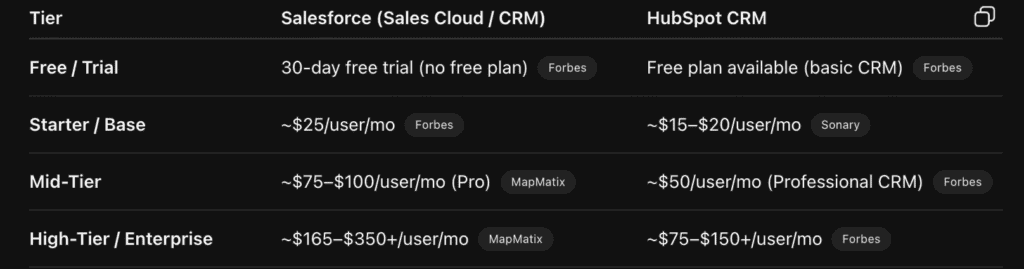
A SaaS comparison article structured as this performs well:
A SaaS comparison article structured as this performs well:
| H2: Salesforce vs. HubSpot: Pricing Comparison H3: Salesforce Pricing Tiers – Sales Cloud Starter: $25/user/month – Professional: $80/user/month – Enterprise: $165/user/month H3: HubSpot Pricing Tiers – Starter: $20/user/month – Professional: $100/user/month – Enterprise: $150/user/month |
When a user asks, “How much does Salesforce cost compared to HubSpot?”, AI can instantly extract and cite this structured data.
# Frequently updated content
AI platforms prioritize freshness, especially for queries where recency matters. Content with recent publication or update dates signals that the information is current and reliable.
Example that gets cited:
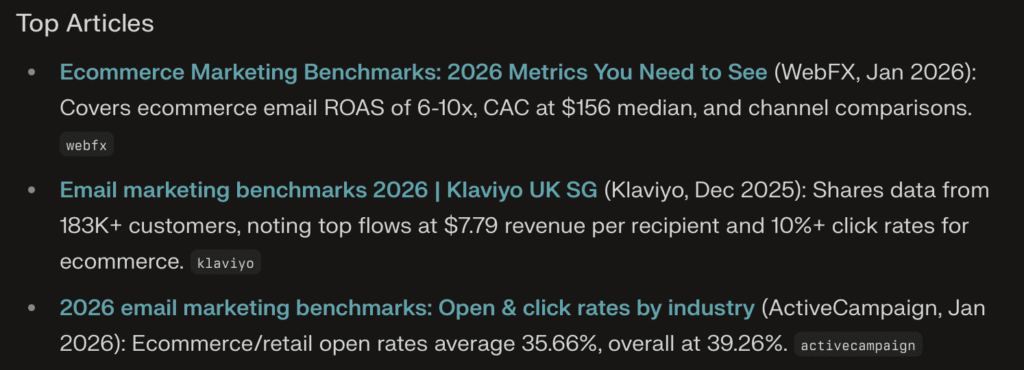
An article titled “Email Marketing Benchmarks for 2026” was published in January 2026 with data like:
- “As of Jan 2026, open rates average 35.66%.”
- “Shares from customers in 2026 …”
- References to current email platforms and their latest features
When a user asks about current email marketing benchmarks, this fresh content gets prioritized over a 2022 article with outdated data.
# Trustworthy and authoritative
AI models heavily weight credibility signals when deciding what to cite. They prioritize sources that demonstrate experience, expertise, authoritativeness, and trustworthiness, also known as E-E-A-T.
Example that gets cited:
A conversion rate optimization guide written by:
- Author: Sarah Chen, Director of Growth at [SaaS Company]
- Credentials: 10+ years optimizing ecommerce funnels, speaker at CRO conferences
- Original data: “In our analysis of 500+ checkout flows across D2C brands…”
- Expert quotes: Interviews with Shopify’s head of merchant success
- Byline appears at the top with LinkedIn profile link
When a user asks about checkout optimization best practices, AI trusts this content because it comes from a verifiable expert with original insights.
# Query aligned and Intent focused
AI models prioritize content that directly answers the question and clearly aligns with the user’s intent. Content that matches user intent, informational, commercial, or transactional, earns more citations.
Example that gets cited (Informational Intent):
When a user asks, “How do I reduce cart abandonment on Shopify?”
An article structured this way performs well:
| H2: 7 Proven Ways to Reduce Shopify Cart Abandonment H3: 1. Send Abandoned Cart Emails Within 1 Hour [Direct how-to with specific steps] H3: 2. Simplify Your Checkout to 3 Steps or Less [Specific implementation advice] H3: 3. Display Trust Badges Above the Checkout Button [Concrete examples and placement recommendations] |
This content directly answers the “how” query with actionable steps. AI can confidently cite these specific tactics.
 Pro Tip: Ever wonder why some content gets cited while similar articles don’t? Content that’s laser on answering specific queries rather than broad topic overviews gets prioritized. Understanding how ChatGPT generates answers reveals exactly how to align content structure with the intent AI models are designed to match.
How AI Citation Tracking Works
AI citation tracking isn’t as simple as checking Google Search Console rankings. It requires a systematic approach to monitor what AI platforms say about your brand across different queries, platforms, and contexts.
1. Prompt-Level Monitoring to Track AI Citations
The foundation of AI citation tracking is understanding what questions trigger citations. Like traditional SEO keyword research, this requires identifying and monitoring the specific prompts that matter for your business.
> Tracking Specific Queries Customers Ask AI
AI citation tracking starts with identifying the exact questions your target audience asks. These are conversational queries that mirror how people naturally speak to AI assistants.
How to identify queries to track:
| Queries | Example |
| Product/Service Discovery Queries | |
| “How do I reduce email unsubscribe rates?”What’s the best way to segment subscribers for e-commerce?”How can I improve email deliverability?” | “What’s the best CRM for small B2B companies?”Which CRM integrates with HubSpot Marketing?”How do Salesforce and Pipedrive compare for sales teams?” |
| Problem-Solution Queries | |
| “What is the best [product category] for [use case]?”Which [solution type] should I use for [specific problem]?”What do I need in a [product/service] for [industry/company size]? | “What’s the best CRM for small B2B companies?””Which CRM integrates with HubSpot Marketing?”How do Salesforce and Pipedrive compare for sales teams?” |
| Feature/Capability Queries | |
| “How do I [solve a specific problem]?”What’s the solution for [pain point]?”How can I improve [metric/outcome]?” | “Can I create Gantt charts in Asana?”Which project management tools have time tracking? What’s the best tool for Agile sprint planning?” |
> Branded vs Non-branded Prompts
Both prompt types need to be monitored, but the implications are different. The goal is to monitor citation patterns for both to build a complete picture of your AI presence.
Branded prompts: controlling your narrative.
Branded prompts include your company name, product name, or brand-specific terms. When users ask AI about your brand directly, four critical dimensions determine the impact: accuracy of pricing and features, completeness of differentiators and updates, sentiment (positive vs neutral vs negative framing), and competitive positioning in comparison queries.
Examples of branded prompts:
- “What is [YourBrand] used for?”
- “How much does [YourProduct] cost?”
- “[YourBrand] vs [Competitor]”
Non-Branded Prompts: Earning Discovery
Non-branded prompts represent the discovery layer. This is where your brand earns awareness among users who don’t yet know you exist. When users ask AI for recommendations without naming a specific company, getting cited means entering the consideration set before the user visits any website.
Examples of non-branded prompts:
- “What’s the best SEO tool for keyword research?”
- “How do I automate my email marketing?”
- “What project management software should I use?”
> High-intent vs Informational Queries
Not all queries have equal business value. Tracking must prioritize based on user intent and proximity to purchasing decisions.
High-Intent Queries
These queries indicate the user is actively evaluating solutions and is close to making a decision. These are revenue-driving citations. Being mentioned (or not) directly impacts the user’s shortlist. This is where AI citation tracking most closely mirrors traditional conversion-focused SEO.
Examples of high-intent queries:
- “Best CRM for B2B sales teams under $50/user”
- “Shopify email marketing tools with abandoned cart automation”
- “Which is better: [Option A] or [Option B]?”
Informational Queries:
These queries focus on learning, understanding, or solving problems without immediate purchase intent. Getting cited for informational queries builds authority and awareness.
Examples of informational queries:
- “What is marketing automation?”
- “How does email segmentation work?”
- “Why is cart abandonment happening?”
2. Model Wise Citation Coverage
Different AI platforms have different citation behaviors, training data, and user bases. Comprehensive tracking requires monitoring across multiple models to understand where AI visibility is strongest and where it is invisible. Citation performance will vary significantly across platforms.
A user might use ChatGPT for brainstorming, Perplexity for research, Claude for detailed analysis, and Google’s AI Overviews while searching. If a brand is only cited in ChatGPT, it’s missing 75% of the users’ decision journey.
Here’s the basic tracking process.
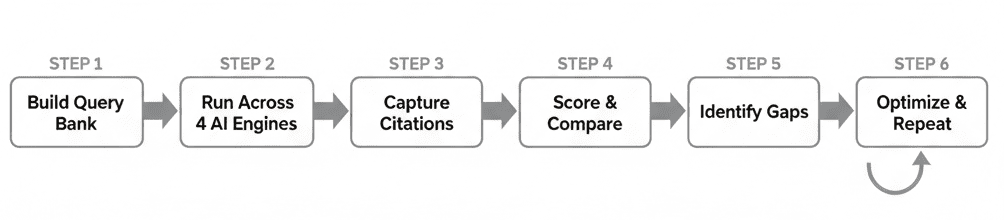
How to Track Citations in ChatGPT
| 1: Create a Query Set | 2: Prompt for Sources | 3: Log Results | 4: Repeat Weekly |
| Commercial queries (e.g., “best AI visibility tools”), Informational queries, Comparison queries, Brand vs competitor queries | Web updates, Prompt phrasing, Model updates | Was your domain cited? (Yes/No)Citation position (1st, 2nd, 3rd)Context (recommendation, mention, comparison)Competitors cited | Web updatesPrompt phrasingModel updates |
See these strategies to rank in ChatGPT responses to improve your citation rate on the platform.
How to Track Citations in Google AI Overviews
| 1: Use Clean Browser | 2: Track Specific SERP Queries | 3: Capture | 4: Track Frequency |
| Prevents personalization bias | “Best [your category] tools”“How to [problem].”[Your brand] vs competitor” Industry comparison queries | “Best [your category] tools”“How to [problem].”“[Your brand] vs competitor” Industry comparison queries | % of queries triggering AI Overview% of those where you’re cited |
Learn this step-by-step guide to rank in Google AI Overviews.
How to Track in Perplexity AI
| 1: Run Query Set | 2: Check | 3: Monitor Trends |
| Use the same standardized query set across all platforms | Citation presence, Citation rank (ranking #1 matters most)Frequency of repeated citation, Page-level visibility (which URL gets cited) | Citation presence, Citation rank (ranking #1 matters most), Frequency of repeated citation, Page-level visibility (which URL gets cited) |
Understand how Perplexity search works to build your optimization strategy.
How to Track in Claude
| 1: Force Source Attribution | 2: Track | 3: Capture |
| Prompt: “Provide sources for each claim.” | Direct citation (linked)Brand mention without a linkIndirect reference | Are you cited? (Yes/No)Position (Top card? 3rd source?)Screenshot evidenceCompeting domains |
3. Data Points Measured to Track AI Citations
Once brands have identified what queries to track and which platforms to monitor, the next step is understanding what to measure. Strong AI citation tracking also surfaces visibility trends over time, showing whether authority is growing or declining across platforms, which is exactly why tracking matters for long-term visibility strategy.
> Citation Presence
This is the most basic metric. Does your brand appear in the AI response at all? It’s a binary yes/no measurement. If your brand isn’t cited, nothing else matters.
Tracking citation presence starts with a simple log: “Best CRM system” → cited (y/n).
They vary due to different training data versions, real-time search result variations, and inherent randomness in generation.
> Position within Answer
Citation presence is the starting point. Position determines impact. This metric measures where your brand appears in the AI’s response: first, second, third, or buried further down.
To track position, log rank across different AI platforms: “Best analytics tools” → Perplexity (rank 1), ChatGPT (rank 2), Claude (rank 3).
Being mentioned matters. Being mentioned first matters more. Just as SERP position 1 gets disproportionate clicks in traditional search, the first brand mentioned in an AI response gets disproportionate attention from users who trust the AI’s implicit prioritization.
> Sentiment Analysis
Position tells you where your brand appears. Sentiment tells you how it’s framed. In AI citation tracking, sentiment is one of the most critical dimensions because perception influences purchase decisions directly.
Getting cited with negative framing can be worse than not being cited at all. You want AI platforms to recommend you, not warn users away. Sentiment breaks into three categories.
Positive sentiment actively recommends your brand, highlights strengths and differentiators, and uses favorable language like “excellent for,” “best option,” or “highly rated.”
Neutral sentiment mentions the brand factually without a clear recommendation or warning. The AI describes features without judgment.
Negative sentiment warns about limitations, highlights weaknesses or complaints, and suggests competitors as better alternatives.
> Competitor Comparison
Citation tracking in isolation is incomplete. Measure performance by identifying who else appears in the same AI responses and how AI positions your brand next to them.
AI platforms typically mention 2 to 5 competing brands in a single response. Knowing your share of voice and relative positioning reveals the real competitive picture.
How to Track Your Brand’s AI Citations: Manual vs Automated
AI citation tracking matters. The practical question is how brands actually do it.
There are two paths: build a manual tracking system, or use automated platforms designed for this purpose. Most marketers start manually to understand the fundamentals, then graduate to automation as tracking demands scale.
Here’s exactly how both approaches work.
The Manual Tracking Method
Manual AI citation tracking means personally testing queries across AI platforms, documenting results, and analyzing patterns. It’s time-intensive. It’s also the best way to understand how AI platforms actually talk about your brand and to build intuition for what drives citation rates before scaling to automation.
Step 1: Build a structured list of queries to monitor consistently.
- “Best [product category] for [ideal customer profile].”
- “[Your brand] vs [competitor]”
- “How to [solve specific problems].”
- “What is [concept related to your product]?”
- “Does [product] have [specific features]?”
Step 2: Test each query across AI platforms and screenshot the responses to track citation performance over time.
Query: “Best email marketing platform for Shopify stores”
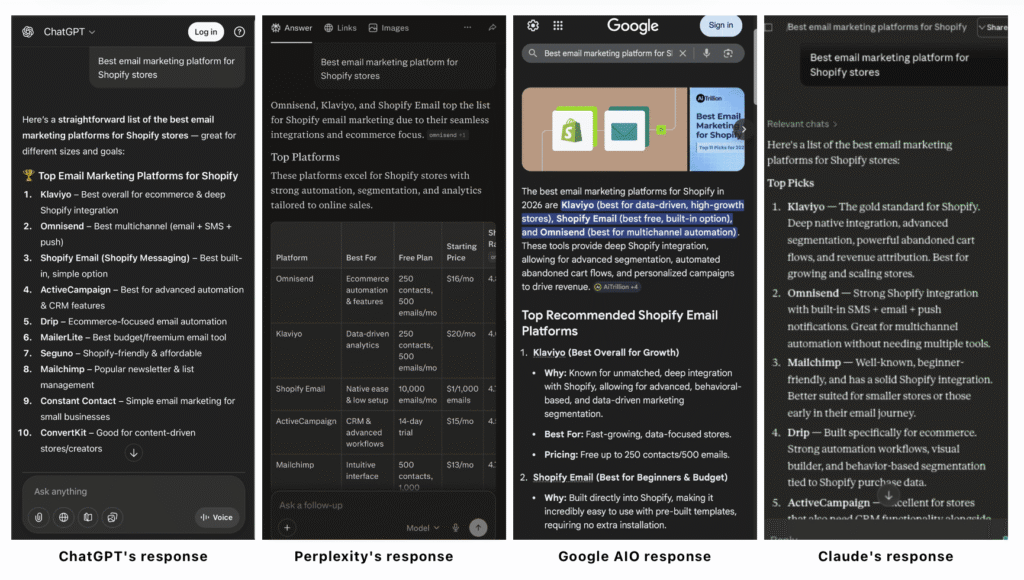
Step 3: Screenshots document individual tests, but spreadsheets turn those observations into trackable data over time. Here’s the sample tracking sheet.

Refer to our Manual prompt testing log sheet to track AI citations and identify patterns across queries and platforms.
Automated Tracking Platforms
Manual tracking establishes the fundamentals, but it doesn’t scale. Manual monitoring of 20+ queries can consume 8 to 10 hours a month, pulling time away from content optimization. Dedicated AI search monitoring platforms eliminate this bottleneck.
This is where automated AI citation tracking platforms come in.
STEP 1: Prompt Libraries at Scale
The foundation of automated tracking is the prompt library, the collection of queries monitored across AI platforms. Upload the queries once, and the platform handles all future testing instead of making you test each one manually.
Most automated platforms support two methods for building a prompt library:
- Manual entry: Add queries one at a time through the platform interface
- CSV upload: Export the existing manual tracking spreadsheet
Beyond just existing queries, platforms like Track My Visibility provide the flexibility to add new prompts. (see how Track My Visibility works)
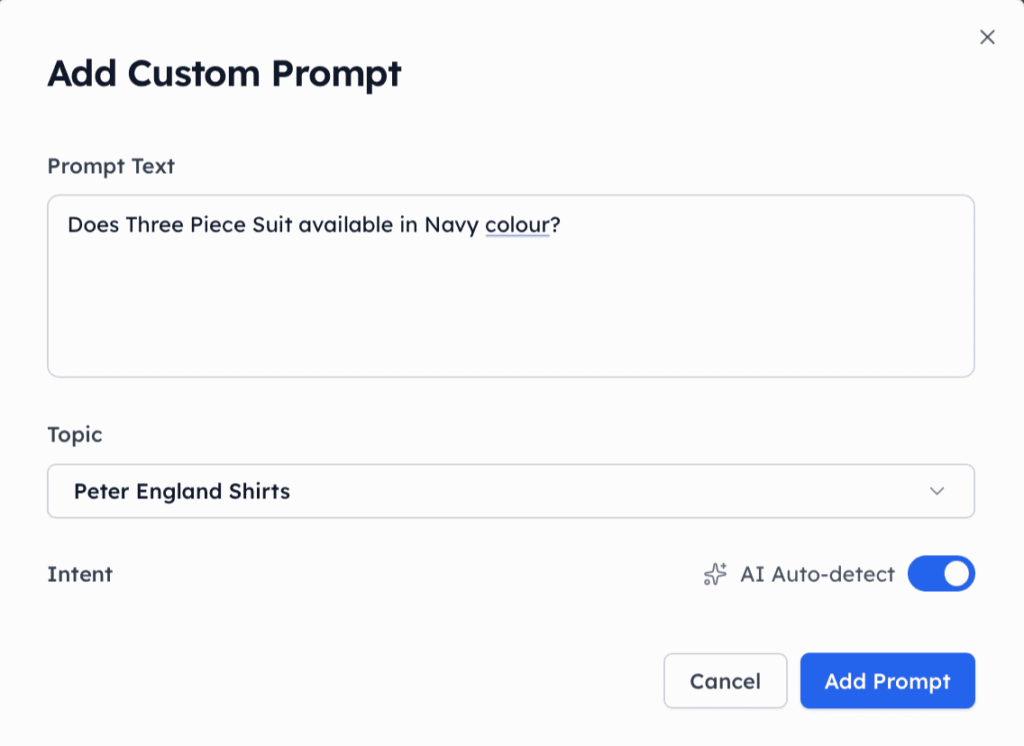
STEP 2: Automated Multi-Model Scanning
After you upload the prompt library, the platform automatically tests it across all major AI platforms on the configured schedule. This is where automation delivers its clearest value: systematically testing hundreds of query-platform combinations that manual processes cannot match.
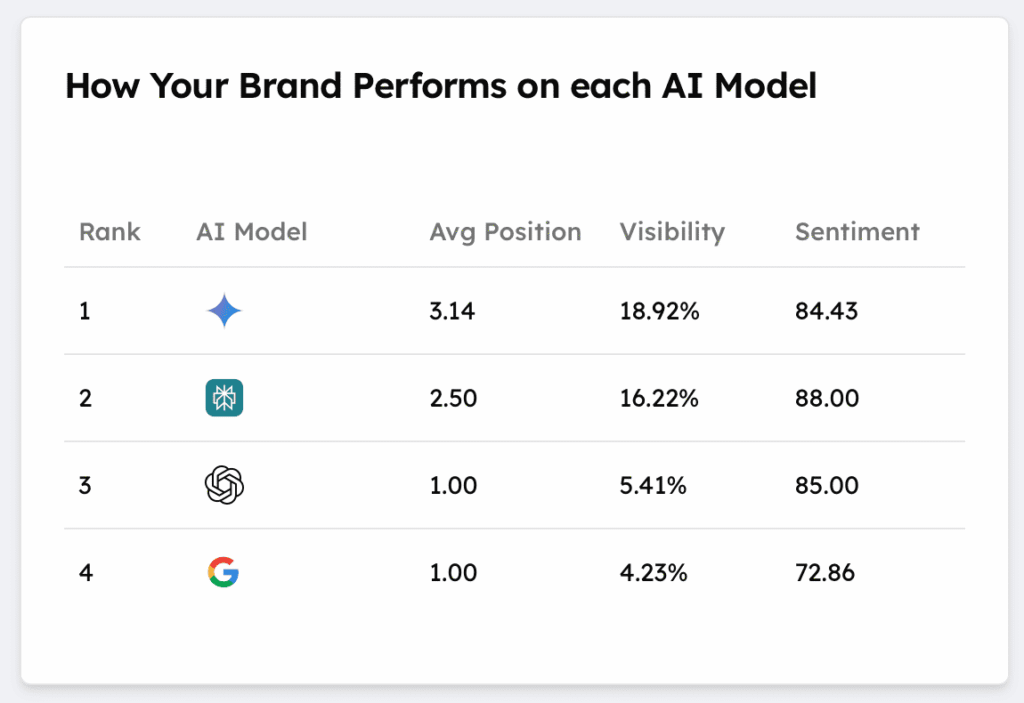
STEP 3: Visibility Scoring
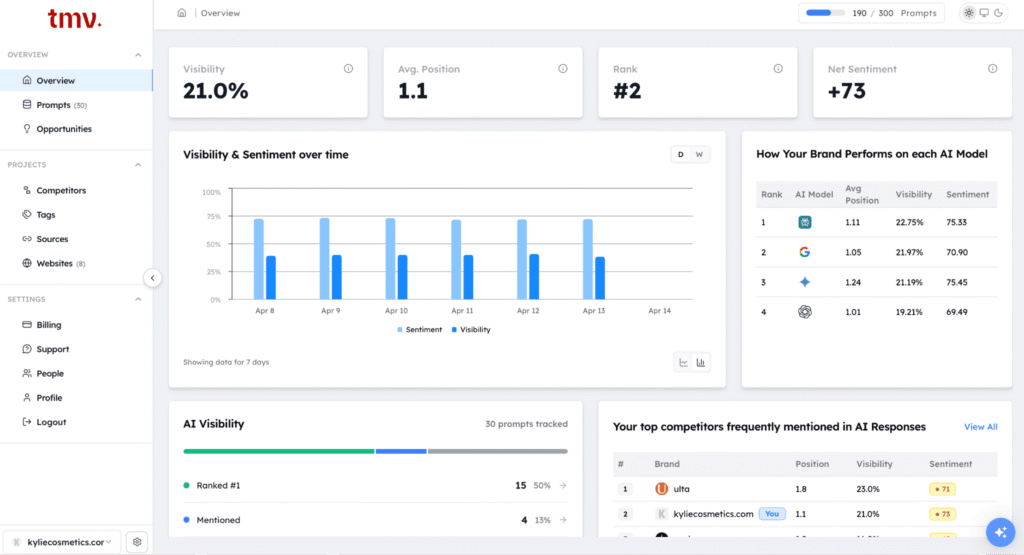
Raw citation data (cited vs. not cited) is useful but incomplete. A visibility score aggregates multiple performance factors into a single trackable metric. That gives you a clearer picture of overall AI presence strength.

Automated tracking platforms translate these complex calculations into clear, actionable dashboards that show exactly where you stand.
Pro Tip: A visibility score tells you where you stand today, but what’s driving that number? Refining your tracking strategy is easier when you understand which specific signals influence AI citation decisions. This comprehensive AEO GEO audit checklist reveals the citation signals most platforms prioritize, helping you identify which prompts are worth tracking.STEP 4: Competitor Gap Analysis
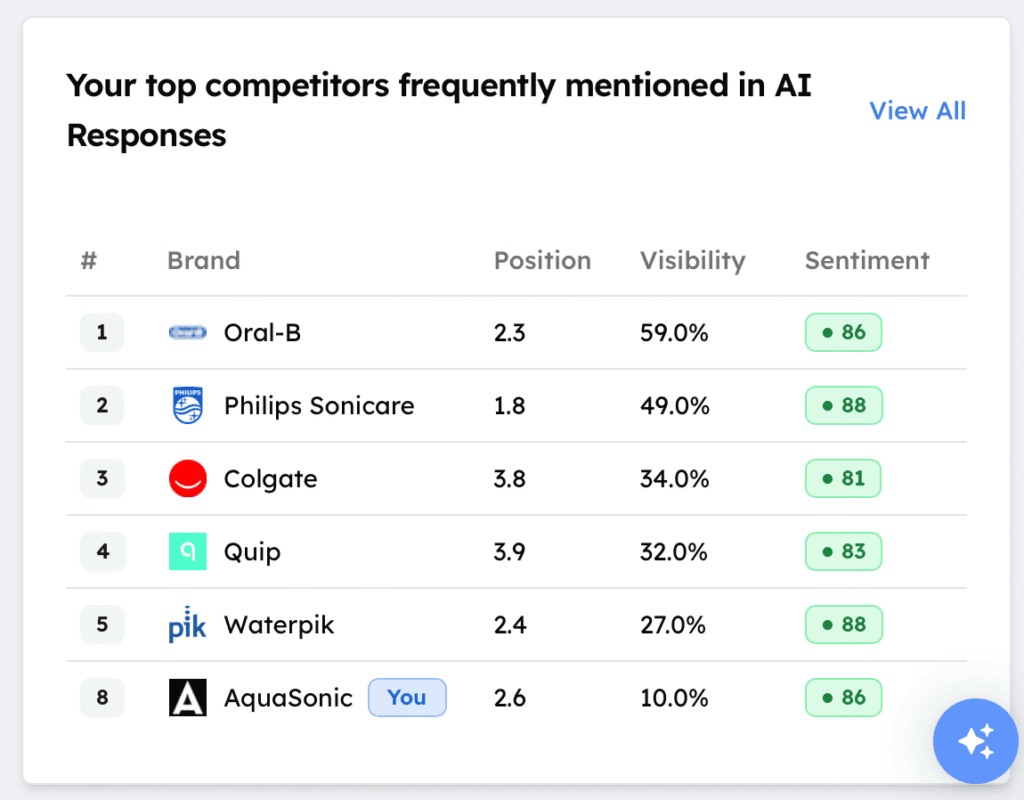
Knowing where you stand against competitors is strategic intelligence. Automated platforms track competitor citations alongside your own, revealing where ground is being won, lost, and where opportunities exist.
Platforms identify competitors through multiple methods:
- Analyzing AI responses to tracked queries
- Identifying brands frequently mentioned alongside the tracked brand
- Suggesting competitors based on citation co-occurrence
- Allowing manual addition of known competitors
STEP 5: Updates on changes
The most powerful part of automated tracking is response speed. How quickly does the platform detect changes and surfaces them for action?
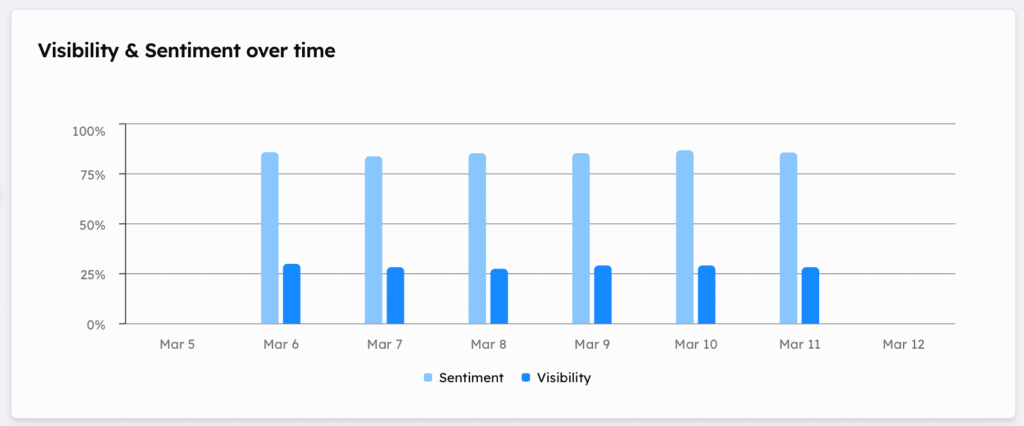
The platform handles the mechanical work testing, capturing, and analyzing, so your teams can focus on the strategic side: creating content that earns citations and drives measurable results.
Quick Decision Framework
| ✅ 1. Are you spending 8+ hours/month on manual AI citation tracking? ✅ 2. Do you need to track 30+ queries regularly? ✅ 3. Do 4+ people need access to citation data? ✅ 4. Do you need daily testing or instant alerts? ✅ 5. Are you reporting AI metrics to leadership or clients regularly? |
| 0-1 checked → Stay manual, re-evaluate in 3 months 2-3 checked → Try hybrid approach or free trial 4-5 checked → Switch to automation now |
View our pricing to find the right plan for your brand.
Advantages of AI Citation Tracking
AI citation tracking isn’t just another metric to add to a dashboard. It’s an early warning system for staying visible, a competitive intelligence goldmine, and a roadmap for content that actually gets recommended. Here’s exactly what brands gain when they start tracking AI citations.
# Stay Visible Where Customers Are Actually Searching
AI citation tracking gives you concrete data: “When does ChatGPT recommend us?” instead of guesswork. It shows where to focus optimization. Without tracking, you can lose three months of AI visibility before noticing declining brand awareness or lost deals. With tracking, you catch visibility drops before they cost customers.
# Let AI Platforms Validate Expertise
Building trust with a customer takes months of nurturing across multiple touchpoints, case studies, testimonials, and lengthy sales cycles. When an AI platform cites or recommends your brand, that’s third-party validation at scale. AI citation tracking lets you measure this trust-building in motion. You see which AI platforms are validating your expertise and how often.
# Discover What’s Working for Competitors Before They Pull Ahead
Competitors are getting AI citations, and most brands have no idea it’s happening. AI citation tracking shows you what competitors are doing right in ways traditional SEO tools can’t match.
You see who dominates citations across tracked queries, which content formats win most often, which pages AI platforms prefer to cite, and what type of structure or data performs best.
# Stop Guessing What Content to Create Next
AI citation tracking shows you what content actually works. Identify which queries trigger AI answers, which topics generate citations, which formats AI selects, and where your visibility gaps appear. Understanding how AI models choose content helps you create content optimized for those selection criteria, focusing on depth, structure, and data that AI platforms prioritize.
Identify citation-target queries, analyze the content competitors earn citations for, create citation-focused content, and track citation rate alongside traffic. Then update based on citation performance.
# Track Your Real Impact Beyond Website Traffic
Google Analytics shows traffic and conversions from organic search, but it misses the growing influence brands have through AI citations. Real business value is being created that’s invisible in traditional analytics.
AI citation tracking measures brand awareness lift from AI citations, qualification improvement from AI education, share of voice in AI responses, category ownership, and thought leadership, and sentiment trends in product recommendations.
It reveals the compounding, long-term value that traffic metrics alone miss.
Final thoughts!
Search is no longer just about rankings. As AI platforms generate direct answers, they determine visibility by deciding which brands to include in those responses. A brand may rank well in traditional search results yet remain absent from AI-generated answers, where consumers increasingly make buying decisions.
AI citation tracking helps marketers adapt to this shift. Instead of focusing only on keyword positions and traffic, it measures inclusion, authority, and competitive presence inside AI responses. It reveals when AI cites brands, how it positions competitors, and which content types improve a brand’s chances of being referenced.
For business and eCommerce teams, this is becoming a strategic advantage. AI answers are shaping early research, comparisons, and product discovery. Monitoring AI visibility ensures brands aren’t losing influence without realizing it.
Frequently Asked Questions
AI citations occur when platforms like ChatGPT or Perplexity AI reference or link to your website in their generated answers. They signal that your content is considered reliable and relevant.
More users are searching inside AI tools instead of traditional search engines. Tracking citations ensures your brand remains visible where decisions are increasingly being made.
SEO tracks rankings and traffic. AI citation tracking shows whether AI references your brand, how prominently it presents it, and how it compares it to competitors in AI responses.
Yes. You can create prompt libraries, run queries regularly, capture screenshots, and log results in spreadsheets. However, this approach becomes time-consuming as you scale.
Automation enables consistent monitoring, visibility scoring, competitor gap analysis, and change detection, helping you move from reactive tracking to proactive strategy.
Yes. When AI platforms cite your content, they effectively validate your expertise, which strengthens credibility and trust among users.
Weekly monitoring is ideal for most brands. In competitive industries, daily tracking provides better insight into visibility shifts and competitor movements. Platforms like Track My Visibility help track whether your content appears in AI-generated answers, identify citation drops, and analyze which competitors are replacing you across different query types.