



Building an AI visibility business case is frustrating because the impact is real, but hard to prove. You’re expected to justify investment in something that doesn’t show up cleanly in traffic or attribution reports, while competitors quietly gain ground inside AI-generated answers.
Leadership asks for ROI, but the influence happens before clicks, in moments traditional metrics don’t capture. This creates a gap between what you know is shifting and what you can confidently present.
To move forward, you need a structured way to translate LLM visibility into business terms, connecting brand presence in AI outputs to measurable signals like consideration, demand, and competitive share. This is where a clear, defensible business case becomes essential.
This guide breaks down the framework, key metrics, and stakeholder-ready approach needed to build a strong, defensible business case.
TL;DR
AI visibility determines whether a brand is included in decision-making moments, not just whether it ranks in search results. A Business AI Visibility Case focuses on a measurable problem: competitors gaining citation share while the brand is underrepresented. Establishing a baseline through prompt-level audits is essential to identify visibility gaps and quantify the share of voice. Frame the opportunity around stakeholder priorities, linking AI visibility to demand, revenue, and competitive positioning. Scope the investment clearly as a time-bound pilot with defined deliverables and success criteria.What an AI Visibility Business Case Actually Argues
An AI visibility business case argues that your brand is being under‑represented or ignored in AI‑generated answers, so you are losing demand, trust, and competitive advantage.
It argues that …
- “Our brand is losing citation share to competitors” is a real business problem, not just a trend.
- Fewer brand mentions directly reduce opportunities to be considered and chosen.
- The citation gap is measurable by tracking brand vs. competitor presence across key AI platforms and prompts.
- There is a clear opportunity: improving content, structure, and authority can increase AI-powered discovery and conversions.
- Framing matters more than data volume, as leadership responds to risk, narrative, and competitive position.
- If ignored, competitors will dominate AI narratives, making your brand invisible at the moment of decision.
There is a clear opportunity: improving content, structure, and authority can increase AI-powered discovery and conversions. This is where AI SEO strategies create measurable business value by improving how AI systems discover, understand, and recommend your brand.
Establish the Visibility Gap
Start by auditing how your brand appears in AI-generated answers. The goal is to clearly identify where you are missing and who is showing up instead.
Identify 10 to 20 high-intent prompts your customers use during research, especially for comparisons, alternatives, and recommendations. Run these prompts across ChatGPT, Perplexity, Gemini, Google AI Overviews, and Claude. Identify which prompts to track are worth prioritizing in this audit.
Record which brands appear in each response. Note how often your brand is mentioned and in what context. Compare this against competitors.
Calculate your AI share of voice by dividing your brand mentions by total mentions across all prompts. This gives you a clear AI search visibility benchmark across every platform you run.
Map which competitors consistently appear, and where your brand does not. Treat this as a direct visibility gap at the consideration stage. Our trackdown studies consistently show this gap is wider than brands expect; competitors often hold citation share in categories a brand assumes it already leads.
Capture screenshots or export the data. Use this audit as the core proof for your business case.
 Pro Tip: Curious to know which AI platforms are actually citing your content right now? Run a quick audit with a free AI visibility checker and see how your content currently performs across AI search platforms.
Frame the Opportunity for Each Stakeholder
Stakeholders care about outcomes, growth, risk, and competitive position, not channels. The challenge is that AI visibility gaps don’t show up in traditional metrics but still influence decisions and demand.
To make the case land, translate that gap into a clear business impact: what’s being lost today, what risk is increasing, and where growth is being missed.
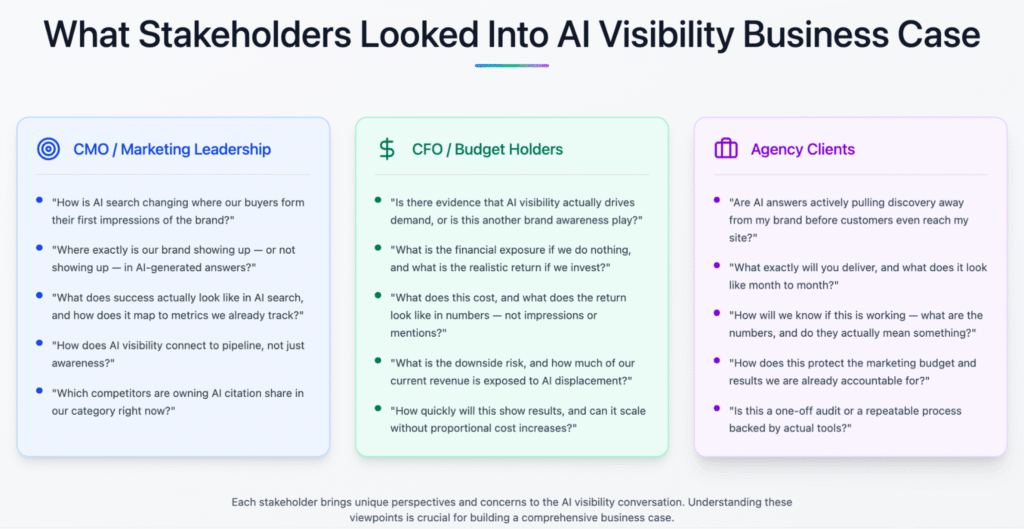
# For CMOs and Marketing Leadership
Focus on what CMOs care about: brand visibility, demand generation, and competitive position. Show them where your brand is missing from AI-generated answers and where competitors are shaping buyer perception.
Translate AI visibility into marketing impact. Connect brand mentions in AI answers to shortlist inclusion, consideration, and pipeline influence. Make it clear that absence in AI answers means lost demand before traffic even starts.
In short, show that presence in AI answers directly impacts brand equity, shortlist inclusion, and revenue.
# For CFOs and Budget Holders
CFOs look for: revenue impact, cost efficiency, and risk exposure. Address the lack of AI search visibility, which is leading to missed demand, and how competitors are capturing that value.
Quantify the opportunity. Connect AI visibility data to measurable signals like branded search lift, assisted conversions, and AI referral traffic from AI search engines, all of which become trackable once a system to measure visibility in AI content is in place. Frame it as a pipeline influence, not a marketing experiment.
Position it as a risk decision. Highlight the cost of inaction; competitors building citation shares now gain a compounding advantage that becomes more expensive to close later.
Keep the investment clear and controlled. Propose a time-bound pilot with defined costs, expected outcomes, and success criteria tied to business metrics.
For CFOs and Budget holders, show that improving AI share of voice is a measurable demand-capture, cost-avoidance, and risk-mitigation play
# For Agency Clients
Agency clients care about clear deliverables, competitive advantage, and measurable progress. Show them where their brand is losing visibility in AI answers and how competitors are outperforming them.
Turn AI visibility into a tangible service. Present competitive citation benchmarking, prompt-level insights, and monthly visibility tracking as structured outputs that they can see and act on.
Connect it to client outcomes. Show how improving AI search visibility strengthens their market position, increases consideration, and closes competitive gaps over time. Use AI visibility reporting to demonstrate a forward-looking AI search strategy.
For agency clients, show that competitors are already winning in AI answers, define exactly what will be delivered, and tie it to clear KPIs and future-proofing.
Scope the Investment Clearly
Define the investment in clear, controlled components. Break it into three parts: tracking (AI visibility tools or systems to monitor AI visibility), content (optimizing and creating pages that AI can cite), and technical (schema markup, internal linking, and consistency fixes).
Limit the scope upfront: Propose a 60–90 day pilot instead of a long-term commitment. This reduces risk and makes approval easier.
Specify exactly what will be done: Outline how many prompts will be tracked, how many core pages will be optimized, and what technical updates will be implemented.
Set clear boundaries: State what is not included: no full site redesign, no complete SEO overhaul, no brand repositioning.
Tie cost to outcomes: Link each investment area to expected improvements in share of voice, brand mentions, and presence in AI answers.
Make progress visible: Include a simple timeline with weekly or monthly milestones so stakeholders can track execution and results.
Pro Tip: Scoping an AI visibility investment is harder when the landscape itself keeps shifting. Before locking in the pilot plan, explore these AI SEO trends about how AI platforms are evolving their citation and ranking behavior.Define Metrics and Reporting Cadence
Define a focused set of metrics that show visibility, authority, perception, and business impact.
Track metrics like:
- Share of answers: how often your brand appears across prompts
- Prompt coverage: how many key buyer-journey prompts you show up in
- Citation share: your share of total mentions
- Mention prominence: whether you appear as a top recommendation or lower in the response
- Recommendation rate: how often AI explicitly suggests your brand
- Sentiment: positive, neutral, or negative context

Connect this to business impact by tracking AI search visibility or leads and correlating AI visibility improvements with pipeline or revenue trends.
Set a clear reporting cadence. Use brand visibility report to monitor your brand’s AI visibility, including share of answers, citation share, prominence, sentiment, and brand mentions across AI search platforms. Run prompt tracking weekly to monitor changes in share of answers, citation share, prominence, and sentiment. Report monthly with a structured view of trends, key wins and losses, and competitive movement. Review quarterly to connect AI visibility to pipeline and revenue impact, and refine your prompt set based on performance.
In the business case, keep it simple: track core metrics weekly, report to leadership monthly, and tie AI visibility to the pipeline on a quarterly basis.
Common Objections and How to Address Them
Expect objections early. Address them directly by reframing each concern into a visibility gap, competitive risk, or missed opportunity. Use data from your audit to make each response concrete.
# “We Already Rank Well on Google”
What they’re really saying: “We’re winning linear search, so why worry about AI answers?”
How to respond:
“AI tools are answering your buyers before they click through to Google. Ranking high on the SERP doesn’t guarantee you appear in the AI answer.”
Show the audit: “In 15 of your top prompts, AI gives buyers 5 recommendations; you’re in only 2, despite ranking #1‑3 on Google.”
# “AI Search Traffic Is Too Small to Matter”
What they’re really saying: “I only see small referral numbers; this can’t be strategic.”
How to respond:
“AI search doesn’t always send a click; it sends belief, shortlists, and trust. The impact is the pipeline, not just visits.”
“Early channels never look like their future. AI‑driven discovery is like voice search in 2018: tiny now, critical later.”
# “We Can Track This Manually”
What they’re really saying: “This doesn’t need a program or budget; a junior person can Google a few prompts.”
How to respond:
“Manual checks are fine for spot checks, but they miss scale, consistency, and trends. You need ongoing, structured tracking across 20–50 prompts and 3-4 AI tools.”
“We’re not just checking; we’re building an AI visibility score, measuring share of voice, and tying it to pipeline over time. That requires a repeatable process and dashboards, not spreadsheets.”
# “This Feels Like a Trend, Not a Channel”
What they’re really saying: “This is hype; don’t lock me into a long‑term investment.”
How to respond:
“AI‑driven discovery is now a default behavior for many buyers. It’s not a ‘trend’ in the way micro‑trends are; it’s a permanent shift in how people research.”
“We’re not betting on a fad; we’re building a repeatable, tool‑backed program that starts with a 6–9‑month pilot and adjusts based on performance data.”
What a Business AI Visibility Case Document Looks Like
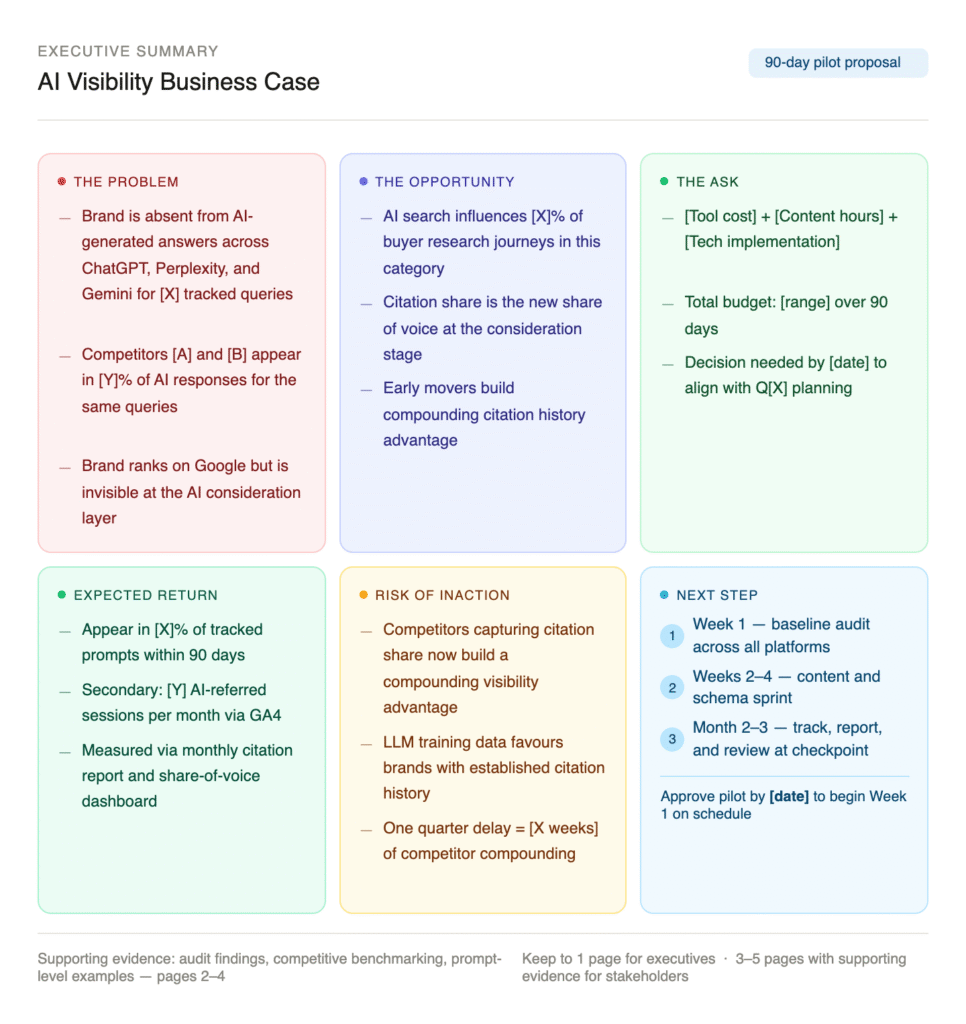
Structure the business AI visibility case document to be concise and decision-oriented. Its purpose is to clearly present the problem, support it with evidence, and guide stakeholders toward a specific investment decision.
The document opens with a defined problem statement. Supporting evidence follows, including audit data, content optimization, prompt-level examples, and competitive benchmarking to validate the gap.
Next, it should outline the opportunity, translating visibility gaps into potential impact on consideration, demand, and market position. The execution plan then details the scope of work, timelines, and ownership, usually framed as a time-bound pilot.
A clear investment section should specify costs, resources, and expected outcomes, along with a brief statement on the risk of inaction. The document concludes with a defined decision task, including approval requirements, timelines, and success criteria that define how results are evaluated.
Example: Sample Business Case Document Structure
Quick Tips to Get Leadership Approval
To get leadership approval for an AI visibility initiative, keep it simple, credible, and tied tightly to their goals. Here are quick, actionable tips:
1. Time The Ask Strategically
Align your request with a budget cycle, a competitor‑win announcement, or a quarterly planning session, so AI visibility feels like part of the agenda, not an extra item.
2. Pre‑sell To Internal Allies
Brief PR, ecommerce, and marketing teams early; show them how AI visibility data can protect share, support messaging, and surface better‑qualified leads.
3. Lead With One Competitor Example
Open with a concrete prompt where a direct competitor is cited and your brand is missing, and say: “This is happening in the first place buyers form their shortlist.”
4. End Every Conversation With A Clear Ask
Close each meeting with a specific decision: “I’m asking for X budget by Y date to run a 90‑day pilot focused on Z core prompts.”
5. Propose A Pilot, Not Perfection
If full budget approval stalls, frame the first phase as a 90‑day AI visibility pilot using existing SEO or content dollars reallocated to AI‑friendly content, schema, structured data, and monitoring.
Final Thoughts
AI search visibility is quickly becoming a core layer of how buyers discover, evaluate, and choose brands. As AI-generated answers take a larger role in shaping decisions, being present in those answers is no longer optional; it is a competitive requirement.
Building a business AI visibility case is the first step toward making this shift actionable. It brings structure to an emerging space, translates visibility into business impact, and creates alignment across teams and leadership.
Looking ahead, AI-powered discovery will only expand. Brands that rank in AI search will compound their advantage, while those that delay will face a widening gap that becomes harder to close.
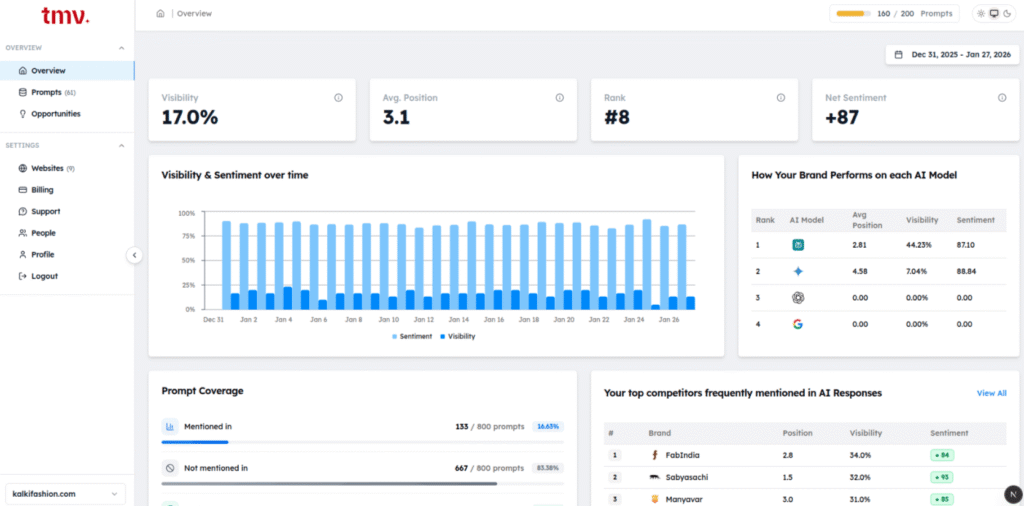
To operationalize this, you need consistent tracking. Tools like Track My Visibility help monitor your presence across AI platforms, measure citation share, benchmark competitors, and turn raw visibility data into actionable insights.
Start by tracking your current AI visibility, identifying where you stand, and using those insights to build and scale a strategy that keeps your brand visible in the moments that matter.
Try our 7-day trial to see exactly where you appear across AI platforms.
FAQs
An AI visibility business case is a structured argument that shows how your brand’s presence (or absence) in AI-generated answers impacts demand, consideration, and competitive positioning, and why investment is needed to improve it.
Traditional SEO focuses on ranking web pages in search results, while AI visibility focuses on being cited, recommended, or included directly within AI-generated answers where decisions are made.
Measure AI visibility using metrics like citation rate, share of voice, and prompt coverage, and presence across platforms such as ChatGPT, Perplexity, and Google AI Overviews.
Most brands see initial improvements within a 60 to 90-day pilot, especially in citation frequency and prompt coverage, with broader impact on demand building over time.
Tracking AI visibility helps identify where your brand is missing, benchmark competitors, and measure progress. Tools like Track My Visibility help to track and analyze AI visibility data across major AI platforms with actionable insights.