



Brands are investing in AI search visibility, but most are still tracking the wrong metrics. Traditional KPIs like keyword rankings, impressions, and click-through rate don’t show how a brand appears in AI search results. AI systems don’t rank pages. They select, synthesize, and present information. That creates a measurement gap most teams haven’t figured out how to close yet.
AI visibility KPIs are metrics that track whether a brand appears, how prominently AI positions it, and how AI represents it in responses. They require a separate framework focused on presence, position, sentiment, and competitive context.
This guide explains what AI visibility KPIs are, why traditional SEO metrics fall short, and how to measure the signals that actually reflect search performance in AI search.
TL;DR
- Tracking brand mentions alone is not enough; you need a broader framework to understand presence, influence, and perception.
- AI visibility KPIs measure how your brand appears, how AI positions it, and how AI-generated answers frame it, not just rankings or traffic.
- Mentions alone are not enough; you need a framework covering visibility, position, sentiment, and competition. Mentions alone are not enough; you need a framework covering visibility, position, sentiment, and competition.
- Key KPIs include visibility rate, citation rate, position, sentiment, share of voice, and prompt coverage gaps.
- AI search is non-deterministic, so consistent tracking across prompts and time is critical.
- Use proxy signals such as branded search lift and direct traffic to measure impact when you can’t directly attribute results.
Why Mentions Alone Are Not Enough to Measure AI Visibility
Tracking brand mentions is important, but it does not give the full picture. Knowing your brand appears across AI platforms doesn’t answer the questions that actually matter:
- Are you positioned correctly in the response?
- Are you recommended for the right use cases?
- Are competitors being shown instead of you?
A mention without context is a shallow signal. It confirms presence, not performance.
A company may appear inside an AI response as a passing reference while a competitor gets the primary recommendation. In another case, the AI system includes the brand in a comparison query but doesn’t connect it to the benefit the user seeks. That’s brand visibility without influence.
This is why mentions need to be evaluated within a broader measurement framework for AI search that differs from SEO. AI visibility KPIs provide a deeper layer of insight by measuring not just presence, but overall performance. These KPIs offer a more complete view of how your brand shows up in AI-generated answers.
The Evolution From SEO KPIs to AEO KPIs
Traditional SEO KPIs were built for a click-based web. With the shift toward AEO & GEO, AI search changes that model. AI search generates answers rather than ranking pages. This shifts measurement from traffic and rankings to visibility, selection, and citation. To adapt, brands need a new set of KPIs aligned with how AI systems evaluate and present content.
Organic Traffic → Source Attribution and Citation Tracking
Organic traffic once measured visibility through clicks. In AI search, users often get answers without visiting your site, so traffic alone undercounts your influence. The focus shifts to source attribution and citation tracking, understanding when and how AI platforms reference your content inside generated answers.
Keyword Rankings → Topic Authority and Source Selection Rate
Ranking first for a keyword no longer guarantees visibility. AI systems synthesize answers from multiple sources, shifting the focus from individual rankings to topical authority. Your brand demonstrates topical authority when AI systems consistently select it as a trusted source across related queries.
Backlinks → Citation Quality and Authoritative Mentions
Backlinks defined domain authority in traditional search. In AI search, citations play that role. Being referenced by platforms like ChatGPT or Perplexity is the equivalent of earning an editorial backlink. Citation quality and source credibility directly influence how AI platforms evaluate and present your brand.
Click-Through Rate → Visibility Rate and Branded Search Lift
CTR measures how often users click. In AI search, visibility matters even without a click. When your brand appears in an AI response, it builds awareness and authority, and often leads users to search for your brand directly. That makes visibility rate and branded search lift more relevant than CTR.
SERP Features → AI Overview Appearances and AI Answer Inclusion
Featured snippets once defined the highest-visibility position in search. In AI search, that role is replaced by AI Overview appearances and inclusion within AI-generated answers. Visibility now requires the brand to be part of these answer blocks, where presence compounds over time as AI systems learn from and reuse these sources.
 Pro Tip: Curious to know which AI platforms are actually citing your content right now? Run a quick audit with a free AI visibility checker and see how your content currently performs across AI search platforms.
Quick View: AI Visibility KPIs
The table below summarizes what each metric measures, how to track it, and why it matters for performance in AI-generated answers.
| KPI | What It Measures | How to Track / Measure | Why It Matters |
| AI Visibility Rate | % of prompts where your brand appears | Track presence across a defined prompt set (grouped by topic/funnel) | Establishes baseline visibility across AI answers |
| Mention Rate | How often your brand is mentioned (with or without citation) | Count mentions across responses ÷ total prompts | Differentiates awareness from actual authority |
| Citation Rate | How often is your content used as a source | Track cited responses ÷ total prompts | Indicates trust and content authority |
| Citation Position | Where your brand appears in responses | Categorize as primary, secondary, or supporting | Higher position = stronger influence |
| Citation Depth | How many sections of an answer reference your content | Count distinct sections referencing your content per response | Shows depth of authority, not just presence |
| Attribution Clarity | Whether your brand is explicitly named | % of citations with direct brand/author mention | Drives brand recall and recognition |
| Brand Sentiment Score | How AI frames your brand (positive/neutral/negative) | Classify sentiment across responses by prompt type | Impacts trust and recommendation likelihood |
| Source Quality | Which external sources shape AI perception | Analyze cited third-party sources by credibility/type | Identifies the root cause of sentiment and perception |
| Share of Voice | Your presence vs competitors | Compare appearances across the shared prompt set | Measures competitive visibility and dominance |
| Prompt Coverage Gap | Queries where competitors appear, but you don’t | Identify missing prompts vs competitor presence | Highlights missed visibility opportunities |
| AI Overview Trigger Rate | % of queries generating AI answers | Track which prompts trigger AI-generated results | Helps prioritize AI-affected queries |
| Branded Search Lift | Increase in branded searches from AI exposure | Compare branded search trends with visibility changes | Connects AI visibility to real user behavior |
Top 12 AI Search Visibility KPIs You Need to Know
You can’t measure AI visibility with a single metric. Each KPI captures a different layer of how AI systems display, select, and represent your brand in AI-generated answers. Tracking a combination gives a more reliable and actionable view of performance.
1. AI Visibility Rate
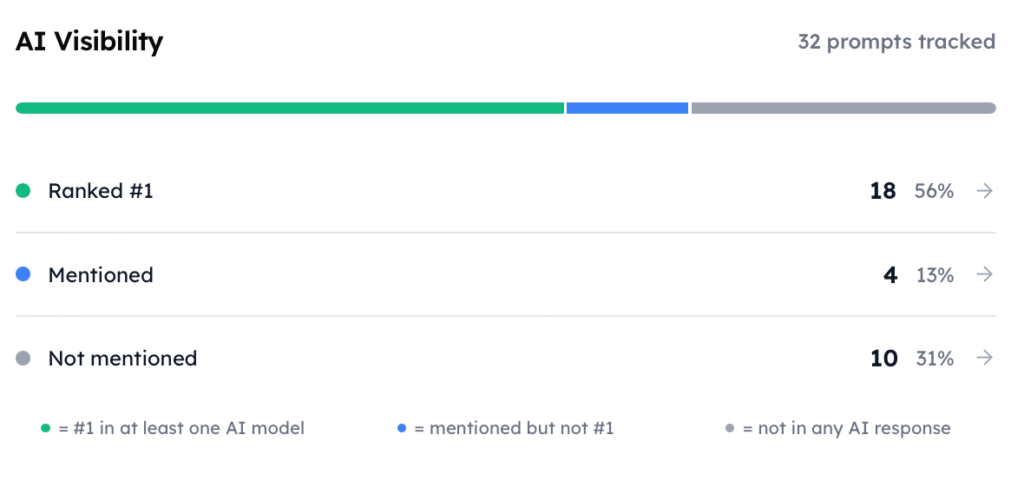
AI visibility rate measures the percentage of tracked prompts where your brand appears in AI-generated responses. It answers a fundamental question: how often are you present when users ask relevant queries?
How to calculate:
AI Visibility Rate = (Number of prompts where brand appears ÷ Total tracked prompts) × 100
If your brand appears in 45 out of 100 tracked prompts, your visibility rate is 45%. When segmented further, you may find stronger visibility in awareness queries but gaps in high-intent prompts.
Why it matters:
AI responses are non-deterministic, meaning results can vary across sessions. Tracking visibility consistently on a weekly basis, with monthly trend analysis, helps identify real patterns. It shows where the brand appears consistently, where it drops out of responses, and how LLM visibility shifts over time.
2. Mention Rate
Mention rate captures how often your brand name appears in AI responses, regardless of whether your content is directly cited. It measures brand presence at a surface level and helps distinguish awareness from actual authority.
How to calculate:
Mention Rate = (Number of responses where brand is mentioned ÷ Total tracked prompts) × 100
Your brand may be mentioned in 60 out of 100 prompts, but only cited as a source in 20. That’s strong visibility but limited influence in shaping the answer.
Why it matters:
Mention rate helps separate brand awareness from content authority. A high mention rate with a low citation rate signals that AI platforms recognize the brand but do not rely on it as a source. That gap points to where improving content quality, structure, and credibility can increase your role in AI-generated answers.
Pro Tip: Curious to see where your brand’s mentioned? Check trackdown reports breakdown for brand AI visibility performance across platforms, showing where your brand stands.3. Citation Rate
Citation rate measures how often your content is used as a direct source in AI-generated answers. It reflects authority, whether AI systems rely on your content to construct responses.
How to calculate:
Citation Rate = (Number of responses where your content is cited ÷ Total tracked prompts) × 100
Segment tracking by platform (e.g., ChatGPT, Perplexity, Gemini) and by prompt category to identify where your authority is strongest and where gaps exist.
How to benchmark:
Benchmark citation rate relative to competitors within the same prompt set. Compare how often AI platforms cite the brand versus competitors for identical queries. A strong benchmark is not just a high percentage, but a higher citation share than competitors in high-intent prompts.
Why it matters:
A high citation rate indicates that AI systems trust and depend on your content. It moves the brand from being mentioned to being a primary source for LLM citations, directly influencing how AI systems generate answers.
4. Citation Position
Citation position tracks where your brand appears within AI-generated responses, whether as the first reference, a secondary mention, or a supporting source. It measures prominence, not just presence.
How to track:
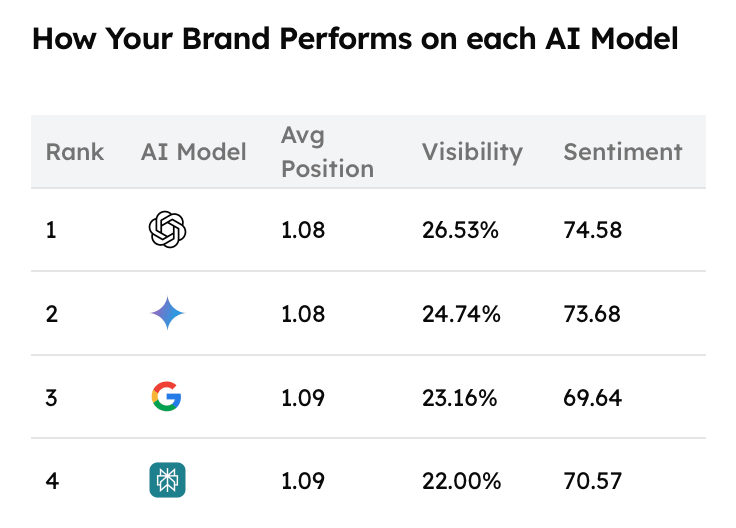
Use AI visibility tracking tools like Track My Visibility or similar platforms to monitor citation placement across prompts and platforms. These tools categorize responses based on position: primary (first mention), secondary, or supporting, and provide aggregated insights over time.
Your dashboard may show that your brand appears first in 30% of responses, second in 20%, and as a supporting source in 10%, helping you understand your actual influence in AI answers.
Why it matters:
Brands cited first shape user understanding before alternatives are introduced. AI systems prioritize content that reads clearly, covers topics structurally, and aligns with query intent, increasing the likelihood of first-position citation. Higher placement directly increases visibility, trust, and influence inside the response.
5. Citation Depth
Citation depth measures how many distinct sections of an AI response reference your brand’s content. It indicates whether the content contributes broadly to the answer or AI systems draw on it only in a limited context.
How to calculate:
Citation Depth = Number of distinct answer sections referencing your content per response
If an AI-generated answer uses your content in the introduction, comparison section, and recommendation block, it demonstrates greater depth than a single mention.
Why it matters:
Higher citation depth signals strong topical authority. It shows that AI systems rely on your content across multiple parts of the response, not just for a single point. This increases your influence over the overall answer and strengthens your position as a comprehensive source.
6. Attribution Clarity
Attribution clarity measures how often AI-generated responses explicitly name your brand or author rather than citing them anonymously. It distinguishes between using your content as a source and recognizing your brand or author by name.
How to calculate:
Attribution Clarity = (Number of citations with explicit brand/author mention ÷ Total citations) × 100
AI systems may draw on the content in responses, but if they do not name the brand, the citation builds authority without creating user awareness.
Why it matters:
Named attribution drives brand recall. Anonymous citations still signal authority to AI systems, but they don’t help users associate the answer with your brand. Improving attribution clarity ensures that your visibility translates into both influence and recognition.
7. Brand Sentiment Score
Brand sentiment score measures whether your brand is framed positively, neutrally, or negatively in AI-generated responses. It reflects how AI interprets and presents your brand to users.
How to measure:
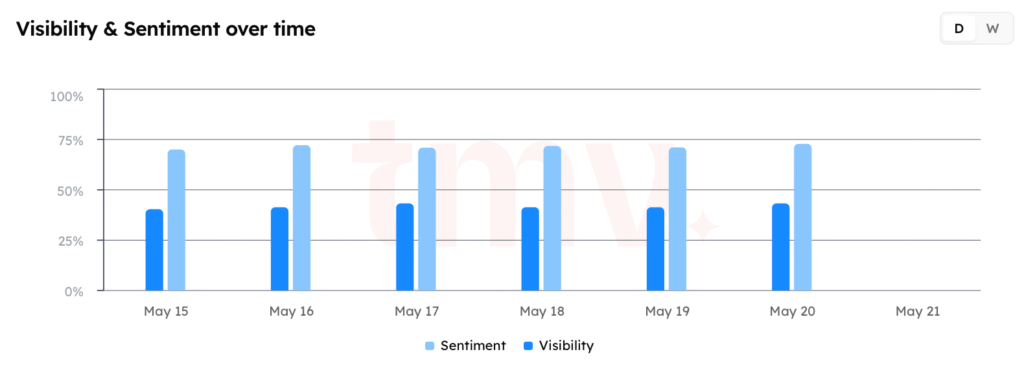
Analyze AI responses across your tracked prompts and classify the framing of your brand as positive, neutral, or negative. You can do this manually or use tools like Track My Visibility to scale sentiment analysis and segment results by prompt type.
Your brand may show strong positive sentiment in awareness queries but shift to neutral or negative in evaluation and decision-stage prompts.
Why it matters:
Sentiment directly impacts trust and recommendations. Third-party sources shape it directly, making source quality critical to how AI answers frame and present the brand.
8. Source Quality
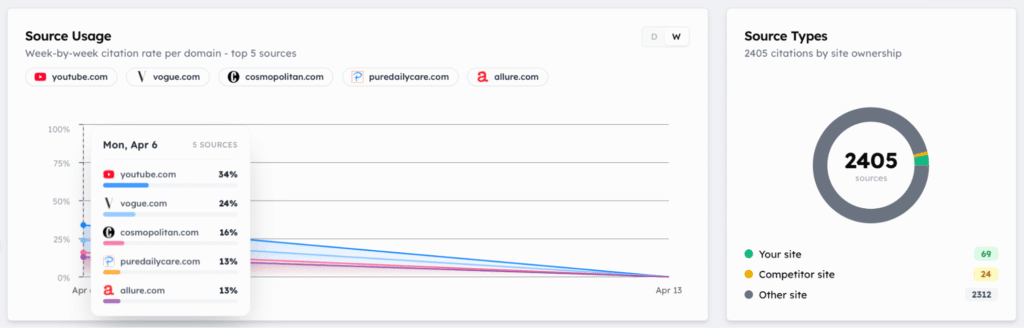
Source quality identifies which third-party publications, review platforms, and external mentions are shaping how AI describes your brand. It shows where AI is pulling its signals from.
How to measure:
Analyze cited sources across AI responses and categorize them by type (reviews, blogs, media, forums) and credibility.
Optimization note:
Prioritize improving or updating high-impact sources that are frequently cited. Strengthen presence on authoritative platforms, address negative or outdated content, and ensure consistent, accurate information across key third-party channels.
Why it matters:
When sentiment is weak or negative, source quality helps pinpoint the exact sources responsible. This makes it one of the most actionable KPIs, as improving or correcting these sources directly changes how AI answers represent the brand.
9. Share of Voice
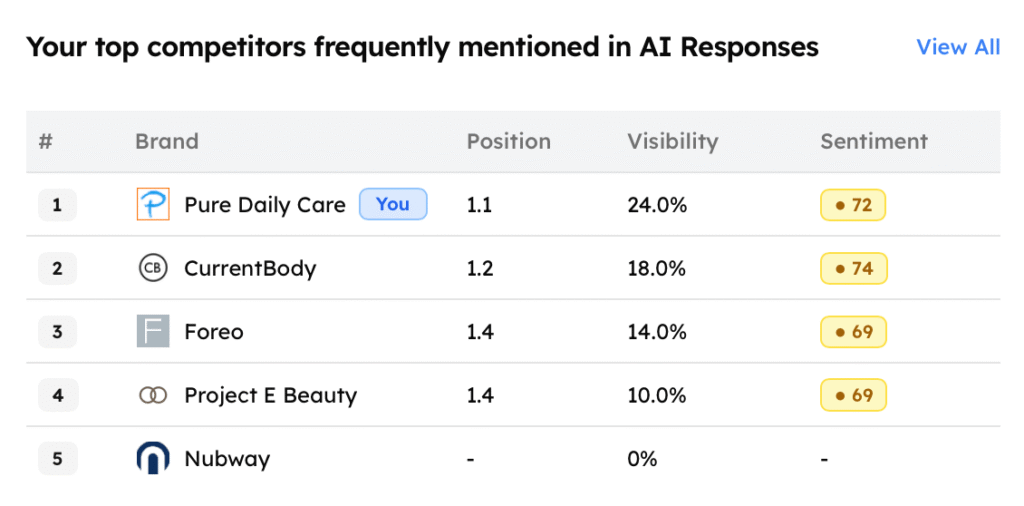
Share of voice measures how often your brand is cited relative to competitors across a defined set of prompts. It shows your visibility in comparison, not in isolation.
How to track and benchmark:
Track how frequently your brand appears across a shared prompt set alongside competitors. Compare your presence across platforms and funnel stages to understand relative performance.
If your brand appears in 40% of tracked prompts while competitors appear in 60%, it indicates a visibility gap. Further segmentation may show a strong presence in awareness queries but weaker coverage in comparison or decision-stage prompts.
Why it matters:
A strong share of voice indicates competitive dominance. It shows where you lead, where competitors outperform you, and where focused improvements can increase your relative visibility.
Actionable Insights:
- Identify prompt categories where competitors dominate and expand content coverage in those areas
- Improve content clarity and structure to increase selection likelihood in AI answers
- Strengthen topical authority by building depth across related queries, not just single keywords
- Analyze competitor positioning and messaging to understand why they are favored
- Continuously track changes to measure impact and adjust strategy over time
10. Prompt Coverage Gap
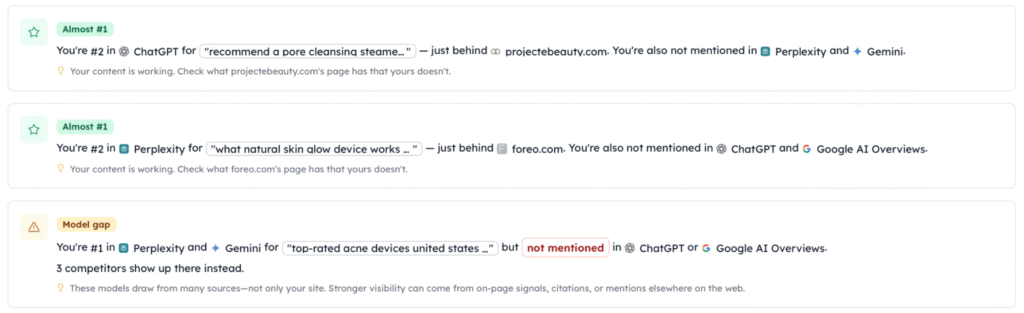
Prompt coverage gap identifies the specific queries where competitors appear in AI responses but your brand does not. It turns visibility data into a clear list of missed opportunities.
How to track:
Compare your presence against competitors across a shared prompt set. Identify prompt queries where AI consistently includes competitors while excluding the brand. Segment these gaps by topic cluster, funnel stage, and platform to locate where they are most concentrated.
Your brand may appear in awareness queries like “what is AI visibility,” but be missing from comparison or decision-stage prompts such as “best AI visibility tools” or “which AI visibility platform should I choose,” where competitors are consistently cited.
Why it matters:
Prompt coverage gaps highlight exactly where you are losing visibility. They provide a direct roadmap for content and optimization efforts.
Pro tip: Wondering which prompts to track for AI visibility? Explore prompt generators to get real prompts people actually ask for AI in your category.11. AI Overview Trigger Rate
AI Overview trigger rate measures how often monitored queries produce an AI-generated answer block rather than standard search results. It shows how often AI is influencing the search experience for your target queries.
How to track:
Monitor a defined set of queries and record how many trigger AI-generated answers. Segment by query type, topic, and funnel stage to identify where AI Overviews appear most frequently.
Informational queries like “what is AI visibility” may trigger AI answers more often than niche or transactional queries, indicating where AI impact is highest.
During Google AI Overview citation analysis, we found that citations from traditional top-10 results have declined significantly, while platforms like YouTube, Reddit, Wikipedia, and Google’s own properties now dominate citation share.
Why it matters:
This KPI helps prioritize which queries are worth optimizing for AI visibility. As AI Overview coverage continues to expand, tracking it monthly reveals trends and helps ensure your strategy adapts to where AI is increasingly present.
12. Branded Search Lift
Branded search lift measures the increase in branded search volume that correlates with improvements in AI visibility. It acts as a proxy for AI-driven discovery when direct attribution is limited.
How to track:
Monitor branded query volume in tools like Google Search Console and compare it against periods where your AI visibility improves. Look for directional patterns rather than exact attribution.
If your branded searches increase from 1,000 to 1,400 per month (+40%) while your visibility rate improves from 30% to 50%, it indicates a strong correlation between AI exposure and, consequently, brand discovery.
Why it matters:
Branded search lift is one of the most reliable indicators of AI impact. It connects visibility in AI-generated answers to real user behavior, showing how AI influences discovery even without direct clicks.
Guide to Tracking Your AI Visibility KPIs
Tracking KPIs is as important as defining them. Without consistent tracking, you cannot identify trends or understand where your brand is gaining or losing visibility in AI answers.
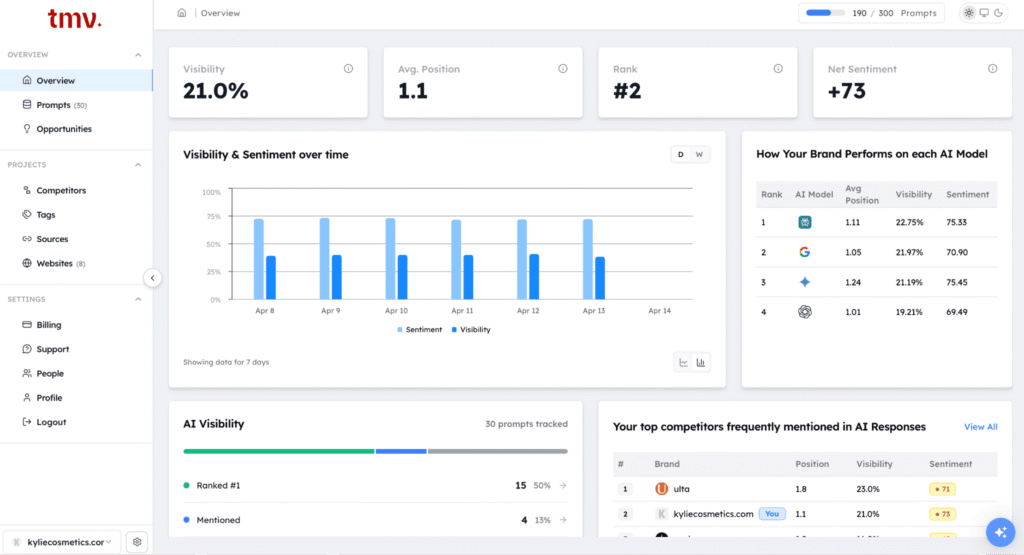
Track My Visibility helps you monitor all key AI visibility KPIs in one place. It provides a clean, easy-to-use dashboard for position, sentiment, and competitor performance across prompts and platforms.
By showing trends over time and breaking down performance by query and AI model, it turns raw data into actionable insights, helping you identify gaps and focus on what to improve next.
Common Confusions & FAQs
AI visibility introduces new measurement challenges. Many traditional assumptions do not apply, making it important to understand what these KPIs actually reflect.
# Is AI Visibility the Same as SEO Rankings?
AI visibility measures whether a brand is selected and cited inside AI-generated answers, not where a page ranks in traditional search results.
# Can Google Search Console Track AI Visibility KPIs?
No. Google Search Console has no record of AI-generated answer appearances, making dedicated AI visibility tools necessary for any meaningful measurement.
# Do More Mentions Mean Better AI Visibility Performance?
Mention volume alone does not indicate performance. It does not reflect position, sentiment, or whether competitors are leading the same response.
# Is Traffic from AI Platforms a Reliable KPI?
No. LLM referral traffic is structurally undercounted because most AI-influenced journeys do not produce a trackable click, making branded search lift and direct traffic more reliable proxy signals.
# Does Improving SEO Automatically Improve AI Visibility?
Strong SEO signals contribute to AI citation likelihood, but AI platforms also evaluate entity clarity, content extractability, and source credibility in ways that require additional optimization.
Start tracking AI search visibility now
AI is already influencing how your brand is represented and recommended. Tracking these signals is no longer optional; it is essential. The earlier you start measuring AI visibility, the better you can understand patterns, identify gaps, and, ultimately, build a long-term strategy.
Consistent measurement of your visibility helps improve presence, positioning, and perception across AI-generated answers. It strengthens domain authority signals, increases prompt coverage, and positions the brand within the right use cases. The AI visibility KPIs covered in this guide give you a structured way to monitor and optimize search performance metrics that traditional SEO simply can’t capture.
To scale this effectively, you need a system that continuously tracks and analyzes these signals. Tools like Track My Visibility help you monitor AI visibility KPIs, benchmark against competitors, and uncover actionable insights, so you can move from observation to optimization.
Start with our 7-day trial to know where you appear across AI platforms.
FAQs
AI visibility KPIs are metrics used to measure how often and how effectively a brand appears in AI-generated answers. They track presence, positioning, sentiment, and competitive performance across different prompts and platforms.
Traditional SEO metrics focus on rankings, clicks, and impressions. AI visibility KPIs focus on whether your brand is selected, cited, and recommended within AI-generated responses. Instead, they prioritize these signals over clicks and rankings, which are less relevant in AI search.
Mentions only confirm that the brand appears in an AI response. They do not show how prominently AI positions it, how AI frames it, or how it compares to competitors in the same answer.
Yes, but indirectly. AI visibility influences brand discovery and decision-making. By combining self-reported attribution and proxy signals like branded search and direct traffic, businesses can estimate their impact on pipeline and revenue.
Start by defining a set of relevant prompts, tracking how your brand appears across AI platforms, and measuring key KPIs like visibility, position, sentiment, and share of voice. Using dedicated tracking tools like Track My Visibility helps automate and scale this process.