


You published the blog post. You optimized the meta tags. Even built a few backlinks. And yet, your brand is nowhere in the AI Search answer.
This isn’t a keyword problem. It’s an authority problem.
AI Overviews now appear in over 50% of all search queries, and that number is expected to cross 75% by 2028 (McKinsey). The brands that show up in those answers aren’t just ranking well; they’re also recognized as the source on their topic. That recognition builds brand authority over time, and that’s what topical authority compounds into.
That recognition is called topical authority, and building it has become the most important content marketing priority for SEO and AEO teams, content strategists, marketing agencies, and eCommerce brands right now.
The rules of AI search vs. traditional SEO have shifted. AI systems don’t rank pages; they evaluate sources. And the brands getting cited are the ones that have built topical authority.
In this blog, you’ll learn:
- What topical authority actually means in the context of AI search
- Why it matters more now than it ever did in traditional SEO
- A step-by-step process to build topical authority using content clusters and topical authority maps
- How LLMs decide which sources to cite
- How to measure your progress and avoid the mistakes that slow most brands down
TL;DR
- Topical authority is about comprehensive, connected coverage of a specific topic, not the volume of content you publish.
- AI systems like ChatGPT and Perplexity associate brands with topics through patterns in training data, not just keyword matches.
- Building topical authority requires a topical authority map: a structured plan covering pillar content, cluster pages, internal linking, and entity signals.
- The measurement goal is shifting from “who ranks” to “who gets cited” in AI-generated answers.
- Brands that build focused, deep topic coverage now will have a significant advantage as AI search continues to grow.
What Is Topical Authority?
Topical authority is the recognized depth of expertise a website demonstrates on a specific subject. It’s not about how many articles you’ve published. It’s about whether your content covers a topic from every meaningful angle, definitions, how-tos, comparisons, use cases, edge cases, and advanced questions.
It is the difference between a website that has one article on email marketing and a website that has an entire library, from beginner guides to A/B testing frameworks to deliverability troubleshooting. Search engines and AI systems both notice that difference.
Topical Authority vs. Domain Authority
| Feature | Topical Authority | Domain Authority (DA) |
| Core Concept | Depth of knowledge in a niche | Overall power of the website |
| Primary Driver | Cluster content and semantic relevance | Backlink profile and site age |
| Search Engine View | Is this site an expert on X? | Is this site trustworthy in general? |
| Metric Type | Qualitative (contextual) | Quantitative (score-based) |
| AI Relevance | High (used for LLM training and citations) | Moderate (standard ranking signal) |
| Growth Goal | Coverage of every sub-topic | Acquisition of high-quality links |
How AI Reads Your Content
Understanding how LLMs choose content is the first step to positioning your brand as a source they return to repeatedly. It’s less about keywords and more about consistent entity associations built over time.
LLMs don’t read your site the way a human does. They learn patterns from training data. If your brand consistently appears in the context of a specific topic, across multiple pages, cited by other sources, and structured clearly. Then the AI model builds an association between your brand and that subject.
That association is what gets you cited. Not a single well-optimized page.
What is the Importance of Building Topical Authority in AI Search?
SEO is still important, but ranking on page one on Google no longer guarantees visibility. Here’s why building true topical authority has become central to any serious content strategy.
1. AI Prioritizes Context Over Keywords
Traditional search rewarded keyword density and backlink volume. AI search works differently. Systems like Google’s AI Overviews and tools like ChatGPT pull from sources that demonstrate consistent, credible coverage of a topic, not just the page that matches a keyword.
And the numbers back this up: only 38% of AI citations overlap with the top 10 organic search results (Ahrefs). That means ranking on page one no longer guarantees you’ll show up in an AI-generated answer. Depth of coverage is doing the work that keyword rankings used to do.
A single well-optimized blog post won’t earn you a citation in an AI-generated answer. A comprehensive source built around interconnected, expert-level content will.
2. Enhanced Visibility in AI Answers
If you’re not already monitoring where your brand appears in AI-generated answers, now is the time to start. Learning how to track your AI search visibility gives you the data to understand which topics are working and which need more coverage.
Zero-click searches now account for 60% of global Google queries (Forbes). The brands appearing in AI-generated summaries are shaping answers before organic traffic ever has a chance to arrive.
3. Demonstrates E-E-A-T
Google’s E-E-A-T framework is amplified by AI. AI systems are trained on web data and pick up the same patterns Google’s quality raters look for.
Content that reflects genuine expertise, clear authorship, and consistent factual accuracy signals authority. Content that doesn’t is increasingly ignored and is absent from AI answers entirely.
4. Improved Content Structure
Building strong topical authority forces you to think about content architecture. Instead of publishing random articles whenever inspiration strikes, you build a deliberate structure with pillar pages, supporting clusters, clear internal linking, and consistent terminology.
And this structure really benefits users and AI systems, who are trying to understand what your brand knows.
5. Long-Term Reliability
Algorithm updates affect individual pages. It builds authority that is more durable. When your brand becomes genuinely associated with a subject, across dozens of related pieces, cited externally, and structured clearly, individual ranking fluctuations matter less. Your overall visibility in that topic space holds.
How to Build Topical Authority in AI Search (Step-by-Step)
A user mentioned on Reddit that the biggest change wasn’t the tools, it was the mindset. Their team stopped asking “what keyword should we rank for next?” and started asking “what topic do we want to fully own?” Publishing fewer articles actually led to more consistent rankings, because every piece had a clear place in the structure.
What actually changed for us when we switched from keyword-first to topical authority
by u/mrtornado79 in seogrowth
That’s exactly what this process is built around.
Step 1: Define Your Core Topic Domain
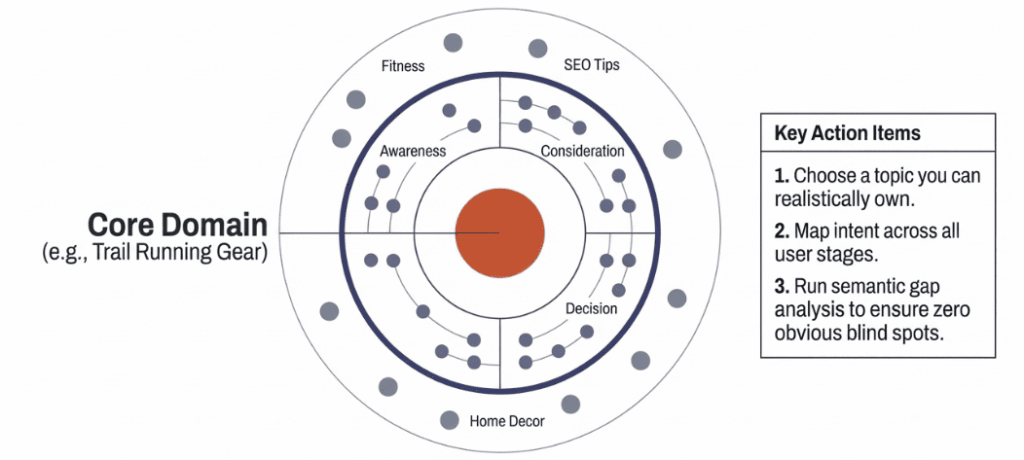
Start by choosing a topic you can realistically own, not everything your brand touches.
Ask yourself: What is the one subject where we can build deep enough coverage to address the entire topic? An eCommerce brand selling running gear doesn’t own “fitness.” They can own “trail running gear” or “running performance for beginners.”
One thing that you should note: trying to cover tangential topics too early sends mixed signals. SEO professionals call this overclustering. If your brand covers trail running, beginner SEO tips, and home décor, LLMs can’t clearly categorize what you’re an authority on.
That confusion makes it harder for you to surface in AI answers. Focus first, then expand.
Step 2: Build Topic Clusters Around Real Queries
Once your core topic is set, map out every meaningful question your target audience actually asks. Don’t start with keyword tools. Start with search intent.
What does a beginner need to know? Where do intermediate practitioners usually get stuck? What decisions do advanced users face?
Content aligns with the intent stage it targets: awareness, consideration, or decision.
Then layer in keyword research. Tools like Surfer SEO, Google’s People Also Ask, and Search Console query data will surface keyword insights to align with each intent cluster. Group related content into clusters, each cluster becomes a supporting page in your topical architecture.
Step 3: Cluster Keywords and Identify Gaps
Run a content gap analysis. Look at what you already have, what competitors rank for, and what’s missing from your coverage.
Strong topical coverage requires no obvious gaps. If someone can find a key question about your topic answered elsewhere but not on your site, you’re signaling incomplete coverage to AI systems.
Use Surfer SEO’s NLP and topical analysis features to identify semantic gaps. Flag every missing subtopic, every question without a dedicated page, and every cluster that exists only as a surface-level post.
Step 4: Map the Content Structure (The Visual Map)
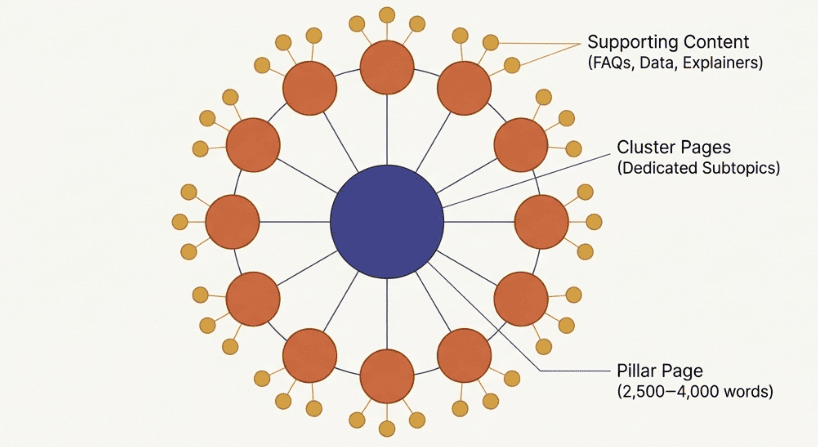
This is where your topical authority map takes shape. A topical authority map is a visual or spreadsheet document that shows your full content architecture. It should capture your key topics, supporting subtopics, and the linking relationships between them.
Structure it like this:
- Pillar page at the center: a comprehensive guide covering your core topic (2,500–4,000 words)
- 8–15 cluster pages branching from it: each targeting a specific subtopic with enough depth to stand alone
- Supporting content around each cluster: FAQs, comparison pages, data-backed posts, beginner explainers
Each cluster page should link back to the pillar. The pillar should link out to every cluster. Related pages should link to each other where the topics genuinely overlap.
Together, these links form a semantic network that maps your expertise clearly. This interconnected structure is what gives AI systems a clear, navigable map of your expertise. It’s not just good for SEO, but it also directly influences your citation rate in AI-generated answers.
Step 5: Plan Semantic Interlinking
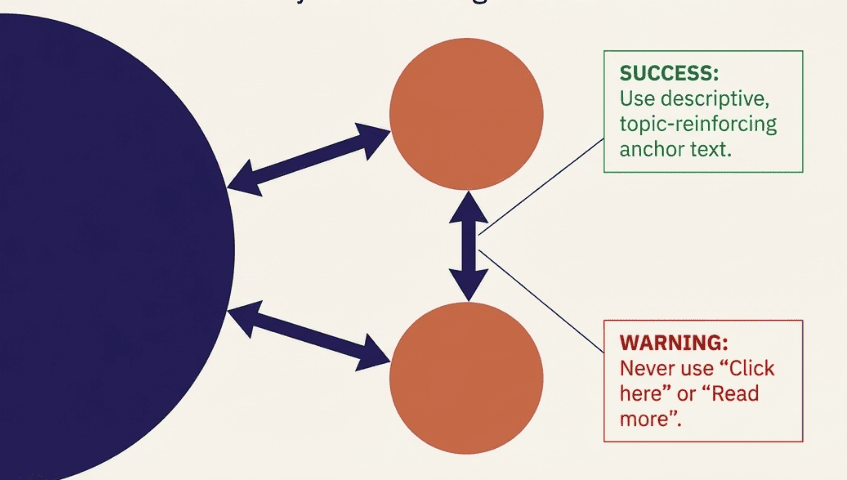
Internal linking isn’t just about passing authority between pages. It tells AI systems how your content relates to itself.
Use descriptive, topic-reinforcing anchor text, not “click here” or “read more.” If you’re linking from a beginner’s guide to your advanced post on the same subject, the anchor text should reflect that relationship clearly.
Build bidirectional links such as pillar to cluster, cluster to pillar, and cluster to cluster where relevant. Avoid orphaned pages; every piece of content in your cluster should have at least one contextual internal link pointing to it.
Using the same keyword and terminology across your cluster is also important. If you call it “content cluster” in one post and “topic hub” in another, you’re diluting the semantic signal. Pick your language and stick to it.
Step 6: Create Content Using AI and Human Expertise
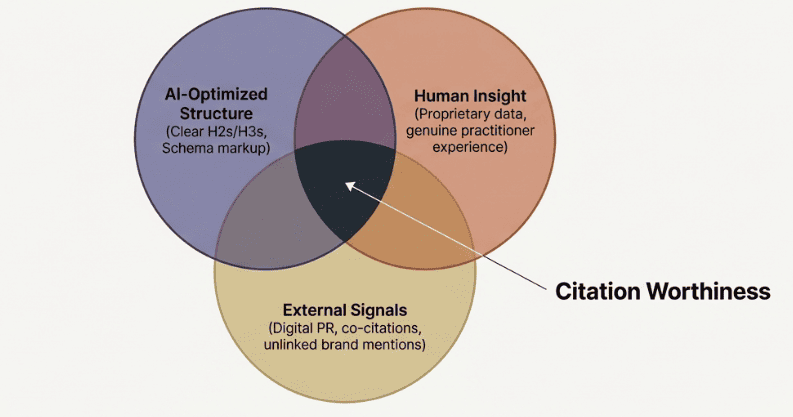
AI tools can help when writing content faster, but AI-generated content alone won’t build topical authority.
What AI systems reward is original research and insight, such as proprietary data, genuine practitioner experience, and a perspective that can’t be replicated by asking ChatGPT the same question your reader just asked. That layer of real expertise is what separates a cited source from content that gets filtered out.
Use AI for research, structure, and drafts. Use human expertise for the insight, the opinion, the case study, and the nuance that makes the content worth citing repeatedly.
Optimize each piece for AI understanding by starting sections with a direct answer. Structure your content with clear H2s and H3s. Use FAQ schema, Article schema, and HowTo schema where appropriate. The clearer the structure, the more extractable the content is for AI Overviews.
Step 7: Build External Signals Around Your Topics
On-site content alone won’t get you cited by AI systems. You also need off-page signals.
Seek mentions from reputable sites, industry forums like Reddit and Quora, and authoritative publications in your space. Digital PR, getting your brand referenced in news articles, expert roundups, and industry reports, directly contributes to your authority signal. When primary sources reference your brand, that association carries more weight than a standard backlink.
Unlinked brand mentions still count. AI systems pick up patterns across the web, not just links. If your brand name consistently appears alongside your core topic in external sources, that association reinforces your authority.
 Pro Tip: Before you start creating content, run a full AEO/GEO audit to understand where your brand currently stands in AI search. The All-in-One AEO & GEO audit checklist from Track My Visibility gives you a structured starting point, covering content gaps, entity signals, schema, and AI visibility, so you’re building on a clear picture, not guesswork.
How LLMs Actually Decide Who Gets Cited

LLMs don’t index pages the way Google does. They associate. Your brand gets linked to concepts through patterns in training data, repeated exposure, consistent coverage, and citation by other credible sources.
To understand why some brands keep showing up in AI responses, it is important to look at how ChatGPT generates answers in the first place. The AI search tool doesn’t search the web the way Google does; it draws from learned associations built during training.
- Co-citation is important because when your content appears alongside recognized authorities in your field, you inherit some of that credibility signal. Being mentioned in the same context as trusted sources reinforces your own authority over time.
- Content freshness directly affects whether AI systems cite you. An Ahrefs study of 17 million citations found that AI-cited content is 25.7% fresher on average than content ranking in traditional search results. A post you published two years ago and never touched is already losing ground to fresher coverage on the same topic.
As Kevin Indig, former SEO Lead at Shopify and growth advisor to some of the world’s largest brands, puts it: “LLMs always prefer fresher information, which means that we need to find ways to keep our content inventory fresh.” - 55% of AI Overview citations come from the top 30% of a page (CXL). If your answer is buried three paragraphs deep, AI will simply pull from a page where it isn’t. Lead every section with a direct answer, then expand. That’s the structure AI Overviews are built to extract from.
Practical tip: Structure key sections with a direct answer in the first 1-2 sentences, then expand. This mirrors how AI Overviews pull content, and it’s also just better writing.
How to Measure Topical Authority in AI Search
Measuring topical authority isn’t like checking a keyword position. You’re tracking signals across two different environments: traditional search and AI platforms. Here’s what to look at in each.
Traditional Signals to Track
Start with keyword cluster rankings. When multiple pages from your cluster start showing up for related terms, not just your pillar page, that’s a sign your authority is being recognized.
Keep an eye on Google Search Console impressions across your topic-related queries. Even when people aren’t clicking, growing impressions across a cluster of related terms tells you your content is surfacing more often.
Indexation speed is another quiet indicator. Once Google sees your site as a reliable source on a subject, new content in that cluster tends to get picked up faster.
AI-Specific Signals to Track
The most direct test is AI Overview inclusion. Test across the major AI engines: Google AI Mode, ChatGPT, and Perplexity. Is your brand showing up? Which questions get you cited and which ones don’t? That gap tells you exactly where to focus next.
Brand mention tracking matters too. Tools like Track My Visibility let you monitor how often your brand appears in AI-generated answers across platforms, so you’re not doing this manually every week.
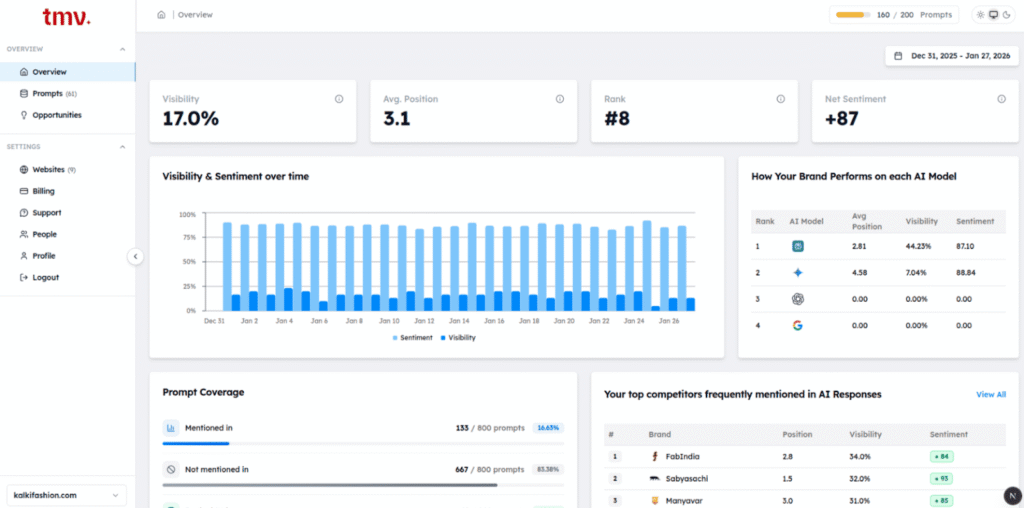
Co-citation frequency is worth watching as well. If your brand is consistently appearing alongside recognized names in your space, that’s a good sign your content is being treated as a peer source, not just filler.
And don’t ignore unlinked mentions. Tracking brand mentions in AI search should be a regular part of your reporting. You’ll often find your brand being referenced in AI answers on pages where you have no backlinks at all.
As AI search grows, search visibility now means presence in both traditional results and AI-generated answers.
The goal is simple: stop measuring only who ranks, and start measuring who gets cited. Your reporting should reflect both.
Pro Tip: Manually checking ChatGPT and Perplexity every week isn’t realistic at scale. Use the free AI visibility checker to monitor your brand’s citation frequency across AI search engines automatically. You’ll see which topics you’re being cited for, where competitors are ahead, and which cluster pages need strengthening, all in one place.Common Mistakes That Undermine Topical Authority
Most brands don’t lose ground in AI search because of bad content. They lose it because of small, avoidable mistakes that quietly chip away at their authority over time. Here’s what to watch out for.
- Publishing Thin Content just to Fill Gaps: More content doesn’t mean more authority. A 400-word post that barely scratches a subtopic actually hurts you. In-depth content is what gets cited. Shallow coverage doesn’t.
- Trying to Cover too many Unrelated Topics: If your brand writes about trail running, SaaS marketing, and home renovation, LLMs genuinely don’t know what to do with you. They can’t categorize you clearly, so they stop surfacing you. Pick your lane and stay in it until you own it.
- Not Adding Internal Links after Publishing: Publishing a new piece and leaving it unlinked is like building a room with no door. The content exists, but nothing connects to it. Every new page needs at least one contextual link pointing to it from a related piece.
- Writing for Keywords, not for People: AI systems don’t count individual keywords. They check whether your content actually answers the question. If you want to rank in AI search, focus on resolving the full user intent behind a query, not just matching the words in it.
- Leaving Old Content Untouched: AI models favor sources that stay current and accurate. A post from two years ago that hasn’t been reviewed is quietly losing citation priority to fresher content covering the same topic. A quarterly content review is worth building into your process.
- Skipping Schema Markup: Structured data helps AI systems understand what your content is about and why it’s credible. FAQ schema, Article schema, and HowTo schema are straightforward to add and genuinely improve how extractable your content is for AI-generated answers.
Topical Authority Checklist for 2026 and Beyond
Building topical authority isn’t a one-time task. Use this checklist before you publish your next piece and run through it once a quarter to make sure nothing is slipping.
Foundation
- You’ve picked a core topic that’s specific enough to realistically own.
- You’ve mapped the full topic universe, covering all subtopics, key questions, and intent stages.
Content Structure
- Your pillar page is live, well-structured, and covers the topic comprehensively.
- You have 8 to 15 cluster pages built around distinct subtopics, all interlinked with the pillar.
- Every cluster page has at least one contextual internal link pointing to it.
Credibility Signals
- Structured data is in place, including FAQ, Article, and HowTo schema where relevant.
- Author bylines, bios, and linked professional profiles are visible on your content.
Ongoing Maintenance
- Content is reviewed and refreshed on a quarterly schedule.
- No high-priority cluster pages are carrying outdated or inaccurate information.
Visibility Tracking
- You’re monitoring AI citations across ChatGPT, Perplexity, Gemini, and Google AI Overviews.
- Linked and unlinked brand mentions are being tracked off-page.
- Cluster growth and AI citation rate are being tracked inside Track My Visibility.
Conclusion
We started with a real problem: you’re doing the work, but your brand isn’t showing up where it matters. That’s not a publishing frequency problem. It’s an authority architecture problem.
Building topical authority for AI search means making a deliberate decision about what your brand is the expert on, and then building a structured body of content that proves it. Pillar pages, content clusters, topical authority maps, internal linking, structured data, and external citations all work together. No single piece carries the weight alone.
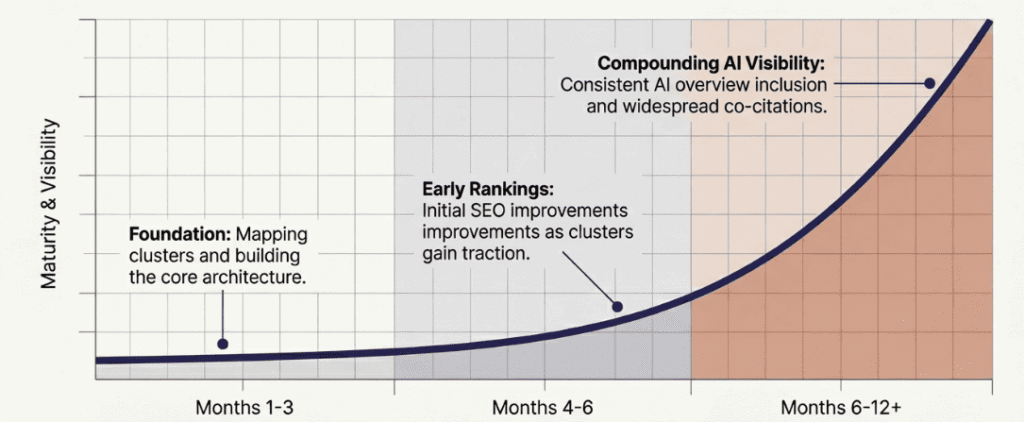
The timeline is realistic but not fast. Expect the first three months to establish foundational coverage, months four through six to show early search ranking improvements, and months six through twelve to deliver compounding AI visibility as your authority builds.
The brands that commit to this now are building something competitors won’t be able to replicate quickly. Topical authority compounds. A rival can copy your articles, but they can’t shortcut the time and consistency it takes to become the source AI systems trust.
Ready to see where you stand today? Track My Visibility lets you monitor your brand’s presence in AI-generated answers, track which topic clusters are gaining traction, and spot the gaps before your competitors do.
Contact us today!
Frequently Ask Questions
Results are gradual. Most brands see initial ranking improvements between months four and six after consistent cluster publishing. Meaningful AI citation visibility typically follows at the six-to-twelve month mark, depending on the competitiveness of the topic and the quality of the content.
Yes, and in some ways it’s an advantage. A new site that commits to a narrow, well-defined topic from the start can build focused authority faster than a large site with scattered, inconsistent coverage. The key is choosing a realistic topic scope and executing it thoroughly.
There’s no fixed number, but 8–15 supporting cluster pages around a pillar is a practical starting point for most topics. What matters more than volume is comprehensive coverage of the topic’s full intent landscape, beginner questions, intermediate how-tos, advanced concepts, comparisons, and FAQs.
Backlinks still help, but they’re not the only path. Strong internal architecture, comprehensive content coverage, structured data, and consistent external mentions (even unlinked) all contribute to AI authority signals. For AI search specifically, the quality and depth of your content ecosystem matter more than raw link volume.
Domain authority reflects your entire site’s link profile; it’s a broad, site-wide metric. Topical authority is subject-specific. A high domain authority site with thin coverage on a topic can still lose out in AI citations to a focused niche site with deep, well-structured content on that same subject.