


You’ve optimized your website, structured content for AI answers, strengthened entity signals, and followed every new “AI-friendly SEO” recommendation.
But do you actually know if any of it is working?
As AI reshapes search, brands are increasingly advised to ensure discoverability and feed high-quality data that will be surfaced by AI tools to maintain credibility in AI-generated answers1. New metrics like “answer inclusion rate” and “entity presence index” are emerging to measure how often algorithms rely on your material and how clearly they recognize your brand as an expert entity 2.
The problem is that most teams still can’t see when, where, or why their brand appears in AI responses. This is why tracking brand mentions across AI platforms has become a critical part of modern brand strategy.
Track My Visibility addresses this problem. It analyzes AI answers across prompts and platforms to show how often your brand is mentioned, cited, and recommended, helping you understand your current AI visibility and uncover opportunities to improve it.
In this guide, we’ll walk through how Track My Visibility helps brands to appear inside AI search results and how teams can use it to monitor their brand performance across AI platforms.
TL;DR
- AI search works differently from traditional SEO ranking; #1 doesn’t guarantee visibility in AI-generated answers.
- Track My Visibility tracks brand mentions, AI citations, sentiment, competitive position, and content gaps across all four major AI platforms, updated daily through prompt-based tracking.
- With insights like prompts, citations, sentiment, and trends, Track My Visibility enables brands to optimize for AI inclusion and improve share of voice over time.
- Track My Visibility helps SEO teams, eCommerce brands, marketing agencies, and executives who want clear insights into how their brand appears in AI-generated answers and where competitors are gaining visibility.
Difference: Traditional SEO Rankings vs AI Search Visibility
First, let’s start by understanding the difference between how traditional search engines rank content and how AI search platforms surface brands.
Traditional SEO follows a crawl-and-rank model. Search engines like Google index web pages and rank them based on signals such as backlinks, keyword relevance, and site authority. Visibility is measured by where your page ranks in search results and how much traffic it receives.
AI search works differently from SEO. Platforms like ChatGPT, Perplexity AI, Google Gemini, and Google AI Overviews generate direct answers instead of a list of links. In doing so, they decide which brands to mention, which sources to cite, and how each brand is described.
This creates a new visibility layer. A brand may rank high in traditional search but still not appear in AI-generated answers. Conversely, brands with lower rankings may appear frequently if their content is well-structured, widely cited, and clearly associated with relevant topics.
Because of this shift, the metrics, optimization strategies, and measurement tools are different. AI search visibility focuses on something traditional SEO tools were never designed to measure: how often your brand appears in AI-generated answers, in what context it’s mentioned, and how it compares with competitors across AI platforms where more discovery decisions are now happening.
Comparative summary:
| Traditional SEO | AI Search Visibility |
| Focuses on ranking pages in search results | Focuses on appearing inside AI-generated answers |
| Success is measured by keyword positions and traffic | Success is measured by mentions, citations, and recommendations |
| Users click through multiple links | AI summarizes information directly |
| Visibility depends on search engine rankings | Visibility depends on whether AI models reference your content |
Why AI Visibility Matters for Your Brand
AI visibility matters because AI tools like ChatGPT, Perplexity AI, and Google Gemini increasingly shape how users discover and evaluate brands. Instead of browsing multiple websites, people often rely on AI-generated answers, making it essential for brands to appear inside those responses.
A recent discussion on this Reddit thread highlights a growing question among founders and marketers: Does AI visibility actually matter? The general sentiment points to a clear shift: while it’s harder to measure, people are increasingly discovering and validating brands through AI tools before visiting websites.
Does AI visibility matter?
by u/Majestic-Context-290 in Entrepreneur
Why?
- AI search behavior is rapidly growing. AI prompts surged about 70% in early 20253, with shopping queries doubling as users bypass traditional search. If your brand isn’t visible in AI answers, it may be excluded from early research and buying decisions.
- Consumers increasingly trust AI recommendations. Many users now rely on AI suggestions when evaluating products and services, with a significant share willing to try new brands recommended by AI platforms.
- AI answers are driving a zero-click environment. AI summaries often resolve searches without users visiting websites, making answer inclusion and citations the new form of visibility rather than just rankings.
- Competitors can dominate the AI share of voice. Even high-ranking SEO pages may not appear in AI answers. Brands that are cited more often gain greater exposure, influence, and credibility.
- AI mentions shape brand perception. Positive or negative references in AI responses can quickly influence public perception, making it important to monitor how your brand is described and cited.
How Track My Visibility helps Brand to appear in AI Search
You’ve optimized your content for AI answers, improved technical SEO, and even structured your pages for AI. But are AI platforms actually picking up your brand? Or are your competitors showing up instead? Track My Visibility changes that by giving you the exact roadmap to get cited and trusted in those responses.
“Our goal isn’t just to help brands show up in AI search. It’s to help them become the answer AI systems rely on.” – Piyush Lathiya
1. Provides an AI visibility score
Ever wonder if your content is truly “AI-ready” or just ranking on page one? TMV gives you a quantified score of how often your brand appears across AI-generated answers.

The AI Visibility Score is a percentage that shows how often a brand appears across all tracked prompts on all monitored AI platforms. If a brand is tracked across 48 prompts and appears in 1 response, the score is 2.08%.
What this tells you:
The score establishes a measurable baseline. As a result, teams can see how much of the AI-generated answer includes their brand and how much competitors dominate. In turn, that baseline makes targeted improvement possible.
2. Track Multi-LLM Performance
Different AIs like Gemini vs. Perplexity favor different content styles, so you’re winning in one but invisible in another. Multi-LLM performance tracking shows exactly how your brand performs across AI models in parallel.
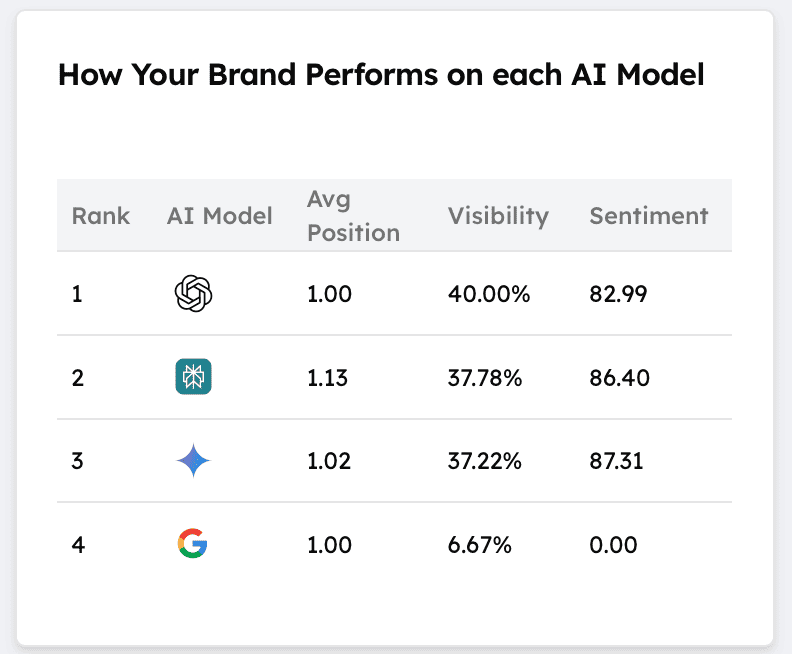
TMV’s Multi-LLM performance tracking runs every prompt across ChatGPT, Perplexity, Gemini, and Google AI Overviews simultaneously every 24 hours, reporting Rank, Avg Position, Visibility %, and Sentiment separately for each platform.
What this tells you:
A brand present on ChatGPT but absent on Gemini and Perplexity is missing the audience those platforms serve. Platform-level data tells teams exactly which AI engines to prioritize so optimization effort goes where the visibility gap is largest.
 Pro Tip: Platform-level gaps are only useful if there is a clear plan to close them. Want to know how to rank in ChatGPT and Google AI Overviews? Explore these ranking strategies for ChatGPT responses and a step-by-step guide to ranking in Google AI overview.
3. Test Prompt-Based Visibility
Customers don’t search keywords. They ask conversational questions like “What is the quality of a men’s clothing brand?”
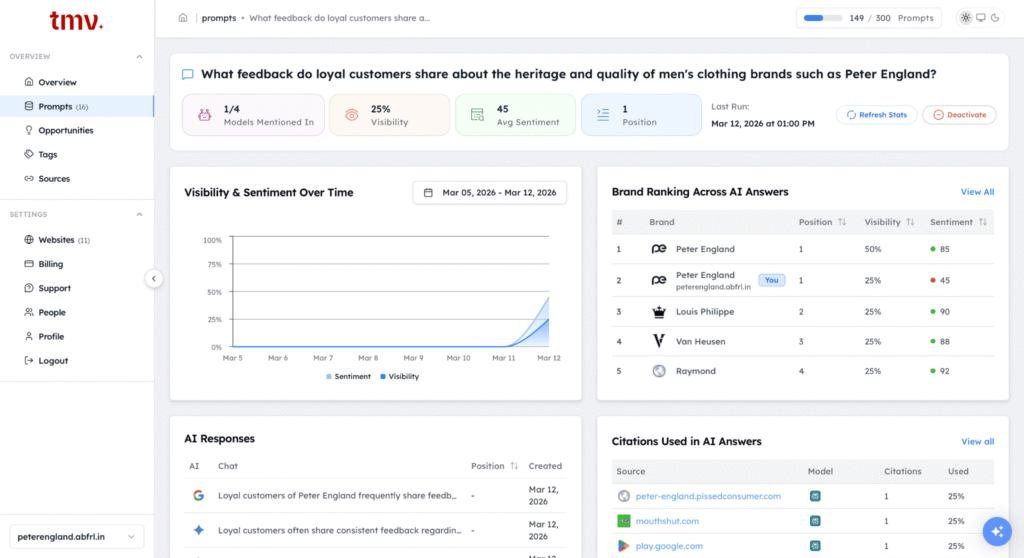
TMV’s Prompt-based visibility tracks brand performance against specific customer questions organized by topic and classified by intent. Each prompt runs daily across all monitored AI platforms.
What this tells you:
TMV shows exactly which customer questions generate AI answers that include the brand and which do not. As a result, teams can identify missing query types and create content that directly addresses those prompts. This, in turn, increases the likelihood of appearing in the AI answers that customers have already read.
4. Monitor Brand Mentions
Your brand might rank #1, but is AI saying “according to [Brand]” or just producing generic fluff? TMV monitors all mentions, explicit, implicit, or misattributed, across AI responses.
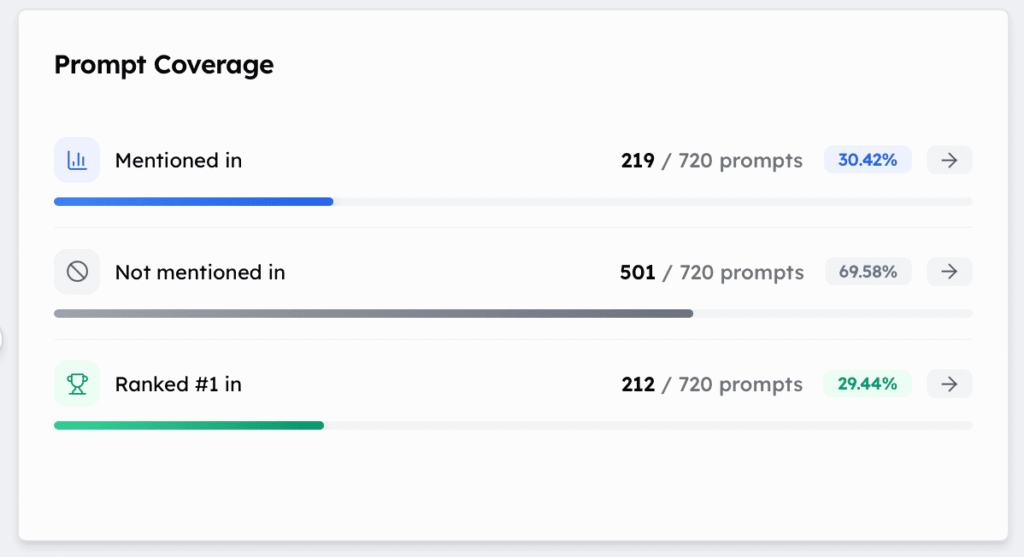
TMV’s Brand mention monitoring tracks how often the brand is directly named in AI-generated answers, how many prompts it was absent from, and how many times it ranked first in a response.
What this tells you:
A low mention rate across tracked prompts quantifies exactly how much of the AI answer landscape the brand is missing. More importantly, it separates two distinct problems: prompts where the brand is mentioned but not cited, and prompts where it is cited but not named. Each pattern points to a different fix, allowing teams to take precise action rather than broadly producing more content.
5. Track Rank & Position
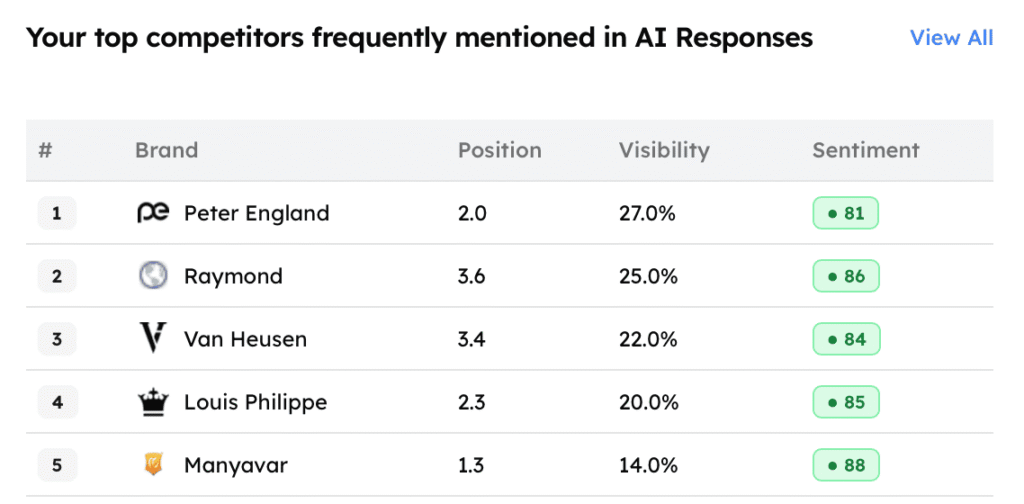
In AI search, position one is not a SERP ranking; it is the first brand an AI answer recommends.
TMV tracks rank and position at both the account level and the individual prompt level, showing where the brand sits in each AI answer relative to every other brand mentioned in that same response.
What this tells you:
Appearing in an AI answer at position 4 behind three competitors is technically visible but strategically weak. Position data reveals which prompts the brand needs to move up in order to rank for maximum AI search visibility. This makes it possible to study what the brand ranked above it is doing differently, whether that is content depth, citation authority, or structural formatting that AI models favor.
6. Benchmark Competitors
You’re top 3 on Google, but your rival gets cited 3x more in AI shopping answers. Ranking above competitors on Google does not mean ranking above them in AI search.
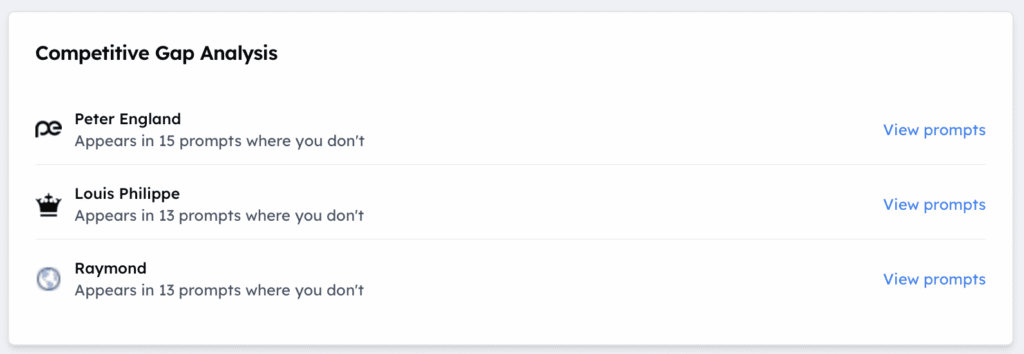
TMV’s Competitor benchmarking tracks named competitor domains alongside the brand across all prompts, surfacing each competitor’s visibility, position, and sentiment scores. The Competitive Gap Analysis identifies exactly which competitors appear in prompts where the brand does not.
What this tells you:
When the dashboard shows a competitor appearing in 12 prompts where the brand is absent, those 12 prompts become the immediate content priority. Teams can identify topics where competitors have established AI visibility while the brand has not. As a result, they can turn visibility gaps into specific, actionable content briefs.
7. Track Citations & Sources
AI builds its answers from sources. Knowing which sources and whether the brand is one of them is what citation tracking reveals.
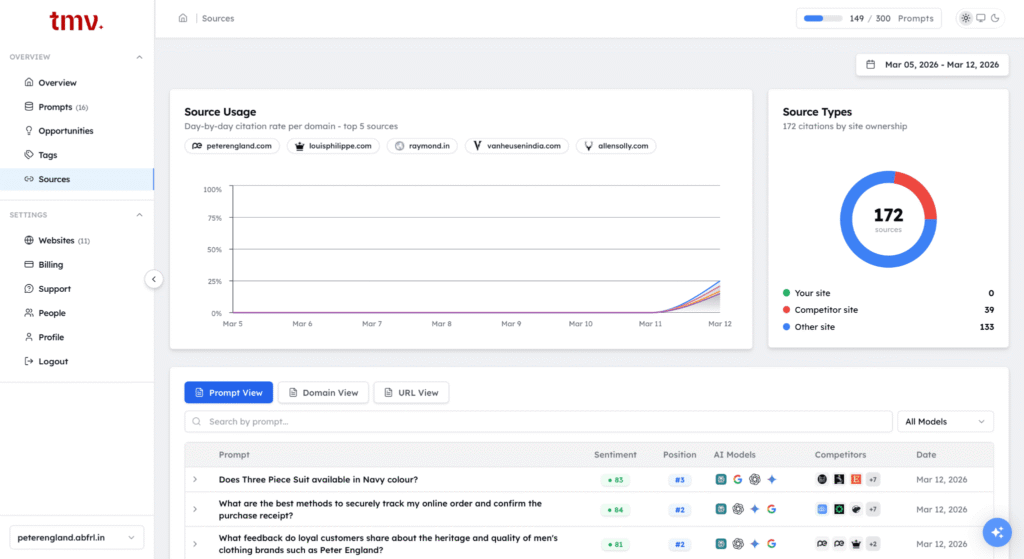
TMV’s Citation and Source Tracking identifies every URL AI models use to generate answers across tracked prompts. It classifies each source as the brand’s site, a competitor site, or a third-party domain, while also showing usage rates and which AI models reference each source.
What this tells you:
When competitor and third-party URLs dominate sources, the cause of low visibility becomes clear. The brand’s content may block AI crawlers, lack structure, or miss important authority signals. Source tracking also reveals which platforms and third-party sites shape AI-generated answers.
This helps teams prioritize the off-site channels that matter most for citations.
Pro Tip: Source dominance by competitors isn’t just a content problem; the data shows it’s a structural pattern across industries. Curious about where the industry actually stands today? See how AI platforms are actually selecting and citing sources in AI search statistics 2026.8. Analyze Sentiment & Context
A brand can appear in AI answers and still be losing if it is consistently framed as the second-best option.
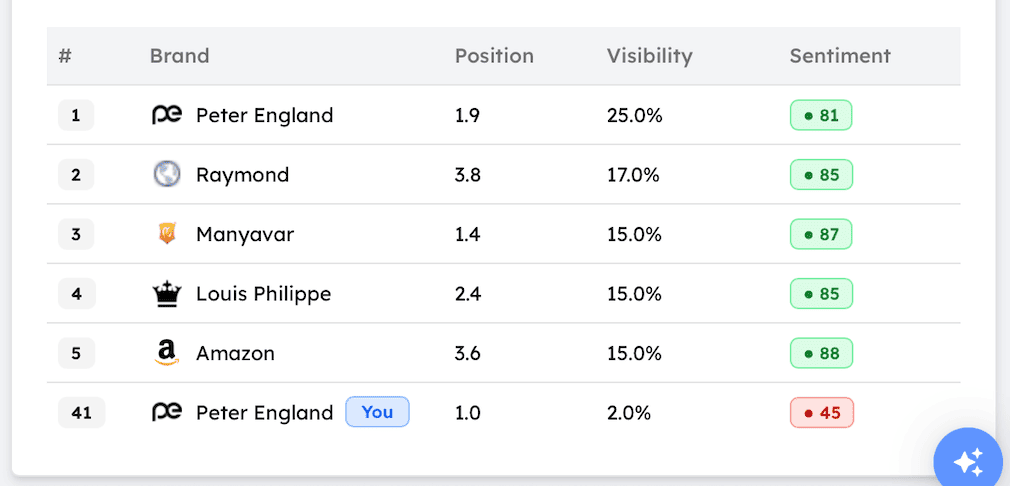
TMV tracks sentiment at the account level, per prompt, and per AI model, giving a clear read on how positively or negatively the brand is being characterized in AI-generated answers across each platform.
What this tells you:
A brand appearing in AI answers with a sentiment score is being characterized less favorably when it does appear. Low sentiment scores point directly to the sources shaping AI narratives: complaint forums, low-authority review sites, or off-brand editorial content being retrieved. Identifying those sources is the first step to correcting the narrative and improving how AI models represent the brand.
9. Track Visibility Trends Over Time
One strong week in AI citations could be a coincidence. A consistent upward trend means the strategy is working.
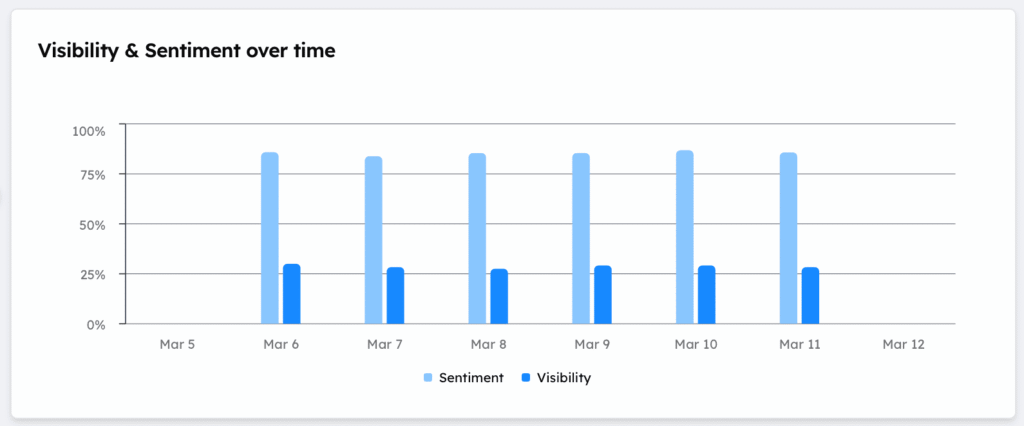
TMV’s trend tracking plots Visibility % and Sentiment over a selectable date range at both the account level and individual prompt level, giving teams a chronological view of how tracking AI search over time helps in evaluating performance.
What this tells you:
When a content change, schema update, or citation-building effort is followed by a measurable visibility increase, the connection becomes visible and repeatable. Without trend tracking, teams optimize without knowing whether their actions are working. With it, improving AI search appearance becomes an iterative, evidence-based process.
10. Identify Opportunities & Fixes
Data without action is just a report. TMV connects visibility gaps directly to what needs to be done next.
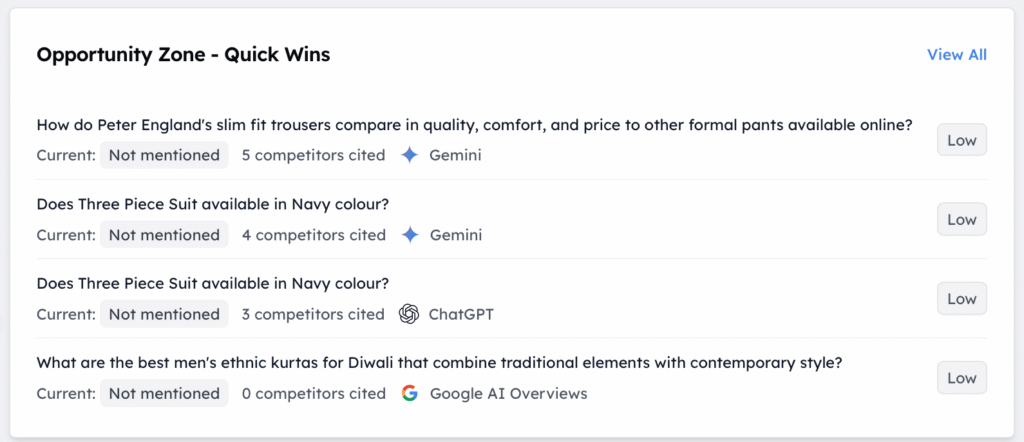
The Opportunity Zone surfaces prompts where the brand is not mentioned, but named competitors are being cited, showing how many competitors appear and on which AI platform.
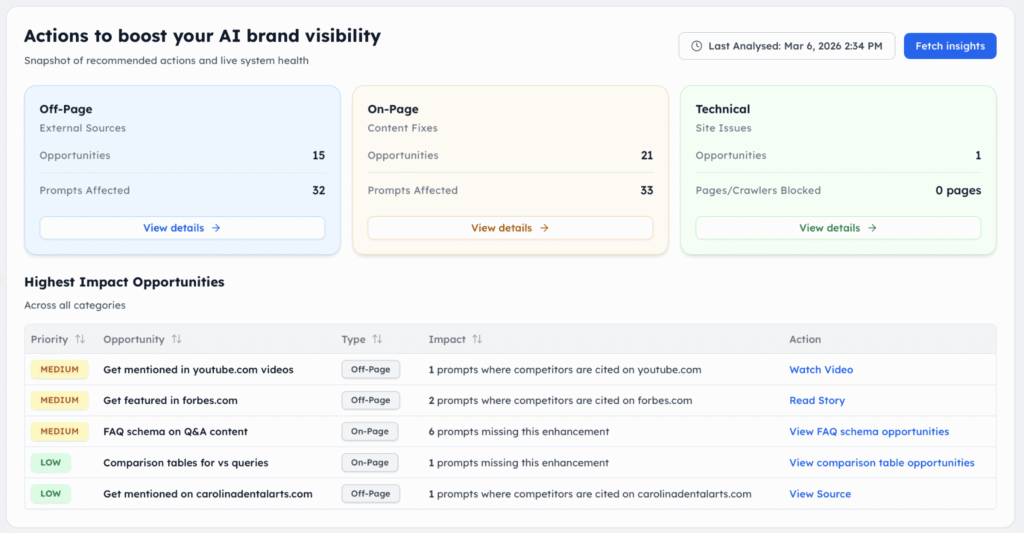
The Opportunities dashboard categorizes actionable fixes into Off-Page (external sources), On-Page (content fixes), and Technical (site issues), with the number of prompts affected per category.
What this tells you:
Teams get clarity on where visibility is low, which prompts to target, what fixes are required, and how to strengthen citation quality. As a result, the dashboard becomes a working brief instead of just a reporting tool. This helps teams map, prioritize, and execute the path toward stronger AI search visibility.
Pro Tip: Refining AI visibility strategy is easier when there is a clear picture of which sources are cited in AI-generated answers. Review this comprehensive AEO GEO audit checklist for citation signals to identify which prompts are worth tracking.Who Uses Track My Visibility
Track My Visibility is designed for teams that need to understand how their brand appears when AI models choose content to form answers. As AI platforms increasingly influence discovery and vendor research, multiple roles across an organization benefit from monitoring AI visibility and citations.
# SEO Teams
For SEO professionals, ranking on search engines is no longer enough. With Track My Visibility, SEO teams can track which prompts trigger AI citations, identify the URLs AI models reference, and benchmark visibility against competitors. As a result, teams can better align content strategies with how AI platforms surface information. This also helps ensure pages are optimized for AI-generated answers.
Pro Tip: AI visibility strategy sits at the intersection of AEO and GEO, two disciplines that are reshaping how SEO teams approach content and authority. For a clear breakdown of what these terms mean and how they change traditional SEO workflows.# eCommerce Brands
AI assistants increasingly influence product recommendations and purchase decisions. eCommerce teams can use Track My Visibility to monitor when product or category pages are cited in AI responses and identify which content AI trusts for recommendations. These insights help brands improve product visibility and capture demand directly from AI-driven discovery.
# Marketing Agencies
Agencies need to demonstrate measurable outcomes beyond traditional SEO metrics. Track My Visibility enables agencies to provide clients with AI visibility reports, competitor benchmarking, and citation insights across platforms like ChatGPT, Claude, Perplexity AI, and Google Gemini, turning AI visibility tracking into a valuable client reporting and growth service.
# Executives & Growth Leaders
For leadership teams, Track My Visibility provides a high-level view of brand authority across AI ecosystems. In particular, dashboards showing share of voice, competitor coverage, and AI citation trends help executives understand brand positioning in AI-driven discovery. As a result, leaders can identify visibility gaps and uncover new growth opportunities.
How Much Does It Cost?
Many tools in the emerging AI SEO and visibility tracking space come with enterprise-style pricing. As a result, smaller teams, startups, and agencies exploring AI search monitoring often face high costs. Consequently, these tools can become difficult to justify early on.
Track My Visibility takes a different approach. Instead of positioning AI visibility tracking as an enterprise-only capability, TMV makes it accessible and affordable, with plans starting at one of the lowest price points in the market.
The platform also offers two months free on the yearly Growth plan, making long-term tracking even more cost-effective.
Track My Visibility Pricing Plans
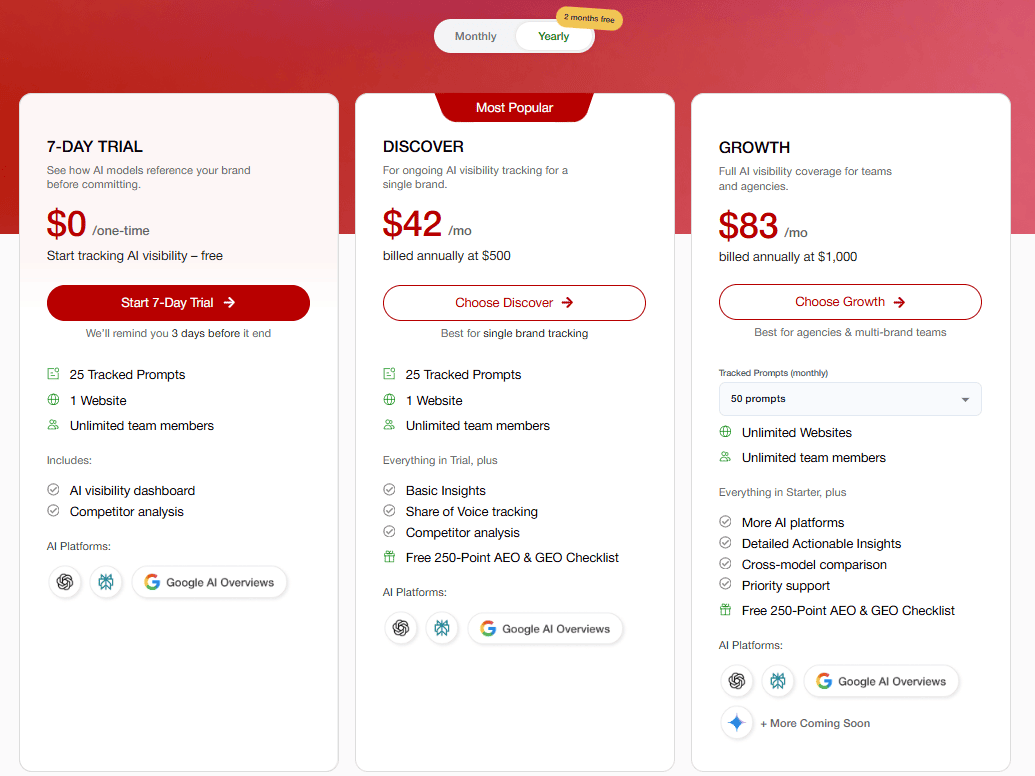
- Discover Plan: $42/month
Designed for individuals or small teams starting to monitor brand visibility in AI search. - Growth Plan: $83/month
Includes expanded prompt tracking and more advanced monitoring features.
Yearly billing includes 2 months free.
These flexible plans make Track My Visibility accessible whether you’re experimenting with AI visibility tracking or running ongoing monitoring across multiple prompts and competitors.
Note: Refer to the updated pricing page for further breakdown.
Ready To Monitor Your AI Visibility
Ranking in AI search doesn’t happen overnight. It takes time to build presence, and tracking how your brand appears across different AI platforms can quickly become complicated.
If your brand is still new and building its digital presence, AI visibility may be limited at first. That’s expected. The important part is discovering where you stand today and where opportunities exist to start appearing in AI answers.
Track My Visibility helps to make your brand visible by turning AI responses into clear, actionable insights showing where your brand is mentioned, where competitors appear instead, and where the next opportunities lie.
Start tracking where your brand actually stands in AI search. Run a quick audit and get your free AI search visibility checker to see how your brand currently shows up across major AI platforms.
FAQs
Track My Visibility monitors brand mentions and citations across ChatGPT, Perplexity, Gemini, and Google AI Overviews daily. Set up an account, add tracked prompts that mirror real customer queries, and the dashboard surfaces exactly where the brand appears and where it does not.
Google rankings and AI search visibility operate on entirely different logic. AI platforms select brands based on content structure, citation authority, and how clearly a brand’s expertise is communicated, not keyword position.
TMV’s multi-LLM performance dashboard breaks down visibility, position, and sentiment separately for each AI platform, showing exactly which engines mention the brand and which do not.
AI models favor brands whose content is well-structured, frequently cited across authoritative sources, and clearly associated with specific topics.
TMV’s Competitive Gap Analysis and Opportunity Zone surface exactly this naming, which competitors appear in prompts where the brand is absent, and how many such prompts each competitor holds.
Content structure, schema markup, citation authority, and prompt-aligned topic coverage are the primary levers.
References
1. Consumers are twice as likely to trust AI over family and friends for recommendations
2. AI is rewriting visibility in the zero-click search era
3. How Customers Are Using AI Search