


Publishing more content has never been easier. Ranking for it has never been harder.
As AI-generated content floods the web, Google Search faces a growing challenge: separating genuinely helpful, credible information from content manufactured purely to capture search traffic.
The answer, at least in part, is Google E-E-A-T guidelines, a framework rooted in Google’s Search Quality Rater Guidelines that evaluates content quality across four dimensions: Experience, Expertise, Authoritativeness, and Trustworthiness.
Google’s algorithms are increasingly trained to recognize and reward these E-E-A-T quality standards, and for brands targeting to rank in Google AI Overviews or any other AI platform, building those signals is now a prerequisite for citation eligibility.
This guide will walk you through what E-E-A-T signals look like, how Google evaluates them, and how to build them systematically.
TL;DR
- Google E-E-A-T measures Experience, Expertise, Authoritativeness, and Trustworthiness, with trust as the core signal.
- E-E-A-T is not a direct ranking factor, but Google rewards content that aligns with it, especially for YMYL topics.
- Credibility comes from on-page signals, off-page reputation, and technical trust signals like schema and entity consistency.
- AI-generated content is acceptable if it includes real expertise, originality, and human oversight.
- E-E-A-T and AI citations now rely on the same trust and authority signals.
What are Google E-E-A-T signals, and what do they mean?
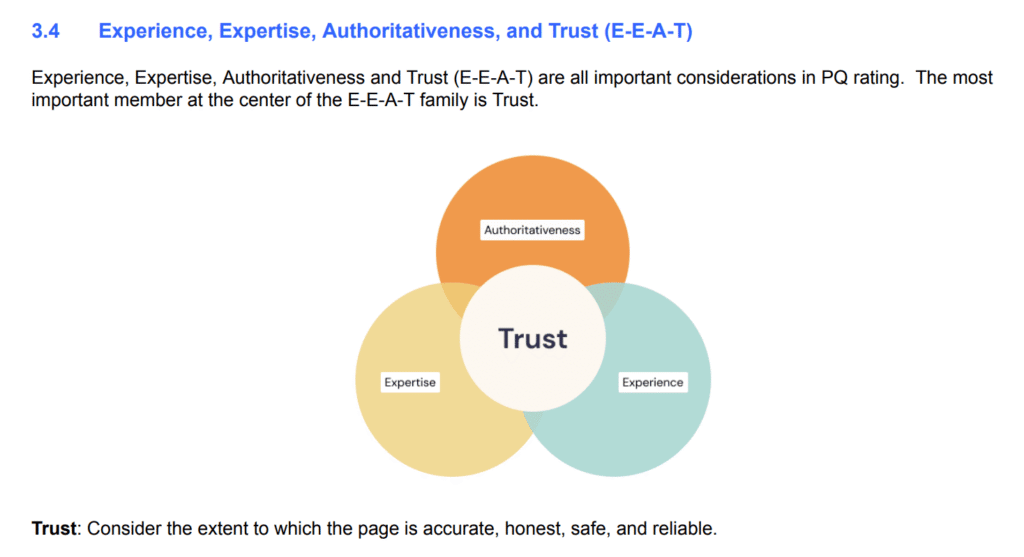
Google E-E-A-T signals are specific indicators Google uses to assess content quality through its Search Quality Rater Guidelines and algorithms, focusing on Experience, Expertise, Authoritativeness, and Trustworthiness.
These signals operate at three levels: document (individual page), domain (site-wide), and source entity (author/publisher). They help prioritize helpful, reliable web pages over low-quality or misleading material, and they influence search rankings indirectly by training AI systems via human raters, with stronger emphasis on YMYL topics like health or finance.
Experience
Experience refers to first-hand, real-world involvement with the topic beyond just theoretical knowledge. Google looks for evidence of this through:
- Personal experiences, testing results, or practical examples (e.g., “I tested this appliance for 6 months”).
- Social media posts sharing genuine user experiences.
- Quality content showing process photos, case studies, or hands-on demonstrations.
Expertise
Expertise reflects deep subject matter expertise, skills, or credentials in the relevant field. Google looks for signals like:
- Blog post with author bios with relevant qualifications, certifications, or professional background.
- Use of specialized vocabulary, comprehensive topic coverage, and original insights.
- Grammar quality, professional layout, and error-free technical accuracy.
Authoritativeness
Authoritativeness measures the creator’s or site’s recognized reputation and influence on the topic. Google evaluates via:
- High-quality backlinks from reputable sites and proximity to trusted “seed” domains.
- Consistent high search rankings, brand mentions in queries, and topical authority via interlinked content.
- Source entity metrics like publication volume, citations, and entity popularity.
Trustworthiness
Trustworthiness gauges overall reliability, transparency, and security of the source. Google checks for:
- HTTPS, clear about us/contact pages, and verified business info (e.g., consistent NAP).
- Factual accuracy via citations, update frequency, and absence of misleading claims.
- User engagement patterns like dwell time, CTR, and low inappropriate content flags.
Why are Google E-E-A-T signals important for SEO?
Google E-E-A-T guidelines are crucial for search engine optimization because they help guide Google’s algorithm to reward high-quality content over spammy or misleading pages. This, in turn, improves visibility in searches (SEO) and increasingly in AI-driven discovery channels like AEO and GEO.
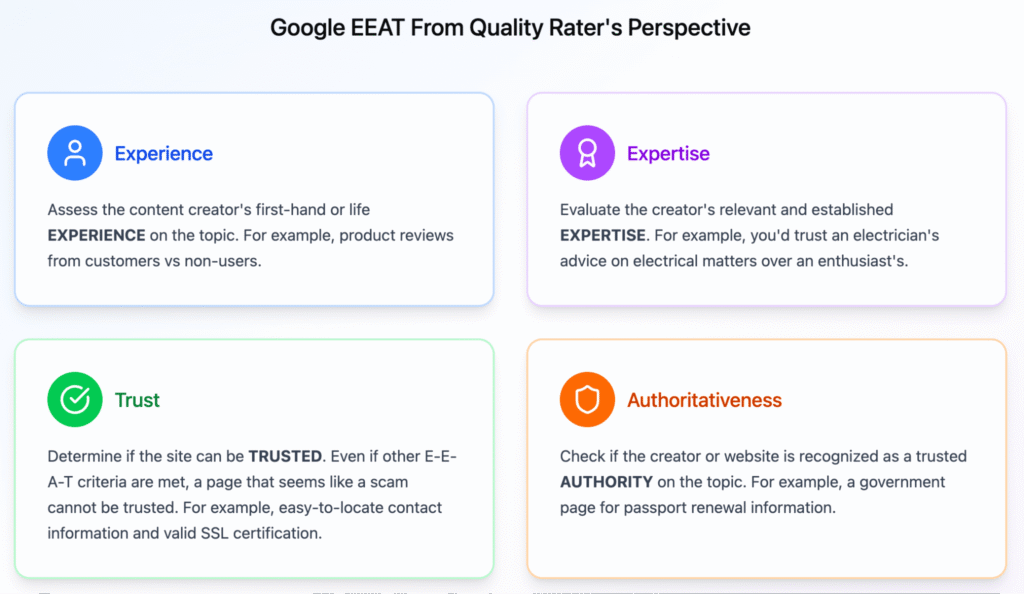
Content Quality and Ranking Signals: E-E-A-T acts as a core content quality indicator, signaling to algorithms that content is helpful and reliable rather than manipulative or thin. This directly influences search rankings by prioritizing pages with strong signals over low-quality pages.
Impact on Search Visibility: Strong E-E-A-T boosts search visibility in search engine results pages, particularly for YMYL topics, as it helps site owners withstand core updates and secure top positions through sustained authority.
User Trust and Engagement: Demonstrating E-E-A-T fosters user trust, resulting in higher user engagement metrics like dwell time, lower bounce rates, and organic shares and backlinks that amplify search engine optimization.
Perspective of Google’s Quality Rater Guidelines: Quality raters use E-E-A-T to evaluate pages, providing feedback that trains AI systems, ensuring algorithms favor authoritative and trustworthy sources and demote misleading ones over time.
 Pro Tip: E-E-A-T signals now influence whether AI systems cite a brand, but AI search platforms evaluate authority differently from traditional search engines. See AI Search vs SEO: Key Differences to understand the biggest gaps.
How Google Evaluates E-E-A-T
Google evaluates E-E-A-T through its Search Quality Rater Guidelines at three levels: document (page), domain (site-wide), and source entity (author/publisher) using human raters’ feedback to refine algorithms.
Ratings range from Lowest to Very High E-E-A-T, applied to page quality scores. Raters are justifying based on visible signals like credentials, content quality, and reputation.
Lowest EEAT
Chapter 4.5.2 of Google’s Search Quality Rater Guidelines states that if the E-E-A-T of a page is low enough, people cannot or should not use the content on that page. Google rates highly inexpert YMYL content as untrustworthy and gives it the Lowest rating.
The same applies when a website or content creator carries an extremely negative reputation to the extent that many people would consider the page untrustworthy.
At this level, no other positive signal compensates. The lowest rating reflects a fundamental failure of credibility.
Lacking EEAT
Chapter 5.1 from Google’s quality rater guidelines identifies the markers search quality raters look for when evaluating low E-E-A-T. Google’s guidelines list the following examples directly:
- A restaurant review written by someone who has never eaten at the restaurant.
- An article about how to skydive, written by someone with no adequate expertise in the subject.
- Tax form downloads are provided on a cooking website.
Google adds an important clarification: a positive reputation elsewhere cannot overcome a lack of E-E-A-T for the specific topic or purpose of the page.
High EEAT
Chapter 7.3 of Google’s quality rater guidelines describes High E-E-A-T pages as trustworthy or very trustworthy. Google notes that experience is valuable for almost any topic and that even informal formats can qualify. Social media posts and forum discussions are often high-quality when they involve people sharing direct experience.
Very High EEAT
Chapter 8.3 from Google’s quality rater guidelines identifies Very High E-E-A-T as the distinguishing factor for the highest quality pages. According to Google’s guidelines, a website or content creator that is the uniquely authoritative or trustworthy source for a topic must meet this threshold. A content creator with a wealth of experience may qualify where experience is the primary factor in trust.
Example:
Consider NerdWallet, a personal finance platform that demonstrates E-E-A-T across all four dimensions, making it one of the most frequently cited examples in the YMYL category.

Experience: NerdWallet’s content is produced and reviewed by writers and editors who have direct, professional experience in the financial products they cover.
Expertise: Every article in a regulated subject area carries a named author and expert reviewer with certified financial planners, CPAs, licensed insurance professionals, and university professors.
Authoritativeness: The platform has a Wikipedia entry, a Nasdaq listing(NRDS), and its contributors are regularly quoted in outlets including The New York Times, The Wall Street Journal, Forbes, and Bloomberg.
Trustworthiness: The site publishes a transparent editorial standards page, clear author and reviewer attribution on every article, a dedicated methodology page for ratings and reviews, and visible contact information.
For a complete audit across all four signal areas, look out for this TMV’s Google E-E-A-T Audit Checklist covering all 40 signal items with performance rating to track improvement over time.
Key Signals That Demonstrate E-E-A-T
E-E-A-T credibility signals operate across three layers: what appears on the page, what exists about a brand across the wider web, and how the site’s technical infrastructure presents that information. A fourth layer, the relationships Google maps between all of these, determines how far that credibility extends.
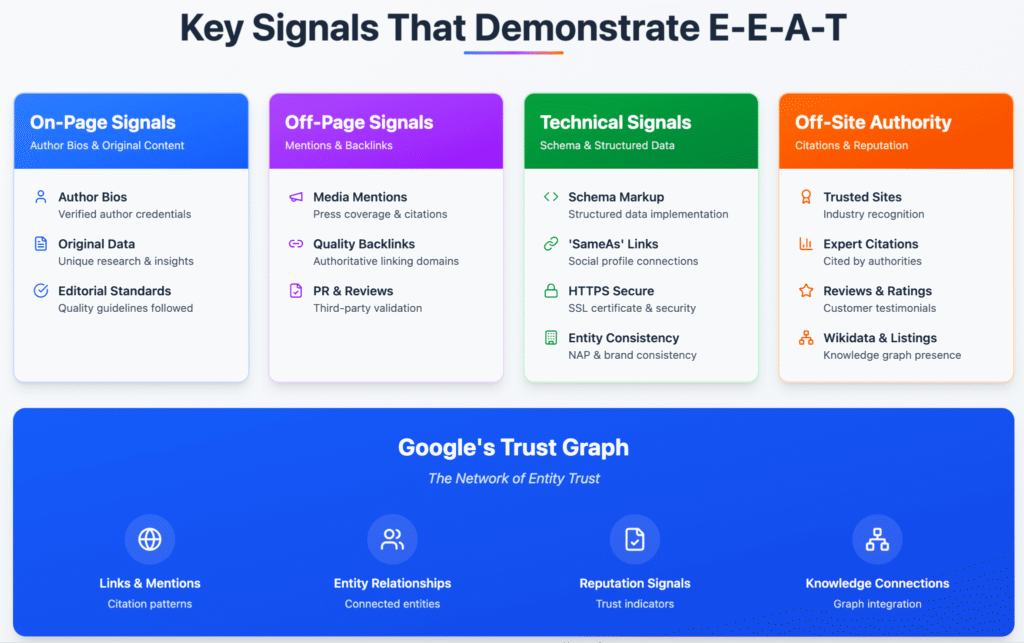
On-Page E-E-A-T Signals
On-page signals are the most direct way to demonstrate expertise, experience, and trustworthiness. Google asks three foundational questions about every piece of created content: who created it, how it was created, and why.
Key signals:
- Named author bylines are linked to credible author pages with documented background and relevant qualifications.
- Original data, first-hand testing, and case studies that cannot be found elsewhere.
- Visible publication and update dates confirming content is current.
Off-Page E-E-A-T Signals
Authoritativeness is assigned by the broader web through those who reference, cite, and recommend a brand without being prompted.
Key signals:
- Brand and author mentions on an external reputable website, with or without a direct link.
- Features, interviews, and quotes in industry publications and authoritative sites.
- Wikipedia or Wikidata presence establishes the brand at the knowledge graph level.
Technical E-E-A-T Signals
Technical signals make existing E-E-A-T legible to Google’s crawlers and search engines. Structured data removes ambiguity about who produced content and how the brand relates to its subject area.
Key signals:
- The organization schema establishes the brand with defined properties.
- SameAs property connecting the website to LinkedIn, Wikipedia, Wikidata, and other authoritative sites.
- FAQ and HowTo schema to structure content for AI extraction and featured snippet eligibility.
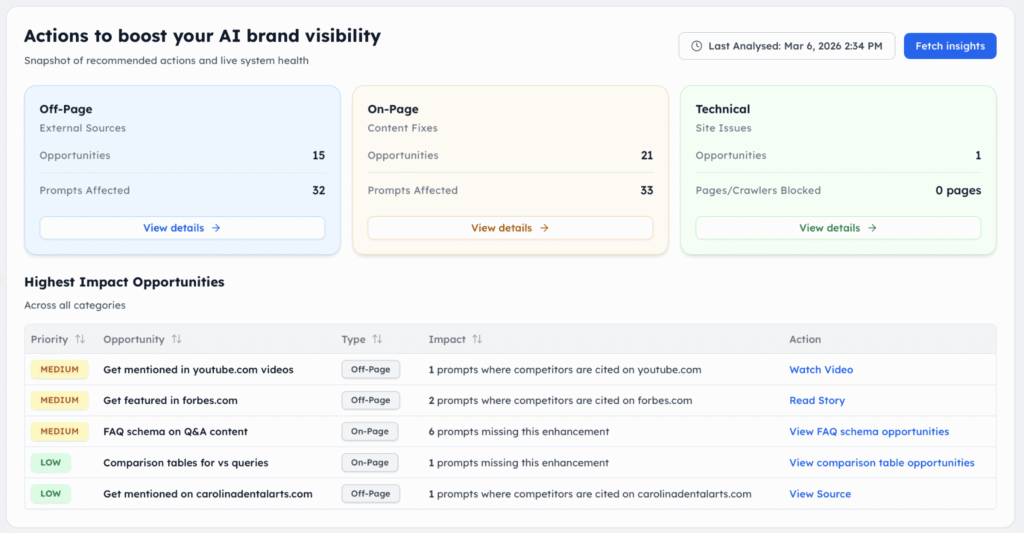
Monitoring these signals with AI visibility tools like Track My Visibility helps track brand appearance inside AI responses and identify key areas for enhancement with actionable insights.
Google’s Trust Graph
Behind all individual signals sits a structural layer that Google uses to map relationships between entities, domains, content creators, and topics. A brand that publishes strong content, earns mentions from trusted sources, maintains consistent entity signals, and demonstrates topical authority becomes a recognised node in that network. This is why tracking your brand mentions is important, as it helps you understand and strengthen your position within that ecosystem.
How to Improve Your E-E-A-T
Improving E-E-A-T involves strategic content creation, reputation building, and technical optimization to align with Google’s search quality raters’ guidelines and boost SEO performance.
Creating Helpful Content
Google’s people-first content strategy is the clearest articulation of what E-E-A-T looks like in practice. Helpful Content earns trust when it is created primarily to help a defined audience.
Practically, this means:
- Creating content that provides original information, reporting, or analysis beyond what already exists.
- Depth and completeness that leave the reader with no need to search elsewhere.
- A clear match between the content’s subject matter and the brand’s genuine expertise.
The test Google applies is simple: would someone bookmark this, share it, or recommend it? If the honest answer is no, the content does not meet the people-first threshold, especially when trying to optimize content for AI answers.
Build Your Brand Reputation
Reputation is the off-page dimension of E-E-A-T. It is earned through consistent external recognition over time.
Key reputation-building actions:
- Earn mentions and coverage in industry publications, news outlets, and authoritative sources.
- Build author visibility, get contributors quoted, interviewed, and referenced outside the site.
- Develop a Wikidata or Wikipedia presence to establish entity recognition at the knowledge graph level.
- Maintain consistent brand information across all platforms, name, description, category, and contact details.
Pro Tip: Don’t want to lose AI visibility for your brand? See where your brand already appears in AI responses and where it doesn’t. Those gaps often reveal the biggest opportunities. Run a quick audit and get your free AI visibility report to see how your brand currently shows up across major AI platforms.Use Credible Sources
Citing credible sources is both an expertise and a trustworthiness signal. It tells Google and readers that claims are grounded in accurate and reliable information rather than assertions.
Best practices:
- Link to primary sources: peer-reviewed research, official documentation, government data, and recognised institutional publications.
- Attribute statistics and data points directly to their origin.
- Avoid citing secondary aggregators when the primary source is accessible.
- Where original research or proprietary data is used, document the methodology transparently.
Avoid Creating Search Engine-First Content
Google’s guidance is explicit. Google’s systems reward content that genuinely helps people, not content creators who primarily aim to attract search engine visits.
Warning signs that content is search engine-first:
- Topics chosen for traffic potential rather than genuine relevance to the brand’s audience.
- Extensive use of AI tools to produce content at volume across unrelated subjects.
- Summaries of existing sources with no additional insight or original perspective.
- Word count or keyword density is optimised to a perceived algorithmic preference rather than the reader’s need.
Provide a Great Page Experience
Page experience signals feed into trustworthiness. A site that is slow, difficult to navigate, or technically unreliable undermines credibility regardless of content quality.
Core page experience factors:
- Core Web Vitals: load speed, interactivity, and visual stability benchmarks that Google measures directly.
- Mobile optimization, web pages that render and function correctly across all devices.
- HTTPS is a baseline security requirement that signals safe, trustworthy content.
- Clean navigation and site structure that makes content easy to find and traverse.
E-E-A-T in the Age of AI-Generated Content
Google’s E-E-A-T framework has become even more relevant as Google prioritizes human-led, verifiable quality over scalable but often shallow AI-generated content.
Challenges with AI Content
AI tools can produce convincing text quickly, but they often lack genuine expertise, firsthand insights, or contextual depth, leading to manufactured pages that Google’s algorithm and quality raters flag as low E-E-A-T. This happens because AI systems prioritize content differently when building answers from content, favoring sources with clear structure, credibility, and depth.
Low-quality AI spam violates quality guidelines, risking demotion via helpful content updates, while high-quality AI-assisted work is acceptable if it demonstrates clear subject matter expertise and editorial accountability.
Strategies to Demonstrate E-E-A-T
Use AI tools as a drafting tool under human oversight: add author credentials, personal testing data, primary source citations, and editorial transparency (e.g., “How we wrote this” notes) to signal accountability.
Google’s systems focus on entity recognition and trust signals like verified creators over production methods, so they emphasize original insights and user value.
Pro Tip: Refining the E-E-A-T strategy is easier when there is a clear picture of which sources are cited across AI platforms. Review this comprehensive AEO and GEO audit checklist for citation signals to identify which prompts are worth tracking.Google on AI content evaluation
Google evaluates AI content via the same E-E-A-T framework with no automatic penalties for AI origin, but rewards people-first material with real-world proof, factual accuracy, and updates.
Disclose AI use optionally for transparency, prioritize YMYL topics with expert review, and avoid keyword manipulation to align with 2026 guidelines, and regularly measure AI content visibility to confirm those efforts are translating into actual citation presence across platforms.
Google’s Stance on AI-generated Content
Google’s position on AI-generated content is consistent: the method of production is not a direct ranking factor. What matters is the quality of the output. Using AI tools like ChatGPT, Perplexity, Gemini, and Claude to assist with content creation is not against Google’s quality guidelines. What is against its guidelines is using automation to produce content at scale, primarily to manipulate search engine rankings.
Google’s algorithm actively works to identify content that aggregates existing sources without original insight, mass-produces articles across topics the publisher has no genuine expertise in, or uses AI generation as a substitute for human knowledge rather than a tool to support it.
Updating timestamps without substantively improving content falls into the same category. Therefore, tracking AI search visibility helps to measure whether those efforts are compounding into real citation presence across platforms.
Subject matter experts review AI-generated content, creators ground it in original insight, they attribute it transparently, and they make it genuinely useful to the audience so it can meet Google E-E-A-T standards.
Conclusion
Google E-E-A-T guideline is a standard Google uses to determine whether a source can be trusted. Building that trust requires consistency across content quality, brand reputation, technical infrastructure, and a content creation process that puts the reader first.
The stakes have grown with the rise of AI search. Google uses the same signals to evaluate E-E-A-T that ChatGPT, Perplexity, Gemini, and Google AI Overviews use to decide whether to cite a brand. SEO authority and AI citation eligibility are now the same discipline.
For brands looking to understand where they stand, Track My Visibility monitors brand citations and share of voice across AI platforms, providing the data needed to track how your brand is recognized and cited in AI-generated responses.
Start with our 7-day free trial to measure your AI visibility.
Frequently Asked Questions
Focus on showing real experience, adding expert authorship, and building trust through accurate, well-structured content. Consistent external mentions also strengthen your authority.
Ranking doesn’t guarantee citations. AI systems prioritize content with strong E-E-A-T signals, especially trust, authority, and clear, extractable answers. Tools like Track My Visibility help to track which content gets cited and on which platform.
Not always. For some topics, real-life experience is enough, but for sensitive areas (like finance or health), verified expertise significantly improves credibility.
Check for clear authorship, original insights, authoritative backlinks, and consistent brand presence across platforms. Weak or missing signals usually indicate gaps.
Yes, but only with human oversight. Content must be accurate, experience-driven, and trustworthy. Purely generic AI content typically lacks strong E-E-A-T signals.