



Most AI‑powered answers in search and chat overviews don’t originate from long, narrative‑style articles. They’re frequently pulled from comparison‑focused, machine‑readable formats like listicles, tables, and structured “pros vs cons” sections.
Analyses of AI citations show that comparative listicles account for around 32.5% of top‑cited content in AI overviews, and well-structured content (lists, tables, and score‑based breakdowns) earns roughly 2.5x more citations than unstructured paragraphs1.
AI models are built to extract clear facts, not read dense prose. When content is already formatted as a numbered list, comparison table, or “best for” breakdown, the model can quickly identify options, attributes, and verdicts, reducing the risk of errors and increasing how often that page gets reused in AI-generated answers.
In this guide, you’ll learn how to create AI-friendly comparison content that is more likely to be recommended, summarized, and cited in AI‑driven search results.
TL;DR
- AI prefers structured comparison content, tables, listicles, and clear “X vs Y” formats that make differences easy to extract.
- Focus on specific, verifiable claims and explicit tradeoffs instead of vague, opinion-based statements.
- Use proven formats like tradeoff matrices and “when to choose” frameworks to map features to decisions.
- Treat competitors fairly and acknowledge strengths and weaknesses to build trust and increase citations.
- Over time, consistent, honest comparisons help you become a trusted source, improving your visibility in AI-generated answers.
What Is AI-friendly Comparison Content?
AI-friendly comparison content works the same way AI platforms evaluate information: by looking for clarity, balance, and verifiable differences between options.
Models interpret comparison content much like a careful human would. Brands signal confidence and credibility when they treat alternatives fairly and include strong competitors. Selective or biased comparisons reduce trust and make platforms less likely to use the content.
What matters most is how differences are expressed. Saying one option is “better” doesn’t help, whereas explaining that it is “faster but more resource-intensive” or “simpler but less customizable” provides clear, usable insight. These kinds of explicit tradeoffs make the comparison more reliable and easier for AI to interpret.
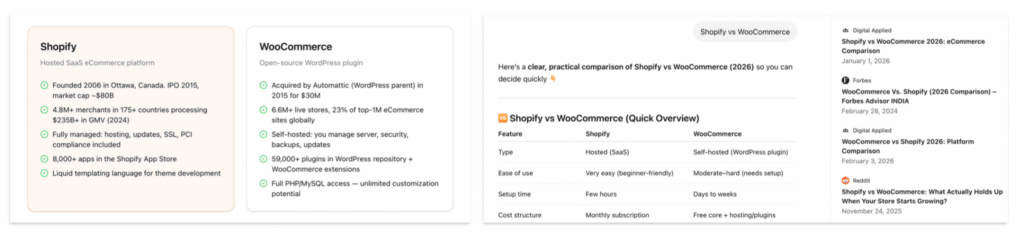
Statements grounded in structured data, observable features, or widely supported information are far more valuable than subjective opinions. When other credible sources across the web support those claims, they strengthen trust and increase the likelihood of citation.
Why Traditional Comparison Pages Fail for AI Citations
Here’s the problem, though. Traditional comparison pages are written to persuade, not to be evaluated, and that’s where they break for AI systems.
Most rely on traditional SEO and targeted keywords. Vague, and non-verifiable claims like “best,” “fastest,” or “most powerful” don’t work. Compare that with statements like “processes 10,000 requests per minute versus 6,000” or “requires one-step setup versus a multi-step configuration.” The difference is simple: one is opinion, the other is a claim that can be checked.
Many pages are structured with competitors either weakened or selectively chosen. Models interpret this as marketing, not analysis. Credible comparisons look more like: “better for small teams but lacks enterprise controls” versus “supports enterprise workflows but requires longer setup.” The presence of tradeoffs increases trust.
Structure also tends to break down in traditional pages. Instead of clearly stating “supports Salesforce, HubSpot, and Microsoft Dynamics” versus “supports Salesforce only,” many brands scatter the information across pages, making it harder for models to connect and compare.
Another gap is the lack of explicit decision logic. Statements like “ideal for teams of 10-100” versus “designed for enterprises with 500+ users” directly answer who should choose what.
Traditional comparison pages fail because they prioritize persuasion while models prioritize content that is specific, balanced, and structured in a way that makes comparisons explicit and verifiable.
5 Core Components of AI-Friendly Comparison Content
AI-friendly comparison content is about presenting authoritative sources and structured evaluation. Models look for the same signals a careful human would: balance, specificity, and evidence. These five components consistently show up in comparison to content that gets cited, and understanding them helps to rank in AI search.
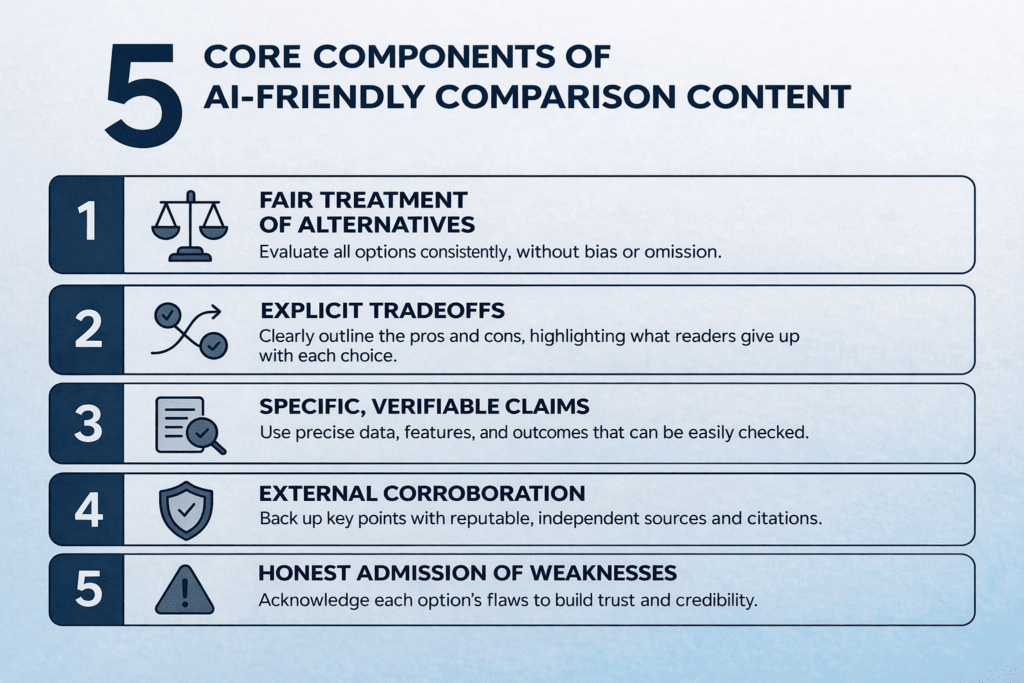
1. Fair treatment of alternatives
Strong comparisons include the best available alternatives. Brands signal confidence when they represent competitors accurately and acknowledge their real strengths and positioning. For example, comparing against a widely used tool with clear advantages in certain areas is far more credible than choosing a weaker option just to look better.
2. Explicit tradeoffs
Every product has strengths and limitations, and models expect to see both. Statements like “faster but more resource-intensive” or “easier to set up but less customizable” reflect real-world decision-making. When everything is framed as an advantage, it reads as marketing. When tradeoffs are acknowledged, it reads as analysis.
3. Specific, verifiable claims
Claims need to be measurable and comparable. For instance, “supports Salesforce, HubSpot, and Microsoft Dynamics” versus “supports Salesforce only,” or “starts at $50/month for 10 users” versus “starts at $200/month for 5 users.” These kinds of details give large language models something concrete to extract and validate.
4. External corroboration
Models evaluate content and compare it against the broader web. When your claims align with product documentation, third-party reviews, or widely accepted data, trust increases. If your page says something that contradicts most other sources, confidence drops across the entire comparison.
5. Honest admission of weaknesses
Acknowledging limitations strengthens credibility. Saying “better for teams of 20–200 but lacks enterprise-grade controls” is more useful than presenting a one-sided advantage. When weaknesses are clearly stated, the strengths become more believable and more likely to be cited.
 Pro Tip: These five components describe what AI engines look for in comparison content, but how well does existing content actually hold up against them? The Google E-E-A-T Audit Checklist breaks down exactly where content is building trust signals and where it is leaving citation opportunities on the table.
The Comparison Formats That Earn AI Recommendations
If you want your content to be surfaced and cited, you need to use formats that reduce interpretation and make decisions explicit. AI systems favor structures that clearly map differences and outcomes.
The Tradeoff Matrix
Start with a tradeoff matrix (comparison table). List key dimensions down the left: core features, integrations, pricing, support, ideal team size, industry fit, technical depth, ease of setup. Across the top, include your product and the most relevant competitors.
Fill each cell with specific, factual information. Avoid “better”, “top tools”, and “worse.”
Instead, describe things like this to improve readability for specific use cases: “Supports Salesforce, HubSpot, and Microsoft Dynamics” versus “Supports Salesforce only.” “Best for teams 10–100” versus “Best for enterprises 500+.”
This level of detail removes ambiguity. Models don’t need to interpret; they can directly extract and compare.
Below the table, explain the implications. Don’t just present data, connect it to decisions. For example: “Choose us if you need multi-CRM support and operate with mid-size teams. Choose Competitor A if you’re enterprise-scale and require advanced security. Choose Competitor B if you’re under 10 people and optimize for cost.”
This may feel overly transparent. You’re highlighting competitor strengths alongside your own limitations. But that’s exactly the point. Models interpret this format as balanced, authoritative, and trustworthy. When a user’s needs align with your strengths, you’re recommended with higher confidence. When they don’t, you’re still remembered as a credible source.
Over time, this positions you not just as a vendor, but as a reliable map of the category.
The “When to Choose” Framework
The second format focuses on decision clarity. Instead of trying to prove universal superiority, define exactly where each option fits.
Write explicit guidance like this to answer questions from customers:
“Choose us if you need deep eCommerce integration and operate in regulated industries.” “Choose them if you need a mobile-first workflow or the lowest-cost option.”
This works because models aren’t trying to pick a single “best” product. Their goal is to match solutions to specific constraints. When you clearly define who each option is for, you make that matching process easier, especially when designing content optimization strategies for AI answers.
A strong structure with original research looks like: “Our product is best for teams of 10–100 that need deep CRM integration and operate in financial services. Competitor A is better suited for large enterprises with complex approval workflows. Competitor B fits startups under 10 people that need a simple setup and the cheapest option.”
This approach may feel risky; you’re actively directing some users to competitors. But in practice, it signals confidence and precision. You’re not trying to be everything to everyone; you’re defining where you win.
That clarity builds trust and authority signals. And trust is what leads to consistent inclusion in AI-driven recommendations, especially for the audiences you actually want to reach.
Pro Tip: The “when to choose” framework only works if the underlying content signals are strong enough for AI engines to trust in the first place. Wondering whether your comparison content meets the full criteria? The AEO GEO audit checklist covers exactly what AI engines look for before deciding whether a source is worth citing.How to Handle Competitive Claims
Treat every claim as something a model can check, compare, and validate across the web. If you can’t prove it, don’t include it. AI systems cross-reference documentation, reviews, and other sources. Unsupported or exaggerated claims reduce trust in the entire comparison.
Focus on provable, specific statements. Instead of broad positioning like “more powerful” or “industry-leading,” use details that can be verified: “Processes 10,000 requests per minute” versus “Processes 6,000.” “Requires one-step setup” versus “requires multi-step configuration.”
When comparing competitors, keep it accurate and appropriately scoped. Don’t misrepresent features or ignore contexts where competitors are stronger. Write comparisons that reflect real differences: “Better suited for enterprise workflows with advanced approval systems” versus “designed for small teams with simpler setup.” How a brand is represented in those comparisons directly shapes how AI engines perceive it, which is why tracking brand mentions in AI search matters as much as the content itself.
Avoid framing every comparison as a win. Models expect tradeoffs and context, not one-sided superiority. If a competitor is stronger in a specific area, state it clearly. This doesn’t weaken your position; it makes your claims more credible.
Ensure your claims align with external evidence. If your positioning matches product documentation, third-party reviews, or widely accepted benchmarks, confidence increases. If it contradicts what’s commonly known, models discount not just the claim, but your overall reliability.
Say only what you can prove, and present it in a way that others would agree with.
Why Comparison Content Compounds Over Time
Comparison content compounds because trust compounds. When you consistently present balanced, factual, and honest comparisons, AI systems treat your content as a reliable reference point.
When your comparisons consistently include fair alternatives, explicit tradeoffs, and verifiable claims, it signals that your content is predictable, accurate, and safe to cite. That consistency increases the likelihood of being reused across multiple queries.
Honesty plays a central role here. When you openly acknowledge where competitors are stronger and where you have limitations, it creates a pattern of credibility over promotion. For example, stating “better suited for mid-size teams but lacks enterprise-level controls” is more trustworthy than claiming universal superiority. Over time, this kind of transparency positions you as an objective source.
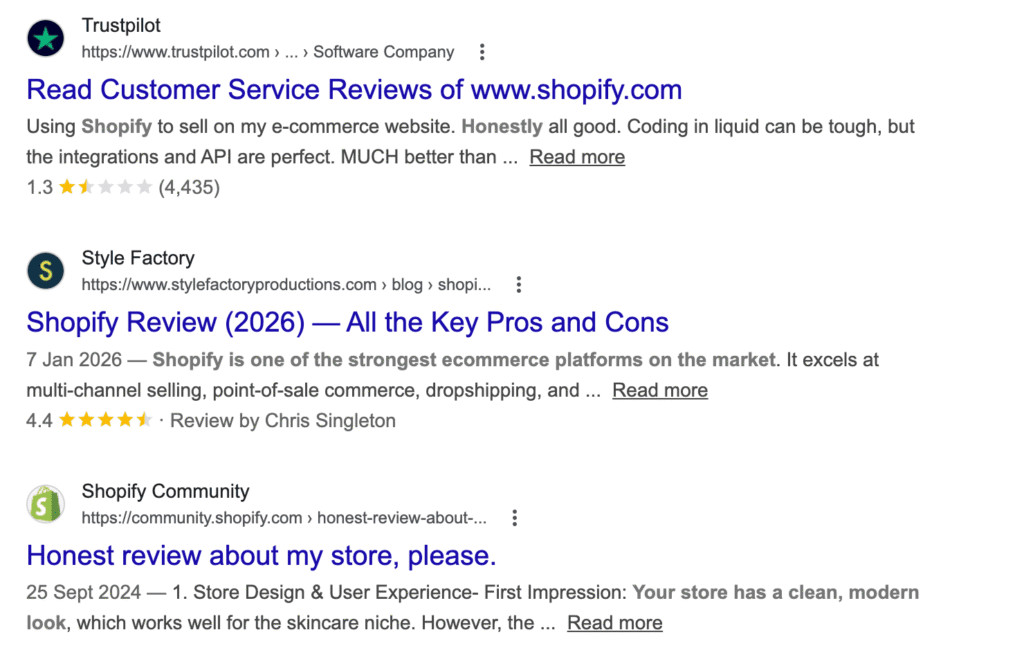
This also changes how your brand mentions are perceived within AI-generated answers. Instead of appearing only when you’re the obvious choice, you start appearing as part of the decision-making layer, the source that helps explain the landscape itself. Even when a competitor is recommended, your content can still be cited because it provides the comparison logic. Tracking your AI visibility across AI-generated answers helps to identify your position and competitors’ gaps.
In practice, comparison content compounds because it shifts your role from promoting a product to defining the category. And once you become a trusted reference, AI systems keep coming back to you.
How This Visibility Plays Out in AI Answers
When your comparison content is structured and trustworthy, it becomes part of the answer layer inside AI-generated content. AI systems pull from it to explain options, highlight tradeoffs, and recommend solutions based on specific user needs.
This visibility shows up in different ways. Your content structure might be used to define categories (“what is it”), explain differences (“how they compare”), or guide decisions (“which one to choose”). Instead of a single mention, you’re contributing to the logic behind the ai generated responses, the part that actually shapes the recommendation.
When your comparisons clearly map features to outcomes, like “better for mid-size teams with multi-CRM needs” versus “better for enterprises with advanced security”, you’re influencing how an AI platform presents each option. You’re defining the criteria the model uses to match users with solutions.
Over time, this gives you a degree of control over your presence in major AI models. If your strengths, tradeoffs, and ideal use cases are clearly defined, models are more likely to represent you accurately in the right contexts.
To understand and refine this visibility, you need to track how often and where your brand appears in AI responses. Citation patterns shift across platforms, query types, and content updates, and without a consistent measurement framework, there is no reliable way to know whether comparison content is earning citations or being passed over in favor of competitors. Measuring your brand’s AI visibility helps identify high-performing data, platform citation patterns, and content gaps.
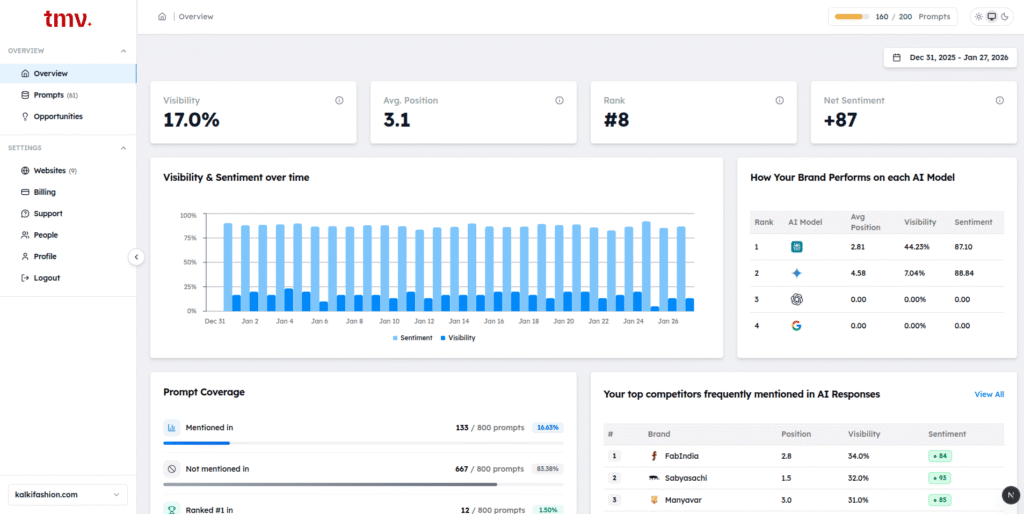
Tools like Track My Visibility help you see these patterns when you’re being cited, for which queries, and in what context. More importantly, it helps with actionable recommendations to boost your AI search visibility across Google AI Overview, ChatGPT, Perplexity, Claude, and Gemini.
Pro Tip: Don’t want to lose AI visibility for your brand? See where your brand already appears in AI responses and where it doesn’t. Those gaps often reveal the biggest opportunities. Run a quick audit and get your free AI visibility report to see how your brand currently shows up across major AI platforms.Final Words
The best comparison content doesn’t just position your product; it teaches the market how to evaluate the category. It defines what matters, what tradeoffs exist, and how buyers should think about their choices.
When you do this well, you become the reference point. AI systems use your content to explain the landscape even when recommending alternatives because you’ve proven to be clear, balanced, and reliable.
This is where the advantage compounds. You’re not just competing for a single recommendation; you’re building category-level authority. Even if you don’t win every decision, you shape how decisions are made.
Be more honest, more specific, and more comprehensive than others. Do that consistently, and your content won’t just be seen; it will be trusted and reused.
If you want to see how this works in practice, start with a free 7-day trial and analyze how your brand appears across AI search and recommendation systems.
Frequently Asked Questions
AI-friendly comparison content is structured, specific, and verifiable. Focus on clear side-by-side comparisons, consistent attributes, and measurable claims so AI systems can easily extract and use your content.
Use formats that reduce ambiguity: comparison tables, bullet points, and a “when to choose” framework. These make it easier for AI to align differences and generate decision-ready answers.
Prioritize data over opinions. Replace vague claims with measurable details like features, pricing, performance, and use cases. AI systems rely on information they can verify.
Start with a quick comparison table, followed by detailed feature breakdowns, then add use-case mapping and a clear decision framework. Keep everything consistent and easy to scan.
Most likely because it’s too vague, biased, or unstructured. If your content lacks clear comparisons, verifiable claims, or balanced tradeoffs, AI systems won’t trust or extract it. Tools like Track My Visibility help track whether your content appears in AI-generated answers and identify citation drops across different query types.
References
1. Why Tables and Structured Lists in Body Content Increase AI Overview Citation Rate