


Search is no longer just about blue links.
Today, people ask questions directly to AI platforms like ChatGPT, Perplexity, Gemini, and Google AI Overviews. Instead of browsing multiple websites, they receive instant answers generated by AI.
And those answers usually highlight only a few brands.
At that time, users are in the buying consideration stage, and the brands that appear in AI answers get that consideration.
And if your brand is not appearing, then you are losing a big opportunity.
This shift is already reshaping how people research products, evaluate solutions, and make buying decisions.
Many brands are now taking action to get brand mentions in AI search. But here is the challenge.
Traditional SEO tools track rankings, traffic, and backlinks, but they cannot show how AI platforms talk about your brand.
That is why AI visibility tools are getting huge attention.
These AI visibility tools help businesses track how often their brand appears in AI-generated answers, which prompts trigger those mentions, and how their visibility compares with competitors.
So, if you are serious about getting brand mentions in AI and want to know which tool can help you improve your brand visibility, this guide is all you need.
In this guide, you will discover:
- What AI visibility tools are and why they matter
- Top 10 AI visibility tools
- Key features to consider
- How to choose the right tool
But first, let’s begin with a basic understanding of AI visibility tools.
TL;DR
Traditional SEO tools don’t show how AI platforms talk about your brand. This guide covers the top 10 AI visibility tools in 2026, what to look for, and how to pick the right one. If you want a quick starting point, Track My Visibility’s free AI visibility report shows your current brand presence across ChatGPT, Gemini, and Perplexity before you commit to any tool.What Are AI Visibility Tracking Tools and Why Do They Matter?
AI visibility tracking tools help businesses understand how their brand appears inside AI-generated answers across platforms like ChatGPT, Perplexity, Gemini, Claude, and Google AI Overviews.
Instead of tracking only keyword rankings like traditional SEO tools, these platforms monitor whether AI systems mention your brand, cite your content, or recommend your product when users ask questions related to your industry.
Because of this shift, new metrics are becoming important for marketers, including:
- Brand mentions in AI responses
- Content citations used as sources
- Share of voice compared to competitors
- The sentiment or tone of how AI describes your brand
AI-powered search is already influencing how people discover products and evaluate solutions. When a brand consistently appears in AI-generated answers, it builds authority and trust over time.
That is why businesses are starting to pay closer attention to AI visibility as part of their overall search strategy.
Here are some key reasons why AI visibility matters more than ever:
- Rise of zero-click search: Many users now get direct answers from AI platforms instead of visiting multiple websites. If your brand is not mentioned in those AI summaries, you lose a major opportunity to be discovered.
- Shorter customer decision journey: AI answers often include comparisons, recommendations, and summaries in one response. When your brand appears there, it quickly becomes part of the buyer’s consideration stage.
- Stronger authority and trust: AI systems prefer sources that appear frequently across trusted websites. Brands that get cited often build stronger credibility and are more likely to appear in future AI answers.
- Protection from misinformation: AI models sometimes show outdated or incorrect information about brands. Tracking AI visibility helps you identify these issues and ensure your brand is represented correctly.
- Higher quality referral traffic: Users who come from AI recommendations are usually more informed and closer to making a purchase decision.
- Competitive advantage: AI search is growing rapidly. Businesses that start optimizing for AI visibility early can build a stronger presence, while competitors who ignore it may fall behind.
Top 10 AI Visibility Tools in 2026
As AI search continues to reshape how people discover brands, businesses need AI visibility tools that can track how they appear inside AI-generated answers.
Here are the ten best AI visibility tools that help businesses track and improve their search visibility across AI platforms:
- Track My Visibility – Tracks brand mentions, citations, prompts, and competitor share of voice across major AI platforms.
- Rankshift AI – AI visibility platform for multi-model tracking, content optimization, and AI crawler analytics.
- Profound AI – Enterprise platform that analyzes how AI systems present your brand and competitors in AI responses.
- Otterly AI – Affordable AI monitoring tool that tracks brand mentions and share of AI voice across AI engines.
- Peec AI – AI visibility tool focused on competitor benchmarking and prompt-level brand tracking.
- Ahrefs Brand Radar – An AI visibility feature inside Ahrefs that tracks AI citations and brand share of voice.
- SE Ranking – SEO platform that tracks AI Overviews and AI chat visibility alongside traditional rankings.
- Scrunch AI – An AI monitoring platform that tracks prompt-level visibility, sentiment, and AI bot activity.
- Writesonic – A GEO platform that combines AI visibility tracking with AI-optimized content creation.
- Semrush – An SEO platform that tracks AI visibility, provides prompt insights, and identifies competitor gaps.
Let’s understand each one in detail!
1. Track My Visibility: #1 Best AI Visibility Tracking Tool
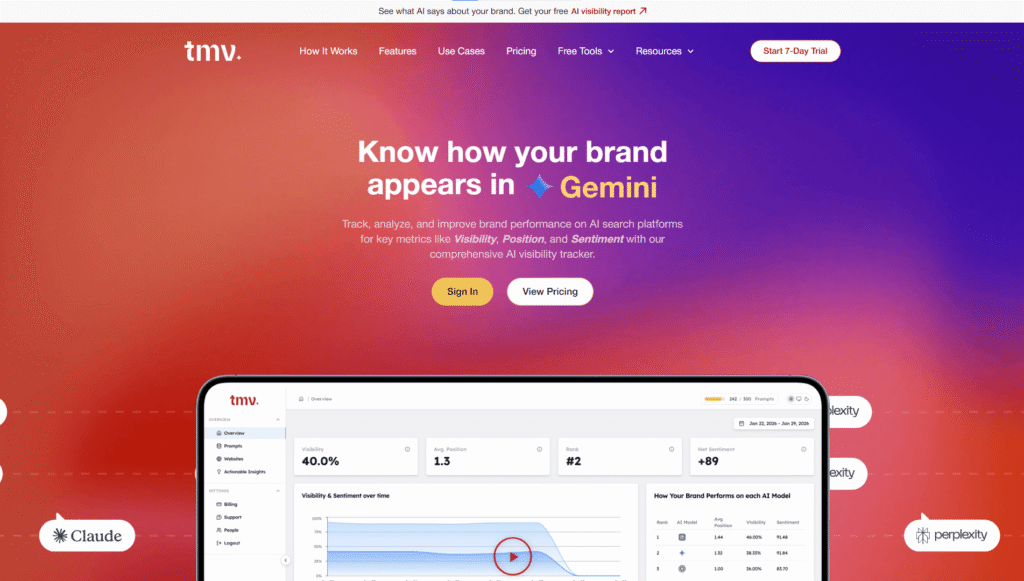
Track My Visibility is one of the top AI visibility tools designed to help brands understand how they appear inside AI-generated answers.
As AI platforms increasingly influence how users research products and make decisions, simply tracking traditional SEO rankings no longer shows the full picture.
Instead of guessing whether ChatGPT, Gemini, or Perplexity recommends your product, the platform shows where your brand appears, which prompts trigger mentions, and where competitors are winning.
The tool monitors AI-generated answers across major platforms and highlights whether your brand is cited, recommended, or completely missing. This helps you quickly identify gaps in your AI visibility.
The platform provides clear insights into which URLs AI engines cite, what sources influence responses, and how your brand compares against competitors in AI answers. That makes it easier to understand what content AI platforms trust and what needs improvement.
Track My Visibility also simplifies AI monitoring through structured dashboards and prompt-level analysis. You can track how AI answers evolve over time, understand which competitors dominate certain topics, and see what content AI platforms trust when generating responses.
In short, Track My Visibility acts like analytics for AI search. It helps you measure brand presence, monitor AI mentions, and improve your chances of being recommended in AI-generated answers.
- Multi-AI platform tracking: Track how your brand appears across major AI platforms, including ChatGPT, Claude, Gemini, and Perplexity.
- Prompt-level visibility insights: Understand which real user questions trigger brand mentions and where competitors dominate AI responses.
- Citation and source tracking: Identify which URLs and domains AI engines rely on when generating answers about your industry.
- Competitor share-of-voice analysis: Compare how often competitors appear alongside your brand and measure relative AI visibility.
- Content opportunity insights: Discover gaps in your content strategy that may prevent AI platforms from citing your website.
- Actionable AI visibility reports: Turn AI search insights into practical recommendations for improving brand presence.
Pros:
- Built specifically for AI search visibility
- Tracks multiple AI platforms in one dashboard
- Clear competitor comparison insights
- Helpful citation and source analysis
- Actionable recommendations to improve AI visibility
Cons:
- Focused on AI visibility rather than full SEO features
- Smaller ecosystem compared to legacy SEO tools
Pricing
- Starts around $50/month, with higher plans available for teams and agencies.
Best For: Marketing teams, SEO professionals, and agencies that want clear visibility into how AI platforms recommend brands.
2. Rankshift AI
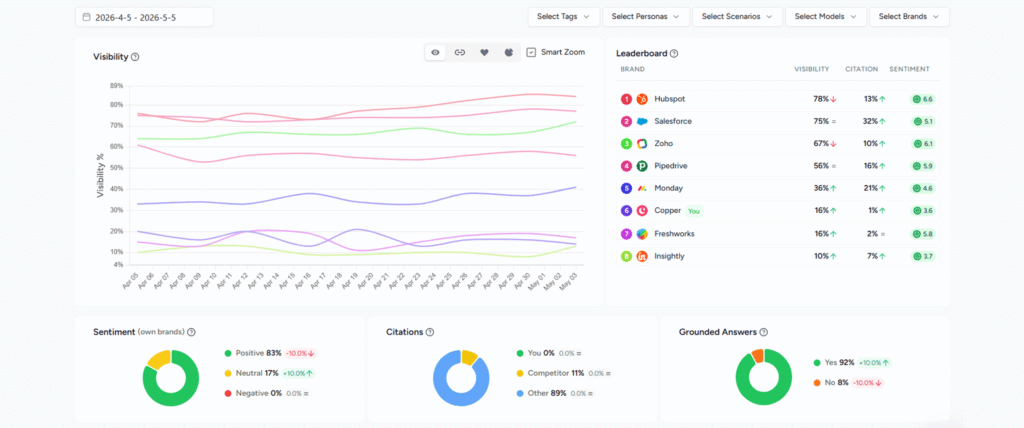
Rankshift is an AI visibility platform built to track how brands appear inside AI-generated answers. It monitors a wide range of platforms, including ChatGPT, Gemini, Google AI Overviews, AI Mode, Copilot, Perplexity, Claude, Meta AI, and Mistral, which makes it one of the broadest tools on this list in terms of engine coverage.
Instead of tracking traditional keyword rankings, Rankshift uses prompt-based monitoring. It analyzes the actual AI responses to detect brand mentions, citations, and competitor presence, then reports share of voice and historical trends so you can see how your visibility changes over time.
One useful feature is its sentiment analysis. Rankshift shows how AI models describe your brand, including recurring themes, strengths, and areas for improvement. This helps teams understand not just whether they appear, but how they are being represented.
What sets Rankshift apart is that it goes beyond monitoring. It includes a built-in AI content writer that analyzes LLM responses and your citations, connects key concepts to relevant entities, and drafts optimized content designed to perform in answer engines. It also offers crawler analytics that show when AI bots visit your site and which pages are used in AI-generated answers, giving teams a clearer link between the content they publish and the citations they earn.
For teams that want the tool inside their existing stack, Rankshift supports MCP integration to connect with Claude, ChatGPT, Cursor, or n8n, along with reporting connections to Looker Studio, BigQuery, and Power BI. Every plan includes unlimited users and projects with unlimited geographic and language coverage.
Overall, Rankshift works well for marketing teams and agencies that want flexible, data-focused AI visibility tracking across many models, with optimization and reporting built into the same platform.
- Broad AI platform tracking: Monitors brand mentions and citations across ChatGPT, Gemini, Perplexity, Claude, Copilot, Meta AI, Mistral, Google AI Overviews, and AI Mode.
- Share of voice and historical tracking: Measures your visibility against competitors and shows how it trends over time.
- Sentiment analysis: Reveals how AI platforms describe your brand, including strengths and recurring themes.
- Built-in AI content writer: Analyzes LLM responses and citations, then drafts content designed to get cited in AI answers.
- Crawler analytics: Shows when AI bots crawl your site and which pages are used in AI-generated answers.
Pros:
- Broadest engine coverage on this list, including Meta AI and Mistral
- Goes beyond monitoring with a built-in content writer
- Crawler analytics link published content to earned citations
- MCP integration plus Looker Studio, BigQuery, and Power BI reporting
- Unlimited users, projects, countries, and languages on every plan
Cons:
- Credit-based pricing can be harder to predict at high tracking volumes
- Newer platform compared to established SEO suites
- Focused on AI visibility rather than full traditional SEO features
Pricing
- Starts at €69/month (Starter plan) with 150 prompts and daily tracking. Includes a 30-day free trial with no credit card required.
Best For: Marketing teams and agencies that want flexible, multi-model AI visibility tracking with content optimization and reporting built into one platform.
3. Profound AI
Profound AI is an enterprise-focused platform that helps companies understand how AI systems present their brand. It tracks mentions across major AI answer engines such as ChatGPT, Perplexity, and Google AI Overviews.
The platform analyzes large volumes of AI-generated responses and shows where your brand appears, how competitors are positioned, and which sources AI engines rely on when generating answers.
One of its strongest capabilities is conversation-level analysis. Specifically, Profound identifies the questions users ask AI systems and reveals where your brand gains or loses visibility. As a result, this helps marketing teams focus on high-impact queries and improve their AI presence more effectively.
However, the tool mainly focuses on LLM response monitoring and does not track traditional search engines or provide advanced prompt research. Because of this, many organizations use it alongside SEO platforms for a complete visibility strategy.
- AI platform monitoring: Tracks how your brand appears across AI systems like ChatGPT, Perplexity, and Google AI Overviews.
- Prompt insights: Shows the common questions users ask AI platforms, so you can understand which queries trigger brand mentions.
- Competitor visibility comparison: Compare how often your brand appears in AI answers versus competing brands.
- Sentiment tracking: Analyzes whether AI platforms describe your brand positively, negatively, or neutrally.
- Large-scale AI data analysis: Processes a high volume of AI-generated responses to reveal patterns in brand visibility.
Pros:
- Tracks brand mentions across multiple AI platforms
- Strong competitor benchmarking insights
- Conversation level prompt analysis
- Built for large-scale brand monitoring
Cons:
- Expensive compared to most AI visibility tools
- Limited prompt customization features
- Focused mainly on AI monitoring rather than full SEO visibility
- Requires sales onboarding
Pricing
- The starter plan begins around $99/month with limited prompt tracking. And advanced plans with multi-platform coverage and full analytics can cost $499/month or more, depending on usage and scale.
Best For: Enterprises and large brands that need detailed analytics on how AI platforms mention and position their brand.
4. Otterly AI
Otterly AI is one of the most accessible AI visibility tools for tracking brand visibility in AI search. It monitors how platforms like ChatGPT, Perplexity, Google AI Overviews, Gemini, and Claude mention your brand when users ask questions related to your industry.
The platform focuses on simple AI visibility monitoring. It shows when your brand appears in AI-generated answers, which prompts trigger those mentions, and how your visibility compares with competitors.
Otterly also tracks citations and brand mentions, including both linked and unlinked references. One useful metric is its Share of AI Voice, which shows the percentage of AI responses that include your brand compared to competitors.
Another strong capability is its GEO audit, which analyzes technical and content issues that may prevent your website from being cited by AI systems. It also converts keywords into AI prompts to help you monitor relevant questions across different markets.
Overall, Otterly works well as a starter AI visibility tool. It is easy to set up, affordable, and gives teams enough insights to start tracking AI brand mentions without investing in enterprise platforms.
- Broad AI platform coverage: Tracks brand mentions across ChatGPT, Perplexity, Gemini, Claude, and Google AI Overviews.
- Share of AI Voice metric: Shows what percentage of AI responses mention your brand compared to competitors.
- Citation tracking: Monitors both linked and unlinked mentions in AI-generated answers.
- GEO audit recommendations: Identifies technical and content issues that affect AI citations.
- Keyword to prompt conversion: Turns SEO keywords into AI prompts to track relevant queries.
Pros:
- Very affordable entry pricing
- Easy setup and beginner-friendly interface
- Tracks multiple AI search platforms
- Helpful GEO audit recommendations
Cons:
- No hallucination or accuracy detection
- Requires manual prompt setup
- Limited deep competitor analysis
- Reporting options are basic
Pricing
- Lite plan starts at $29/month for 15 prompts. Standard plan starts around $189/month, while higher plans can go up to $489/month depending on prompt limits.
Best For: Small teams, startups, freelancers, and marketers who want an affordable way to monitor AI search visibility.
5. Peec AI
Peec AI is a visibility tracking platform designed to show how your brand appears across AI answer engines. It monitors platforms such as ChatGPT, Perplexity, and Google AI Overviews and reveals whether your brand is mentioned when users ask questions related to your industry.
The platform focuses heavily on competitive visibility analysis. It shows how often your brand appears compared to competitors, which prompts trigger those mentions, and where competitors dominate AI-generated responses.
Peec also provides prompt-level insights and sentiment tracking, allowing teams to see how AI platforms describe their brand and whether mentions are positive or negative. This makes it useful for companies that want to monitor brand perception across AI-generated answers.
The dashboard is clean and easy to navigate, and setup takes only a few minutes. It also supports collaboration features like report exports and shared workspaces, which make it useful for agencies managing multiple clients.
However, Peec mainly acts as a data monitoring platform. It shows where visibility gaps exist, but does not provide detailed optimization guidance or prompt research. Because of this, many teams use it alongside SEO or AI visibility tools.
- Competitor visibility comparison: Shows how often competitors appear in AI answers compared to your brand.
- Prompt level tracking: Reveals which queries trigger brand mentions and how brands rank inside AI responses.
- Sentiment monitoring: Tracks whether AI mentions your brand positively, negatively, or neutrally.
- Multi-platform tracking: Monitors visibility across major AI engines like ChatGPT, Perplexity, and Google AI Overviews.
- Agency-friendly reporting: Supports report exports and shared dashboards for client reporting.
Pros:
- Strong competitor benchmarking features
- Clear prompt level visibility insights
- Easy-to-use dashboard and fast setup
- Useful reporting features for agencies
Cons:
- Limited prompt research capabilities
- No hallucination or accuracy detection
- Provides insights but not optimization guidance
- Higher pricing compared to some alternatives
Pricing
- Starter plan starts at €89/month for 25 prompts. Pro plan costs around €199/month, while enterprise plans can reach €499/month depending on usage.
Best For: Marketing teams, agencies, and established brands that want competitive insights into how AI platforms mention brands.
6. Ahrefs Brand Radar

Ahrefs Brand Radar is the AI visibility tracking feature inside the Ahrefs platform. It helps you see whether AI platforms like ChatGPT, Google AI Overviews, Gemini, and Perplexity mention your brand when users ask questions related to your industry.
The tool analyzes a massive database of AI queries and shows where your brand appears in AI answers, how often competitors get mentioned, and which prompts trigger those responses. Instead of manually testing prompts, Brand Radar automatically scans millions of AI results to give you a clearer visibility picture.
One useful advantage is its connection with Ahrefs’ SEO data. You can see which pages AI engines cite and combine that insight with backlink and keyword data to understand why some content gets referenced more often.
In simple terms, Brand Radar helps you track AI share of voice, citation sources, and competitor visibility using the same platform many teams already use for SEO.
- Huge AI prompt database: Tracks hundreds of millions of AI prompts across major answer engines.
- Share of voice insights: Shows how often your brand appears in AI answers compared to competitors.
- Citation tracking: Reveals which pages AI platforms use as sources.
- SEO + AI data together: Connects AI visibility insights with Ahrefs backlink and keyword data.
- Multi-platform monitoring: Tracks visibility across ChatGPT, Gemini, Perplexity, Copilot, and Google AI Overviews.
Pros:
- Built into a trusted SEO platform
- Strong competitor benchmarking
- Large AI query database
- Useful citation insights
Cons:
- Requires an Ahrefs subscription
- AI features are paid add-ons
- Fixed prompts with limited customization
- No optimization recommendations
Pricing
- Requires an Ahrefs plan starting at $129/month, with AI visibility add-ons starting around $199/month.
Best For: SEO teams and marketers already using Ahrefs who want to track AI visibility without adding another tool.
7. SE Ranking
SE Ranking is a well-known SEO platform that now includes AI visibility tracking. It helps you understand how your website appears in AI-powered results like Google AI Overviews and answers generated by AI visibility tools such as ChatGPT, Gemini, and Perplexity.
The platform checks whether your website is cited inside AI answers and shows which keywords trigger those responses. You can also compare your traditional rankings with AI visibility to see where your content appears in AI-generated summaries.
For teams already using SE Ranking, enabling AI visibility is simple. The tool uses your existing keyword lists and projects, so you can track AI results without setting up a new system.
Another useful feature is AI snippet analysis. It shows when Google AI Overviews appear for your keywords, whether your domain is mentioned, and which competitors dominate those answers.
Overall, SE Ranking works well for marketers who want SEO and AI visibility insights together in one dashboard.
- AI Overviews tracking: Shows when Google AI summaries appear for your keywords and whether your site is cited.
- AI chat monitoring: Tracks visibility across AI visibility tools like ChatGPT, Gemini, and Perplexity.
- Keyword level insights: Identifies which queries trigger AI-generated answers.
- Competitor comparison: Reveals which domains appear most often in AI responses.
- SEO + AI data together: Combines traditional rankings, traffic data, and AI visibility in one dashboard.
Pros:
- Combines SEO and AI visibility tracking
- Easy setup for existing SE Ranking users
- Helpful keyword and competitor insights
- Agency-friendly reporting tools
Cons:
- AI tracking is strongest for Google AI Overviews
- Less flexible than dedicated AI visibility platforms
- Requires an SE Ranking subscription
Pricing
- Starts around $50/month, with advanced plans ranging from $90 to $200+ per month depending on usage.
Best For: SEO professionals, freelancers, and agencies already using SE Ranking who want AI visibility insights without adding another tool.
8. Scrunch AI

Scrunch AI is a dedicated platform built to track how AI systems mention and present your brand. It monitors platforms like ChatGPT, Gemini, Claude, Perplexity, and Google AI Overviews to show where your brand appears in AI-generated answers.
The platform focuses heavily on prompt-level tracking. You can analyze how AI responds to specific queries and see whether your brand is recommended, how competitors are positioned, and what sources influence those responses.
Scrunch also helps identify brand reputation issues in AI answers. It shows whether AI platforms present your brand positively, negatively, or incorrectly, which makes it useful for companies concerned about misinformation.
Another strong feature is its AI bot monitoring and crawler insights. The platform tracks how AI bots access your website and connects AI citations with GA4 data to help understand potential traffic impact.
Scrunch AI is particularly useful for companies managing multiple brands or large content libraries because it supports multi-brand tracking and detailed prompt segmentation.
Overall, Scrunch AI works best for organizations that want deep monitoring and detailed analytics on how AI engines reference their brand.
- Wide AI platform coverage: Tracks visibility across ChatGPT, Gemini, Claude, Perplexity, Google AI Overviews, and other AI engines.
- Prompt level analysis: Monitor how specific queries trigger AI responses mentioning your brand.
- Sentiment and share of voice insights: Understand how AI platforms position your brand compared to competitors.
- AI crawler tracking: See when AI bots visit your site and which pages they access.
- Multi-brand monitoring: Manage visibility tracking for multiple brands or clients.
Pros:
- Tracks multiple AI engines in one platform
- Detailed prompt level analysis
- Useful sentiment and competitor insights
- Supports multi-brand visibility tracking
Cons:
- Higher pricing compared to most AI visibility tools
- Interface can feel complex for beginners
- Focuses mainly on monitoring rather than optimization
Pricing
- Plans typically start around $250–$300 per month, with higher tiers for larger prompt volumes and enterprise features.
Best For: Enterprises, agencies, and marketing teams that need detailed monitoring of brand mentions across AI search platforms.
9. Writesonic
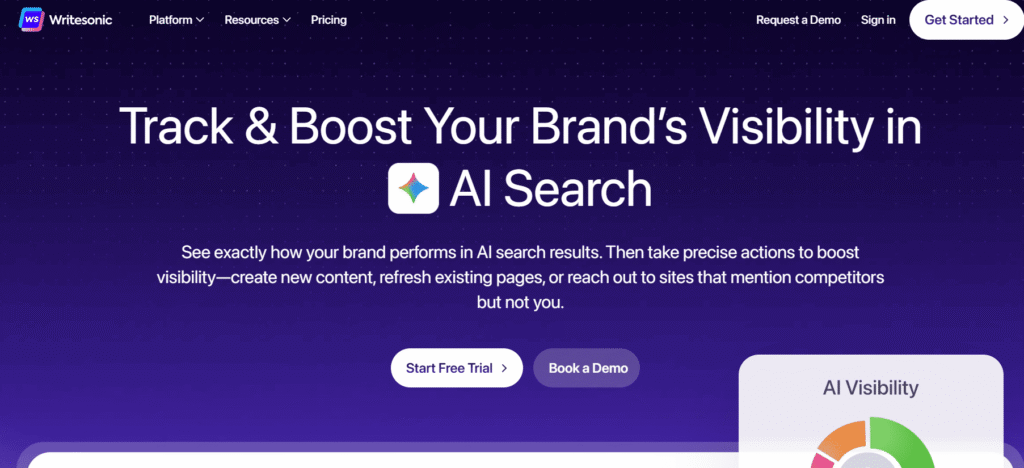
Writesonic is widely known as an AI writing platform, but its GEO tracking tools also helps track and improve AI search visibility. It allows you to monitor how your brand appears in AI-generated answers across platforms like ChatGPT, Gemini, Perplexity, and Google AI results.
What makes Writesonic different is that it combines AI visibility tracking and content creation in one platform. You can see which prompts trigger AI mentions, analyze competitor visibility, and then directly create or optimize content to improve your chances of getting cited.
The platform also provides page-level visibility insights and prompt analysis, helping you understand what topics AI engines prefer when answering questions in your industry.
Another useful capability is its content strategy planning. It analyzes competitor content and suggests topics that can improve your AI search visibility.
Overall, Writesonic is a good option for marketers who want one platform to track AI visibility and create AI-optimized content.
- AI visibility tracking: Monitor brand mentions across AI platforms like ChatGPT, Gemini, and Perplexity.
- GEO optimization insights: Get page-level visibility scores and prompt-level analysis.
- Content strategy suggestions: Discover content topics that can improve AI visibility.
- AI content creation tools: Write and optimize articles directly inside the platform.
- Competitor visibility insights: See how competitors appear in AI answers.
Pros:
- Combines AI visibility tracking and content creation
- Helpful prompt and topic insights
- Supports AI-optimized content workflows
- Useful for content-driven SEO strategies
Cons:
- Limited deep SEO analytics
- Learning curve for new users
- Some AI visibility features are available only on higher plans
Pricing
- Basic plans start around $20/month, while full GEO visibility features are available on plans starting around $249/month.
Best For: Content marketers, SEO teams, and agencies that want AI content creation and AI visibility tracking in one platform.
10. Semrush

Semrush has expanded its SEO platform to include AI search visibility tracking. The AI Visibility Toolkit helps you understand how often your brand appears in AI-generated answers across platforms like ChatGPT, Google AI Overviews, AI Mode, and Gemini.
The platform analyzes millions of AI prompts and shows where your brand is mentioned, where competitors dominate, and which topics drive AI visibility in your industry. This helps teams understand why their brand appears in AI answers and where opportunities exist to improve.
One useful capability is Prompt Research, which works like keyword research but for AI search. It shows the questions people ask AI visibility tools and highlights prompts where competitors are getting recommended instead of your brand.
Semrush also provides AI readiness audits and strategic recommendations. These reports identify issues such as missing citations, crawl problems, or content gaps that prevent your pages from being referenced by AI systems.
Overall, Semrush is a strong choice for companies that already rely on Semrush for SEO and want AI visibility insights within the same platform.
- AI visibility score: Shows how often your brand appears in AI answers compared to competitors.
- Prompt research insights: Discover which questions trigger AI responses in your industry.
- Competitor gap analysis: Identify topics where competitors dominate AI answers.
- AI search site audit: Detects technical or content issues affecting AI citations.
- Integrated SEO + AI data: Analyze AI visibility alongside rankings, backlinks, and traffic data.
Pros:
- Integrated with a trusted SEO platform
- Large AI prompt database
- Strong competitor and topic insights
- Helpful AI readiness audit features
Cons:
- Uses fixed prompts in some AI tracking features
- Limited coverage compared to specialized AI visibility tools
- No AI crawler visibility tracking
- Pricing increases with additional users
Pricing
- AI Visibility Toolkit starts around $99 per month per domain, while Semrush One plans with full SEO + AI features start around $199 per month.
Best For: Marketing teams, agencies, and companies already using Semrush who want AI visibility tracking without adopting another tool.
 Pro Tip: Picking the right tool is only step one. Knowing what to track, how often, and what changes to make based on the data is where most teams get stuck. This guide on how to track AI search visibility over time walks through that part in detail.
Key Features to Consider in an AI Visibility Tool
Here are some key features you must consider before finalizing the AI visibility tracking tool:
- Multi-platform AI tracking: Track brand visibility across major AI platforms like ChatGPT, Google AI Overviews, Google Gemini, Perplexity, and Copilot to understand your complete AI search presence.
- Prompt and query tracking: Identify which user questions trigger AI responses mentioning your brand so you can discover new content opportunities and optimize for those prompts.
- Competitor visibility analysis: Compare how often competitors appear in AI answers versus your brand to find gaps and improve your positioning in AI-generated results.
- Citation and source tracking: See exactly which pages AI platforms cite when generating answers, helping you understand which content earns AI references.
- Brand sentiment monitoring: Analyze whether AI describes your brand positively, negatively, or neutrally to manage brand perception and detect misinformation.
- Real-time monitoring and alerts: Receive regular updates or alerts when your AI visibility changes so you can quickly respond to new trends or competitor movements.
How to Choose the Right AI Visibility Tool?
Here’s how you can choose the right AI visibility tool by following the given steps:
1. Define Your Goal
Start by understanding what you actually want from the tool. Some platforms only help you audit AI visibility, while others help you monitor brand mentions or improve your chances of getting cited in AI answers.
2. Consider Your Budget and Scale
Different AI visibility tools target different business sizes. Smaller teams may prefer affordable monitoring tools, while enterprises often need advanced platforms with deeper analytics and multi-brand tracking.
3. Check Prompt Tracking Capabilities
A good tool should allow you to track custom prompts related to your industry. This helps you see how AI responds to real user questions, not just branded searches.
4. Ensure Multi-platform Coverage
Choose a tool that tracks major AI platforms such as ChatGPT, Google AI Overviews, Gemini, and Perplexity. This ensures you get a complete view of your AI search visibility.
5. Look for Reliable Data
AI visibility insights are only useful if the data is accurate. Established platforms with consistent tracking usually provide more reliable insights.
6. Evaluate Integration with Your Existing Tools
If you already use SEO tools like Semrush or Ahrefs, selecting a platform that integrates with them can make reporting and analysis much easier.
Why Do Businesses Choose Track My Visibility for AI Visibility?
Most AI visibility tools only show whether your brand appears in AI answers.
Track My Visibility helps you understand why you appear, where you are missing, and how to improve your visibility.
The platform is built specifically for the AI search era. Instead of mixing AI visibility inside a traditional SEO dashboard, Track My Visibility focuses entirely on how AI platforms talk about your brand.
With Track My Visibility, you can:
- Track brand mentions across AI platforms like ChatGPT, Gemini, Perplexity, and Google AI Overviews
- Identify prompts that trigger AI answers related to your brand or industry
- Compare your AI visibility with competitors and discover gaps
- Analyze which content gets cited by AI systems
- Monitor changes in AI visibility over time
This helps businesses understand where they stand in AI search and what actions can improve their presence.
Want to know how often AI platforms mention your brand?
Start tracking your AI visibility with Track My Visibility
Conclusion
Search is no longer limited to traditional search engines. Today, people rely on AI platforms like ChatGPT, Gemini, Perplexity, and Google AI Overviews to get instant answers.
Because of this shift, AI visibility has become a key part of modern search strategy. If your brand does not appear in AI-generated answers, you risk losing attention during the buyer decision stage.
We hope this guide helps you explore top AI visibility tools, their key features, and how you can find the right one.
Now, it’s your turn to explore each tool, consider the factors, and find the best AI visibility tracking tool which is best for your brand.
Frequently Ask Questions
TMV is a strong AI visibility tool in 2026 that tracks brand mentions, citations, and competitor visibility across ChatGPT, Gemini, and Perplexity, while providing clear reports to help brands improve AI search performance.
AI visibility tools run targeted prompts across platforms like ChatGPT, Gemini, and Perplexity, then log when your brand is mentioned, cited, or compared with competitors. They also track source links, query triggers, and visibility trends over time.
Look for cross-platform tracking, competitor benchmarking, citation analysis, sentiment insights, prompt-level reporting, and clear recommendations that show how your brand appears across AI search results.
Traditional SEO tools track keyword rankings, backlinks, and SERP positions. AI visibility tools measure how often your brand appears, gets cited, or is recommended inside AI-generated answers across ChatGPT, Gemini, Perplexity, and similar platforms.
Tracking AI citations matters because citations show when AI systems trust and reference your content. For SEO and GEO, they reveal what drives visibility, improve content strategy, and help you win traffic from AI-generated answers.