


Your rankings look fine. Your content is live. But traffic keeps dropping, and nobody on the team has a clear answer for why.
Here’s what’s actually happening…
Search engines like Google are now answering more queries directly through AI-generated responses. Users get the answer without ever clicking your link.
According to Search Engine Land, publishers expect search engine referrals to fall by 43% by 2029.
This isn’t a rankings problem. It’s a visibility problem. The rules of search have changed, and understanding the difference between AI search vs traditional SEO is the first step toward fixing it.
This guide is for SEO teams, marketing agencies, eCommerce brands, PR professionals, and growth leaders who need a working AI search strategy example, built from the ground up.
What you’ll learn from this blog:
- What an AI search strategy actually is and how it differs from traditional SEO
- A step-by-step framework to build AI search visibility from scratch
- How to create structured content that AI systems cite
- Common mistakes and how to avoid them
- How the strategy looks different depending on your team or industry
TL;DR
- AI search doesn’t rank pages; it cites sources. Getting cited requires a different approach than getting ranked.
- You need to audit your current AI visibility before building anything. Most teams skip this.
- Structured content, entity clarity, and off-site authority signals are the three pillars of any working AI search strategy.
- Traditional SEO and answer engine optimization work together; one doesn’t replace the other.
- Measurement matters. If you’re not tracking AI-referred traffic and citation frequency, you’re flying blind.
What Is an AI Search Strategy?
An AI search strategy is a plan for making your brand visible inside AI-generated answers, not just in the blue-link search results you’re used to.
To understand it properly, you need to know three terms: traditional SEO, AEO (answer engine optimization), and GEO (generative engine optimization).
Traditional SEO gets your page ranked so users click through to your site. Answer engine optimization focuses on getting your content cited inside AI answers, on platforms like ChatGPT search, Perplexity, and Google AI Overviews. Generative engine optimization is the broader practice of making your content readable and retrievable by AI systems that generate answers from multiple sources.
These aren’t competing approaches. They work together. SEO makes sure your content is indexed and crawlable. AEO and GEO make sure it gets pulled into answers once it’s found.
As Aleyda Solis, International SEO Consultant and Founder of Orainti, puts it: “Mature, sophisticated SEO has a lot of overlap with the concepts, principles, and criteria needed for AI-driven search. We’re already creating content that’s useful to users, that connects with their intent, and meets their needs.”
The problem is that ranking alone no longer guarantees search visibility. The overlap between top-10 Google rankings and AI Overview citations has collapsed from 76% in mid-2025 to between 17% and 38% by early 2026 (Search Engine Journal). You can sit at position one and still not appear in a single AI-generated response.
If you want a deeper breakdown of what AEO and GEO mean for your SEO, we’ve covered that separately.
How Do You Build an AI Search Strategy Step by Step?
Building an AI search strategy isn’t about chasing algorithms. It’s about making your brand easy for AI systems to find, understand, and trust, and that starts with a clear, repeatable process.
Step 1: Audit Your Current AI Visibility
Before you start with anything new, you need to know where your brand stands.
Start by writing 15 to 20 real user queries your potential buyers actually type or speak. Mix informational ones (“what’s the best tool for tracking AI visibility”) with transactional ones (“best AI monitoring platform for agencies”). These search terms should reflect genuine search intent, not internal jargon. Type the exact phrase a buyer would use, not a cleaned-up version of it.
Then test each query across multiple AI tools like ChatGPT, Perplexity, Google AI Overviews, and Microsoft Copilot. For each one, document whether your brand is cited, mentioned in passing, absent, or misrepresented.
Run the same queries for your top three competitors. Note where they appear, and you don’t. That gap is your starting point.
Finally, score your baseline. Something simple works, cited, mentioned, absent, or wrong. You can’t track progress without a starting number.
Once you have your query list ready, the next step is knowing how to read what you find. This guide on how to track your AI search visibility walks through the process platform by platform.
 Pro Tip: Not sure where to start with your audit? Download the All-in-One AEO & GEO audit checklist, it walks you through exactly what to test, which platforms to check, and how to document your baseline AI visibility in one sitting..
Step 2: Define Your AI Search Goals
Not every brand needs the same outcome from AI search. Before you start optimizing, be clear on what you’re actually trying to achieve.
An eCommerce brand might want its products cited in “best X for Y” comparisons. A marketing agency might want to appear when someone asks ChatGPT to recommend agencies for a specific service. A PR team might want to ensure the brand is represented accurately, not just frequently.
Your goals shape everything: which queries to target, which platforms to prioritize, and how you measure success. Write them down before moving to the next step.
Step 3: Identify Your Entity and High-Intent Prompts
AI systems don’t think in keywords. They think in entities like brands, people, products, and organizations that have clear, consistent attributes attached to them.
Your brand needs to exist as a well-defined entity across the web. That starts with NAP consistency: your Name, Address, and Phone number should be identical across every directory, social profile, and site you appear on. Inconsistency confuses AI models about which version of your brand is authoritative.
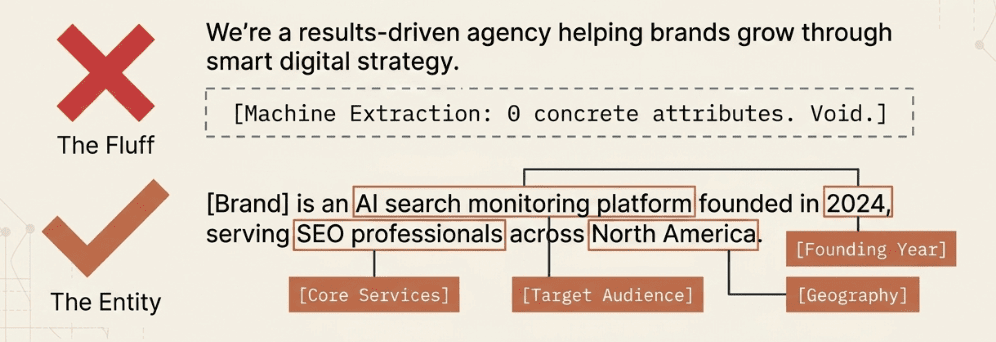
Your “About” page is more important than most teams realize. It shouldn’t read like a sales pitch. It should read like an encyclopedia entry mentioning the founding year, core services, geography, key credentials, and what specifically sets you apart.
Let’s look at an example:
Marketing version: “We’re a results-driven agency helping brands grow through smart digital strategy.”
Entity-clear version: “Track My Visibility is an AI search monitoring platform founded in 2024, serving SEO professionals, marketing agencies, and eCommerce brands across North America and Europe.”
The second version gives AI something concrete to work with. The first gives it nothing.
Beyond your about page, internal linking is also important. Link related pages together using consistent anchor text that reinforces your topical authority. If you write about AI visibility, link those posts to each other so AI systems understand your subject area clearly. Use relevant terms consistently across those linked pages so AI systems build a clear picture of what you cover.
Once you’ve identified your core entity attributes, map the high-intent prompts your buyers are using. These aren’t keywords in the traditional sense; they’re full questions with context attached. “Which platforms track AI search citations?” is more useful than “AI tracking tool.”
Step 4: Analyze Why Competitors Are Being Mentioned
If competitors are appearing in AI answers and you’re not, there’s a reason. Your job here is to figure out what it is.
Pull the queries where they show up. Read the AI-generated responses carefully. Notice what gets cited. Is it a specific article? A product page? A third-party review? The type of content being cited tells you what AI systems in your space are trained to look for.
Check their off-site presence too. Are they getting mentioned in industry publications? Do they have more structured data on their pages? Are their articles longer and better organized?
Track My Visibility shows you exactly where competitors are being cited across AI platforms, so you can spot the patterns without running every query by hand.
This is about identifying the gap between what exists and what AI needs to include you. Once you see the pattern, you can close it.
Step 5: Create Content AI Can Actually Cite

AI systems don’t read your page the way a person does. They break content into smaller pieces. The process is called parsing and reassembling those pieces into AI answers. Understanding how LLMs choose which content to cite helps you write so that the right sections get pulled.
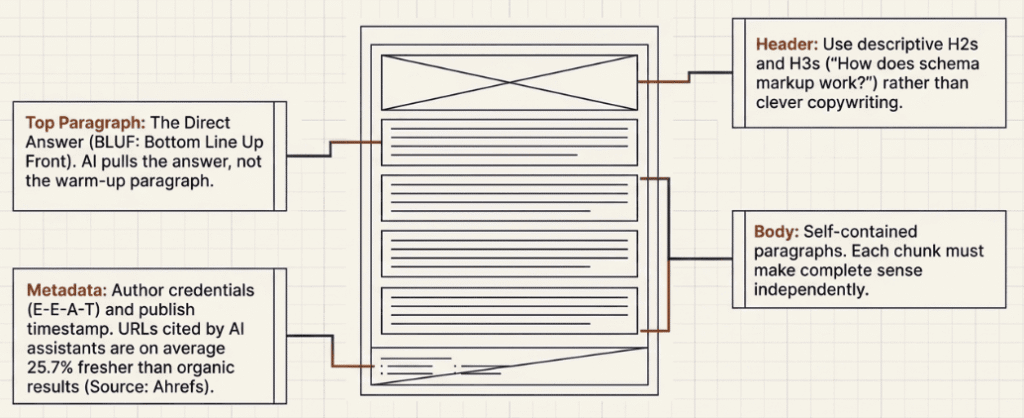
Structure matters as much as substance. Use H2 and H3 headers that directly state what each section covers. These subject headings are like signposts; they tell AI exactly what each section is about before it reads a single word.
For example, “How does schema markup work?” is better than “Getting technical with your content.”
Write self-contained paragraphs. Each one should make complete sense on its own, without needing the paragraph before it for context. AI doesn’t always pull a full section; sometimes it pulls a single sentence.
Write answers, not articles. Lead every section with the direct answer. Put the supporting detail after. Frame content around real questions your buyers ask, “What is X,” and “How do I Y” formats are the most citable. Avoid long introductions before getting to the point. AI tools pull the answer, not the warmup.
Keep content fresh. URLs cited by AI assistants are, on average 25.7% fresher than those ranking in organic search results (Ahrefs). Outdated information hurts your chances of being cited, even if the page itself ranks well in traditional search.
Build E-E-A-T into everything you publish. Author credentials, first-person experience, original data, and links to reputable external sources all tell AI tools that your content is trustworthy. These aren’t optional signals; they’re ranking factors in the AI citation process.
Step 6: Build Authority Signals Across the Web
Your own site isn’t enough. AI systems look at your entire digital footprint when deciding whether to cite you.
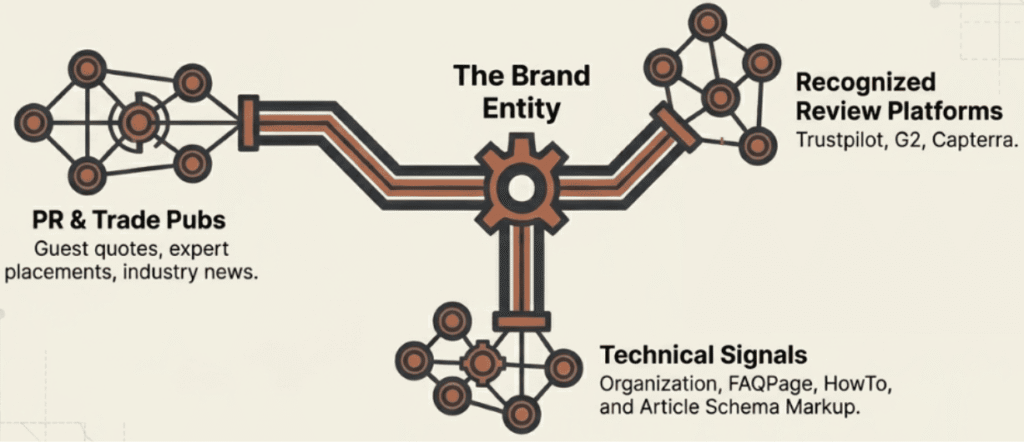
Citations from reputable external sources carry significant weight, including industry publications, news mentions, third-party directories, and recognized review platforms. If credible sources reference your brand, AI models take that as a trust signal.
In fact, brands with active profiles on platforms like Trustpilot, G2, and Capterra have a 3x higher chance of being cited by ChatGPT (SurferSEO). Visibility in AI-generated answers and chat summaries can be improved by securing mentions on high-authority industry platforms.
This is where PR and digital PR teams have a real advantage. A mention in a respected trade publication isn’t just good for brand awareness, but it also directly feeds AI with citable, authoritative references to your brand. Guest content, expert quotes, and podcast appearances all build the same kind of cross-platform authority.
External authority signals matter as much as what’s on your own site. For a practical breakdown of how to get LLM citations, including which source types carry the most weight, that post goes deeper.
The approach varies by audience. For eCommerce brands, manufacturer listings, product review aggregators, and third-party retail pages all count as authority signals. For agencies, externally published case studies and award mentions tell AI you’re a recognized player in your space.
Step 7: Optimize Technically
Schema markup helps AI systems understand your content at a machine level. The most important schema types for AI search are Organization, FAQPage, HowTo, and Article. Adding these to your pages gives AI search tools a cleaner signal about what your content covers and who created it.
Align your page titles, H1s, and meta descriptions. They should all point to the same topic clearly. Conflicting signals make it harder for AI models to categorize your content confidently.
Site speed and crawlability still matter. AI systems reference indexed content; if your page is slow to load or blocked from crawling, it may not make it into the pool at all.
Step 8: Monitor, Measure, and Iterate
Building an AI search strategy without measuring it is like running a paid campaign without checking conversions.
Here’s what to track:
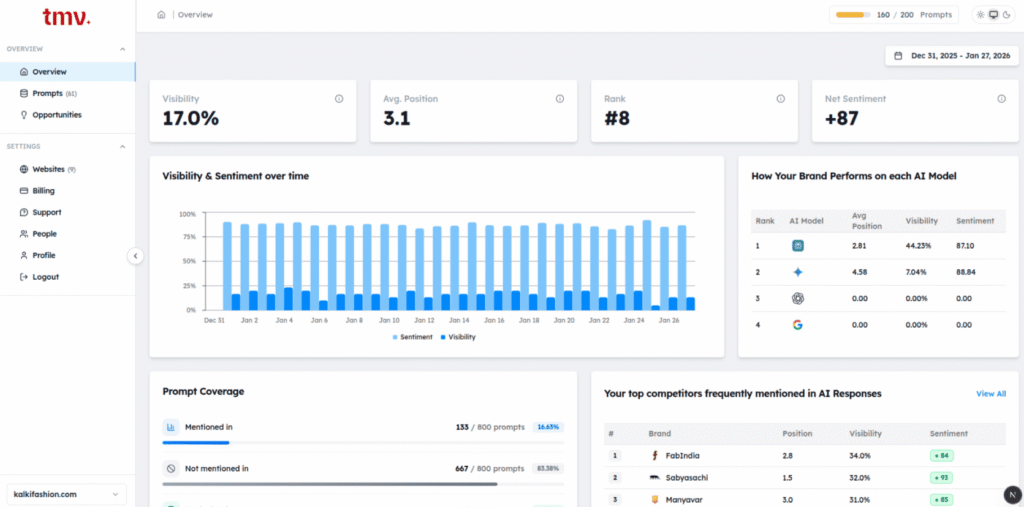
- AI Citation Frequency: how often your brand appears in AI-generated responses for your target queries
- Brand accuracy: is what AI says about you actually correct?
- AI-referred traffic: in GA4, check referral traffic from chat.openai.com, perplexity.ai, and similar sources
- Conversion rates from AI sessions: AI-referred visitors often convert better because they arrive already informed
A user mentioned on Reddit, that they tracked every demo request source for 90 days and found that AI search, ChatGPT, Perplexity, and AI Overviews combined accounted for 23% of all demos. Six months earlier, that number was basically zero. The kicker? They had no AI search strategy at all. It happened purely because their technical blog posts were getting cited.
I tracked every demo request source for 90 days and AI search was 23% of them
by u/Johannascot in digital_marketing
Review this monthly at a minimum. AI platforms update their models and citation behavior frequently, and your search visibility can shift without any change on your end.
Set a quarterly content review cadence. Find which pages are losing citations and refresh them, update the data, add new sections, and improve the structure.
Track My Visibility monitors your brand’s AI citations across platforms automatically. Instead of running manual tests every month, you get a consistent view of where you stand and where things are shifting.
How Does AI Search Strategy Differ by Audience?
A good AI search strategy example looks different depending on who’s building it. Here’s how the same framework applies across different teams.
- eCommerce Brands: If you are an eCommerce company, you should focus on product category pages first. Write structured “best X for Y” content that mirrors how buyers ask questions. Getting your products mentioned in third-party review content and comparison articles matters more than most teams realize; those external citations directly influence what AI recommends. Keep product descriptions factual and specific. Promotional language gets filtered out.
- Marketing Agencies: If you’re a marketing agency, you should build AI visibility for your own service verticals before pitching it to clients. If someone asks ChatGPT to recommend agencies for SEO or content strategy and you don’t appear, that’s a problem. Fixing your own visibility first gives you a working AI search strategy example to bring into client conversations.
- PR and Communications Teams: You should monitor what AI says about your brand every month. When you find inaccuracies, correct them by updating the authoritative source content, your own site, your press page, and your executive bios. Build a coverage strategy that feeds AI with accurate, citable facts about your brand.
- SEO Teams: You should add AI visibility audits to their standard reporting workflow. AI citation rate should sit alongside rankings and traffic as a core KPI. The teams that do this now will have a significant advantage in 12 months when clients start asking for it as a baseline.
What Mistakes Should You Avoid With AI Search?
Most AI search mistakes come from applying old thinking to a new system. Here are the four that come up most often.
- Writing for AI Instead of Humans: It seems logical to optimize your content to sound like what AI wants. In practice, content that’s stilted, keyword-heavy, or written to game AI systems performs worse, because those systems are specifically trained to identify and discount promotional or unnatural language. Write for people first. AI will follow.
- Treating this as a One-time Project: Running an audit and updating a few pages is a start, not a finish. AI search is an ongoing program. Platforms update, training data shifts, and competitor content changes. Your strategy needs regular attention.
- Ignoring Misrepresentation: If an AI tool doesn’t mention your brand, that’s recoverable. If AI says something wrong about your brand, wrong pricing, outdated services, incorrect location, that’s actively damaging. Set up monitoring before it becomes a problem.
- Skipping the Baseline Audit: This is the most common mistake. Teams jump straight to content creation without knowing where they currently stand. Without a baseline, you have no way to tell if anything you’re doing is working.
Conclusion
We started with a simple tension: your rankings are holding, but traffic is falling. Now you know why. AI search has changed how search results work, and the brands showing up in AI answers are the ones that will capture attention at the moment buyers are making decisions.
The shift isn’t from SEO to AI, it’s from rankings to citations, and from traffic to authority. Both matter. But the teams that only focus on one will keep wondering why the numbers don’t add up.
Your next step is straightforward: run the audit. Write out 15 to 20 queries your buyers actually ask. Test them across ChatGPT, Perplexity, and Google AI Overviews. See where you stand today. Everything else builds from there.
If you want a head start, Track My Visibility monitors your AI search visibility across platforms automatically, so you always know where your brand stands, what’s being cited, and where the gaps are.
The brands that build this now won’t be scrambling to catch up later. The question is which side of that line you want to be on.
Frequently Ask Questions
Write clear, direct answers with descriptive headings and structured data like FAQ and HowTo schema. Keep content updated and strengthen E-E-A-T with expert authorship and trusted citations to improve AI visibility.
Track AI traffic in GA4 from sources like ChatGPT and Perplexity, and regularly test your target queries across AI platforms. Tools like Track My Visibility help monitor citations and brand mentions over time.
Build clear, trustworthy content that directly answers real questions and maintain consistent brand information across the web. Strong authority signals, citations, and solid SEO fundamentals all improve AI search visibility.
Resources:
- News publishers expect search traffic to drop 43% by 2029: Report.
- Google AI Overview Citations From Top-Ranking Pages Drop Sharply
- SEO Reloaded: Adapting the Old SEO Rules in the New AI World | Aleyda Solís