



For years, SEO had one clear objective. That is to rank higher on Google.
That approach is no longer enough.
Search behavior is shifting toward AI-powered platforms like ChatGPT, Google Gemini, Perplexity, and Google AI Overviews. Instead of scrolling through multiple results, users now ask questions and receive instant AI-generated answers from several sources.
This shift means visibility is no longer just about ranking pages. It is about becoming the source AI engines use when generating answers.
That is where FAQs become powerful.
FAQ sections follow a simple format. A clear question followed by a concise answer. This structure makes it easier for AI systems to understand, extract, and cite information when responding to user queries.
Because of this, well-optimized FAQs can significantly improve your chances of appearing in AI-generated summaries, voice search responses, and answer engine results.
However, simply adding a few questions at the bottom of a page is not enough. To appear in AI search results, FAQs must be structured carefully, written in natural language, and optimized so AI systems can easily understand and cite them.
Now the question is – How to optimize FAQs for AI search? We’ve got you covered!
In this guide, you will learn:
- Why FAQs matter more in the age of AI search
- Why FAQ Schema is Critical for AI Search, GEO & AEO
- 10 practical ways to optimize FAQ content for AI search engines
By the end of this guide, you’ll know exactly the importance and how to optimize FAQs for AI search and how to optimize them.
Why FAQs Matter More in the Age of AI Engines?
AI search engines are designed to answer questions.
Platforms like ChatGPT, Gemini, and Google AI Overviews look for content that clearly explains a topic and directly responds to user queries. FAQ sections naturally provide this format.
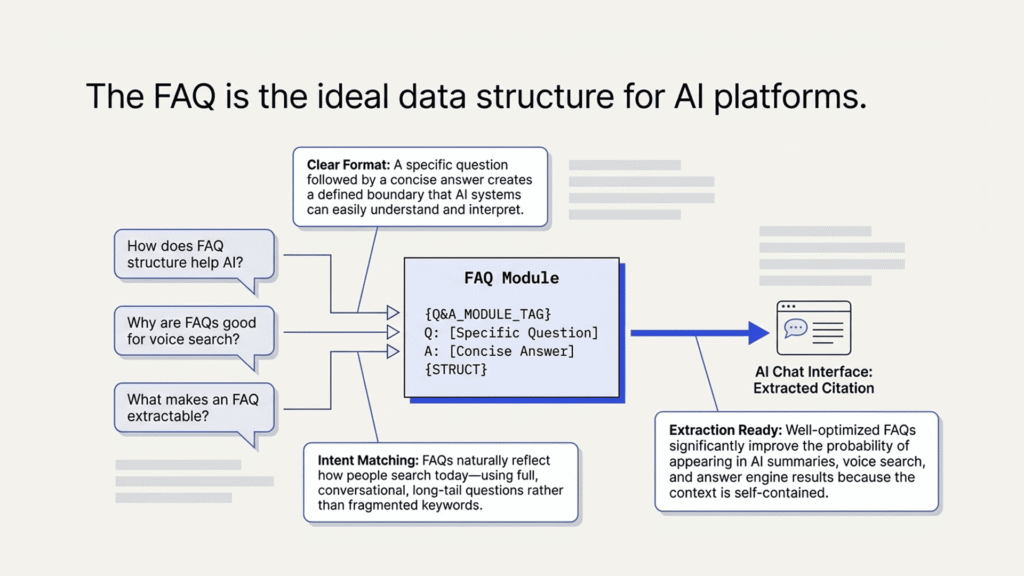
Each FAQ contains a specific question followed by a concise answer. This structure makes it easy for AI systems to understand the context and extract information for summaries, voice responses, and AI answers.
FAQs also reflect how people actually search today. Most users ask conversational, long-tail questions such as “How does AI SEO work?” or “What is answer engine optimization?” When your FAQ content matches these real queries, it becomes easier for AI engines to identify and cite your information.
Because of this, well-structured FAQs increase the chances of your content appearing in AI answers, improving both visibility and credibility in AI-driven search.
Why FAQ Schema is Critical for AI Search, GEO & AEO
Here are some key reasons why the FAQ schema is critical for AI Search, GEO, and AEO:
1. AI Platforms Depend on Structured Data
AI search engines such as ChatGPT, Perplexity, and Google AI Overviews rely on structured data to understand web content. The FAQ schema clearly tells these systems which parts of a page contain questions and answers. This makes it easier for AI engines to interpret the content correctly and extract accurate information for responses.
2. Improves Chances of AI Citations
AI platforms often generate answers using a question-and-answer format. The FAQ schema organizes content in the same structure. When your page clearly signals this format, AI systems can easily identify and cite the answers in summaries, AI overviews, or conversational responses.
3. Matches the Way People Ask Questions
Users interacting with AI search tools often ask detailed and conversational questions. FAQ sections are designed to answer these types of queries directly. When questions on your page match real user language, search engines can better connect your answers to those queries.
4. Makes Content Easier for AI to Extract
AI FAQ optimization helps AI systems quickly locate the most relevant information without scanning large blocks of text. Each question and answer pair is clearly defined, which increases the chances that the content will be selected for AI-generated results.
5. Improves Visibility Across AI and Search Features
Properly structured FAQ content can appear in AI summaries, voice assistant responses, and AI snippets. Because the answers are concise and self-contained, search engines can confidently use them to answer user queries.
6. Strengthens GEO and AEO Strategies
For businesses focusing on Generative Engine Optimization and Answer Engine Optimization, the FAQ schema is a valuable technical improvement. It helps AI systems understand your content structure, increases the likelihood of being cited in AI answers, and improves overall search visibility.
How to Optimize FAQs for AI Search? 10 Effective Ways
AI search engines do not read pages the way humans do. Platforms like ChatGPT, Gemini, Perplexity, and Google AI Overviews scan the web to find clear, structured answers they can extract and present to users.
Here are the 10 most important ways to optimize FAQs for AI search:
1. Use Real Questions from Users
The best FAQ content starts with real questions, not guesses.
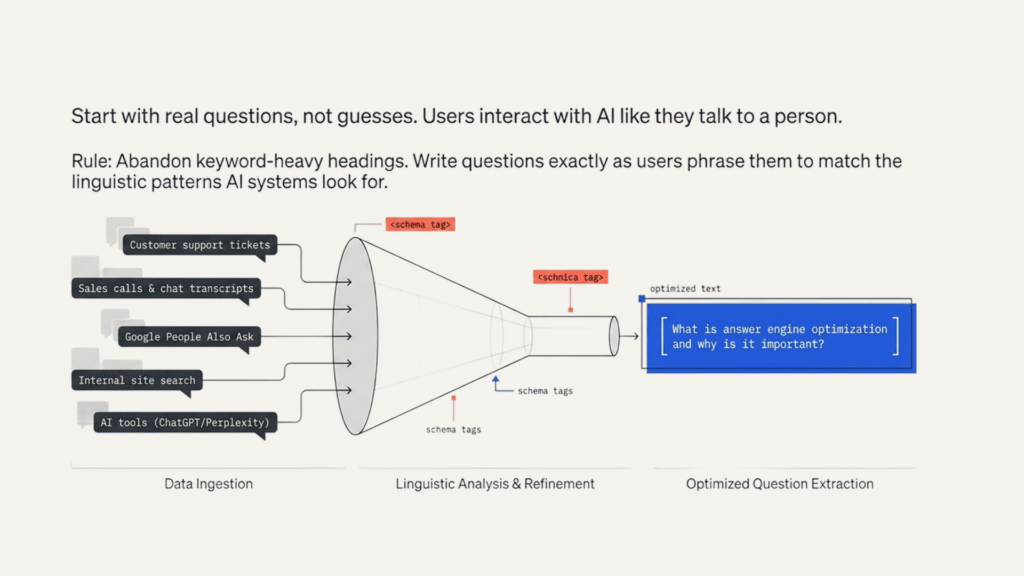
AI engines prioritize content that reflects actual search intent. If your questions match the way people search, your answers become more relevant for AI-generated responses.
You can find these questions in several sources:
- Customer support tickets
- Sales calls and chat transcripts
- Google “People Also Ask” results
- Internal site search queries
- AI tools like ChatGPT or Perplexity
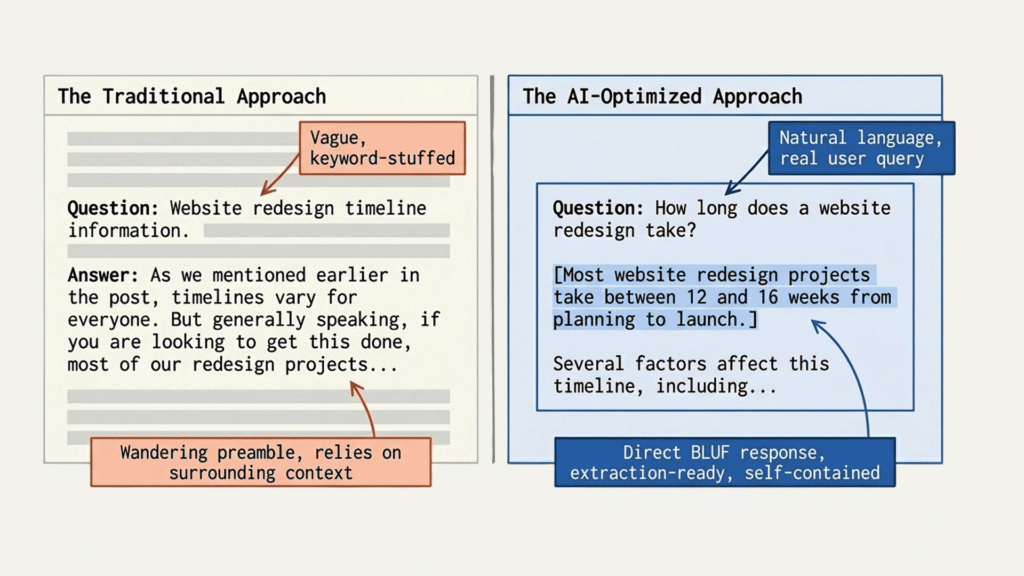
For example, instead of writing a vague question like, “Website redesign timeline information.” Use the actual query users ask, like, “How long does a website redesign take?”
When your FAQ questions mirror real user language, AI engines can match them directly with user prompts. This increases the probability that your answer will be used in AI-generated responses.
This approach ensures your FAQ section is built around actual user intent, which makes it far more valuable for both readers and AI engines.
2. Write Questions in Natural Language
AI search is highly conversational.
Users now interact with search tools the same way they talk to another person. Instead of typing short keywords, they ask full questions.
Examples of conversational search:
- “How does AI SEO work?”
- “What tools help track AI search visibility?”
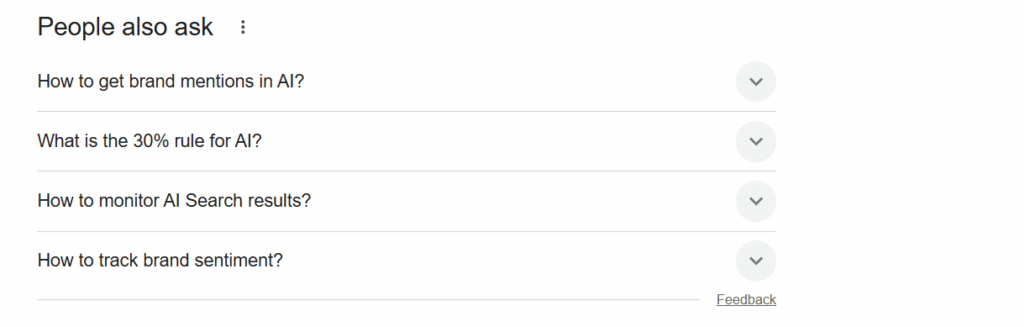
Because of this, your FAQ questions should sound natural and conversational rather than keyword-focused.
Instead of writing keyword-style questions like:
- “AI SEO tools”
Write the way users actually ask:
- “How can I track my visibility in AI search engines?”
This matters because AI systems match user prompts with content that uses similar language patterns. When your questions sound natural and conversational, AI engines can connect your answers to those queries more easily.
Avoid technical jargon or keyword-heavy headings. Instead, write questions exactly as users would say them.
This approach improves your chances of appearing in voice search responses, AI-generated answers, and conversational search results.
3. Start Every Answer with a Direct, Clear Response
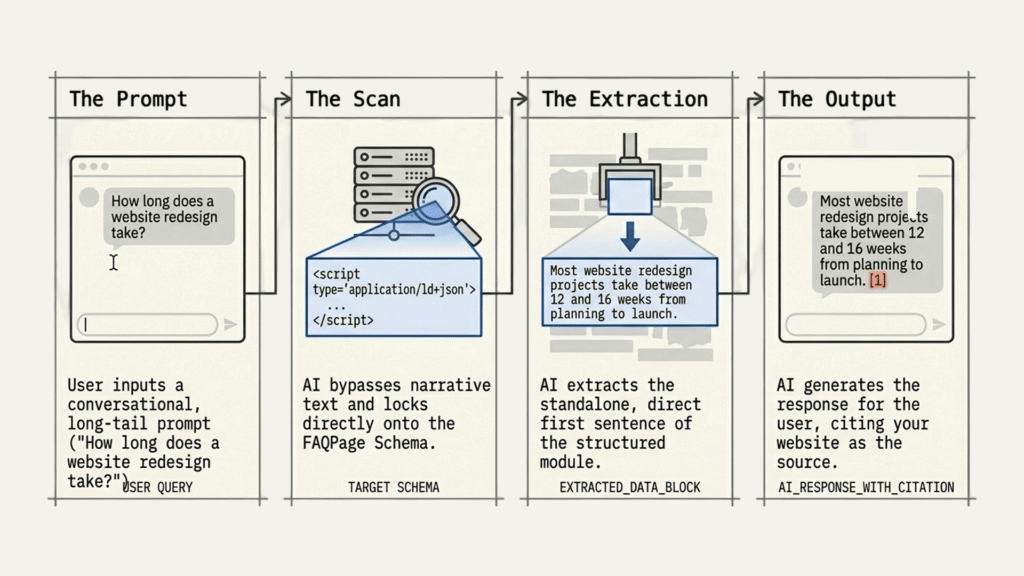
AI engines often extract the first sentence of an answer when generating summaries.
For this reason, the opening line of your FAQ answer should provide a direct response to the question.
Example structure:
- Question: How long does a website redesign take?
- Answer: Most website redesign projects take between 12 and 16 weeks from planning to launch.
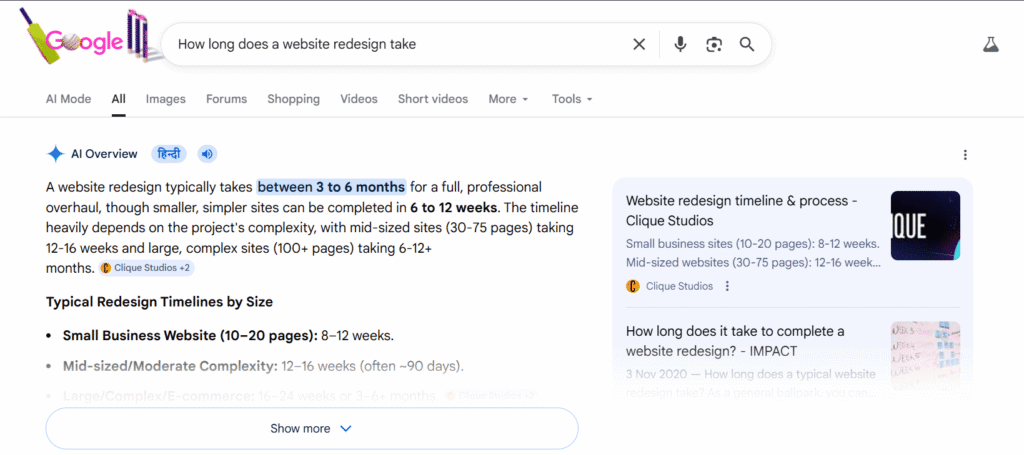
After this direct answer, you can add additional context explaining the factors that affect the timeline.
This approach works well because:
- Users get quick answers
- AI engines can extract clear information
- Content becomes easier to quote
This “answer-first” format works well for both readers and AI engines. Users get immediate clarity, and search systems can easily extract the core response for featured snippets, voice assistants, or AI-generated summaries.
4. Keep Answers Concise and Focused
Long explanations make it harder for AI systems to extract useful information.
Most AI-optimized answers work best when they stay concise and focused on one specific question.
Well-Optimize FAQs for AI search answers should:
- Focus on one question only
- Provide a clear explanation
- Avoid unnecessary filler text
A common recommendation is to keep answers within a short paragraph that delivers clear value. Each answer should address a single intent instead of mixing multiple topics.
Concise answers help AI systems identify the most relevant information quickly. They also make the content easier for users to read and understand.
However, concise does not mean incomplete. The goal is to provide enough detail to make the answer useful while avoiding unnecessary complexity.
5. Make Every Answer Stand Alone
AI systems frequently extract individual answers without showing the surrounding page content.
Because of this, every FAQ answer should make sense on its own.
Avoid references such as:
- “As explained above.”
- “This solution works well for them.”
Instead, include enough context in the answer so that it remains clear even when quoted independently.
Self-contained answers also improve readability for users who may only skim a single section of the page.
6. Use Clear Formatting and Structure
Content structure plays a major role in how AI systems interpret information.
Your FAQ content should be organized in a predictable format that makes it easy to scan.
Best practices include:
- Using clear headings for questions
- Keeping paragraphs short
- Breaking complex information into bullet points
- Separating each question and answer clearly
This structured layout helps AI crawlers identify the boundaries between questions and answers. It also improves readability for users who are scanning the page for specific information.
When information is organized clearly, both humans and machines can process it more efficiently.
7. Implement FAQ Schema Markup
The FAQ schema is one of the most important technical elements to optimize FAQs for AI search.
Schema markup tells search engines exactly which parts of a page contain questions and answers. This structured data helps AI systems interpret your content more accurately.
Without a schema, AI systems must guess the structure of your content. With the FAQ page schema, you explicitly define it.
When implemented correctly, the FAQ schema can increase the chances that your answers appear in:
- AI overviews
- Voice assistant responses
- Featured snippets
- Rich search results
By adding FAQ page schema markup to your pages, you make your content easier for AI engines to identify and extract.
8. Focus on Long Tail and Intent-Driven Queries
AI search queries are typically longer and more detailed than traditional searches.
Instead of short keywords, users ask full questions such as:
- “What is answer engine optimization and why is it important?”
These long-tail queries reveal strong intent. They indicate that the user is looking for a clear explanation rather than general information.
FAQ sections are ideal for targeting these questions because they allow you to answer them directly in a structured format.
By focusing on long-tail queries, you increase your chances of appearing in AI-generated answers that respond to those exact questions.
9. Place FAQs Strategically Across Your Website
Many websites place all FAQs on a single page. While this can work, a more effective strategy is to distribute FAQs throughout relevant pages.
For example:
- Service pages can answer questions about pricing or timelines
- Product pages can clarify features and compatibility
- Blog posts can address related questions readers may have
Placing FAQs in context improves user experience and provides answers exactly where visitors need them.
It also creates more opportunities for AI search engines to discover and extract useful information from different parts of your site. Topic-specific FAQ sections tend to build stronger topical authority than a single monolithic FAQ page covering everything
10. Update FAQs Regularly to Maintain Relevance
FAQs should be treated as living content rather than static information. Customer questions change over time as products evolve, policies change, or new features are introduced.
Regularly reviewing and updating FAQ sections ensures that answers remain accurate and relevant.
Updated content also signals freshness to search engines and AI platforms, which can improve visibility and increase the likelihood of being cited in AI-generated responses.
By applying these practices, you can optimize FAQs for AI search and improve how your content appears in AI search results.
 Pro Tip: Optimizing your FAQs improves your chances of being cited, but understanding how AI platforms actually decide what to reference takes it further. Read how LLMs choose what to cite to see what signals matter beyond structure and schema.
How TrackMyVisibility Helps Improve AI Visibility?
Optimizing content for AI search is only half the job. The bigger challenge is knowing whether AI platforms actually recognize and use your content.
Unlike traditional SEO, where tools like Google Search Console show rankings and traffic, AI search offers very little visibility into what is happening behind the scenes.
That is where Track My Visibility becomes valuable. It’s built specifically to help businesses understand how their brand appears inside AI search engines and how often their content is used as a source.
With Track My Visibility, you can:
- Track AI citations to see where your content is referenced
- Measure AI’s share of voice against competitors
- Identify pages influencing AI answers
- Discover visibility gaps where competitors appear, but you don’t
- Monitor AI search trends and refine your strategy
Instead of guessing your AI search performance, you get clear insights into how AI engines interpret and use your content.
Want to see how visible your brand is in AI search?
Visit Track My Visibility and start tracking your AI search presence today.
Conclusion
Search is changing fast. Ranking on Google is no longer the only goal.
Today, visibility also depends on whether AI platforms like ChatGPT, Gemini, and Perplexity use your content when answering questions.
If your content is not structured in a way AI engines can understand and extract, your brand may never appear in those answers.
This is why optimizing FAQs has become so important.
Well-structured FAQ content helps AI engines quickly understand your information, match it with user queries, and cite it in generated responses.
By using real user questions, writing conversational queries, giving direct answers, implementing FAQ schema, and targeting long-tail intent, you make your content far more likely to appear in AI-generated responses.
We hope this guide helps you understand the effective ways to optimize FAQs for AI search.
Now, if you have understood the importance of FAQs for AI visibility and are ready to take action, tools like TrackMyVisibility can help you track how AI engines reference your content and where you can improve.
FAQs
FAQs improve AI search visibility because they present information in a clear question-and-answer format that AI systems can easily understand. Platforms like ChatGPT, Gemini, and Google AI Overviews often look for concise answers to user queries. Well-structured FAQs make it easier for AI engines to extract and cite your content when generating responses.
The FAQ schema is a type of structured data that tells search engines which parts of a page contain questions and answers. By implementing FAQPage schema markup, you help AI systems understand the structure of your content. This increases the chances of your answers appearing in AI summaries, voice search responses, and featured snippets.
The best FAQ questions are real, conversational queries that users actually ask. Long-tail questions such as “How does AI SEO work?” or “How can I track AI search visibility?” perform well because they match how people interact with AI search platforms. Using real user questions improves the chances of your content being selected in AI-generated answers.
AI Optimize FAQs for AI search should be concise and focused. A good approach is to start with a direct one-sentence answer, followed by a short explanation that provides context. Clear and self-contained answers are easier for AI engines to extract and use in generated responses.
Businesses can track their AI search visibility using tools designed for AI search monitoring. Platforms like TrackMyVisibility help identify where your content is cited across AI engines, measure your share of voice against competitors, and reveal which pages influence AI-generated answers.