


Your SEO rankings look healthy. But the traffic is slowly dropping. If that sounds familiar, you’re not alone, and the reason is that AI search and traditional SEO are no longer the same game.
More and more buyers are skipping Google entirely and going straight to ChatGPT, Perplexity, and Google AI Overviews for answers. ChatGPT alone now has 900 million weekly active users, and a growing chunk of them never touch a search results page.
If your brand is not showing up in those answers, you are effectively invisible to a growing segment of your audience.
That is exactly the problem Track My Visibility (TMV) was built to solve. But as more teams start paying attention to AI visibility, one question keeps coming up: how accurate is the data, really?
This guide breaks down how Track My Visibility accuracy actually works, what the numbers mean, and how to use the tool to drive real decisions.
In this blog, we’ll cover:
- Why data accuracy for AI rank tracking matters more than most marketing teams realize
- How Track My Visibility measures brand mentions across AI platforms
- What “accuracy” actually means when dealing with AI tools that produce different answers every time
- How to interpret AI visibility data without drawing the wrong conclusions
- The real limitations of any AI visibility tracking tool, including this one
TL;DR
- AI search works differently from traditional search. Brand mentions in LLM answers require a different kind of tracking entirely.
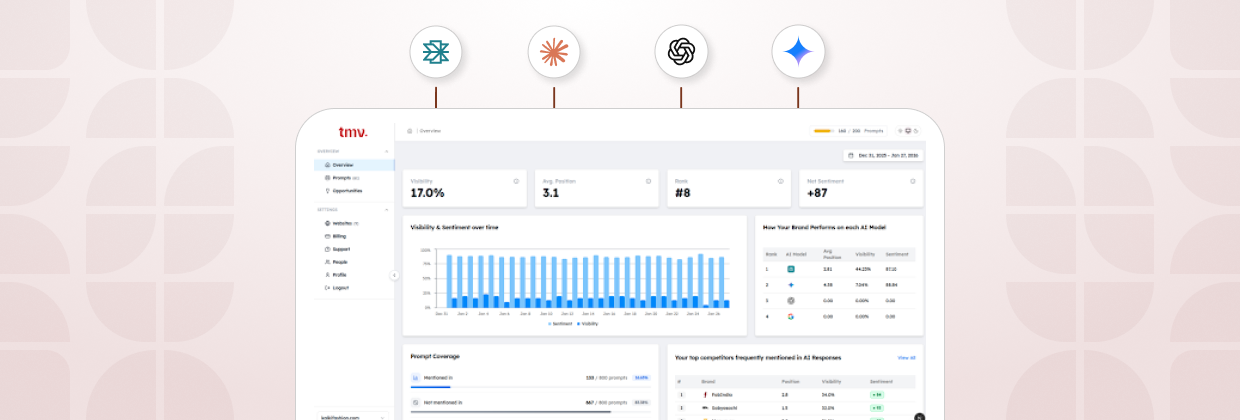
- Track My Visibility provides a comprehensive way to track visibility by using prompt-based testing across ChatGPT, Perplexity, Gemini, and Google AI Overview to measure where your brand appears in AI-generated answers.
- No AI visibility tool guarantees 100% consistency because AI models are non-deterministic by design.
- Understanding Track My Visibility accuracy helps you set the right expectations before you start tracking.
Why Accuracy in LLM Brand Tracking Matters
Most teams still treat AI search as a secondary channel. That is a mistake that is getting more expensive by the month.
ChatGPT crossed 900 million weekly active users in early 2026. Google AI Overviews has more than 2 billion monthly active users (Alphabet Q2). A growing number of buyers are using AI answers and not traditional search results to research products, compare tools, and shortlist vendors.
When someone asks ChatGPT or Perplexity for a recommendation, the brands mentioned get consideration. The ones left out simply do not exist in that moment.
Traditional SEO tools tell you where you rank in the ten blue links. They say nothing about what AI engines are saying about you, and that gap is where the real risk sits.
At the 2025 Google Search Central Meetup, the industry was hungry for reliable AI visibility data.
As Lily Ray, Senior SEO Expert, put it:
“Everyone wants to understand how this new feature affects their traffic and their clients, and how to measure it.”
That is exactly what Track My Visibility accuracy is designed to address.
The demand exists because most traditional SEO tools were never built for AI search.
The danger of relying on inaccurate tracking is just as real. A tool that overcounts your brand mentions gives you false confidence. One that misses semantic references gives you a distorted picture of your competitive positioning. Both lead to poor decisions about content investment, generative engine optimization, and where to direct your team’s effort.
Data accuracy for AI rank tracking is not a nice-to-have. When the data is wrong, the strategy built on top of it is also wrong. This is exactly why AI visibility matters and why improving AI search visibility requires reliable, consistent data rather than one-off checks.
 Pro Tip: Not sure where your brand stands in AI search right now? Use the free AI visibility checker to see how your brand appears across ChatGPT, Perplexity, Google AI Overviews, and Gemini before diving into the tracking methodology below.
What “Accuracy” Means in the AI Visibility Tracking Tool
Before judging Track My Visibility accuracy, it helps to be clear about what accuracy actually means in this context. There are four distinct dimensions.
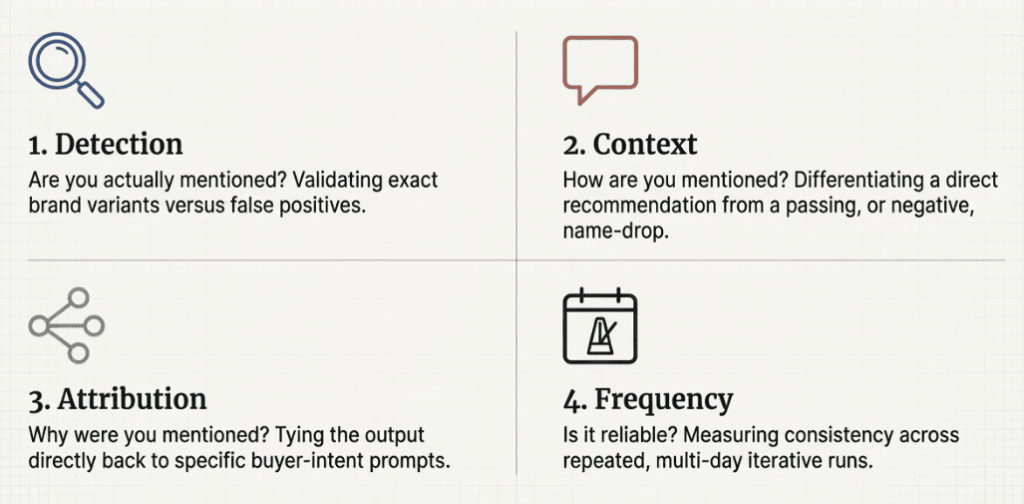
- Detection Accuracy: Detection accuracy determines whether your AI mentions are being correctly identified in responses. A tool must correctly identify when your brand name appears and avoid false positives where unrelated content gets flagged as a mention.
- Context Accuracy: Not all brand mentions are equal. There is a difference between a direct recommendation (“we suggest Brand X”), a passing reference, and a comparative mention where your brand is listed alongside others. A tool that only tells you whether you appeared, without telling you how, leaves a lot of the story out. Being mentioned with wrong information causes more damage than not being mentioned at all.
- Attribution Accuracy: It connects the mention to the right prompt and use case. If your brand shows up when someone asks “what are the best CRM tools for startups,” but not when they ask “best enterprise CRM,” that distinction matters for your GEO strategy. It comes down to understanding how LLMs choose content when constructing their answers.
- Frequency Consistency: It is about reliability across repeated runs. Because AI models do not produce identical outputs each time, a single run of a prompt is not a trustworthy data point on its own. Accurate tracking requires running prompts multiple times and understanding how consistently your brand appears across those iterations.
TMV addresses all four of these. It uses cloro.dev as its underlying data infrastructure, which means the AI visibility data it surfaces is pulled from real AI responses in a structured format, complete with source links.
The tool tracks both brand visibility (direct name mentions) and citation visibility (when your content informs a response without your brand being named), giving you a fuller picture of where you actually stand.
Pro Tip: Not sure if your pages are even set up to be cited by AI? Before you start tracking metrics, run your site through the All-in-One AEO & GEO Audit Checklist. It covers 250 checkpoints across technical setup, content structure, and citation signals, so you’re not measuring a site that isn’t ready to be found.How Track My Visibility Measures Brand Mentions
The methodology behind Track My Visibility accuracy is worth understanding, because the data is only as good as how it is collected.
1. Prompt-based AI Visibility Checks
You set up custom prompts that reflect the real questions your target buyers are asking, things like “what are the best tools for X” or “alternatives to [competitor].” Unlike keyword-based tracking, this approach mirrors how real users actually interact with AI search.
2. Multi-LLM Testing
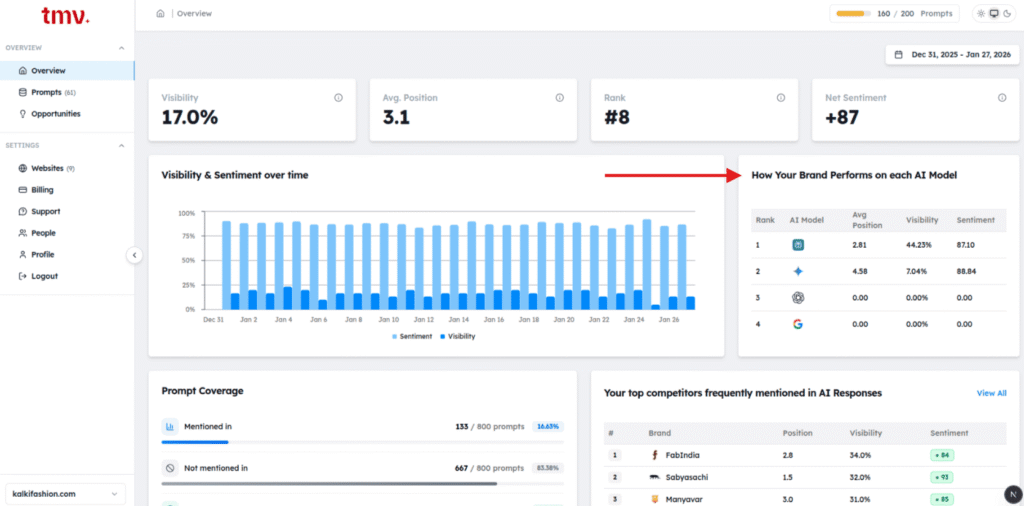
Your prompts are executed across ChatGPT, Google AI Overviews, Perplexity, and Gemini simultaneously. This is important because AI models do not behave the same way. Like your brand might appear consistently in ChatGPT but rarely in Google AI Overviews. Tracking across major AI platforms at once gives you a side-by-side comparison rather than a single-model snapshot.
3. Iterative Runs
It addresses the non-determinism problem directly. Track My Visibility runs prompts every 24 hours, making AI visibility monitoring reliable over time rather than a one-off snapshot.
4. URL-level Citation
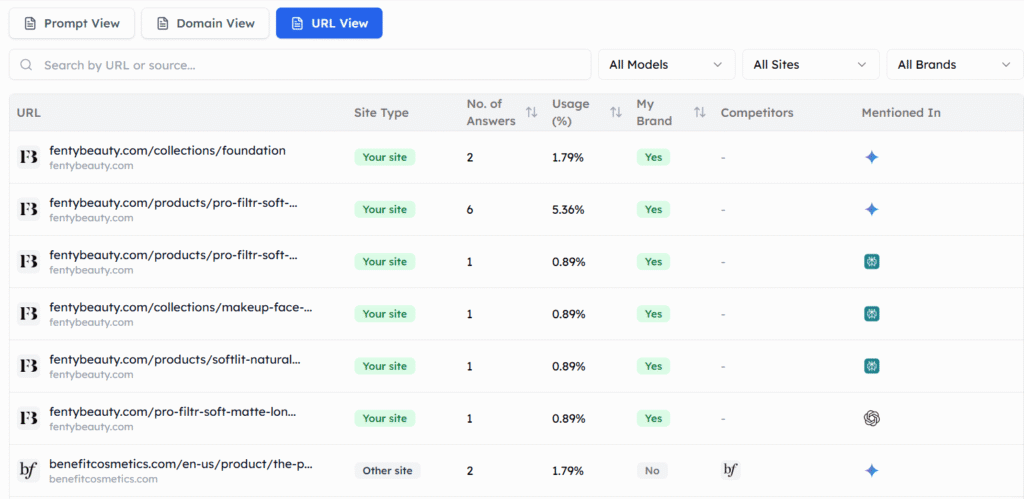
Track more than just whether AI systems mentioned your brand. It shows exactly which pages earn citations, how often AI systems cite them, and which AI search engines reference your website. For a deeper look at what AI citation tracking is, see this AI citation tracking guide. It also tells whether you earned an inline link or your brand was just a passing name-drop.
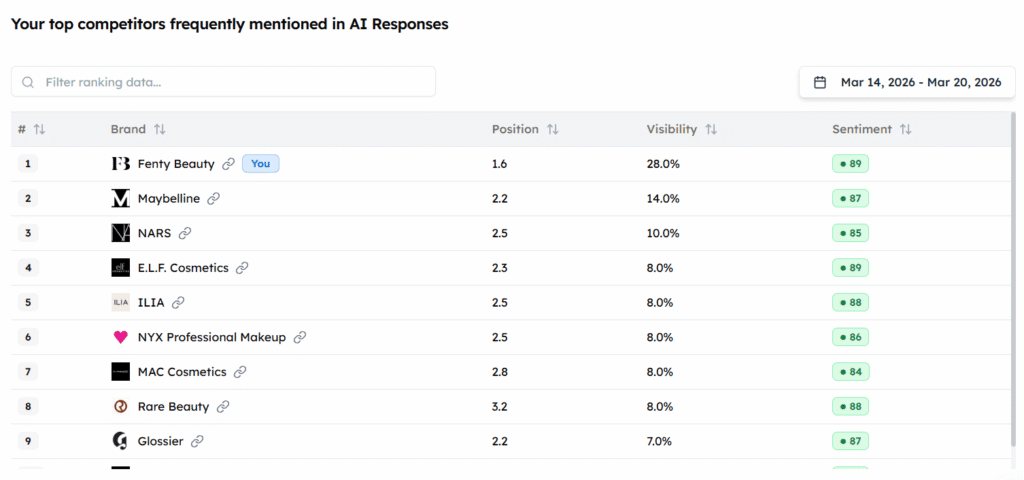
5. Competitor Benchmarking
The competitive intelligence layer shows how you rank against specific competitors across AI responses, and which competitors are appearing in prompts where you are completely absent. That gap analysis is what turns a visibility report into an actual content strategy.
6. Insights Section
It surfaces specific action items across off-page opportunities, on-page content fixes, and technical site issues. Each insight ties directly to real prompts and competitor citation patterns, and it goes beyond providing generic recommendations.
How Accurate Is Track My Visibility in Practice?
The single biggest accuracy challenge in AI visibility tracking is that AI models are non-deterministic. The same prompt does not produce the same answer every single time. This doesn’t mean that there is a flaw in the tool; it is a fundamental property of how large language models work.
TMV handles this through repeated runs every 24 hours. It builds a trend dataset over time rather than relying on a single response that may not reflect your brand’s typical presence.
The data itself comes from cloro.dev, an API-first scraping service built specifically to track AI visibility. This helps pull live responses directly from multiple AI search tools like ChatGPT, Perplexity, Gemini, Google AI Overviews, etc. So what you see in the dashboard reflects what these AI search tools are actually returning to users.
TMV also distinguishes how AI systems cite your brand by identifying whether they include an inline link, add it to a source list, or simply mention it by name. That distinction matters because treating all mentions equally would inflate your numbers without telling you anything useful about how prominently your brand actually appears.
On hallucinations, the daily cadence and multi-run approach naturally filter out one-off or inconsistent mentions when you are looking at trends rather than individual responses.
Real Challenges in Measuring LLM Mentions (And How TMV Solves Them)
Tracking brand visibility in AI responses sounds straightforward until you run into the quirks of how large language models actually work. Most tools fall short. Track My Visibility handles it differently.
Challenge 1: Non-Deterministic Outputs
AI search platforms do not work like databases. Ask the same question twice, and you may get meaningfully different answers, which makes single-run data unreliable.
Solution: TMV runs prompts on a daily cadence and averages results over time. This normalizes the variability and gives you a visibility rate you can actually act on. The dashboard shows trends rather than one-off snapshots.
Challenge 2: Semantic Mentions (Not Exact Keywords)
The way a question is phrased changes the answer. “Best CRM for startups” and “top CRM tools for small businesses” may produce entirely different AI responses, even though they reflect the same buyer intent. A narrow prompt library produces an incomplete picture of your actual AI search visibility.
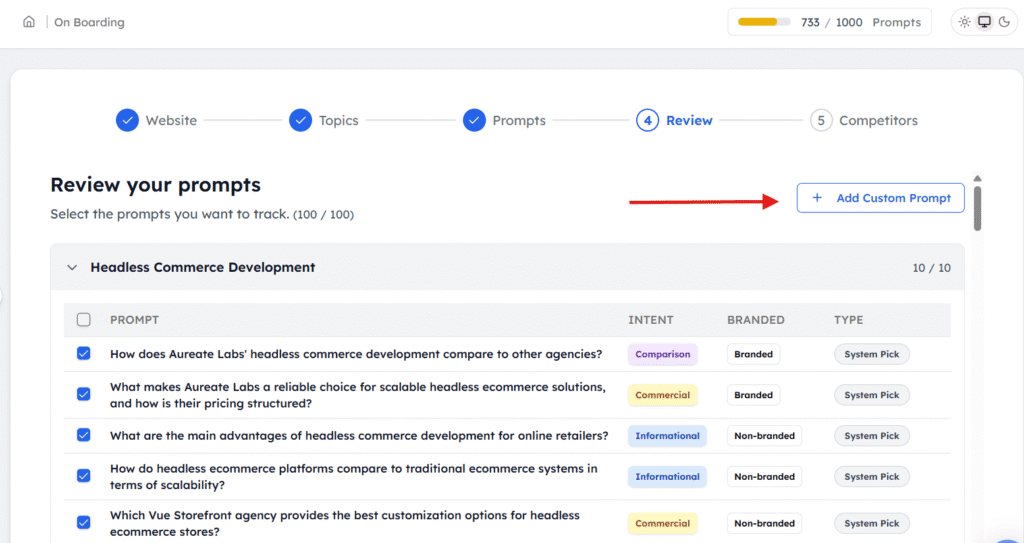
Solution: TMV lets you build a custom prompt set that covers the full range of queries relevant to your category. You can map prompts to different buyer stages or intent types, so the visibility data reflects how a real customer might actually discover you.
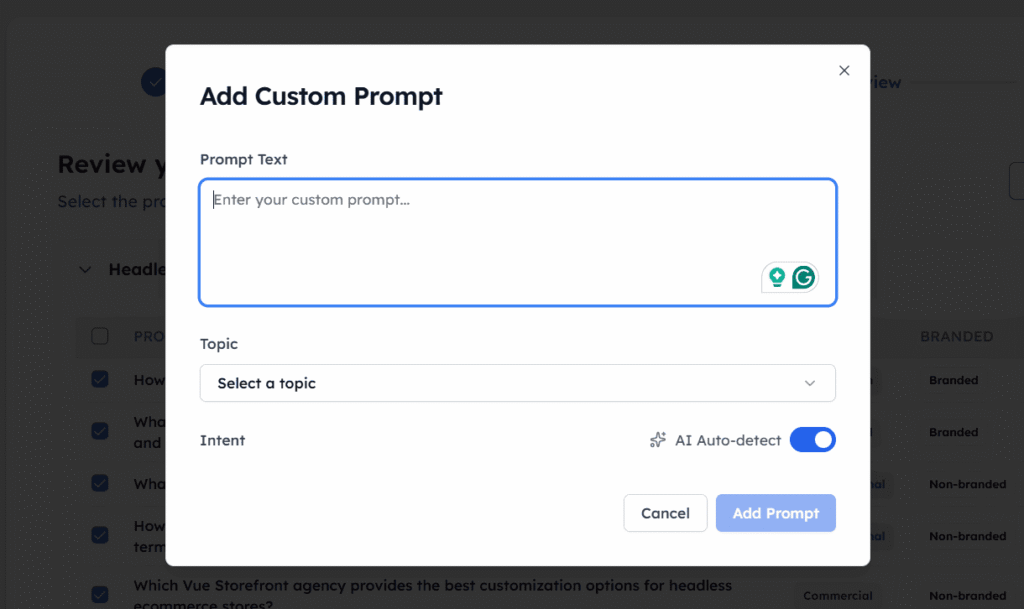
Challenge 3: Prompt Sensitivity
Some tools count any mention as a win. Appearing as an example of what not to use gives you nothing useful.
Solution: The context validation layer checks why a brand was mentioned, not just whether it appeared. That keeps the visibility trends you track reflective of genuine recommendation presence.
What Track My Visibility Does Better Than Traditional SEO Tools
Traditional SEO tools are built for discovery that happens through search engine results pages. Track My Visibility focuses on AI-generated answers that millions of users see before they ever click a link.
The effectiveness of any AI visibility tool depends on whether it can deliver prompt-level insights and competitive benchmarking, not just a topline score.
1. Tracks Answers, Not Rankings
Where a traditional rank tracker tells you your site is in position 7 for a keyword. Track My Visibility tells you whether AI engines are recommending your brand at all, and in what context. That is a fundamentally different question.
2. Works Across Multiple AI Platforms
Traditional tools focus almost entirely on Google, but modern AI search systems work across multiple platforms simultaneously. Track My Visibility covers ChatGPT, Perplexity, Gemini, and Google AI Overview simultaneously, which reflects how AI search actually works across the different AI search tools your buyers use daily.
3. Measures Recommendation Probability, Not Just Presence
Knowing your brand appeared in 40% of runs for a given prompt is more useful than a binary yes or no. The brand visibility tool, TMV, tells you how consistently AI models consider you worth mentioning. It is a reliable proxy for how trusted your content and brand signals actually are.
4. Captures Citation-Level Detail
Beyond showing that AI systems cited your brand, the AI visibility tracker identifies the specific URLs on your site that earned those citations. That gives your content team a direct line of sight to what is working and what needs improvement for AI readiness.
5. Supports Competitive Benchmarking
You can see how your share of voice compares to competitors across the same prompts. The gap analysis shows where competitors appear, and you don’t feed directly into your GEO strategy.
If you want a complete walkthrough of the process, this guide on how to track AI search visibility covers the full methodology.
Limitations of the AI Visibility Platforms that you Should Know
Understanding the boundaries of Track My Visibility accuracy helps you read the data correctly. No AI SEO tool is perfect, and most come with real constraints worth knowing before you read too much into the numbers.
1. LLM Outputs Are Probabilistic, Not Fixed
No tool can guarantee that the mention rate you see today will hold tomorrow. AI providers frequently update their models, and those updates can change how the models respond to certain prompts even when you make no changes on your end.
A 2023 study found GPT-4’s accuracy on identical reasoning tasks dropped significantly between March and June of that year, purely from model updates.
New study confirms user rumors: Huge drop in quality of GPT generations from March to June 2023
by u/Successful-Western27 in ArtificialInteligence
Track My Visibility’s accuracy is built on repeated measurement precisely because of this.
2. Variance in Results Is Unavoidable
The non-determinism of AI models means some inconsistency is baked in. The same prompt can return different answers on different runs. What a good tool does is minimize that variance through repeated runs and honest reporting. Track My Visibility shows you trend data rather than making false promises about exactness. The way AI platforms mention brands’ content can shift with every model update.
3. Coverage Depends on Your Prompt Set
The quality of what the AI search visibility tool tracks is directly tied to the quality of the prompts you configure. If your prompt library does not reflect how real buyers in your category actually search, the visibility data will not tell you what you need to know. This is less a limitation of the AI visibility tool and more a reminder that setup matters.
4. Rapid Model Updates Can Affect Results
When OpenAI, Google, or Anthropic updates their models, outputs for the same prompts can shift overnight. That can show up as sudden changes in your AI visibility score that have nothing to do with your content or brand authority. Continuous AI search monitoring helps you distinguish genuine visibility changes from model-update noise.
How to Interpret Track My Visibility Data Correctly
TMV gives you a detailed picture of how your brand shows up across multiple AI platforms. The numbered list that follows is self-explanatory.
1. Look at Trends, Not Single Snapshots
Track My Visibility accuracy is best measured as a trend. A single prompt run tells you what happened once. Monthly trend data tells you what is actually happening to your brand visibility over time. Changes in your mention rate across consecutive weeks are far more meaningful than any single data point.
2. Compare Against Competitors
Your raw AI visibility number means more when you can see it in relation to how your competitors are performing on the same prompts. TMV shows you exactly this: your position, visibility percentage, and sentiment score alongside your closest competitors. If you appear in 30% of runs and your nearest competitor appears in 60%, that gap is the real insight.
3. Focus on Prompt-Level Gaps
Look at which specific prompts you are not appearing in. The competitive gap analysis shows you which competitors are showing up in prompts where you are completely absent. Those gaps point directly to content opportunities worth prioritizing.
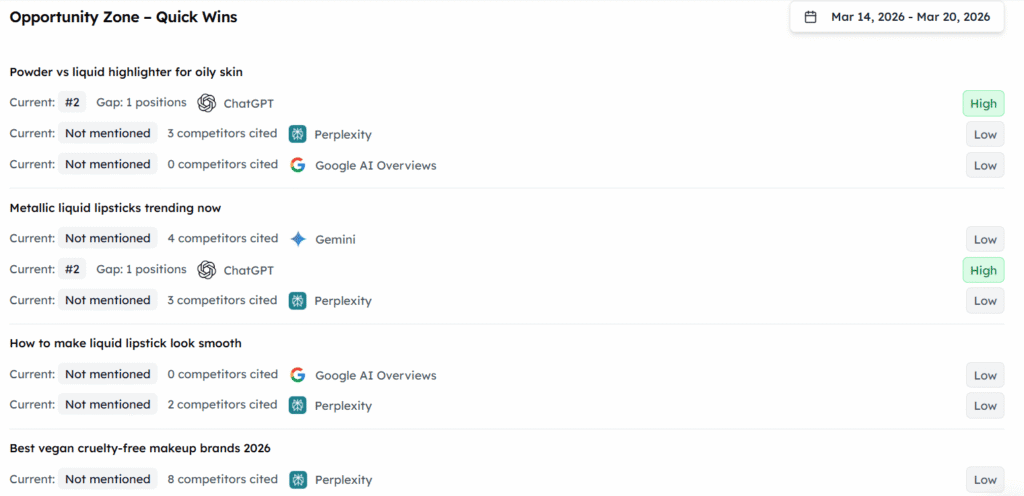
4. Use Insights for GEO
The URL-level citation data and AI readiness scores feed directly into a generative engine optimization workflow. When a competitor’s URL earns citations for prompts where your URL does not, the insights section shows you why the competitor is being cited and highlights the changes you can make to improve your AI visibility.
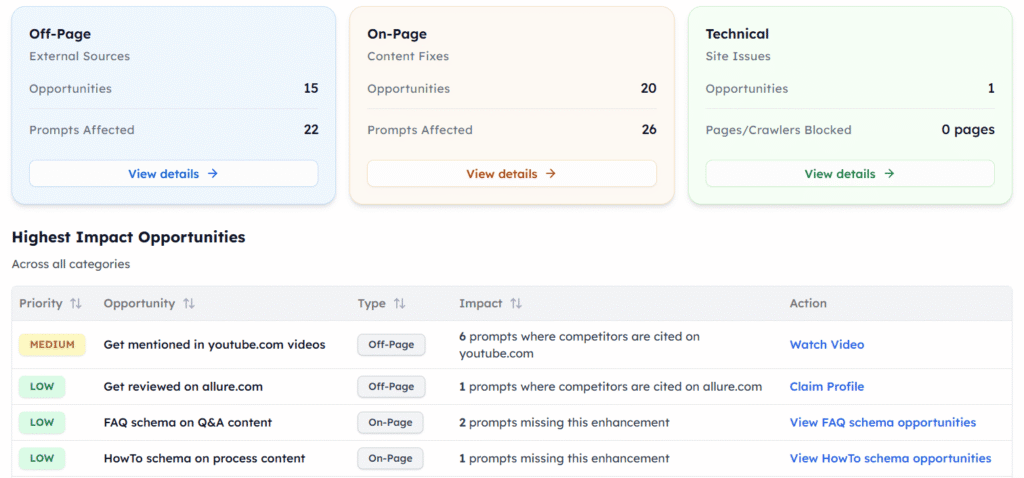
The insights section flags whether that is an off-page issue, an on-page content fix, or a technical site problem. Brands that succeed in AI visibility adapt their content so AI tools can understand it, and that requires this kind of prompt-by-prompt detail.
5. Integrate with your Existing Reporting
The TMV platform supports data export and dashboard connections, so you can surface AI visibility trends alongside your traditional search visibility metrics in one place. That side-by-side view is useful for showing teams how the two channels are diverging over time.
Final Take: Can You Trust Track My Visibility?
The honest answer on Track My Visibility accuracy is yes, with the right expectations in place. It is not a source of absolute truth, but it is the best available approximation of your brand presence across AI search engines, updated daily, with enough context to act on.
Most AI visibility tools give you a snapshot. TMV gives you a trend. Used as a search visibility checker and ongoing AI tracking tool, the value compounds over time.
Continuous monitoring is what separates teams that are ahead of this shift from those still catching up.
The brands showing up in AI-generated answers are building a compounding advantage. The ones that are not are becoming invisible faster than most teams realize.
Ready to see where your brand actually stands? Start your 7-day trial for free and get your first AI visibility report within hours.
FAQs
Google Search Console shows you how your site performs in traditional Google search, like impressions, clicks, and rankings. Track My Visibility tracks how your brand appears in AI-generated answers across ChatGPT, Perplexity, Gemini, and Google AI Overview. As AI search grows, both become necessary parts of a complete search visibility picture.
AI models are non-deterministic by design. The same prompt can produce different outputs depending on many factors, including model state, training updates, and input phrasing. This is why Track My Visibility uses daily runs and trend data rather than single-point snapshots. The trend across multiple runs is a far more reliable signal than any individual result.
Yes. The AI visibility tool lets you add competitor domains and compare your AI visibility against theirs on the same prompt sets. This is one of the most useful features for understanding your competitive positioning in AI search results.
Track My Visibility runs prompts once every 24 hours across your selected AI tools. Your dashboard shows a countdown to the next run, so you always know when fresh data is coming.
Yes. The Growth plan supports unlimited websites and unlimited team members, which makes it practical for agencies managing AI visibility tracking across multiple clients. Visibility reports can be exported and connected to external dashboards for client reporting.
Set up your account with your brand domain, auto-generate prompts, or add prompts manually that reflect real customer questions. Your dashboard will show AI visibility insights within a few hours. There is a 7-day trial available for free before the standard plan pricing kicks in.
Resources:
- Alphabet Q2 earnings call: CEO’s remarks
- What I learned at the 2025 Google Search Central Meetup in NYC – Lily Ray