


Copilot tracking tool!! Yes, I got you.
Probably a client wants to know their visibility on Copilot, or you’ve noticed your Google rankings are solid while you have no idea what Bing-powered Copilot is actually saying about you. Either way, you’re now hunting for a tool that tracks it properly.
Most tools advertise Copilot right there on the pricing page, only to find it locked behind a higher tier or, worse, behind a sales call once you actually try to turn it on. You go in expecting the entry price to cover it, and it doesn’t.
I’ve seen this gap show up firsthand at Track My Visibility, our AI visibility tracking tool. So in this guide, I’m breaking down the tools that actually let you track Copilot properly.
I’ll walk you through what I found evaluating them, including a couple of things that genuinely surprised me.
How I Evaluated These Tools
I went hands-on wherever a free trial or demo let me in, ran the same handful of prompts through each tool where possible, and pulled in reviews and community feedback. Since Copilot behaves differently from a standard SERP, I paid particular attention to how each tool actually captures that.
Here’s what I consider:
- Accuracy of Copilot citation capture, whether the tool shows real sources Copilot pulled from, rather than just a mention count.
- How well each tool scales, from a single brand to multiple markets or clients.
- Pricing flexibility, and specifically whether the advertised entry price actually includes Copilot or gates it behind a higher tier.
- Actionable insights, whether the tool suggests a step further, like a recommendation, instead of just data.
- Other engine coverage, how Copilot sits alongside ChatGPT, Perplexity, and the rest each tool tracks.
7 Best Copilot Rank Tracking Tools
| Tool | Best for | Standout feature | Copilot starting price |
| AIClicks | Most Copilot-native tracking | Derives a relative-position score since Copilot has no fixed rank | $189/mo (Pro tier, not on the $59 Starter) |
| Otterly | Affordable, no-catch access | Copilot included by default on every tier, no gating | $29/mo |
| Peec AI | Clean, multi-engine visibility | Polished dashboard, easy to read at a glance | $95/mo (1 of 3 selectable engines) |
| AthenaHQ | Turning Copilot data into action | Action Center converts gaps into assignable tasks | $295/mo (all 8 engines included, no per-engine gating) |
| Scrunch AI | Understanding how Copilot sees your brand | Site Diagnostics shows what AI crawlers can and can’t reach | $250–300/mo |
| Profound | Enterprise-level Copilot intelligence | FactCheck and real user Prompt Volumes data | Enterprise only, custom pricing (not on $99 or $399 tiers) |
| Omnia | Location-aware Copilot tracking | Simulates real local browser sessions per market | ~$79/mo, but Copilot is “available on request,” not default |
*Pricing can vary, so check out the official pricing pages on product websites.
1. AIClicks
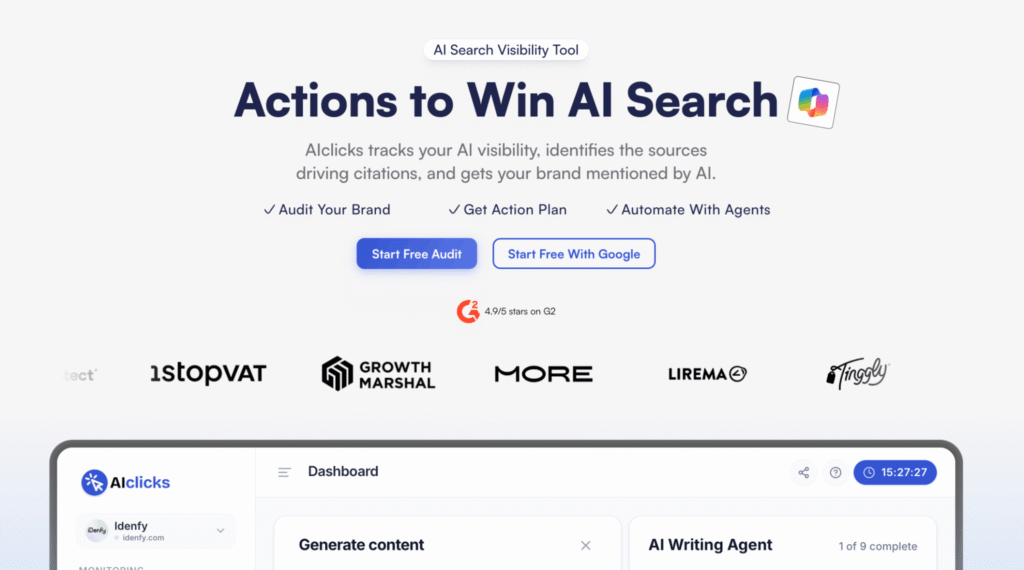
I’ve placed AIClicks at #1 for this specific category as it treats Copilot as its own thing.
What makes AIClicks particularly useful for Copilot?
Copilot doesn’t rank brands the way a SERP does; it just includes or leaves them out of a generated answer. AIClicks builds its whole approach around that, deriving a relative position by comparing how often you’re named against everyone else showing up in the same answers. Important AI visibility metrics like visibility, citations, sentiment, and that position are all tracked as separate metrics.
How much Copilot data do you actually get?
Honestly, more than I expected.
- Prompt-level tracking, so you see exactly which questions trigger your brand
- Country-level filtering to catch market-by-market differences
- Competitor benchmarking against up to 10 named competitors
- A relative-position score against every brand named in the same answers
Where AIClicks goes beyond a basic rank tracker
It shows the reason behind the number. Every answer comes with the sources Copilot pulled from, so a citation drop traces back to an actual page instead of staying a mystery. Mentions get a sentiment tag too, catching the cases where Copilot names you but describes you in a way that undercuts the win. Layer the competitor data on top, and you get a real picture of who’s winning specific prompts, which is what turns a visibility number into something you can act on.
Where it stood out and what to consider
What stood out to me was how Copilot-specific the whole approach felt. The relative-position metric, the split scoring, the source-level citation logging, all of it reads like someone actually studied how Copilot behaves before building this.
One thing worth considering, though: nowhere on the Copilot tracker page does the company mention Bing indexation, even though Copilot’s answers are grounded in Bing’s index. And real Copilot access starts at $189/mo, not the $59 Starter price on the homepage.
My take: If Copilot is the engine you actually care about, this is the most purpose-built option here. Just budget for $189/mo, not $59.
 Pro tip: If you want to get a quick look at your overall AI visibility in just minutes, run a free AI visibility checker to see where you stand.
2. Otterly AI
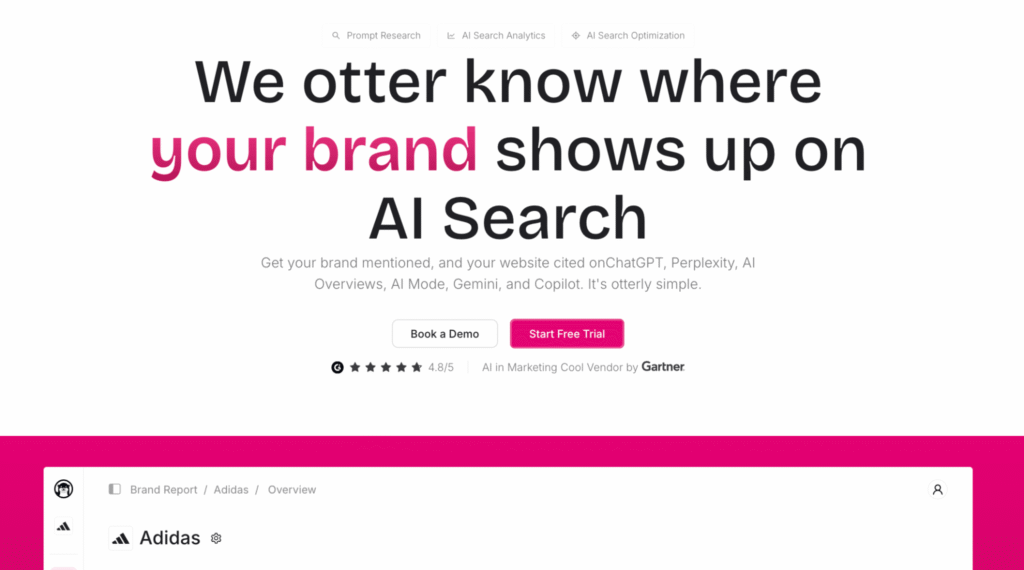
Yes, an affordable option. Otterly is the tool I’d point someone toward if they just want to know whether Copilot mentions them at all, without signing up for a sales call or a $500 plan to find out.
You add your prompts, Otterly runs them, and you’re looking at real results within a day or two. The dashboard shows you the actual response text for each tracked prompt, so you’re reading what Copilot actually said rather than a summarized score.
What does the entry plan ($29/mo Lite tier) actually let you monitor?
- 15 tracked prompts across all included engines, Copilot among them
- Copilot included by default, no upgrade needed, unlike AIClicks
- Unlimited brand reports, no cap on brands or products
- Multi-country tracking across 50+ countries, included even here
- 3 AI-generated recommendations per week
- 1,000 URL audits per month for the GEO Audit feature
How Copilot fits into Otterly’s wider AI tracking
Copilot is one of four engines bundled into the base price from day one, alongside ChatGPT, Google AI Overviews, and Perplexity. It’s not treated as a specialty the way AIClicks treats it, no dedicated ranking logic, no separate landing page, just part of the core set every plan gets.
Where the lower price comes with tradeoffs
Fifteen prompts go fast. And the jump from Lite to Standard, $29 to $189, is steep enough to call it out as a real budget stretch. Which makes choosing the right prompts matter more, since you don’t have room to waste a slot on a question nobody’s actually asking.
There’s a pricing quirk too: per prompt, Lite actually costs more than Premium does, so “cheap” only holds at the sticker price, not underneath it. Reporting depth and historical trends are also thinner, and refresh cadence for Copilot specifically isn’t stated anywhere.
My take: Real Copilot tracking for $29, no catch. Just don’t expect to run a serious multi-brand operation on Lite.
If you want to check your position quickly, consider running a quick check with our Copilot Rank Tracker.
3. Peec AI
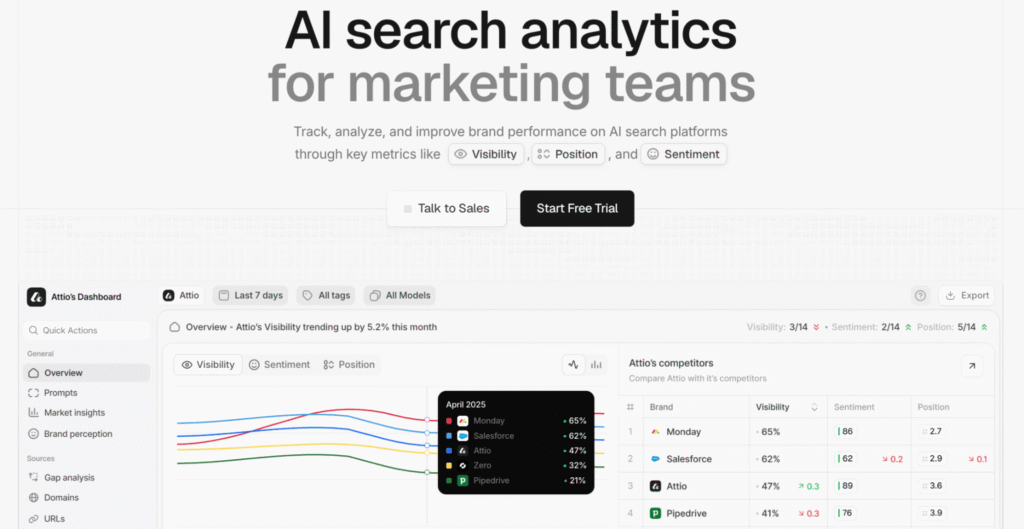
When it comes to better user experience and analytics data, Peec AI is the one. I genuinely like Peec’s analytical insight, especially the way mentions, sentiment, and citations sit together on one clean screen instead of forcing you to piece it together yourself.
Where Copilot fits into Peec’s broader tracking experience
Copilot isn’t a headline feature here; it’s one of seven engines you can choose from, and every self-serve tier caps you at picking 3. So Copilot competes for a slot alongside ChatGPT, Perplexity, Gemini, AI Overviews, AI Mode, and Grok, rather than coming bundled by default. If you want Copilot plus three others, that fourth engine is a paid add-on, reported around $35 to $165/mo depending on tier.
The dashboard experience matters here
This is genuinely where Peec pulls ahead. Setup is fast, described by more than one source as close to zero-friction, and the interface makes Copilot data easy to read at a glance rather than something you have to dig for. Auto-suggested prompts save you the blank-page problem at the start, though you might need manual cleanup from a suggested one. It’s similar to what we’ve done with our trackdown reports, giving a clean, dashboard-level breakdown of a brand’s AI visibility.
From Copilot rankings to competitive visibility
Once Copilot is one of your three engines, you get the same depth Peec applies everywhere: mention tracking, sentiment, which URLs get cited, and competitor benchmarking. It’s engine-agnostic analytics applied consistently, so what you get for Copilot is exactly what you’d get for any other engine in your three, no more, no less.
What you sacrifice for the polished experience
- Only 3 engines at a time on self-serve, so tracking Copilot alongside your other priorities means paying for a 4th slot.
- No historical backfill; tracking starts the day you turn it on, so there’s no Copilot trend data from before you signed up, that’s what the main gap Peec’s alternatives are trying to fill.
- Priced per brand, not unlimited, 50 prompts per brand at the $95 entry tier.
My take: Pick Peec if Copilot is one piece of a broader AI visibility program you want to see clearly, not if it’s the only engine you care about. For a Copilot-only need, you’re paying for a lot of polish you won’t use.
4. AthenaHQ
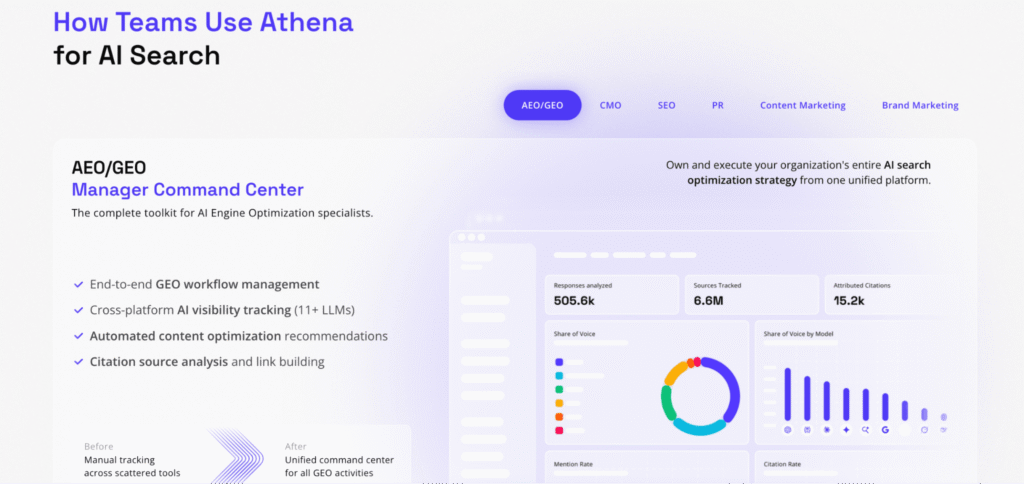
I know, I’ve covered a lot of tools that just tell you where you stand. AthenaHQ is the one that also tells you what to do about it, providing that “what to do next” layer the same way Track My Visibility does.
Copilot is one of 8 engines included at the $295/mo Self-Serve tier, with no per-engine gating, a genuinely rare structure in this category where most tools charge extra past 3 or 4 engines.
But tracking is really the input here, not the product. Once AthenaHQ has your Copilot visibility data, it feeds into the Action Center, which turns that data into structured, assignable tasks instead of leaving you staring at a chart wondering what to fix first.
From visibility gap to fix list
The part I like is ‘Action Center,’ which turns the gap into a task someone on your team can pick up and close. Ask Athena, a conversational copilot layered over your visibility data, lets you interrogate the why behind a number instead of digging through a dashboard yourself. ACE goes further still, analyzing citation patterns to predict which pages are likely to get cited next, though that one’s Enterprise-only.
How much does the execution layer matter?
- Teams juggling several engines benefit most; Copilot and ChatGPT gaps land in one queue
- Teams without content resources get less value; Action Center assigns tasks; it doesn’t write
- Agencies get real use from one task list instead of per-client dashboards
- Solo marketers may find this more structure than they need
The price of going beyond rank tracking
$295/mo buys one of the broadest entry-tier engine sets around, but nearly every independent review says that number understates real spend. Monitoring, Ask Athena, and Action Center all draw from one shared 3,600-credit pool, so heavier usage drains it fast, and add-ons run $100 per 1,250 credits. Self-Serve is also single-country only, with no free trial, just a $95 first month that renews to $295.
My take: If you want Copilot gaps turned into a task list your team can act on, AthenaHQ is the strongest fit here. Just a budget above $295, not at it.
5. Scrunch AI
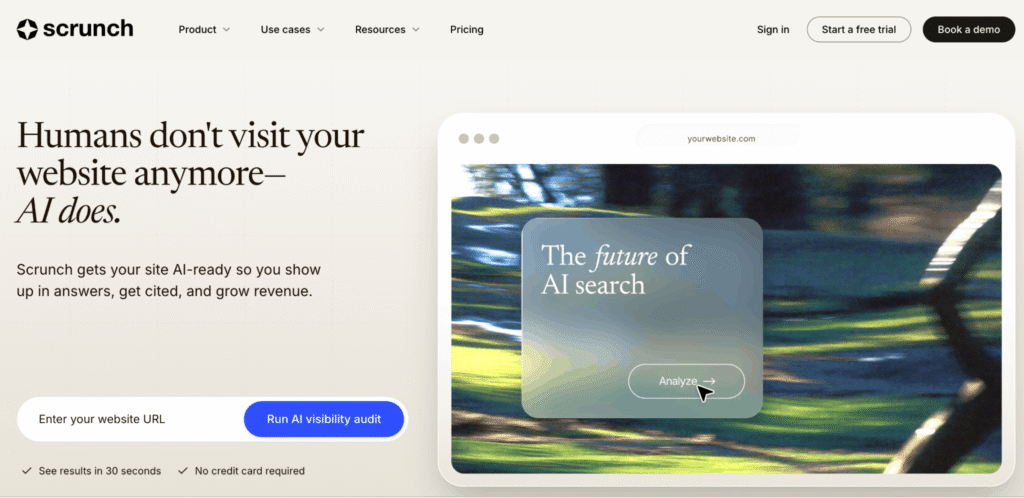
Next one is Scrunch AI for anyone who wants to see how Copilot sees their brand, not just whether it mentions them. The thing I want to mention here is its technical depth.
Most tools on this list answer “did Copilot name us?” Scrunch asks a different question: what is Copilot actually seeing when it looks at your site in the first place.
Copilot is one of four engines on the Core plan, alongside ChatGPT, Perplexity, and Google AI Overviews, but the mention tracking is really the entry point into a bigger diagnostic story about how AI systems read your brand at all.
What happens between your website and the AI answer?
Site Diagnostics maps your site structure and flags which pages AI crawlers can and can’t reach, similar in spirit to Bing indexation for Copilot. Content Delivery shows a side-by-side of how a page renders for a human versus an AI agent, token count and content differences included. GA4 and Cloudflare integration adds crawler-traffic analytics on top, which is one of the stronger implementations in this category.
Where Scrunch is broader than Copilot rank tracking
- Hallucination detection flags when an AI model says something false about your brand, Enterprise-only
- AXP, a machine-readable layer served to AI crawlers, is still in limited beta and not generally purchasable
- Crawler and agent-traffic analytics tie directly to GA4, real bot behavior, not just visibility
- Treats AI visibility as a website-readiness problem, not just an answer-tracking one
Who actually needs that extra layer?
Enterprise teams with real crawlability questions, and mature GEO teams past the “are we mentioned” stage. If you just want a clean answer to whether Copilot names you, this is more infrastructure than you need. Core runs $250 to $300/mo, and credits are consumed per engine, not per prompt, so 125 credits across 4 engines works out to roughly 31 actual questions tracked, not 125.
My take: Scrunch isn’t a Copilot tracker you’d pick for Copilot alone. It’s a broader AI-readiness platform that happens to track Copilot along the way.
6. Profound
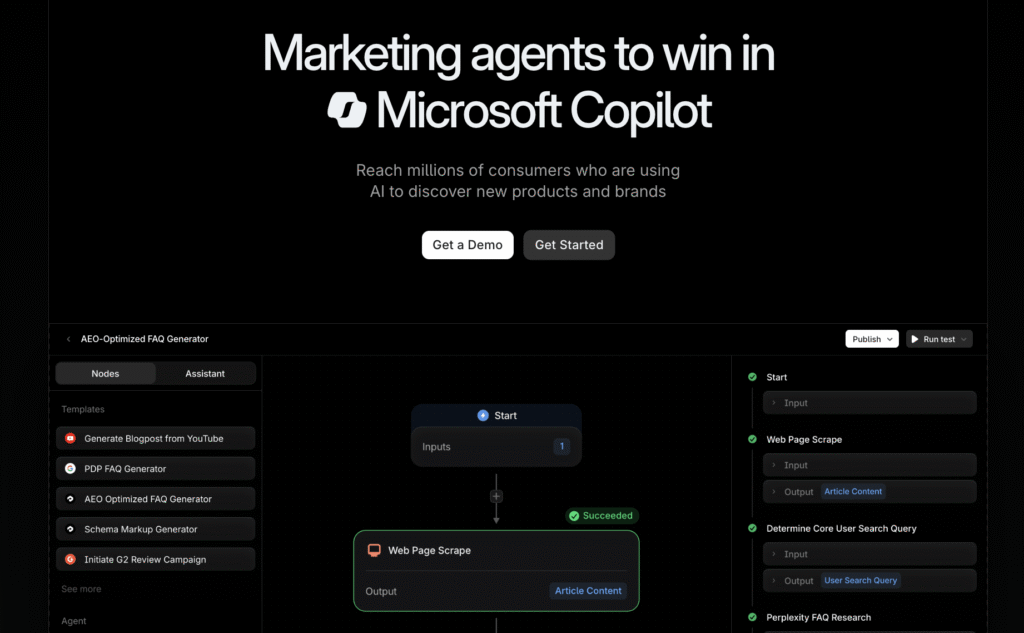
Obviously, the most well-known tool in the AI visibility category: Profound. It’s good at treating AI visibility as a full research and execution platform, and that shows the moment you look past the entry-level plan.
How much pricing do you need around Copilot?
- Copilot is Enterprise-only (not on Starter or Growth!), gated above both self-serve tiers
- Real Copilot access means a sales call, not a checkout page, since Enterprise pricing is custom
- Everything else in the product, Prompt Volumes, FactCheck, Agents, Aim only applies once you’re already paying Enterprise rates for Copilot specifically
What Copilot-specific intelligence looks like once you’re in
Once you’re past the Enterprise gate, Copilot tracking stops being a mention count and starts drawing on the same research layer Profound built for every engine.
FactCheck catches when Copilot says something factually wrong about your brand, wrong pricing, invented features, which matters more here than on a narrower engine since Copilot pulls from a broad web index. Prompt Volumes adds real user query data licensed from opt-in panels, so instead of guessing which Copilot prompts matter, you’re seeing actual demand.
Agent Analytics tracks AI-bot crawler behavior server-side, with unlimited domains on every tier, which is one of the few pieces of this that’s genuinely useful regardless of team size. Aim turns all of it into a weekly priority list, though that layer is also Enterprise-only.
Pro tip: There’s a quick way to see how your own website looks to AI crawlers before diving into any of this. Run an AI visibility audit for your website and see exactly what’s readable and what’s getting missed.When Profound becomes overkill
- You’re a single brand or small team just trying to confirm Copilot mentions you at all
- You don’t have a content team ready to act on Agents-generated drafts
- You’re not ready for an annual commitment or a sales-cycle-gated Enterprise conversation just to unlock Copilot
- Budget matters more than breadth, and $189/mo elsewhere gets you Copilot without the negotiation
My take: Worth the sales call if Copilot is one piece of a bigger AI-intelligence operation. Consider Profounds’ alternatives if Copilot is the only thing you’re looking for.
7. Omnia
Lastly, I’ve placed Omnia on this list for its GEO expertise, since it pulls live Copilot data based on prompt and location rather than treating every market the same way.
What does Omnia do differently with Copilot?
Omnia opens real browsers from real locations like New York, Singapore, wherever your market actually is, and runs prompts the way an actual local user would see them, rather than pulling a single API response and calling it done. That matters for Copilot specifically, since answers can shift by market, and most trackers on this list report one flat result regardless of where the person asking is sitting.
One thing worth flagging plainly, though: Copilot isn’t one of Omnia’s four default engines. ChatGPT, Google AI Overviews, Google AI Mode, and Perplexity come standard, and Copilot is listed as “available on request,” even on the entry tier.
How the tracking model works for Copilot
Once Copilot is switched on for your account, Omnia runs your tracked prompts through simulated browser sessions in whichever locations you’ve set up, so you’re seeing what Copilot actually shows someone in that market rather than a generic result.
Alongside that, AI Prompt Discovery surfaces which Copilot-relevant prompts get asked most in a given country or language, which helps decide what’s actually worth tracking before you spend limited prompt slots on it.
From there, the platform flags citation-level gaps where a competitor is showing up in a Copilot answer and you’re not, and rolls everything into a prioritized backlog. Omnio can then draft content against those gaps, though nothing publishes without your approval.
The data you can get
- Location-segmented Copilot visibility, not a single blended result
- Prompt demand data by country and language
- Citation-level gaps showing exactly where a competitor is winning a Copilot answer you’re not in
- A prioritized backlog ranked by impact
- Unlimited brands tracked on every tier, including entry
My take: Best for multi-market brands where Copilot’s answers genuinely change by location. For a single-market brand just checking whether Copilot mentions you at all, the “available on request” gate is more setup than needed; an always-included option like Otterly gets there faster.
Which Copilot Rank Tracker is right for you
If you’re still confused about which one is right for you, let me help you a little bit.
AIClicks for genuine Copilot depth. Otterly for a fast, affordable start. Peec AI for a clean multi-engine view. AthenaHQ for teams ready to act on the data. Scrunch for crawlability and AI-readiness questions. Profound for enterprise-scale research. Omnia for multi-market brands where location actually changes the answer.
Each one earns its slot for a specific reason, so match the “best for” to your actual situation rather than the price tag alone, since the cheapest option and the right option aren’t always the same tool here.
BTW, if you’re looking for an AI visibility tool, we’ve got a 7-day trial over at Track My Visibility. Just a first step if you feel like giving it a look 😉
FAQs
No. Copilot doesn’t return a ranked list; it just includes or leaves out brands inside a generated answer. That’s why most tools on this list track mentions and relative positions instead of a traditional rank.
Copilot draws its answers from Bing’s index, so if your pages aren’t indexed there, no amount of content optimization fixes the gap. It’s worth checking before you assume your content is the problem.
Start with Bing indexation, since Copilot pulls from Bing’s index and can’t cite what isn’t there. Beyond that, the same fundamentals apply: clear, well-structured content that directly answers the questions people are actually asking, along with the kind of citation-worthy pages Copilot tends to pull from.
Copilot is the current name for what used to be called Bing Chat, so if you’re seeing older content reference “Bing AI” or “Bing Chat,” it’s talking about the same underlying product.
Not automatically. Bing indexation is necessary but not sufficient; Copilot still decides which indexed pages actually get cited in a given answer, so a page can be indexed and still get skipped.