

AI-generated answers now show up before anything else when someone types a query on traditional search engines. And because of this, understanding AI search vs traditional SEO has become even more important for marketing teams.
According to recent data, over 60% of Google search sessions end without a single click. People are getting their quick answers directly on the results page, which means if your brand is not being cited by the AI, you are essentially invisible in those results.
Most marketing teams already know they need to track this.
The difficult part is picking the right AI SEO tool. Track My Visibility vs Authoritas comes up a lot in these conversations, and both monitor how often your brand appears in AI answers, but they are built with very different goals and budgets in mind.
Here is what this blog post covers:
- How each AI visibility platform works and what it actually does for your workflow
- The specific strengths and weaknesses of each AI brand visibility tool
- Direct feature comparison of both AI search Visibility tools
- Clear breakdown of what you can expect to pay
- Which AI visibility tool fits your specific business needs
Key Takeaways
- Track My Visibility is built for SMBs and agencies that want quick setup, clear recommendations, and affordable pricing starting at $20/month.
- Authoritas suits enterprise teams that need 115+ language support, BI integrations, and GDPR compliance, but expect to pay $300-$1,000+/month.
- Both tools track brand citations across AI platforms like ChatGPT, Gemini, and Perplexity, but differ sharply in depth, cost, and actionability.
- Track My Visibility tells you what to fix; Authoritas shows you what’s happening and leaves the strategy to you.
- Neither tool drives results automatically; both require a human with a content strategy behind the data.
What Is Track My Visibility?
Aureate Labs developed Track My Visibility as an AI search visibility tool. The thinking behind it is pretty straightforward: AI search tracking shouldn’t require an enterprise budget to be useful.
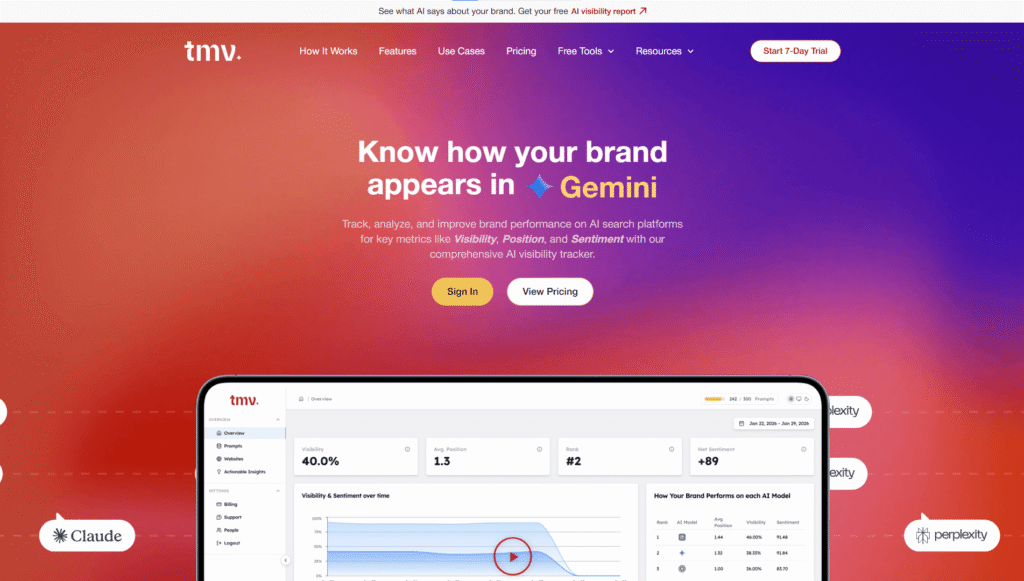
A lot of tools in this space hand you a dashboard packed with numbers and leave you to figure out what any of it means for your actual work. Track My Visibility AI SEO tool takes a different approach.
The goal is to give you a clear picture of where your brand stands in AI answers across multiple AI search tools like ChatGPT, Gemini, Perplexity, and Google AI Overviews, which specific pages are getting cited, which aren’t, and what you should do about it.
You don’t need a six-figure contract. Or a data analyst to decode the reports. It’s built for the people who are actually doing the work.
Its main target audience is small to mid-sized businesses, marketing agencies managing multiple clients, startups exploring AI SEO for the first time, and anyone who wants to get started without committing to a long-term enterprise deal.
 Pro tip: Want to know where your brand stands today? Before comparing tools, try a free check. The AI Visibility Checker gives you a quick view of how your brand appears across AI platforms, with no signup needed.
Key Features of Brands AI Visibility Tool Track My Visibility
1. The AI-Ready Score: Every URL on your site gets a score between 0 and 100, showing how likely it is to be cited by an AI model. Rather than guessing which pages need work, you can open the dashboard and see immediately what’s performing and what isn’t.
2. URL-Level Citation Monitoring: Most tools tell you your brand was cited 12 times and leave you to figure out the rest. This tool shows you which page got cited, by which model, and when. That’s why tracking brand mentions in AI search at the URL level matters more than aggregate counts.”
3. Persona-Based Prompt Generation: Building a prompt list from scratch takes longer than most teams expect. The platform generates prompts based on your target audience’s persona, so you’re not starting from a blank screen. Custom queries can also be uploaded via CSV if you have specific ones in mind.
4. Cross-Model Comparison: Every AI tool behaves differently based on its training. This AI visibility tool lets you compare performance side by side. If you’re performing well on Perplexity but nowhere to be found on Gemini, you’ll know exactly where to focus.
5. Competitor Benchmarking: You can add competitors directly and track them alongside your own brand. The AI visibility platform shows you which competitor pages are getting cited for specific queries, which is exactly the kind of detail that helps you decide what content gaps to fill.
Want to see how these features apply to different team types? See how Track My Visibility helps brands appear in AI search across SEO, eCommerce, and agency use cases.
How Does the AI SEO Tool Track My Visibility Work?
The setup is intentionally quick. Most users are looking at their first data within a few hours.
Once you create your account, you define the prompts you want to track, either by generating them through the persona tool or by uploading a CSV. The AI search visibility platform then runs those prompts automatically across all supported AI search platforms, captures the responses, and maps which sources get cited.
Daily monitoring keeps your data current without any manual work. Each day, the platform re-runs your prompt set and updates your citation and score data. You can see trend lines, spot drops in search visibility, and catch when a competitor starts getting cited more often.
The dashboard is built around clarity. You get model-wise coverage breakdowns, your AI-Ready Score for each tracked URL, top-cited pages, and a content gaps analysis that highlights topics where you are not showing up but your competitors are. Export options (CSV and PDF) make it easy to share results with clients or internal stakeholders.
Track My Visibility: Strengths and Weaknesses
Strengths
1. AI-Ready Score for Prioritization: The 0–100 score per URL is genuinely useful for SEO teams that need to prioritize. Instead of treating all pages equally, you can focus on the ones with the greatest chance to improve.
2. Lower Entry Cost: At $50/month for the Discover plan, this is one of the most affordable entries into AI visibility tracking available.
3. URL-Level Optimization Recommendations: The platform does not just tell you what is happening; it tells you what to do. Page-level suggestions give you relevant information you can act on immediately.
4. Persona-Based Prompt Generation: Building a prompt library from scratch is tedious. The persona-based approach removes that friction and gets you to meaningful data faster.
5. Unlimited Team Members on All Plans: No per-seat cost. Your entire team gets full access regardless of which plan you are on.
6. Transparent Pricing: Published pricing with no contact sales for details required. You know exactly what you are paying before you start.
Weaknesses
1. Newer Platform: Track My Visibility was launched more recently than Authoritas. The documentation library is still growing, and there is less long-term reliability data to draw on.
2. Limited Integration Options: If your team runs reports through Looker Studio, Power BI, or Tableau, you will need to wait. These integrations are in development but not live yet.
3. Smaller Language Support: The platform is currently focused on English. If you need to track AI search visibility in 50+ languages, this is a meaningful constraint.
4. Less Mature Analytics Suite: The reporting is clean and clear, but it does not yet have the depth of a more established platform.
Pricing and Accessibility of Track My Visibility AI SEO Tool
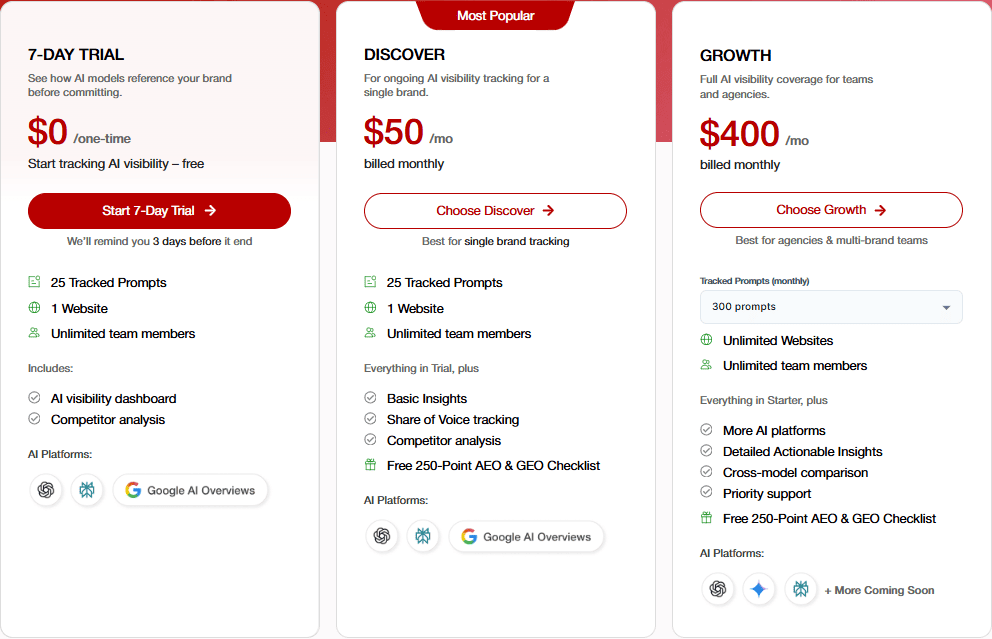
Trial: Free for 7 days
- 25 tracked prompts
- 1 website
- Unlimited team members
- Competitor Analysis
- AI Visibility Dashboard
- 3 AI platforms (ChatGPT, Perplexity, Google AI Overviews)
Discover Plan: $50/month
- 25 prompts per month
- 3 AI platforms tracked (ChatGPT, Perplexity, Google AI Overviews)
- Unlimited users
- Basic Insights
- Share of Voice tracking
- Competitor analysis
- Free 250-Point AEO & GEO Checklist
Grow Plan: $400/month
- Up to 300 prompts per month
- 4 AI platforms (ChatGPT, Perplexity, Google AI Overviews, Gemini)
- Unlimited websites
- Unlimited team members
- Detailed Actionable Insights
- Cross-model comparison
- Priority support
- Free 250-Point AEO & GEO Checklist
They offer an annual discount with 2 months free when you choose yearly billing on any plan.
Every plan comes with unlimited team members. Your whole marketing or content team can use the platform without extra fees per user.
Note: Pricing may change over time, so it’s best to check their official page for the most up-to-date information.
What Is Authoritas?
Authoritas has been around for over 15 years, and that experience shows in how the platform is built. Based in the UK, they started as an SEO suite and added an AI visibility module more recently.
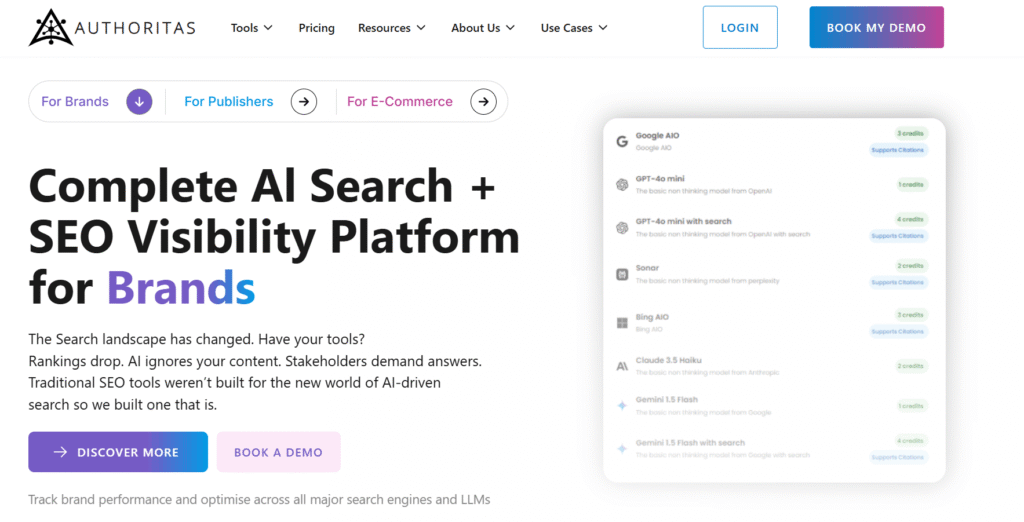
Log in, and it is immediately clear this tool was designed for large organizations. It is detailed, data-heavy, and built for teams with complex tracking needs.
That depth makes it a natural fit for global marketing teams juggling brand visibility across multiple regions and languages at the same time. It is also the go-to choice for companies operating under GDPR requirements or strict data policies, where a more enterprise-grade setup is not optional.
And if your team is already using Authoritas for SEO audits and keyword research, adding the AI visibility module is a straightforward extension. There is no need to onboard an entirely new platform.
Key Features of Brands AI Visibility Tracking Tool Authoritas
1. 115+ Language Support: If you need to track your brand’s search visibility in German, Japanese, Portuguese, and 112 other languages, Authoritas can handle it. No other tool in this comparison comes close.
2. GDPR Compliance: This AI search visibility tracking tool is built with European data requirements in mind. For companies operating across the EU, this is not a nice-to-have.
3. Branded vs. Unbranded Flow: This feature tracks how your brand voice and brand presence appear in both branded and unbranded queries. The distinction matters because unbranded search visibility is often where real growth happens.
4. Multi-Source Tracking: AI SEO tool Authoritas tracks AI answers through both API calls and direct UI crawling. This dual-source approach improves data quality and catches differences in how models respond depending on how they are accessed.
5. Advanced Integrations: Looker Studio, Power BI, Tableau, and BigQuery connectors are all available. Full API access is included at higher tiers. For enterprise teams that run everything through a centralized BI stack, this is a significant practical advantage.
6. Sentiment Tracking: Beyond whether your brand is cited, Authoritas also tracks how it is described in AI answers. Positive, neutral, or negative, this is important for reputation management and brand mentions monitoring.
How Does the AI Brand Visibility Tool Authoritas Work?
Setting up Authoritas is a bit more of a commitment than a tool like Track My Visibility. Instead of a self-serve signup, you start with a demo and a sales consultation. The demo process adds lead time but ensures the setup is tailored to your goals from day one.
Once you’re up and running, the platform tracks your prompts on a schedule you choose, either daily or weekly. It maps out exactly where your brand is being cited across AI engines and the web.
One of the standout features here is the “Branded vs. Unbranded Flow.” It’s designed to give you a clear look at how you appear when someone searches for your brand specifically, versus when they’re just searching for a general solution in your category, measuring how well you align with different types of search intent.
Authoritas uses a multi-source approach for accuracy, running API queries alongside real-time UI crawling to catch any discrepancies that a single source might miss.
The dashboard itself is built for deep dives, offering metrics on visibility percentages, sentiment, and how you stack up against competitors by region.
If your team is already using Looker Studio or Power BI for reporting, piping your AI search data into those existing dashboards is a very straightforward process.
Authoritas: Strengths and Weaknesses
Strengths
1. Established, Proven Platform: 15+ years of SEO experience translates into reliability. Authoritas has a track record that newer tools simply cannot match yet.
2. Strong Global and Multi-Language Support: 115+ languages, multi-country monitoring, regional breakdowns, and local language prompt support. This makes it the clear choice for global operations.
3. More Mature Analytics Suite: The depth of reporting in Authoritas is significantly greater. Advanced custom reporting, API access, and BI integrations give enterprise analysts the flexibility they need.
4. Better Integration Ecosystem: Looker Studio, Power BI, Tableau, BigQuery, and full API access. If your team’s workflow depends on these tools, the AI SEO tool Authoritas fits in cleanly.
5. Sentiment Tracking Included: Knowing you are being cited is useful. But knowing if it is positive or negative is even more important and useful.
6. GDPR Compliance: If you operate in Europe, GDPR compliance isn’t optional. Authoritas is built with EU data protection standards in mind. Data residency, privacy controls, and compliant handling. Your legal team will appreciate not having to audit another vendor.
Weaknesses
1. Higher Cost for Smaller Teams: Estimated starting prices around $300–$500/month put this out of reach for most small teams and startups.
2. Add-Ons Increase Total Cost Significantly: The base plan includes multiple AI chatbots such as ChatGPT, Perplexity, and Google AI Overviews. Claude and Gemini require add-ons. Each add-on adds to your monthly bill, and they can stack up quickly.
3. Limited Actionable Recommendations: Authoritas is primarily a monitoring platform. It shows you what is happening, but gives you less direct guidance on what to do about it.
4. Steeper Learning Curve: More features mean more complexity. Plan for 4–8 hours of setup.
5. Annual Contracts Typically Required: Less flexibility than month-to-month billing. If you are testing the AI visibility tracking tool before fully committing, this is a real friction point.
Pricing and Accessibility: Authoritas
Trial: Free AI Search Brand Report
- Requires a sales demo/onboarding call
- Limited to a one-time test against a single AI provider
- Provides a snapshot of mentions and sentiment
- Designed to showcase platform depth before committing
Paid Plans
Starter Plan: $99-$119/month
- 2,000 Prompt Credits included
- Access to base AI platforms (Google AI Overviews, SearchGPT, Perplexity)
- Track brand mentions
- Pay-as-you-go (PAYG) flexibility for additional credits
- Best for smaller eCommerce brands or niche tracking
Professional Plan: Custom Pricing (Typical range $300–$600/month)
- Higher prompt credit volume
- Expanded platform coverage, including Gemini and Claude
- Advanced competitor benchmarking
- Looker Studio and BigQuery integration
- Priority email support
Enterprise Plan: Custom Pricing (Typically $1,000+/month)
- Unlimited or high-volume prompt credits
- Full access to all models (ChatGPT, Gemini, Claude, Perplexity, DeepSeek, Bing)
- AI Licensing Deal Database access
- Dedicated account manager and custom training workshops
- Full API access for custom internal dashboards
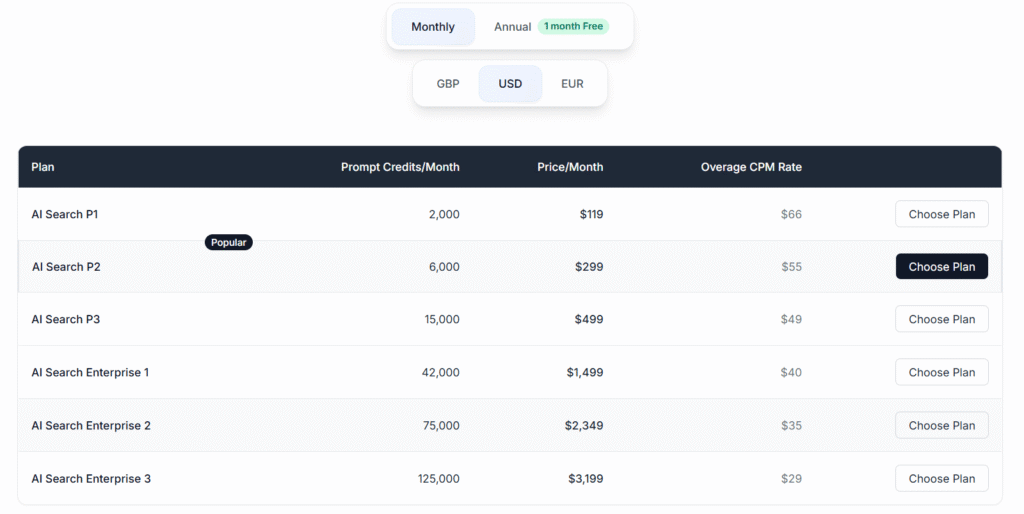
Track My Visibility vs Authoritas: Head-to-Head Feature Comparison of LLM Visibility Tools
Here is a direct comparison of Track My Visibility vs Authoritas across the features that matter most for AI search visibility tracking:
| Feature | Track My Visibility | Authoritas | Winner |
| Starting Price | $50/mo | $99-$119/mo (Starter Plan) | Track My Visibility |
| AI Platforms (Base) | ChatGPT, Google AI Overview, Perplexity | SearchGPT, Perplexity, Google AI Overviews | Tie |
| Prompts Included | 25 (Discover) / 300 (Grow) | 2,000 Credit Units (Starter) | Authoritas |
| Actionable Insights | AI-Ready Score & URL-level advice | Data-heavy monitoring, less guidance | Track My Visibility |
| Unique Feature | Predictive AI Visibility Scoring | Branded vs. Unbranded Flow Mapping | Tie |
| Reporting Depth | Clean, streamlined dashboard | Advanced BI & BigQuery exports | Authoritas |
| Language Support | Focused on English | 115+ languages supported | Authoritas |
| Integrations | Limited (Dashboard focused) | Looker Studio, Power BI, API access | Authoritas |
| Setup Time | Instant / Self-serve | 4–8 hours (Demo & Onboarding) | Track My Visibility |
| Price Transparency | Fully published online | Tiered; Starter public, others via Sales | Track My Visibility |
| Contract Terms | Month-to-month flexibility | Annual preferred for Enterprise | Track My Visibility |
| Support Level | Dedicated AM & Phone (Enterprise) | Authoritas | |
| Trial | For 7 days | Limited Snapshot Report (Demo required) | Track My Visibility |
Limitations of Track My Visibility vs Authoritas AI SEO Tools
No AI visibility platform solves everything, and it is worth being clear about where both have real constraints.
- Simulated vs. Real Life: These tools use “synthetic prompts,” automated questions they send to the AI search tools to see what happens. While this is great for spotting trends, it doesn’t perfectly match the messy, unpredictable ways real people type. A real user might phrase a question in a way the tool didn’t test, leading to a different result.
- Cannot Guarantee Traffic Volume: Just because an AI tool cites your brand doesn’t mean a human clicked your link. Neither tool can tell you exactly how many people saw that answer or how many of them actually visited your site. You’re tracking “Share of Model,” not guaranteed hits.
- The “Moody” Algorithm Problem: Specific AI models like ChatGPT or Gemini update their logic constantly. The AI citation strategy that worked on Monday might disappear on Tuesday after a silent update. Both AI visibility tools are at the mercy of platforms they don’t control.
- Data, Not Strategy: These AI search visibility platforms are like a GPS; they tell you where you are, but they don’t drive the car. You still need a human strategist to look at the data and decide if a dip in visibility is a temporary glitch or a sign you need to rewrite your entire content library.
- Scores are Just a Starting Point: Features like the “AI-Ready Score” help triage your work, but they lack nuance. A high score doesn’t automatically mean you’ll convert customers, and a low score might not matter if that specific page isn’t critical to your sales funnel. Context still plays a very important role.
Future of Track My Visibility vs Authoritas AI Search Visibility Tracking
AI search is not going to get smaller. Google AI Overviews, ChatGPT’s web browsing, Perplexity, and Gemini are all expanding their footprint in how people get quick answers to questions.
According to the study, traditional search engine volume is projected to drop 25% by 2026 due to AI chatbots and virtual agents.
SEO expert Lily Ray says, “AI search is forcing marketers to rethink SEO. It’s not just about ranking pages anymore. It’s about being a trusted source that AI systems want to cite.” For brands, this shift starts with knowing where you currently stand.
This means brands that don’t establish AI visibility now will face increasingly limited opportunities to reach customers through traditional search alone.
For brands, source transparency, knowing which sites AI models cite and why, is becoming a critical part of digital strategy.
Brand visibility in AI answers is likely to become as important as traditional rankings within a few years. Generative engine optimization (GEO), the practice of deliberately optimizing content to be cited in AI search answers, is emerging as a distinct discipline alongside traditional AI SEO.
For a broader look at what’s available as this space matures, see this top AI visibility tools for 2026.
For Track My Visibility, the roadmap includes expanded language support, role-based access controls, and API development. The platform is newer, which means more room to grow, but also more unknowns about long-term reliability.
For Authoritas, the AI visibility module is an addition to an established SEO platform. The company has the infrastructure and the client relationships to develop this module significantly, especially for enterprise use cases. The challenge is pricing flexibility; if they do not create more accessible entry points, they will cede the SMB and agency market entirely.
Track My Visibility vs Authoritas: Actual Performance Analysis of Both AI Search Visibility Tools
Let’s look at Track My Visibility vs Authoritas dashboards. And see how both platforms perform.
1. AI Platform Coverage
AI platform traffic grew 527% year-over-year from 2024 to 2025, while ChatGPT reached 900 million weekly active users. This explosive growth explains why tracking across multiple AI platforms matters.
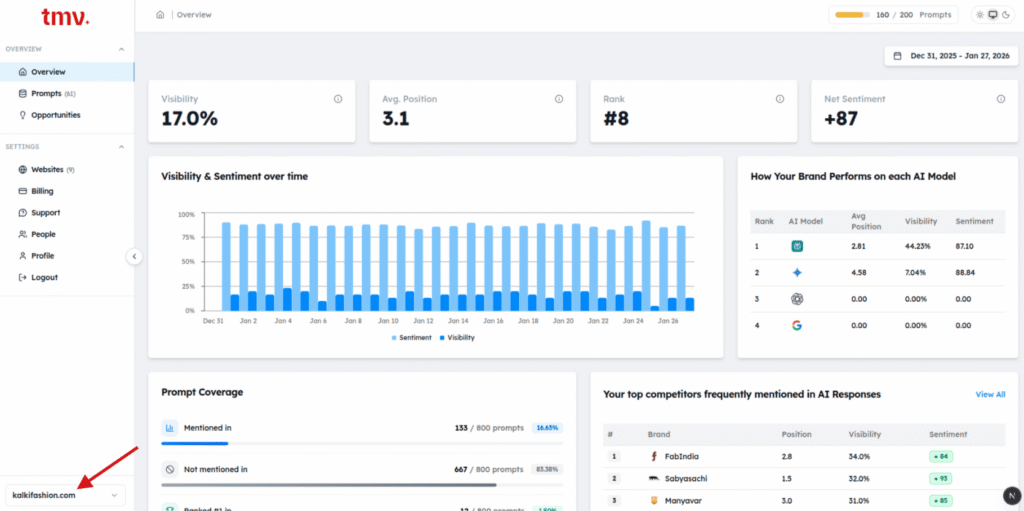
Track My Visibility currently covers ChatGPT, Gemini, Google AI Overviews, and Perplexity. You can access these AI models by purchasing a plan. If you’re looking to start with the 7-day trial for free, then you will be able to access ChatGPT, Google AI Overviews, and Perplexity.
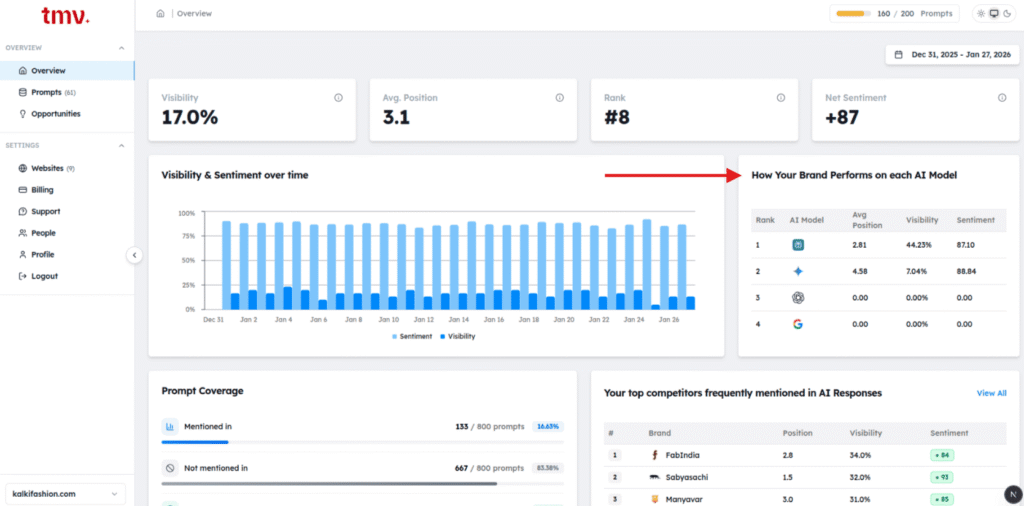
If you choose the Discover plan, then you can get access to ChatGPT, Perplexity, and Google AI Overviews. And if you choose the growth plan, you’ll get access to ChatGPT, Perplexity, Google Gemini, and Google AI Overviews.
The AI SEO platform is expanding its coverage to additional AI-powered search engines as they become significant.
Authoritas takes a different approach. They technically cover more ground, including platforms like Bing Copilot and DeepSeek. But that coverage is modular. Want to track Claude? You’ll have to buy an add-on. Need Gemini? Another add-on. Each one adds up, and those charges add up faster than you’d expect.
If you’re running an enterprise operation that genuinely needs eyes on every corner of the AI landscape, Authoritas’s extensive reach might justify the extra cost.
2. Ease of Use and Setup
The Track My Visibility tool keeps onboarding very simple. The first step is to create your account and select the plan. After that, you just need to enter the name of your website.
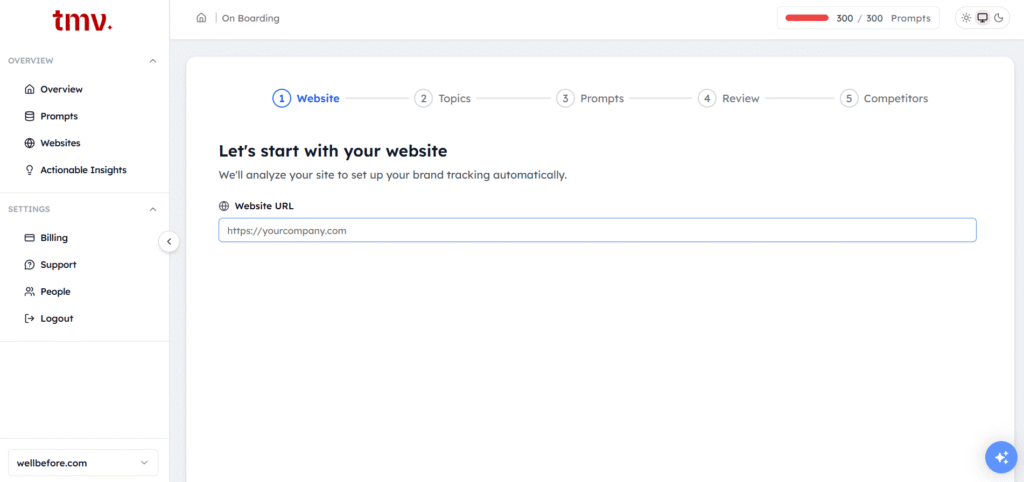
From there, you follow a 5-step process where the platform suggests topics you can select or deselect. Then it generates prompts, with the option to add more later. After that, it surfaces recommendations on what to change. Your dashboard updates every 24 hours.
Getting started with Authoritas takes more time than most AI brand tracking tools.
First, you’ll have to create your account to access the AI SEO platform’s SEO and AI visibility features from the start.
After that, you’ll have to define the questions and topics you want to monitor. After adding these, you can add your competitors. In this AI SEO tool, you can also choose how frequently you want data updates.
If you need clear visuals or client-ready reports, you can connect Authoritas to tools like Looker Studio. That will save time and remove the need to build reports manually.
Once everything is set up, the dashboard becomes your go-to view. You can track visibility scores, see which pages are being cited, and understand whether various AI platforms are referencing your brand positively or negatively.
3. Reporting and Analytics
Here is how both platforms handle reporting and analytics. Track My Visibility provides model-wise coverage tracking, so you understand performance differences across multiple AI platforms.
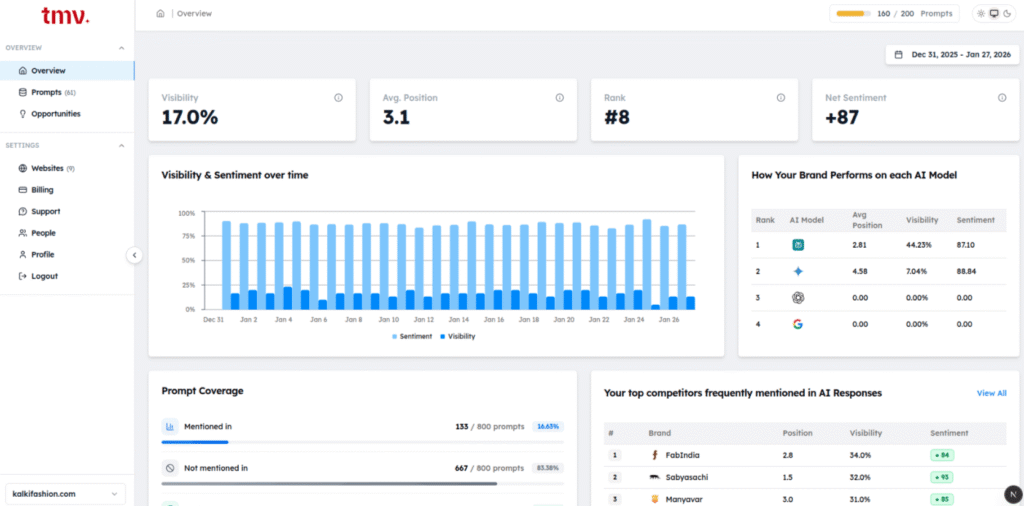
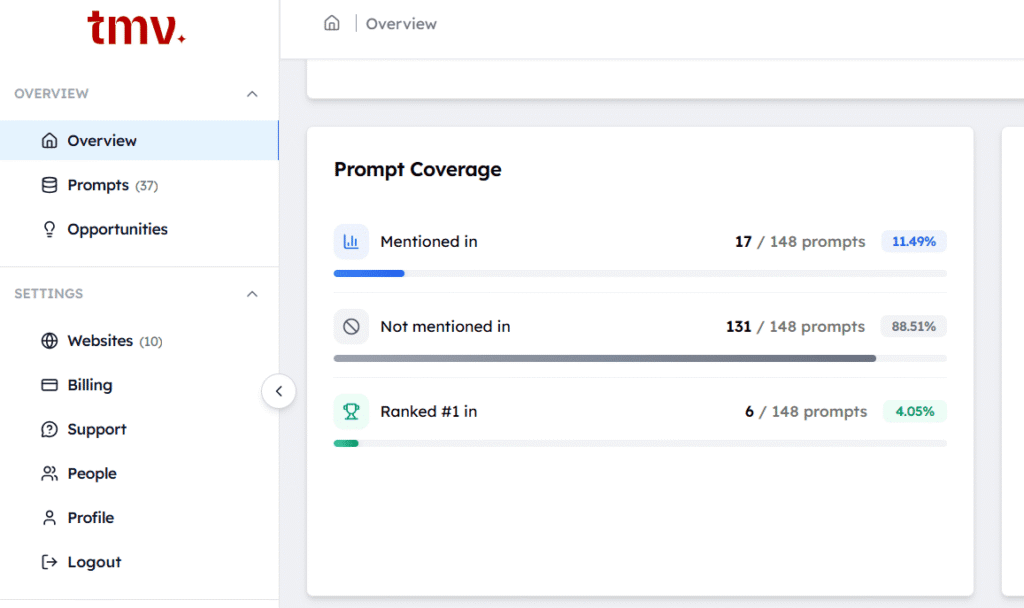
The AI-Ready Score is unique and valuable. It gives each URL a specific rating and explains what to improve. It shows a full prompt coverage breakdown, including how many prompts your brand was mentioned in, how many it was absent from, and how many times it ranked #1.
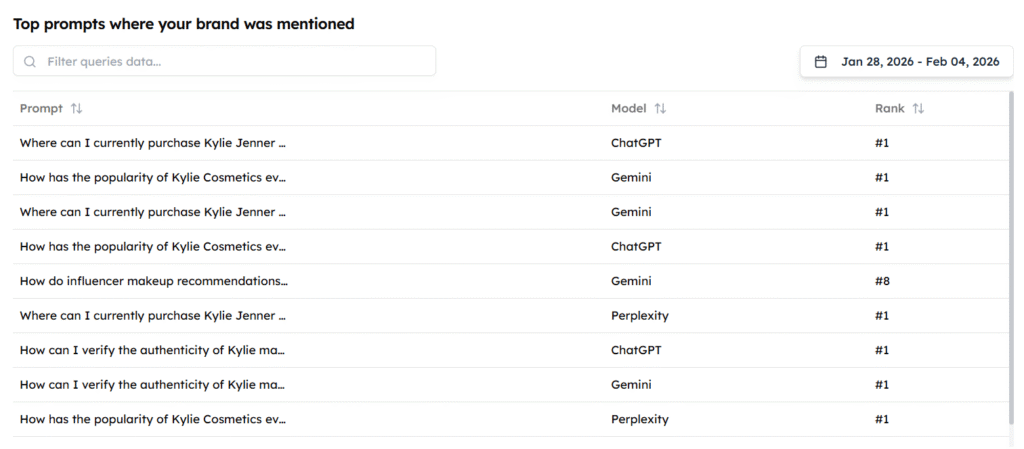
Top cited URLs show which content performs best, helping you understand what AI models value. Competitor benchmarking lets you track share of voice against other brands competing in your space.
When it comes to the sheer depth of data, Authoritas definitely feels like the more mature platform. It is built for enterprise teams who live in their dashboards and need to pipe data into tools like Looker Studio, Power BI, or Tableau.
If you need to break down your visibility by specific regions, track sentiment over time, or analyze “share of voice” across branded and unbranded searches, Authoritas gives your analysts plenty of raw material to work with.
4. Actionable Insights
Track My Visibility provides an AI-Ready Score for each URL with specific improvement suggestions. Its page-level optimization helps you know exactly what to fix on individual pages.
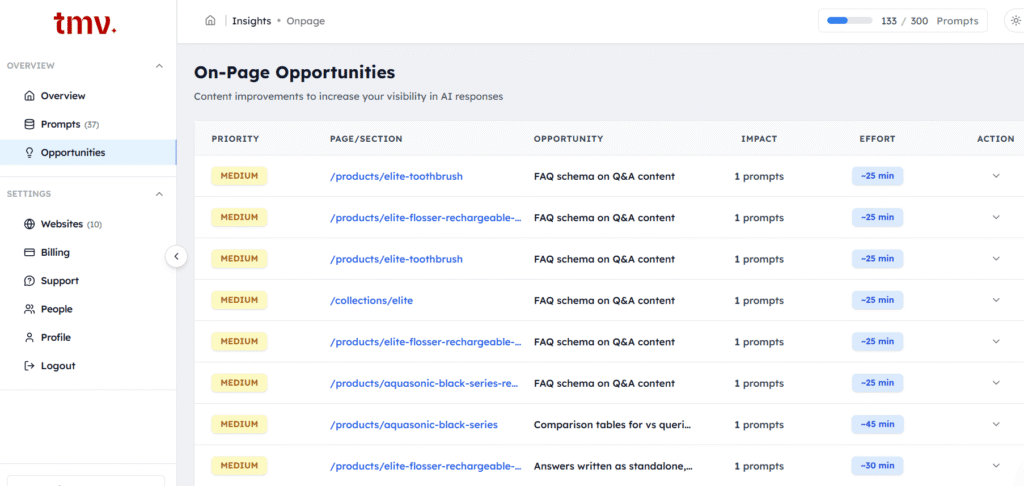
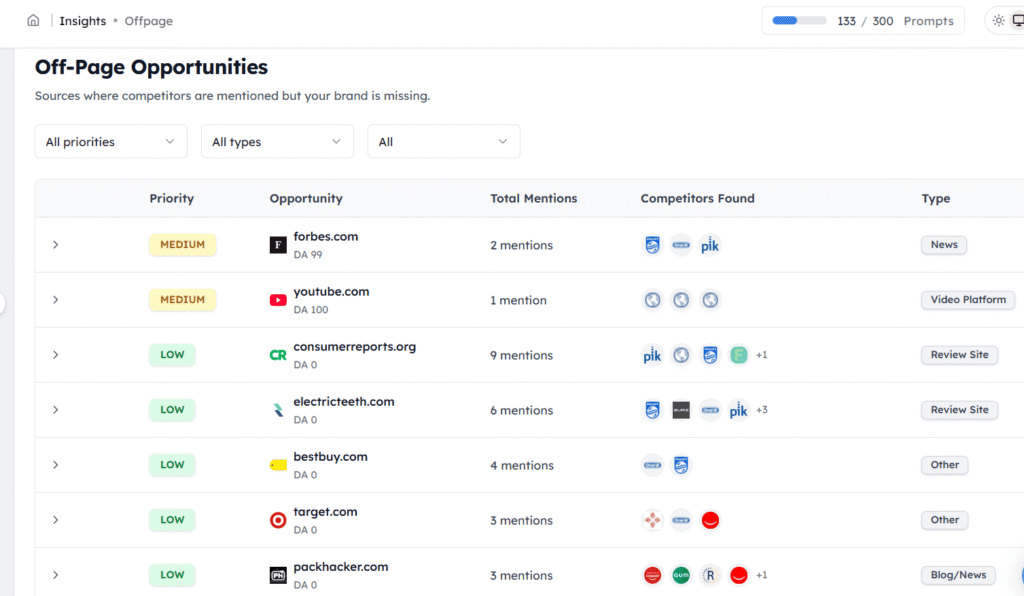
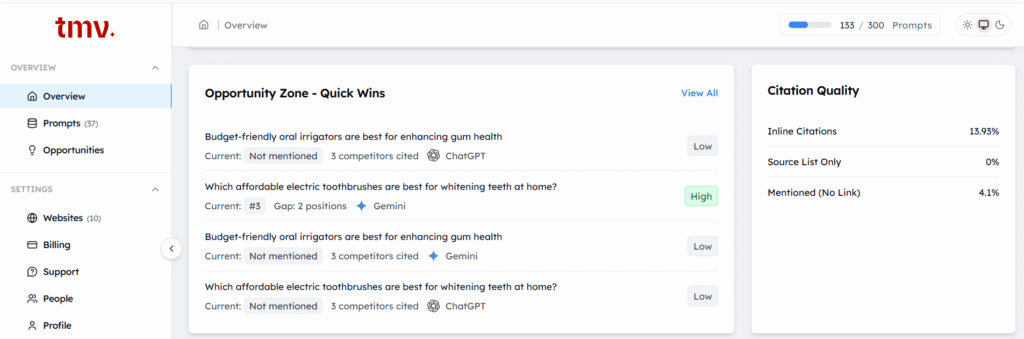
It also identifies content gaps and shows on which topics and queries you’re missing, but should appear. The Opportunity Zone shows you exactly which prompts to prioritize, with High or Low urgency labels, which AI platform has the gap, and how many competitors are already being cited there.
It also breaks down citation quality, showing whether your brand is getting inline citations, source list mentions, or name drops without a link. Each type carries a different weight in terms of how AI models perceive your authority.
With the help of this tool, you’ll also get suggestions on how to optimize content for AI answers so that you get cited across different AI search platforms.
The user mentioned, “Smaller pages that are clear and structured often get cited repeatedly,” while high-authority sites get ignored, which is exactly the gap that tracking brand mentions in AI search helps you identify and close.
Authoritas, on the other hand, is much more of a pure monitoring powerhouse. It provides an incredible amount of detail about what is happening across the web, but it leaves the “why” and the “how to fix it” up to you. If you have a dedicated SEO analyst on staff who loves digging into the weeds to build a strategy from scratch, you’ll appreciate that depth.
But if you’re part of a smaller team that just needs a clear, actionable to-do list, the lack of direct guidance in Authoritas might feel like a missing piece.
5. Competitor Tracking
Both AI SEO tools offer competitor tracking, but the execution is different.
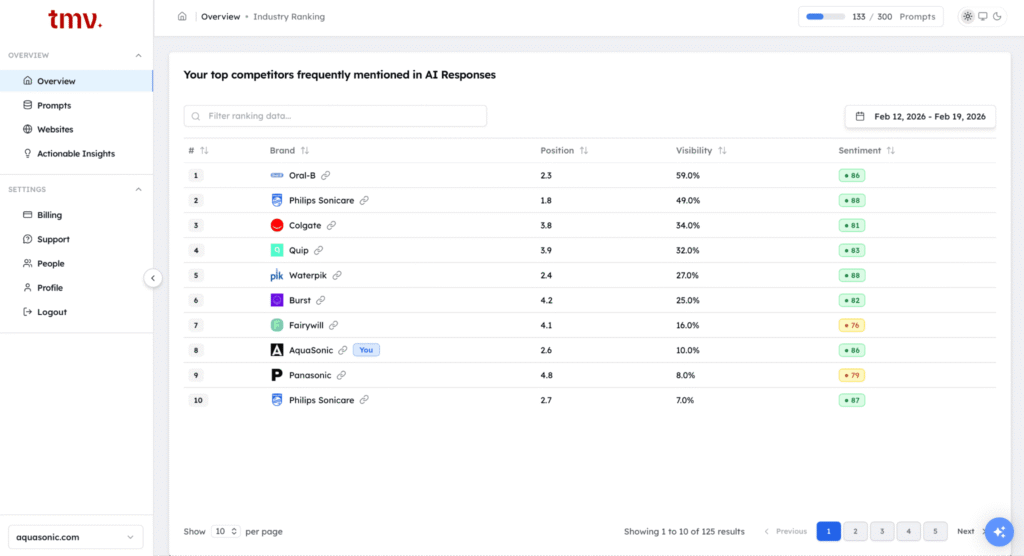
AI brand tracking tool, Track My Visibility, lets you compare citation rates at the URL level. You can see exactly which competitor pages are being cited for specific queries and compare that against your own website pages. This is granular enough to be genuinely useful for content creation decisions.
Authoritas offers broader competitive intelligence, including sentiment comparison, regional competitive analysis, and branded vs. unbranded competitive insights. It is more useful for enterprise brand teams managing reputation across markets.
6. Team Collaboration and Integration
Track My Visibility keeps things simple. Every plan comes with unlimited team members, which is great if you’re an agency or startup that doesn’t want to pay more every time you add someone new. You can share your dashboard with your team or export reports for stakeholders who don’t need to log in every day.
Authoritas is built for teams that need serious integration power. You get unlimited seats here, too, so your entire SEO, PR, and content crew can jump in without driving up costs. But Authoritas is great as it connects with other tools. If your company already uses Looker Studio, Power BI, or Tableau to visualize data, Authoritas plugs right in. Your AI visibility stats flow directly into those dashboards without you having to export spreadsheets and rebuild reports every week.
7. Data Accuracy and Reliability
AI search tools change fast. What ChatGPT says about you today might be different tomorrow. Both AI SEO tools update daily, running your prompts every 24 hours to catch those shifts.
Track My Visibility shows you the exact URLs getting cited and breaks down how your AI-Ready Score is calculated. You’re not just getting a number; you’re seeing why AI models are treating your content the way they are. That makes it easier to trust the data and act on it.
Authoritas brings 15+ years of SEO expertise to the table. Their data collection methods have been stress-tested by enterprise clients for over a decade, which makes them a solid, reliable choice when the stakes are high.
They use sophisticated techniques to mimic real user behavior, so what you see in the dashboard reflects what actual people would encounter in their AI results.
Track My Visibility vs Authoritas: Which Should You Choose?
The honest answer is that the right choice depends almost entirely on your organization’s size, budget, and specific needs.
Choose Track My Visibility If You
- Are working with a growth-stage budget: With a starting price of $50 monthly. It is significantly more accessible for solo creators and small teams.
- Want a “To-Do” list, not just data: The standout feature here is the AI-Ready Score. It gives you a roadmap for specific URLs, telling you exactly what content to tweak so AI models are more likely to cite your page.
- Want source-level citation clarity: The Sources tab shows whether AI is citing your pages, competitor sites, or third-party domains, so you know exactly where to focus.
- Need broad coverage in your base plan: You get tracking across ChatGPT, Gemini, Perplexity, and Google AI mode without having to pay for individual model add-ons.
- Prioritize the US and English-speaking markets: While it is expanding, its primary strength lies in domestic search and straightforward content optimization.
- Run a lean agency: Unlimited team members and low per-client costs mean you can scale your AI reporting service without your software bill eating your margins.
- Value simplicity: If you want a dashboard that your account managers and clients can understand in five minutes, this is the better fit.
If you want a clear starting point for how to rank in AI search without enterprise overhead. The 7-day free trial is a low-stakes way to see exactly where your brand stands. Seven days is usually plenty of time to run your top prompts and see if the optimization tips actually save you time.
Choose Authoritas If You
- You’re managing 100+ prompts: If you need enterprise-level reliability and high-volume tracking, Authoritas is built for that scale.
- You’re going global: With support for over 115 languages, this is the tool for brands that need to see how they appear in AI results across different countries and cultures.
- Compliance is a priority: If your legal team is strict about GDPR and European data standards, Authoritas has those boxes checked.
- You’re already in the ecosystem: If you already use Authoritas for your standard SEO, it’s much easier to add AI tracking here than to vet and onboard a whole new vendor.
- You love a good dashboard: It’s the right choice if you need to export data into Power BI, Tableau, or Looker Studio for your monthly board reports.
- You have the budget: At $500+ per month, this is an investment for established teams rather than a casual tool for a solo founder.
- You need the “Why” behind the data: It’s great for tracking how AI visibility fluctuates by region and how your brand is described in AI answers.
- You have an analyst on staff: To get the most out of this tool, you really need someone who can dive into the data and turn those spreadsheets into a real marketing strategy.
In short, if you need direction and affordability, Track My Visibility is the better fit. If you need depth, global reach, and enterprise integrations, Authoritas is worth the investment, assuming you have the budget and the team to use it well.
Conclusion
The Track My Visibility vs Authoritas choice comes down to one thing: what your team actually needs right now.
Track My Visibility is the practical starting point. It is affordable, quick to set up, and built around helping you act on data. The AI-Ready Score alone is worth the entry price for smaller teams that need clear direction.
Authoritas is built for enterprise scale. The 15 years of platform history, 115-language support, and BI integrations make it the right call for large organizations with the budget and resources to match. For smaller teams, the cost and complexity get in the way more than they help.
If you have never tracked AI search visibility before, the 7-day trial from Track My Visibility is the lowest-risk place to start. If you are running a global marketing operation, Authoritas deserves a look; just factor in the full cost before signing anything.
Pick the tool that fits where you are, not where you hope to be. While traditional search traffic is declining, early data shows AI-referred visitors convert significantly better than organic search.
Frequently Asked Questions
For SMBs, agencies, and teams watching their budget, absolutely. Track My Visibility includes more leading AI models in the base plan, gives you actionable optimization guidance, and costs way less to get started. But if you’re running a large enterprise with complex needs, Authoritas has more firepower.
Yes. Track My Visibility offers a free trial for 7 days, no sales call required. Authoritas has a limited snapshot trial on one platform, but you’ll need to hop on a demo call first to access it.
Track My Visibility, hands down. It’s cheaper, doesn’t lock you into a contract, takes way less time to set up, and focuses on giving you actionable next steps instead of overwhelming you with enterprise-level dashboards.
Pretty accurate, but with some limits. Both tools use synthetic search queries, which means they don’t perfectly capture how real people phrase questions. Results can also shift when AI search engines update their models. The data is directional rather than the absolute truth.
Yes. Both platforms offer competitor benchmarking and brand monitoring. Track My Visibility goes deep at the URL level, showing you exactly which competitor pages are getting cited. Authoritas gives you broader competitive intelligence, including sentiment analysis and regional comparisons.
Resources:
- The Google Click Crisis: 60% of Searches Now End Without a Visit
- Gartner Predicts Search Engine Volume Will Drop 25% by 2026, Due to AI Chatbots and Other Virtual Agents
- ChatGPT reaches 900M weekly active users | TechCrunch