


There! You’ve opened another tab searching “Peec AI alternatives”, looking for a better option.
Peec AI is a genuinely liked tool in this category with its clean UI, near-zero onboarding friction, and straightforward analytics, making it one of the easier AI visibility tools to start using.
But a good tool is not always the right fit for every team.
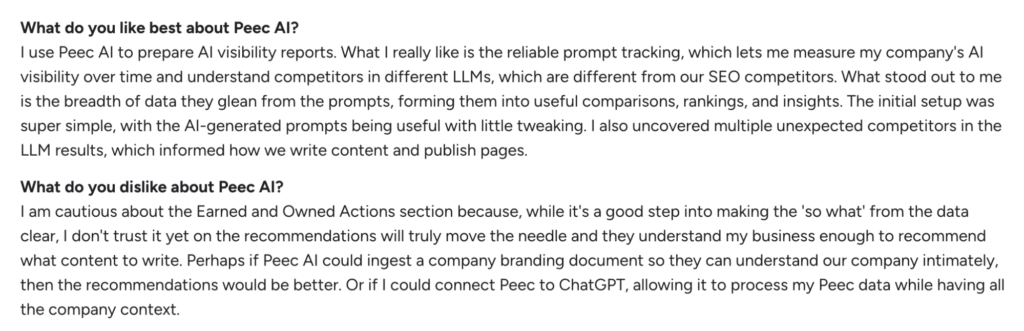
In a recent G2 review, one user praised Peec AI’’s prompt tracking and the analytics of competitor data it surfaces, but it lacks the action recommendations that they actually needed.
And that’s completely fair. Peec AI is a strong tool for AI visibility tracking, but the “best” tool depends on what you’re actually trying to solve. A marketer tracking a few key prompts has very different needs from an enterprise team building a full AI search strategy.
So I looked at several Peec AI alternatives to understand what each one does differently, where it fits better, and what tradeoffs you should know before switching.
No hard selling here. Just a practical look at your options, so you can figure out what works best for you.
How I Evaluated Peec AI Alternatives
You know what Peec AI does, right?
But that’s not the question you’re looking for. What you really want to ask is “does this tool fulfill my requirement that Peec AI doesn’t?”
With that in mind, I evaluated each tool against these:
- AI model coverage compared with Peec AI
I compared the AI engines included in each tool’s standard paid plan with Peec AI’s supported models, using official pricing pages to confirm availability. - Beyond visibility tracking
Does this tool provide actionable insights like recommendations, content briefs, and execution? I checked whether each tool only reports brand mentions or also provides recommendations, content suggestions, optimization guidance, or execution workflows. - Target users (Whom it’s actually useful for)
Whether each platform is best suited to solo marketers, SEO teams, agencies, or enterprise brands.
I’ve considered official product sites, reviews, customer case studies, and ran free trials where I could.
Peec AI Alternatives at a Glance
| Tool | Best suited for | Standout feature | Starting price |
| Radarkit AI | AI visibility tracking plus built-in optimization | 6 engines on every tier, no upgrade required | $29/mo |
| Track My Visibility | Flexible multi-model AI visibility tracking | On-page, off-page, and technical opportunities with implementation steps | $50/mo |
| Otterly | Simple AI visibility monitoring | Fast setup, unlimited brand reports from the entry tier | $29/mo |
| Rankscale AI | Flexible, credit-based AI search tracking | 10 engines with citation-level source analysis, every tier | $20/mo |
| AthenaHQ | Turning AI visibility insights into action | Action Center, assignable tasks instead of a dashboard | $295/mo |
| Profound | Enterprise AI search intelligence | Full measure-to-publish workflow, panel-based prompt demand data | $99/mo |
| Scrunch AI | AI visibility, site diagnostics, and crawler intelligence | GA4/Cloudflare bot analytics, human-vs-agent rendering view | $250-300/mo |
*Pricing can vary, so check out the official pricing pages on product websites.
1. Radarkit AI: Best for AI Visibility Tracking Plus Built-In Optimization
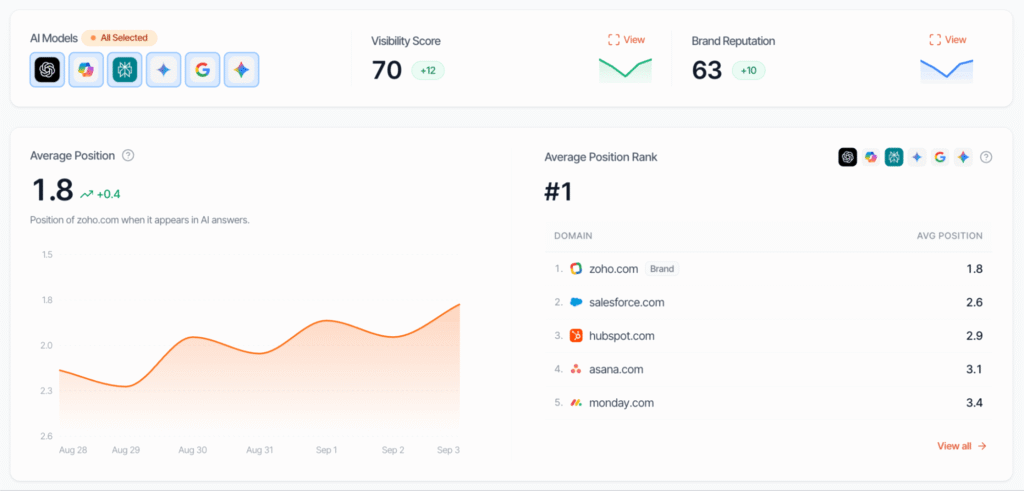
Let’s start with the first one: Radarkit AI. Most of the tools in this category track fine, but it’s what happens afterwards.
Peec shows you where you’re missing and stops there, while Radarkit bundles content, outreach, and Reddit agents in from the cheapest plan. Then there’s engine coverage, which is probably the actual reason you’re reading this.
Every self-serve tier on Radarkit, even the $29 one, tracks the same six engines: ChatGPT, Copilot, Gemini, Perplexity, Google AI Mode, and Google AI Overviews, no upgrade required. Peec AI, by comparison, caps you at 3 of 7 unless you move up to agency or Enterprise.
What You Actually Get for the Price
- Competitor tracking is included at every tier
- Refresh frequency runs every 72 hours on Lite, then moves to daily from Growth up
- Projects go 2 on Lite, 5 on Growth, and 10 on Pro, with unlimited only at custom Enterprise
- Recommendations come in through content, outreach, and Reddit agents from the cheapest tier
- Client portal access and branded PDF reports are included everywhere too, scaling from 2 reports a month up to 20
Peec AI vs Radarkit
| Comparison criteria | Radarkit | Peec AI |
| Entry price | $29/mo | $95/mo |
| AI model coverage | 6 engines, every tier | 3 of 7, more behind agency/Enterprise |
| Prompt tracking | 15 to 100 by tier | 50 to 350 by tier |
| Actionable recommendations | Content, Outreach, Reddit agents from Lite | Actions tab, no execution layer |
| Location-based AI visibility tracking | Included, Local Radar | Not offered |
| Overall focus | Tracking plus execution | Tracking plus light analytics |
My take: If engine access is the actual wall, Radarkit is the cleanest fix here, since it doesn’t ration models by tier the way Peec AI does. If track record matters more than price to you, hold off, because the company is young and the review base hasn’t caught up to the product yet.
2. Track My Visibility: Best for Flexible Multi-Model AI Visibility Tracking
Before moving forward, a quick note: I’m from Track My Visibility, and honestly, I’m one of the people who built it, so take everything in this section with that in mind.
With that said, I’ll say it straight: Peec AI is genuinely good; the clean UI and the way it lays out data work really well if you’ve got a team that knows how to read it.
At Track My Visibility (our AI visibility tracker), we do more than just tracking; source-level analysis and fix-it recommendations sit in the same workflow instead of living in separate tabs the way they do elsewhere. You can see which Reddit thread or partner page the AI model actually pulled from to answer it, and the platform tells you what to do about that specific source.
How much can you actually track?
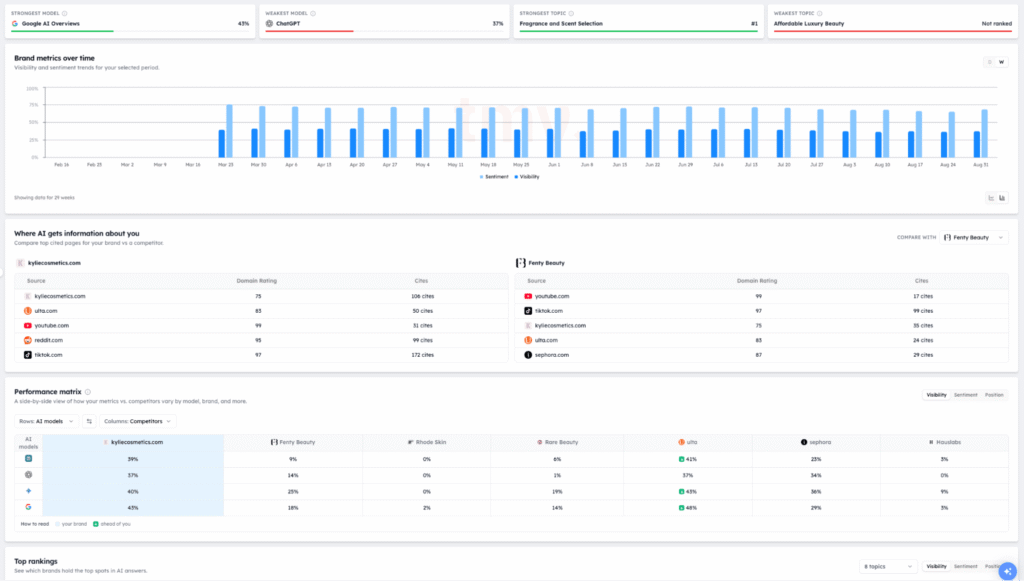
With Track My Visibility, you can see:
- Which AI model has the highest or lowest visibility for your brand, model-wise visibility
- Which topics have the highest or lowest visibility, topic-wise visibility
- Full competitor analysis, ranked by position and visibility
- Where AI models are actually pulling from, broken down by prompt, domain, and URL
Opportunities You Can Work on
One thing I really like to tell people about is Track My Visibility’s Opportunities section, because it goes beyond just analytics.
Opportunities you can act on:
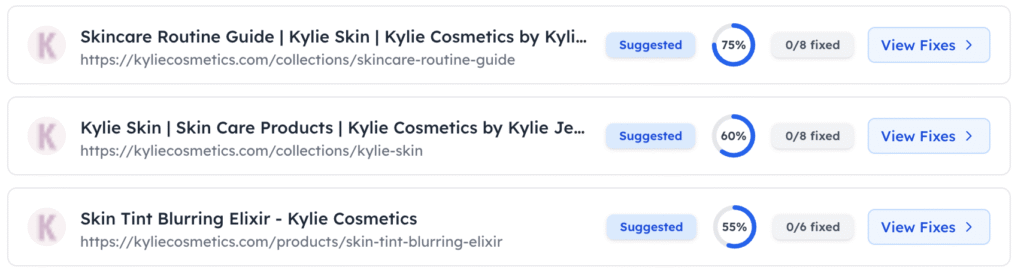
- Off-page suggests specific domains and threads worth engaging with, ranked by priority and domain rating, so if a competitor’s showing up in a Reddit thread AI models are pulling from, you know exactly where to go to join the conversation.

- On-page suggests a concrete fix on a specific page of your own site, like adding FAQ schema to a page that’s currently missing from every AI answer for a given prompt.
- Technical suggests whether AI bots are fully or only partially allowed to crawl your site, and flags exactly which bot and which pages are affected. A quick way to check this for your own site is to run an AI visibility audit and see exactly.
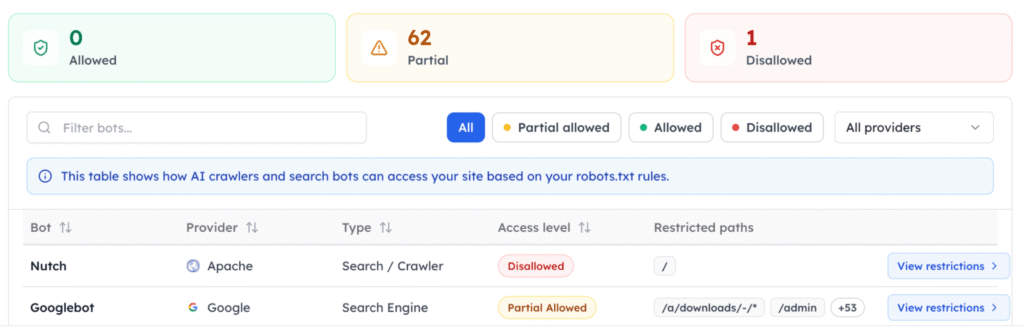
Each one comes with an effort estimate, and on-page fixes come with the actual implementation instructions you can copy directly. This is exactly where Peec AI stops. Peec AI’s Actions tab tells you where you’re missing, but it doesn’t tell you which page to fix, which domain to go after, or which bot is partially blocked.
Peec AI vs Track My Visibility
| Comparison criteria | Track My Visibility | Peec AI |
| Entry price | $50/mo | $95/mo |
| AI model coverage | 4+ engines, with more being added | 3 of 7, more behind agency/Enterprise |
| Prompt tracking | 25 to 300+ by tier | 50 to 350 by tier |
| Actionable recommendations | On-page, off-page, and technical opportunities with implementation steps | Actions tab, no execution layer |
| AEO / GEO guidance | Built into Opportunities, per-page and per-source | Light, recommendation-only |
| Overall focus | Tracking plus fix-it guidance | Tracking plus light analytics |
My take: If what’s missing from Peec AI is a clear next step, Track My Visibility’s Opportunities layer is built specifically for that gap.
 Pro tip: If you want to get a quick look at your AI visibility in just minutes, our free AI visibility checker does exactly that.
3. Otterly: Best for Simple AI Visibility Monitoring
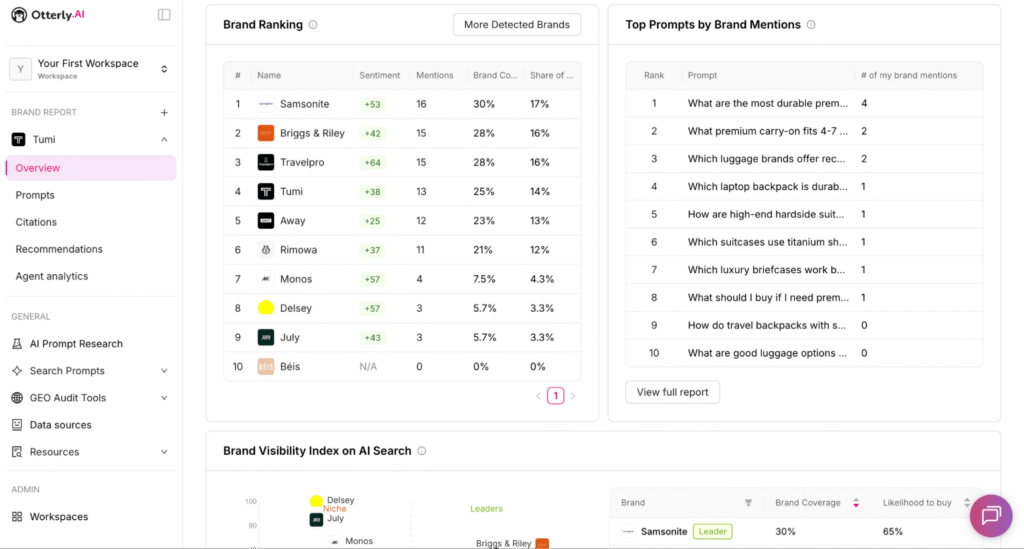
Yepp, I’ve included a budget-friendly option, and here’s Otterly for you. The thing I like about Otterly is its simplicity: it shows visibility, competitors, and gaps without asking you to learn a new mental model first, and you get something useful out of it within the first session.
Setup takes almost no time, and unlimited brand reports are included from the cheapest plan, so you’re not stuck tracking a single brand while you figure out if the tool’s for you. Multi-country tracking across 50+ countries is also included on every tier, even the $29 one, which is unusually generous at that price.
The tradeoff: where it wins against Peec AI
- You’ll get 4 core engines: ChatGPT, Google AI Overviews, Perplexity, and Microsoft Copilot, at $29/mo, no more.
- Compared to Peec AI’s 3 of 7 at a $95/mo floor, you’re starting cheaper, but you’ll pay per engine to go past 4.
- You get simple monitoring without a complex workflow and useful data fast, without a dashboard that needs a team to interpret it.
Peec AI vs Otterly
| Comparison criteria | Otterly AI | Peec AI |
| Entry price | $29/mo | $95/mo |
| AI model coverage | 4 engines base, 3 more as paid add-ons | 3 of 7, more behind agency/Enterprise |
| Reporting capabilities | Basic on Lite, Looker Studio from Standard up | Broader reporting from Advanced tier up |
| Actionable recommendations | GEO Audit and Recommendations, no execution layer | Actions tab, no execution layer |
| Agency use case | Agency Partner program, white-label reporting, pitch workspaces | Credit-based agency tier, no published per-credit cost |
| Overall focus | Fast, simple monitoring | Tracking plus light analytics |
My take: Otterly makes sense if you just want a working AI-visibility tool without a sales call, and the $29 tier genuinely isn’t a bait-and-switch shell. But if you need more than 4 engines, the add-on math can quietly push your real monthly cost well past what Peec AI or Track My Visibility would have charged for the same coverage upfront.
4. Rankscale AI: Best for Flexible, Credit-Based AI Search Tracking
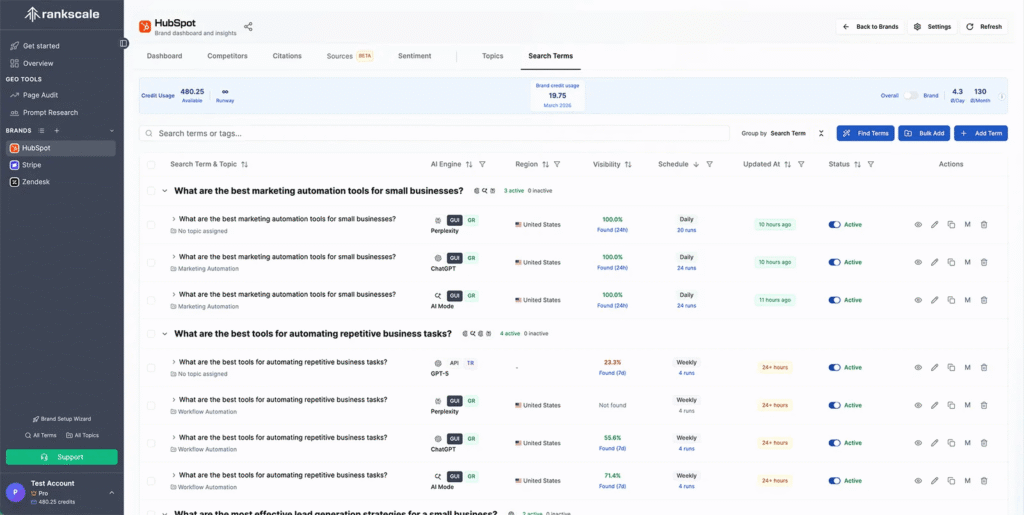
Next up, I’m placing Rankscale for its vast model coverage, and I mean that genuinely; this is one of the only tools on this list where the model list doesn’t shrink the moment you look at the entry tier.
Starting at $20/mo, you’re covering a genuinely broad platform list, marketed as 17+ but really 10 named engines once you account for model variants, including ChatGPT, Claude, Gemini, Perplexity, Copilot, Grok, DeepSeek, and Mistral, with no engine gated behind a higher tier.
The citation analysis itself is a real, specific strength independently praised across sources, since seeing exactly which domains and URLs an AI engine actually cites, broken down by category and tracked over time, is more useful than a simple “were you mentioned” check. It’s the same kind of source-level tracking Track My Visibility’s Trackdown report is built around, so you’ll recognize the value here if you’ve used that before.
Does the pricing match the depth?
- You’ll get the full feature set from the entry tier, sentiment tracking, query fan-out tracking, citation analysis, and page audits included, not gated behind Pro or Growth.
- You’ll get credit-based usage rather than a flat prompt count, and each engine query draws roughly 0.25 credits, so a single prompt tracked across all ten platforms costs closer to 2.5 credits.
- At $99/mo, you’ll roughly get sixteen prompts tracked daily across every engine, which is a genuinely specific and checkable conversion.
Peec AI vs Rankscale
| Comparison criteria | Rankscale | Peec AI |
| Entry price | $20/mo | $95/mo |
| AI model coverage | 10 engines, every tier | 3 of 7, more behind agency/Enterprise |
| Optimization guidance | Rankscale Scout recommendations, no execution layer | Actions tab, no execution layer |
| Actionable recommendations | Citation-level, source and URL specific | Prompt-level, mention or no mention |
| Agency use case | Growth tier badged “Agency’s Choice,” white-label dashboards, partner directory | Credit-based agency tier, no published per-credit cost |
| Overall focus | Broad coverage plus citation depth | Tracking plus light analytics |
My take: If engine breadth and citation-level detail are what you actually need, Rankscale gets you there at a lower floor than Peec AI. Where it asks for caution is the credit math, since the sticker price doesn’t map cleanly onto real usage, and the entry tier’s usability is genuinely disputed across independent sources.
5. AthenaHQ: Best for Turning AI Visibility Insights Into Action
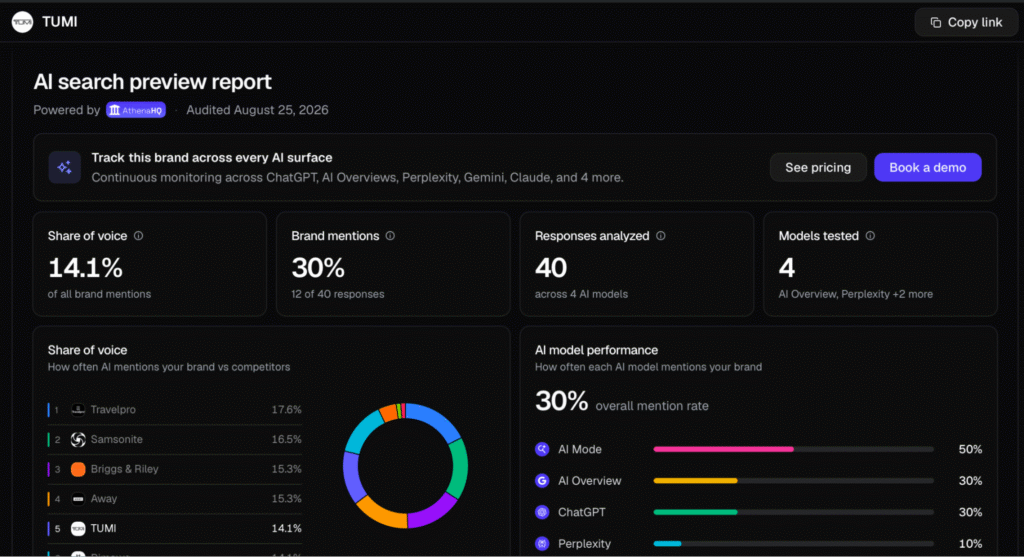
I’ve placed AthenaHQ on this list for a team looking for “before-and-after outcomes” with broader model coverage. AthenaHQ covers all 8 major platforms, including Claude and Gemini, with no per-engine gating, at $295/mo.
What stood out to me is “Action Center,” which turns tracking data into structured, assignable tasks instead of a dashboard you have to interpret yourself. Onboarding is simple too, without any need for demo calls and security reviews.
Peec AI vs AthenaHQ
| Comparison criteria | AthenaHQ | Peec AI |
| Entry price | $295/mo | $95/mo |
| AI model coverage | 8 engines, every tier, no gating | 3 of 7, more behind agency/Enterprise |
| Prompt tracking approach | Credit-based, shared pool | Flat prompt count per tier |
| Actionable recommendations | Action Center, assignable tasks | Actions tab, no execution layer |
| Content optimization support | Deep Research agent, Enterprise-only | Not offered |
| Overall focus | Tracking plus structured execution | Tracking plus light analytics |
Where the extra cost starts to make sense
- Credit-based pricing, not a flat prompt count, so real spend can climb past the $295 sticker, worth comparing against Track My Visibility’s flat per-tier allowance if predictable billing matters, especially when you’re deciding which prompts are actually worth spending those credits on.
- A genuinely well-corroborated, structured workflow, assignable tasks with clear owners, not just recommendations.
- ACE and the Deep Research content agent, the most advanced execution pieces, are Enterprise-only.
My take: If you want a task list instead of a dashboard, AthenaHQ delivers, and the Action Center holds up under scrutiny. The credit system is the real catch, since the $295 sticker price is well-documented across independent sources as understating what you’ll actually pay.
6. Profound: Best for Enterprise AI Search Intelligence
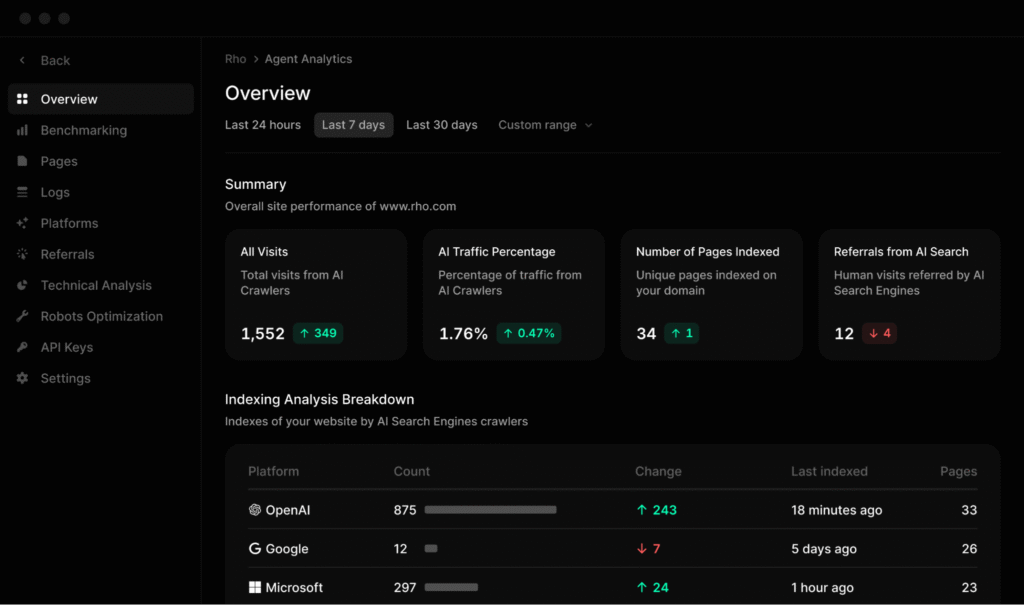
I believe Profound is the most mature tool in this category. I haven’t placed it as #1 because it seems more suitable for large enterprises with the budget and the yearly billing commitment to match, starting at $99/mo but really landing closer to $399/mo if you needed Perplexity tracking.
Profound’s depth here is what stood out to me.
(1) Prompt Volumes uses licensed panel data to show actual query demand, not just gaps, and Agent Analytics does server-side AI-bot log tracking across 100k+ pages, unlimited domains on every tier.
(2) FactCheck surfaces inaccurate AI claims about your brand and traces where they came from, and the content workflow goes all the way to publishing, with Agents drafting and pushing content directly into WordPress, Sanity, or Contentful.
(3) Enterprise unlocks up to 9 engines and multi-brand tracking.
Peec AI vs Profound
| Comparison criteria | Profound | Peec AI |
| Entry price | $99/mo (Perplexity access at $399/mo) | $95/mo |
| AI model coverage | 2 engines: Starter, 3 Growth, 9 Enterprise | 3 of 7, more behind agency/Enterprise |
| AI crawler insights | Agent Analytics, server-log level, unlimited domains | Not offered |
| Actionable recommendations | Opportunities and Aim, Enterprise-gated prioritization | Actions tab, no execution layer |
| Content optimization support | Agents, drafts and publishes directly to CMS | Not offered |
| Overall focus | Full-stack tracking, insight, and execution | Tracking plus light analytics |
Do you actually need Profound?
- If you want Perplexity tracking specifically, that starts at Growth, $399/mo, billed yearly, not the $99 headline most roundups quote.
- Want more than ChatGPT and Perplexity, Google AI Overviews, Claude, Gemini, and Copilot are all Enterprise-only.
- Need content generation baked into the same workflow as tracking? Profound is one of the very few tools that goes all the way to publishing, not just recommending.
- If annual billing is a dealbreaker, both self-serve tiers commit you to it; Track My Visibility’s flexibility here is worth weighing if yearly commitment isn’t something you want to sign up for yet.
My take: If your team has an enterprise budget and wants a genuine measure-to-publish workflow in one place, Profound is doing things nothing else on this list attempts. For anyone smaller, most of what justifies the price lives behind Enterprise, and the annual commitment on both self-serve tiers is worth sitting with before you sign.
7. Scrunch AI: Best for AI Visibility, Site Diagnostics, and Crawler Intelligence
Finally, I’ve put Scrunch AI on this list for its technical distinctiveness. Scrunch’s AXP layer is what makes it stand apart from everything else here; it operates monitoring, auditing, optimization, and content delivery through what it calls its Agent Experience Platform, and that’s genuinely where it stood out.
Where most tools on this list stop at “were you mentioned,” Scrunch asks whether your site is even legible to an AI crawler in the first place.
Site Diagnostics maps your site structure and flags exactly which pages AI crawlers can reach and which ones they can’t. Content Delivery goes a step further, showing a side-by-side of how a page renders for a human visitor versus an AI agent.
Peec AI vs Scrunch AI
| Comparison criteria | Scrunch AI | Peec AI |
| Entry price | $250-300/mo | $95/mo |
| AI model coverage | 4 engines: Core, up to 9 Enterprise | 3 of 7, more behind agency/Enterprise |
| AI crawler insights | GA4/Cloudflare bot analytics, human-vs-agent rendering view | Not offered |
| Actionable recommendations | Present but described as vague, not concretely actionable | Actions tab, no execution layer |
| Content optimization support | Listed as “coming soon” on published tiers | Not offered |
| Overall focus | Crawler diagnostics plus visibility tracking | Tracking plus light analytics |
Where it wins against Peec AI
- Genuinely ahead on crawler-level diagnostics, since Peec AI has nothing comparable to GA4/Cloudflare bot analytics or the human-vs-agent rendering comparison
- Stronger on source-level citation transparency, showing exactly which URLs an AI answer pulled from, including third-party review sites
- Considering pricing clarity, since prompt credits are consumed per engine, not per prompt, so 125 credits on Core works out to roughly 31 real queries once split across 4 engines
- With no native export tool on reporting, pushing some users to manual spreadsheet workarounds for client reports
My take: If crawler-level visibility into how AI agents actually read your site is what you’re after, Scrunch is doing something genuinely different from everything else on this list. Go in aware that AXP isn’t generally available yet, the pricing page has shown real inconsistency across visits, and the acquisition adds a layer of uncertainty about where the product goes next.
Which Peec AI Alternative Fits Your Team Best?
After reviewing these tools, what I found is that AI visibility isn’t about finding one winner; it’s about finding the exact gap in your current setup and picking the tool built to close it. Peec AI is good at what it does, and so is every other tool on this list, just in different directions.
- Solo marketers, small businesses: Otterly, fast-working data, no learning curve.
- Stuck behind Peec’s engine cap: Radarkit or Rankscale, six to ten engines, no agency tier.
- Want tasks, not another dashboard: AthenaHQ’s Action Center, tracking turned into assignable work.
- Enterprise budget, yearly commitment: Profound, all the way to content and publishing.
- Crawler diagnostics over visibility scores: Scrunch, genuinely different, caveats aside.
- Want to know exactly what to fix: Track My Visibility’s Opportunities layer, the gap turned into a specific fix.
What matters more than any single feature is your priorities, and which specific thing about Peec sent you looking in the first place. And if what you actually want is not just to know what’s broken, but exactly how to fix it, that’s the gap Track My Visibility was built to close.
Give it a 7-day trial and see exactly where your gaps are, and exactly how to fix them.
Good luck with your AI visibility.
FAQs
Neither, really. Peec is genuinely well-built for what it does: clean UI, fast onboarding, solid prompt tracking. What usually happens is a team’s needs shift toward something Peec doesn’t cover: more engines, deeper action steps, or crawler-level insight, not that the tool itself got worse.
Some teams do exactly that, especially short-term, running a cheaper tool like Otterly or Radarkit for broader engine coverage while keeping Peec for its dashboard and reporting. It’s not efficient long-term, but it’s a reasonable way to test an alternative before committing.
It depends on where your buyers actually are, but as a baseline, ChatGPT, Google AI Overviews, and Perplexity cover most of the volume for most brands. If you’re seeing traffic or mentions on Claude, Gemini, or DeepSeek too, a tool that caps you at three engines, like Peec’s self-serve tiers, will leave real gaps in the picture.
Monitoring tools tell you where you stand: mentions, rankings, sentiment, across AI engines. Optimization tools go a step further and tell you what to actually do about it: a page to fix, a source to pursue, a technical issue to resolve. Peec and Otterly lean toward monitoring, while Track My Visibility, AthenaHQ, and Profound’s Agents build in more of the optimization layer.