


We’d assume that AI Overviews and Gemini should behave similarly. They’re both Google products. They answer questions, pull information from across the web, and use that information to generate an answer.
So it seems reasonable to assume that the underlying logic: how they find information, evaluate sources, and decide what to include; should be similar.
It’s not.
We analyzed 383,188 citations across 64 ecommerce brands to see how the two engines actually behave.
What we found was a clear difference in the sources they rely on, the types of websites they cite, and the kinds of pages they choose to surface.
Key Takeaways
- AI Overviews and Gemini shared just 15.8% of cited domains across the 64 ecommerce brands in our study.
- Only 2 of 64 brands had the same #1 cited source, showing how rarely the two engines agreed on their most prominent source.
- AI Overviews cited social platforms 7.5× more often than Gemini, with social sources accounting for 19.83% of its citations compared with 2.63% for Gemini.
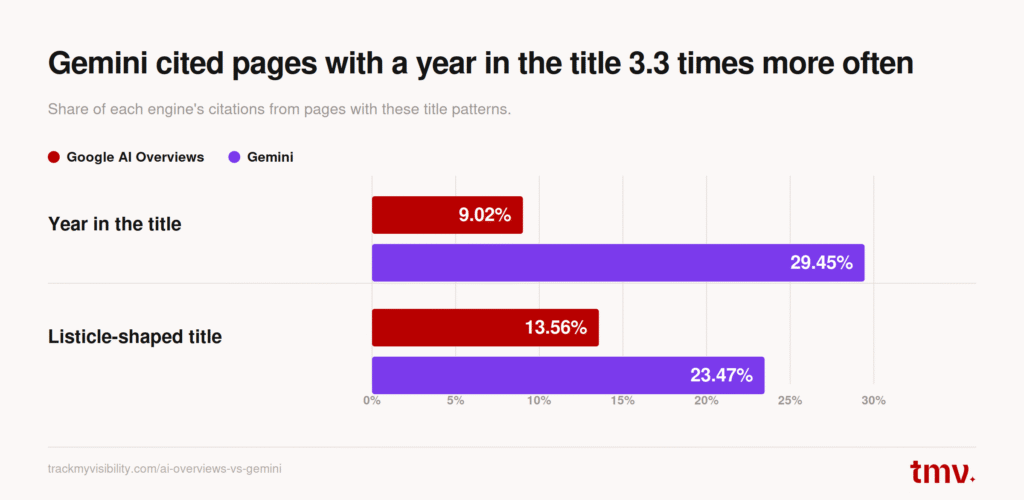
- Gemini cited editorial sources 1.7× more often and pages with a year in the title 3.3× more often than AI Overviews.
- Even when both engines cited a brand’s own website, they often selected different pages, with a median owned-page overlap of 24.6%.
- The takeaway: Google AI is not one channel. AI Overviews and Gemini show different citation patterns and need to be understood separately.
Do AI Overviews and Gemini cite the same websites? No, 84.2% of cited domains were different.
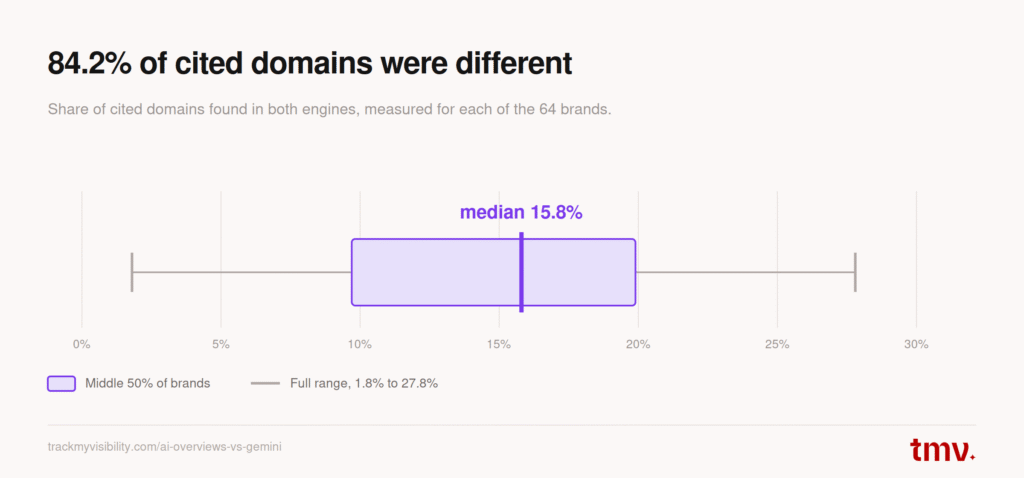
We compared the cited domains across 64 ecommerce brands tracked in both AI Overviews and Gemini, covering 383,188 citations.
The median overlap was just 15.8%, meaning most of the websites cited by one engine were not cited by the other.
The difference also varied across brands:
- 1.8% lowest overlap
- 9.7% 25th percentile
- 15.8% median
- 19.9% 75th percentile
- 27.8% highest overlap
We also looked at the most-cited domain for each brand. Only 2 of 64 brands had the same #1 cited domain across both engines.
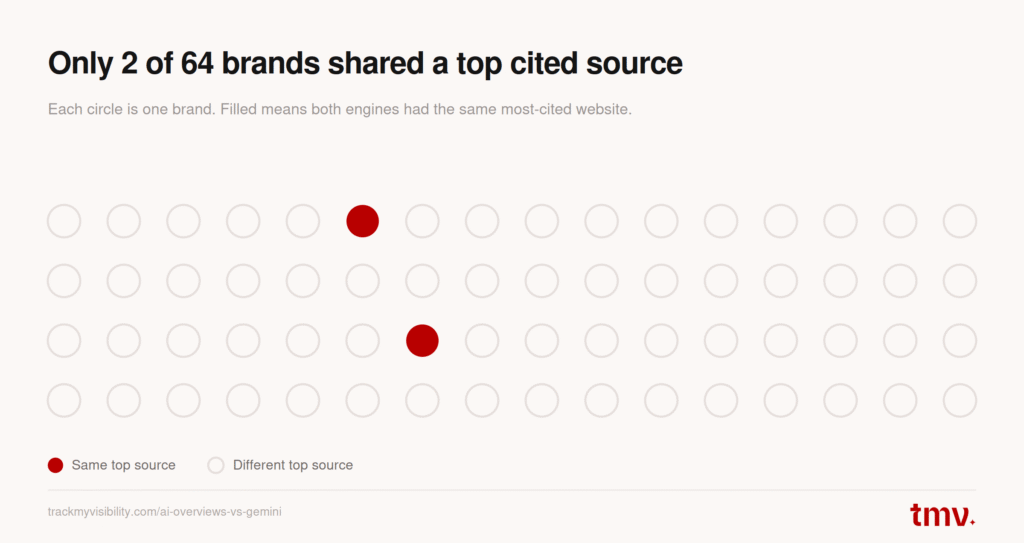
So the difference isn’t limited to less important sources. In most cases, the two engines also disagreed on which website was cited most often.
AI Overviews cite more social sources while Gemini prefers editorial sources
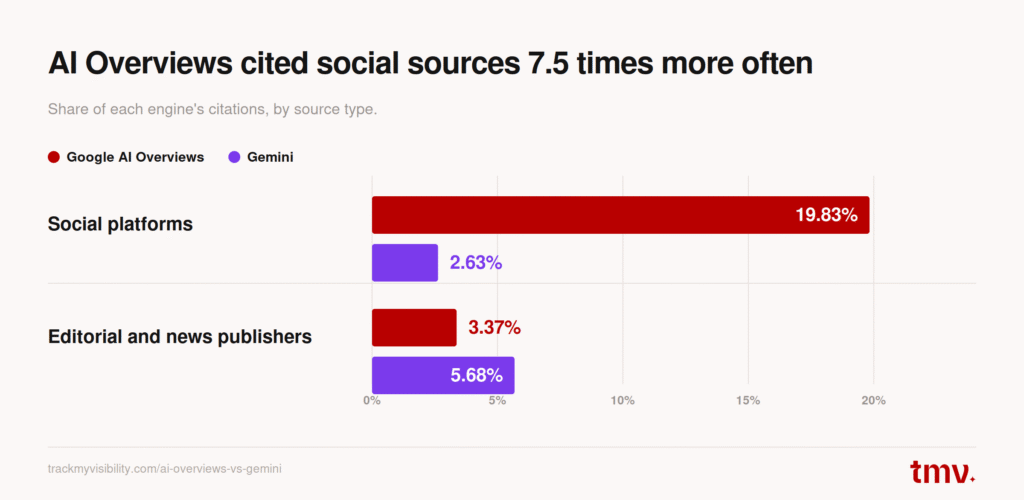
The difference in source overlap becomes clearer when we look at what types of websites each engine cites.
Social platforms accounted for 19.83% of AI Overviews citations, compared with just 2.63% for Gemini. That means AI Overviews cited social sources 7.5× more often.
The biggest differences came from platforms such as:
- YouTube: 8.90% vs. 0.81%
- Reddit: 4.51% vs. 1.78%
- Instagram: 2.62% vs. 0%
- TikTok: 1.33% vs. 0.04%
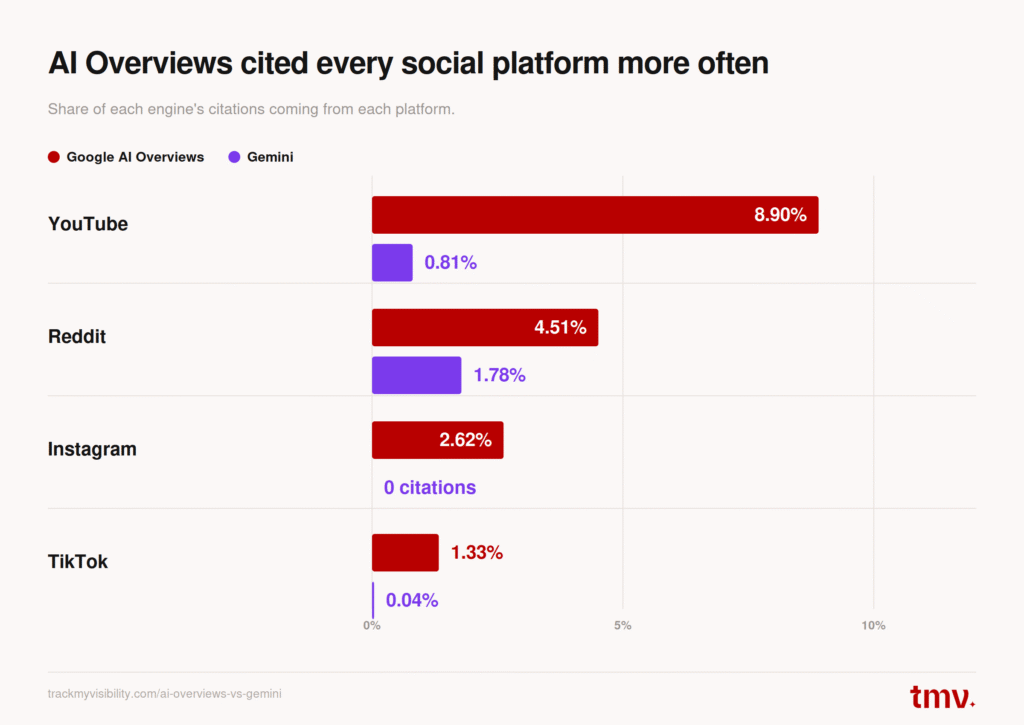
AI Overviews cited Instagram 7,213 times in our dataset, whereas Gemini cited it zero times.
The pattern shifts when we look at editorial and news publishers. They accounted for 5.68% of Gemini citations, compared with 3.37% for AI Overviews, making editorial sources 1.7× more common in Gemini.
In our dataset, the two engines therefore showed different source preferences: AI Overviews cited social platforms more often, while Gemini cited editorial sources more often.
AI Overviews and Gemini cite different types of pages
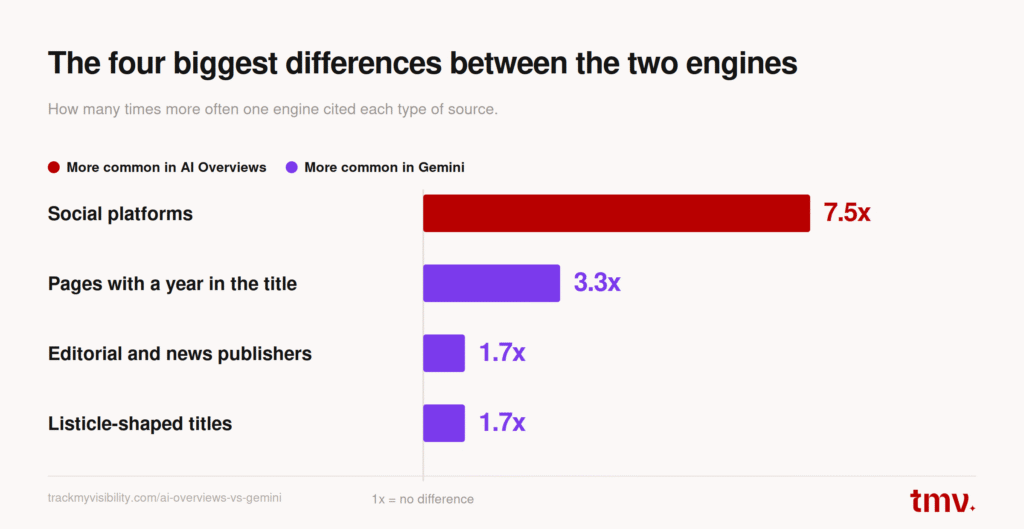
The difference is not limited to the websites the two engines cite. They also show different patterns in the types of pages they select.
Pages with a year in the title made up 29.45% of Gemini citations, compared with 9.02% for AI Overviews. Gemini cited this type of page 3.3× more often.
The same pattern appears with listicle-style content. 23.47% of Gemini citations came from pages with listicle-shaped titles, compared with 13.56% for AI Overviews, a 1.7× difference.
Together, these patterns show that the two engines differ not only in which websites they cite, but also in the types of pages they select from those websites.
Both engines cite brand websites at almost the same rate
Despite the differences we’ve seen, there are some areas where AI Overviews and Gemini behave similarly.
Both engines cited the brands’ own websites at almost exactly the same rate:
- AI Overviews: 6.09%
- Gemini: 6.01%
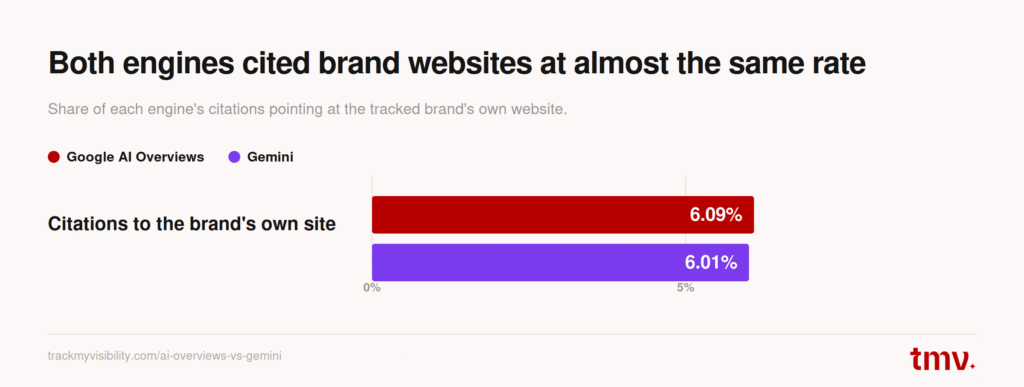
But the similarity ends when we look at which pages they choose.
Among the 48 brands that received citations from their own websites on both engines, the median overlap in selected pages was just 24.6%. Only 17 of 48 brands (35.4%) had the same top cited page across both engines.
So even when AI Overviews and Gemini choose the same domain, they can still choose different pages from that domain.
What does this mean to you?
Short answer: AI Overviews and Gemini should be measured and optimized separately.
Seeing your brand appear frequently in AI Overviews does not mean you will see the same results in Gemini.
Our data shows that the two engines use different sources and favor different types of content. That means a strategy that helps your brand get cited in one engine may not have the same effect in the other.
For example, social sources made up 19.83% of AI Overviews citations, compared with 2.63% for Gemini. YouTube and other social platforms were much more visible in AI Overviews.
Gemini showed a different pattern. Editorial and news sources accounted for 5.68% of its citations, compared with 3.37% for AI Overviews. Gemini also cited pages with a year in the title 3.3× more often.
So if your SEO and content strategy is already helping you appear in AI Overviews, you cannot assume the same strategy will translate directly to Gemini.
Instead, the data points toward different priorities for different engines:
- For AI Overviews, prioritize the sources that appeared more frequently in our data, including YouTube, social platforms, and other forms of third-party content.
- For Gemini, editorial coverage and other content patterns observed in the study may deserve more attention.
- Continue building your core SEO and content foundation, but don’t assume one strategy will produce the same visibility across engines.
The key is not choosing between AI Overviews and Gemini, but understanding what drives visibility in each and optimizing accordingly.
How we measured the differences
We used Track My Visibility and analyzed 383,188 citations across 64 ecommerce brands that appeared in both Google AI Overviews and Gemini. The dataset included:
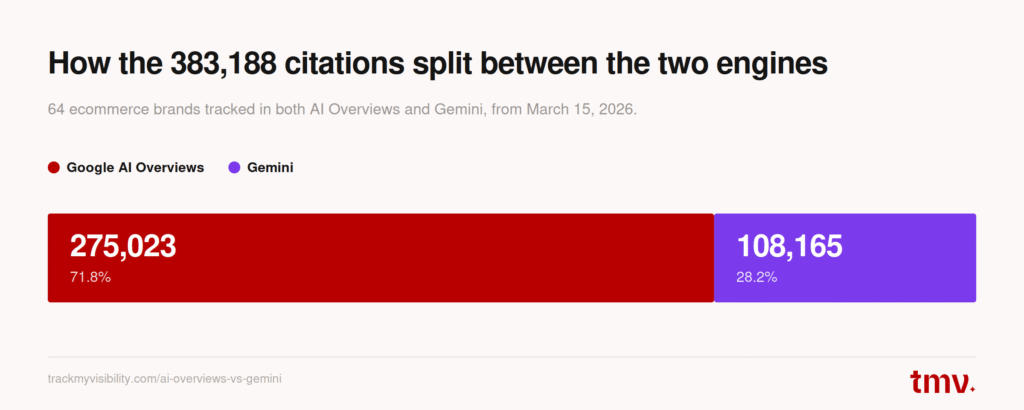
- 275,023 citations from AI Overviews
- 108,165 citations from Gemini
- Data collected from March 15, 2026 onward
We compared the two engines across three areas:
- Cited domains: how much the websites cited by each engine overlapped
- Source types: social platforms, editorial/news publishers, and other source categories
- Page characteristics: year-based titles, listicle-style titles, and pages from the brands’ own websites
For brands whose own websites were cited by both engines, we also compared the specific pages selected by each engine.
A note on the data
This study focuses on ecommerce brands, so the findings should not be treated as representative of every industry
The results describe the citation patterns we observed in this dataset. They show how the two engines behaved, but they do not establish that any individual source or content format directly causes higher visibility.
Track and improve your AI visibility across models
Track My Visibility helps you understand how your brand appears across AI search engines and models.
See your visibility across platforms, including where your brand is mentioned, which sources are cited, which competitors appear alongside you, and which prompts drive your visibility.
Instead of treating AI visibility as one number, you can see how your brand performs across different models and identify where you need to improve.
Start tracking your AI visibility with a 7-day trial.