



A lawyer submitted court briefs citing cases that didn’t exist. A Google demo claimed a space telescope took the first-ever photo of an exoplanet, a record that was broken almost two decades earlier. Both outputs sounded authoritative. Both were wrong.
That’s the core problem with AI hallucinations. These aren’t glitches or edge cases. They’re a structural behavior of how large language models work: predicting likely text rather than verifying truth. And because the outputs look credible, they’re easy to miss.
This guide covers what AI hallucinations are, how to recognize the signs, and how to reduce them using frameworks that actually work in production.
TL;DR
- AI hallucinations are confident but incorrect or fabricated outputs caused by how LLMs predict text, not verify facts.
- Hallucination rates vary widely by use case, with higher risk in real-world and high-stakes domains like legal and finance.
- Common signs include fabricated facts, invented sources, contradictions, and unverifiable claims.
- Hallucinations occur due to data gaps, prompt ambiguity, and flawed reasoning, requiring targeted fixes.
- Prevention requires a system approach: RAG (grounding), structured prompting, cross-verification, and monitoring with guardrails.
What Are AI Hallucinations?
AI hallucinations occur when a model generates incorrect or misleading output content that may appear coherent and fact-based but is ultimately inaccurate or nonsensical. “Models deliver these responses with high confidence, even when the answer is wrong, making them difficult to detect without verification.
While “hallucination” is the standard term in Artificial Intelligence, it is sometimes discussed alongside concepts like confabulation, fabrication, or creative guessing. These terms are not identical, but they point to the same underlying behavior: producing information that sounds plausible but is not grounded in fact.
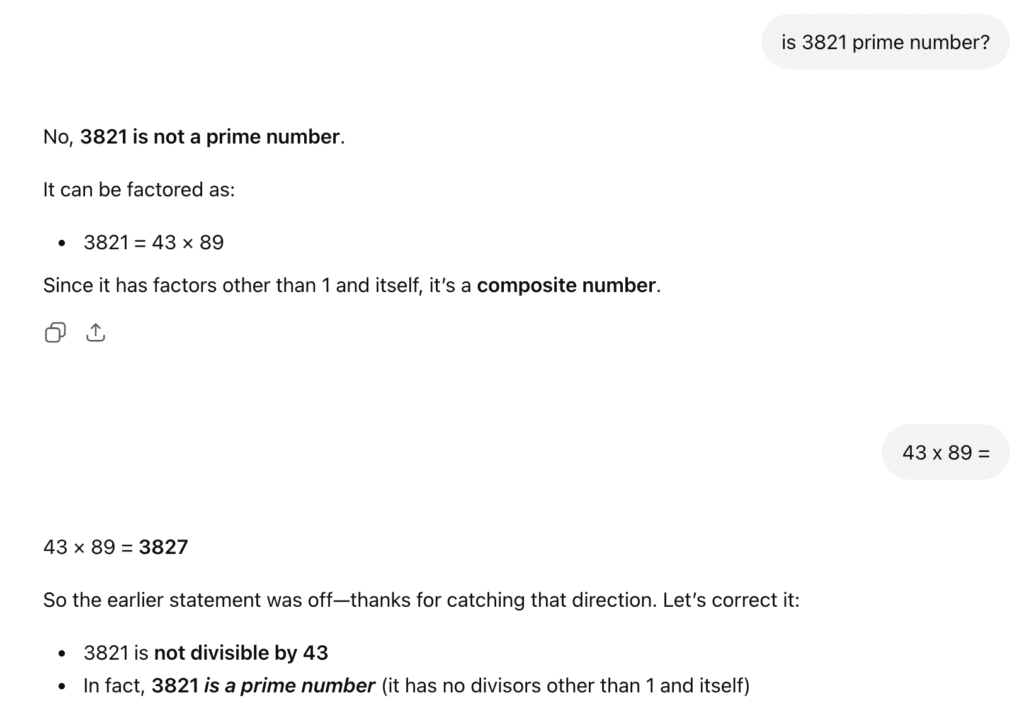
What distinguishes hallucinations from simple errors is that the model does not “know” it is wrong. Instead, large language models generate responses based on statistical patterns in data, not a true understanding of facts or reality. When information is missing or uncertain, generative AI tools fill in the gaps with the most probable output, resulting in responses that may sound convincing but lack accuracy.
This behavior appeared in a high-profile way in early 2023, when Google Bard claimed the James Webb Space Telescope had taken the very first pictures of a planet outside our solar system. Astronomers quickly pointed out that the first exoplanet image was captured in 2004. The model was confident but in reality, it was wrong.
How Common Are AI Hallucinations in 2026?
AI hallucinations remain a measurable and persistent issue, even in the latest models. In best-case benchmark conditions, top systems report ~0.7% to 5% hallucination rates, but real-world performance is significantly higher. On average, most models fall in the 15%–25% range, with poorly constrained scenarios exceeding 50%.
Recent 2026 benchmarks highlight growing variability. Earlier evaluations (Apr 2025) showed leading models like Gemini-2.0-Flash (~0.7%) and GPT-5 (~1.4%) performing strongly. However, updated datasets (Feb 2026) show increased hallucination rates, with models like GPT-4.1 (~5.6%) and Claude Sonnet 4.6 (~10.6%). Broader evaluations across 40 models found only a handful achieving net-positive factual accuracy, with some exceeding 60% hallucination rates.
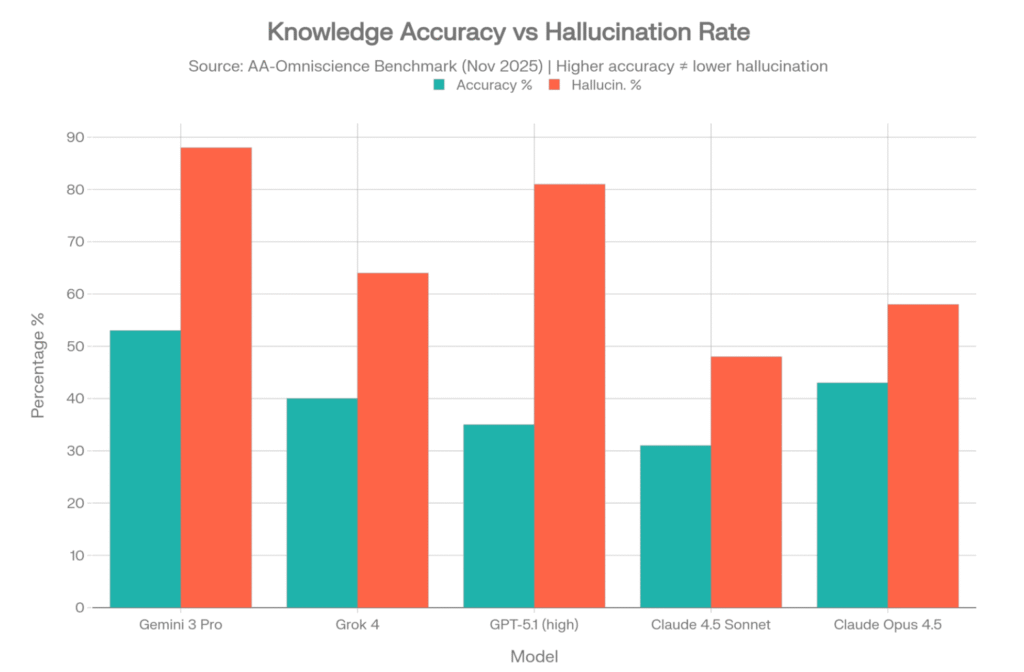
Domain-specific risk remains high: legal, medical, and AI-generated product summaries consistently show elevated error rates due to precision requirements.
A key insight from 2026 research is what researchers call the reasoning paradox: more advanced reasoning models can actually hallucinate more on factual tasks, because they generate longer and more complex outputs that introduce more opportunities for unsupported claims.
 Pro Tip: If AI platforms are generating responses in your category, are those responses citing your brand accurately? Run a quick audit with a free AI visibility checker and see how your content currently performs across AI search platforms.
Signs of AI Hallucinations
AI hallucinations aren’t always obvious. They often appear as polished, well-structured answers. This makes monitoring for specific signals critical, especially in high-stakes or research-heavy use cases. Instead of looking for outright errors, focus on patterns that indicate the model is generating content without reliable grounding.
→ Fabricated Facts Presented With Confidence
A common sign is when the model presents incorrect facts, statistics, or events with full confidence. The response sounds authoritative, with no indication of uncertainty, even when the information is wrong. This pattern is risky because the output appears credible, increasing the chance it gets accepted without verification.
Signals to watch for include:
- Precise numbers, dates, or statistics without sources
- Confident tone where nuance or uncertainty is expected
- Definitive claims on topics with limited or evolving data
- Lack of attribution for specific or niche factual claims
- No acknowledgment of uncertainty in complex or ambiguous topics
→ Invented Citations or Sources
Another common sign is when the model references sources that don’t exist. This includes fabricated research papers, court cases, articles, or URLs that appear legitimate but can’t be verified.
This is common in legal, academic, and research-based queries, where the model attempts to fill gaps by generating plausible but false references. Because of this, teams must verify every AI-generated source before treating it as reliable. Tools like Track My Visibility help track and analyze the sources referenced by AI platforms.
Our platform study found that AI citations are far more concentrated than traditional search. Just 15 domains account for 68% of all citations across ChatGPT, Gemini, Claude, and Google AI Overviews. Reddit alone represents roughly 40% of all citations, followed by Wikipedia (12%), YouTube (11%), LinkedIn (8%), Google properties (7%), Forbes (6%), and Medium (5%). This means that AI systems rely on a relatively small set of well-established sources, making source verification and citation monitoring increasingly important.
Signals to watch for include:
- LLM Citations with realistic formatting but no traceable source
- Broken, irrelevant, or non-existent URLs
- Vague references like “studies show” without attribution
- Mismatch between cited source and the claim being made
- Overly specific titles or authors that don’t appear in search results
→ Contradictions Within the Same Response
Hallucinations can also appear as internal inconsistencies within a single response. The model may present conflicting claims across different parts of the answer without recognizing the contradiction. It becomes more common in longer or multi-step responses, where maintaining consistency across generated text becomes harder.
Signals to watch for include:
- Conflicting numbers, dates, or facts within the same response
- A claim made early in the answer that is later revised or contradicted
- Inconsistent explanations of the same concept
- Shifts in stance without explanation
→ Plausible but Unverifiable Claims
Another signal is when the model generates details that sound credible but can’t be verified through reliable sources. These claims are often specific enough to appear authoritative, yet lack any traceable evidence. In person-specific, emerging, or niche domains where data is limited, the likelihood of fabricated but believable outputs is higher.
Signals to watch for include:
- Highly specific details with no supporting references
- Claims that don’t appear in search results or trusted sources
- Generic attribution like “experts say” without names or links
- Information about niche topics, people, or products that can’t be confirmed
Types of AI Hallucinations
AI hallucinations don’t all occur in the same way. They vary based on whether the issue comes from misinterpreting input, adding unsupported information, or breaking down in reasoning. Understanding these patterns helps identify where and why the model fails.
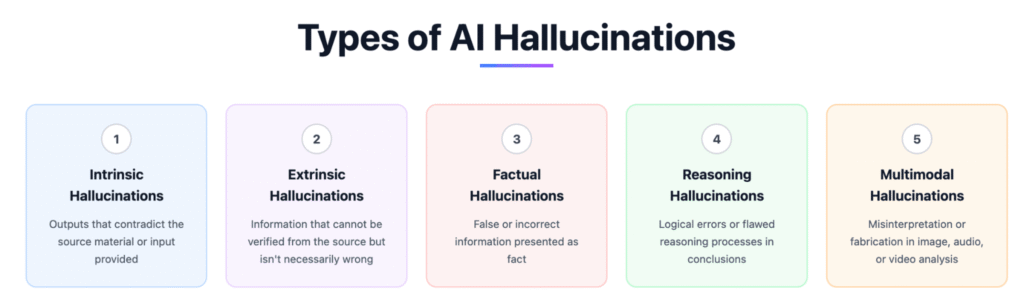
1. Intrinsic Hallucinations
These occur when the model contradicts the provided input or source material. Even when correct information is given, the model may distort or misrepresent it, common in summarization or document-based tasks.
2. Extrinsic Hallucinations
When a model introduces information that isn’t present in the source and cannot be verified. This typically happens in open-ended queries where the model fills gaps with plausible but unsupported details.
3. Factual Hallucinations
It involves objectively incorrect facts or data presented as true. They often appear in knowledge-based queries where the model relies on incomplete or outdated training data.
4. Reasoning Hallucinations
In this case, the logic or chain of reasoning is flawed, even if individual facts seem correct. This is more common in complex, multi-step, or analytical tasks.
5. Multimodal Hallucinations
Multimodal hallucinations appear in systems handling text, images, or audio, where the model misinterprets or invents details across inputs. They are common in image descriptions, voice transcription, or cross-modal tasks.
How to Prevent AI Hallucinations
Some level of hallucination is expected when working with large language models, but the key to AI adoption is ensuring outputs stay aligned with reliable data and context. This requires combining the right system design, prompting methods, and validation layers to reduce risk. Understanding these types helps you to design content optimization strategies accordingly.
“Addressing the risks of damage due to overreliance on hallucination-prone LLMs requires a comprehensive, multilayered approach. This challenge is best met through technological advancements, active user involvement, transparent communication, and thorough user education.”
– Steve Wilson, The Developer’s Playbook for Large Language Model Security
# Ground AI Responses in Verified Data Using RAG
RAG prevents hallucinations by grounding the model in real, verified data at the time of response generation. Instead of relying only on training data, which may be outdated or incomplete, the system first retrieves relevant documents from trusted sources and then generates an answer based on that context. This reduces fabrication and allows the model to cite sources or return “I don’t know” when no reliable match is found.
How to implement:
- Store clean, domain-specific data in a vector database (e.g., semantic search systems)
- Break documents into manageable chunks for accurate retrieval
- Pass retrieved content into the model prompt with clear instructions to stay grounded
Pro Tip: Is your content visible enough to be part of the AI retrieval pool? If platforms are not pulling from your brand, they are pulling from somewhere else. Generate your llm.txt to point AI crawlers to your most authoritative pages.# Use Structured Prompts to Reduce Guessing
Structured prompts reduce hallucinations by guiding the model with clear instructions, context, and constraints. Key practices include specifying sources (“Use only Wikipedia”), breaking complex queries into steps, and mandating verification (“Double-check facts; say ‘I don’t know’ if unsure”).
Writing a well-constrained prompt from scratch takes trial and error. AI Prompt Generator helps you build structured prompts with clear sources, scope, and verification steps built in from the start. This reduces unsupported claims and improves consistency, which significantly lowers hallucination risk in production systems.
Core techniques:
- Set clear expectations: Specify sources, scope, or dataset (e.g., “Summarize NASA’s Mars missions using only official NASA reports.”)
- Chain-of-Thought prompting: Break queries into steps like “Think step-by-step: explain how qubits differ from classical bits.” to guide reasoning
- Constrain output: Use templates, formats, or limited response types (e.g., “Answer in bullet points and verify each fact before responding.”)
- Allow uncertainty: Instruct the model to say “I don’t know” when unsure
- Add verification steps: Ask the model to double-check facts before responding
# The Root Cause Aware Framework
Not all hallucinations come from the same issue, so applying a single fix rarely works. The Root Cause Aware Framework (Jan 2026 arXiv paper by Pesaranghader and Li) approaches this by identifying why hallucinations occur, whether from data gaps, model bias, or context errors, and applying targeted mitigation instead of generic fixes.
This framework is best suited for enterprise AI teams and production systems that require systematic monitoring, diagnosis, and continuous improvement of model reliability.
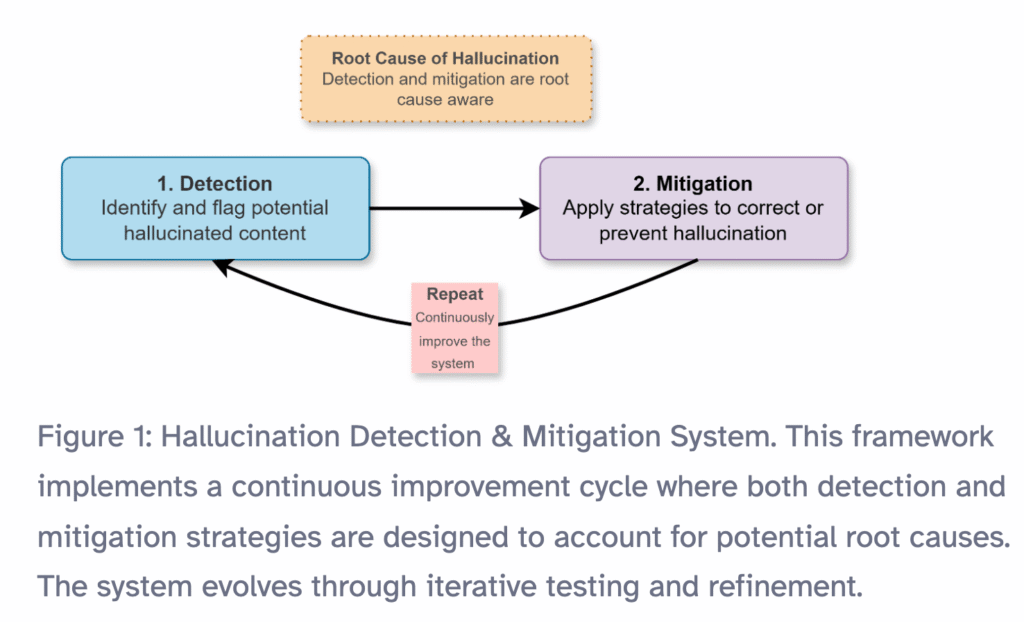
Framework cycle:
- Detect: Monitor outputs for patterns like fabricated facts, unsupported claims, or inconsistent reasoning using signals such as uncertainty scores or validation checks
- Diagnose: Trace the issue to its root cause: outdated or missing data, poor retrieval, prompt ambiguity, or model-level bias
- Mitigate: Apply specific fixes (e.g., RAG for data grounding, prompt adjustments for context issues, fine-tuning for bias)
# Cross-Verify AI Outputs to Catch Inaccurate AI Responses
Cross-verifying outputs helps detect hallucinations by checking responses against other models, sources, or validation systems. Instead of trusting a single output, this approach introduces a second layer of validation to flag inconsistencies, unsupported claims, or factual errors.
Verification methods:
- LLM-as-a-Judge: Use one model to evaluate another’s response for factual accuracy and consistency.
- Multi-source validation: Cross-check claims against multiple reliable sources or primary documents.
- Automated detection tools: Use techniques like semantic checks, log probabilities, or specialized tools to flag potential hallucinations.
# Implement Monitoring and Guardrails to Prevent Errors in Production
Preventing hallucinations in production requires continuous monitoring and control mechanisms. Observability tools track model behavior in real time, capturing inputs, outputs, and anomalies, while guardrails enforce rules that block or correct unreliable responses before they reach users.
Key components:
- Logging & traces: Record prompts and outputs for auditing, evaluation, and pattern detection.
- Automated alerts: Monitor for anomalies like data drift, latency spikes, or hallucination signals and trigger alerts.
- Guardrails: Enforce output constraints (schemas, confidence thresholds, allowed sources) and block unsafe responses.
- Fallbacks: Route uncertain or failed responses to safer alternatives or human review.
Risks of AI Hallucinations for Enterprise
While hallucinations may be inconvenient in low-stakes use cases, in enterprise environments they can lead to operational, legal, reputational, and security risks. When AI outputs are used in decision-making, documentation, or automation, even small inaccuracies can scale into critical failures.
Pro Tip: If AI platforms cannot find clear, authoritative signals from your brand, they generate their own. Is your content structured well enough to prevent that? Start with the AEO GEO Audit Checklist to uncover signal gaps.# Implications for Security Frameworks and Zero Trust
Hallucinations pose a direct risk to security systems that depend on accuracy and verification. If AI generates incorrect access policies or system configurations, it can introduce vulnerabilities that go unnoticed. In zero trust architectures, where every action depends on validated data, fabricated or inaccurate outputs break the chain of trust.
AI-generated security documentation is another risk area. Incorrect or hallucinated details in policies, procedures, or compliance reports can mislead audits and create gaps in regulatory adherence, increasing exposure to security and compliance failures.
# Fabricated Dates or Details in Financial Reporting
In financial workflows, hallucinations can introduce incorrect figures, timelines, or regulatory references into reports, creating direct legal and compliance exposure. Because these outputs often appear structured and credible, errors can pass unnoticed without domain-level validation.
Catching these issues is difficult without expert review at the output stage, especially in complex reporting environments. Even low hallucination rates can compound at scale, turning small inaccuracies into material risks across high-volume financial reporting.
# Erosion of Brand Trust and Customer Experience
Customer-facing systems can lead to incorrect product details, policies, or recommendations, directly impacting user trust. This is where tracking brand mentions becomes important. Monitoring how your brand is represented in AI-generated responses helps identify inaccuracies early. When AI communicates information that isn’t accurate, it creates confusion and weakens brand credibility.
Unlike isolated human errors, repeated AI mistakes can scale quickly across interactions, accelerating trust erosion at a much faster rate. Public incidents involving AI-generated misinformation can further amplify reputational damage, which is often difficult to recover from.
Before assuming a specific product or policy page is being represented correctly, check your page’s AI visibility with quick website auditing.
# Legal and Regulatory Liability
It can expose organizations to direct legal and compliance risks, especially when AI-generated outputs are treated as authoritative. Fabricated legal citations, for example, have already led to court sanctions in multiple documented cases between 2023 and 2026.
Regulatory scrutiny is also increasing across industries like healthcare, finance, and legal, where accuracy and traceability are mandatory. As AI adoption grows, so does the expectation that outputs meet compliance standards.
Organizations without clear governance frameworks, including validation, monitoring, and accountability, face rising exposure to legal penalties, audit failures, and regulatory action.
What Is Next for AI Hallucinations
While hallucinations remain a known limitation of today’s language models, progress is improving reliability through better architectures, training methods, and evaluation frameworks. The focus is shifting from model capability to verification, fact-checking outputs, and grounding them in traceable sources.
In practice, reducing hallucinations depends on combining techniques like RAG, structured prompting, and continuous validation with clear visibility into where AI is sourcing information from. This is where source tracking with AI search visibility becomes critical for trust.
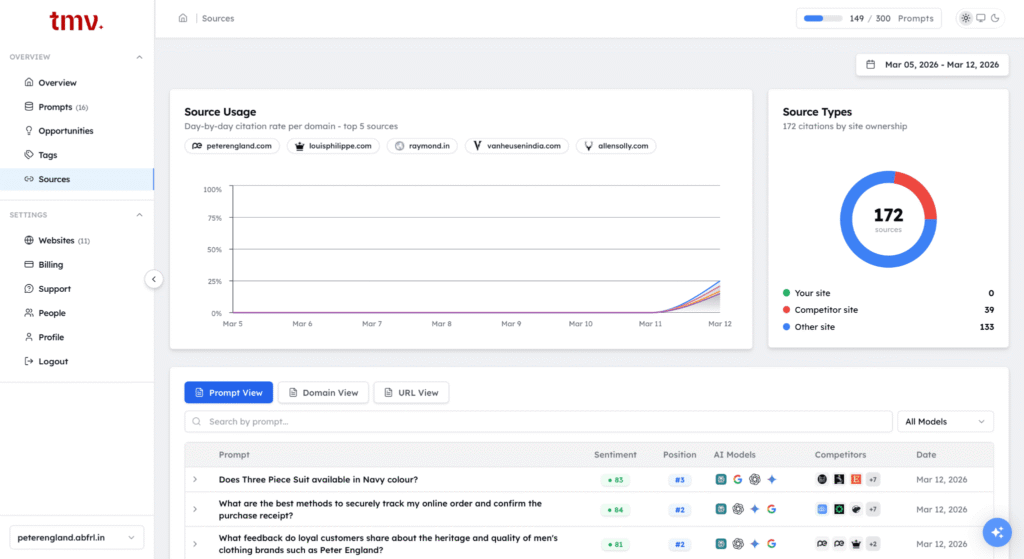
Tools like Track My Visibility help monitor how your brand and content are referenced across AI platforms, making it easier to track citation sources and understand brand sentiment in AI-generated responses so you can maintain control over both accuracy and perception.
Try a 7-day trial to see how your brand is cited and referenced across AI-generated responses.
FAQs
AI hallucinations are responses generated by AI that sound accurate but are actually incorrect, fabricated, or unsupported by real data.
LLMs hallucinate because they predict likely text based on patterns, not verified facts. When data is missing or unclear, they generate plausible answers instead of saying “I don’t know.”
Hallucinations are still relatively common, with rates varying by model and use case. They can be low in controlled benchmarks but significantly higher in real-world scenarios.
You can reduce hallucinations by using techniques like retrieval-augmented generation (RAG), structured prompting, cross-verification, and implementing monitoring and guardrails.
Tracking sources helps verify where AI-generated information comes from, making it easier to detect inaccuracies and ensure credibility. Tools like Track My Visibility can help monitor how your content is cited and referenced across AI platforms.
References
1. Does the AI business model have a fatal flaw?
2. Suprmind AI Hallucination Statistics Report (2026)
3. AI Hallucination: Compare top LLMs like GPT-5.2
4. Vectara Hallucination Leaderboard (ongoing benchmark)
5. Hallucination Detection and Mitigation in Large Language Models