


Search is no longer just about clicks. AI platforms are answering questions directly, and users are getting what they need without ever visiting a website.
For brands, this is the shift. The traffic you worked to earn is quietly shrinking, not because your content got worse, but because the search experience itself changed.
That’s why optimizing your brand’s visibility in AI content has become the new priority: getting cited, mentioned, and recommended inside AI-generated answers, and knowing how to measure AI search visibility is where that work begins.
This guide walks you through:
- How AI models work and what content types they prefer
- The real differences between traditional SEO and AI search optimization
- A practical AI visibility framework for your business
- How to optimize your brand for AI search
Let’s get into it.
TL;DR
AI search is reducing clicks from traditional search, making rankings alone less valuable. AI citations matter more than first rankings, and every platform chooses sources differently. Create structured, authoritative content that’s easy for AI to understand and cite. Tailor your AI SEO strategy to your business model (SaaS, eCommerce, agencies, startups, etc.). Track AI visibility across platforms, monitor citations, and benchmark against competitors.Why Optimizing for AI Search Matters Now
Search isn’t what it used to be. A few years ago, getting to the top of Google meant traffic would follow. Today, with AI-powered platforms like Google AI Overviews and ChatGPT Search stepping in, that’s no longer guaranteed.
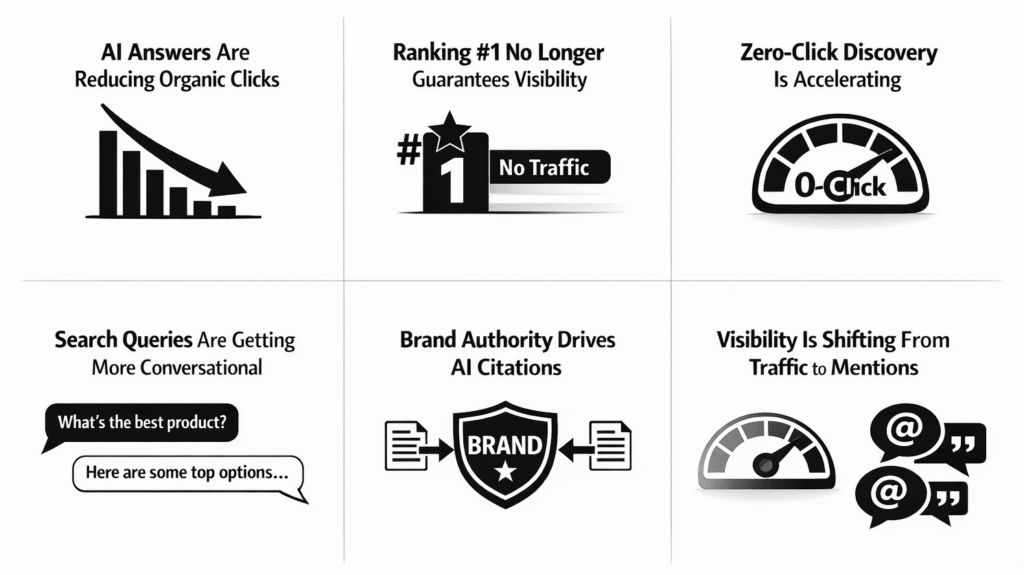
AI Answers Are Reducing Organic Clicks: More users are getting answers directly from AI summaries without ever visiting a website. Users read what they need and move on. The number is only growing as AI Overviews expand.
Ranking #1 No Longer Guarantees Visibility: AI chooses answers from sources it considers authoritative, prioritizing content quality and relevance over search position alone. The way LLMs choose content is fundamentally different from how search engines rank pages. Ranking high helps, but it’s not enough anymore.
Zero-Click Discovery Is Accelerating: Users get synthesized answers upfront. Visibility today means being part of those instant answers, not just driving visits.
Search Queries Are Getting More Conversational: Users are asking detailed, intent-rich questions like “What’s the best way to optimize my brand for AI search in 2026?” Content needs to match that conversational style to stay relevant.
Brand Authority Drives AI Citations: AI search platforms don’t cite randomly. Strong E-E-A-T signals increase the likelihood of your brand being referenced. Credibility across the web directly influences how often AI mentions you.
Visibility Is Shifting From Traffic to Mentions: A citation puts your brand in front of users who may never have found you otherwise. It builds recall, trust, and branded search activity, shifting the measure of success from pure traffic volume to broader presence and influence.
How AI Search Engines Retrieve Data and Generate Answers
Before jumping into optimization strategies, it helps to understand what’s actually happening behind the scenes when a user asks a question.
How AI Models Process and Retrieve Information
AI search engines use Retrieval Augmented Generation (RAG):
1. User query processing: The system interprets your query to identify the intent and context.
2. Retrieval: It pulls the information from sources connected, matching the query.
3. Generation: It synthesizes a clear, conversational response using the retrieved data.
This approach grounds responses in current, external data rather than relying solely on pre-trained knowledge. That reduces hallucinations and enables up-to-date answers.
 Pro Tip: Want to know which competitors are already being cited by AI and why? This free AI visibility checker will help you find visibility gaps before your competitors own the space.
How AI Platforms Decide Which Brand to Mention in Answers
AI platforms prioritize sources that best satisfy the query with high quality and trust.
As discussed in this Reddit thread, different LLMs cite different sources for the same user intent.
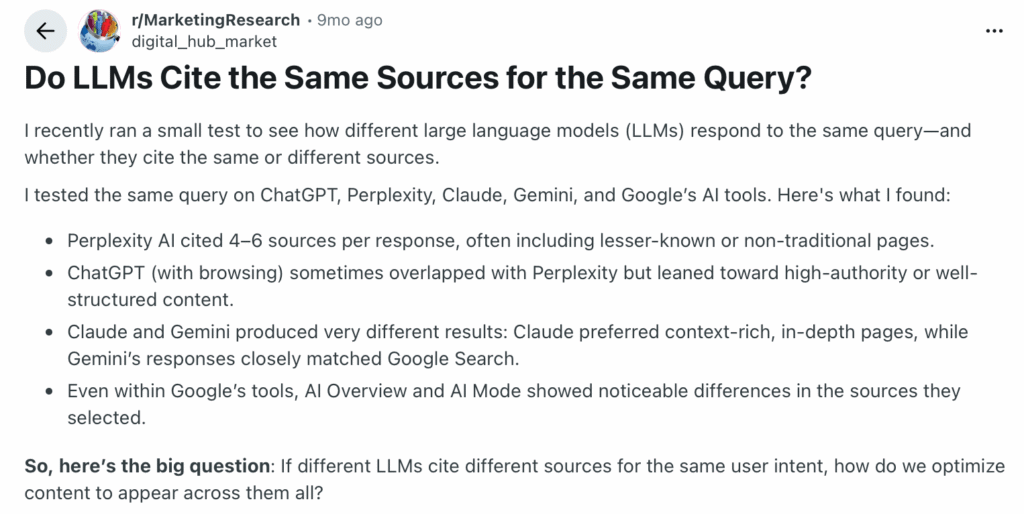
Google AI Overviews prioritize relevance, authority, and structured clarity. Pages that clearly answer the query, demonstrate E-E-A-T, and have strong entity signals are more likely to be cited.
ChatGPT responses favor high-authority, well-structured sources. It often favors established domains and content that presents clear, consensus-driven information.
Perplexity search emphasizes real-time retrieval. It frequently cites a mix of blogs, news, Reddit discussions, and recent sources, often showing multiple references in a single answer.
Claude tends to be more selective, preferring logically structured, in-depth content and authoritative explanations over broad citation lists.
Across all platforms, clarity, trust, and direct answerability consistently increase your chances of being mentioned.
AI Search Optimization vs Traditional SEO: What’s Actually Different?
While traditional SEO and AI search optimization share foundational elements like quality content and technical health, their objectives and execution differ in a way that matters.
| Aspect | Traditional SEO | AI Search Optimization (AEO/GEO) |
| Primary Goal | Rank pages high in SERPs to drive clicks & traffic | Be cited in AI answers for visibility & mentions (often zero-click) |
| Focus | Ranking pages | Generating direct answers |
| Keyword Strategy | Exact-match keywords, density & placement | Semantic intent, natural language & conversational queries |
| Authority Building | Primarily backlinks & domain signals | Entity authority, E-E-A-T, brand mentions & topic trust |
| Success Metrics | Organic traffic, clicks, impressions, CTR | Mentions, citations, AI impressions & brand awareness |
| Optimization Type | Crawlability (indexing, speed, mobile, technical SEO) | Extractability (structured data, clear structure, passage-level clarity, schemas) |
How to Optimize Your Brand for AI Search
AI search optimization, often called Generative Engine Optimization (GEO), is about making your brand’s content as easy as possible for AI models to parse, trust, and cite.
# Create Citation-ready Content
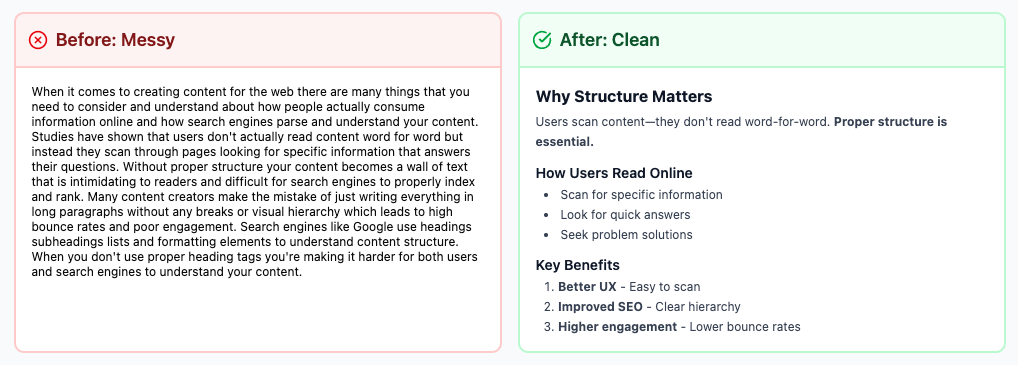
Build content pieces that AI can extract and reference directly: clear definitions, side-by-side comparisons, lists, tables, statistics, and evidence-based claims (e.g., “According to [source]…”). This format makes it easy for AI to pull your content into direct answers.
Here’s what the difference between messy and structured content looks like.
# Build Topical Depth, Not Just Keyword Pages
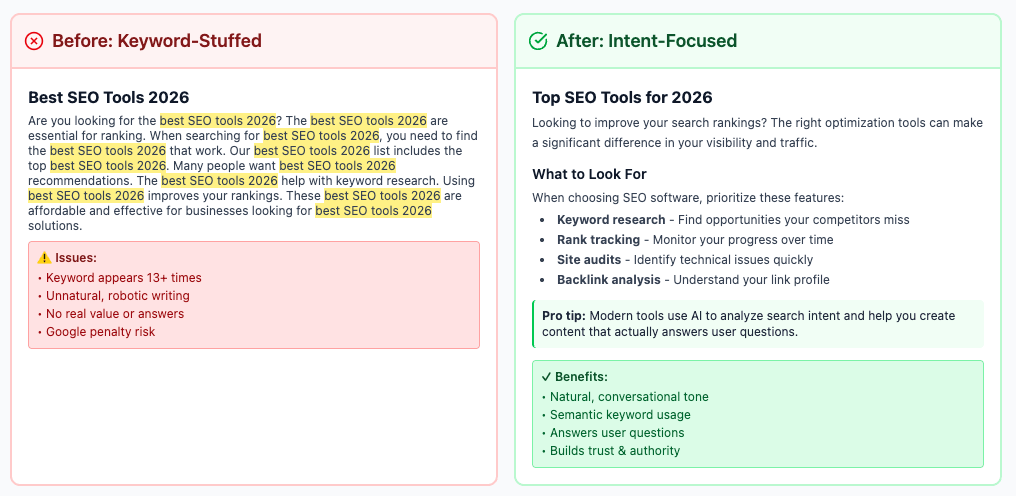
Develop comprehensive topic clusters around core subjects to demonstrate deep subject authority. Cover related subtopics thoroughly. This signals expertise and helps AI connect your brand to broader queries.
An intent-focused article performs better than keyword-stuffed content every time.
# Strengthen E-E-A-T Signals
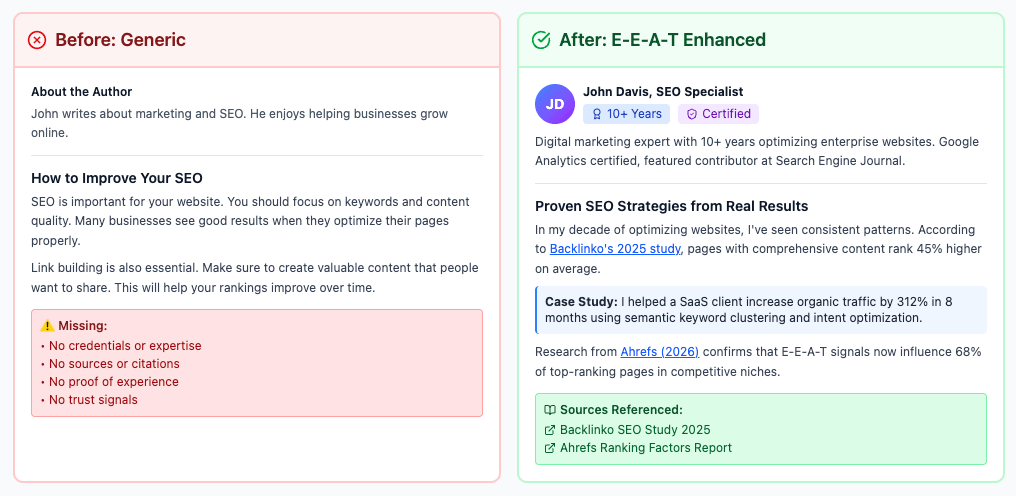
Highlight real-world Experience (case studies, examples), Expertise (author bios, credentials), Authoritativeness (citations, backlinks), and Trustworthiness (transparent sources, updates, reviews). Consistently positioning experts strengthens E-E-A-T by building trust and increasing citation likelihood.
A generic author description signals nothing. Real-world experience with verifiable sources shows trustworthiness.
# Optimize for Semantic Clarity
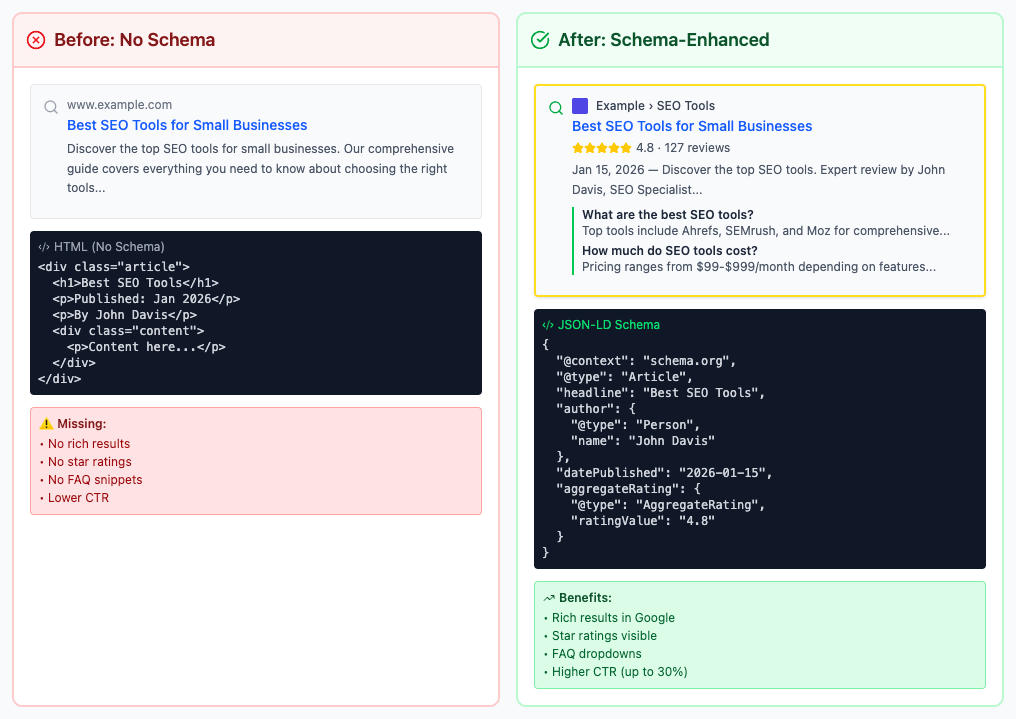
Use clear heading hierarchy (H1 through H3), concise explanations, bullet points, short paragraphs, and schema markup (FAQ, HowTo, Article, Organization). Clean HTML structure improves extractability so AI can parse and quote your content accurately.
It’s much easier for AI to parse content with a structured schema than web pages with no schema at all.
# Maintain Technical Health
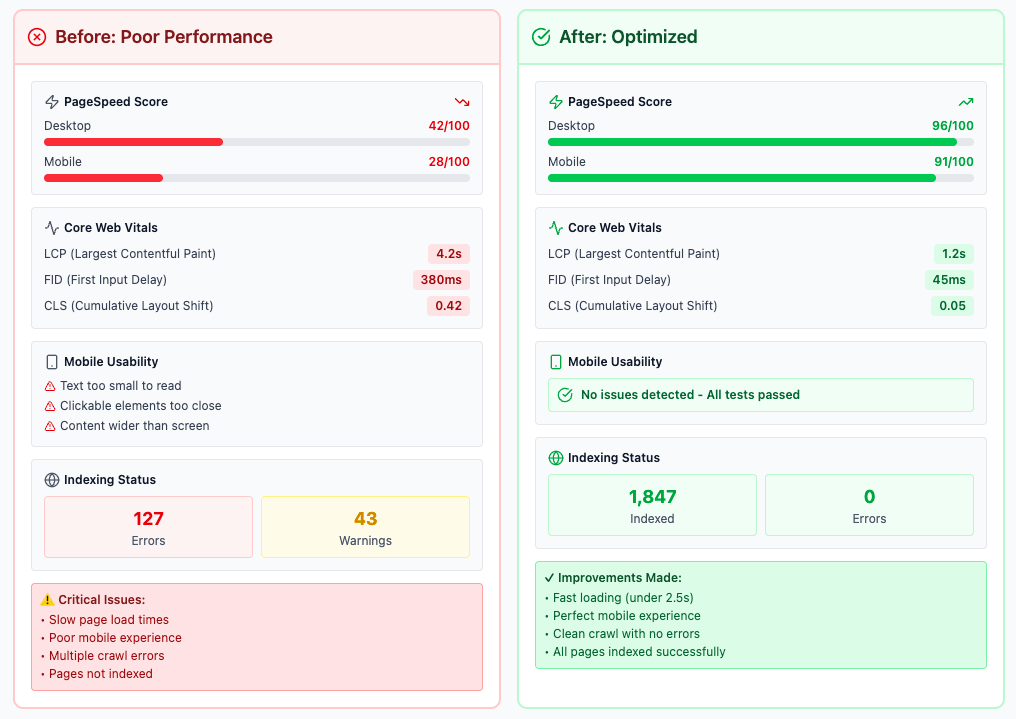
Ensure fast-loading pages, mobile-friendliness, proper indexing, crawlability (allow AI bots like GPTBot and Google-Extended in robots.txt), and robust structured data implementation. These foundational elements keep content accessible to AI crawlers.
Page loading speed, mobile friendliness, and Core Web Vitals all affect the indexing status of your website, and by extension, your AI search visibility.
# Increase Off-site Authority Signals
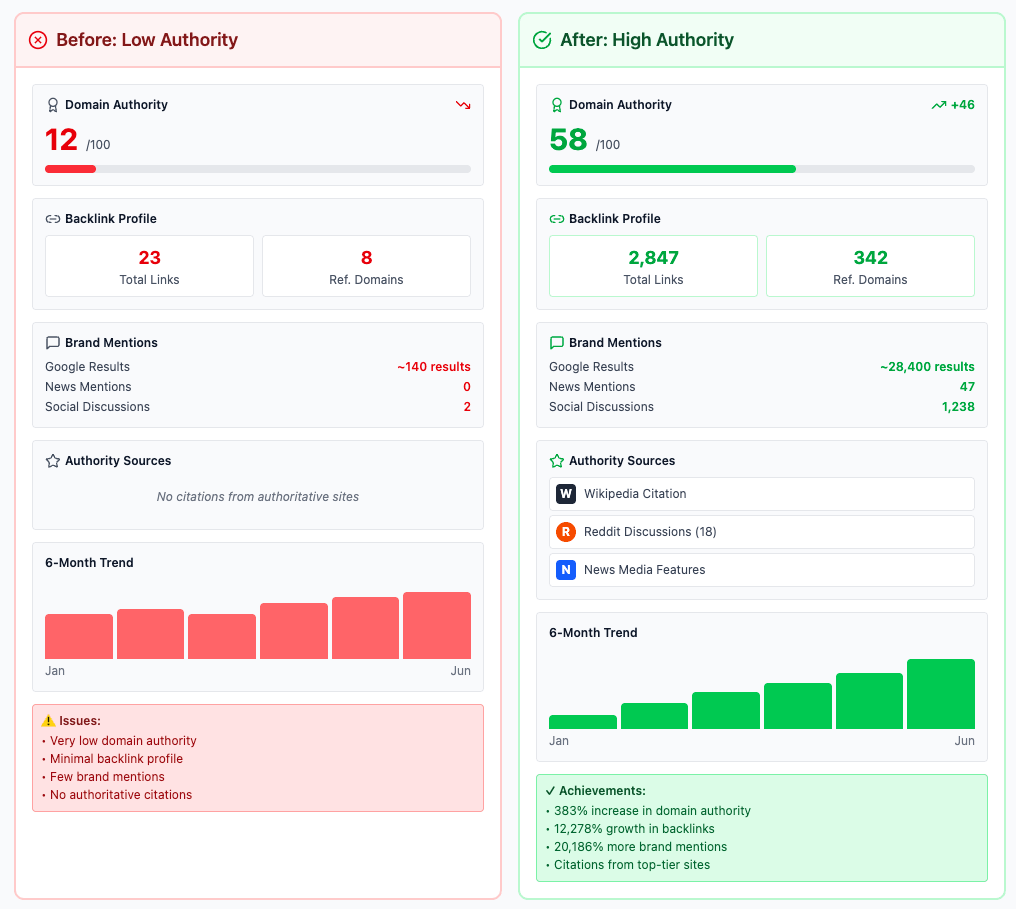
Earn brand mentions, press coverage, high-quality backlinks, positive reviews, and citations from trusted third-party sources (e.g., Wikipedia, industry sites, directories). This amplifies your entity authority beyond your own site.
# Ensure Brand Consistency Across The Web
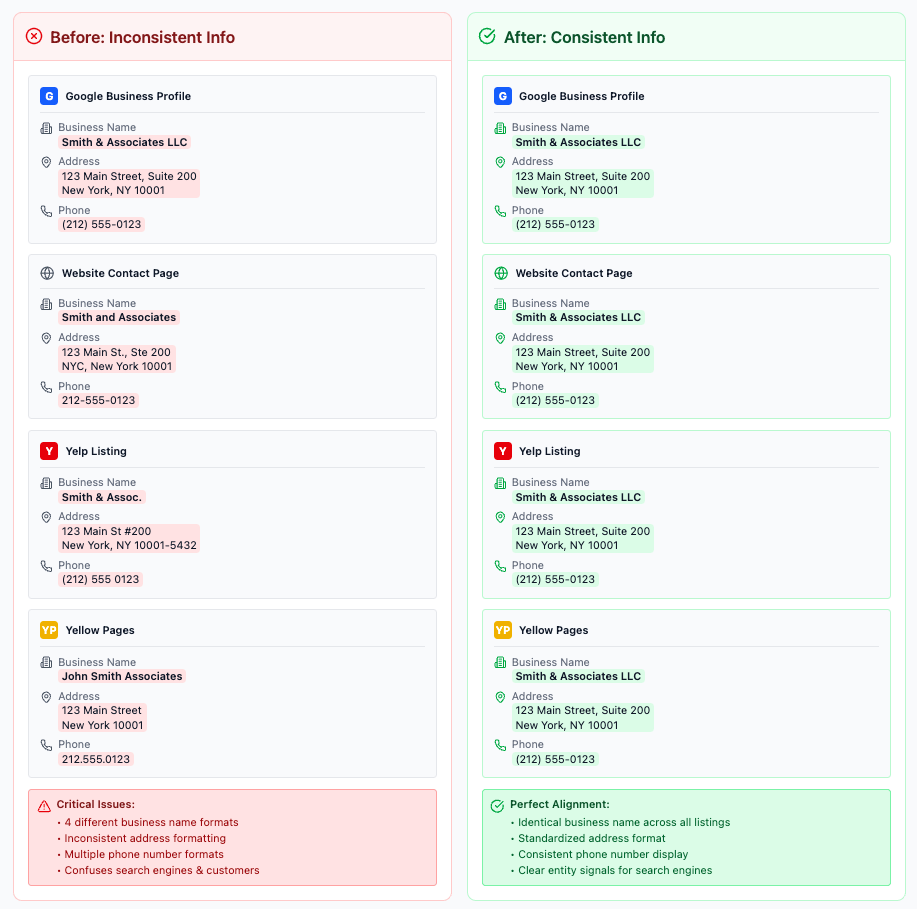
Align your brand name, description, positioning, key facts, and entity details (e.g., via Knowledge Graph, Wikipedia, directories) consistently everywhere. Uniform presence helps AI accurately represent and reference your brand.
AI Visibility Guidelines for Different Business Types
Not every brand competes in AI search the same way. Depending on your business model, the queries your audience asks and the sources AI checks can look very different.
AI search prioritizes authoritative, extractable, and intent-focused content. Here’s how to tailor these core strategies to your business model for maximum citations, mentions, and indirect influence.
→ AI Visibility Strategies for SaaS Companies
Focus: Buyer’s questions, comparisons, targeted queries
- Create in-depth comparison tables, use-case breakdowns, and ROI calculators (citation-ready)
- Build topic clusters around buyer pain points with original data and research
- Strengthen E-E-A-T: expert-authored content, case studies, G2 and Capterra mentions
- Target long-tail conversational queries (e.g., “which SaaS tool saves time on [task]?”)
→ AI Visibility Strategies for eCommerce Websites
Focus: Product citability, real-time data, purchase intent
- Implement rich Product schema (price, availability, reviews, GTIN), Offer and Review markup
- Publish buyer guides, product comparison articles, sizing charts, and category FAQs
- Optimize listings: detailed bullet benefits, user photos and reviews, clear descriptions
- Create content for “best [product] 2026” and “alternatives to [competitor]” queries
→ AI Visibility Strategies for Agencies and Service Providers
Focus: Expertise, results, and local trust, testimonials, and case studies
- Showcase client results: case studies, testimonials, metrics (e.g., “+300% leads”)
- Use the Organization/Person schema for team bios and credentials
- Earn off-site signals: Clutch, LinkedIn, Reddit mentions, industry features
- Create service-specific guides (e.g., “how to choose a [service] agency”)
→ AI Visibility Strategies for Emerging Brands & Startups
Focus: High-quality and original content, tracking AI prompts, community engagement
- Focus on narrow, high-quality topic depth to dominate emerging queries
- Claim & populate Organization schema, early Wikipedia and Reddit presence
- Publish founder stories, transparent roadmaps, data-backed insights
- Actively test & iterate using AI prompt tools (track citations weekly)
Pro Tip: Each business type has different visibility challenges, but how do you know if your strategy actually aligns with best practices? Review this comprehensive AEO GEO audit checklist to identify overlooked gaps that may be limiting your AI search presence.How to Track Your Performance in AI Search Results
There’s no single dashboard that shows you where your brand appears across every AI platform. Each one surfaces answers differently, cites different sources, and responds to the same query in its own way.
That’s why tracking AI visibility requires consistency and focus on the prompts your audience actually uses across AI platforms.
Here’s the step-by-step process to get it right:
1. Identify Your Priority Queries
Start by listing the most business-critical prompts:
- Branded ones (e.g., “[Your Brand] review”)
- Non-branded industry terms (e.g., product, services)
- Comparison searches (e.g., “best [category] 2026”)
- High-intent buying questions (e.g., “which [product] should I choose?”)
Prioritize 20 to 50 that reflect real user intent.
2. Conduct Regular Prompt-based Testing
Run these exact queries manually or via AI visibility tools on major AI platforms at consistent intervals, weekly or bi-weekly. Screenshot or log the full responses to see if your brand is mentioned, recommended, linked, or ignored.
3. Measure Citation Frequency and Context
Analyze each result:
- How often does your brand appear?
- Are you the top/primary recommendation, an alternative, part of a comparison list, or just briefly mentioned?
Note the sentiment (positive/negative/neutral) and exact phrasing. Context drives trust and influence more than raw count.
4. Monitor AI Overviews and Generated Summaries
Check Google AI Overviews and similar summaries for your target queries. Track inclusion in featured answers, citations, or links, especially for commercial and high-value terms where zero-click resolution is common.
5. Benchmark Against Competitors
Run the same queries and compare:
- What’s your share of voice vs. key rivals?
- Who gets cited more often, in better positions, or with stronger sentiment?
This reveals gaps and relative positioning when tracking AI search visibility over the period of time.
6. Simplify Tracking with Dedicated Tools
Manual testing doesn’t scale. Using dedicated tools like Track My Visibility to automate prompt runs across ChatGPT, Perplexity, Gemini, and Claude saves hours while giving consistent, data-backed progress tracking. It quantifies visibility scores, tracks citations over time, benchmarks competitors, and surfaces actionable insights.
Final Thoughts
AI search isn’t a future trend to prepare for; it’s the present reality your brand is already being judged by, whether you’re optimizing for it or not.
The brands gaining ground are the ones building authority AI recognizes. Start with the section most relevant to where your brand stands today.
If you want a clear picture of where your brand currently stands across AI platforms, Track My Visibility gives you that visibility in one place.
Start your 7-day free trial and see where your brand appears across ChatGPT, Perplexity, Gemini, and Google AI Overviews.
Frequently Asked Questions
AI platforms cite brands that publish structured, definition-based, and data-backed content supported by strong authority signals such as expert authorship, quality backlinks, and third-party mentions.
Yes. Technical SEO, crawlability, and high-quality content remain foundational, but optimization must now also focus on semantic clarity and entity authority.
Clear definitions, comparisons, FAQs, case studies, and problem-solution content perform best because they are easy for AI systems to extract and reference.
Yes. Consistent descriptions, positioning, and structured entity data across websites, directories, and social platforms strengthen brand recognition in AI systems.
Test branded and non-branded queries across AI platforms, track mentions within generated answers, and monitor referral patterns. Tools like Track My Visibility automate this across ChatGPT, Perplexity, Gemini, and Claude.
Yes. Smaller brands can gain visibility by building deep topical authority in a focused niche and earning credible third-party signals.