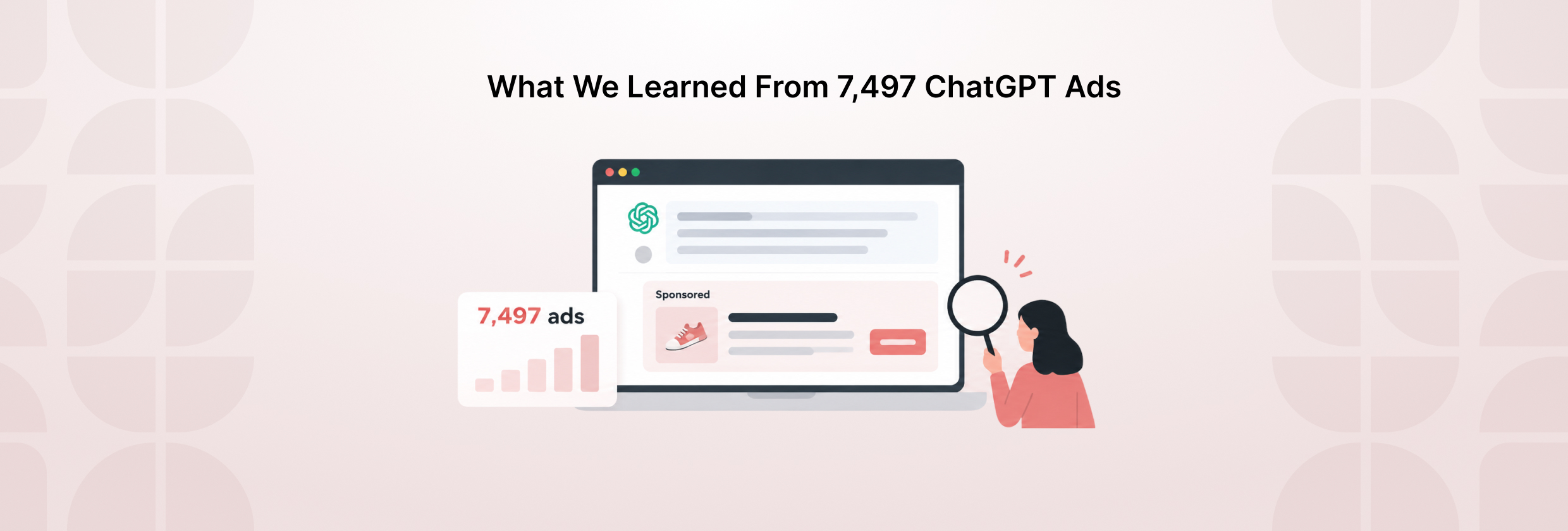



ChatGPT started showing ads in February 2026, in the US first. By September it had reached more than 60 countries, including Southeast Asian countries and Taiwan. Most people reading this can now see them.
We wanted to know what these ads actually look like, which brands are buying them, and which kinds of questions they turn up on. We track what AI engines say about brands, so we had a way to watch it. This report is 7,497 of those ads.
Disclaimer: Everything below is what we observed. Where we could count something across the whole dataset, we counted it and gave you the number. Where we only have one odd case, we say so and call it an example.
Key Takeaways
- In all 63 questions that named a specific company, the ads came from other companies. The named company appeared in none of them.
- 65.1% of questions showed ads from a single advertiser. This is an empty room, not a crowded auction.
- 86.2% of questions naming a market outside the US returned no advertiser from that market.
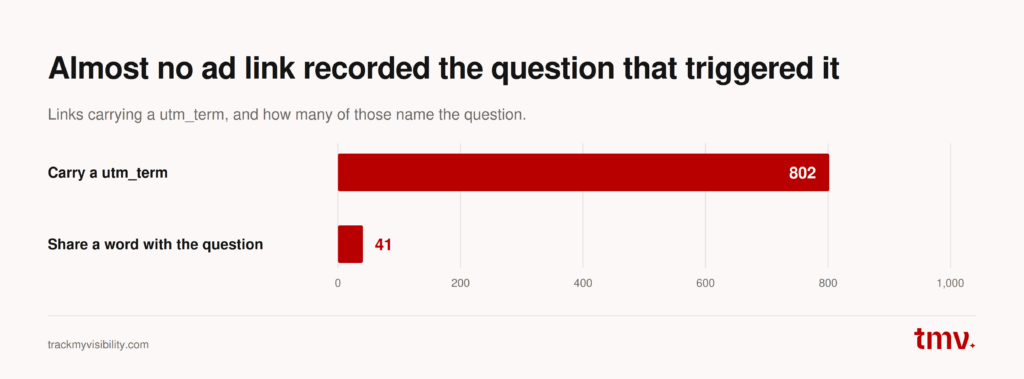
- We found no evidence in the ad links that your question reaches the advertiser. Of 806 search-term parameters, 43 shared even one word with the question that triggered the ad.
- Every single ad link carries the same two OpenAI tokens, and none carry a Google click ID. That gives you a way to find this traffic in your own logs even when the advertiser tagged nothing.
- Questions that ask how something works carried as many ads as questions that ask where to buy. 3.92 ads per question against 3.43.
What we studied
We exported every ad observed across the accounts we track. Each row has three things: the question asked, the advertiser name, and the page the ad linked to. Three units run through this report, and they are easy to mix up:
| Unit | Count | What it means |
| Ad observations | 7,497 | One advertiser shown against one question |
| Questions | 1,957 | Distinct prompts that returned at least one ad |
| Advertisers | 1,346 | Distinct advertiser names as exported |
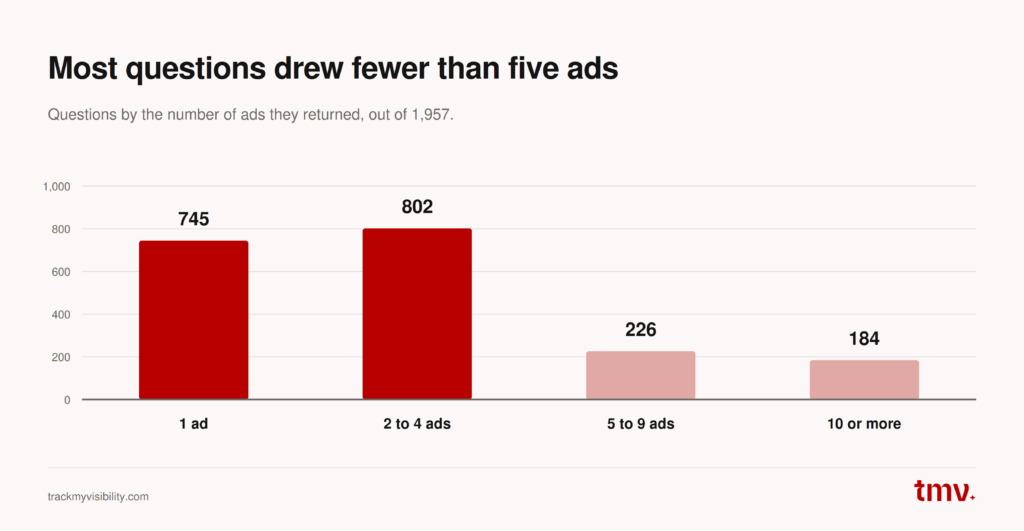
So no number here tells you how often ChatGPT shows an ad, and we never make that claim. Every other percentage is a share of one of the three units above, and we say which one each time.
How ChatGPT ads match user questions
86.2% of questions naming a market outside the US returned no advertiser from that market
58 questions mention India, Australia, New Zealand or the UAE. 50 of them returned no advertiser on a matching country domain.
“Best air cooler in india” returned 15 ads from 5 advertisers, the most frequent being MRCOOL, a US company whose main products are mini-split air conditioners.
In one case the mismatch went further: “Price range for jumbo coolers in India” returned 60 ads led by L.L.Bean (20) and Home Depot (16), both landing on ice chests rather than the air coolers the question is about.
Note: A local business can use a .com domain, so 86.2% is a floor rather than an exact figure. The location our tracking ran from is not recorded in the dataset, so we cannot determine whether geography influenced this.
5.5% of service questions returned an ad for a product to buy
510 questions in the dataset use service language: agency, company, firm, provider, contractor, hire. 28 of them returned at least one ad pointing to a product page.
Across those 510 questions, 93 of 1,507 ad observations (6.2%) were product ads, from 21 advertisers. The clearest case is “which cleaning companies offer deep cleaning”, which returned 48 ads from 11 advertisers.
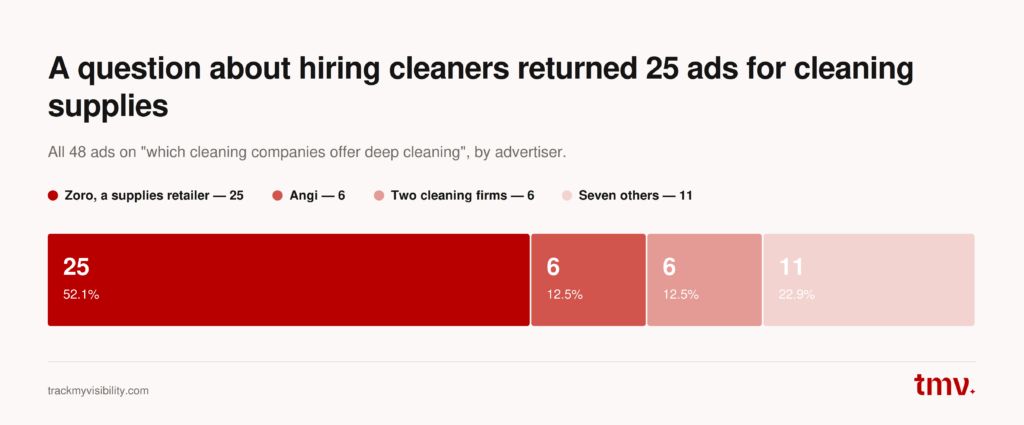
25 of them were Zoro, a retailer selling cleaning chemicals, landing on individual product pages for all-purpose cleaners and floor cleaners. The most frequent advertiser on a question about hiring a cleaning company was a shop.
(This is a minority pattern, so we can conclude anything. This maybe a case of not enough service companies running ChatGPT ads)
Questions that ask how something works carried as many ads as questions that ask where to buy
388 informational questions (how, what, why, is, can, should) carried 1,520 ads, an average of 3.92 each.
380 transactional questions (buy, where to, hire, order, book) carried 1,305 ads, an average of 3.43 each. “What are the best floor mats for chemical environments?” returned 29 ads, 18 of them Wayfair.
The idea from search advertising that you only pay at the bottom of the funnel does not carry over cleanly here.
(Both figures count only questions that returned ads, so this does not say informational questions trigger ads more often)
Questions of three words or fewer drew an average of 7.75 advertisers
Longer questions drew 1.89. “Personal injury lawyers” returned 27 ads from 14 different advertisers, led by Morgan & Morgan with 9. Long conversational questions, which is how most people talk to ChatGPT, mostly drew a single advertiser.
(Note: Only 8 questions of three words or fewer exist in the dataset, so we need to treat this as directional.)
Questions containing “near me” drew 4.89 advertisers against a dataset average of 1.91
Nine questions use that phrase. Between them they carried 89 ads. Local intent appears to be the most contested space in the dataset, which fits what happens in search advertising.
Four Japanese advertisers appeared on questions written in English
Six ad observations came from advertisers with Japanese company names. “Generative AI vs traditional quant models for investments” returned an ad from Dospara, a Japanese computer retailer, landing on a Japanese-language homepage. LayerX and Geekly appeared the same way on English finance and AI questions.
Who is buying the ads
In all 63 questions that named a specific company, the ads came from other companies
63 questions in the dataset name a real company, across 50 distinct companies; shapes like “X vs other agencies” and “alternatives to X”. Between them they returned 180 ads from 94 advertisers, an average of 2.9 ads per question. The company named in the question accounted for 0 of those 180 ads, on 0 of the 63 questions.
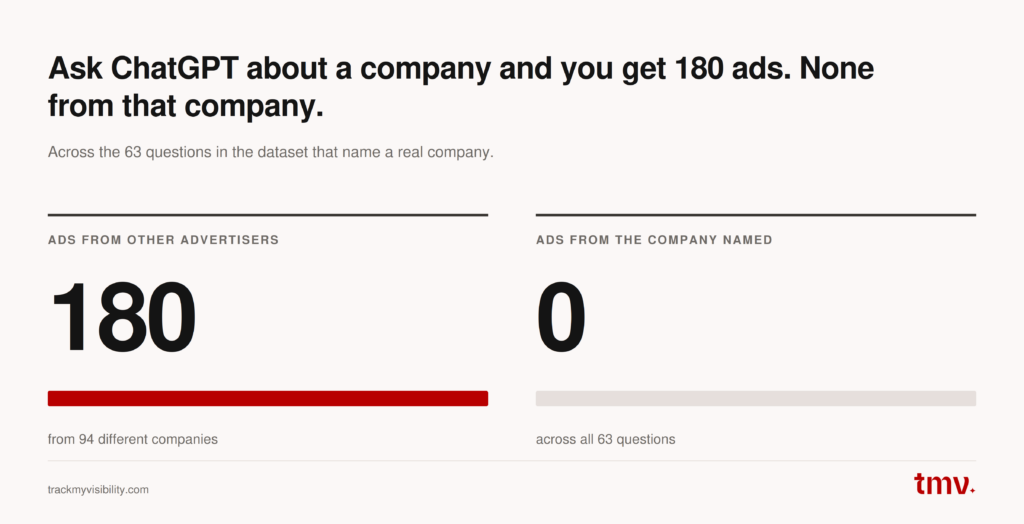
For instance, “Symphony Limited vs other brands for industrial cooling systems” returned 31 ads, none of them Symphony. “Appsumo vs other stores for sales software deals” returned 27, none of them AppSumo.
65.1% of questions showed ads from a single advertiser
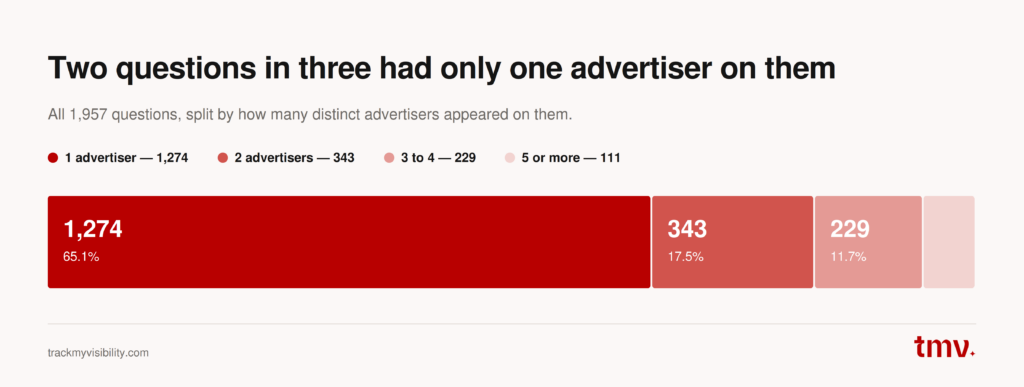
1,274 of 1,957 questions returned ads from exactly one advertiser name. “Cooler with humidity control” returned seven ads and every one was MRCOOL. Most of this channel is not a contested auction yet.
Where several ads did appear, one advertiser usually took most of them
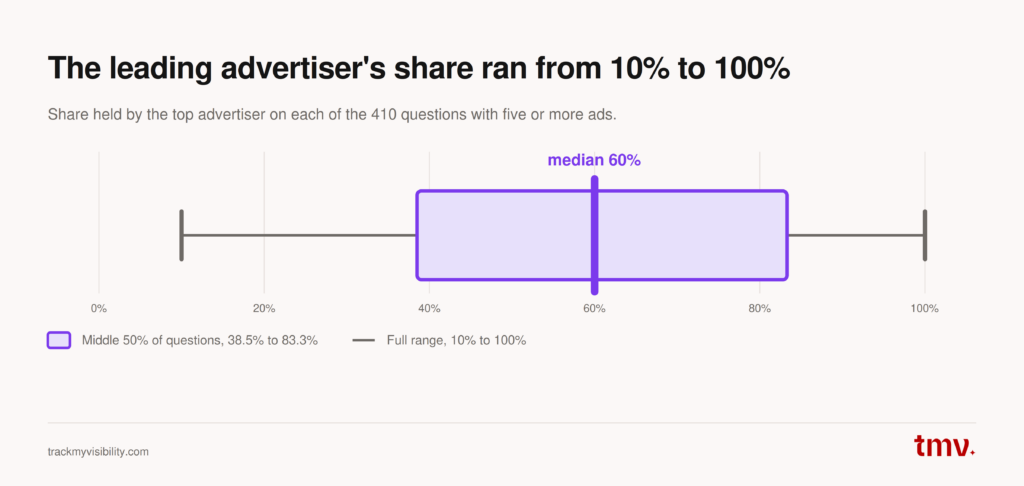
Across the 410 questions that returned five or more ads, the leading advertiser holds a median 60% of them. On 109 of those questions it holds 80% or more. “Top office cleaning firms serving New Jersey businesses” returned 31 ads from 11 advertisers, 13 of them Cintas.
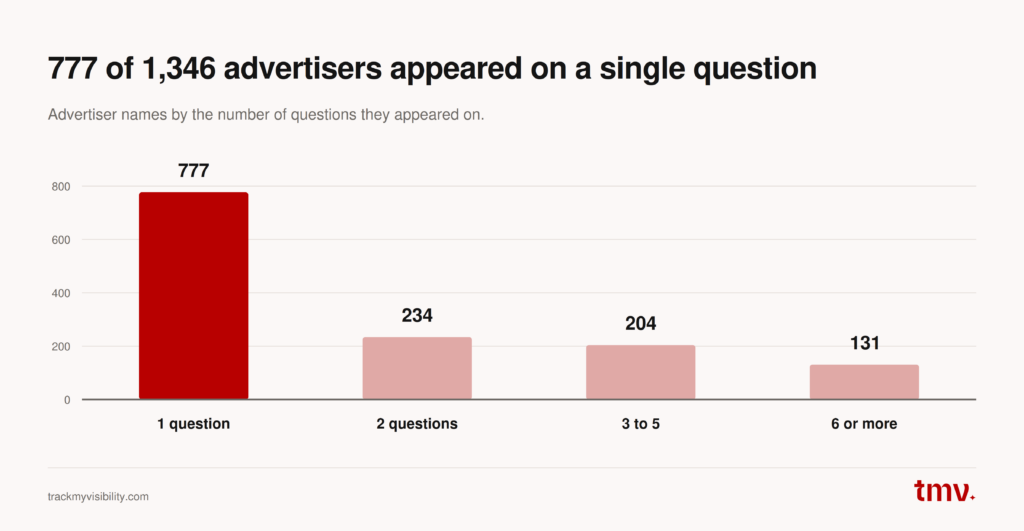
57.7% of advertisers appeared on only one question
777 of 1,346 advertiser names show up against a single question. At the other end, the ten largest advertisers account for 1,598 of 7,497 ad observations (21.3%). This is a young, fragmented advertiser base.
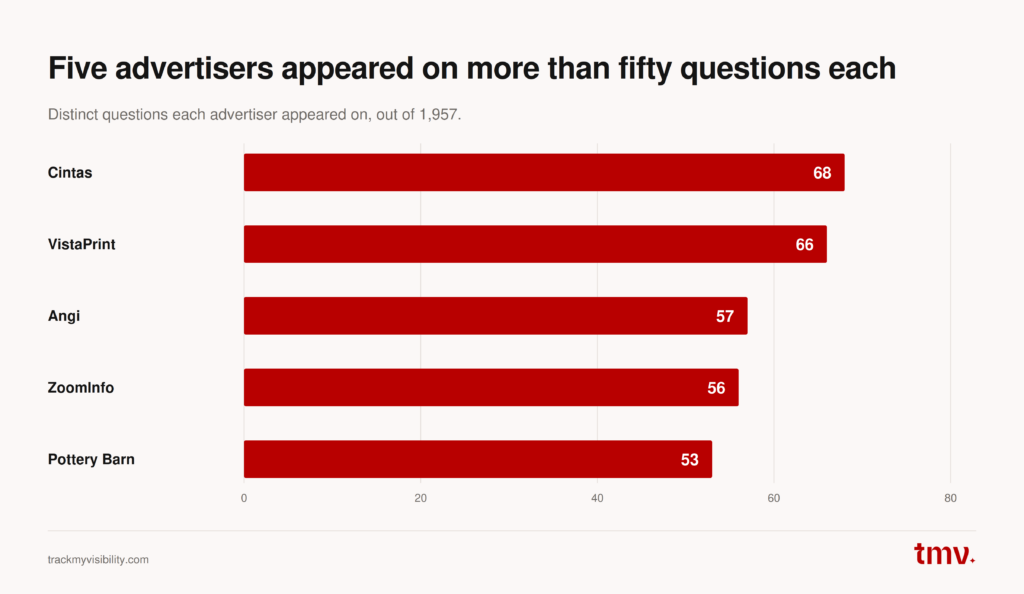
Lead-generation and directory sites appeared across far more questions than individual businesses
Cintas appeared on 68 questions, VistaPrint on 66, Angi on 57, Capterra on 40. For comparison, 777 advertisers appeared on one question each. The companies buying breadth here are mostly the ones that sit between the user and whoever actually does the work.
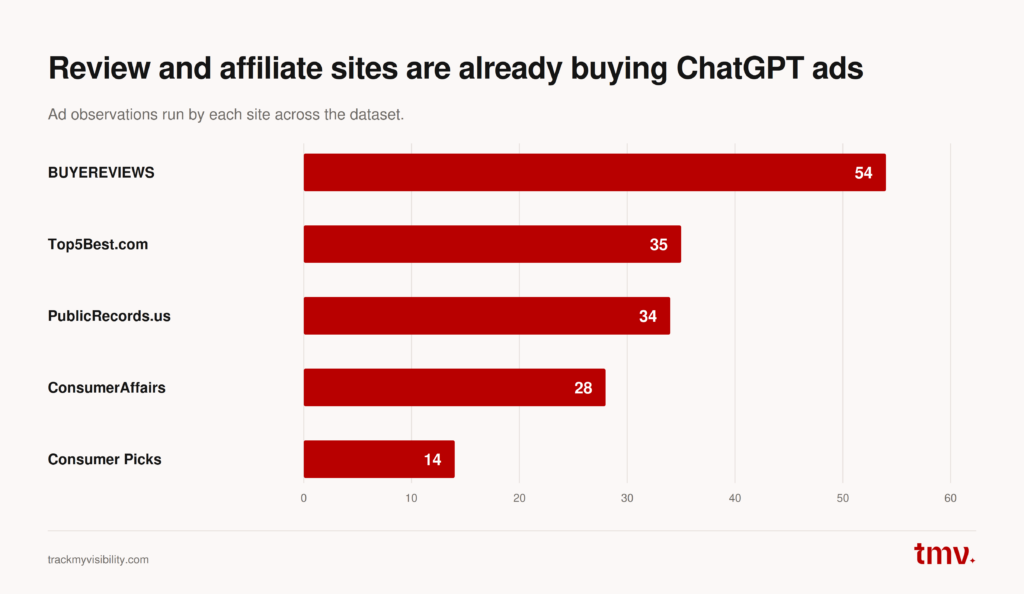
Review and affiliate sites are already among the advertisers
BUYEREVIEWS ran 54 ads across 24 questions. Top5Best.com ran 35 across 5, including 10 on “KN95 face masks”. PublicRecords.us ran 34 across 11. ConsumerAffairs ran 28 across 7.
Two “10 best” sites appear under different company names: 10bestcrmsoftware.com and 10bestpayrollservices.com as CompareGround, 10bestprojectmanagement.com as Kolmind.
3.3% of ads sent people to a marketplace or a third-party storefront
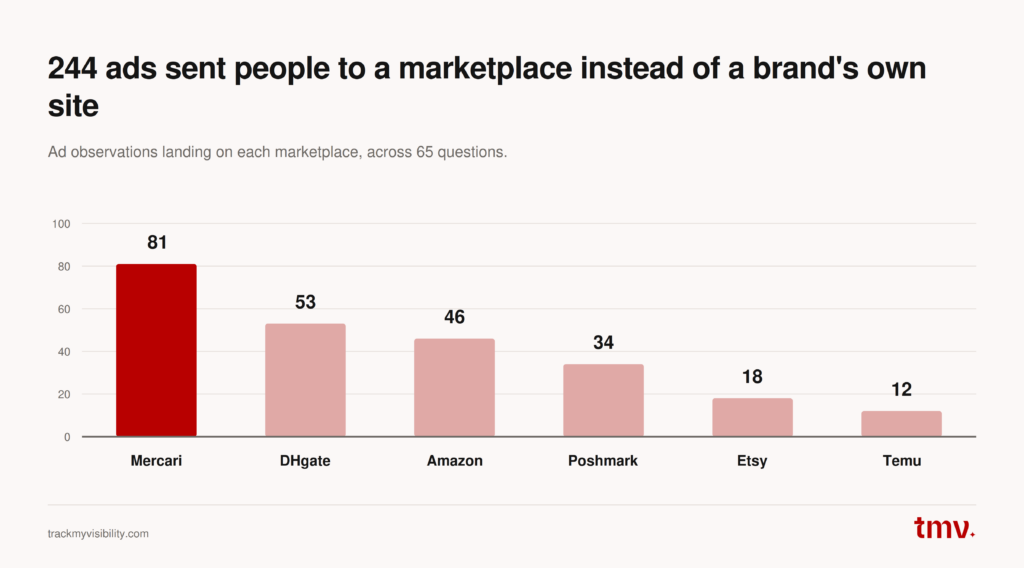
244 ad observations across 65 questions landed on Mercari (81), DHgate (53), Amazon (46), Poshmark (34), Etsy (18) or Temu (12). “Best online store for men’s bold innerwear” returned 12 ads, 10 of them DHgate product pages. Inside the Amazon group, 40 observations are Philips Sonicare ads landing on Amazon product listings rather than the brand’s own site.
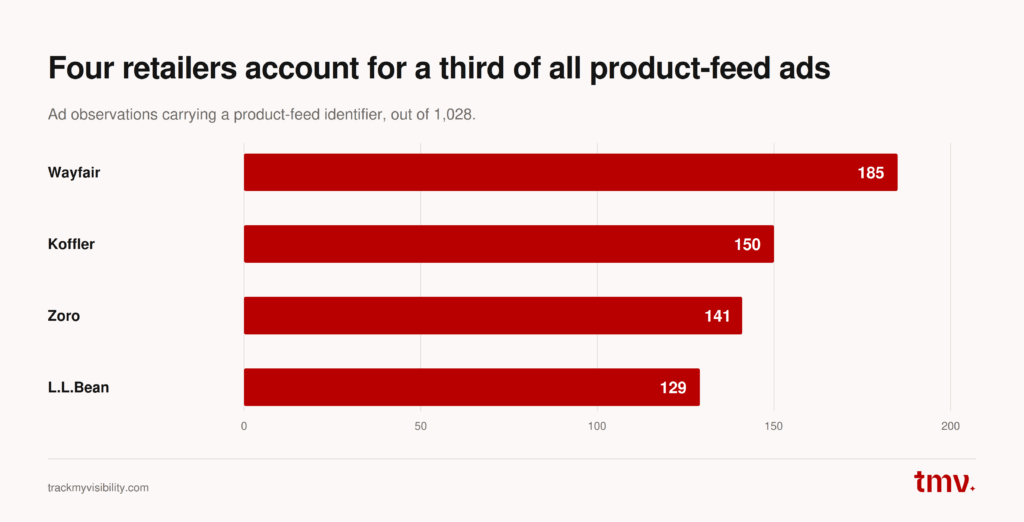
13.7% of ads carried product-feed identifiers
1,028 of 7,497 ad observations came from 62 advertisers using product feeds, identified by a product code in the link or a feed-related tracking value. Wayfair accounts for 185, Koffler 150, Zoro 141, L.L.Bean 129. Shopping-style advertising is already a meaningful share of this inventory.
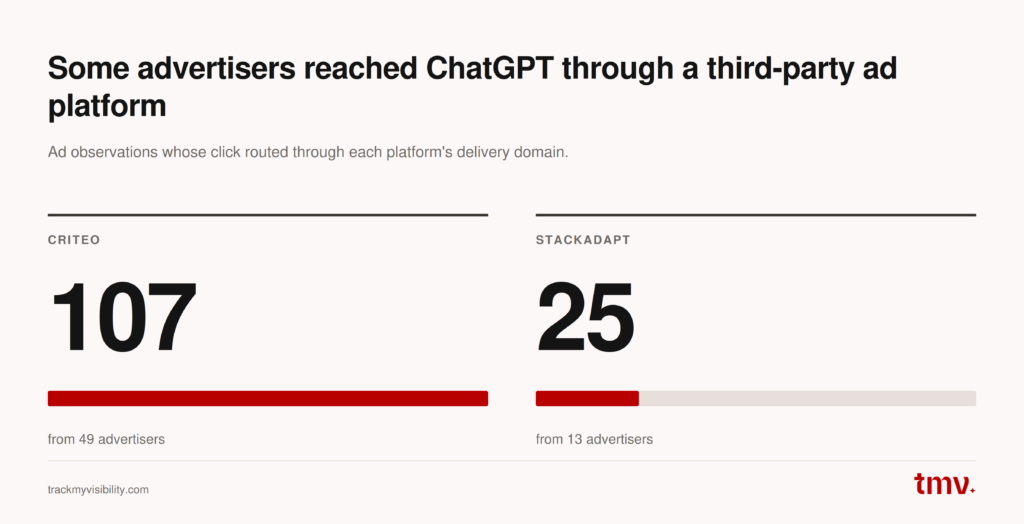
Some ads reached ChatGPT through third-party ad platforms
107 ad observations from 49 advertiser names routed through a Criteo delivery link. Another 25 from 13 advertisers routed through StackAdapt. Buying inside ChatGPT does not appear to require going to OpenAI directly.
The domain tells us where the click is routed. It does not prove how the inventory was bought.
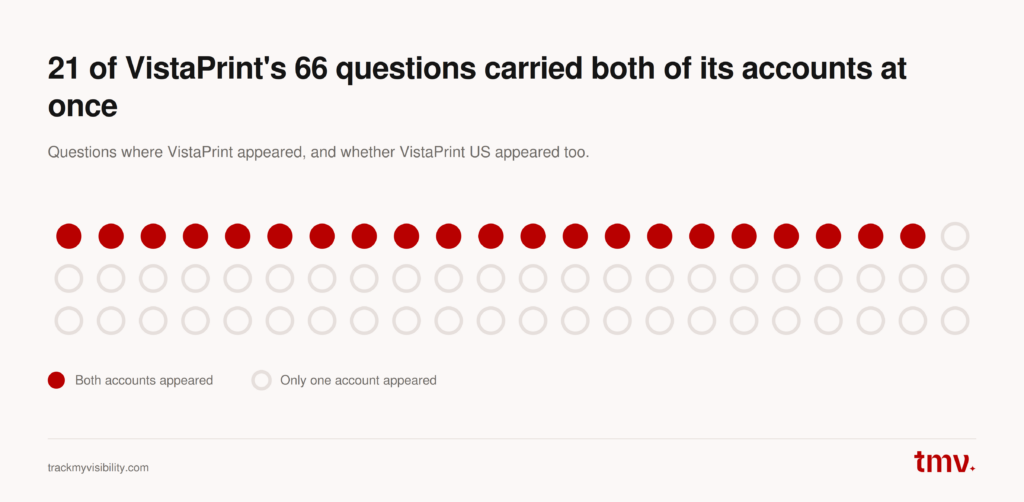
One brand appeared under two advertiser names on the same questions
VistaPrint appears on 66 questions and VistaPrint US on 52, and 21 questions have both. Whether that is two accounts, two regions, or an artifact of how names are exported, we cannot tell.
What advertisers can actually see
We found no evidence in the ad links that the question reaches the advertiser
In search advertising, a parameter called utm_term normally records the search term that triggered the ad. 806 of the links in our dataset carry one. Only 43 of them (5.3%) share a single word of four letters or more with the question that triggered the ad. The rest hold the advertiser’s own labels instead: ad3, var-b, crmpaid. There is no search term to record, so the slot gets used for something else.
(Our evidence comes only from URL parameters. A server-side reporting feed could exist and would not be visible here.)
Every ad link carries two OpenAI tokens, and none carry a Google click ID
All 7,497 links carry a parameter called oppref, exactly 120 characters long, and a second called olref at around 163. Not one link contains gclid, fbclid or msclkid. That gives you something useful: you can find ChatGPT ad clicks in your own server logs or analytics by looking for oppref, even when the advertiser tagged nothing at all. It also makes these links enormous. The median ad link is 433 characters and the longest is 994.
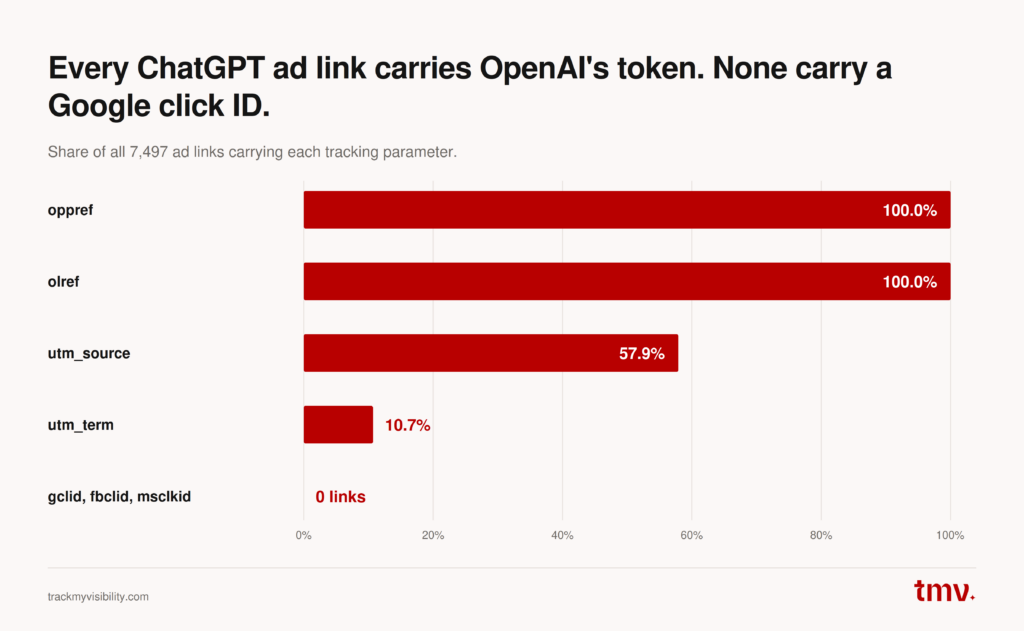
This matters because 3,154 of 7,497 links (42.1%) carry no utm_source at all. For four in ten ads, the token is the only thing identifying where the click came from.
26.4% of advertisers only ever sent clicks to their homepage
355 of 1,346 advertisers never linked anywhere else. Across all ads, 54.0% went to a category or content page, 18.7% to a homepage, 18.1% to a product page and 9.2% to a dedicated campaign page.
71 advertisers built landing pages specifically for this channel
You can read it in the addresses. ConsumerAffairs runs /homeowners/moving-companies/chatgpt3/. HighLevel runs /paid-ad-chatgpt. Amsive runs /aeo-assessment-chatgpt. Mercury, Lease End, Market Leader and Beautiful.ai all have one. 370 ad observations land on a page whose address names this channel.
8.7% of advertiser and question pairs used more than one landing page
327 of 3,747 pairs sent people to two or more different pages for the same question. Somebody is already testing. This could be page testing, product-feed rotation or a dynamic link. The dataset cannot separate them.
What this means
If you run ads
The room is close to empty. 65.1% of questions returned ads from one advertiser, and 777 of 1,346 advertisers appeared on a single question. Long conversational questions drew an average of 1.89 advertisers. Whatever it costs to be there now is not what it will cost once more people show up.
Check your tracking before you scale anything. If your links carry {keyword} or {campaign_id} from a Google template, they are collecting nothing here. And there is no search term coming back to you, so the question that earned your click is not something you can report on from the link alone.
Look at where you are sending people. 355 advertisers in this dataset only ever linked to their homepage, while 71 built a page specifically for this channel.
If you are a brand that does not advertise
The finding to sit with is the first one in this report. Across 63 questions naming a company, the ads came from 94 other companies and never from the one being asked about.
We cannot tell you why. Most of those companies do not appear to advertise anywhere in our data, so the ordinary explanation is that they are simply not running ads, and we are not going to dress that up as something ChatGPT did to them. But the practical position is the same either way. When somebody asks ChatGPT about you, the space under that answer is filled by somebody, and in our dataset it was never you.
That is a decision to make deliberately rather than by default.
If you are measuring AI visibility
Treat the paid layer and the organic layer as two separate things. Getting cited in an answer and appearing in the ad under it are different systems with different rules, and this dataset shows the paid one running on topic matching with no keyword and no term passed back.
The practical piece you can use today is oppref. Every ChatGPT ad link in this dataset carries it and none carry a Google click ID, so you can identify this traffic in your own logs without depending on how anyone tagged their campaign.
What we still don’t know
We can see the ads that appeared in what we track. We cannot determine any of the following, and nothing in this report should be read as if we could.
- How often ChatGPT shows an ad at all. Every question in this dataset returned one, so we have no denominator for that question.
- How many people saw any of these ads, clicked them, or bought anything.
- What any of it cost. No spend, no cost per click, no bids.
- Where an ad sat on the page.
- Why a particular advertiser was selected for a particular question.
- Whether an advertiser deliberately targeted a question, or landed on it through broader targeting.
- Whether a company that did not appear chose not to advertise, was not shown, or was not eligible.
- Whether these observations hold for all ChatGPT users, or only for the conditions our tracking ran under.
- When any of this ran, or whether any of it is still running today.
- Whether geography played a part in the non-US findings, since the location our tracking ran from is not recorded.
Track and improve your AI visibility across models
We built this report from data collected with our own product, and we sell in this category; which is why the finding about AI-visibility advertisers above carries a disclosure.
Track My Visibility tracks every prompt people ask around your brand and your niche, and shows you both layers of what comes back.
On the ads side, you can see what your competitors and vendors are running against the prompts you already track: which advertisers turn up, what they link to, and who is buying the space on questions that name you. That is the data this report is built on.
On the visibility side, you can see whether you are mentioned at all, where you rank inside the answer, how the sentiment reads, which sources the models cite, and which competitors appear alongside you; across ChatGPT, Gemini, Perplexity and Google AI Overviews, rather than collapsed into a single number.
Then you act on it. Find the prompts where you are invisible, see which sources are shaping those answers, make the changes, and track whether anything moved.
Start a 7-day trial, or read how to track AI search visibility first.