


The gap between AI search and traditional SEO is widening fast, and most brands are not ready for it. Gartner predicts traditional search engine traffic will drop 25% by 2026.
Why? People are skipping Google links entirely and going straight to ChatGPT, Perplexity, and Google AI Overviews for instant answers.
But the major problem is…
Most brands are completely invisible in these AI-generated answers. If your brand doesn’t appear in AI responses, you’re losing a growing chunk of organic traffic.
That’s where AI visibility tracking tools come in. The Track My Visibility vs Peec AI debate is important as they’re built for completely different users. One is fast, affordable, and gives you immediate optimization steps. The other is comprehensive, enterprise-focused, and handles complex global reporting.
In this blog, you’ll learn:
- How Track My Visibility and Peec AI compare on pricing, features, and platform coverage
- Which AI SEO tool fits your team (startup, agency, or enterprise)
- Real differences in reporting and recommendations
- Performance Analysis of both AI search visibility tools
Let’s get started!
Key Takeaways
- AI search tools like ChatGPT, Perplexity, and Google AI Overviews are now a primary discovery channel, and most brands have no visibility data for them at all.
- Track My Visibility is built for teams that want specific, actionable fixes. Its AI-Ready Score tells you which pages to improve and why, instead of just reporting what’s happening.
- Peec AI is designed for enterprise teams managing global brand presence across 115+ languages, with deeper analytics and integrations like Looker Studio.
- Track My Visibility starts at $50/month with no per-seat fees, while Peec AI starts at ~$95/month and charges extra for additional AI platforms.
- Neither tool replaces human strategy. They give you visibility data, but interpreting it and acting on it still requires judgment from your team.
What Is Track My Visibility?
Track My Visibility is an AI search visibility tool developed by Aureate Labs. It was built to fix a real problem: most AI visibility tracking software costs a fortune, which locks out smaller teams completely. If you’re new to the concept, here’s a practical guide on how to track AI search visibility before comparing tools.
With this platform, you can start tracking for $50 a month. This actually makes it accessible for teams that aren’t sitting on enterprise budgets.
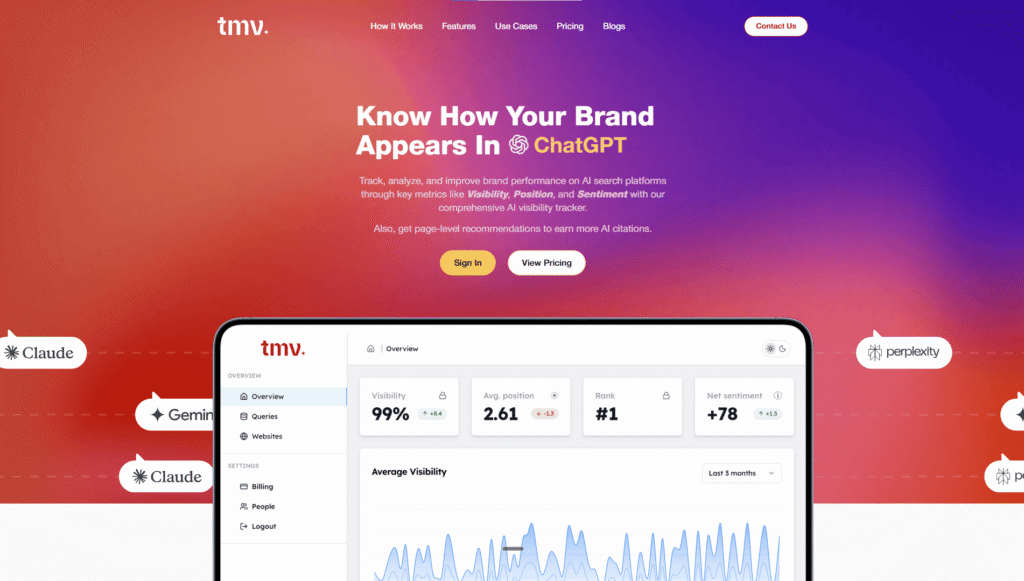
This platform is great for marketing agencies, SEO specialists, executive and growth leaders, PR and communications, and e-commerce brands. If you need to find where your brand appears across AI platforms without spending hundreds every month, this is the AI seo tool to consider.
Instead of just showing you the data, it shows you exactly which AI models are citing your content and tells you what to do about it. User finds it difficult to track brand mentions manually across AI platforms, and this is a frustration a lot of teams share. This thread from Reddit puts it well:
How are you tracking brand mentions in AI search
by u/snustynanging in microsaas
This is exactly the gap Track My Visibility was built to fill. Instead of manually opening ChatGPT and Perplexity every day and hoping you remember to check, the platform runs those searches automatically and brings everything into one dashboard.
 Pro Tip: Not sure where your brand stands right now? Before comparing tools, run a free check. The AI visibility checker gives you a quick snapshot of how your brand appears across AI platforms, no signup required.
Key Features
- AI-Ready Score: This is what sets the platform apart. It doesn’t just tell you “your content could be better.” It breaks down individual URLs and explains exactly what’s holding them back from getting cited by AI engines. You get specific fixes, not vague advice.
- URL-Level Citation Tracking: Most AI visibility tools say, “Congrats, you got mentioned.” Track My Visibility tells you which exact page on your site the AI pulled from. That level of detail matters because you can see what’s working and what’s getting ignored.
- Persona-Based Prompt Tracking: Writing test queries manually is tedious. This feature generates prompts based on your target audience, then runs them automatically across ChatGPT, Google AI Overview, Gemini, and Perplexity. You just need to set it up once, and it will handle the rest.
- Cross-Model Comparisons: Every AI model behaves differently based on its training. This AI visibility tool lets you compare performance side by side. If you’re crushing it on Perplexity but nowhere to be found on Gemini, you’ll know exactly where to focus your effort.
- Competitor Benchmarking: It will help you compare your brand’s LLM visibility and cited URLs with your competitors.
How Does Track My Visibility Work?
The platform tests your brand’s visibility by running searches on major AI engines every day using the prompts you care about. You feed it queries like direct product questions, industry topics, or comparisons with competitors.
Every day, it runs those searches and analyzes the results. It tracks which URLs get cited, measures your share of voice in AI mentions, and shows where you stand against competitors. All of this goes into a dashboard so you can see trends over time.
The AI-Ready Score is a key feature. It evaluates your pages based on the same signals that determine how LLMs choose content to cite, like structured data, semantic clarity, and authority signals. You get specific, page-level fixes instead of vague SEO tips.
Marketing teams use this to prioritize their work. If an organic page performs well but has a low AI-Ready Score, that’s your cue to optimize it for AI citations. If a competitor owns a topic, you can see exactly which of their pages AI models prefer and understand why.
Track My Visibility Pros and Cons
Strengths:
- Actionable AI-Ready Score: This score gives you a clear starting point for optimization. Instead of guessing which pages to update, you have data-driven priorities based on how LLMs perceive your content.
- Accessible Entry Point: Pricing is transparent and built for growth. At $50 monthly for 25 prompts, small teams can test AI brand visibility without a heavy financial commitment.
- Specific URL Recommendations: The platform moves beyond generic advice like “write better content.” It identifies specific pages and suggests concrete technical and editorial improvements.
- Persona-Based Prompting: Building a prompt list manually is tedious. This feature generates relevant queries based on your target audience personas, which saves hours of setup time.
- No Per-Seat Fees: Unlimited team members on all plans is a significant win for agencies. You can collaborate with colleagues and clients without worrying about scaling costs.
Weak points:
- Growing Documentation: As it’s a new platform, the help library is still expanding. You might find yourself reaching out to support for more complex or niche use cases.
- Early-Stage Integrations: Direct connections to tools like Google Analytics are still being refined. While you can export data, fully automated workflows with other SEO suites are still in the works.
- Limited Language Support: If your brand operates globally in dozens of regions. You might find the current language options restrictive compared to enterprise-level competitors.
- Streamlined Analytics: It focuses on visibility and optimization. But it currently lacks the deep sentiment analysis and granular regional breakdowns found in high-end enterprise AI tools.
Pricing and Accessibility
Trial: Free for 7 days
- 25 tracked prompts
- 1 website
- Unlimited team members
- Competitor Analysis
- AI Visibility Dashboard
- 3 AI platforms (ChatGPT, Perplexity, Google AI Overviews)
Discover Plan: $50/month
- 25 prompts per month
- 3 AI platforms tracked (ChatGPT, Perplexity, Google AI Overviews)
- Unlimited users
- Basic Insights
- Share of Voice tracking
- Competitor analysis
- Free 250-Point AEO & GEO Checklist
Grow Plan: $400/month
- Up to 300 prompts per month
- 4 AI platforms (ChatGPT, Perplexity, Google AI Overviews, Gemini)
- Unlimited websites
- Unlimited team members
- Detailed Actionable Insights
- Cross-model comparison
- Priority support
- Free 250-Point AEO & GEO Checklist
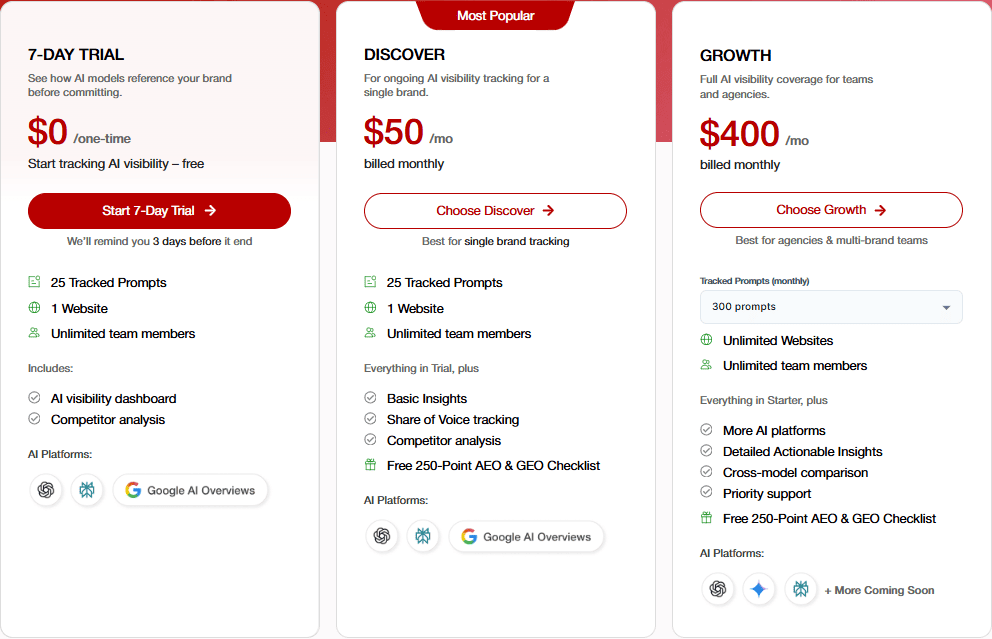
They offer an annual discount with 2 months free when you choose yearly billing on any plan.
Every plan comes with unlimited team members. Your whole marketing or content team can use the platform without extra fees per user.
Note: Pricing may change over time, so it’s best to check their official page for the most up-to-date information.
What Is Peec AI?
Peec AI is a marketing platform based in Berlin. In late 2025, it raised $21 million in Series A funding.
The company focuses heavily on the European market and takes GDPR compliance seriously. That said, they recently opened an office in New York, which suggests they’re aiming for a bigger global presence.
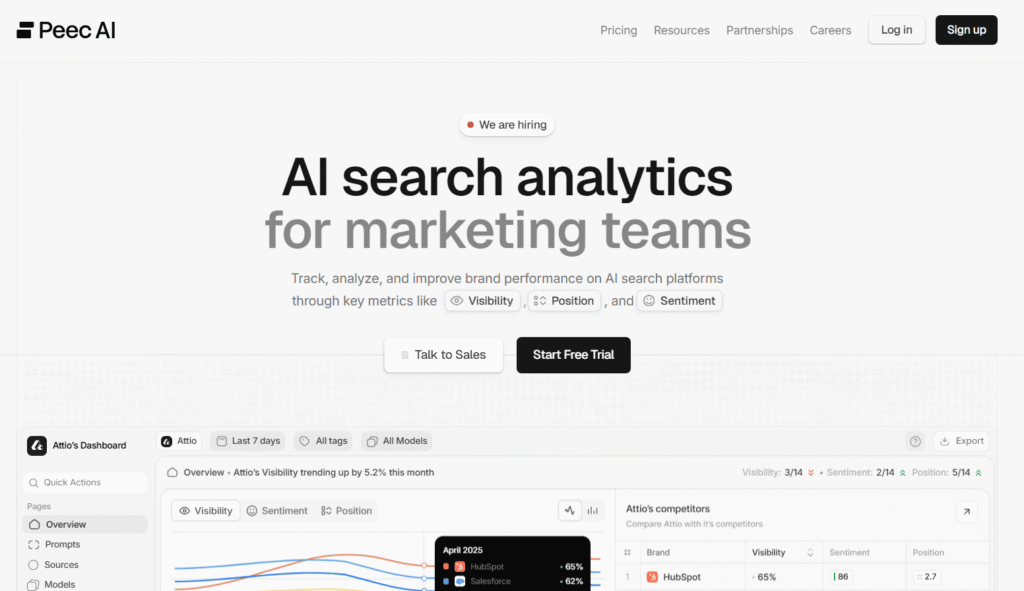
The platform is meant for established brands and agencies dealing with complex reputation management across multiple markets. If you’re tracking how a brand is perceived in different regions and languages, Peec AI offers the kind of enterprise infrastructure you’d need to handle that at scale.
Key Features
- 115+ Language Support: It is unusually broad for this type of platform. That means you can track how your brand appears in AI responses across major markets and smaller regional ones.
- Privacy-First Architecture: The platform was built in Germany with GDPR baked in from the start, not added later. If you’re a European company or you have strict data requirements, that matters.
- Intuitive “Depth with Design” UI: The interface is clean and modern. It gives you detailed data like source influence and sentiment analysis without turning into a cluttered mess of features.
- Smart Prompt Recommendations: If you’re not sure what prompts to track? This platform will also suggest high-impact ones based on search volume and relevance to your brand.
- Daily Visibility Updates: It also updates daily. In a space that moves as quickly as AI search platforms do, you need fresh data to catch changes in how AI models respond or when competitors get mentioned.
How Does Peec AI Work?
Peec AI runs your selected prompts through major AI platforms on a schedule that fits your plan, typically daily or weekly. On the base plan, the system monitors brand presence across ChatGPT, Perplexity, and Google AI Overviews. If you need to track other engines like Claude or Gemini, those are available as modular add-ons.
Once an AI-generated response, the platform captures exactly where your brand appears and its “position” in the answer. A standout feature here is the built-in sentiment analysis. It doesn’t just tell you that you were mentioned; it interprets the tone of the response so you can see if the AI is painting your brand in a positive or neutral light.
The platform also does well at source attribution. You can see exactly which of your website pages are being cited as references, giving you a clear link between your content and AI responses. For teams that love data visualization, the Looker Studio integration is a major plus.
It allows you to pull your AI visibility metrics into the same dashboards you use for Google Analytics, creating a single source of truth for your marketing performance.
Most teams use Peec AI as a high-level monitoring hub. PR departments use it to keep an eye on brand narrative shifts, while marketing leads use the data to spot content gaps that competitors might be filling.
Peec AI Pros and Cons
Strengths:
- Established Reputation: Peec AI has built a solid track record with big international brands, largely because its data holds up. If you operate across multiple countries, the 115+ language support and multi-region monitoring are hard to beat.
- Mature Analytics: The analytics go deeper than most alternatives. You can see visibility percentages, share of voice, and how you perform in different regions. It also tracks sentiment, which matters if you care about how you’re being portrayed in AI responses, not just whether you appear at all.
- Seamless Integrations: On the technical side, it plays nicely with enterprise tools. There’s a Looker Studio connector, API access, and CSV exports, so fitting it into your existing setup shouldn’t be a problem.
Weak points:
- Higher Entry Cost: The pricing starts at around €89 per month (roughly $97) for 25 prompts. That’s a real jump from cheaper tools, and the base plan only covers three AI engines. If you want to track more platforms, that will cost extra.
- Monitoring vs. Optimization: Peec AI is built to show you what’s happening, not to tell you what to do about it. You’ll get detailed reports, but no step-by-step guidance on how to actually improve your visibility. Your team will need to interpret the data and figure out the next moves on their own.
If you’re looking for a tool that delivers actionable checklists or optimization tips, this one takes a more hands-off approach.
Pricing and Accessibility
Peec AI offers a 7-day free trial (or a limited free version, depending on your region) so you can explore the dashboard before committing.
- Starter Plan (€89/month ~ $95): This entry-level tier allows you to track up to 25 prompts. It covers the “big three” platforms like ChatGPT, Perplexity, and Google AI Overviews. It also includes 2,250 AI answers analyzed monthly.
- Pro Plan (€199/month ~ $215): If you’re managing a growing brand, this plan jumps to 100 prompts and 9,000 AI answers. It’s a better value for those needing more frequent data and includes Slack support alongside email.
- Enterprise Plan (€499/month ~ $540): For large-scale operations, this plan covers over 300 prompts and 27,000+ answers. You also get premium perks like a dedicated account representative and SSO support.
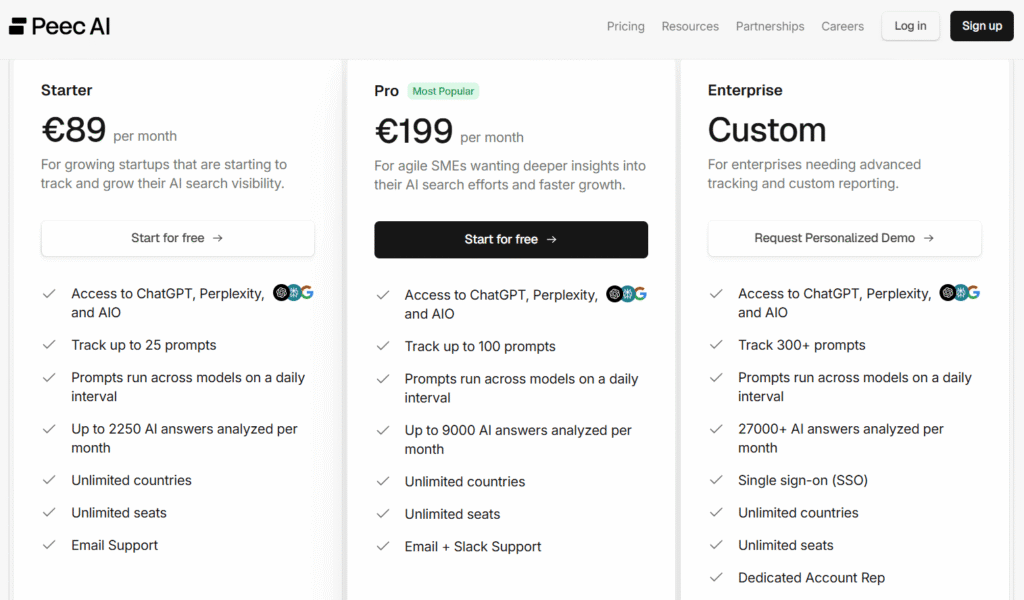
One thing to watch out for is “platform creep.” While the base plans cover the essentials, adding extra engines like Claude, Gemini, or DeepSeek typically requires a monthly add-on fee per model (usually around €20–€30).
Track My Visibility vs Peec AI: Head-to-Head Feature Comparison of LLM Visibility Tools
| Feature / Segment | Track My Visibility | Peec AI | Recommended Winner |
| Starting Price | $50/mo | €89/mo (~$95) | Track My Visibility |
| Free Trial | 7-Day Free Trial | 7-Day Free Trial | Tie |
| AI Platforms (Base) | ChatGPT, Google AI Overviews, Perplexity | ChatGPT, Perplexity, Google AIO | Tie |
| Unique Feature | AI-Ready Score (Actionable) | Sentiment & Multi-Country | Tie (Depends on goal) |
| Recommendations | Page-level fixes (Specific) | High-level strategy trends | Track My Visibility |
| Team Members | Unlimited (All plans) | Unlimited (All plans) | Tie |
| Integrations | CSV Exports, API | Looker Studio, API, CSV | Peec AI |
| Startups & SMBs | High ROI; provides a “to-do list.” | Clean UI; good for monitoring. | Track My Visibility |
| Marketing Agencies | Higher margins; white-label ready. | Pitch Workspaces for sales. | Track My Visibility |
| eCommerce Brands | URL tracking for product SKUs. | Category-wide brand tracking. | Track My Visibility |
| Enterprise Brands | Lightweight; growing features. | GDPR Certified; SSO; SOC 2. | Peec AI |
| PR & Brand Teams | Focuses on content citations. | Focuses on Brand Sentiment. | Peec AI |
Limitations for LLM Visibility Tracking Tools
Both AI tracking tools give you valuable data, but they’re not perfect. AI search is still changing fast in 2026, so what you’re seeing today is just a snapshot of something that’s constantly changing.
- Prompts are synthetic, not behavioral: The prompts these platforms test are synthetic. They’re based on what you think people might ask or what the system predicts, but they don’t capture how real users actually talk to AI. Real conversations are messier and more varied. You might look like you’re dominating on paper, while real users are asking questions in completely different ways.
- Visibility does not equal clicks: These AI tools show you how often you’re cited or what your share of voice is, but they can’t tell you if anyone actually clicked through to your site. There’s no way to measure click-through rates from ChatGPT or Claude responses yet. Google’s documentation on AI Overviews talks about why tracking attribution in AI is still a work in progress.
- Algorithm volatility: The algorithms change without notice. AI models update their training data and how they retrieve information, sometimes overnight. One tweak to how RAG weights are calculated can tank your visibility just as fast as a Google core update used to.
- You still need human judgment: The data is useful, but it’s not a substitute for thinking critically about what it means. You have to connect what the AI search visibility tracking tool shows you with your actual brand strategy and what your users are trying to accomplish.
Pro Tip: Don’t rely solely on AI visibility metrics. Cross-reference your citation data with actual referral traffic in Google Analytics. If you’re getting cited frequently but seeing zero traffic from AI platforms. It means that users trust the AI’s answer without needing to visit your site.Risk of Over-reliance
The risk is relying too much on the numbers. These platforms tell you what’s happening, but they don’t explain why. A visibility report is diagnostic. It’s not a strategy.
Context matters more than rankings. Figuring out why certain content performs well in AI responses takes real expertise. A tool might show a competitor ahead of you, but you need to know whether that’s because of their technical setup or because they’ve built stronger topical authority.
This isn’t something you set up once and walk away from. The best AI visibility tool requires constant attention. The models learn, the web grows, and what works today might not work next month. Treat it like an ongoing process, not a problem you solve one time.
Future of AI Search Visibility Tools
AI search is already here and growing fast. ChatGPT alone is handling over 2.5 billion searches every day in 2026 (Techcrunch).
Liz Reid, Head of Google Search, said we don’t view AI as replacing search. We view it as augmenting and enabling us to reinvent search.”
The game has changed. Learning how to rank in AI search is now as important as traditional SEO, and the rules are different.
Quality matters more than ever. Trying to trick the system with keyword stuffing or thin content doesn’t work anymore. AI models use something called Retrieval-Augmented Generation to find content that’s authoritative, well-organized, and accurate. If you want to show up in AI results, you need real expertise and trustworthiness.
Citations are the new currency. People and AI platforms both want to know where information comes from. The major platforms now show their sources more clearly, which means getting cited by AI is almost as valuable as getting a backlink used to be. When AI references your content, it builds credibility that protects your reputation.
Tracking isn’t enough on its own. The teams doing well in 2026 aren’t just watching their numbers. They’re using AI visibility tools that tell them what to actually fix, which content gaps to fill, what needs improvement, and how to optimize so AI models choose their pages over competitors.
So, you can use the Track My Visibility tool if you’re new to using tools. And if you want to know what you need to fix to get cited in various AI search tools.
Track My Visibility vs Peec AI: Actual Performance Analysis
Here’s how both platforms perform when you actually log in and use them.
1. AI Platform Coverage
Track My Visibility currently covers ChatGPT, Gemini, Google AI Overviews, and Perplexity. You can access these AI models by purchasing a plan. If you’re looking to start with the 7-day free trial, then you will be able to access ChatGPT, Google AI Overviews, and Perplexity.
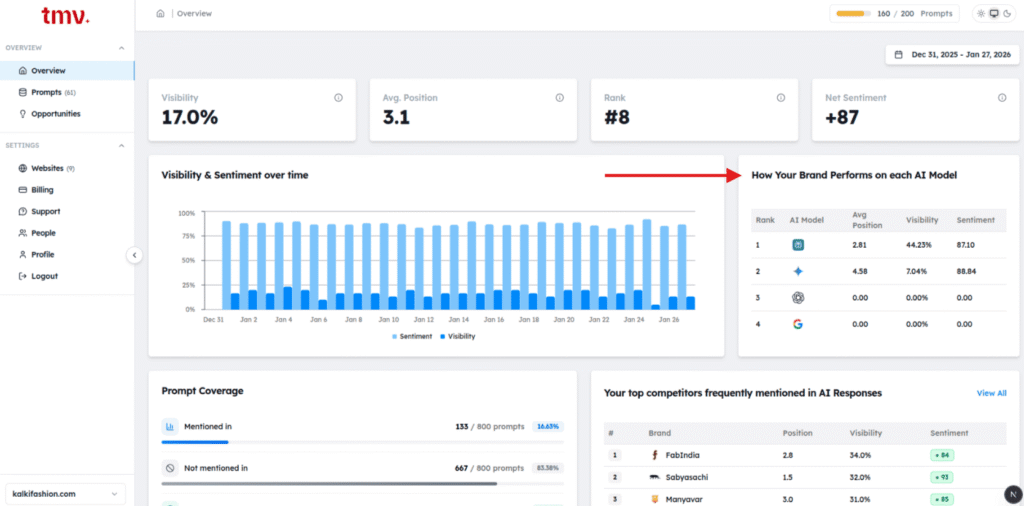
The platform is expanding its coverage to additional AI-powered search engines as they become significant.
Peec AI tracks ChatGPT, Perplexity, and Google AI Overviews on the base plan, which is €89 per month (approximately $95 USD).
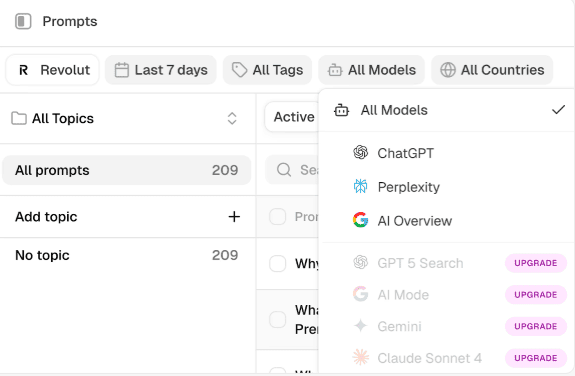
Additional major AI platforms like Claude Sonnet 4, Google Gemini, or AI mode require add-on purchases.
2. Ease of Use and Setup
Let’s see how to use and set up these AI search analytics tools. The Track My Visibility tool keeps onboarding very simple. The first step is to create your account and select the plan. After that, you just need to enter the name of your website.
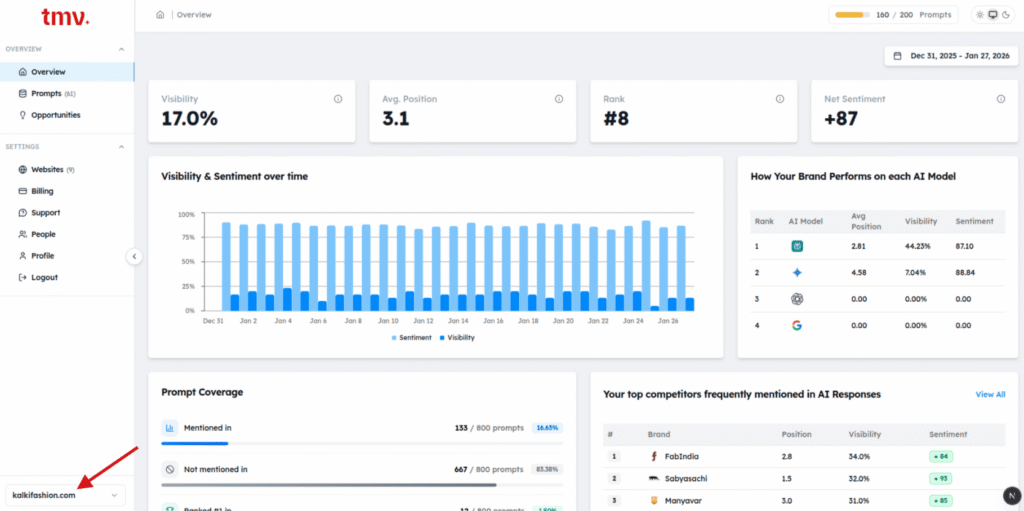
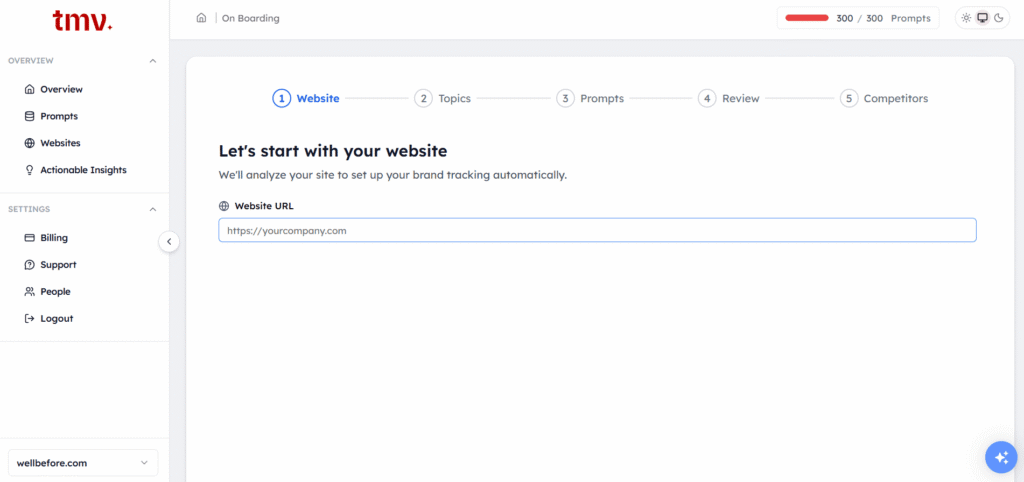
After that, you follow a 5-step process, where the website will provide you with a few topics that you can select or deselect yourself. Then, the tool will provide you with prompts, and if you want, you can add more prompts later.
Then, it will recommend you reviews, with what to change. You can also monitor your brand’s performance on the dashboard. Data updates happen every 24 hrs.
Peec AI offers a clean, modern interface that’s intuitive even for first-time users. As soon as you log in with your email, you’ll have to select the plan. After that, you can create a new workspace by adding your brand details. Then, it will ask you to select the target region or country. After that, you will have to add topics, and then it will automatically generate prompts. If you want, you can add prompts on your own, also.
Then, it will take you to the next step, which is adding competitors. After you’re done filling in all the details, the system will start running the prompt, and you’ll be able to see your brand’s AI visibility insights within 24 hours.
3. Reporting and Analytics
Now, let’s move forward and see how both the AI visibility software reports and analyzes your data. Track My Visibility provides model-wise coverage tracking, so you understand performance differences across AI platforms.
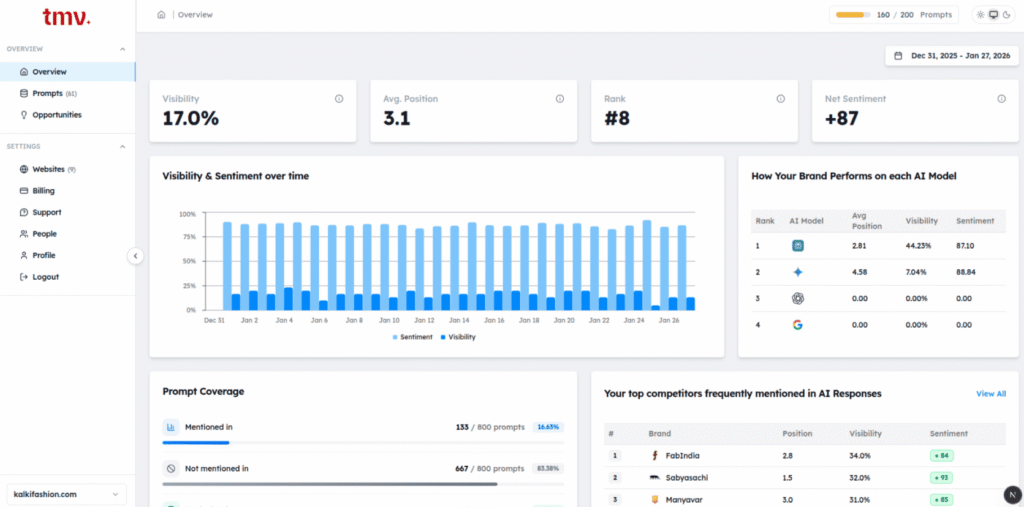
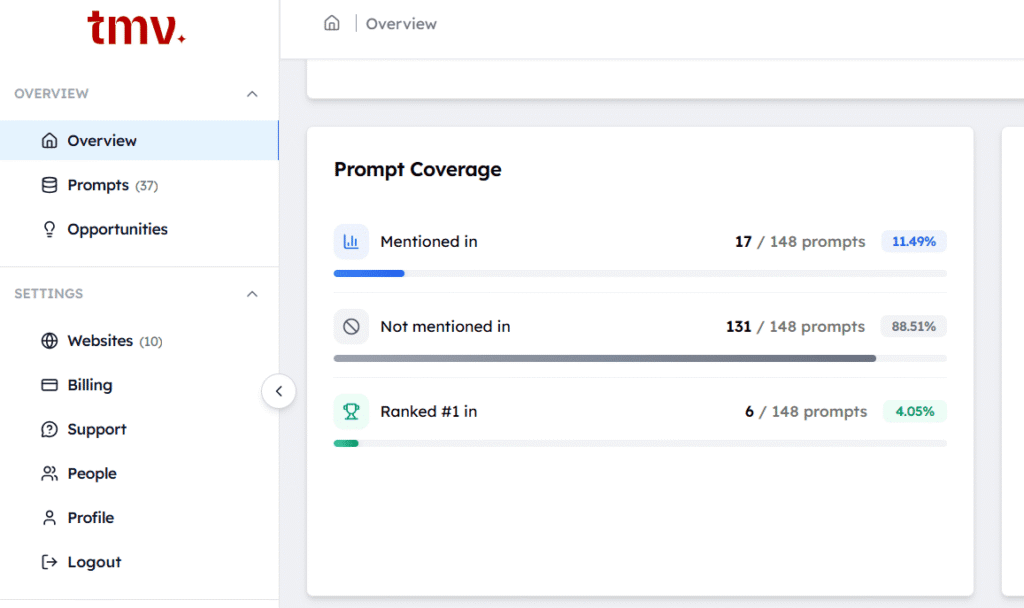
The AI-Ready Score is unique and valuable. It gives each URL a specific rating and explains what to improve. It shows a full prompt coverage breakdown, including how many prompts your brand was mentioned in, how many it was absent from, and how many times it ranked #1.
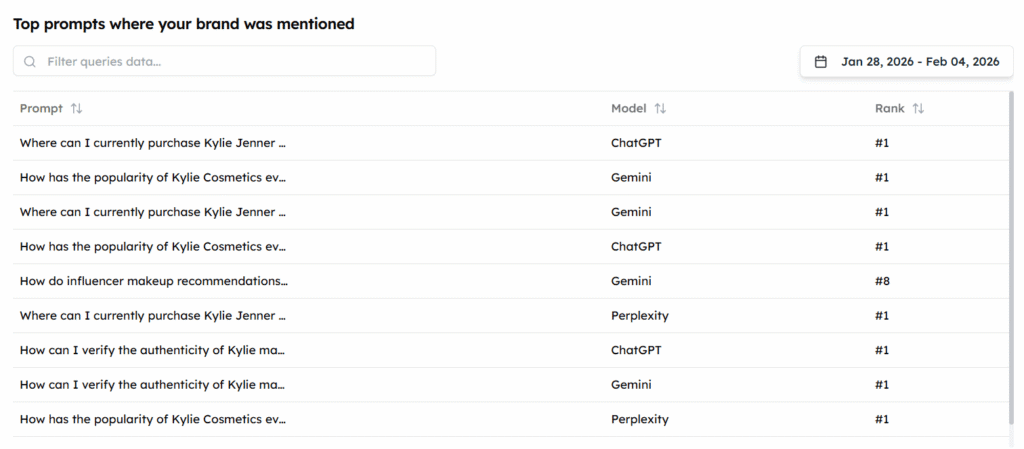
Top cited URLs show which content performs best, helping you understand what AI models value. It also mentions competitor benchmarking, so you can track share of voice against other brands competing in your space.
On the other hand, Peec AI offers visibility percentage tracking that shows how often your brand appears across all monitored prompts.
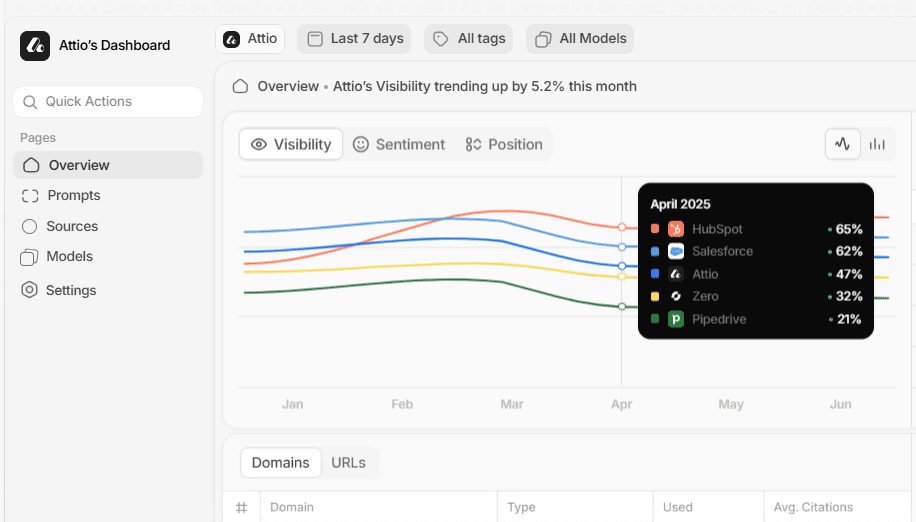
It also provides position and sentiment metrics. These metrics reveal not just if you’re mentioned, but how prominently and positively. It also has source attribution that clearly shows which pages AI platforms cite and how many times.
You can also compare your brand mentions against competitors across tracked prompts with the help of Share of Voice tracking. And its regional visibility breakdowns performance differences across geographic markets.
4. Actionable Insights and Recommendations
Track My Visibility provides an AI-Ready Score for each URL with specific improvement suggestions. Its page-level optimization helps you know exactly what to fix on individual pages.
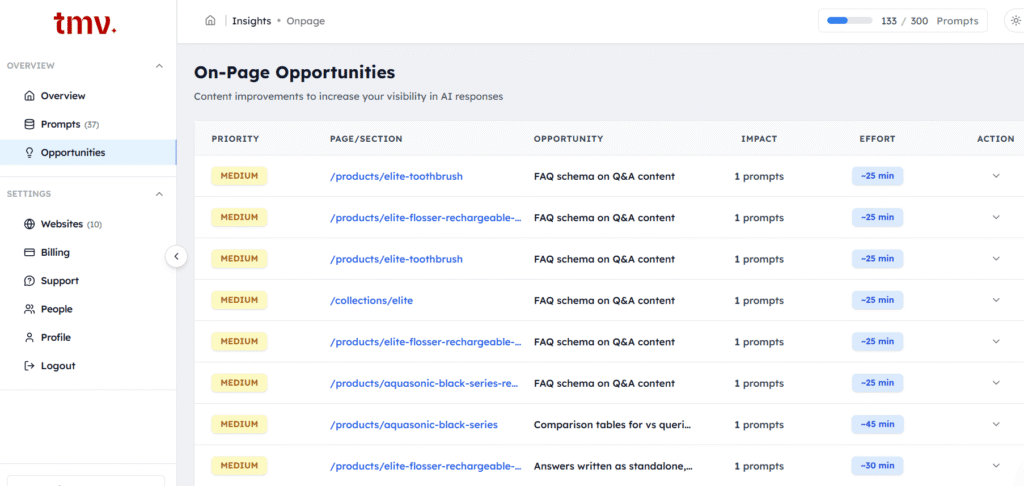
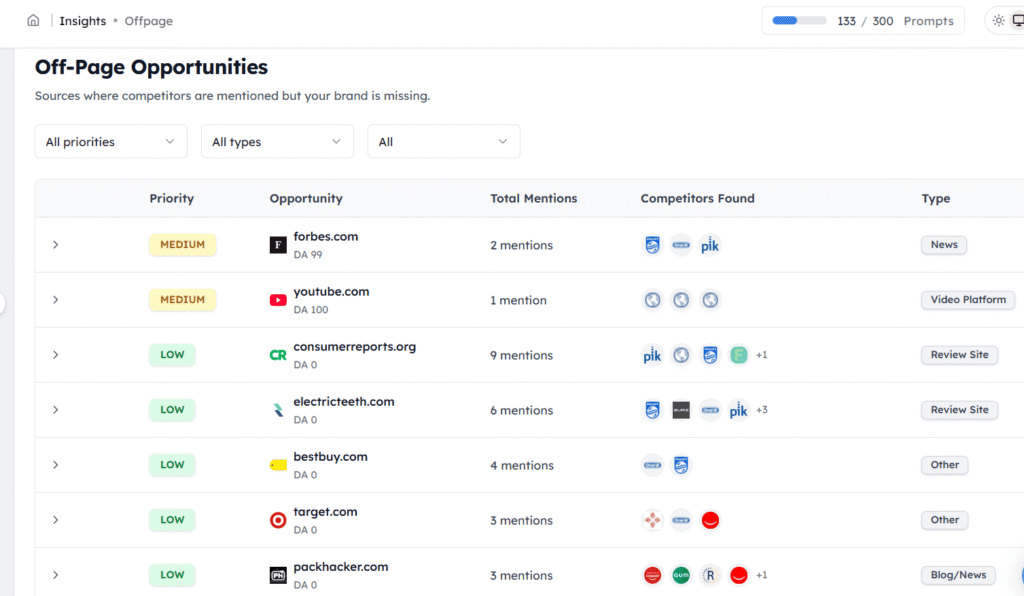
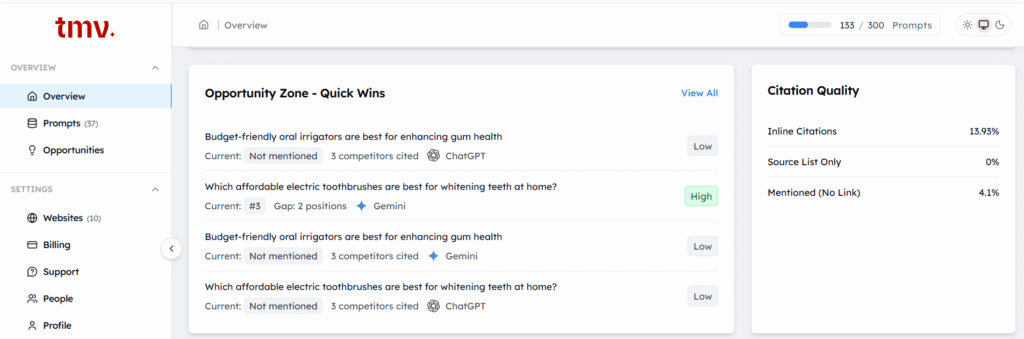
The Opportunity Zone shows you exactly which prompts to prioritize, with High or Low urgency labels, which AI platform has the gap, and how many competitors are already being cited there.
It also breaks down citation quality, showing whether your brand is getting inline citations, source list mentions, or name drops without a link. Each type carries a different weight in terms of how AI models perceive your authority.
With this tool, you’ll also get suggestions on how to make your content better so that you get cited on different AI search platforms.
Peec AI offers limited actionable insights. The platform excels at showing you where you stand, but provides less guidance on improvement steps. The monitoring focus means you get comprehensive data about current performance.
Without content workflows built in, you’ll need to develop optimization strategies based on the visibility data yourself. The platform only provides intelligence, but it expects you to translate that into action.
Both AI SEO tools give you something to do with the data. But knowing how to optimize content for AI answers is what turns that data into actual citations.
5. Competitor Tracking
With Track My Visibility, you get competitor benchmarking in all the plans. No matter which one you choose, a 7-day trial, a discover plan, or the growth plan.
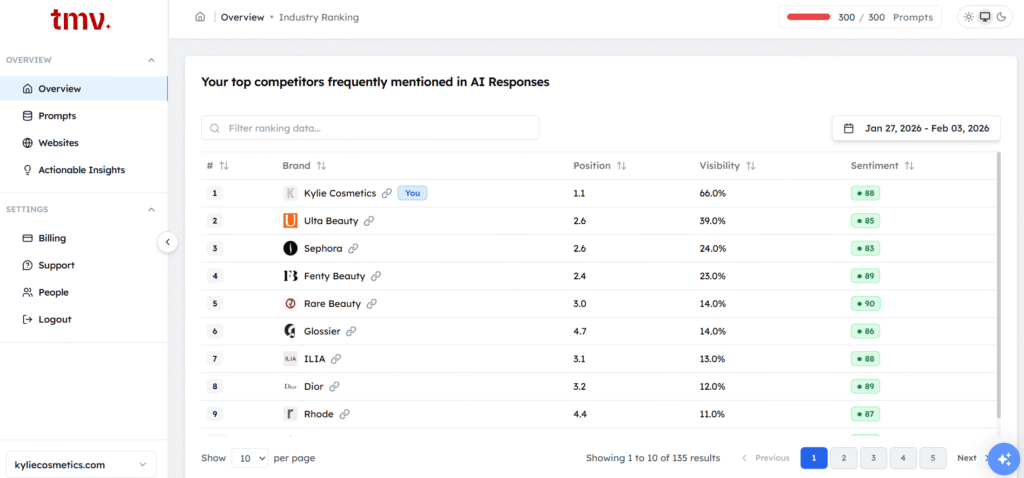
The dashboard monitors brand mentions, does Share of voice tracking, and also shows which competitor was cited for which prompt. It does side-by-side competitor analysis, which helps you analyze the gap. It also identifies any backlink potential or any opportunities in your content.
Peec AI provides competitor visibility comparison across all monitored queries.
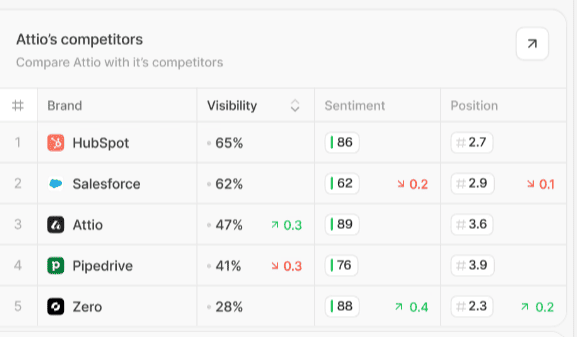
The dashboard analyzes your brand’s prompt responses to detect and suggest brands that frequently appear alongside yours. It also provides you with the option of adding your competitors manually. It provides you with up to 6 competitors, along with their visibility, sentiments, and ranking percentages.
You can also check the content gaps by reviewing your competitors’ citation data. With this information, you can make changes accordingly to get cited on multiple AI search tools.
6. Team Collaboration and Integration
Track My Visibility platform provides you with unlimited team members on all plans. It is valuable for agencies and growing companies. You can also share visibility data with stakeholders outside the platform by using exportable reports.
Dashboard sharing allows team members to view the same data without separate logins. There also working on API development, which will expand integration possibilities.
Peec AI is built for professional teams that need to turn raw visibility data into a shared strategy. Unlike other AI brand visibility tools that charge per seat, Peec AI offers unlimited team members on all plans. This means you can invite your entire content, PR, and SEO team, as well as external clients, without worrying about scaling costs.
7. Global and Multi-Language Support
Both platforms let you track performance across different regions, but they’re built for different scales. Track My Visibility gives you solid multi-country tracking with settings you can adjust based on your needs.
For smaller teams wanting to see how they show up in a few key markets, it gets the job done without overwhelming you. The language support is growing, just not as extensive as what Peec AI offers right now.
Peec AI is where you go if you need serious global coverage. We’re talking 115+ languages that cover almost every market you can think of. The nice part? Multi-country monitoring comes standard on every plan, no extra fees.
So if you’re an international company that needs to compare how you’re performing in Germany versus Japan versus Brazil, you can do that all in one view.
8. Data Accuracy and Reliability
Both platforms refresh your data daily by running your prompts every 24 hours. This lets you catch sudden changes in how AI models like ChatGPT, Claude, and Gemini reference your brand. Daily updates matter because these models get refreshed constantly; a citation you see today might disappear tomorrow.
Track My Visibility focuses on transparency. It shows you URL-level citations in real-time and explains exactly how it calculates the AI-Ready Score. This clarity helps teams trust the optimization recommendations they receive.
Peec AI built its reputation serving major brands over several years. The platform refined its data collection through extensive real-world testing, making it the go-to choice for high-stakes enterprise reporting. You can explore their full methodology on their official features page.
One important note: both the brand AI visibility tools use synthetic prompts (automated questions run on schedules) rather than tracking actual user queries. They show your potential visibility and share of voice, which is great for competitor benchmarking. But they can’t tell you exact click-through rates or actual organic traffic numbers.
9. Customer Support and Resources
Track My Visibility provides email support across all plans. What makes it different is the founder’s hands-on involvement with the product team. You’re often getting answers from the people who actually built the platform, which smaller teams and agencies find valuable. The documentation is growing as the platform matures, and the user community is expanding quickly.
Peec AI scales support based on your plan. Everyone gets email access, but Pro and Enterprise customers get Slack channels for faster responses. Enterprise users also have phone support for urgent situations. Their documentation covers most standard questions and technical scenarios you’ll run into.
Peec AI also has an active community where users share optimization strategies and case studies from their own work.
Which AI Search Visibility Tool Should You Choose?
The decision between Track My Visibility vs Peec AI comes down to your specific situation.
Choose Track My Visibility If You:
- Are working with a growth-stage budget: With a starting price of $5 to $50 monthly. It is significantly more accessible for solo creators and small teams than the €89 entry point of Peec AI.
- Want a “To-Do” list, not just data: The standout feature here is the AI-Ready Score. It gives you a roadmap for specific URLs, telling you exactly what content to tweak so AI models are more likely to cite your page.
- Want source-level citation clarity: The Sources tab shows whether AI is citing your pages, competitor sites, or third-party domains, so you know exactly where to focus.
- Need broad coverage in your base plan: You get tracking for ChatGPT, Gemini, Perplexity, and Google AI Overview without having to pay for individual model add-ons.
- Prioritize the US and English-speaking markets: While it is expanding, its primary strength lies in domestic search and straightforward content optimization.
- Run a lean agency: Because you get unlimited team members and low per-client costs, you can scale your “AI Reporting” service without your software bill eating your profits.
- Value simplicity: If you want a dashboard that your account managers and clients can understand in five minutes, this is the better fit.
Choose Peec AI If You:
- Manage complex product lines: It’s built to track 100+ prompts, which is essential if you’re juggling multiple market segments or extensive catalogs.
- Operate on a global scale: With support for 115+ languages, it’s the gold standard for international teams that need to see how they appear in non-English results.
- Prioritize European compliance: Headquartered in Berlin, Peec AI is built with GDPR compliance at its core, making it a safer bet for companies with strict data residency requirements.
- Need high-level reporting: If you live in your BI tools, you’ll value the Looker Studio connector and API access, which allow you to pipe AI visibility data directly into your existing executive dashboards.
- Monitor brand sentiment: Beyond just “being there,” Peec AI uses sentiment analysis to tell you if the AI’s “vibe” toward your brand is positive, neutral, or negative.
- Care about source authority: The platform provides a detailed breakdown of which third-party domains are influencing the AI’s answers, helping you identify which publications or forums are shaping your reputation.
- Value a proven track record: As a venture-backed firm with an established history of serving major brands, it offers a level of “procurement peace of mind” that smaller, newer tools might not yet have.
- Have an enterprise budget: With plans starting at €89 to €199+ monthly, it’s a strategic investment for teams that prioritize deep analytics and regional performance comparisons.
Final Thoughts
Choosing Track My Visibility vs Peec AI depends on what you need: affordable optimization help or enterprise-grade global monitoring.
Track My Visibility is good for smaller teams on a budget. Its AI-Ready Score tells you exactly what to fix on specific pages, which is helpful when you need to act fast. Plans start around $50 a month with trials available.
Peec AI is built for enterprises to monitor performance across languages and markets. It handles sentiment tracking, regional breakdowns, and integrates with tools like Looker Studio for reporting.
There’s no perfect choice. It depends on your budget, team size, and scope. If you need to know which pages to fix, start with Track My Visibility. If you’re managing a global brand, Peec AI makes more sense.
AI search is becoming central to discovery, so the important thing is to start tracking now. Pick what works for your situation, establish a baseline, and adjust as you learn.
Frequently Asked Questions
Neither one is clearly better across the board. Peec AI has more developed analytics, better coverage for global markets, and stronger integrations. Track My Visibility gives you better value if you’re on a smaller team, clearer advice on what to fix, and lower prices. What’s right for you depends on your budget, team size, and where you’re operating.
Track My Visibility makes more sense for startups, small teams, and agencies that need an affordable AI visibility platform tracking with specific tips on how to improve. Peec AI is the better choice for enterprises, global brands, and teams that need detailed multi-language monitoring with sophisticated analytics.
Probably not for the same market. That said, some agencies use Track My Visibility for smaller clients and save Peec AI for their enterprise accounts. The price difference makes that split practical.
Track My Visibility has a 7-day free trial that gives you access to everything. Peec AI offers a 7-day free trial, so you can explore the dashboard. Testing both the AI search visibility tool is straightforward.
Track My Visibility is much better for small businesses. The $50 monthly starting price is manageable, the AI-Ready Score tells you what to do, and the platform focuses on insights you can use instead of just throwing data at you. Peec AI’s pricing is aimed at bigger organizations.
Resource:
- Gartner Predicts Search Engine Volume Will Drop 25% by 2026, Due to AI Chatbots and Other Virtual Agents
- ChatGPT users send 2.5 billion prompts a day | TechCrunch
- Google’s head of search Liz Reid on the company’s AI transition | Semafor