


There are plenty of AI visibility tools out there, and AthenaHQ is one of them, with 8 AI engines covered at entry and no gating. Action Center, unlimited topics, and ACE make the credit-based system feel reasonable if you’re ready to commit to the platform’s execution-heavy approach.
Thinking about it more, though, Action Center is genuinely good at turning data into assignable tasks, but it draws from the same 3,600-credit monthly pool as everything else, so the more you lean on it, the faster that pool runs out. ACE, the feature that predicts future citation patterns, is Enterprise-only, so many Self-Serve buyers never actually get to use the thing that’s supposed to justify the price.
Both of these trace back to the same root issue: monitoring cadence, Ask Athena queries, and content-agent runs all pull from one shared credit pool, and the entry price understates what you’ll actually spend once you’re using the platform the way it’s meant to be used.
If any of that sounds familiar, I’ve got a few alternatives I’ve tested and evaluated. Feel free to take a look and see what fits better for your setup.
How I Evaluated These AthenaHQ Alternatives
These AI visibility tools change fast; pricing, features, even engine coverage can shift within a month. So instead of just listing what each tool claims to do, I evaluated it against these.
- Does the pricing stay predictable? Not just the sticker price, but what happens to your bill once prompts, models, brands, or seats start climbing.
- Does it actually help you act? Insights are easy. I looked at whether the tool gets you to a published brief, an optimized page, or a fixed citation gap, or just a dashboard.
- Who’s it really built for? A solo consultant and a fifty-client agency need different things, so I mapped each tool to the buyer it genuinely fits rather than everyone.
- What do actual users keep saying? Beyond the marketing page, the recurring themes in reviews are support, reporting, pricing surprises, and day-to-day usability.
7 AthenaHQ Alternatives I Tested
| Tool | Best For | Standout Feature | Starting Price |
| Profound | Enterprise teams wanting deeper data | Prompt Volumes, real panel data on what people ask AI | $99/mo (annual) |
| Track My Visibility | Clear tracking without enterprise complexity | Flat, predictable pricing, no credit system | $89/mo |
| Otterly.ai | Simple AI search monitoring | Unlimited brands, 50+ countries included | $29/mo |
| AIClicks | Turning GEO insights into action | Content creation bundled in from entry tier | $59/mo |
| Peec AI | A clean, focused tracking experience | Zero-setup onboarding, clean UI | $95/mo |
| Semrush AI Visibility Toolkit | GEO as part of a bigger SEO workflow | Bundled with the full SEO suite | $99/mo per domain |
| Writesonic | Content production as part of the GEO workflow | Content suite and crawler analytics included at entry | $79/mo |
* Pricing can vary based on platform; please check the latest pricing on their official pages.
1. Profound: Best for Enterprise-Level AI Visibility
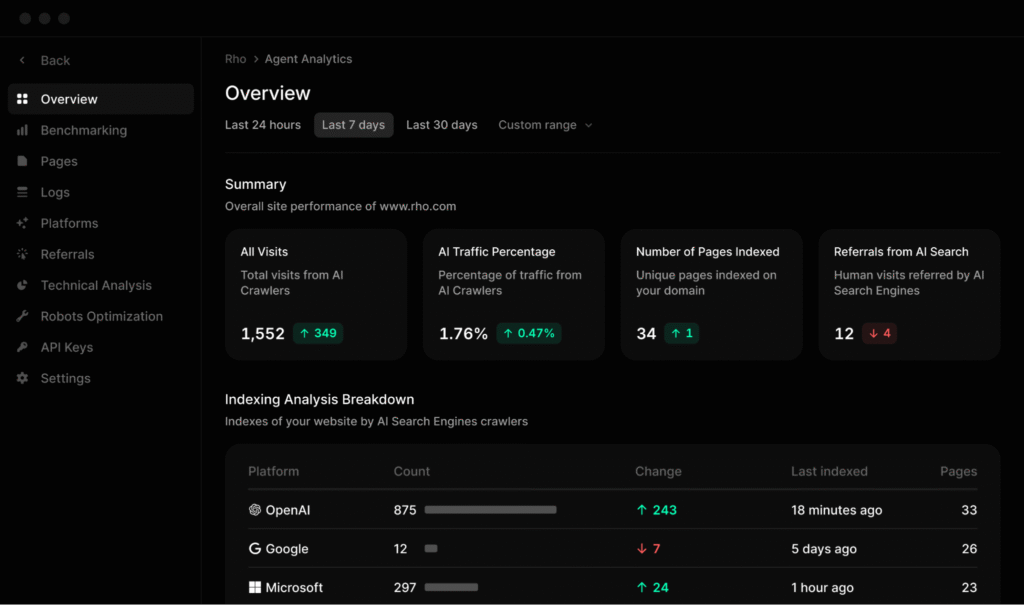
I believe Profound is the strongest alternative to AthenaHQ. It goes a bit deeper than just measurement, combining answer-engine visibility, citation and sentiment analysis, agent analytics, prompt intelligence, and content agents. The differentiator is Prompt Volumes, a dataset intended to show how often real users ask different types of questions across AI experiences (check it with our Query fan out tool), something AthenaHQ doesn’t have an equivalent for.
What Are You Actually Paying More For?
Mainly three things. Prompt Volumes, which is real panel data on what people actually ask AI. Agent Analytics, server-side crawler-log tracking on unlimited domains. And Agents, which drafts full content and publishes it straight into WordPress or Sanity. If your team needs that execution layer built in, this is where it lives.
Things to consider with Profound
- Perplexity and AI Overviews only unlock at $399/mo Growth
- Both tiers bill annually, so it’s a year commitment either way
- Full Prompt Volumes access is Enterprise-only
- API, SSO, and multi-brand tracking all need Enterprise too
- Reviewers mention a real learning curve
Profound vs AthenaHQ
| Criteria | Profound | AthenaHQ |
| Pricing | $99–$399/mo, annual | $295/mo, credit-based |
| Engines | 1 to 3 on self-serve | 8, all included |
| Analytics | Panel data + crawler logs | Strong tracking, method undisclosed |
| Content execution | Full drafting, CMS publishing | Action Center; ACE is Enterprise-only |
| Best for | Enterprise teams wanting deep data | Growth-stage brands wanting breadth |
My take: Go with Profound if panel data or crawler analytics are things you’d actually use weekly. Consider Profound’s alternatives if you just wanted AthenaHQ’s engine breadth without the credit system, because Profound mostly makes you pay more to get less of that.
2. Track My Visibility: Best for Clear Tracking Without Enterprise Complexity
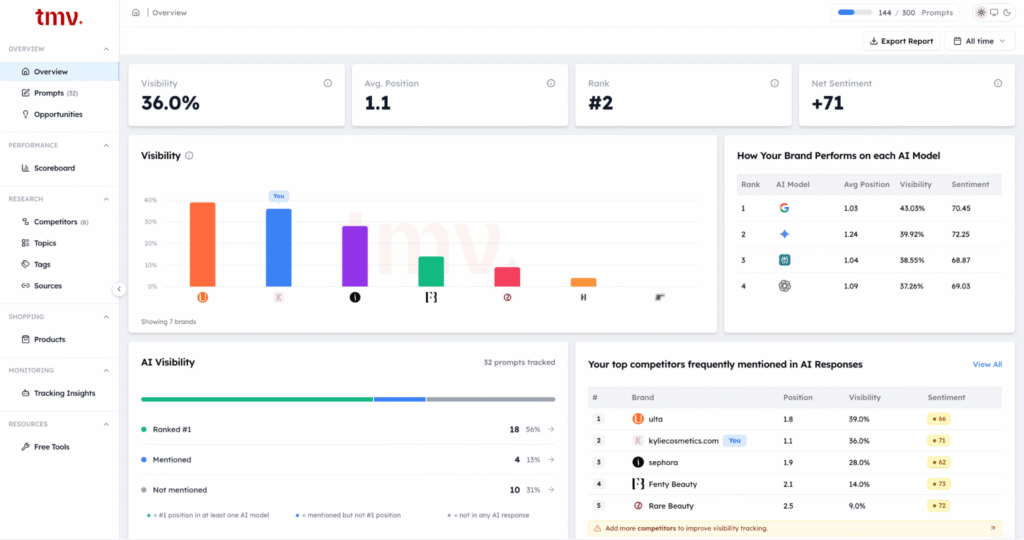
Quick disclosure: this is our AI visibility tracker tool, Track My Visibility, and I’m one of the people behind it.
Profound is genuinely strong, and if you’re an enterprise team with real budget, it’s probably the more mature pick for deep AI visibility work. Track My Visibility was built for the other end, small and mid-sized businesses and agencies that want most of what a platform like Profound does, without the enterprise price tag or the setup overhead.
What Stood Out Once I Got Past the Dashboard
- Which AI model has the highest or lowest visibility for your brand, model-wise visibility across ChatGPT, Perplexity, Gemini, AI Overviews, Grok, and Copilot
- Full competitor analysis, ranked by position and visibility across every model
- Citation and source-level breakdowns, so you can see exactly which domains AI answers are pulling from
- Sentiment tracked by brand and by topic, not just a single overall score
- A prioritized list of opportunities, split into on-page, off-page, and technical, so you know what to fix first
The Tradeoff Against a Platform Like AthenaHQ
AthenaHQ does go deeper in a few places. Action Center turns monitoring into assignable tasks, and ACE analyzes citation patterns well enough to predict future ones, though that’s Enterprise-only. AthenaHQ runs on a shared credit pool, so monitoring, its AI copilot, and content-agent all draw from the same 3,600 credits a month.
Track My Visibility skips that entirely. Pricing stays flat no matter how much you monitor, so there’s no credit math to keep an eye on, and for a team that just wants to know where they stand and what to do next, that simplicity usually wins out over ACE’s predictive polish.
AthenaHQ vs Track My Visibility
| Criteria | Track My Visibility | AthenaHQ |
| Pricing | Starts at $89/mo, no credit system | $295/mo, credit-based |
| Engines | ChatGPT, Perplexity, Gemini, AI Overviews, and more | 8, all included |
| Citation analysis | Yes, source and domain-level | Yes, plus ACE (Enterprise-only) |
| Recommendations | Prioritized opportunities, on-page and off-page | Action Center, task-based |
| Best for | SMBs and agencies wanting simple, predictable tracking | Growth-stage brands wanting broad engine access |
My take: Consider Track My Visibility if you want clear, actionable tracking without a credit system to manage. If you’re a small or mid-sized company trying to understand and improve AI visibility, or an agency managing it across multiple clients, Track My Visibility makes the most sense.
 Pro tip: If you want to get a quick look at your AI visibility in just minutes, our free AI visibility checker does exactly that.
3. Otterly.ai: Best for Simple AI Search Monitoring
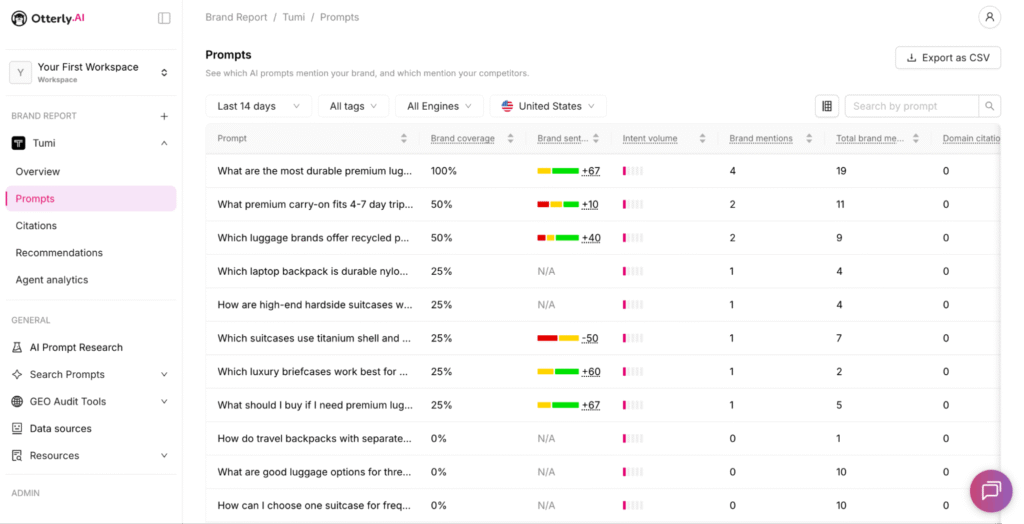
I’ve placed Otterly next on this list, and not just because it’s the budget option. It’s also one of the few tools here with a genuinely disclosed data-capture methodology, replicating the actual AI web interface instead of pulling from an API. On top of that, it comes with unlimited brand reports, unlimited team members from Standard up, 50+ country tracking included at every tier, and a prompt-research tool that actually works.
How Much Tool Do You Actually Need?
- Setup takes minutes, not a sales call
- Monitoring stays straightforward, no credit math to track
- Reporting is simple and easy to read
- Multi-country tracking (50+ countries) is included from the entry tier
Where the Cheap Starting Price Can Get Complicated
The $29/mo Lite plan only covers 4 engines: ChatGPT, Google AI Overviews, Perplexity, and Microsoft Copilot. Claude, Gemini, and Google AI Mode are paid add-ons, and the pricing scales steeply by tier, so getting all 6 engines on the Premium plan pushes your real bill past $1,200/mo.
Prompt limits are tight too, just 15 on Lite, so a real workload usually pushes you to Standard fast. And once you’re monitoring across the board, execution stays thin. Otterly tells you where you stand and what to audit, but closing the gap still means doing the content work by yourself.
Otterly.ai vs AthenaHQ
| Criteria | Otterly.ai | AthenaHQ |
| Pricing | $29–$489/mo, engine add-ons extra | $295/mo, credit-based |
| Engines | 4 included, 3 more as paid add-ons | 8, all included |
| Prompt tracking | 15 to 400 prompts by tier | Shared credit pool, no fixed cap |
| Content execution | Audits and recommendations only | Action Center; ACE Enterprise-only |
| Best for | Small teams wanting simple, transparent monitoring | Growth-stage brands wanting broader execution |
My take: Consider Otterly if you want a transparent capture method and don’t need every engine from day one. Skip it if full 6-engine coverage matters to you, since the add-on costs erase most of the savings that it actually needed in the first place.
4. AIClicks: Best for Turning GEO Insights Into Action
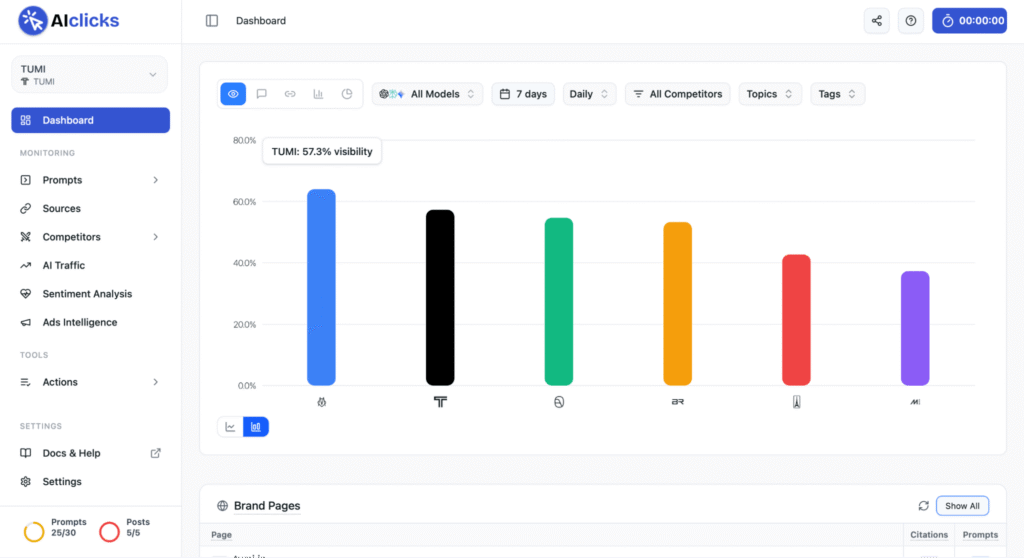
Okay, so next one is AIClicks. It shows exactly which pages an AI engine cited and why, with coverage across 10+ AI platforms. It tracks prompt-level visibility, citations, competitors, and sources, then converts the findings into recommended work.
What Happens After AIClicks Find a Gap?
- AI-generated recommendations, split into content, source outreach, and community-engagement work
- Content opportunities flagged at the page level, not just a generic “improve content” note
- AI-optimized article generation bundled in from the $59 Starter tier
- Source-outreach suggestions tied to specific domains an engine is already citing
- A real execution workflow, from insight to published fix, without leaving the platform
Where the Plan Limits Start to Matter
Starter caps you at 30 tracked prompts and just 3 engines, chosen from a pool that only unlocks Claude and Copilot once you’re on Pro at $189. One website too, so if you’re managing more than one brand, you’re paying $189 minimum for unlimited sites. Content allowances scale the same way: 5 articles a month on Starter up to 30+ on Business, so the “content creation layer” that makes AIClicks stand out barely shows up until you’re spending real money.
AIClicks vs AthenaHQ
| Criteria | AIClicks | AthenaHQ |
| Pricing | $59–$499/mo, tiered | $295/mo, credit-based |
| Engines | 3 to 6, chosen from 10+ | 8, all included |
| Recommendations | Content, source, and community actions | Action Center, task-based |
| Content execution | AI article generation at every tier | Enterprise-only deep-research agent |
| Best for | Teams that want tracking and content creation in one tool | Growth-stage brands wanting broad engine access |
My take: Consider AIClicks if you want the recommendation and content-creation layer without an enterprise contract. Skip it if broad engine coverage matters more than execution, since you’re stuck at 3 engines until you move past Starter.
5. Peec AI: Best for a Clean, Focused Tracking Experience
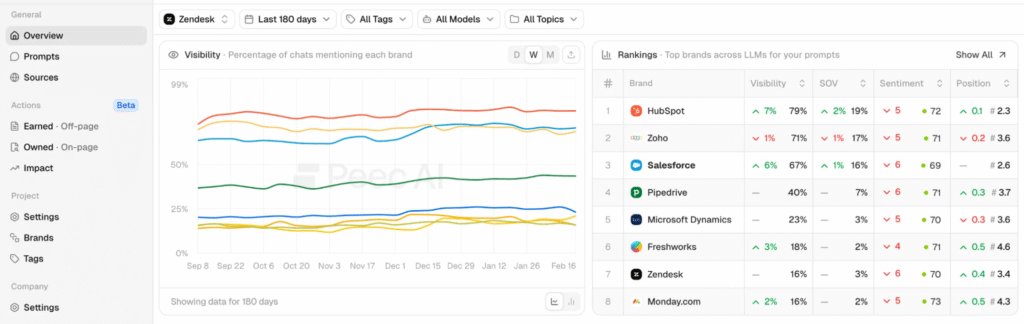
If clean data and a UI are what you can read, Peec AI is the one that holds up best. It gives clear visibility, position, sentiment, prompt performance, competitor benchmarking, and citation sources.
Where Peec differs from AthenaHQ is that it’s genuinely good at measurement. It works well if you’ve got a strategist on the team who knows how to read visibility data and turn it into content, PR, or technical fixes. If you’re expecting the platform itself to manage that next step like Track My Visibility’s Opportunities, that’s exactly where it stops short.
Why Peec Feels Lighter to Work With
- Interface is clean and easy to read, no learning curve to speak of
- Prompt tracking with tagging, bulk upload, and clustering built in
- Competitor visibility that surfaces rivals you didn’t know you had
- Day-to-day use stays simple, nothing to configure beyond picking your prompts
How Far Does It Take You After Finding the Problem?
This is where Peec pulls back, and it’s the reason so many people end up searching Peec AI alternatives in the first place. Recommendations exist, but the tool doesn’t have enough context on the business to make them useful. There’s no optimization guidance beyond flagging where you stand, and no content execution layer at all; no drafting, no publishing, nothing that closes the loop. So once Peec tells you where the gap is, actually fixing it, writing the content, doing outreach, making technical changes, is up to you entirely.
Peec AI vs AthenaHQ
| Criteria | Peec AI | AthenaHQ |
| Pricing | $95–$495/mo, tiered | $295/mo, credit-based |
| Engines | 3 of 7, more as paid add-ons | 8, all included |
| Competitor analysis | Strong, cross-LLM benchmarking | Strong, tied to Action Center |
| Recommendations | Light, measurement-focused | Task-based via Action Center |
| Best for | Teams with a strategist who can act on the data themselves | Teams that want the platform to suggest next steps |
My take: Consider Peec if your team already knows what to do with visibility data and just wants it clean and fast. Skip it if you’re relying on the platform to tell you what to do next, since that’s the one thing it deliberately doesn’t try to do.
6. Semrush AI Visibility Toolkit: Best When GEO Is Part of a Bigger SEO Workflow
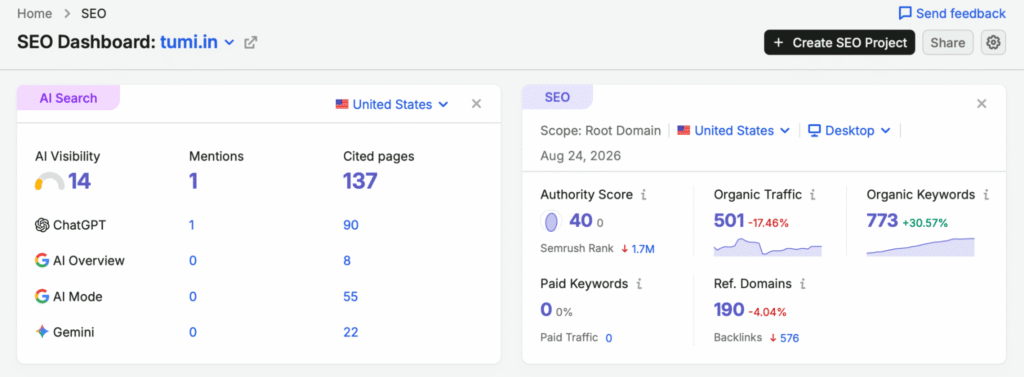
Semrush, with AI visibility sitting right beside keyword research, technical audits, backlinks, content optimization, and recurring SEO reports, takes a different approach entirely. It includes 25 custom prompts with daily rankings across ChatGPT, Google AI, Gemini, and reportedly Perplexity, at $99/mo per domain, plus a Content Analyzer that grades pages on AI-citability and an AI-readiness site audit.
The Real Advantage Is Everything Around the AI Toolkit
- Traditional SEO data already sitting in the same login
- Keyword research pulled straight into the same reports
- Competitor research that spans SEO and AI visibility together
- Backlink data without switching tools
- Site audits that flag technical issues before they hit AI visibility
- AI tracking sitting inside a workflow you probably already run
Where the All-in-One Argument Starts to Break
The catch is the toolkit is genuinely thin on its own. $99 buys 25 prompts across roughly 4 engines, which works out to a much smaller allowance than a same-priced dedicated tracker, and extra prompt blocks cost $60/mo on top.
It tells you the score and points in a direction, but doesn’t close the loop into published content the way a dedicated GEO platform does, which makes it a fit for teams layering AI visibility into existing SEO work, not for teams that want AI visibility to be the main job.
Semrush AI Visibility Toolkit vs AthenaHQ
| Criteria | Semrush AI Toolkit | AthenaHQ |
| Pricing | $99/mo per domain, add-on | $295/mo, credit-based |
| Engines | ~4, coverage disputed by source | 8, all included |
| Prompt tracking | 25 prompts, daily rankings | Shared credit pool |
| Content execution | Audit and grading only | Action Center; ACE Enterprise-only |
| Best for | Teams already running SEO in Semrush | Growth-stage brands wanting dedicated GEO execution |
My take: Consider this if AI visibility is one piece of a bigger SEO workflow you’re already paying for. Skip it if GEO analytics is the main job, since the prompt allowance and engine coverage are both too thin to carry that on their own.
7. Writesonic: Best When Content Production Is Part of the GEO Workflow
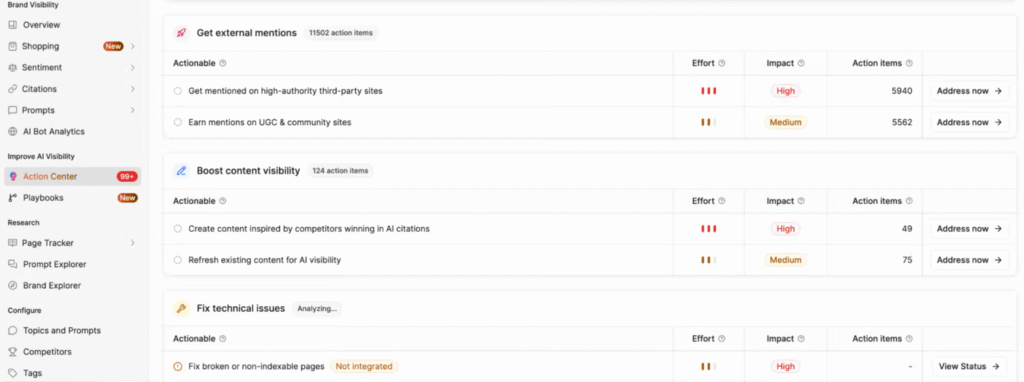
Writesonic has content-and-SEO engine capabilities that work well for a content execution workflow. AI Bot Analytics, server-side crawler tracking for GPTBot, ClaudeBot, and similar bots, is included from the $79 entry tier, which is more generous than several competitors that gate crawler analytics higher. It combines visibility tracking with a genuinely robust content creation suite.
Can One Platform Take You From Insight to Published Content?
- AI visibility monitoring, tracked daily across every tier
- Opportunity identification built into the same dashboard
- Content creation through the AI Article Writer and SEO Content AI Agent
- Optimization guidance via automated site-audit fixes
- A publishing workflow that connects insight to output without switching tools
What if You Already Have a Content Stack?
If you already run a content tool separately, there’s real feature overlap here, so you’re paying for article generation you may not use. Whether the bundled content tools add enough value depends on whether your team actually writes inside Writesonic or just needs the tracking half.
And on AI visibility specifically, the depth doesn’t run as deep as a dedicated platform; all three self-serve tiers track just 3 engines, ChatGPT, Gemini, and Google AI Overviews, with Perplexity and Claude locked behind Enterprise despite the marketing promising 10 platforms. If tracking depth matters more to you than the writing tools, a dedicated GEO platform probably makes more sense.
Writesonic vs AthenaHQ
| Criteria | Writesonic | AthenaHQ |
| Pricing | $79–$399/mo, annual | $295/mo, credit-based |
| Engines | 3 on every self-serve tier | 8, all included |
| Content creation | Full article writer, included at entry | None at entry, Enterprise-only agent |
| Optimization | Action Center, Growth tier trial only | Action Center from $295/mo |
| Best fit | Teams that want tracking and writing in one place | Teams that want broad engine coverage and task-based execution |
My take: Consider Writesonic if content production is the piece you’re missing and you don’t mind trading engine breadth for it. Skip it if tracking depth or coverage matters more, since Perplexity and Claude aren’t available until Enterprise.
Which AthenaHQ Alternative Is Right for You?
Choosing the right one depends a lot on your budget, your goals, and honestly how much complexity you’re willing to manage day-to-day.
If you’ve got an enterprise budget and want the deepest data available; panel-based prompt demand, crawler logs, the works Profound is the one to look at. For most small and mid-sized teams who just want clear tracking without a credit system to manage, Track My Visibility tends to be the right fit. If all you need is straightforward monitoring without much setup, Otterly.ai gets you there fast and cheap.
When execution matters as much as insight, AIClicks is built around that loop. If you’d rather keep things clean and let your own strategist decide what to do with the data, Peec AI stays out of your way better than most. Teams that already live inside Semrush for SEO should probably just add AI visibility there instead of running a second platform, since Semrush folds it into the same workflow. And if content production is the piece you’re actually missing, not just tracking, Writesonic bundles that in from the entry tier.
My Verdict
Let me give you a quick summary of this blog.
Profound wins on enterprise depth. Track My Visibility wins on balanced tracking with insights you can actually act on. Otterly.ai wins on simplicity. AIClicks wins on execution. Peec AI wins on focused usability. Semrush wins if AI visibility just needs to live inside your existing SEO ecosystem. Writesonic wins if content production is the gap you’re filling.
BTW, If you’re looking for a place to start, we’ve got a 7-day trial. See how it works for you.
FAQs
Not always; it depends on how you use the tool. Credits can work fine if your usage is steady and predictable, but they get risky the moment monitoring, content, and chat features all draw from the same pool, which is exactly what trips people up on AthenaHQ.
Otterly.ai, starting at $29/mo, is the cheapest with a disclosed capture method and real monitoring. Just know the 6-engine coverage AthenaHQ gives you at entry costs extra here through add-ons.
Track My Visibility, since brands and seats stay unlimited on Growth without triggering an Enterprise sales conversation. Omnia and Peec AI are worth a look too; both offer unlimited brands or seats at more accessible entry tiers than AthenaHQ.
Profound’s Agents and AIClicks both go further into content execution, drafting, and publishing rather than just assigning tasks. Writesonic aims for the same thing but gates its own Action Center behind Growth and Enterprise, so it’s not a clean win there.