


I’ve had more than one conversation this year that started with someone telling me they liked Rankscale. They liked that the engine list doesn’t shrink as you go down the pricing tiers, and then somewhere around the second or third month they hit a wall that had nothing to do with the product’s actual tracking.
If you’re reading this, there’s a decent chance you’re at that same wall, and it’s usually one of a handful of things.
- Prompt tracking across all engines costs you more than just a single one
- Credits at the entry tier seem unusable
- Top-up credit pricing is nowhere on the pricing page
- You’ve no way to export a report of your data
- No SSO unless you’re on Enterprise
So I’ve evaluated the tools in this (AI visibility) category worth considering; see which one fits you.
7 RankScale AI Alternatives I Tested
AI visibility is a broader category than any one tool’s pricing page makes it look, and RankScale is just one way into it. For these alternatives, I looked at cost per prompt-and-engine pair, how the pricing actually scales once you add brands or seats, and whether the tool tells you what to fix or just where you’re invisible.
| Tool | Best For | Standout Feature | Starting Price |
| Peec AI | Straightforward AI visibility monitoring | Unlimited seats on every plan, including entry tier | $95/mo |
| Track My Visibility | Turning visibility data into optimization opportunities | Tracking, gap identification, and action recommendations in one platform | $89/mo |
| Writesonic | Combining GEO tracking with content creation | AI Article Writer bundled into every tier | $79/mo |
| AthenaHQ | GEO strategy and execution | All 8 engines open at every tier, no per-engine gating | $295/mo |
| Otterly AI | Simple AI search monitoring | Independently corroborated capture methodology, no credit system to manage | $29/mo |
| Scrunch AI | AI visibility and website readiness | Shows what an AI crawler sees on your site versus what a human sees | ~$300/mo |
| Profound | Enterprise AI visibility programs | Prompt Volumes, panel data on real user prompts nobody else has | $99/mo |
* Pricing can vary based on platform; please check the latest pricing on their official pages.
1. Peec AI: Best for Straightforward AI Visibility Monitoring
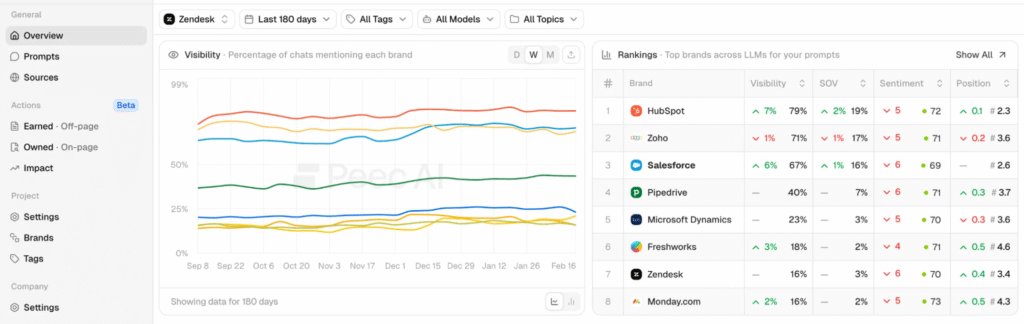
First in this list is Peec AI. If you’re looking for a tighter, more focused visibility dashboard rather than the widest possible engine list, Peec AI is probably the fit over Rankscale.
Where Rankscale spreads itself across 10 engines at every tier, Peec gives the flexibility to narrow to 3 of 7 on self-serve plans with analytics data, tracking position, sentiment, and cited sources daily by scraping the actual interface rather than calling the underlying APIs.
Where It Stands Out
- Genuinely easy to get live visibility, with unlimited seats on every paid plan, including the entry tier
- Competitor benchmarking that surfaces brands you didn’t know you were being compared against
- Prompt-level reporting clean enough to hand to a client without much reformatting
- Built-in “Pitch Workspaces” for agencies to build a prospect report before a client’s even signed
What to Consider
You’re capped at 3 engines on self-serve, and a 4th is a paid add-on rather than an upgrade unlock, so it costs more the moment you need Claude or Grok alongside the default three, which is worth considering when evaluating Peec AI alternatives. There’s also no historical backfill, so your data starts the day you start tracking rather than showing where you stood last quarter.
When to Choose Peec AI Over Rankscale
- You want unlimited seats on every plan, not just above the entry tier
- You’d rather have citation data and sentiment scoring in one dashboard than piece it together yourself
- You’re building pitch reports for prospects before they’ve signed
- You’d rather have a handful of engines tracked well than a wide list tracked thin
My Verdict: If your team is small, your engine list is short, and you want a clean dashboard without paying for coverage you won’t use, Peec is the pick. Skip it if engine breadth was the whole reason you looked at Rankscale in the first place, since that’s the one thing Peec makes you pay extra for.
2. Track My Visibility: Best for Turning Visibility Data Into Optimization Opportunities
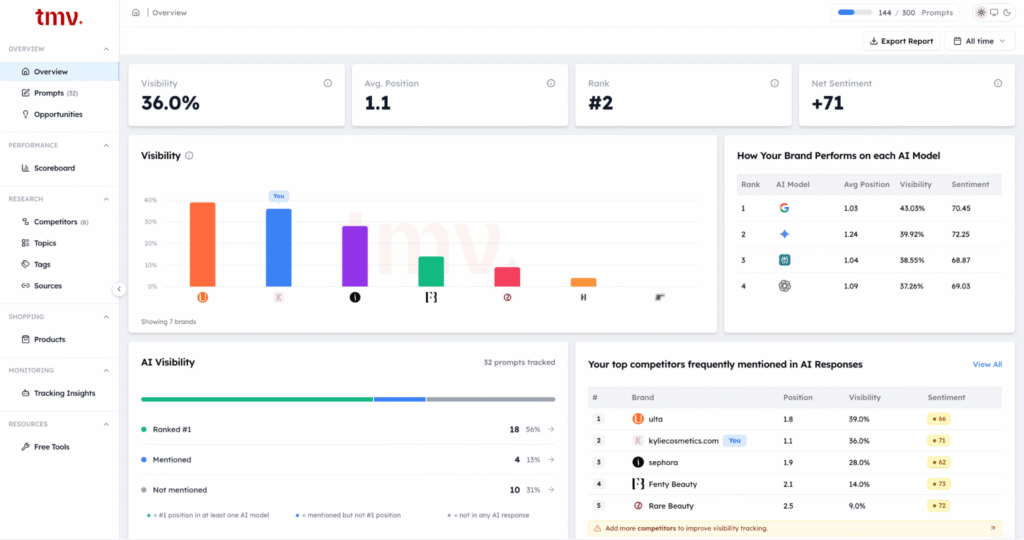
First, let me tell you that I’m from Track My Visibility, an AI visibility tracking tool.
Track My Visibility tracks brand visibility across ChatGPT, Perplexity, Gemini, and Google AI Overviews, and now also covers Grok and Microsoft Copilot, with the flexibility to choose any of those models right from the entry tier rather than gating them behind a higher plan. That model flexibility at the entry point is the kind of thing a lot of this category still charges extra for.
What Makes Track My Visibility Different
- Multi-platform visibility tracking across ChatGPT, Perplexity, Gemini, and Google AI Overviews
- Prompt-level brand monitoring, with position, sentiment, and visibility broken out per prompt
- Competitor comparison, including a Competitive Gap view that shows exactly which prompts a competitor wins that you don’t
- Citation and source analysis, showing which domains AI models actually pull from
- Content and page-level opportunities, with on-page, off-page, and technical recommendations tied to specific prompts, not generic advice
- Crawl insights, tracking which AI bots actually crawl your site, how often, and which pages, and whether they’re partially blocked
Where Track My Visibility Is Better Suited
Most tools in this category stop at telling you where you’re invisible. Track My Visibility’s whole structure is built around the next step, which is tracking, then surfacing the specific gap, then handing you a recommendation you can actually act on, whether that’s an FAQ schema addition, a crawl permission fix, or a content gap tied to a prompt you’re losing. If you want to know how we analyze brands, just take a quick look at our trackdown reports.
What to Consider
We surface content and page-level opportunities, meaning we’ll tell you exactly what to add or fix and where.
When to Choose Track My Visibility Over Rankscale
- You want tracking, gap identification, and a concrete next action in one platform instead of three
- You’re paying per brand somewhere else and want that pressure gone entirely
- You want crawl-level visibility into which AI bots are actually reaching your pages, not just answer-level tracking
- You’d rather get a prioritized recommendation than a dashboard you have to interpret yourself
My Verdict: If you want tracking, visibility gaps, and optimization direction in one place instead of stitching a tracker to a separate audit tool, Track My Visibility is built for exactly that.
 Pro tip: If you just want a quick look at how your brand’s showing up across AI platforms before you commit to anything, our free AI visibility checker does exactly that. It’s a lot easier to see than to guess.
3. Writesonic: Best for Combining GEO Tracking With Content Creation
Next, I’ve placed Writesonic for anyone looking for GEO tracking with content creation in one workflow rather than two separate tools.
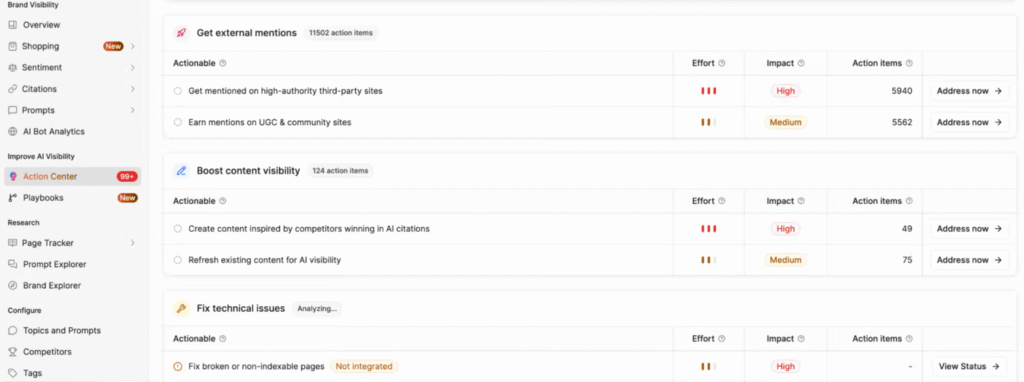
Writesonic bundles an AI Article Writer and a content agent right into the same product, where Rankscale tracks and hands you recommendations only. But it’s worth knowing upfront that self-serve tiers only cover ChatGPT, Gemini, and Google AI Overviews, with Perplexity and everything else locked to Enterprise. So if you specifically need a Perplexity tracking tool, Writesonic isn’t it below that tier.
Why Writesonic Is Different
The core buying angle here isn’t tracking accuracy; it’s the ecosystem around it.
- AI visibility and GEO monitoring, daily, across a smaller engine set than most on this list
- Content creation, with an AI Article Writer and SEO content agent included at every tier
- Content optimization tied directly to the visibility gaps it finds
- Broader SEO workflows, including site audits and crawler analytics
- Brand monitoring across the platforms it does cover
Where It Makes Sense
Best for teams that don’t want separate tools for tracking and producing content, and would rather close the loop on a visibility gap inside the same login than hand it off to a writer somewhere else.
What to Consider
Someone wanting a dedicated visibility analytics platform, with deep engine coverage and nothing else competing for attention, may find Writesonic’s content-first roots showing, and the real execution feature (Action Center) isn’t available below Growth at $399/mo.
When to Choose Writesonic Over Rankscale
- You want content production and visibility tracking living in the same workflow, not two tools you’re stitching together
- You’d rather have article generation included than pay for tracking alone
- You’re fine with a narrower engine list in exchange for that content layer
My Verdict: Best suited to content-heavy teams that want GEO insights tied directly to content production, rather than a tracker they still have to hand off to someone else to act on. Skip it if Perplexity coverage matters to you, since that stays locked to Enterprise on every self-serve tier.
4. AthenaHQ: Best for GEO Strategy and Execution
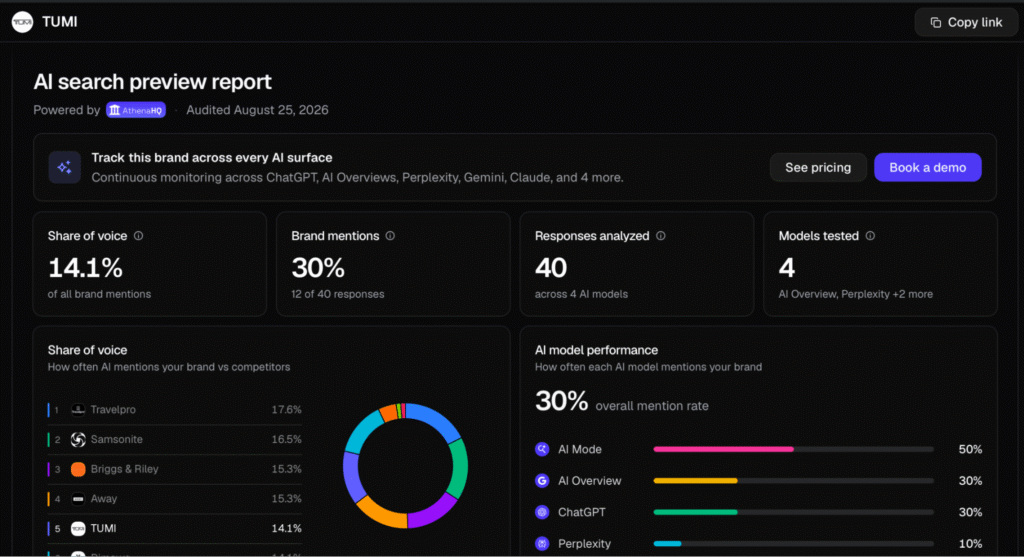
Up next is AthenaHQ. It’s structurally the closest match to Rankscale on this list, since both run a credit-based system and both refuse to gate engines behind higher tiers. AthenaHQ covers 8 platforms at $295/mo Self-Serve with nothing held back, versus Rankscale’s 10 at $20/mo.
One thing to note is the execution layer: Rankscale’s Scout gives you recommendations, but AthenaHQ adds Ask Athena, a conversational copilot for querying your own visibility data, and an Action Center that turns findings into assignable tasks rather than a dashboard you have to interpret yourself.
What AthenaHQ Focuses On
- Brand visibility across all 8 platforms, unlimited topics, no per-engine gating
- Competitor benchmarking and share of voice
- Citation and source tracking, with a more advanced citation-prediction layer at Enterprise
- Content gaps surfaced through dynamic crawling and blindspot detection
- Optimization recommendations delivered as structured, assignable tasks rather than static charts
Where It Stands Out
The real strength is that AthenaHQ doesn’t stop at analytics; it pairs the tracking with an execution layer built to hand off, so a finding turns into a task someone on your team can actually pick up and close.
What to Consider
That broader GEO workflow is genuinely more than a smaller team needs, and the credit pool is shared across monitoring, Ask Athena, and agent runs, so the $295 sticker price is widely reported to understate what you’ll actually spend once you’re using more than basic tracking. If you’re a single brand just trying to see where you stand, this is more machinery than the job calls for.
When to Choose AthenaHQ Over Rankscale
- You want the findings turned into assignable tasks, not just a recommendation to act on
- You’d rather query your data conversationally than build your own reports
- You’re actively resourced to act on GEO, rather than just monitor it
My Verdict: Good fit for teams actively investing in GEO rather than simply monitoring mentions. Skip it if you’re watching spend closely, since the shared credit pool makes the real monthly cost harder to predict than the sticker price suggests.
5. Otterly AI: Best for Simple AI Search Monitoring
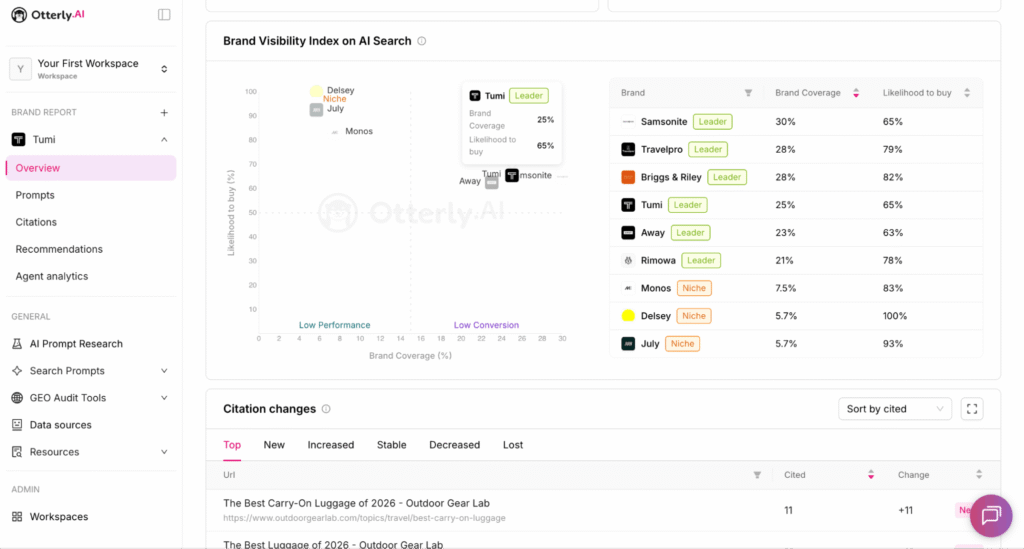
Of course, I’ll add a simple and budget-friendly tool to this list: Otterly. What makes it different from Rankscale is methodology transparency and billing:
(1) Rankscale’s capture method isn’t clearly disclosed in comparison to Otterly’s data-capture methodology. And that claim holds up under scrutiny in a way a lot of marketing copy in this category doesn’t, since Otterly replicates the actual AI web interface rather than pulling from an API.
(2) Another thing is Otterly bills by a straightforward prompt count per tier instead of a shared credit pool like Rankscale.
Why Otterly AI Is Worth Considering
- Straightforward setup, without a lot of configuration before you see your first data
- Prompt tracking across the 4 core engines, included on every tier
- Brand mentions and where you stand against competitors
- Citations, showing which sources AI answers actually pull from
- Competitor monitoring built into every plan
- Accessible pricing, with a genuinely usable $29/mo entry tier and no feature bait-and-switch at that price
Where It Fits
Useful for users who want fewer layers and a simpler monitoring workflow, without a credit system to track or a methodology they have to take on faith. It’s a genuinely good fit if you’re a solo consultant or a small team who wants flat, predictable billing and a clear answer to “how is this actually measured” rather than a usage meter and a shrug.
What to Consider
It may not provide the same depth required by larger enterprise or highly advanced GEO teams, and the moment you want Claude or Gemini alongside the core four, the real monthly cost climbs well past the advertised $29/mo.
When to Choose Otterly AI Over Rankscale
- You want a clearly stated, corroborated capture methodology instead of an undisclosed one
- You’d rather bill by a flat prompt count than manage a shared credit pool
- You’re a smaller team or solo marketer who wants monitoring without a learning curve
My Verdict: A good starting point for smaller marketing teams, consultants, and businesses just beginning AI visibility tracking. Skip it if you already know you need Claude and Gemini in the mix, since that’s where the price stops looking like $29/mo.
6. Scrunch AI: Best for AI Visibility and Website Readiness
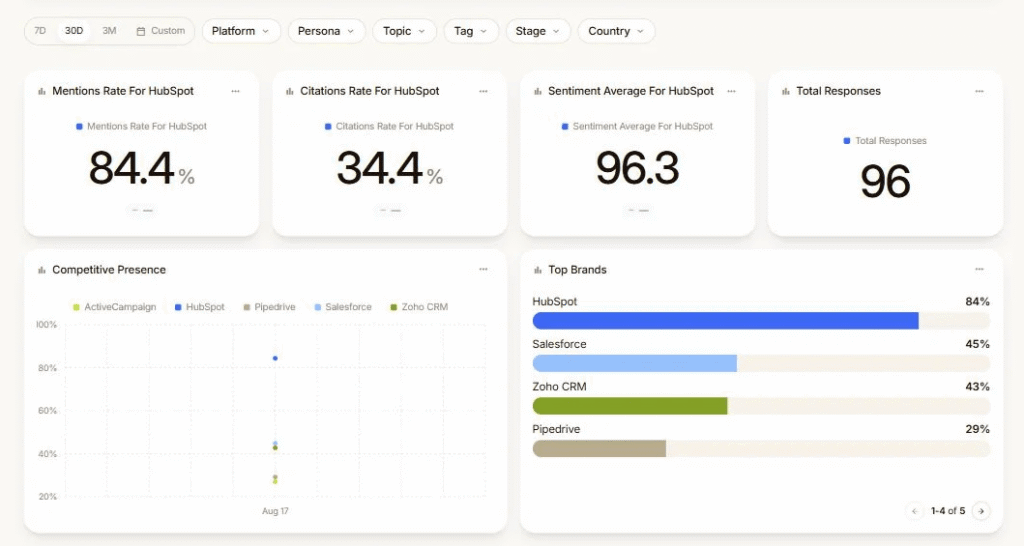
For anyone looking for deep analytics at the infrastructure level, Scrunch is the one to know. It shows what an AI crawler actually sees on your site versus what a human sees, tracks bot traffic through GA4 and Cloudflare, and flags when a model states something flat-out wrong about your brand, bad pricing, fake partnerships, that sort of thing, which is a layer of diagnosis Rankscale simply doesn’t have.
What Scrunch AI Adds Beyond Tracking
- AI visibility monitoring across mentions, sentiment, and citation rate
- Website analysis showing exactly what an AI crawler renders versus what a person sees
- How AI agents understand and access your website, down to which pages they can’t reach
- Brand and citation monitoring, plus hallucination detection for when a model gets your own facts wrong
- Enterprise workflows built for teams managing this at scale, now backed by Sitecore’s stack
When to Choose Scrunch AI Over Rankscale
For companies concerned with both “are we appearing in AI?” and “can AI systems actually understand our website?” Rankscale answers the first question well. Scrunch is one of the only tools on this list built to answer the second.
What to Consider
This is genuinely more than smaller businesses need, and the entry price reflects that: Core starts around $300/mo for 4 engines, with credits consumed per engine rather than per prompt. The pricing page itself has also been documented showing different plan structures to different visitors on the same day, so whatever you see quoted is worth confirming directly before you commit.
My Verdict: Best suited to larger organizations thinking about AI discoverability beyond rankings alone. Skip it if you’re a smaller team just trying to track mentions, since you’d be paying enterprise infrastructure pricing for a diagnosis layer you don’t need yet.
7. Profound: Best for Enterprise AI Visibility Programs
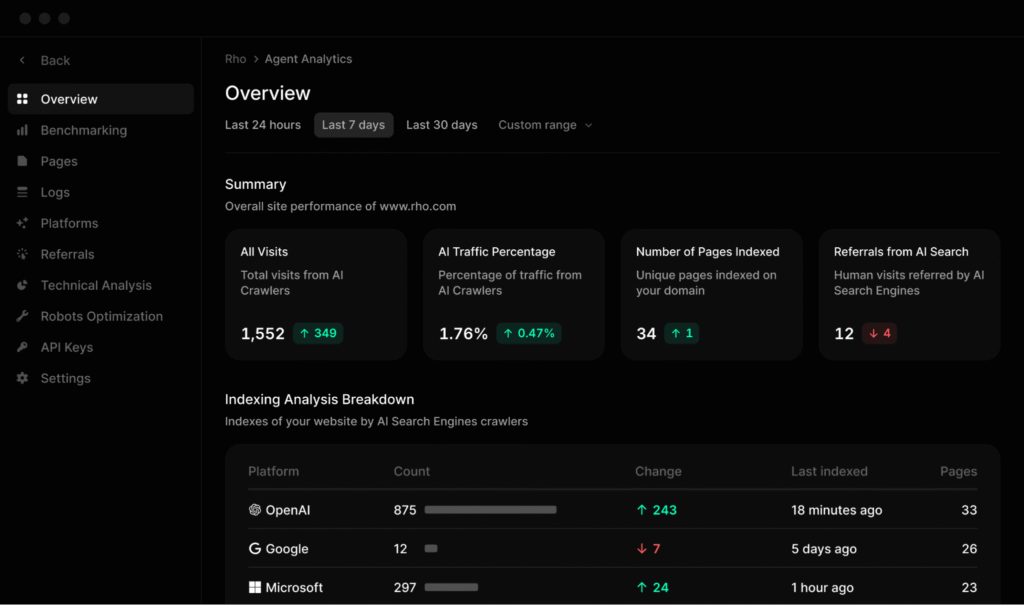
Most known tool in this category: Profound. It queries the front-end experience rather than APIs and runs every tracked prompt daily on every tier, including the $99 one, and it’s the only tool on this list with Prompt Volumes, panel data on what real users are actually asking AI models, which nobody else here has access to. On the infrastructure side, it also does server-side AI-bot log tracking with spoof verification, unlimited on every tier, which is the kind of depth Rankscale simply doesn’t compete on.
Why Profound Is Different
The positioning here is genuinely enterprise, even though the reviewer base skews more mid-market than the branding suggests.
- Answer-engine visibility across up to 9 platforms, though 7 of those 9 require an Enterprise contract
- Large-scale prompt monitoring, with response volumes in the thousands per month on paid tiers
- Citation intelligence, including FactCheck for surfacing inaccurate AI claims about your brand
- Competitive analysis and share-of-voice benchmarking
- Reporting built for organizations with more than one stakeholder to answer to
- Content and AEO workflows, with Agents that draft and publish directly into WordPress, Sanity, or Contentful
Where Profound Fits
This is built for companies that need more than a tracker, meaning dedicated GEO/AEO teams running content generation, crawler-log analytics, and weekly prioritization inside one platform rather than stitching several tools together.
What to Consider
This is likely excessive for smaller businesses or anyone primarily looking for inexpensive monitoring, and the real entry cost for meaningful engine coverage is closer to $399/mo than the $99 headline, since Starter alone only gets you ChatGPT, which may push smaller teams toward Profound alternatives with broader coverage at a lower price point.
When to Choose Profound Over Rankscale
- You need content generation and publishing built into the same platform as tracking
- Your team requires crawler-log analytics at the scale Agent Analytics provides
- You’re an established brand with a dedicated GEO/AEO team and complex reporting needs
My Verdict: Best for established brands with larger teams and serious AEO/GEO programs already in motion. Skip it if you’re price-sensitive or just need broad engine coverage without the enterprise machinery.
Pro tip: If you’re evaluating Profound (or any enterprise-tier tool) against what your program actually needs, check through our AEO/GEO audit checklist first to know whether you need enterprise-level machinery or whether a simpler tool.How to Choose the Right RankScale AI Alternative
Okay, let me help you make things a bit easier. Look out for these things when choosing a RankScale alternative, and use them to decide which one fits.
- AI platform coverage: Check if it covers the AI engines your audience actually uses.
- Prompt limits: Figure out how many prompts you actually need to track, then check whether you can run and monitor that many at the price you’d pay.
- Citation tracking: Confirm you can see which URLs and domains are actually influencing what the AI says about you.
- Competitor insights: Check that it shows exactly where competitors are showing up in your place.
- Optimization features: Look for whether it tells you what to fix, beyond just showing where you’re invisible.
- Pricing model: Check whether cost stays predictable as your prompt volume grows, or climbs quietly with usage.
- Team needs: Confirm it covers agency workspaces, exports, APIs, or client-ready reporting if you need them.
Which RankScale Alternative Fits Your Needs Best?
Let me give you a quick summary of this blog.
If you’re mainly frustrated with the credit math, Otterly gets you flat, predictable billing without a credit pool to manage. Agencies chasing white-label reporting without a steep tier jump should look at Peec instead, since unlimited seats come standard on every plan there. For a team that wants tracking and a concrete next action in one place rather than a dashboard to interpret, that’s exactly the gap Track My Visibility was built to close.
Writesonic fits best once content production and visibility tracking need to sit in the same workflow. Larger organizations worried about whether AI crawlers can even read their site properly should be looking at Scrunch, not a pure tracker. And AthenaHQ or Profound are the right call once you’ve moved past monitoring and have a team actually resourced to act on GEO, with Profound fitting specifically once both the budget and the team are enterprise-sized.
BTW, If you’re looking for a place to start, we’ve got a 7-day trial. See how it works for you.
FAQs
Yes, and it’s the safer way to do it. Most of these have short trials or month-to-month entry tiers, so overlapping for a few weeks costs little and lets you compare real numbers before you cancel anything.
Track My Visibility and AthenaHQ both go beyond reporting into recommendations or assignable tasks. Scrunch does this too, but the fix layer is Enterprise-only.
Not inherently, but credit systems get expensive fast once you’re tracking across multiple engines, since most charge per engine response rather than per prompt. Flat pricing is easier to predict; credit pricing can be cheaper if you genuinely use few engines.
Citation tracking matters if you want to know why you’re showing up, not just that you are. Visibility scores alone won’t tell you which pages or domains the AI is actually pulling from.