


You’ve spent months optimizing your website. Rankings look solid. Traffic is decent. Then someone on your team searches your brand name in ChatGPT or Perplexity, and you’re nowhere to be found.
That sucks, right? Especially when a competitor you’ve been outranking on Google shows up in the very first sentence of the AI response.
This is the new visibility gap, and it’s catching a lot of teams off guard. Just 16% of brands today systematically track their AI search performance (McKinsey), which means most brands have no idea where they stand.
75% of people say they’re using AI search tools more than they did a year ago, and 43% use them daily or more (Yext). If your buyers are in that group and your brand isn’t showing up in their AI search results, you’re not just losing visibility, but you’re also losing the consideration stage entirely.
That’s why AI search visibility tools exist. Two names that keep coming up for teams not ready for enterprise pricing are Track My Visibility vs RankScale AI.
Both are AI visibility tracking platforms that monitor brand mentions across AI search engines. The difference is in how they’re built and who they’re built for.
In this blog, we’ll cover:
- What each tool does and how it actually works
- Where they’re genuinely different (beyond the feature lists)
- Which one fits your budget, team size, and comfort level
- A clear recommendation for your specific use case
- Honest limitations of both platforms
Key Takeaways
- Track My Visibility is built for accessibility; RankScale AI is built for analytical depth.
- RankScale covers 10+ AI engines; Track My Visibility covers the 4 most widely used ones.
- Track My Visibility offers unlimited team seats on all plans; RankScale AI locks that to Pro and above.
- Both tools run synthetic prompts, not real user queries, so results are directional, not absolute.
- The right AI search visibility tool depends on your budget, technical comfort, and how many AI engines you actually need to track.
What Is Track My Visibility?
Aureate Labs built Track My Visibility for the kind of team that doesn’t have a data analyst on speed dial or a five-figure tool budget to throw at the problem.
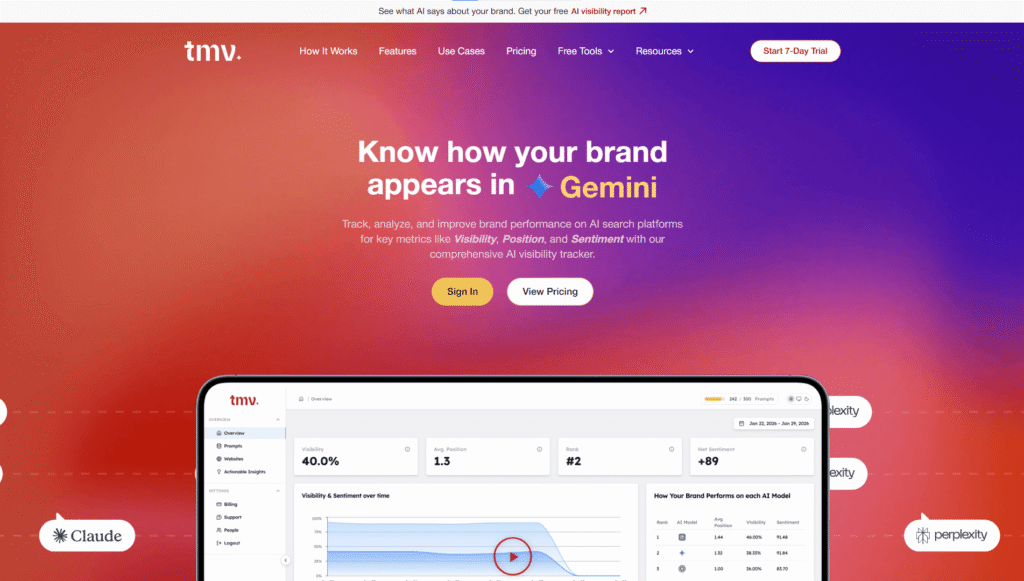
The core of what it does is URL-level citation tracking. You find out exactly which pages on your site are showing up in AI engines like ChatGPT, Google AI Overview, Gemini, and Perplexity, and which ones are getting ignored completely. Once you know that, the platform points you toward what actually needs fixing.
If you’re a startup, a small agency, an eCommerce brand, or just someone taking their first real steps into generative engine optimization (GEO), this is probably the least overwhelming place to start.
 Pro Tip: Not sure where your brand stands right now? Before comparing tools, run a free check. The AI Visibility Checker gives you a quick snapshot of how your brand appears across AI platforms, no signup required.
 Key Features of Brand AI Tracking Visibility Tool Track My Visibility
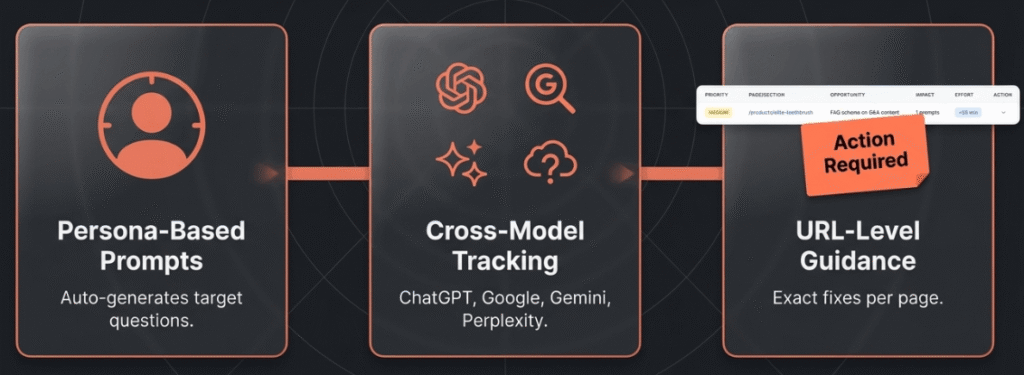
1. AI-Ready Score: Every URL on your site gets graded on how well it’s set up to appear in AI answers. But it doesn’t just hand you a number and walk away. It tells you what’s holding each page back and what to fix first. That prioritization is what most teams are missing when they first start thinking about AI search visibility. You stop asking “where do I even begin” and start working through an actual list.
2. URL-level Citation Tracking: With this feature, you can see which pages are getting picked up by ChatGPT, Google AI Overview, Gemini, and Perplexity, and which ones aren’t registering at all. That specificity matters because “your site isn’t showing up” is not an actionable problem. “These three pages are getting cited, and these seven aren’t.
3. Persona-based Prompt Generation: This is one of those features you don’t fully appreciate until you’ve manually built a prompt list from scratch. The tool generates your AI prompts based on your customer personas instead of making you write them all out yourself. For agencies handling multiple clients, that’s a meaningful chunk of setup time saved on day one.
4. Cross-model Comparison: It shows you how your brand’s visibility stacks up across different AI search engines at the same time. The gaps between what Perplexity surfaces vs. what Gemini picks up are often surprising, and usually worth investigating.
5. Competitor Benchmarking: This feature helps you see exactly where competitors are getting cited, and you’re not. Those visibility gaps are your starting point for figuring out what content to write or fix next.
How Does Track My Visibility Work?
The setup of the Track My Visibility AI SEO tool is pretty straightforward and simple. You define your prompts (or let the persona-based generator handle it), and the AI SEO tool runs them automatically across the AI search tools it covers. It checks which URLs get pulled into the AI-generated answers, logs the results, and refreshes your dashboard daily.
What makes it click for content teams is the page-level focus. The AI-Ready Score doesn’t just tell you “your brand isn’t showing up in AI search.” It tells you which specific page is the problem and why. That’s the difference between a useful insight and a vague warning.
If you’re not an SEO professional, that matters a lot. The interface doesn’t just dump raw visibility data on you and expect you to figure it out. It’s built around a simple set of questions: what’s being cited, what’s being ignored, who’s showing up instead of you, and what you should fix first. That’s it.
Track My Visibility: Pros and Cons
Pros
- Actionable AI-Ready Score: Instead of staring at your content and guessing what to fix, this score tells you exactly where to start. It grades your pages based on how LLM visibility tools perceive them, so your team is working from actual data rather than gut feel.
- Accessible Entry Point: At $50/month for 25 prompts, smaller teams can genuinely start building AI search visibility without a big financial bet.
- Specific URL Recommendations: You get concrete suggestions at the URL level, both technical and editorial, so you know what to do and where to do it.
- Persona-Based Prompting: Building a prompt list from scratch takes time most teams don’t have. This feature generates relevant AI prompts based on your target audience personas automatically, which cuts hours off your initial setup.
- No Per-Seat Fees: Unlimited team members on all plans is a real advantage for agencies. You can loop in clients, writers, and strategists without watching the bill climb every time someone new needs access.
Cons
- Growing Documentation: It’s a newer platform, and the help library reflects that. For straightforward use cases, you’ll be fine, but anything niche might mean a support email rather than a quick help article.
- Early-Stage Integrations: If your team lives inside Google Analytics or other SEO suites, the connections aren’t fully there yet. Data export works, but fully automated workflows between Track My Visibility and the rest of your stack are still being built out.
- Limited Language Support: Works well for English-first markets. If your brand operates across multiple regions in non-English languages, you may run into walls that enterprise-level AI visibility tools don’t have.
- Lighter Analytics Depth: The focus is on visibility and optimization, which is exactly what most teams need at this price point.
Pricing and Accessibility of Track My Visibility
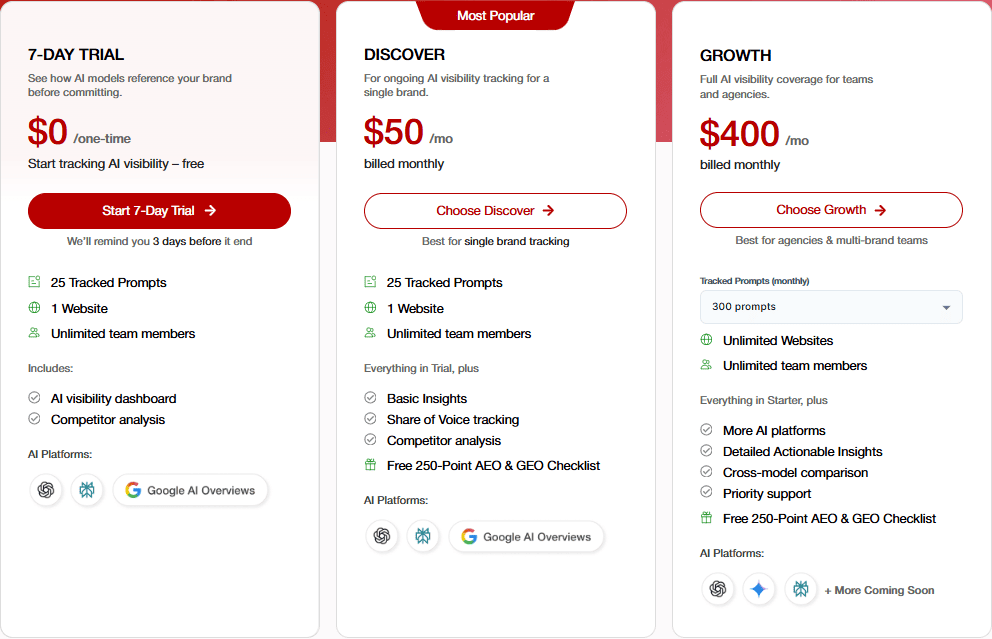
Trial: Free for 7 days
- 25 tracked prompts
- 1 website
- Unlimited team members
- Competitor Analysis
- AI Visibility Dashboard
- 3 AI platforms (ChatGPT, Perplexity, Google AI Overviews)
Discover Plan: $50/month
- 25 prompts per month
- 3 AI platforms tracked (ChatGPT, Perplexity, Google AI Overviews)
- Unlimited users
- Basic Insights
- Share of Voice tracking
- Competitor analysis
- Free 250-Point AEO & GEO Checklist
Grow Plan: $400/month
- Up to 300 prompts per month
- 4 AI platforms (ChatGPT, Perplexity, Google AI Overviews, Gemini)
- Unlimited websites
- Unlimited team members
- Detailed Actionable Insights
- Cross-model comparison
- Priority support
- Free 250-Point AEO & GEO Checklist
They offer an annual discount with 2 months free when you choose yearly billing on any plan.
Every plan comes with unlimited team members. Your whole marketing or content team can use the platform without extra fees per user.
Note: Pricing may change over time, so it’s best to check their official page for the most up-to-date information.
What Is RankScale AI?
RankScale AI comes out of Vienna, Austria. Mathias Ptacek and Patrick Schmid founded RankScale GmbH in 2024. They officially launched in July 2025, shipped RankScale 2.0 just three months later in October, and have been bootstrapped the whole way through.
That founder-led, no-outside-funding setup has a real effect on how the product feels. Features move fast. Documentation occasionally struggles to keep pace. If you’re the type who reads every changelog, you’ll have plenty to read.
The core philosophy is different from Track My Visibility. Where Track My Visibility is built around making things approachable, RankScale AI goes deep. It’s the kind of tool that SEO professionals, digital agencies, and technically comfortable marketing teams reach for when they want serious AI visibility tracking data without paying enterprise prices.
The model coverage alone sets it apart. Most tools in this price range track the same four AI search tools. RankScale AI covers 10+, including Grok, DeepSeek, Mistral, Copilot, Google AI Overviews, and Google AI Mode. If your audience is spread across the broader AI search ecosystem and not just the big four, that matters quite a bit.
Key Features of RankScale
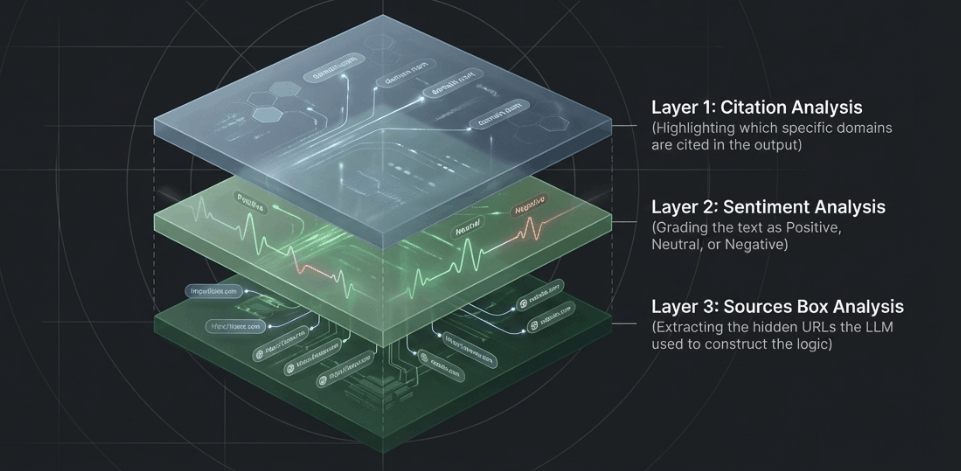
1. AI-Ready Score via Page Audit: Rule-based (not LLM-generated), covering traditional SEO, RAG readiness, E-E-A-T, and Schema. Pages are categorized as “perfect-mix,” “ai-trap,” or “hidden-gem.” This gives you a concrete before/after framework for content changes.
2. Comprehensive Citation Analysis: Which domains are getting cited, how frequently, and which ones have the most influence in AI responses for your tracked queries.
3. Sentiment Analysis: Positive, neutral, or negative sentiment per AI engine and topic. Useful for brand visibility monitoring, not just citation counting.
4. Competitive Benchmarking: Automatic competitor discovery, share-of-voice by engine, citation analysis, and trend graphs over time.
5. Sources Box Analysis (Rankscale 2.0): Deep analysis of the source boxes that appear in AI-generated answers.
6. Query Fan Out (Rankscale 2.0): Maps how AI engines expand a single query into related topics. This helps you understand the full range of questions your content needs to answer to stay in the mix.
7. Prompt Decoding: A methodology RankScale exclusively licenses to understand how prompts are interpreted across different engines.
How Does RankScale Work?
You set up your prompts, pick which AI search engines you want to track, and RankScale handles the rest. It runs those prompts on a schedule, either daily or hourly, and logs your visibility score, mention position, and citation sources each time.
You also get the full AI-generated answer captured for every run, so you can actually read what each engine said about your brand, not just whether it mentioned you.
The credit system is straightforward once you understand it, but it catches people off guard at first. One credit equals one AI response. Track one prompt across four AI engines, and that’s four credits, every single run. Run that daily for a month, and you can see how the numbers climb. It’s worth mapping this out before you set up tracking for a large prompt list.
The filtering is genuinely useful. You can cut the data by region, AI tools, topic cluster, or sentiment, depending on what you’re trying to answer. If you’re on Pro or Enterprise, you also get CSV export for pulling the raw data into your own reporting setup.
RankScale AI: Pros and Cons
Pros
- Most Affordable Entry Point at $20/Month: For the depth of data you’re getting, $20/month is hard to argue with. Most tools with comparable AI model coverage charge significantly more just to get started.
- Broadest AI Platform Coverage (10+ Engines): This is where RankScale AI really pulls ahead. While most AI visibility tools cover the big four, RankScale tracks 10+ AI search engines, including Grok, DeepSeek, Mistral, and Copilot.
- Deep, Query-Level Granularity with Full Answer Capture: You don’t just see whether your brand was mentioned. You see the full AI-generated response, which gives you context that summary-level AI visibility tracking simply can’t offer.
- Before/After Content Recommendations via Page Audit: The Page Audit doesn’t just flag problems. It gives you a before/after framework so you can see the actual impact of content changes on your AI search visibility.
- Live Support Across Plans: Even the $20 Essential plan. That’s not common. Most tools at this price tier give you a knowledge base and a contact form.
Cons
- Steep Learning Curve: Multiple users have described it that way, and it fits. The interface is clean, but the feature set is dense. If you’re new to AI visibility tracking, expect to spend real time learning the platform before you feel confident in the data.
- Credit Burn Can Sneak Up on You: Tracking one prompt across 4 AI engines daily burns 4 credits per day. Scale that up across multiple prompts and AI search tools, and your 120 monthly credits on the Essential plan go faster than expected.
- No PDF Report Download: This one comes up a lot in user feedback, and it hasn’t shipped yet. If you regularly send reports to clients or stakeholders who just want a PDF they can open, you’ll need to work around this for now.
- No Native Looker Studio or Google Analytics Integration: There’s no direct connector to either platform. You can export CSV data and build your own dashboards, but it’s a manual process.
Pricing and Accessibility of RankScale
RankScale keeps its entry point low enough that even a small team can test it without much financial risk. There’s a 7-day free trial.
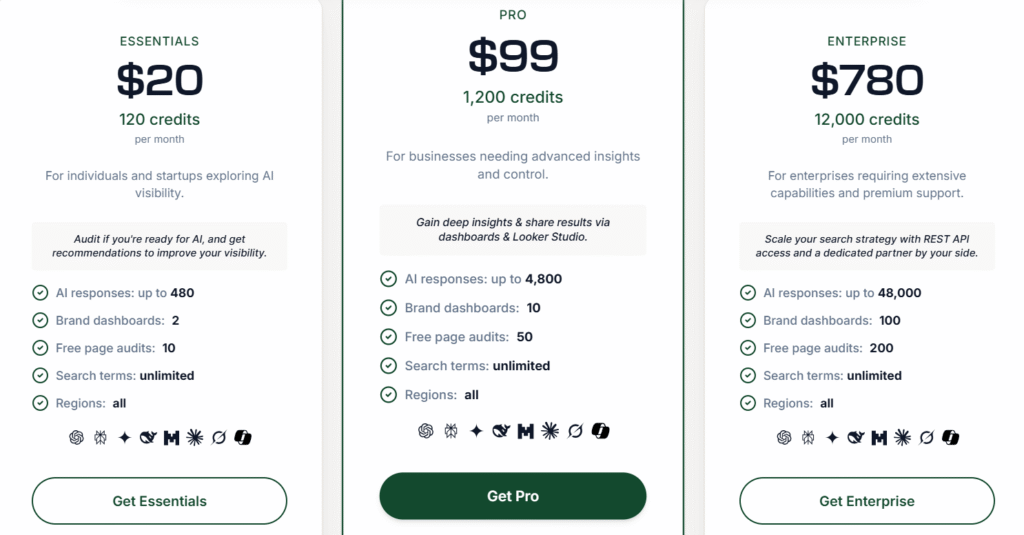
- The Essential Plan: $20/month gets you 120 credits, which translates to up to 480 AI responses, 10 page audits, and 5 brand dashboards. It’s a solid starting point for individuals or small teams tracking a focused set of prompts.
- The Pro Plan: At $99/month, you get 1,200 credits, up to 4,800 AI responses, 50 audits, and 25 brand dashboards. This tier also unlocks the team workspace, so your full team can collaborate inside the platform.
- The Enterprise Plan: $780/month covers 12,000 credits, up to 48,000 AI responses, 200 audits, and 100 brand dashboards. Built for agencies or in-house teams managing multiple brands at scale.
One thing that’s worth noting is that unlimited team seats are only available on Pro and Enterprise. If you’re on the Essential plan and need more than one person in the account, you’ll need to factor that into your plan decision before signing up.
Track My Visibility vs RankScale AI: Head-to-Head Feature Comparison
Now that you know what Track My Visibility vs RankScale AI each tool is, here’s how they stack up directly across the features that actually matter.
| Feature | Track My Visibility | RankScale AI | Winner |
| Starting Price | 7-day Free trial / $50/month | $20/month | RankScale (lower entry) |
| AI Platforms Tracked | 4 | 10+ | RankScale |
| Prompts Per Month (Base) | 25 | ~30 equivalent | Draw |
| Primary Strength | URL-level guidance | Analytical depth | Depends on use case |
| Unique Feature | AI-Ready Score + Persona Prompts | Query Fan Out + Sources Box Analysis | Draw |
| Reporting & Analytics | Clean, action-focused | Deep, multi-dimensional | RankScale |
| Actionable Recommendations | URL-centric optimization | Before/after content comparisons | Draw |
| Multi-Language Support | Primarily English | Primarily English | Draw |
| Team Members Included | Unlimited (all plans) | Unlimited (Pro+ only) | Track My Visibility |
| Integration Options | Limited (API in development) | CSV export, maturing API | RankScale |
| Customer Support | Email, founder-led | 24/7 live + email | RankScale |
| Best For | Beginners, small teams, agencies | Technical SEOs, data-heavy teams | Depends |
| Free Trial | Yes (7-day free trial) | Yes (7-day free trial) | Tie |
Limitations of Both LLM Visibility Tracking Tools
Before you commit to either AI SEO platform, there are a few things worth being clear-eyed about.
Both tools run AI prompts synthetically. They don’t track actual user search volume. When a tool shows you that your brand appears in a certain percentage of responses, that’s based on the prompts you defined, not on real queries from real users. It’s directional data, not confirmed impressions.
And here’s something that makes this even more interesting: there’s less than a 1 in 100 chance that ChatGPT or Google’s AI, if asked the same question 100 times, will give you the same list of brands in any two responses
— Rand Fishkin, Co-founder, SparkToro (research conducted with Patrick O’Donnell, Gumshoe AI)
That’s how inconsistent AI-generated answers can be, even without any content changes on your end.
Neither tool can guarantee that better AI visibility translates to more traffic or conversions. Citation presence is a signal, not a sale.
AI search engines update constantly. A content change that improves your visibility in Perplexity today might not move the needle in Google AI Mode at all, and vice versa. You need to monitor continuously, not just check in quarterly.
Human judgment is still required. A tool that shows you’re being cited regularly can’t tell you whether those citations are in contexts that actually matter to your buyers. That interpretation is still yours to do.
Risk of Over-Relying
The data is a starting point, not a strategy. Both brand AI search visibility tracking tools give you visibility data, but the strategy of what to write, which topics to prioritize, and how to position your brand in AI-generated answers still requires competitive expertise and audience understanding that no tool can substitute.
The teams getting the most out of these tools are the ones treating them as a feedback loop, not a decision engine.
Future of Both the Track My Visibility vs Rankscale AI Search Visibility Tools
AI search is not a niche anymore. It’s shifting how buyers at every level of the funnel discover brands, compare options, and form opinions before they ever visit a website. The volume of AI answers being served daily is significant, and it’s still growing.
The scale is hard to ignore. Google AI Overviews now reach 1.5 billion monthly users (Search Engine Land), and Gartner projects that traditional search volume will drop 25% by 2026. That’s not a slow shift, that’s a structural change in how buyers find information, and it’s already underway.
Content quality, entity clarity, and schema structure are becoming more important than raw link volume. If an AI engine can’t confidently determine what your brand does, who it’s for, and why it’s credible, it won’t cite you, regardless of how many backlinks you’ve built.
Both Track My Visibility vs RankScale AI are building toward integrated platforms where tracking and optimization happen in the same place. Both tools still require you to take insights and fix things manually. Expect that gap to close as the market matures.
The GEO tools category is still early. Features are being shipped faster than documentation in some cases. That means both platforms will look meaningfully different six months from now. The teams that start building visibility data now will have a significant advantage over those who wait for the tools to mature.
Track My Visibility vs RankScale: Actual Performance Analysis
Let’s look at both Track My Visibility vs RankScale AI brand visibility tool dashboards. And see how both AI search platforms perform.
1. AI Platform Coverage
Track My Visibility covers ChatGPT, Google AI Overviews, Gemini, and Perplexity. That’s the core four. And honestly, for most teams, those four are where the bulk of your audience is actually searching right now. You can get access to these AI search tools with different plans, and they are also working on adding more AI models to their list.
RankScale goes wider. On top of those four, you also get Grok, DeepSeek, Mistral, Copilot, and Google AI Mode. If you need to track brand visibility across the full AI ecosystem, that kind of breadth is tough to match at this price point.
2. Ease of Use and Setup
Here’s what the setup looks like for each tool.
Track My Visibility keeps onboarding refreshingly simple. You create your account, pick a plan, and enter your website name. This is your starting point.
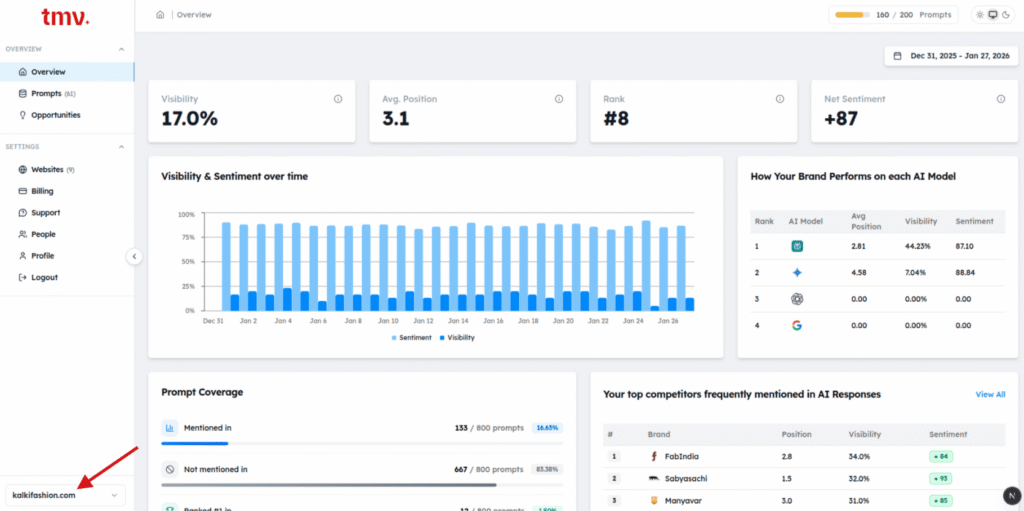
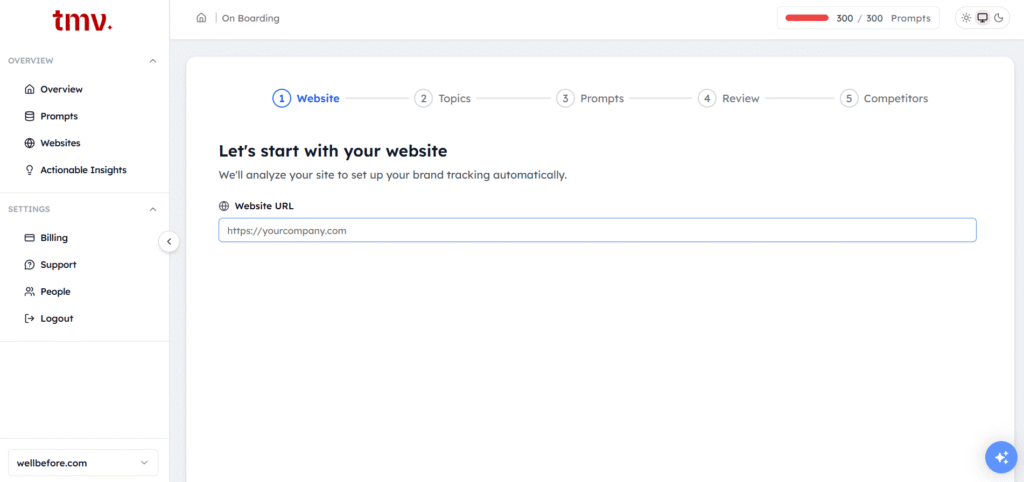
From there, you walk through a 5-step setup process. The tool suggests topics relevant to your site, and you just pick what fits and drop what doesn’t. No manual configuration required. Once that’s done, it generates your AI prompts automatically. You can leave them as-is or add more later as your tracking needs grow.
After setup, it pulls together recommendations showing what’s working and what needs attention. Your brand’s visibility across AI platforms lives in the main dashboard, which refreshes every 24 hours, so you’re always looking at current data, not last week’s snapshot.
RankScale interface is clean and focused, giving you actionable before-and-after comparisons without burying you in noise. The analytics go deep when you need them, covering sentiment analysis and citation analysis by source, but the dashboard stays navigable because it’s built specifically for GEO rather than trying to be a full traditional SEO suite.
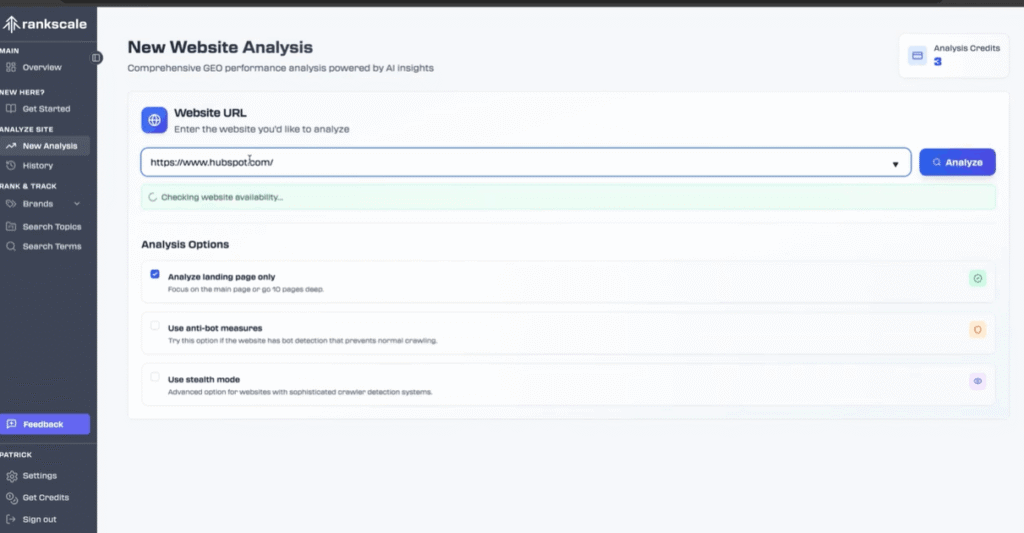
Setup is fast, too. Most users have their topics, AI prompts, and brand visibility dashboard configured in under two minutes, with the flexibility to choose which AI search engines they want to monitor, whether that’s ChatGPT, Google AI Overviews, Perplexity, Claude, or Google Gemini.
3. Reporting and Analytics
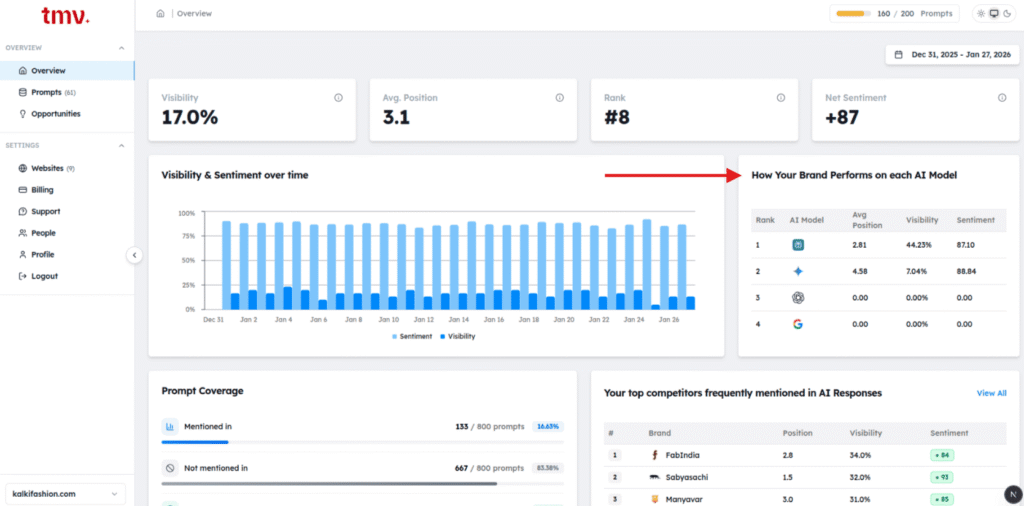
Track My Visibility keeps reporting straightforward. You get model-wise AI platform coverage so you can see where your brand appears and where it doesn’t.
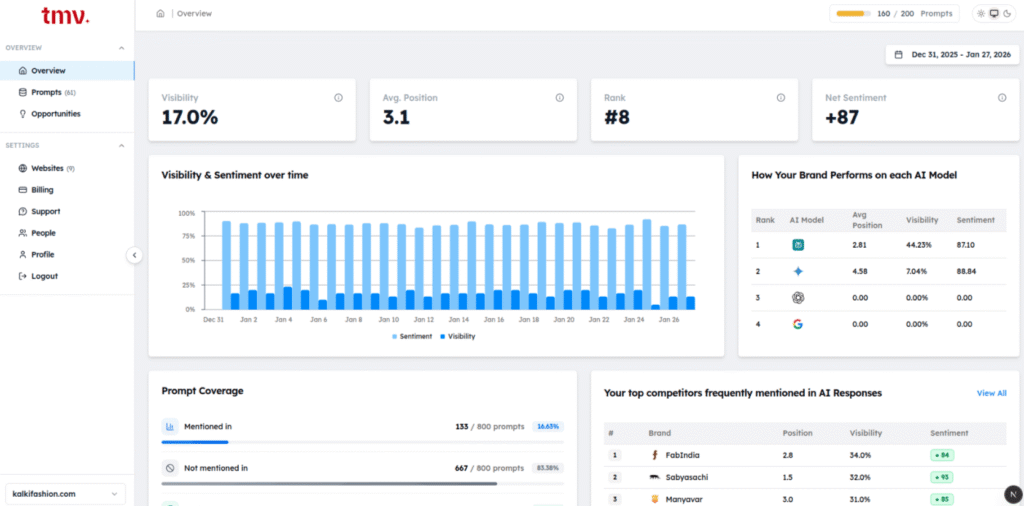
You also get an AI-Ready Score per URL that tells you exactly what to fix, a full AI visibility tracking breakdown showing how many prompts your brand appeared in, how many it missed, and how many times it ranked first.
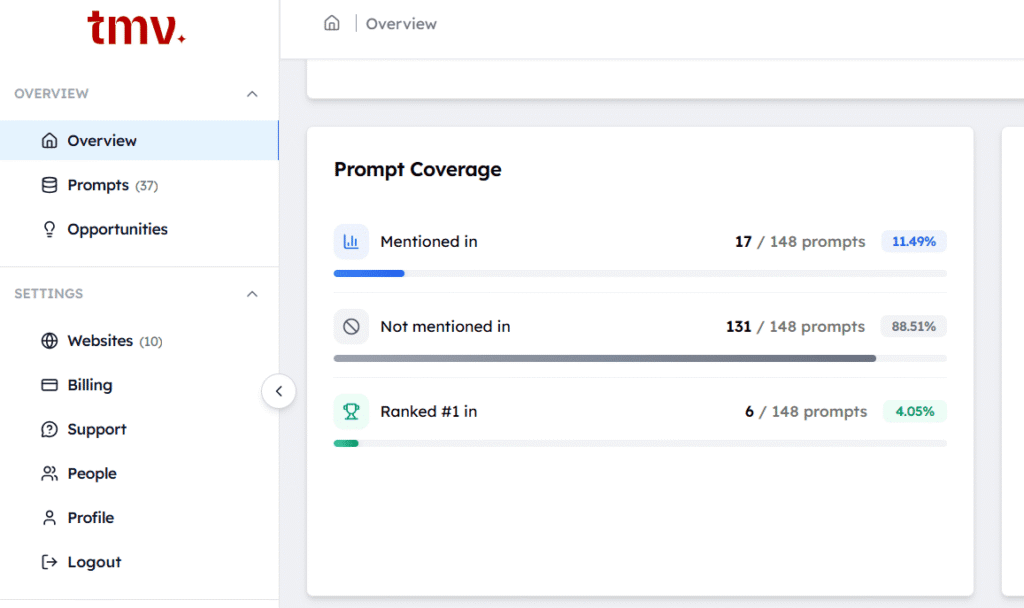
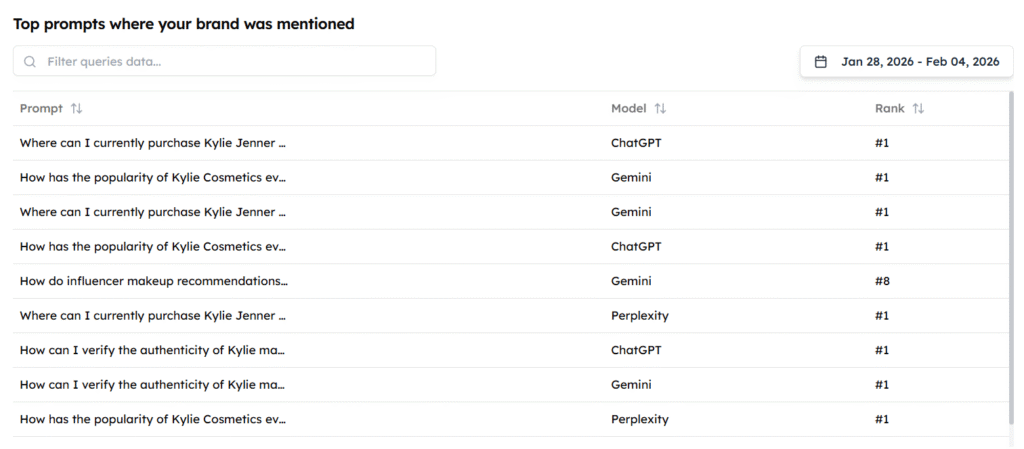
Top cited URLs and competitor benchmarking round out the dashboard, so you always know where you stand.
RankScale AI covers everything you’d actually want in one place. The brand dashboard pulls together your visibility score, sentiment analysis, and brand mentions so you’re not jumping between screens. It tracks your brand presence across ChatGPT, Claude, Perplexity, and Google AI Overviews, automatically identifies competitors, and monitors their numbers alongside yours.
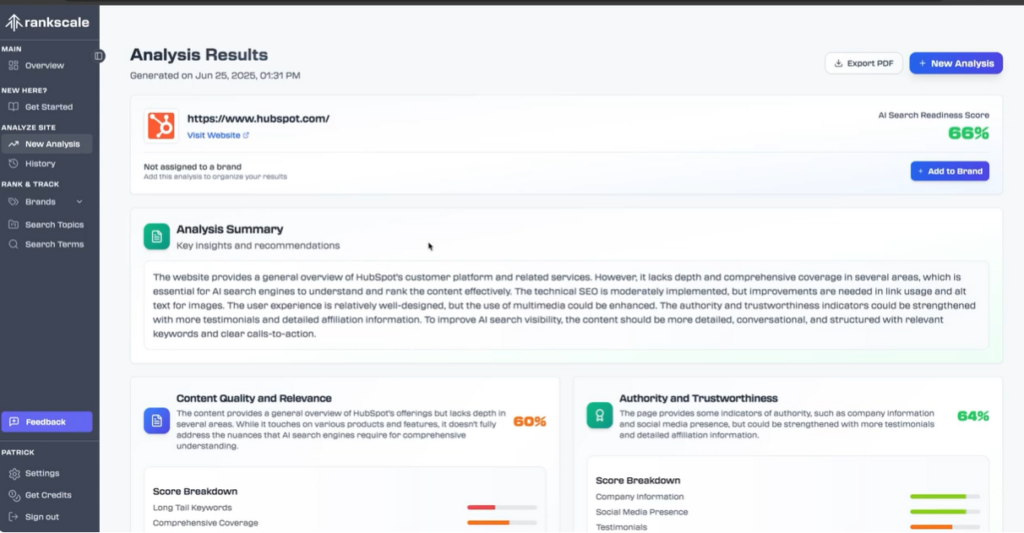
The citation analysis shows which domains are getting picked up by AI search engines and how often, while the sentiment layer tells you whether those AI-generated answers are framing your brand positively or not. On top of that, it surfaces recommendations based on your AI visibility gaps so you know what to actually fix.
4. Actionable Insights and Recommendations
Both AI SEO tools give you something to do with the data.
Track My Visibility gives each URL an AI-Ready Score with specific suggestions on what to fix, so you’re never guessing where to start.
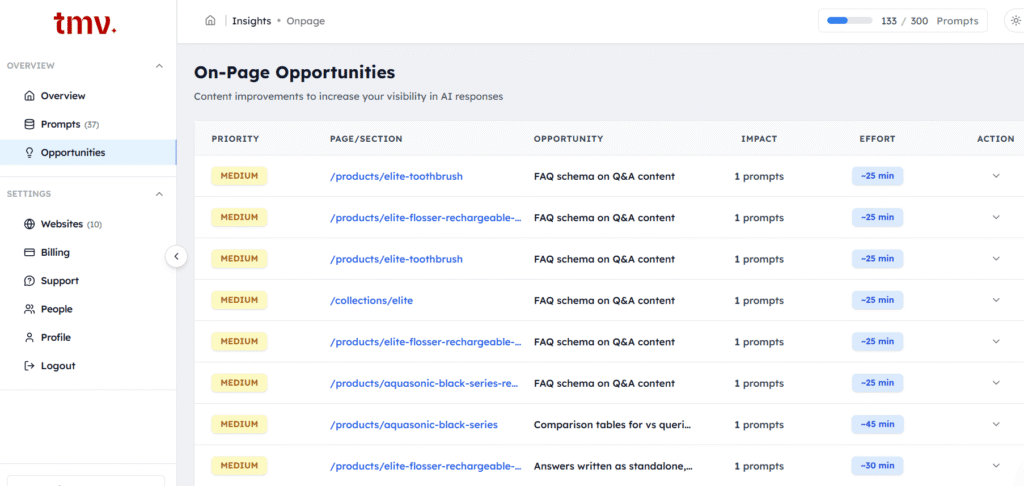
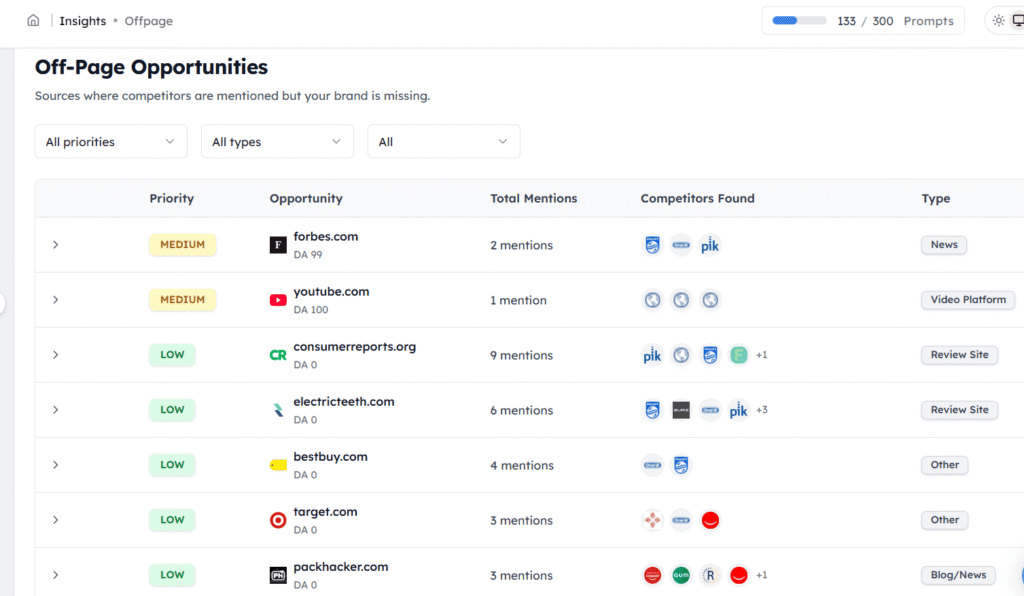
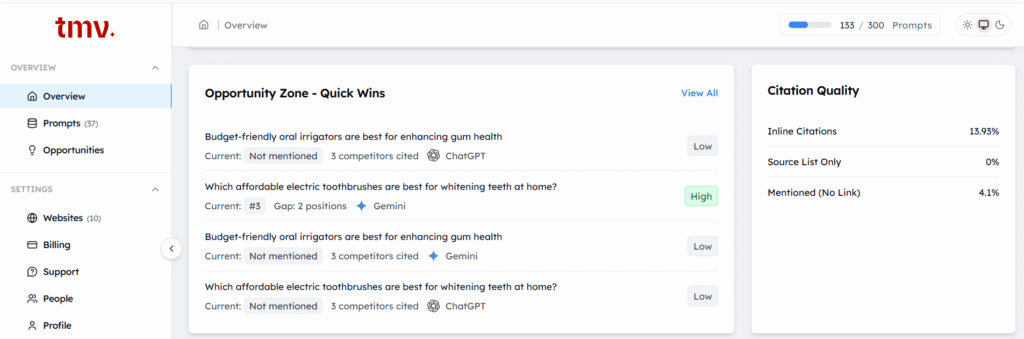
The Opportunity Zone takes it further by showing which AI prompts to prioritize first, complete with urgency labels, which AI platform has the gap, and how many competitors are already being cited there.
It also breaks down citation quality, whether your brand is getting inline citations, source list mentions, or name drops without a link. Content suggestions tailored to help you get cited across different AI search platforms round out the insights.
RankScale gives you enough data to actually act on. The Page Audit shows how AI models read your site and where content gaps are killing your citations. The competitive benchmarking tells you exactly where competitors are outranking you, and sentiment analysis tracks whether AI answers are framing your brand positively or not.
Use that data to adjust your content, fix any wrong information showing up in AI responses, and let the guided onboarding handle the initial dashboard setup.
5. Competitor Tracking
Track My Visibility includes competitor benchmarking on every plan, whether you’re on the 7-day free trial, Discover, or Growth.
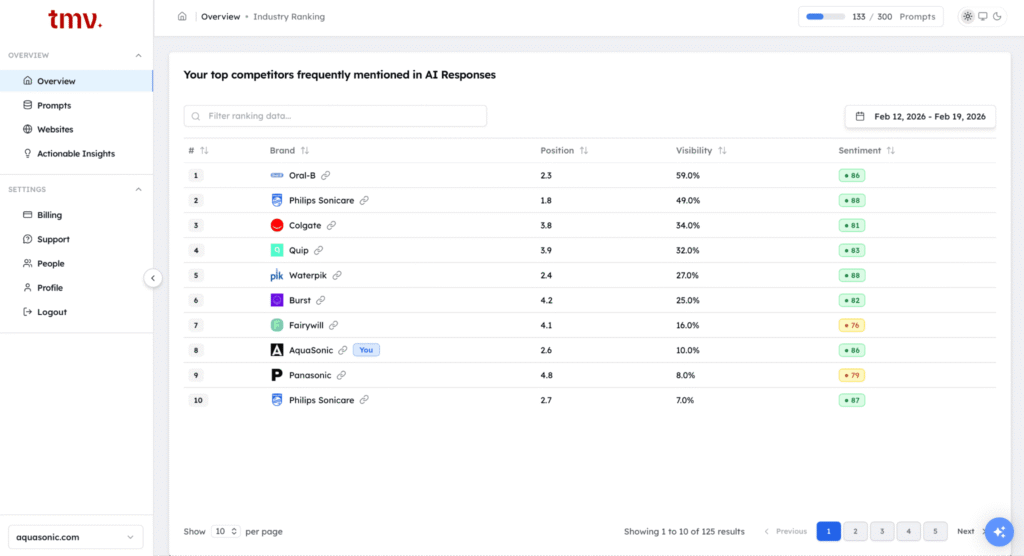
It tracks brand mentions, share-of-voice, and shows you exactly which competitor got cited for which prompt. The side-by-side comparison makes visibility gaps easy to spot, and it even flags content opportunities you might be missing.
RankScale makes competitor benchmarking straightforward. It automatically identifies rivals based on your tracked terms, compares visibility scores, average position, and brand mentions side by side.
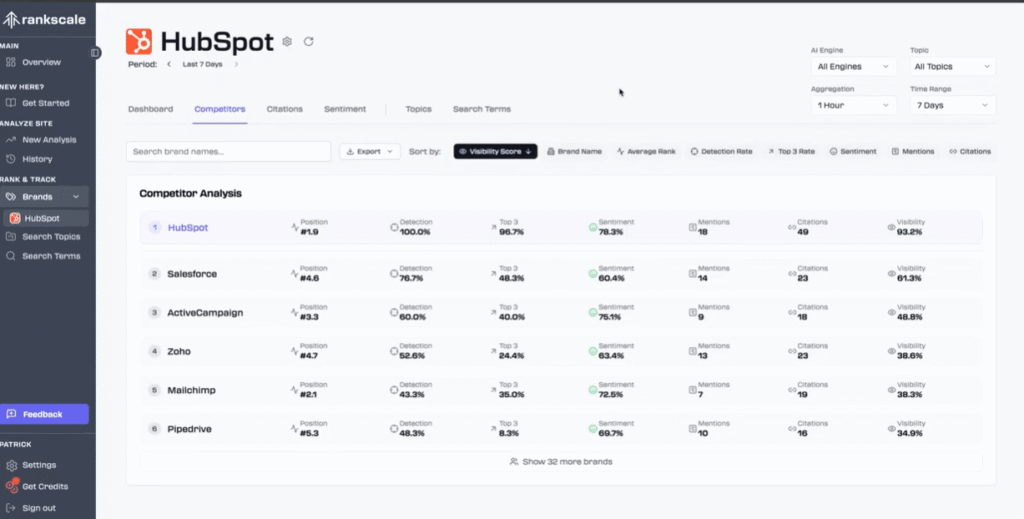
The brand sentiment analysis tells you how AI models describe your brand versus theirs, and the AI Readiness Score flags exactly what to fix to pull ahead in AI search results.
6. Team Collaboration and Integration
Track My Visibility gives you unlimited team members on every plan, including the $50 entry tier. That’s genuinely useful for agencies or teams where multiple people need access without paying per seat.
RankScale’s unlimited seats only kick in at the Pro plan ($99/month). The Essential plan doesn’t include team workspace access. On the integration side, RankScale offers CSV export and a maturing API.
7. Data Accuracy and Reliability
Both tools run synthetic prompts, which means they’re not capturing actual user queries. They’re simulating what happens when someone searches a specific phrase. This is standard across all AI visibility tracking tools, including enterprise options.
RankScale exclusively licenses its Prompt Decoding methodology, giving it a slight edge in depth.
Track My Visibility’s daily prompt execution and transparent methodology are solid for its price point.
Pro Tip: If you want to go beyond tracking and actually start moving the needle, check out this guide on how to track AI search visibility for a step-by-step approach to building a monitoring workflow that informs your content decisions.8. Customer Support and Resources
Track My Visibility offers email support and founder involvement. The documentation is growing, but still thin in places. If you get stuck, you can reach the team, but there’s no live chat option yet.
RankScale offers 24/7 live support on all plans, including the $20 Essential tier. Founder Mathias Ptacek is personally responsive based on multiple user reviews. The documentation is catching up with the rapid feature releases.
Which Brand AI Search Tracking Tool Should You Choose?
The decision between Track My Visibility vs RankScale AI comes down to your specific situation. As one SEO practitioner noted on Reddit, the real value of these tools isn’t the number they give you; it’s knowing which pages to fix and which competitors to watch.
Choose Track My Visibility If You
- Working with a Growth-stage Budget: 7-day free trial to start and $50/month after that, it’s genuinely accessible. Track My Visibility is the more realistic option for solo creators and small teams watching their spend.
- Want a “To-Do” list, not just Data: Most AI visibility tools hand you a wall of numbers and leave you to figure out what to do next. Track My Visibility’s AI-Ready Score skips that frustration. It looks at specific URLs and tells you exactly what to tweak so AI models are more likely to cite your page. It’s less “here’s your data” and more “here’s what to fix first.”
- Need Road Coverage in your Base Plan: You’re not piecing together add-ons to get decent coverage. ChatGPT, Google Gemini, Perplexity, and Google AI Overviews are all included from day one, no upgrades required.
- Prioritize the US and English-speaking Markets: It’s still expanding its reach, but if your audience is primarily domestic and your content is in English, that’s where it performs best. No need to pay for global coverage you won’t use.
- Run a Lean Agency: Unlimited team members at every pricing tier means you can bring clients into the dashboard, loop in account managers, and scale your AI visibility reporting without your software costs growing every time you land a new client.
- Value Simplicity: Not every client wants a technical deep-dive. If you need a dashboard that an account manager or a non-technical client can open and understand in five minutes, this is the one. Clean, clear, and built for people who aren’t SEO power users.
Choose RankScale AI If You
- More Engine Coverage: Need to track ranking across more than 4 AI search engines, especially Grok, DeepSeek, Mistral, or Copilot.
- Budget-Friendly Depth: Want the most affordable entry to serious AI visibility tracking at $20/month.
- Tech-Savvy Teams: Are comfortable with a technically detailed interface and willing to invest time learning the platform.
- Sentiment Tracking Matters: Need built-in brand sentiment analysis across all AI engines you track.
- Hourly Tracking Needed: Require hourly prompt tracking (not just daily).
- Content Optimization Clarity: Want before/after content comparisons with a clear optimization rationale from the Page Audit.
- Exclusive Feature Access: Need Sources Box Analysis or Query Fan Out, both unique to Rankscale 2.0.
- Multi-Brand Management: Manage multiple brands or brand dashboards at scale.
- Heavy Competitive Analysis: Do data-heavy competitive analysis, or need CSV export for custom reporting.
- Advanced SEO Professionals: Are technically oriented SEO professionals or analysts who want the deepest AI visibility tracking software at this price tier.
Final Thoughts
The Track My Visibility vs RankScale AI comparison ultimately comes down to what you need the data to do for you.
If you want something you can hand to a non-technical content manager and get results from in the first week, Track My Visibility is the better starting point. The AI-Ready Score, persona-based prompts, and clean URL-level reporting make it one of the best AI visibility tools for teams that are just getting started with AI search.
For teams ready to go deeper, RankScale AI is the stronger pick. The breadth of AI platform coverage, the sentiment analysis, the Sources Box Analysis, and the Query Fan Out make it the most analytically capable tool at its price point. You’ll need to invest time learning it, but the data you get back is genuinely useful for a serious AI search strategy.
Neither is a permanent decision. The AI visibility category is moving fast enough that both tools will look noticeably different by the end of the year. The best move is to start building data. Use the Track My Visibility 7-day trial to check whether the URL-level guidance and rank tracking fit your workflow. Test RankScale at $20/month on the Essential plan to see if the analytical depth is worth the learning curve for your team.
Whichever you choose, don’t wait too long. The brands building AI visibility tracking habits today will be well ahead of the ones still sitting on the fence.
Frequently Asked Questions
For accessibility and ease of use, yes. The 7-day free trial, unlimited team seats, and AI-Ready Score make it a better starting point for teams new to generative engine optimization or working with tighter budgets.
Probably not. If RankScale is already giving you value, Track My Visibility won’t add meaningfully different coverage. The one scenario where running both makes sense is if you need RankScale’s data depth internally but want a cleaner reporting interface for non-technical stakeholders or clients.
Track My Visibility gives you a 7-day free trial with full feature access, so there’s very little risk. RankScale AI offers a free trial, and the $20 Essential plan is low enough that it works as a real-world evaluation. Spend a month with it before deciding whether to upgrade.
Track My Visibility, without much debate. Lower cost, simpler interface, unlimited team members from day one, and a trial that removes the commitment risk entirely. If you’re just getting started with AI visibility and don’t need enterprise-level AI metrics, it covers the essentials well.
No, and that’s kind of the whole point of using a dedicated AI tracker in the first place. Both tools run prompts across multiple AI search engines from a single dashboard. You don’t need separate setups for different AI.
Resources:
- New front door to the internet: Winning in the age of AI search
- Yext Report: The Rise of AI Search Archetypes
- NEW Research: AIs are highly inconsistent when recommending brands or products; marketers should take care when tracking AI visibility – SparkToro
- The future of AI search: What 6 SEO leaders predict for 2026
- Gartner Predicts Search Engine Volume Will Drop 25% by 2026, Due to AI Chatbots and Other Virtual Agents