I used to check AI Overviews the manual way, typing the same ten prompts into Google every few days. It took about two weeks to admit that it didn’t work. AIO isn’t consistent; it shows for one search and skips the next, and a screenshot from Tuesday tells you nothing about Thursday.
That gets painful once someone above you starts asking about it directly. A client wants to know if they show up in the AI Overview when someone searches their category, and “I checked a couple times, looked fine” isn’t a report. You need a real number you can defend, tracked the same way every time.
Or there’s a traffic report where a page that used to perform quietly stopped, and you’re trying to work out if an AI Overview gets those clicks. That’s the actual job these tools need to do.
I went through six of them, tested what I could get my hands on, and I’ll walk you through what’s worth paying for.
How I Evaluated Google AI Overview Tools
I cared less about the homepage feature list and more about whether each tool actually catches Google AI Overviews, what it really costs past the advertised tier, and what real users say once the sales page isn’t in front of them. I’ve considered official product sites, reviews, customer case studies, and ran free trials where I could.
- Which AI engines are included in each tool’s standard paid plan, confirmed against live pricing pages rather than the marketing copy.
- What each tool costs at the tier you’d actually need for full engine coverage and a usable prompt volume, not the headline number.
- Whether the tool just reports brand mentions, or also gives you recommendations, content guidance, or an execution layer.
- Whether it’s built for a solo marketer, an in-house team, an agency running multiple clients, or an enterprise brand.
If you also want to evaluate your current AI visibility, our free AI visibility checker can help you check it in minutes. It’s easy to see where you stand.
9 Best AI Overviews Tracking Tools I Tested
| Tool | Best for | Standout feature | Google AIO starting price |
| SE Ranking | Teams already in the SE Ranking SEO ecosystem | AI visibility sits inside your existing SEO dashboard | ~$89/mo (Add-on) |
| Track My Visibility | Marketing teams and agencies wanting dedicated AI-visibility tracking | Model-by-model breakdown, not one blended score | ~$42/mo (Discover) |
| AIclicks | Teams wanting AI Overviews and AI Mode compared side by side | Daily refresh on every plan, no upgrade needed | $59/mo (Starter) |
| Thruuu | Content teams optimizing specifically to earn AIO citations | Clearest credit-pricing disclosure in the category | $49/mo (Pro, not Starter) |
| Otterly AI | Brands wanting affordable core-engine tracking | Share of AI Voice metric vs. competitors | $29/mo (Lite) |
| Ziptie | Technical SEOs prioritizing measurement accuracy | Real-browser capture, slot-based pricing | From $35.63/mo (Starter preset) |
| SEOClarity | Large enterprises managing dozens of domains | Hallucination/accuracy detection on AI responses | Custom, enterprise-only |
| Semrush | Teams already running Semrush for core SEO | AIO tracking lives inside your existing SEO dashboard | $99/mo (Base) |
| Cloro | Teams with engineers who’d rather build their own tracking | Raw AI Overview data as structured JSON, far cheaper per response | $30/mo (Lite) |
*Pricing can vary, so check out the official pricing pages on product websites.
1. SE Ranking
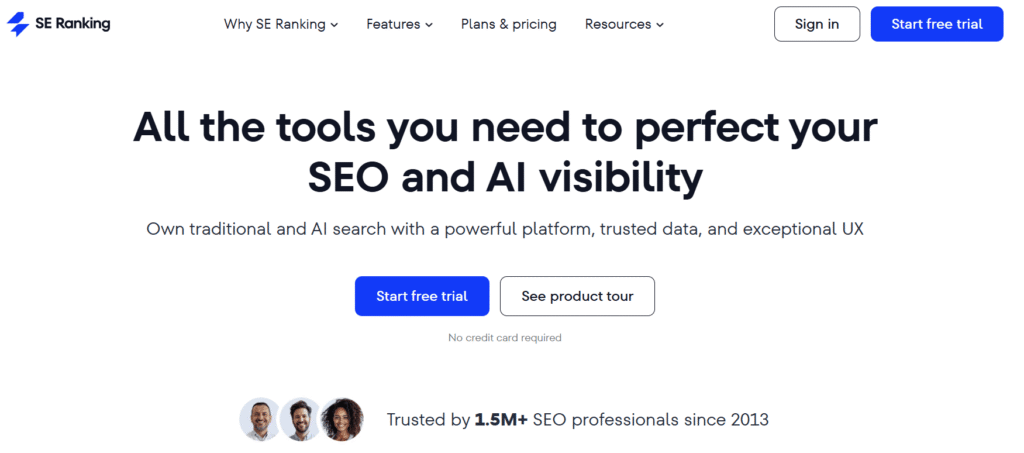
I’ve placed SE Ranking at #1, having it as two products in one: an AI Search Add-on layered onto an existing SE Ranking SEO subscription, priced around $89/mo, or the standalone version sold separately as SE Visible.
SE Ranking’s own help docs confirm the add-on “includes access to SE Visible.” So you’re buying the same underlying tool either way, just through two different doors with two different price tags, and at least one independent comparison calls this out as a real buying obstacle rather than a minor annoyance.
The platform tracks which keywords trigger AI Overviews, whether your brand gets mentioned, and which pages get used as sources, so you can see how AI results affect your visibility right alongside your regular keyword rankings.
What I liked is that this AI visibility data sits inside the same dashboard you already use for rankings, audits, and backlinks, which makes it easier to connect AI summaries back to actual traffic and keyword performance rather than treating them as a separate report you have to cross-reference.
The tool also holds onto historical AI Overview data, so you can track visibility trends over time and catch the moment a competitor starts showing up in AI answers for queries you care about.
What’s included
- Citation tracking across five engines, including Google AI Overviews and Google AI Mode
- Brand mention detection paired with the source URLs each AI system pulled from
- An AI Keyword Research tool that turns your existing keyword list into the actual prompts people ask these models
- A GEO Audit feature for spotting why specific pages aren’t getting cited
- Multi-client workspaces if you’re running this for more than one brand
Where it stood out
- The AI Keyword Research tool bridges regular keyword research with prompt-level thinking, and I didn’t see an equivalent this direct elsewhere on this list
- AI visibility data lives right next to your existing SEO metrics, no separate tool to check
Things to consider
- No Copilot, Claude, Grok, DeepSeek, or Meta AI tracking
- Refreshes run weekly, not daily, so a mid-week citation change won’t show up until the next cycle
- The two-product setup means real time spent figuring out which version you’re even supposed to buy
My take: SEO professionals, agencies, and marketing teams that want AI Overview visibility insights combined with traditional SEO tracking in a single platform.
2. Track My Visibility
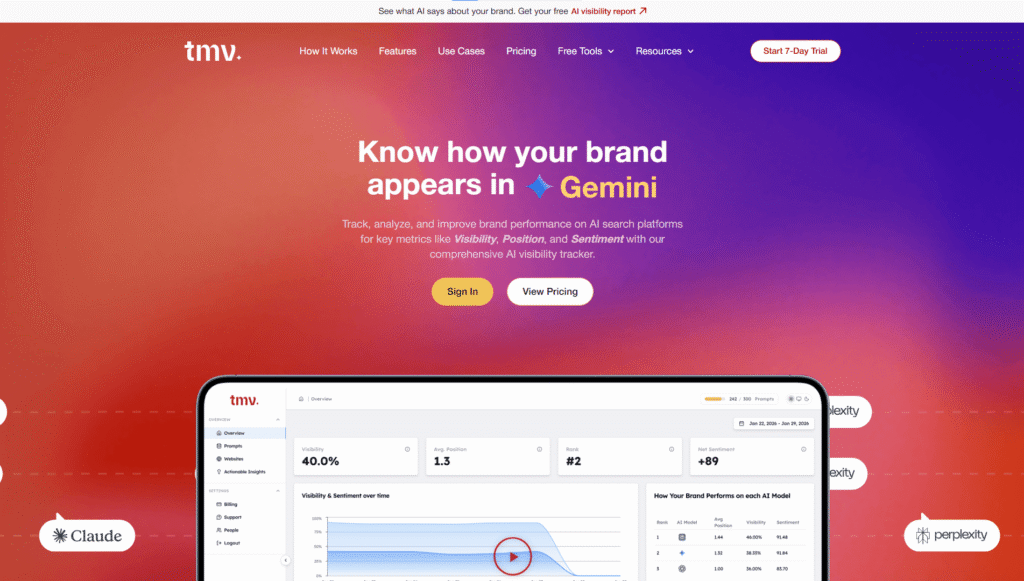
A quick note: I’m from Track My Visibility. I put Track My Visibility second here, not first, because I believe SE ranking is a genuinely mature tool with both AI search and existing SEO visibility.
Track My Visibility, our AI visibility tracking tool, is built specifically to help businesses understand how their brand shows up inside AI-generated search results, Google AI Overviews included. As AI summaries increasingly sit at the top of the page, a regular rank tracker just can’t tell you whether you’re actually the one being cited, and that’s the specific gap Track My Visibility is built to close.
The platform analyzes how AI engines generate answers for the prompts in your industry. It shows you which prompts trigger an AI answer, which sources get cited, and how your visibility stacks up against competitors for the same query.
At Track My Visibility, you can track AIO alongside multiple other platforms, including ChatGPT, Grok, Gemini, Perplexity, and Copilot, with the flexibility to pick any combination starting from the entry plan.
What’s included
- Citation and ranking data broken down by AI model, so you can see position, visibility, and sentiment for ChatGPT, Google AI Overviews, Perplexity, and Gemini separately rather than blended together
- Prompt-level tracking showing exactly which prompts trigger a brand mention, a competitor mention, or nothing at all
- Source URL analysis showing which pages AI models pull from when generating an answer
- Competitor visibility comparisons for the same tracked prompts
- Actionable recommendations aimed at improving citation odds
Where it stood out
- Model-by-model breakdown makes it easy to see exactly where AIO differs from ChatGPT or Perplexity on the same prompt, instead of one blended visibility score
- Flexible engine selection from the entry plan, so you’re not paying extra just to unlock Google AI Overviews specifically
- Reports are clear enough to hand to a client without much extra explanation
Things to consider
- Methodology isn’t published the way a couple of competitors on this list do, so you’re trusting the numbers without a documented capture process
- Smaller ecosystem than the full SEO suites on this list, so this isn’t a replacement for your existing rank tracker
My take: Marketing teams, SEO professionals, and agencies that want clear insights into how their brand appears inside Google AI Overviews and other AI-generated search answers.
 Pro tip: There’s an easier way to see your visibility across AI Overviews. Run your site through the free AI Overview Tracker and get your visibility in just minutes.
3. AIclicks
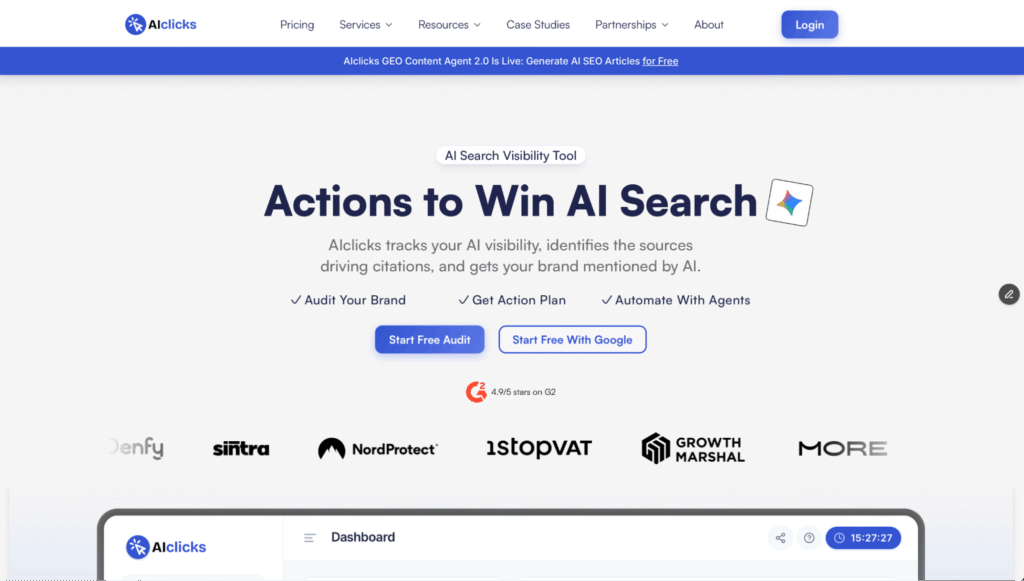
Up next is AIclicks, an AI visibility platform that tracks Google AI Overviews alongside 10+ other AI surfaces, including Google AI Mode, ChatGPT, Gemini, Perplexity, Claude, Copilot, and Grok.
Tracking AI Overviews and AI Mode together matters more than it first appears. Both are Google surfaces, both are powered by Gemini, and a brand can hold citations in one while being entirely absent from the other. AIclicks tracks them from the same prompt set, so you get a direct comparison instead of piecing it together yourself across two separate reports.
Every prompt you track runs on every enabled engine once a day, on all plans including the entry tier, and refresh frequency isn’t something you upgrade for here, which is unusual in this category. The platform also classifies each cited URL by page type across 14 categories, so instead of a flat list of citing domains, you see whether AI Overviews pulled from a listicle, a comparison page, a forum thread, or a review site.
Pricing starts at $59/month for Starter (30 prompts, 3 engines), moves to $189/month for Pro (150 prompts, 4 engines, unlimited websites, API and MCP access), and tops out at $499/month for Business (300 prompts, 6 engines). Annual billing knocks up to 29% off, and there’s a 3-day free trial, no card required.
What’s included
- AI Overviews and AI Mode tracking from the same prompt set, so you can compare citation performance between the two directly
- Daily refresh on every plan, with no upgrade required for frequency
- Page-type source classification across 14 categories
- Fan-out query analysis, surfacing the sub-queries a model expands your prompt into while composing its answer
- Regional tracking, with country-level projects and state-level granularity for the US, Canada, India, and Australia
- Built-in execution, including content generation with direct publishing to WordPress, Webflow, Shopify, or Framer, plus mention outreach and Reddit actions
Where it stood out
- Tracks 10+ AI platforms, one of the widest coverage sets in this list
- Daily tracking included at every tier, starting at $59/month
- Source classification shows exactly what type of content earns citations
- Unlimited websites with separate client workspaces from the Pro plan
Things to consider
- The entry plan allows 3 simultaneous engines, so a Google-focused setup (AI Overviews, AI Mode, plus one more) already uses all three
- The free trial is 3 days, shorter than most alternatives here
- No traditional keyword rank tracking, so it pairs with an SEO tool rather than replacing one
My take: Marketing teams and agencies that want AI Overviews tracked alongside AI Mode and the wider AI search ecosystem, with content and outreach tools built into the same platform.
4. Thruuu

Next is Thruuu. What stood out to me first was the credit disclosure, stated plainly on the pricing page with no hidden multiplier to work out yourself, and a Visibility Score paired with a separate AIO Presence Rate, which is a smarter setup than one blended score since it tells you “we’re not visible” apart from “there’s nothing to be visible in.”
Thruuu started life as a SERP-analysis and content-brief tool, well before the current AI-visibility wave, and AIO Monitoring got added later as a separate, credit-metered feature bolted onto that existing system rather than being the product itself.
The catch is that AIO Monitoring doesn’t show up on the cheapest paid tier. The Starter plan runs $19/month, but the real entry point for AI Overview tracking specifically is the Pro plan at $49/month. So if you came here expecting AIO tracking at the entry price, what you’re actually looking at is the mid-tier.
There’s also a separate LLM Analyzer that touches ChatGPT, Gemini, and Perplexity, though it’s less documented and it’s not fully clear whether that’s continuous brand-mention tracking or a one-off SERP-style analysis.
What’s included
- AIO Monitoring, tracking which keywords trigger Google AI Overviews and whether your brand gets cited
- A Visibility Score alongside an AIO Presence Rate, splitting out “not visible” from “no AI Overview to be visible in”
- Source and content analysis, showing which pages get cited and what topics and questions those pages cover
- An LLM Analyzer touching ChatGPT, Gemini, and Perplexity, alongside the AIO-specific tracking
- SERP preview showing the full AI Overview next to the regular search results for the same query
- Exportable reports
Where it stood out
- The clearest credit-pricing disclosure in this category, with no ambiguity to decode yourself
- Splitting Visibility Score from AIO Presence Rate is a genuinely smarter pair of metrics than most competitors offer
- Content-pattern analysis helps teams reverse-engineer what AI Overviews prefer to cite
Things to consider
- AIO Monitoring is gated above the entry-level plan, so budget for Pro
- Tracks mostly Google AI Overviews; multi-engine coverage through the LLM Analyzer is less proven
- Built as a content tool first, so it’s lighter on the ongoing multi-brand monitoring workflows
My take: Content teams, SEO specialists, and marketers who want deep insights into how AI Overviews are generated.
5. Otterly AI
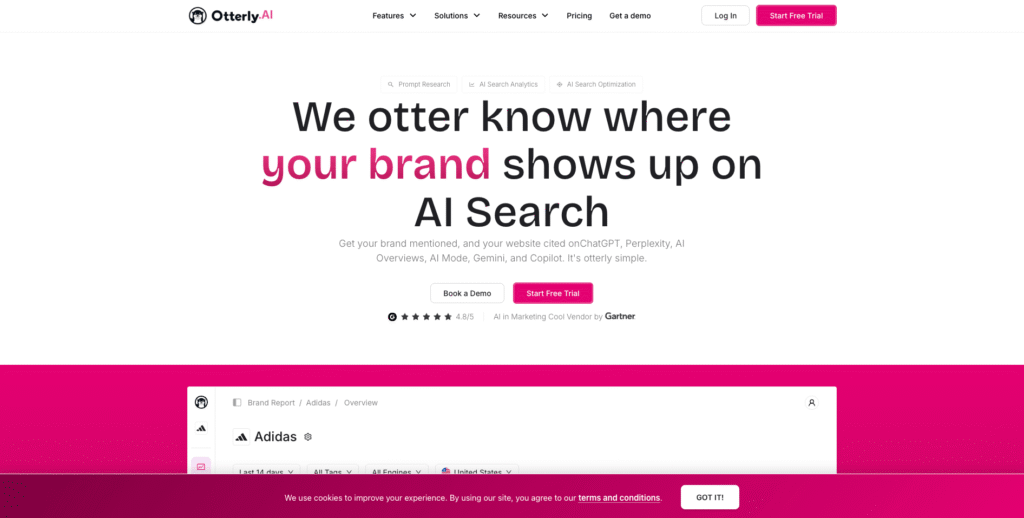
Otterly AI tracks brand mentions across ChatGPT, Google AI Overviews, Perplexity, and Microsoft Copilot right out of the Lite plan, and that’s the number most comparisons lead with. But Claude, Gemini, and Google AI Mode aren’t included at any tier; they’re paid add-ons that scale steeply with plan level. That’s worth knowing before you get attached to the headline price.
Honestly, what you get for the base price is solid. Otterly replicates the actual AI interfaces real users interact with rather than pulling answers through an API, and that browser-simulation approach is independently corroborated by at least one third-party analyst, which is more methodology transparency than most tools on this list offer.
What’s included
- Core coverage across ChatGPT, Google AI Overviews, Perplexity, and Microsoft Copilot at every tier
- A Share of AI Voice metric, showing what percentage of AI responses mention your brand versus competitors
- Linked and unlinked brand mention tracking, so you can see where you’re cited with a link and where you’re just mentioned
- A GEO Audit diagnosing why specific pages aren’t getting cited, plus a Recommendations feed
- Unlimited Brand Reports on every tier, including the cheapest one
Where it stood out
- Browser-simulation capture methodology is stated plainly and backed by third-party corroboration
- Unlimited brand tracking even on the entry tier, which several competitors gate behind higher plans
- The Share of AI Voice metric is a genuinely useful way to compare your visibility against competitors rather than just tracking yourself in isolation
Things to consider
- Claude, Gemini, and Google AI Mode are paid add-ons, not part of the base price, and stacking all three gets expensive fast at higher tiers
- The interface can feel data-heavy if you’re new to this category
- Reporting customization is fairly limited compared to a full SEO suite
My take: Marketing teams, brands, and agencies that want affordable AI visibility monitoring across multiple AI search platforms.
6. Ziptie

I believe Ziptie should be placed here as one of the earlier AIO tracking tools. It was built specifically to track Google AI Overviews visibility, helping marketers monitor which keywords trigger AI summaries and whether their brand or domain shows up inside those answers.
The platform lets you build your keyword list in several ways. For example, you can import queries from Google Search Console, or add keywords manually. Alternatively, you can generate keyword ideas using its AI keyword assistant. That makes it easier to discover queries where AI Overviews actually appear and track your presence against them.
Ziptie’s dashboard gives you a quick snapshot of AI Overview visibility for your brand. For example, it shows how often your domain is used as a source and, at the same time, compares your presence against competitors through a Share of Voice graph. It also supports scheduled monitoring, so you can track how your AI visibility shifts over time without manually rechecking.
What’s included
- AI Overview detection across an expanded engine set, now seven engines total, including Google AI Mode, Copilot, Bing AI Overview, and Gemini
- Flexible keyword setup via Google Search Console import, manual entry, or the AI keyword assistant
- Share of Voice tracking comparing your domain’s presence against competitors
- Scheduled monitoring for ongoing visibility tracking
- Unlimited teammates and projects on every configuration, with no per-seat charge
Where it stood out
- A simple, focused dashboard that doesn’t require learning a full enterprise SEO suite
- Slot-based pricing is more transparent than the credit system the earlier version used
- Unlimited seats at every tier, a real fix from where the old product started
Things to consider
- The rebuilt platform has little independent review coverage yet, so you’re trusting the improvements without much third-party verification
- Google Search Console integration has historically been a dependency point worth watching
- Best suited to teams that want a focused AIO tool rather than a full-featured suite
My take: SEO teams and marketers who want a simple way to monitor brand visibility and competitor presence in Google AI Overviews.
7. SEOClarity

Okay, so the next one in this list is SEOClarity, an enterprise SEO platform that includes a powerful AI Overviews tracking system designed for large-scale search monitoring. It helps businesses understand when Google AI Overviews appear for their target keywords and whether their brand or website gets cited as a source.
The platform identifies queries that trigger AI Overviews and, in addition, tracks brand mentions inside those summaries. It also shows which pages are used as references. It also reveals the prompts and variations that generate AI answers, which helps SEO teams understand user intent a lot better than just guessing at keywords.
One of SEOClarity’s strongest capabilities is its traffic impact analysis. The tool connects AI Overview visibility with actual performance metrics like clicks, traffic, and conversions. Combined with historical SERP snapshots and real-time monitoring, this helps teams see how AI results affect organic performance over time rather than just at a single point in time.
Where this needs a real caveat is pricing. There’s no public self-serve tier here; everything is custom-quoted, and the AI Overviews tracking module specifically sits as an added cost on top of the core platform. This is squarely an enterprise purchase, not something you back into casually the way you might with a $50/month tool.
What’s included
- Query-level detection of which keywords trigger AI Overviews, with brand mention and source-citation tracking
- Prompt and variation discovery to understand the user intent behind AI-triggered queries
- Traffic impact analysis connecting AI Overview visibility to clicks, traffic, and conversions
- Historical SERP snapshots paired with real-time monitoring
- Competitor benchmarking and optimization insights
Where it stood out
- Traffic impact analysis is a genuinely useful bridge between visibility data and business outcomes; not every tool on this list makes that connection
- Historical SERP tracking gives a real sense of how AI results shift over time, not just a current snapshot
Things to consider
- Enterprise-level pricing puts this out of reach for small teams or solo operators
- No public pricing means budgeting this requires a sales conversation before you know your real cost
- The interface and onboarding can feel complex given how much the platform covers beyond just AI visibility
My take: Large enterprises and SEO teams that need deep AI visibility analysis, competitive insights, and traffic impact tracking at scale.
8. Semrush
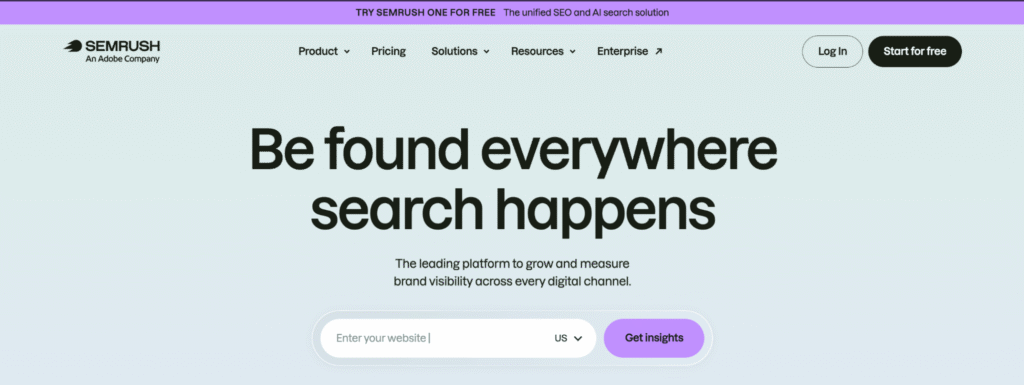
“We’ve worked with traditional SEO tools” , I know and that’s exactly why this is my pick: Semrush. You can bring AIO tracking directly into its Position Tracking toolkit, right alongside the keyword rankings you’re already checking.
The AI Visibility add-on sits on top of an existing Semrush subscription, starting at $99/month for the Base tier with 25 custom prompts and daily AI rankings.
What’s included at Base is a real toolkit that I like. You get AI visibility reports for any domain, competitor research, prompt research, and a Content Analyzer that grades URLs across AI-citability signals, plus a published AI Visibility Index built on a large prompt dataset.
What’s included
- AI visibility reports, competitor research, and prompt research at Base
- 25 custom prompts with daily AI rankings, additional 50-prompt blocks at $60/mo
- A Content Analyzer grading URLs A-F on AI-citability
- AI Brand Sentiment tracking
- Enterprise AIO tier adding full LLM coverage and multi-brand analysis
Where it stood out
- Lives inside your existing SEO dashboard, no new tool to learn
- Content Analyzer turns visibility data into an actual action
- A rare, large-scale published visibility benchmark
Things to consider
- Base-tier engine coverage is genuinely disputed, worth confirming directly
- Prompt volume is limited, scaling costs extra
- Full feature set really opens up at custom-quoted Enterprise
My take: Teams already running Semrush for core SEO who want AI visibility layered into that same workflow.
9. Cloro

I’ve added Cloro to this list. It’s worth including because it’s built differently from everything else here. It’s not a dashboard; it’s an API. For any query, it returns Google AI Overview text and its cited sources as structured JSON, and it covers AI Mode, ChatGPT, Perplexity, Gemini, and Copilot the same way.
What that means in practice is you’re not paying per seat for a finished report; you’re pulling the raw AI Overview data yourself and building the dashboard around it. That includes rerunning your prompts on whatever cadence you choose and storing the results over time, rather than relying on someone else’s refresh schedule. A few teams are already building their own AI Overview tracking on top of Cloro this way, Ahrefs and BrightEdge among them.
The free tier includes 500 credits a month, enough for a real sandbox, and the Lite plan starts at $30/month.
What’s included
- Google AI Overview text plus cited sources returned as structured JSON, per query
- Coverage across AI Mode, ChatGPT, Perplexity, Gemini, and Copilot
- Hosted MCP server, Python and TypeScript SDKs for direct integration
- A free, public AI Visibility Leaderboard across twelve software categories
Where it stood out
- Raw data is far cheaper per response than any packaged tracker on this list
- Already powering AI Overview tracking inside other SEO products
- No per-seat pricing, so cost scales with usage
Things to consider
- No dashboard, no metrics computed for you; that layer is on you to build
- You’ll need someone on your team who can actually work with an API to get this running
My take: Teams that want raw AI Overview data into their own product or BI stack.
How to Pick the Right AI Overviews Monitoring Tool for Your Business?
Each platform here does a genuinely different job, so the right pick comes down to what you’re actually trying to solve.
- Start with your goal: Decide what you want to measure. If your focus is on protecting traffic, choose a tool that shows which pages AI Overviews cite as sources. If your goal is brand visibility, pick a platform that tracks brand mentions across multiple AI engines.
- Check platform coverage: People now search on tools like Google AI Overviews, ChatGPT, Gemini, and Perplexity. AI monitoring tools should track several of these platforms so you can see where your brand appears.
- Look for citation tracking: The tool should clearly show which pages AI systems use as sources and whether your brand is mentioned in the summary (take a quick look at our trackdown report).
- Analyze competitor visibility: AI answers often mention multiple brands. Tracking competitor presence helps you understand who dominates AI responses in your industry.
- Choose a tool that fits your team: Some AI overview tracking tools are simple and designed for content teams, while others offer deeper analytics for enterprise SEO teams. Pick one that provides useful insights without adding unnecessary complexity.
My Verdict
If I had to sum it up: SE Ranking and Semrush make sense if you’re already paying for those SEO suites and just want AIO tracking layered on top. Track My Visibility and Otterly are the strongest picks if you want dedicated AI-visibility tracking without an overcomplicated suite.
AIClicks is worth it specifically if comparing AI Overviews against AI Mode matters to your setup. Thruuu and Ziptie each work for a narrower angle, content optimization and measurement accuracy. SEOClarity is the one to reach for once you’ve outgrown all of them. And Cloro is the pick if you’d rather build your own tracking on raw data than buy someone else’s dashboard.
All these tools serve a different setup and have their own strengths and things to consider, so pick based on what your team and budget actually need.
And if you’re not sure where to start, consider our 7-day trial. Good luck with your AI visibility 🙂
FAQs
AI overview tracking tools are platforms that monitor Google’s AI-generated summaries (AI Overviews) to show whether your brand is cited, which pages are used as sources, and how your visibility compares to competitors. Unlike traditional rank trackers, they focus specifically on your presence inside AI-generated answers.
Some traditional SEO platforms like SE Ranking and Semrush have added basic AI Overview detection features. But dedicated AI visibility tools like TrackMyVisibility, Otterly AI, and Ziptie provide deeper citation tracking, multi-platform monitoring, and competitive benchmarking that general SEO tools typically don’t cover.
For most businesses, weekly monitoring is a good starting point. AI Overviews can change frequently as Google updates its AI model and sources. If you’re in a competitive space or running a product launch, daily tracking gives you faster visibility into shifts.
Yes, but coverage varies by tool. Platforms like Otterly AI support 50+ countries. Ziptie covers 14 countries. SE Ranking and seoClarity offer multi-country support as well. Check each platform’s country availability before committing, especially if you operate in non-English markets.
AI Overviews appear at the top of standard Google search results as an AI-generated summary. Google AI Mode is a separate, conversational search experience where users interact with Google’s AI in a chat-like format. They’re related but distinct surfaces. Not all tracking tools monitor both, so check before you choose.