


Over a billion people are expected to be using generative AI by 2031. And by 2028, roughly 36% of U.S. adults will likely use AI as their primary way to search. If you want to stay ahead, you first need to understand how AI citation tracking works before you can compare the tools that do it.
Here’s the real problem…
You need to track where your brand appears in AI answers and create content that actually gets cited. Most tools only do one or the other.
Track My Visibility is an AI visibility tracking tool. Writesonic is an all in one platform that combines content creation, SEO tools, and generative engine optimization. They’re solving related but different problems.
The question is…
Should you pick the specialized monitoring tool or the comprehensive platform? The answer depends on what you actually need.
Here’s what you’ll learn in this guide:
- How Track My Visibility vs Writesonic compares on key metrics, pricing, and real-world performance
- Which AI search engines does each platform tracks and what coverage do you actually get
- Whether you need a specialized AI SEO tool or a full content platform
- Specific recommendations based on your budget, team size, and workflow
Let’s break down Track My Visibility vs Writesonic so you can make an informed decision.
Key Takeaways
- Track My Visibility is a lightweight AI visibility tracker for small teams, with daily citation tracking and unlimited users from $50/month.
- Writesonic is an all-in-one GEO and content platform covering 10+ AI engines, with GEO tools starting at $249/month.
- Neither platform improves visibility automatically. They show what needs fixing, but execution is still up to you.
- Choose Track My Visibility for monitoring AI search presence. Choose Writesonic for scaling AI-optimized content production.
- AI search now drives traffic for 69%+ of websites, making AI visibility tracking essential for growth-focused brands.
What Is Track My Visibility?
Aureate Labs founded Track My Visibility with a clear goal. To make AI visibility tracking affordable and accessible for small teams.
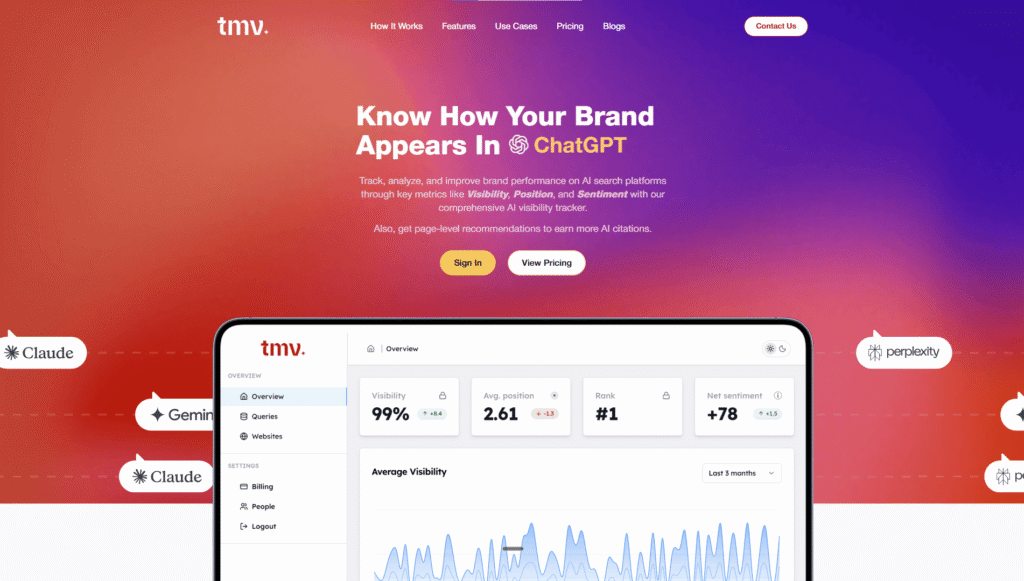
The platform is designed for actionability. Instead of drowning you in data, it tells you what to fix. The core value is budget-friendly tracking with their proprietary AI-Ready Score that prioritizes which pages need optimization.
The target audience is small teams, agencies, and budget-conscious brands testing the AI visibility tool for the first time. If you’re spending $50 to $100/month and need clear direction without the complexity of enterprise platforms, Track My Visibility was built for you.
 Pro Tip: Not sure how visible your brand is in AI search results? Start with a free AI visibility checker to see how your business appears across major AI platforms before investing in advanced tools. It’s a simple way to understand whether AI tracking makes sense for your brand right now.
Key Features of Brand AI Visibility Tool Track My Visibility
1. AI-ready Score: This metric evaluates each URL of your website. It tells you how well-positioned it is to appear in AI generated answers. With the help of this feature, you’re not guessing which pages need work.
2. URL-level Citation Tracking: This feature shows which pages got cited, how many times, and on which AI search platform. You can see your best-performing content and identify what needs improvement.
3. Persona-based Prompt Generation: Writing test queries manually is tedious. This feature generates prompts based on your target audience, then runs them automatically across ChatGPT, Google AI Overviews, Gemini, and Perplexity. You set it up once, and it handles the rest.
4. Cross-model Comparison: You can execute prompts across major AI search tools, including ChatGPT, Google AI Overviews, Perplexity, and Gemini, and compare your AI brand visibility side by side. This shows where your brand stands and where competitors are leading.
5. Competitor Benchmarking: It will help you compare your brand’s LLM visibility and cited URLs with your competitors.
6. Brand Mention Dashboard: Track all brand mentions and citations in one central dashboard with comprehensive AI citation tracking. This includes top-cited pages, visibility trends by AI model, and competitor comparisons.
The platform currently tracks four major AI search engines, with plans to expand coverage. It’s focused coverage, not comprehensive, but it covers the platforms that matter for most businesses.
How Does the AI SEO Tool Track My Visibility Work?
When comparing Track My Visibility vs Writesonic, understanding the workflow is also important.
You connect your domain to Track My Visibility. The system automatically generates persona-based prompts, the types of questions your customers would ask ChatGPT or similar AI search tools. These prompts run daily across multiple AI platforms to see how often your brand shows up.
When your brand gets mentioned, the tool maps those citations back to specific URLs on your site. Your dashboard updates every 24 hours with an AI-Ready Score for each page. This score tells you how likely top AI models are to recommend your content.
Instead of generic keyword suggestions, you get prioritized tasks showing exactly which pages need better structure or stronger information.
Track My Visibility Pros and Cons
Pros
1. The AI-Ready Score: Small teams without dedicated generative engine optimization (GEO) specialists know exactly where to focus efforts.
2. Pricing: Entry cost is low. $50/month gets you meaningful tracking across the 3 best AI platforms (ChatGPT, Google AI Overviews, and Perplexity). It’s accessible for startups and small businesses testing the AI search visibility tool for the first time.
3. Unlimited Users: All plans include unlimited team members, so your whole team can access the platform without extra per-seat costs. For agencies managing multiple clients, this eliminates the per-seat fees that multiply quickly on other platforms.
4. Persona-based Prompt Generation: It saves hours of manual setup. You don’t have to brainstorm hundreds of queries yourself.
5. Daily Updates: Unlike many other AI SEO tools with weekly cycles, you’re working with 24-hour-old data, not week-old information.
Cons
1. Growing Ecosystem: It’s a newer platform, so documentation is still growing. You’ll find fewer tutorials and community resources compared to established tools.
2. Focus on Core Markets: Language support is limited compared to enterprise AI tools. If you operate globally in many languages, this might be an issue.
3. Integration: While API access has recently launched for higher tiers, the native “plug-and-play” integrations are still basic. Don’t expect it to sync perfectly with your entire tech stack just yet.
4. Function over Form: The analytics suite is less mature than platforms that have been around longer. You get the data you need, but not as many ways to slice and visualize it.
Most importantly, Track My Visibility is monitoring-only. It shows you what’s wrong but doesn’t help you create content to fix it. If you need content generation capabilities, you’ll need separate tools.
Pricing and Accessibility
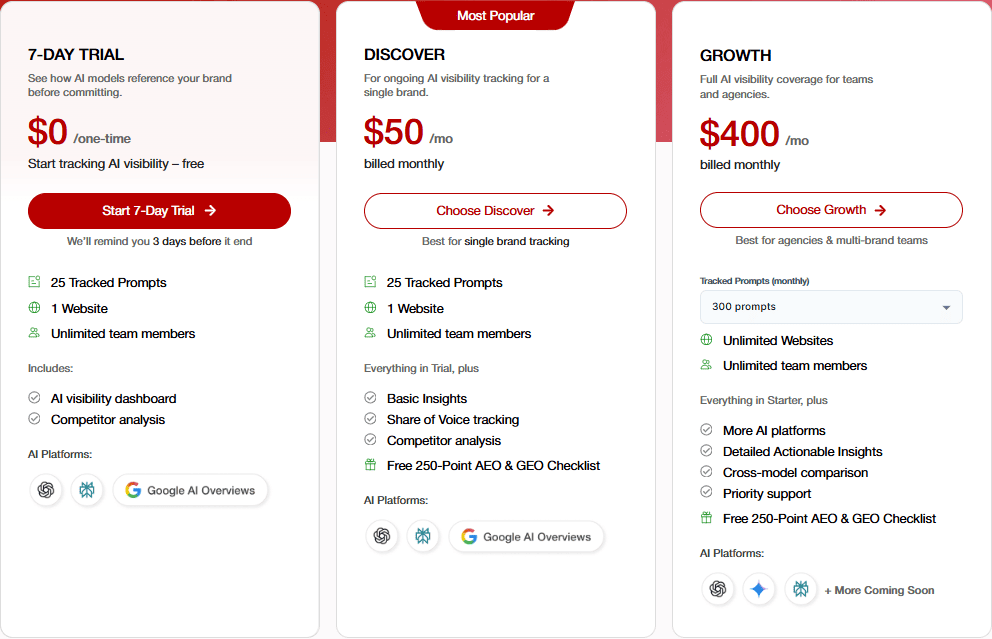
Trial: Trial for 7 days
- 25 tracked prompts
- 1 website
- Unlimited team members
- Competitor Analysis
- AI Visibility Dashboard
- 3 AI platforms (ChatGPT, Perplexity, Google AI Overviews)
Discover Plan: $50/month
- 25 prompts per month
- 3 AI platforms tracked (ChatGPT, Perplexity, Google AI Overviews)
- Unlimited users
- Basic Insights
- Share of Voice tracking
- Competitor analysis
- Free 250-Point AEO & GEO Checklist
Grow Plan: $400/month
- Up to 300 prompts per month
- 4 AI platforms (ChatGPT, Perplexity, Google AI Overviews, Gemini)
- Unlimited websites
- Unlimited team members
- Detailed Actionable Insights
- Cross-model comparison
- Priority support
- Free 250-Point AEO & GEO Checklist
They offer an annual discount with 2 months free when you choose yearly billing on any plan.
Every plan comes with unlimited team members. Your whole marketing or content team can use the platform without extra fees per user.
Note: Pricing may change over time, so it’s best to check their official page for the most up-to-date information.
What Is Writesonic?
Writesonic launched in 2021 with Y Combinator backing and $2.5M in seed funding. The platform now serves over 10 million marketers globally with a valuation exceeding $250 million.
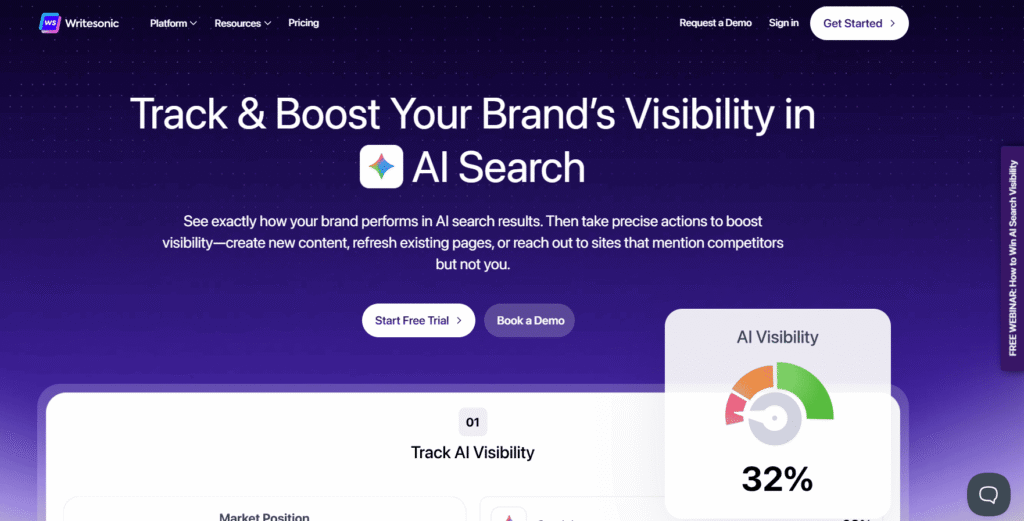
It started as an AI writing assistant but evolved into a full SEO and GEO suite. This is different than Track My Visibility. It’s not just tracking; it’s a complete content creation and optimization platform.
The core value proposition is consolidation. Replace 3-5 separate tools (content writer, SEO tools, visibility tracking, traffic analytics) with one platform. The target audience is content-heavy teams, agencies, and businesses that need both creation and monitoring.
The key differentiator is integration. You can identify visibility trends, gaps, and create optimized content to fix them without switching platforms.
Key Features of the AI SEO Tool Writesonic
1. GEO/AI Search Visibility Tracking: It tracks your brand across 10+ major AI search platforms. This includes ChatGPT, Perplexity, Google AI Overviews, Gemini, Claude, Grok, DeepSeek, Copilot, and Meta AI.
2. Citation & Sentiment Analysis: It shows which URLs are getting cited by which AI models and whether the sentiment is positive, neutral, or negative.
3. AI Search Volume Explorer: It also gives you data on what people are actually asking AI engines. This is powered by a dataset of over 120 million real AI conversations.
4. Unified Action Center: It turns visibility gaps into a clear to-do list. It suggests specific content updates or outreach targets to get the citations you’re missing.
5. AI Bot & Traffic Analytics: It also tracks visits from AI crawlers and identifies actual human clicks coming from AI citations. This feature is also available on the free tier.
6. Full-Stack SEO Integration: It combines traditional SEO data from Ahrefs and Semrush with AI-specific insights. With the help of this, you can get both Google rankings and AI visibility in one place.
7. Automated Content Engine: It also includes the AI Article Writer 6.0 for creating long-form, fact-checked content that’s optimized for both human readers and AI engines.
8. Workflow & Publishing Tools: One-click publishing to WordPress, Google Docs integration, and full API access for scaling your content operations.
9. Brand Voice & Global Support: This AI visibility tool lets you customize content to match your brand tone. It also supports content generation in 115+ languages for international teams.
How Does Writesonic Work?
Writesonic connects tracking and creation in one place. Instead of just showing you data, it focuses on what it calls “The Action Loop.”
The process starts with a dataset of over 120 million real AI conversations. Instead of guessing what people search for, the system tracks specific, natural language queries like “best organic dog food for senior labs with joint issues.” This gives you a clearer picture of how AI engines actually talk about your brand.
The tracking runs continuously. The system analyzes your presence every six hours, mapping your citations across 10+ major AI search engines, including ChatGPT, Perplexity, and Gemini. You’re not just seeing whether you appear; you’re seeing the context, the sentiment, and exactly which competitor is getting cited instead of you.
The Action Center sets it apart. On higher-tier plans, the platform moves beyond reporting to execution. It analyzes the gaps where a competitor is cited, but you aren’t, then provides a prioritized list of tasks.
Writesonic Pros and Cons
Pros
- All-in-one Platform: You can replace separate tools for writing, SEO, and AI visibility tracking with a single subscription, which cuts both cost and workflow complexity.
- Massive AI Platform Coverage: Most AI visibility tools track four AI search engines. Writesonic covers 10+ with no add-on fees, which matters if your brand needs broad coverage.
- Data-Driven Roadmap: The Action Center gives you prioritized optimization steps, so you’re not staring at raw data trying to figure out your next move.
- Free AI Traffic Analytics: Even on the free tier, you can see AI crawlers visiting your site, which is useful before committing to a paid plan.
- Pro-Grade SEO Built-In: Native Ahrefs and Semrush integration means you get serious keyword research and competitor analysis without paying for those tools separately.
- Built for Global Teams: With support for 115+ languages, teams creating content across multiple markets can work within a single platform.
- Proven Reliability: Thirteen million users means established best practices, a large community, and a track record that newer tools simply don’t have yet.
- One-Click Execution: Spotting a visibility gap, generating a fix, and publishing it directly to WordPress in minutes is a genuine workflow advantage.
- Enterprise-Ready Security: SOC 2 Type II, GDPR, and HIPAA compliance covers the security requirements most enterprise buyers will ask about.
Cons
- Higher Entry Cost: GEO tracking and the Action Center require the Professional plan at $249/month, which is a steep jump if you only need basic monitoring.
- Feature Overload: Eighty-plus tools create a real learning curve. New users frequently feel overwhelmed before they find their footing.
- Generic Outputs: The AI Article Writer produces solid drafts, but they lean template-heavy and need significant editing to sound like your brand.
- Credit Management: Tracking words, generations, and monitoring credits simultaneously makes monthly budgeting unnecessarily confusing.
- Data Transparency: Some users report discrepancies between platform-reported visibility and manual testing. The methodology behind the 120M+ conversation dataset isn’t fully disclosed.
- Analysis Lag: The six-hour refresh cycle is industry standard, but PR teams managing a fast-moving news cycle may find the lack of real-time data limiting.
Pricing and Accessibility of Brand AI Visibility Tracking Tool
Free Plan
- 25 one-time credits for advanced tools + 5 daily generations
- Basic AI writing (GPT-4o mini) and 100+ templates
- 1 site audit (up to 100 pages)
- Basic AI traffic monitoring to see bot visits
- No GEO/visibility tracking or Action Center
Lite Plan: $49/month
- 15 AI article generations per month
- Full content creation suite and 2 writing styles
- 6 site audits per month
- No AI visibility tracking; strictly for solo content needs
Standard Plan: $99/month
- 40 AI article generations per month
- Includes Google Search Console and Analytics integrations
- 15 site audits + Automatic SEO Fixes (AI-powered technical fixes)
- Still no GEO/visibility tracking features
Professional Plan: $249/month
- Monitor where your brand appears in AI answers
- Track 100–300 specific AI queries per month
- Monitors ChatGPT, Perplexity, and Google AI Overviews
- Included for prioritizing visibility and citation gaps
- Includes 2 user seats (additional seats are ~$40/month)
Advanced Plan: $499/month
- Adds tracking for Google Gemini and sentiment analysis
- 200 AI articles and 400+ prompts tracked daily
- Includes Prompt Explorer (finding trending AI queries) and priority support
- Includes 5 user seats
Enterprise Plan: Custom pricing
- Tracks 10+ engines (Claude, Copilot, Grok, etc.) and ChatGPT Shopping
- Dedicated GEO strategist, SSO/SAML, and custom data refresh rates
- Unlimited prompts and custom user seats
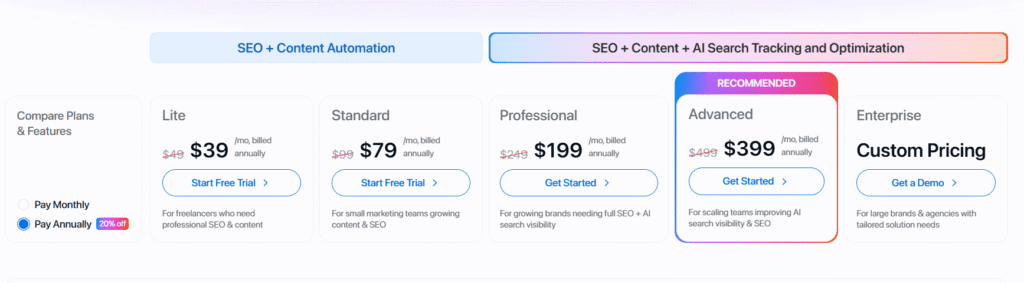
Track My Visibility vs Writesonic: Head-to-Head Feature Comparison
Here’s how Track My Visibility vs Writesonic compare on the factors that matter most for your decision.
| Feature | Track My Visibility | Writesonic | Winner |
| Starting Price | 7-day trial, $50/mo | $20/mo (no GEO), $249/mo (with GEO) | Track My Visibility |
| AI Platforms Tracked | 4 (ChatGPT, Gemini, Perplexity, Google AI) | 10+ (includes Claude, Grok, DeepSeek, Meta AI) | Writesonic |
| Prompts Per Month (Base) | 25 prompts | Varies by plan | Track My Visibility (transparency) |
| Primary Strength | AI-Ready Score + focused tracking | All-in-one content + SEO + GEO | Depends on need |
| Unique Feature | AI-Ready Score prioritization | 120M conversation dataset + Action Center | Tie |
| Reporting & Analytics | Clear, action-focused | Comprehensive, data-heavy | Writesonic (depth) |
| Actionable Recommendations | Built-in daily | Action Center (Professional+) | Tie |
| Multi-Language Support | Limited | 115+ languages | Writesonic |
| Team Members Included | Unlimited (all plans) | Per-seat costs ($40-149) | Track My Visibility |
| Integration Options | Limited (API coming) | Extensive (WordPress, GSC, Analytics) | Writesonic |
| Customer Support | Direct founder access | Tiered (email to dedicated manager) | Track My Visibility (responsiveness) |
| Best For | Pure visibility tracking | Content creation + monitoring | Depends on use case |
| Free Trial Available | No | Yes (free tier exists) | Writesonic |
| Content Creation | No | Yes (80+ templates, AI writer) | Writesonic |
| SEO Tools Included | No | Yes (keyword research, technical SEO) | Writesonic |
| Update Frequency | Daily (24 hours) | Every 6 hours (major insights daily) | Writesonic |
Limitations of the LLM AI Visibility Tracking Tool
Both tools share fundamental constraints worth understanding before you rely on them too heavily.
Where Both Tools Have Constraints
- Simulations, not real searches: Track My Visibility tests engines with synthetic prompts, while Writesonic draws from 120 million past conversations. That’s useful for spotting trends, but neither tool tells you what real people are asking right now.
- Traffic estimates are educated guesses: These tools show share of voice and citation frequency well. What they can’t do is give you the precise click and conversion data you’d find in Google Analytics. You’re looking at potential visibility, not actual visitors.
- AI platforms change constantly: OpenAI and Google adjust their algorithms almost weekly. What gets you cited today might stop working next month. These tools react to changes after they happen, not before.
- Human judgment is still required: The platforms surface data and suggestions. They can’t build your strategy. Someone needs to decide whether a recommendation actually fits your brand voice or makes sense for your business goals.
- There’s a lag in the data: Writesonic refreshes roughly every six hours. Track My Visibility updates daily. If you’re managing breaking news or a crisis, the dashboard won’t reflect the latest AI responses immediately.
- No one has inside access: Since ChatGPT and similar tools are proprietary, no tracking platform knows exactly how they make decisions. The insights are based on careful observation, but there’s always some uncertainty compared to traditional search tracking.
Future of the Best AI Search Visibility Tools
AI search is changing faster than traditional SEO ever did. Right now, about 69% of websites are getting consistent traffic from AI sources. That’s a real shift, showing these “answer engines” are now mainstream. That context is important when deciding between Track My Visibility vs Writesonic for your team.
Google’s AI Overviews now show up in 55% search queries. ChatGPT has over 900 million weekly users, and SearchGPT is officially live.
Sam Altman, CEO of OpenAI said, “I don’t use Google anymore. I legitimately cannot tell you the last time I did a Google search.”
We’re in the zero-click era: people get their answer in a summary and never click through to your site. The new goal is to be the source that the AI actually cites.
A user on Reddit raised a frustration that many marketers are quietly dealing with: their pages rank in the top 3-5 on Google, yet ChatGPT, Gemini, and Perplexity rarely cite them, while competitors with weaker rankings show up consistently.
Why is my site never cited in ai search even with top rankings?
by u/Altruistic-Meal6846 in GrowthHacking
This means moving beyond keyword density toward what’s called GEO. AI models pay close attention to E-E-A-T signals when deciding which brands to cite.
These engines favor well-structured, authoritative content that genuinely helps people, which is why understanding how to rank in AI search matters as much as choosing the right tracking tool.
The tool market is splitting between specialists and all-in-one platforms.
Track My Visibility is focused on monitoring. Their roadmap prioritizes API access and deeper analytics across multiple AI models. If your content team is strong and just needs precise data to guide decisions, it’s a solid fit.
Writesonic is building toward a full-cycle platform. Their Action Center draws from over 200 million real AI conversations to recommend specific content updates, then helps you write and publish the fix without switching tools.
Track My Visibility vs Writesonic: Actual Performance Analysis
Let’s examine how Track My Visibility vs Writesonic perform in practice across specific criteria.
1. AI Platform Coverage
On coverage, both AI SEO tools give you a view of where your brand shows up, but they take different paths.
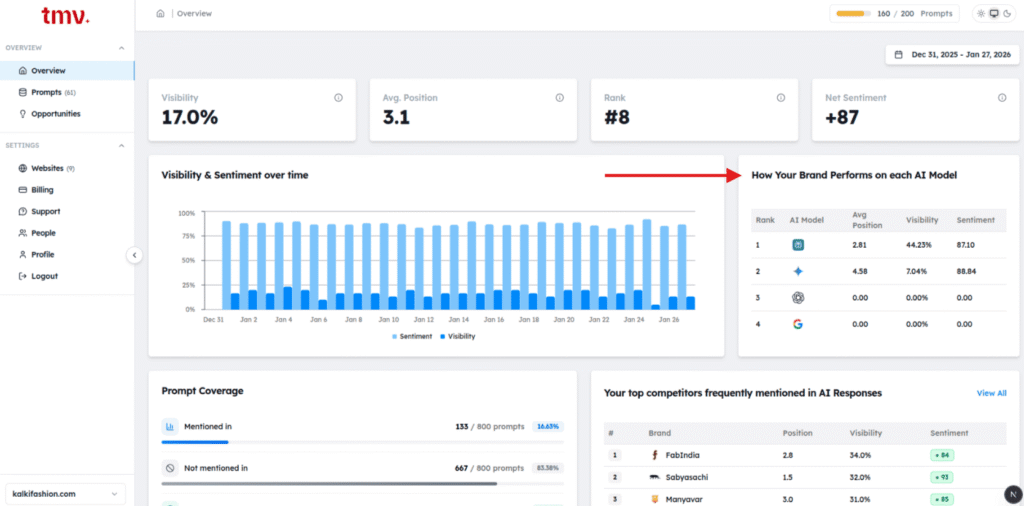
Track My Visibility keeps things focused. It tracks the four platforms that drive most AI traffic: ChatGPT, Gemini, Perplexity, and Google AI Overviews. The platform list is shorter, but you get detailed cross-model comparisons so you can see how answers change between engines.
It works well if you’d rather go deep on the platforms instead of tracking every new AI search tool that launches.
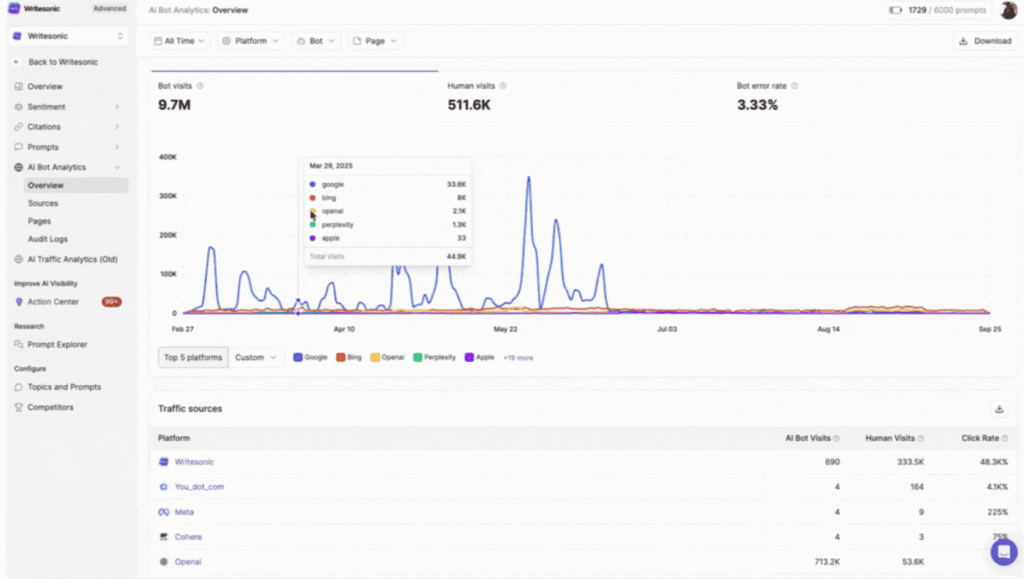
Whereas Writesonic casts a wider net. It covers more than 10 AI platforms, including the major ones plus emerging players like Claude, Grok, DeepSeek, Copilot, and Meta AI. Since it’s an all-in-one setup, you don’t pay extra for those additional engines.
The broad coverage is included in their base tracking tiers. That makes it a solid pick for larger brands that need to know how they appear across the entire generative landscape, with new platforms added as they come online.
2. Ease of Use and Setup
For ease of use, the experience really depends on whether you want a focused, data-first approach or a full content ecosystem.
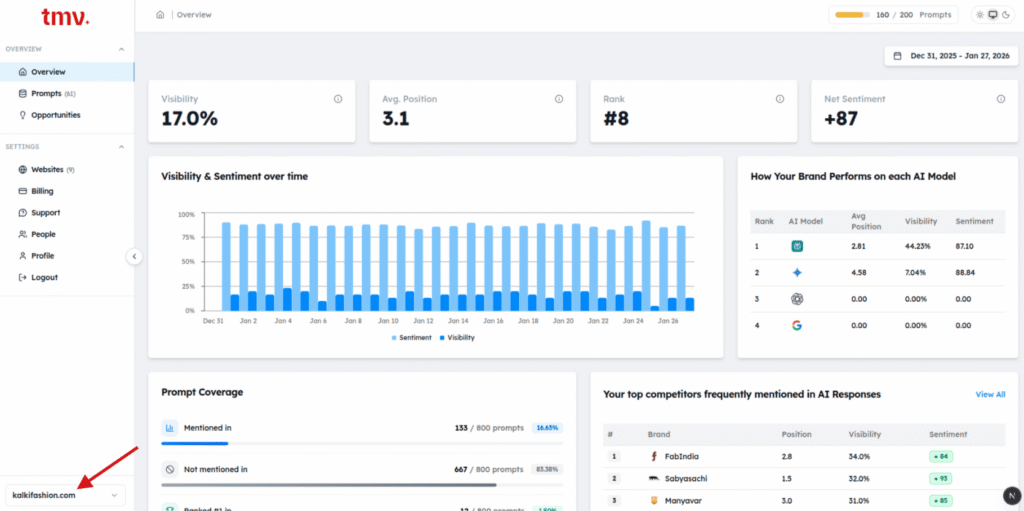
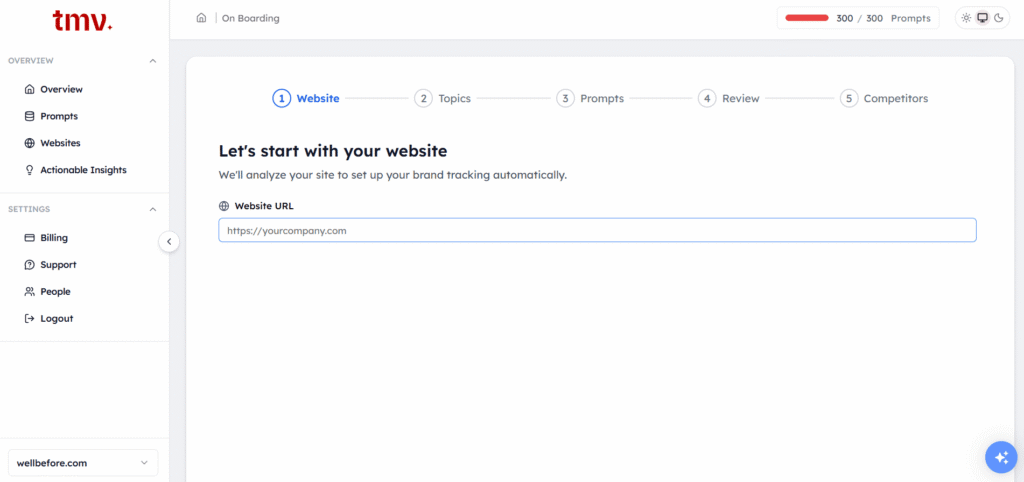
Track My Visibility is built for speed and simplicity. Setup is straightforward: enter your domain and a few core topics, and you’re good to go. The standout feature is persona-based prompt generation. It automatically creates the kind of natural-language questions real users actually ask AI engines. You can add custom prompts, but this feature saves you from having to guess how to test your visibility.
Right from the start, the dashboard focuses on URL-level citation clarity. You see exactly which pages are being cited and why, without getting distracted by unrelated marketing tools.
Writesonic is a much larger platform with a steeper learning curve, mostly because it packs in over 80 features. The interface is clean, but the sheer number of options can feel overwhelming if you just want tracking data. You’ve got everything from AI image generation to real-time research agents.
That said, if you want a power-user environment, the guided onboarding does a solid job walking you through connecting your SEO stack, including integrations with Ahrefs and Google Search Console. Once past the initial setup, all that complexity becomes useful.
The Action Center works like a built-in consultant, using your tracking data to tell you exactly which content to create or refresh next. It’s a more involved start, but it’s designed for teams that want to go from spotting a problem to publishing a fix in one workflow.
3. Reporting and Analytics
Both AI visibility tools show you how AI search engines see your brand.
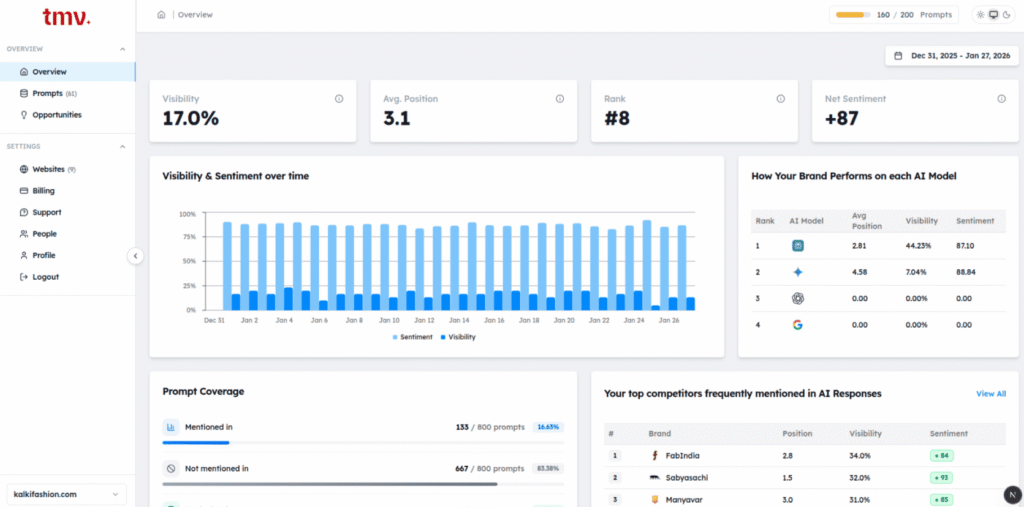
Track My Visibility is built for anyone who wants to start tracking quickly without much hassle. You type in your brand name and a few competitors, and it starts monitoring your “AI-Ready Score.” This score gives you a snapshot of how prepared your site is for AI discovery.
It shows a full prompt coverage breakdown, including how many prompts your brand was mentioned in, how many it was absent from, and how many times it ranked #1.
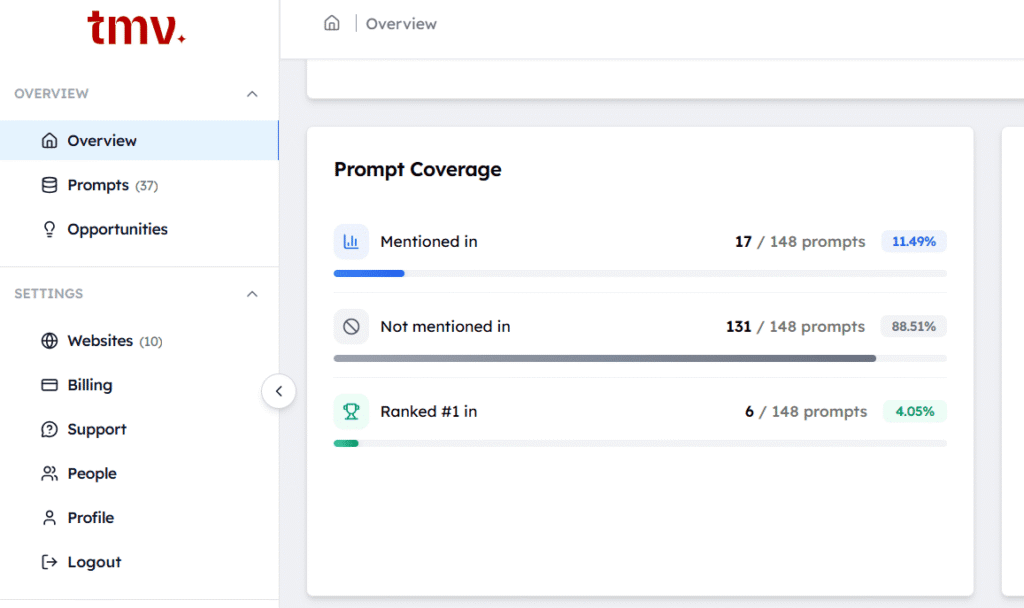
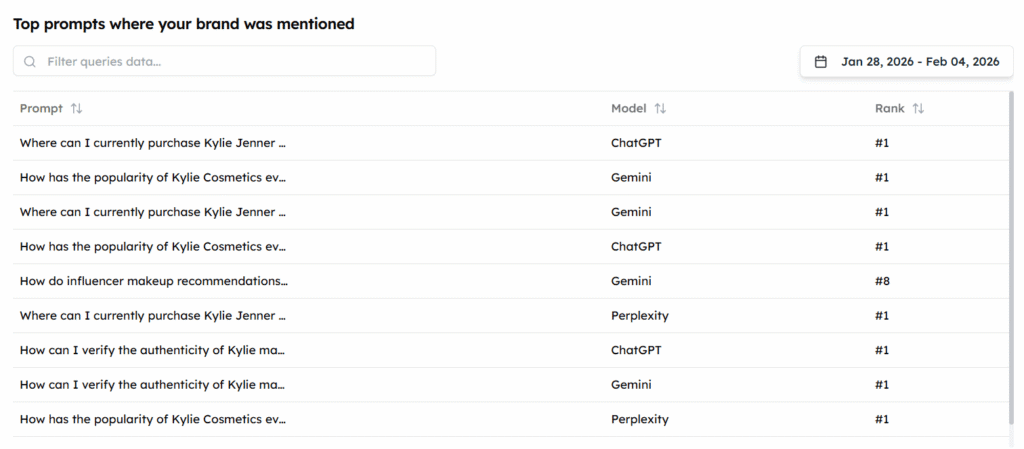
The dashboard keeps things simple: you see your most-cited URLs and how you compare to competitors. It updates daily, but it won’t bury you in data. If you just need a reliable pulse on your AI presence without the noise, this is a solid option.
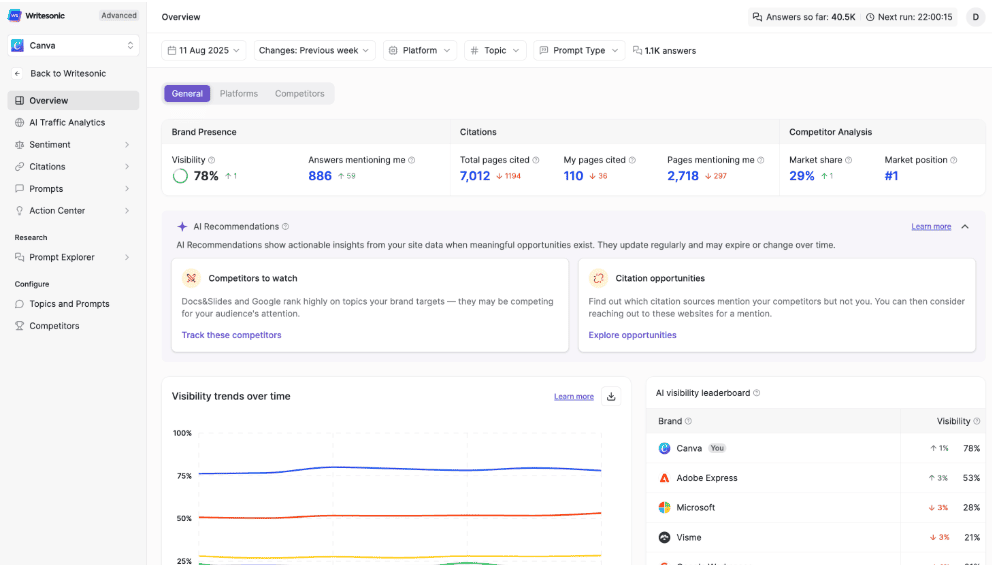
Writesonic takes a different route. It’s more of a full monitoring and optimization system, so the setup takes a bit longer. You connect it to tools you probably already use, like Google Search Console or Ahrefs.
Once that’s done, it pulls from a database of over 120 million actual AI conversations, not just keyword estimates. The reporting gets specific. It updates every six hours and shows your visibility percentage, share of voice, and even how positively the AI talks about you if you’re on a higher plan.
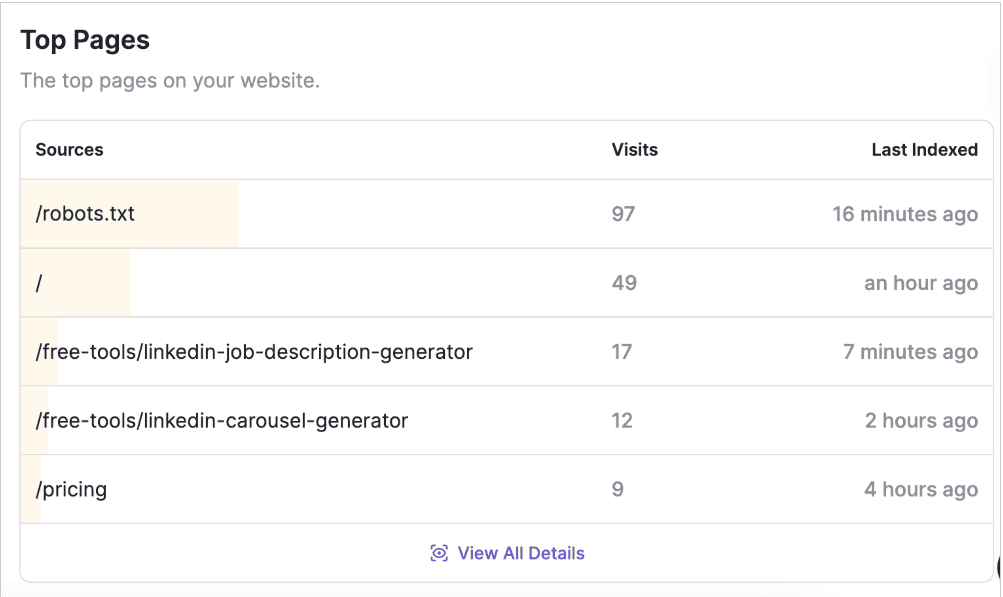
There’s also a top page, which reveals the pages getting the most attention from AI crawlers.
4. Actionable Insights and Recommendations
Track My Visibility tool is for people who want clean data without all the extra stuff that comes with a full content platform. You put in your domain and the prompts you’re targeting, and it gives you an “AI-Ready Score” for each URL. That score is your starting point. It shows you how a machine interprets your page.
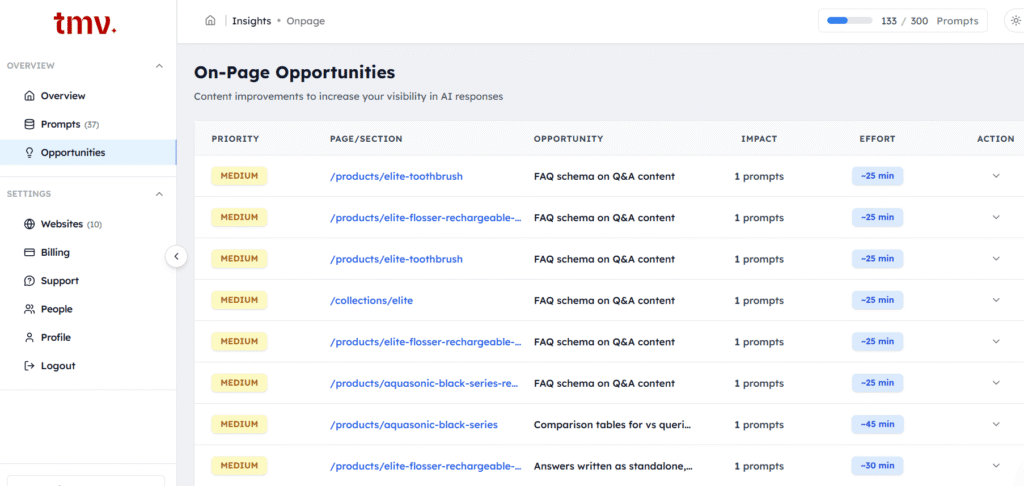
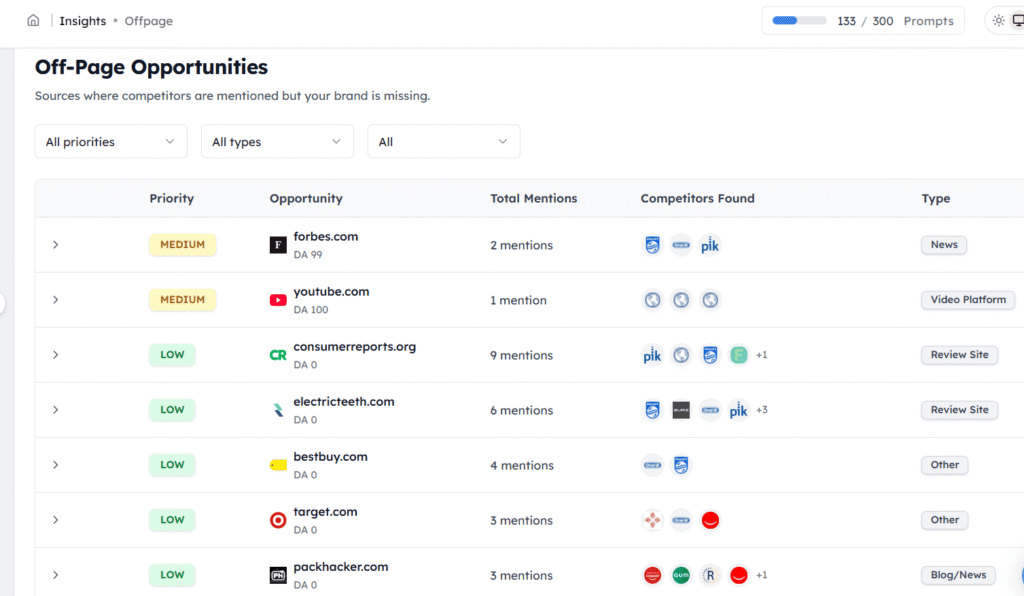
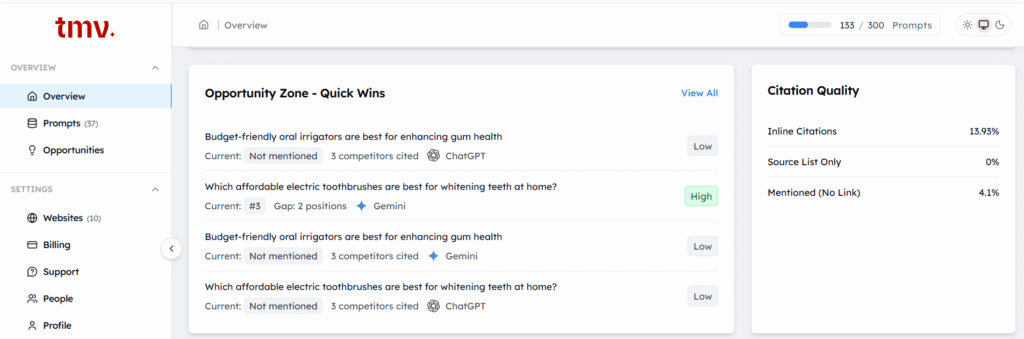
The Opportunity Zone shows you exactly which prompts to prioritize, with High or Low urgency labels, which AI platform has the gap, and how many competitors are already being cited there.
It also breaks down citation quality, showing whether your brand is getting inline citations, source list mentions, or name drops without a link. Each type carries a different weight in terms of how AI models perceive your authority.
It tells you what’s broken and where, but the actual work of optimizing your content for AI answers still falls on you.
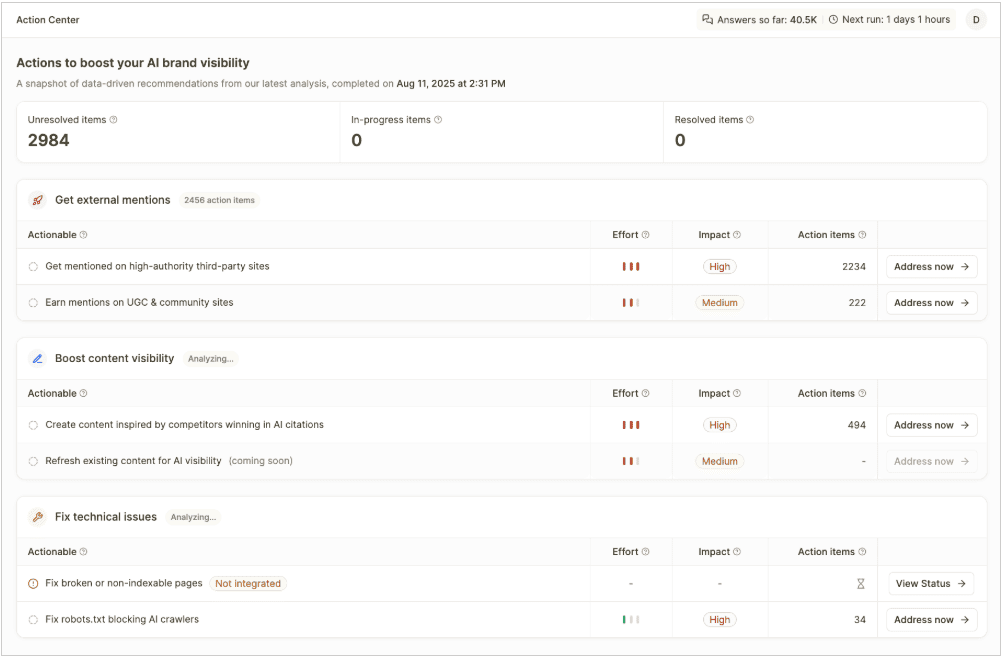
Writesonic, on the other hand, pairs tracking with its built-in production tools. You connect your site through a WordPress plugin or Cloudflare worker, which lets the platform watch AI bot traffic as it happens.
Once data starts flowing into the Action Center (on the Professional plan and above), it doesn’t just score your pages. It runs a Citation Gap Analysis that shows exactly where competitors are being cited instead of you, then provides the outreach templates or content updates you need to close those gaps.
The workflow advantage is real. You can spot a gap, use their SEO AI Agent to write a citation-focused article, and publish it to your site without leaving the platform.
5. Competitor Tracking
When it comes to tracking your competition, both AI search visibility tools show you what’s happening, but they have different ways.
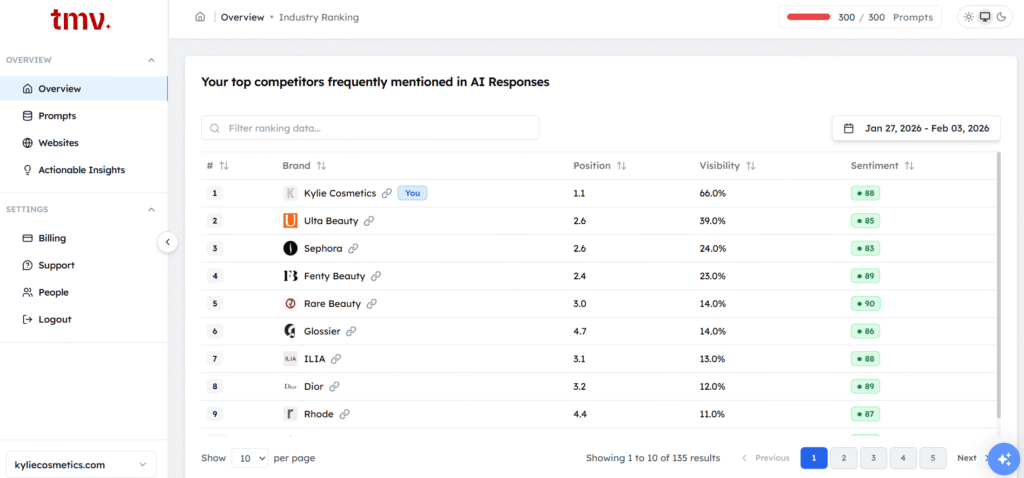
Track My Visibility keeps things simple. Plug in your brand and a few competitors, and you get a side-by-side view of performance right away. It shows your Share of Voice and lets you see how your citations compare across different AI models.
Writesonic goes deeper but asks more of you upfront. It works more like a full SEO platform and can help you find competitors you might not have considered by scanning its AI conversation database to see which brands get mentioned alongside yours.
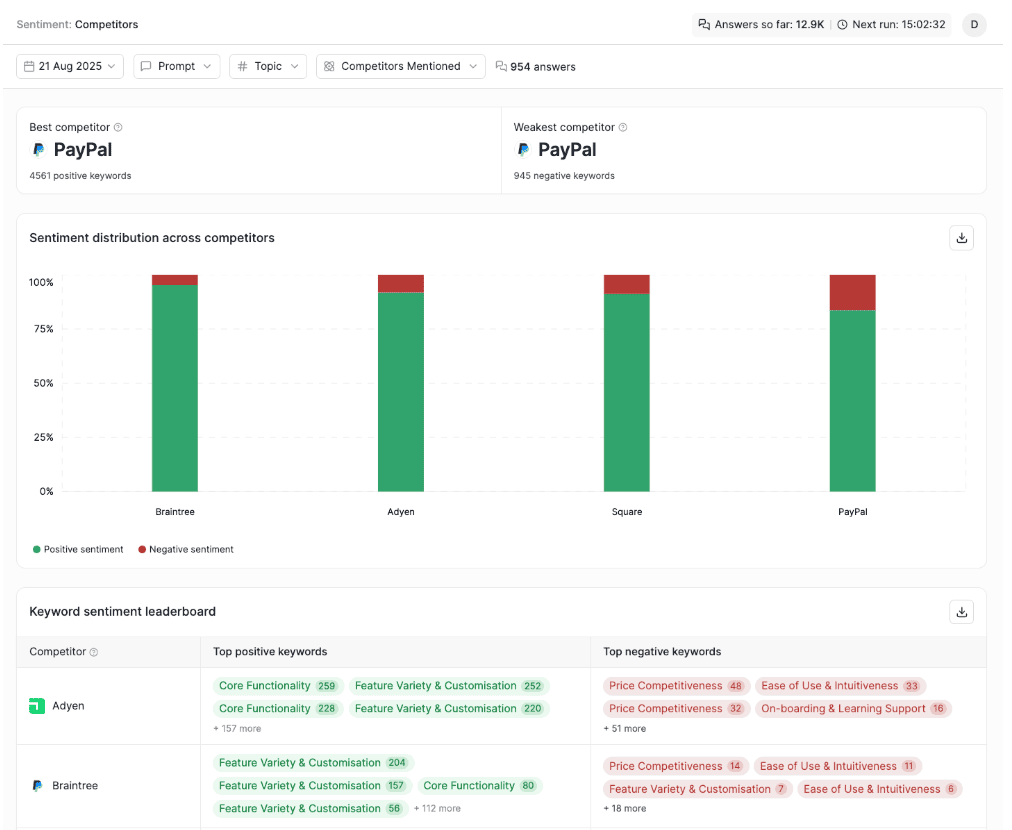
Beyond just tracking where you rank, it gives you sentiment analysis and topic-based leaderboards so you can see exactly where competitors are winning and why. You can spot the specific content gaps that explain why they got a citation, and you didn’t.
The tradeoff is that Writesonic needs more initial work. It connects to your website through Cloudflare or similar integrations to see how AI crawlers interact with your site versus your competitors’. That means more configuration on your end, but it also means a more complete picture once everything’s running.
6. Team Collaboration and Integration
Track My Visibility brand AI visibility tool is all about speed. Small teams and lean agencies love it because you can invite as many people as you want without paying per seat. CSV exports and shared dashboards are available, but there’s no API and few integrations.
Writesonic, on the other hand, takes a completely different approach. It’s designed as a full marketing hub, so the setup has more depth. You pay per user, which can run anywhere from $40 to $149 a month, depending on your plan. That means you need to think about the budget if you’re bringing on a bigger team.
On premium plans, you get API access to pipe visibility metrics into your own systems. It also integrates with WordPress for publishing and Cloudflare for tracking AI crawlers. The setup takes longer, but you end up with a system where you can spot a problem and fix it without leaving the platform.
7. Global and Multi-Language Support
Track My Visibility is starting to add regional support and basic multi-country tracking, but right now, it is best for the US. You set it up by plugging in your brand domains and customer prompts.
Then, see how major AI models like ChatGPT and Gemini reference you in those core markets. If you want a clean, straightforward view of your visibility without getting buried in global data you don’t actually need, this is your tool.
Writesonic is designed for global enterprises from the ground up. There’s a dedicated “Markets” dashboard built specifically for geographic intelligence. You can track unique country-language combinations, like “United States – Spanish,” separately from “Spain – Spanish.”
With support for over 115 languages and the ability to simulate AI queries from different locations, the setup is really about mapping your entire global footprint.
This makes it a better fit for international content teams who need to monitor how they show up across dozens of regions and also create and optimize localized content that matches the cultural context of each specific market.
8. Data Accuracy and Reliability
Track My Visibility focuses on transparency. It shows you URL-level citations in real-time and explains exactly how it calculates the AI-Ready Score. This clarity helps teams trust the optimization recommendations they receive.
Writesonic takes more effort upfront because it connects to your existing SEO tools, like Cloudflare for bot analytics and Google Search Console for traffic. It pulls from over 200 million real AI conversations to model how people search. The methodology isn’t fully open, but updates are much faster. Major insights refresh daily, with deeper analysis every six hours. Some advanced users have noted occasional gaps between automated results and manual testing.
You’re weighing simplicity and transparency against depth and speed. One gives you a specialist’s precision, the other gives you comprehensive historical trends and established market presence.
Which AI Search Visibility Tool Should You Choose?
Both tools solve the same core problem but approach it differently. The right choice comes down to your budget, team size, and whether you need a focused tracker or a full content workflow in one place.
Choose Track My Visibility If You
- Are working with a growth-stage budget: At $50/month, it’s significantly more accessible for solo creators and small teams than enterprise alternatives that require a sales conversation before you see pricing.
- Want a “To-Do” list, not just data: The standout feature here is the AI-Ready Score. It gives you a roadmap for specific URLs, telling you exactly what content to tweak so AI models are more likely to cite your page.
- Want source-level citation clarity: The Sources tab shows whether AI is citing your pages, competitor sites, or third-party domains, so you know exactly where to focus.
- Need broad coverage in your base plan: You get tracking for ChatGPT, Claude, Gemini, Perplexity, and Google AI mode without having to pay for individual model add-ons.
- Prioritize the US and English-speaking markets: While it continues to expand, its primary strength lies in domestic search and straightforward content optimization.
- Run a lean agency: Because you get unlimited team members and low per-client costs, you can scale your “AI Reporting” service without your software bill eating your profits.
- Value simplicity: If you want a dashboard that your account managers and clients can understand in five minutes, this is the better fit.
Choose Writesonic If You
- Want a “Monitor-and-Fix” workflow: You can spot a visibility gap in the morning and use their AI Article Writer to publish a fix by lunch.
- Have the budget for a full GEO suite: Access to the specialized Generative Engine Optimization tools typically starts at $249/month (Professional plan).
- Need massive engine coverage: It monitors your brand across 10+ AI platforms (including ChatGPT, Perplexity, Gemini, Claude, and SearchGPT) in one dashboard.
- Want the Action Center: This is the operational hub of the tool. It turns data into a prioritized task list of specific technical and content fixes.
- Manage global brands: With support for 115+ languages, it’s built for international teams who need to track and create content for multiple markets.
- Need all-in-one SEO integration: It pulls in professional data from Ahrefs and Semrush, so you can stop paying for those separate subscriptions.
- Want to track real human behavior: It uses a dataset of 120M+ real AI conversations, giving you a better look at how people actually talk to AI compared to simple keyword guesses.
- Require Enterprise-level security: It’s fully compliant with SOC 2 Type II, GDPR, and HIPAA, which is often a deal-breaker for large corporate legal teams.
Final Thoughts
Picking between Track My Visibility vs Writesonic AI visibility tools in 2026 depends on what you need. Track My Visibility is a focused monitoring tool. Add your domain, select AI models like ChatGPT or Perplexity, input a few prompts, and you get an AI-Ready Score in minutes. At $50 to $400 monthly with unlimited users, it’s affordable if you just need visibility data to guide your existing content team.
Writesonic is a complete workflow platform. Starting at $249 monthly for GEO features, it’s pricier but does more. Connect your SEO tools, spot visibility gaps, generate content with its AI writer, and publish directly to WordPress. If you’re producing content at scale, the ability to identify and fix problems in one system justifies the cost.
Your choice comes down to your current bottleneck. Need to know if AI engines mention you? Try Track My Visibility’s 7-day trial. Struggling to produce enough content? Test Writesonic’s free tier first to check if the writing quality fits your brand.
Frequently Asked Questions
Neither is universally “better.” Writesonic offers more features (content creation, SEO tools, 10+ platform tracking) but costs significantly more ($249+/mo vs $50/mo). Track My Visibility is better if you only need focused AI visibility tracking without the complexity and cost of additional features.
Track My Visibility wins on price, simplicity, and unlimited users. It’s the better pick for agencies managing multiple clients or startups just testing AI search visibility. The tradeoff is no content creation tools and narrower platform coverage.
Probably not if you’re on Writesonic’s Professional or Advanced plan, which includes AI visibility tracking across 10+ platforms.
Yes. Track My Visibility offers a trial for 7 days with full feature access, making it low-risk to test. Writesonic has a free tier that includes content generation (10,000 words/month) and basic AI traffic analytics, though GEO features require the Professional plan at $249/month.
Yes. Track My Visibility includes competitor benchmarking, share of voice tracking, and citation comparison. Writesonic offers more detailed competitor insights, including position tracking, sentiment analysis (Advanced+), seeing exact competitor content that wins, and leaderboards.
You’ll see baseline data within days of setup. Actually improving visibility takes weeks to months of consistent optimization. Significant visibility trends improvement typically takes 2-3 months of steady content optimization and technical fixes.
Resource:
- Generative AI Statistics By Adoption, Usage and Facts (2026)
- ChatGPT Reaches 900 Million Weekly Active Users: What Every Business and Marketer Must Know in 2026 | ALM Corp