


Have you ever wondered how AI tools like ChatGPT, Claude, and Perplexity seem to instantly “know” information from across the internet? You’re not alone.
Behind these systems are AI crawlers continuously collecting and processing web content. That collected content is what LLMs draw on to form an answer, which makes crawler access the first step in the visibility chain. Unlike traditional search crawlers focused mainly on rankings, AI crawlers power retrieval, citations, and conversational answers.
In this guide, we’ll break down what AI crawlers are, how they work, what they look for, and how brands can improve their discoverability across AI systems.
TL;DR
- AI crawlers collect and process web content for AI-generated answers and retrieval systems.
- Unlike traditional search bots, AI crawlers focus on semantic understanding and extractable information.
- Major AI crawlers include GPTBot, ClaudeBot, Google-Extended, PerplexityBot, and Applebot.
- AI crawlers discover websites through links, sitemaps, backlinks, and public web references.
- Robots.txt settings directly affect whether AI systems can access and use your content.
What Are AI Crawlers?
AI crawlers are automated bots that scan, collect, and process web content so AI systems can retrieve, understand, and generate answers from online information.
These crawlers work similarly to traditional search engine bots, but with a different purpose. Instead of only indexing webpages for rankings, AI crawlers help large language models and AI search systems access usable information from across the web.
They continuously visit websites, read page content, analyze structure, and extract meaningful data such as headings, FAQs, definitions, product details, and entity relationships. The collected information may then support AI training, retrieval systems, citations, summaries, and conversational search experiences.
What Kind of Data Do AI Crawlers Collect?
AI crawlers collect different types of publicly accessible web data, including:
- Written content like articles, blogs, guides, forums, and documentation
- Metadata such as headings, page structure, links, and publish dates
- FAQs, lists, tables, and structured schema markup
- Brand mentions, entities, and topical relationships
- Images, PDFs, videos, and other media-related data
- Product information, reviews, and technical references
Insights: In our citation report, we found that ChatGPT heavily weights Wikipedia, Claude prioritizes legacy journalism, Perplexity emphasizes research sources, and Google AI Overviews leverage YouTube.
 Pro Tip: Crawlers may be collecting this
data from a site already, but collection does not guarantee a brand
actually shows up in AI answers. The free AI
Visibility Checker reveals which side of that gap a brand currently
sits on.
Pro Tip: Crawlers may be collecting this
data from a site already, but collection does not guarantee a brand
actually shows up in AI answers. The free AI
Visibility Checker reveals which side of that gap a brand currently
sits on.How Are AI Crawlers Different From Traditional Web Crawlers?
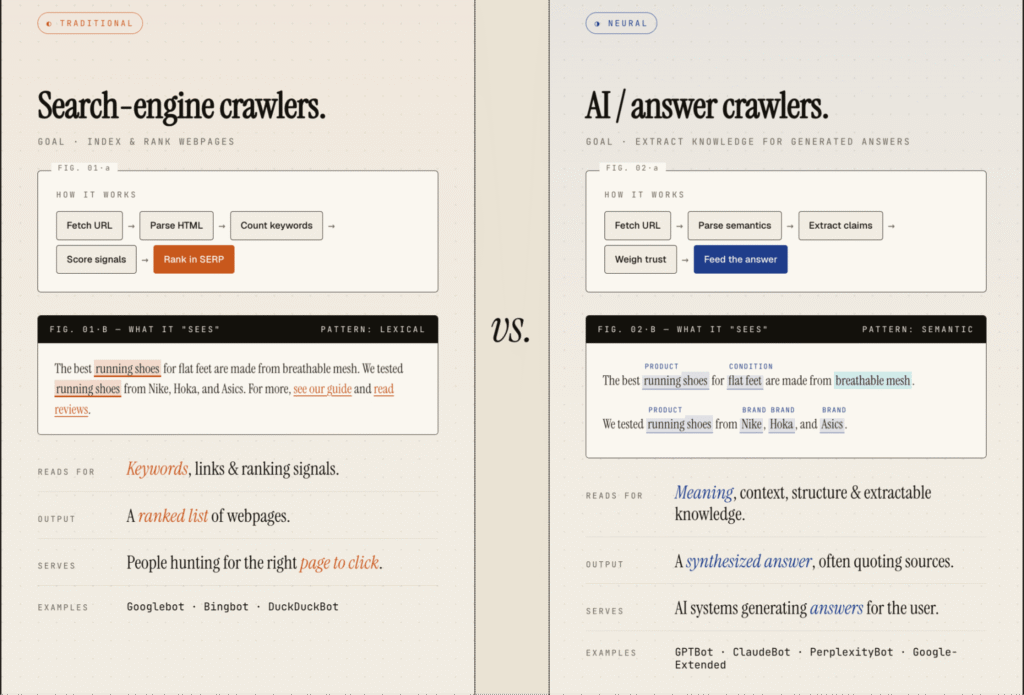
Traditional web crawlers mainly index webpages to rank them in search engine results. AI crawlers focus on collecting and understanding information that AI systems can retrieve, summarize, and use inside generated answers. This shift is changing how brands think about optimizing for AI answers, where clarity, structure, and contextual relevance matter as much as traditional SEO signals.
Unlike traditional crawlers that rely heavily on keywords and ranking signals, AI crawlers analyze semantic meaning, context, structure, and extractable knowledge. They evaluate whether content is clear, trustworthy, and useful for answering real user questions.
In simple terms: search engine crawlers help users find webpages, while AI crawlers help AI systems generate answers from web content.
Which AI Crawlers Are Active Today?
Industry analysis shows AI crawler traffic rose 18% between May 2024 and May 2025, with GPTBot growing 305% year over year and PerplexityBot surging by 157,490% in observed activity. One 2026 research summary also reported an average of 19,454 AI crawler requests per week in its baseline sample, where OpenAI accounted for 55.6% of measured AI crawler traffic, followed by Anthropic (24.0%), Amazon (22.4%), Perplexity (8.7%), and ByteDance (0.1%) (Optimly State of AI Brand Crawling, March 2026). A separate Cloudflare analysis reported Meta-ExternalAgent holding nearly 19% of AI-only crawler share as of May 2025.
| Company | AI Crawler / Bot | Primary Purpose | What They Commonly Look For |
| OpenAI | GPTBot, ChatGPT-User, OAI-SearchBot | AI training, retrieval, and search experiences | Structured informational content, accessible pages, authoritative sources, and concise explanations |
| Anthropic | ClaudeBot, Claude-SearchBot | AI retrieval and answer generation | Reliable factual information, semantic clarity, educational content, contextual depth |
| Google-Extended, Googlebot AI systems | AI Overviews and generative search systems | E-E-A-T signals, freshness, structured data, topical authority | |
| Apple | Applebot | Search and AI-related retrieval systems | Mobile-friendly pages, fast-loading websites, clean structure, trusted sources |
| Perplexity AI | PerplexityBot | AI answer generation and citations | Citation-friendly formatting, concise answers, updated information, and semantic relevance |
| Meta | Meta external crawlers | AI model research and retrieval systems | Publicly accessible content, entity relationships, and large-scale web data |
| ByteDance | Bytespider | AI, search, and content discovery systems | Crawlable content, multimedia signals, structured webpages |
| Emerging AI Startups | Various proprietary bots | AI search, RAG systems, and LLM training | High-quality knowledge content, FAQs, definitions, and semantic structure |
Pro Tip: Which AI crawler is pulling the
most weight this quarter, and is that share climbing or already
slipping? The numbers rarely hold steady long enough to memorize. The AI
Search Statistics 2026 reference keeps the latest AI search
statistics data and citation benchmarks in one place.How Do AI Crawlers Access Your Website?
AI crawlers access websites similarly to traditional search engine bots. They discover webpages through links, sitemaps, and public references, then request and analyze page content to understand the information available on the site.
During this process, crawlers check crawl permissions, read page
structure and content, and process useful information for AI retrieval,
citations, and generated answers.
1. URL Discovery
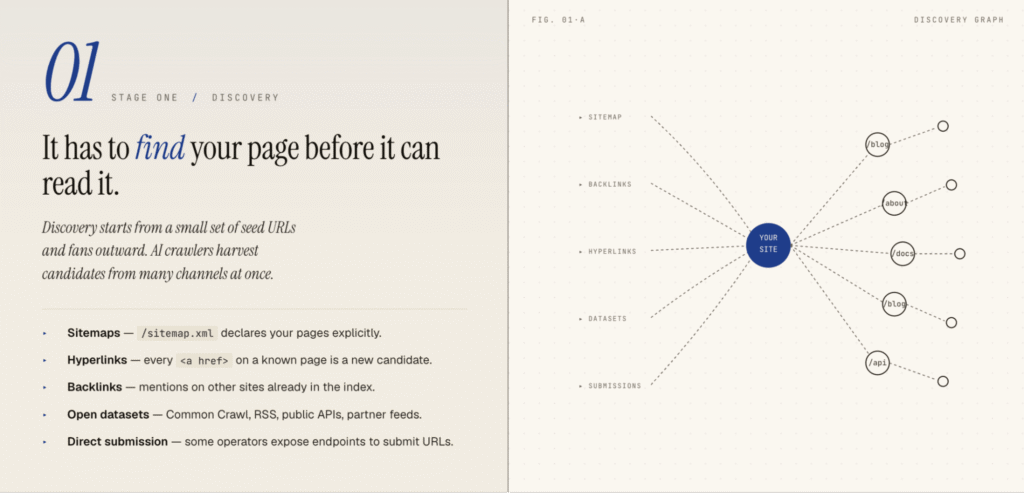
AI crawlers first need to discover web pages before accessing their content. They typically find URLs through internal website links, XML sitemaps, external backlinks, public datasets, and syndicated or republished content across the web. In addition, these discovery sources help AI crawlers identify and access relevant pages more efficiently.
For example, if a blog post is linked from your homepage, included in your sitemap, or referenced by another website, AI crawlers can discover it much faster. Strong internal linking and properly maintained sitemaps help crawlers find deeper pages that may otherwise remain difficult to access.
2. robots.txt Evaluation
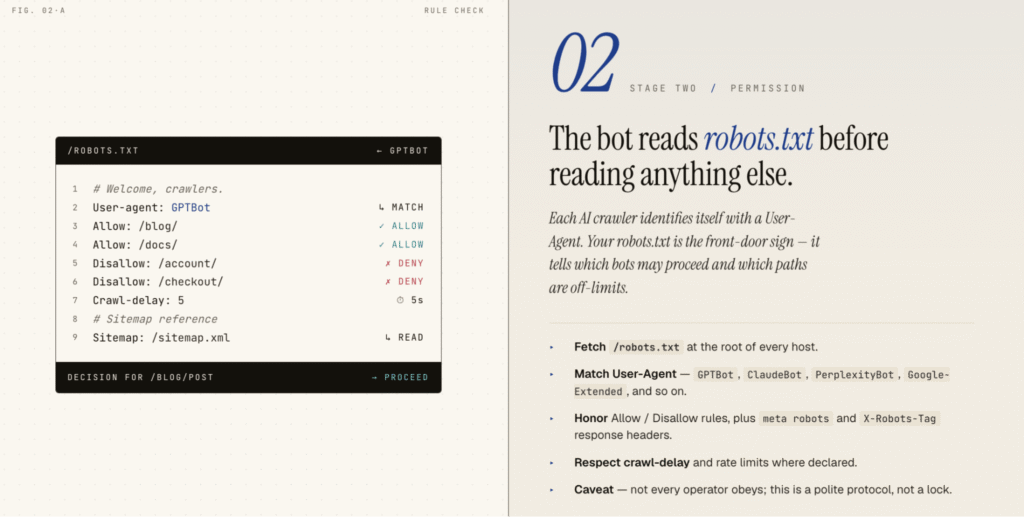
Before crawling a website, AI crawlers usually check the robots.txt file to understand access permissions. Website owners can allow or block specific AI bots, and different crawlers follow different identifiers and crawling policies.
A website can block GPTBot while still allowing Googlebot or PerplexityBot. If important sections of a site are accidentally restricted in robots.txt, AI systems may not be able to access or retrieve that content for an AI-generated response.
Important distinction: GPTBot (training) and OAI-SearchBot (search) are separate directives. Blocking one does not block the other. Similarly, ClaudeBot (training) and Claude-SearchBot (retrieval) are independent. You can block training crawlers while keeping search/retrieval bots active.
3. Fetching and Parsing Content
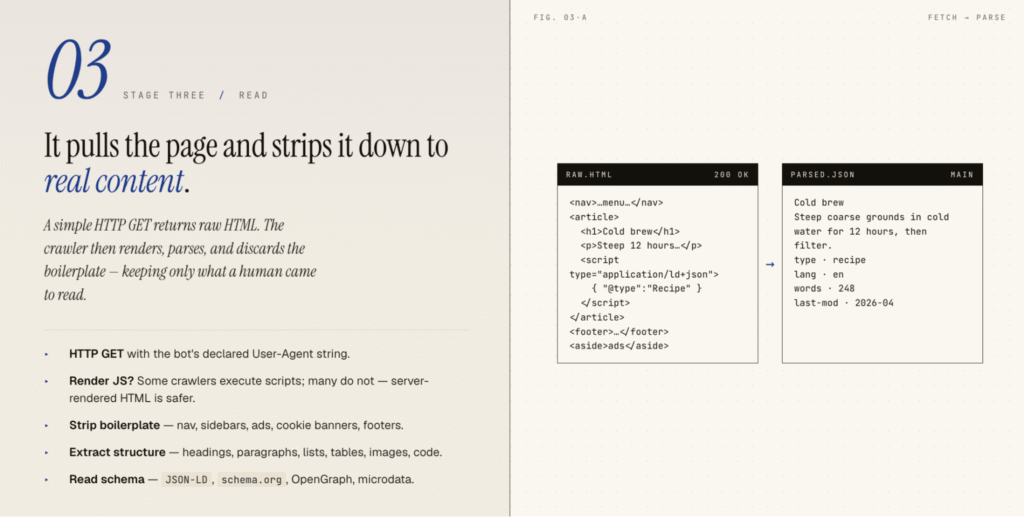
Once access is allowed, AI crawlers retrieve the webpage’s HTML content and analyze elements like headings, visible text, metadata, and structured data. Some advanced crawlers can also process JavaScript-rendered content to access dynamically loaded information.
Critical technical note: Unlike Googlebot and Applebot, the major AI crawlers, including GPTBot, ClaudeBot, OAI-SearchBot, PerplexityBot, Meta-ExternalAgent, and Bytespider, do not execute JavaScript.
They fetch your HTML but never run client-side scripts. If your site is a JavaScript SPA (React, Vue, Angular) without server-side rendering, these crawlers receive a near-empty HTML shell and miss all your content.
Analysis by Vercel found that ChatGPT encounters a 34.82% 404 error rate on JavaScript-only pages that render correctly for human visitors. Therefore, server-side rendering (SSR), static site generation (SSG), or pre-rendering is required to improve AI visibility.
During parsing, crawlers try to understand the structure and meaning of a page. Clean HTML structure, semantic headings, schema markup for AI, and properly organized content make it easier for AI systems to extract accurate information and interpret topical relationships across the page.
4. Content Chunking and Semantic Processing
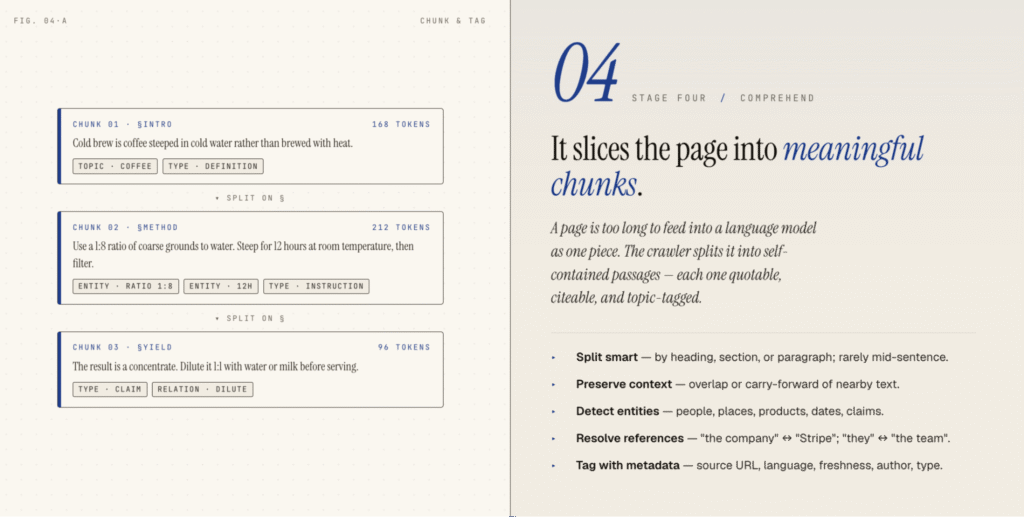
AI systems often break webpages into smaller semantic sections or “chunks” to better understand and retrieve information. Therefore, clear headings, contextual sections, and well-structured formatting help improve extraction accuracy and content interpretation.
This process allows AI systems to analyze topics at a more granular level instead of treating an entire page as one block of text. Semantic processing also helps models understand relationships between concepts, identify key entities, and retrieve the most contextually relevant sections when generating answers.
5. Storage, Embeddings, and Retrieval Systems
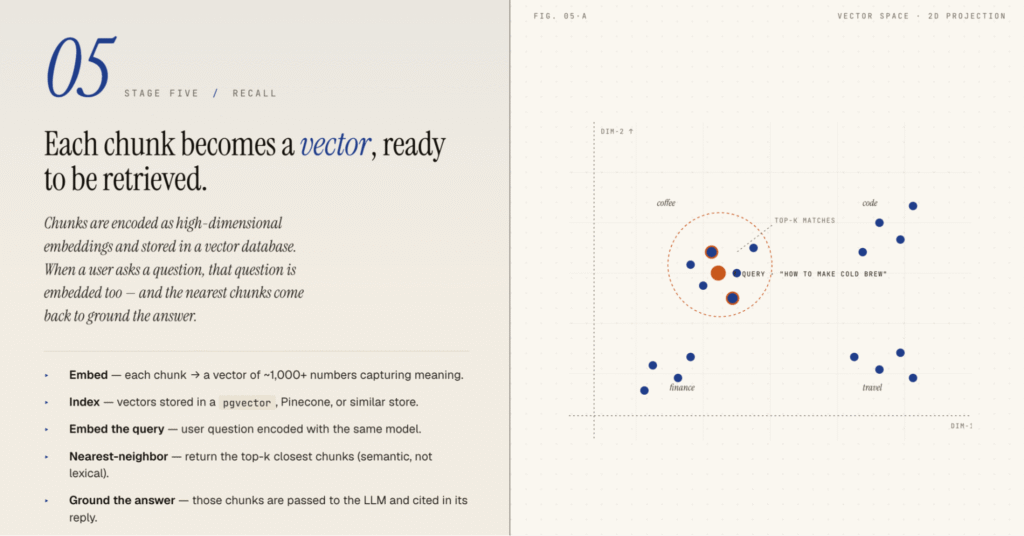
After processing content, AI systems may store the information in training pipelines, vector databases, retrieval indexes, or citation systems. Semantic embeddings help these systems understand topical relationships and retrieve the most contextually relevant information when generating answers.
Instead of relying only on exact keyword matches, embeddings allow AI systems to compare meaning, context, and semantic similarity between different pieces of content. This helps retrieval systems surface more relevant information even when users phrase questions differently from the original webpage content.
How to Check If AI Crawlers Visit Your Site
Monitoring crawler activity helps you understand which AI systems are interacting with your site, how often they visit, and whether your content is accessible for AI retrieval and visibility. It also becomes an important first step in learning how to measure AI visibility, since crawler access often influences whether brands appear in AI-generated answers and citations across different platforms.
Method 1 – Server Log Analysis
One of the most reliable ways to detect AI crawler activity is through raw server log analysis. For example, server logs can help identify visits from bots like GPTBot, ClaudeBot, PerplexityBot, and other AI crawlers by their user-agent identifiers. You can also analyze crawl frequency, requested pages, and how often AI systems access specific URLs on your site.
Pro Tip: Server logs confirm a crawler
arrived, but they say nothing about whether the content was structured
well enough to be retrieved and cited afterward. The AEO GEO
Audit Checklist maps the on-page signals AI systems weigh once a
crawler gets through.Method 2 – CDN and Analytics Dashboards
CDN and hosting analytics platforms like Cloudflare or Akamai can help monitor bot traffic and crawler activity on your website. In addition, these dashboards often show which AI crawlers are visiting your site, how frequently they access pages, and how their activity compares to traditional search engine bots like Googlebot.
Method 3 – robots.txt Review
Review your robots.txt file to check whether AI crawlers are allowed or blocked from accessing your website. Verify directives for bots like GPTBot, ClaudeBot, Google-Extended, and PerplexityBot, and ensure accidental restrictions are not limiting your AI visibility or content accessibility.

For faster audits, run a quick AI study with this AI visibility checker extension to see how your website looks in seconds.
How AI Crawler Access Affects Your AI Visibility
AI crawler access directly affects whether content can appear in AI search results. When crawlers cannot reach or properly interpret a page, brand visibility across AI search environments tends to decline. Brands focused on AI discoverability often allow trusted AI crawlers as a strategic foundation.
Crawler access alone is not enough. AI systems also evaluate content quality, semantic clarity, structure, and trust signals before retrieving or citing information. Accessible, well-structured content helps these systems build higher confidence in a brand and its content.
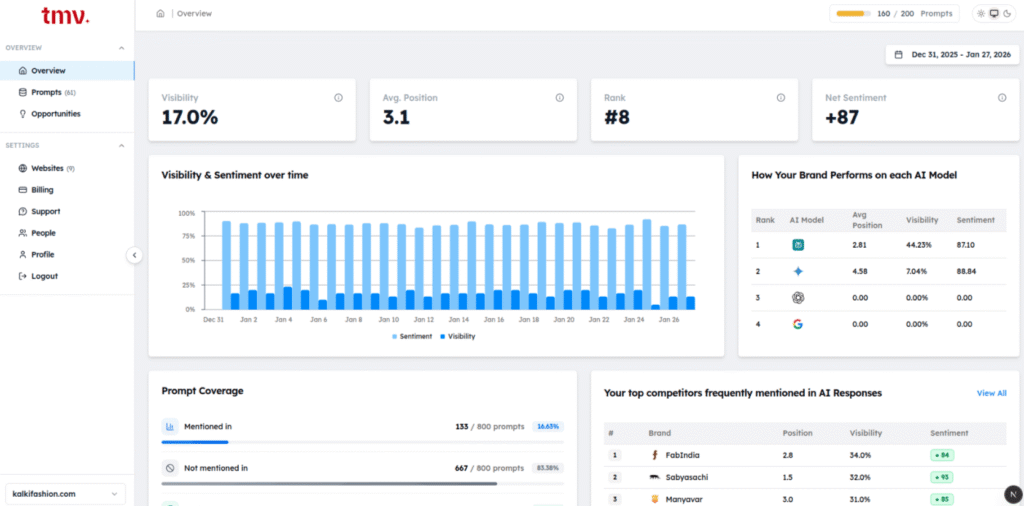
The harder part is knowing whether any of it is actually working. Crawl access, citation frequency, and answer presence constantly shift across AI platforms, and as a result, most of this visibility never appears inside traditional analytics tools. To address this gap, tools like Track My Visibility help monitor AI citations, brand mentions, and answer presence across platforms like ChatGPT, Perplexity, Gemini, and Google AI Overview.
Start with a free 7-day trial to see how AI systems are currently referencing your brand.
FAQs
OpenAI’s crawler that accesses public web content for AI-related systems and retrieval processes.
Yes. AI crawlers focus more on extracting and understanding information for generated answers rather than ranking webpages.
Yes. You can block specific bots through robots.txt directives.
Allowing access can improve eligibility for AI retrieval and citation systems.
You can monitor server logs, CDN dashboards, and crawler analytics tools.
Structured, trustworthy, concise, and semantically clear content performs best for AI retrieval.
AI visibility monitoring tools like Track My Visibility can help track brand mentions, citations, and presence across platforms like ChatGPT, Perplexity, and other AI search systems.
References
1. 15
Most Common Web Crawlers in 2026: What You Need to Know
2. What Are AI
Crawler Bots?
3. Monthly AI
Crawler Report: April 2026 Traffic Trends & Q1 Predictions
Scorecard
4. Overview of
OpenAI Crawlers
5. Anthropic: AI research and
products that put safety at the frontier