



When OpenAI introduced SearchGPT, it was not just another feature launch. It signaled a fundamental shift in how search works. Instead of returning a list of links, SearchGPT was designed to deliver direct answers by combining real-time information with AI reasoning.
That foundation did not stay experimental for long. It quickly evolved into ChatGPT search, turning ChatGPT answers into a full-fledged AI-powered search experience. This transition challenges the traditional search engine model, replacing it with synthesized responses that prioritize clarity over navigation.
In this article, we break down what SearchGPT is, how SearchGPT works, and how ChatGPT became a search engine redefining online discovery.
TL;DR
- SearchGPT transforms search into an answer-first experience by synthesizing real-time web data into a single response inside ChatGPT.
- It uses retrieval-augmented generation (RAG) to combine live data with AI reasoning, making answers more contextual and up-to-date.
- Unlike Google, which ranks links, SearchGPT focuses on understanding intent and delivering direct answers with citations.
- Search behavior is shifting from keywords to conversational queries, increasing the importance of structured, answer-first content.
- AI search is fragmented across platforms (ChatGPT, Google AI Overviews, Perplexity), so visibility in one does not guarantee presence in others.
What Is SearchGPT?
SearchGPT is OpenAI’s conversational AI search technology designed to deliver direct answers instead of a list of links. It combines real-time information with advanced natural language processing to generate responses that are contextual, up-to-date, and supported by cited sources when choosing content.

Originally introduced as a prototype in July 2024, SearchGPT marked the first step toward redefining search as an answer-first experience. By October 2024, this capability was integrated into ChatGPT as ChatGPT search, turning it into a fully functional AI search interface. Since February 2025, it has been available to all users.
At its core, SearchGPT works by blending live web retrieval with trained AI models, allowing it to interpret user intent and generate real-time answers. This creates a dynamic search experience where information is understood, combined, and clearly presented in a single response.
How Does SearchGPT Work?
SearchGPT is built on the same architecture as the latest models from OpenAI, allowing it to understand the context of an entire conversation rather than treating each query independently. This means it can interpret intent more accurately and refine responses based on previous inputs.
The system uses retrieval-augmented generation (RAG), a method that combines a language model with live web search data. It pulls fresh information from the internet and connected data providers, largely supported by Microsoft’s infrastructure and Bing’s web index, and uses it to ground its responses. This grounding improves ChatGPT citation accuracy and reduces fabricated information by ensuring answers are based on real, verifiable, authoritative sources.
In our citation report, we found Reddit and Wikipedia together account for nearly 45% of ChatGPT’s citations, with Reddit alone leading at 29.43%. It shows ChatGPT’s retrieval layer prefers community-driven discussion, as it does on encyclopedic authority when grounding a response.
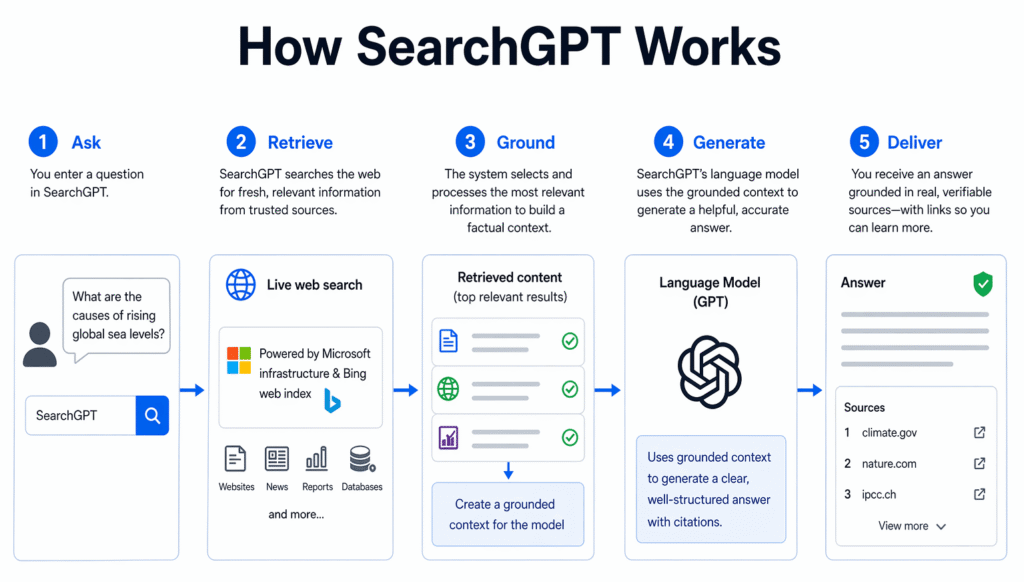
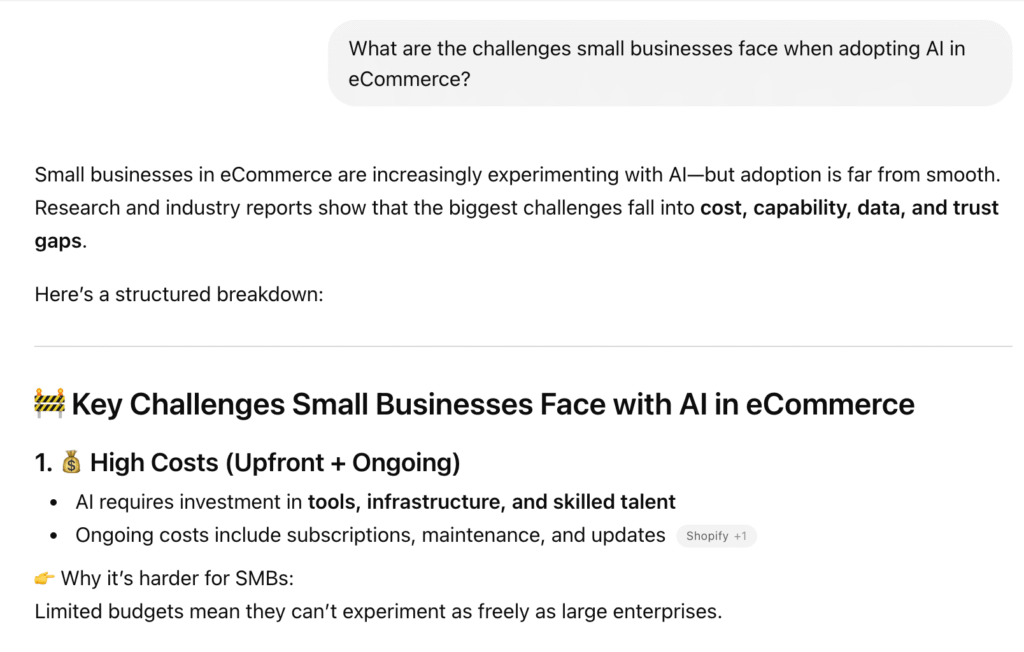
When a query is entered, SearchGPT converts the query into a numerical representation to identify the most relevant information. Instead of returning a list of links, SearchGPT synthesizes key insights from multiple relevant websites into a single, structured answer, often including cited sources and even multimodal elements like images or videos.
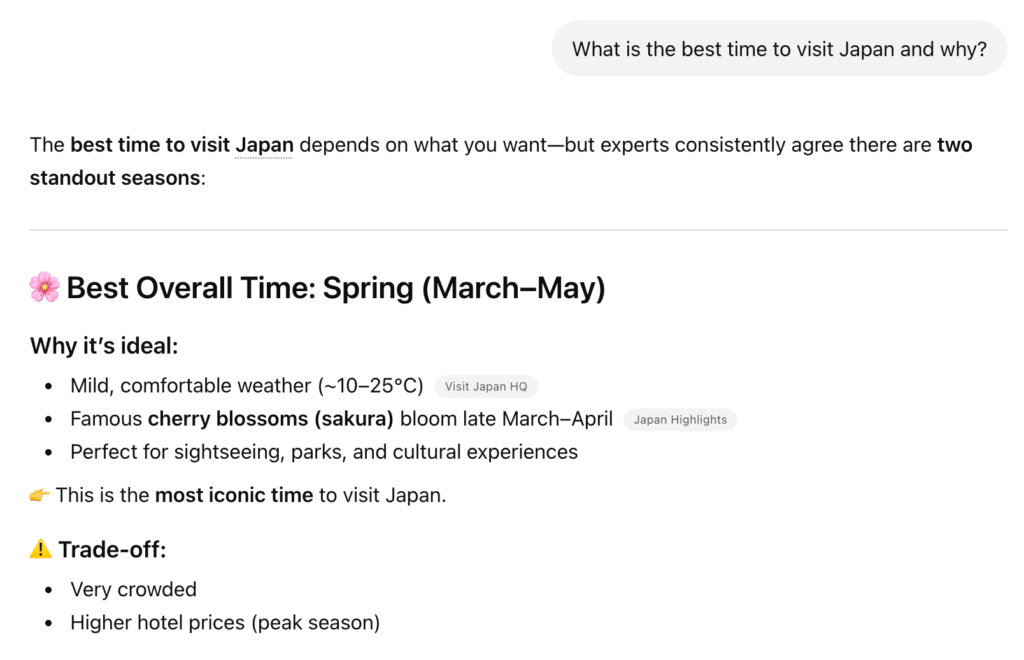
Because of this approach, results are dynamic. The same query can produce slightly different responses over time, as the system continuously evaluates relevance and updates its answers based on available data.
 Pro Tip: Curious to know which AI platforms are actually citing your content right now? Run a quick audit with a free AI visibility checker and see how your content currently performs across AI search platforms.
How ChatGPT Incorporated SearchGPT: From Prototype to Core Feature
When OpenAI introduced SearchGPT, it marked the beginning of integrating real-time information directly into AI search conversations.
Instead of searching for “best CRM tools 2026”, users now ask, “What is the best CRM for a small SaaS business with under 50 customers and why?” This is a shift from keyword queries to intent-rich, conversational AI prompts (query fan-out). This change exposed a key limitation: traditional AI models rely on trained data, which quickly becomes outdated when users expect accurate, up-to-date information.
OpenAI integrated SearchGPT directly into ChatGPT rather than keeping it as a separate search engine. Search became a native capability, triggering live web searches when queries require fresh data, and combining it with the model’s existing knowledge.
As of 2026, ChatGPT operates as a hybrid system. It can pull current information from the web, synthesize insights from multiple authoritative sources, and present them as structured answers with cited sources. This allows it to handle everything from time-sensitive queries to in-depth research, effectively functioning as both a conversational AI assistant and a real-time information engine within a single interface.
Google vs. SearchGPT
There are fundamental differences in how both systems present their 2026 versions of search.
| Aspect | Google (2026 Search Experience) | SearchGPT (ChatGPT Search) |
| Search Model | Hybrid model: combines AI Overviews with a vast index of ranked links | Conversational model: synthesizes information into a single dialogue response |
| Interaction Style | Multi-format: supports voice, image, and text with switchable modes | Primarily conversational with multi-turn context retention |
| Display of Results | Mix of AI summaries, snippets, videos, maps, and shopping results | Cohesive answer with embedded links and structured citations |
| Underlying Technology | Powered by Gemini for multimodal reasoning | Powered by GPT-4–based models with Azure-powered retrieval |
| Monetization | Mature ad ecosystem across search results and AI Overviews | Emerging monetization: shopping integrations and in-chat placements |
| Data Sources | Proprietary web index with continuous crawling and updates | Web retrieval via Microsoft infrastructure and Bing index |
| Usage Strengths | Deep research, local discovery, complex navigation | Quick answers, summarization, planning, conversational tasks |
When to Use SearchGPT Instead of Google?
There are times when one tool is clearly better than the other. While many users still wonder if ChatGPT uses Google to generate answers, the reality is that SearchGPT operates differently, focusing on synthesizing information rather than simply pulling from a single search engine.
Use SearchGPT when needing an explanation, a structured answer, or a clear plan. It works best for complex, multi-part questions where visiting several pages would otherwise be necessary, as it combines relevant information into a single, conversational AI response that can be refined further with follow-up questions.
SearchGPT is especially effective for research-style queries and learning. If you’re trying to understand a complex topic or compare options with more context, the dialogue-based format helps break things down and adapt to follow-up questions. It is also increasingly strong for guided tasks like shopping or planning, where recommendations come with reasoning rather than just listings.
Google, however, remains the better choice for navigational and location-based searches. If your goal is to find a specific website, login page, or local business information like phone numbers or directions, Google is faster and more precise. It is also more reliable when you want to explore multiple sources directly instead of relying on a summarized answer.

So the question is: Is ChatGPT better than Google?
In practice, SearchGPT is better suited for understanding and decision-making, while Google is still preferred for navigation, local discovery, and direct access to sources.
SearchGPT Is Not the Only AI Search Engine
SearchGPT is not the only system reshaping search. Google still dominates traditional search queries with its massive index and AI Overviews layered into results, while ChatGPT is increasingly capturing AI-driven search traffic through conversational queries.
Pro Tip: If SearchGPT is already reshaping how answers get surfaced, what does it actually take for a brand to appear in ChatGPT responses consistently? The strategies to rank in ChatGPT breaks down exactly what signals and content decisions move the needle across AI search systems. Alongside them, Perplexity AI has positioned itself as a citation-first answer engine, emphasizing transparency in sources, and Google Gemini powers Google’s broader AI ecosystem with strong multimodal capabilities.
A recent comparison by marketers highlights how each platform surfaces different sources and answer styles for the same query, reinforcing that visibility varies significantly across AI search engines and cannot be assumed to be consistent.
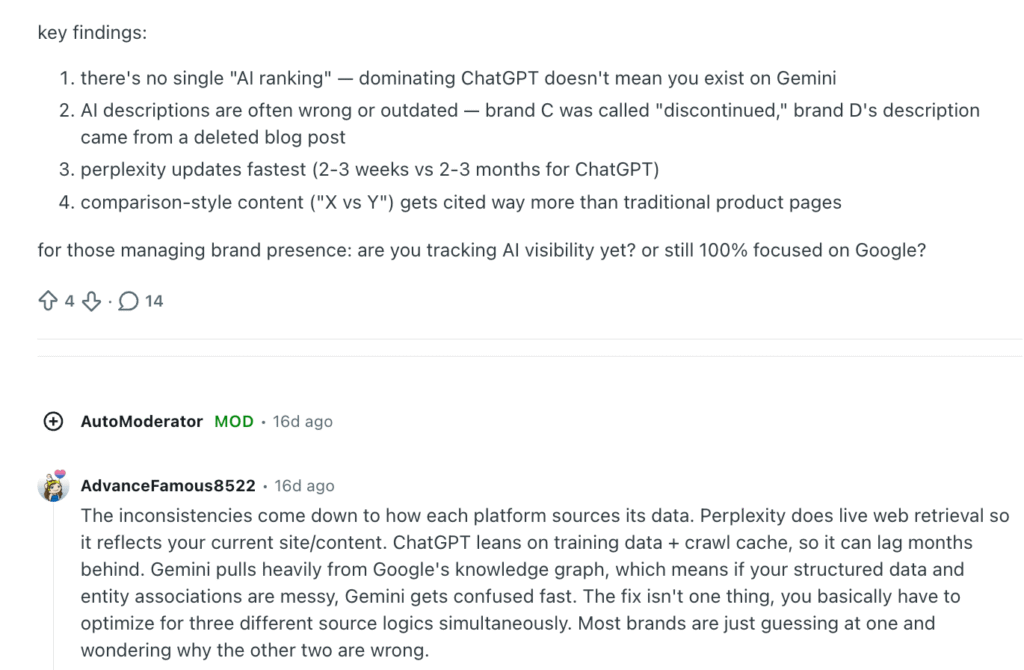
Each of these platforms retrieves and attributes information differently. Google relies on its proprietary web index and ranking systems, Perplexity prioritizes direct citations with minimal synthesis, and ChatGPT’s SearchGPT model focuses on combining multiple sources into a single, contextual response. This means visibility is not universal. One system may surface content that another ignores entirely
In practice, Google continues to lead in overall search volume, but AI platforms are rapidly growing as primary entry points for discovery. This fragmentation means businesses can no longer rely on a single platform. LLM visibility now requires monitoring and optimizing across multiple search systems.
Advantages of SearchGPT
SearchGPT simplifies how information is discovered by turning fragmented search journeys into a single, guided experience.
Synthesized answers: Delivers a clear response that combines insights from multiple sources into one cohesive explanation.
Efficiency: Helps you find what you need faster, without switching between multiple tabs or pages.
Context-aware interaction: Remembers previous queries, making it easier to refine questions and explore topics in depth.
Inline citations: Includes direct source references, allowing quick access to original content when needed.
Real-time information: Pulls fresh data from the web, ensuring answers are current and not limited by training cutoffs.
Multi-modal experience: Can display images, products, or additional data formats directly within the chat, across mobile devices.
Clean interface: Presents information in a focused, clutter-free format compared to traditional search pages.
Limitations of SearchGPT
Despite its advanced capabilities, SearchGPT still has limitations that impact consistency, speed, and reliability in certain scenarios.
Dynamic responses: Answers can vary for the same query across sessions, as results are generated rather than fixed.
Narrower source pool: Relies on a more limited set of retrieved sources compared to Google’s extensive web index.
Weak in hyper-local queries: Can struggle with highly specific or location-based searches, sometimes returning incomplete results.
Hallucination risk: May generate incorrect or assumed information when reliable source data is limited.
Slower response time: Takes longer to generate answers compared to instant link-based search results.
Inconsistent citations: Some responses include strong references, while others may lack clear or sufficient source attribution.
How to Optimize for SearchGPT
Optimizing content for SearchGPT requires shifting from ranking-focused SEO to answer-first, citation-driven content that AI systems can easily extract, validate, and reuse in responses.
# On-site Optimization
Write direct answers to specific user queries in a compact format. For example, starting a section with “The best CRM for small SaaS teams is…” rather than a long introduction improves search functionality within AI search systems.
Publish proprietary data, original research, and statistics, such as benchmarks, surveys, or internal reports. AI models cite unique numbers more readily than generic statements when generating responses from retrieved sources.
Use well-structured content with clear headings, FAQ structures, and defined entities so individual sections can be pulled as standalone direct answers in AI search results.
Index the site properly in Bing Webmaster Tools. Pages that perform well on Bing surface more frequently in ChatGPT search’s retrieval layer.
Allow OAI-SearchBot in robots.txt. Blocking it cuts the content off from ChatGPT’s retrieval layer entirely.
Build strong E-E-A-T signals by adding author bios, citing credible authoritative sources, and using schema markup such as Article and FAQ to make trust signals machine-readable.
Pro Tip: Wondering why competitors keep appearing in AI answers even when the content quality looks comparable? The AEO GEO audit checklist breaks down every on-site and off-site signal that AI search systems use to select and cite sources. # Off-site Optimization
Secure brand mentions on high-authority aggregators like G2, Capterra, or industry comparison blogs, as these platforms are frequently referenced in AI search results.
Get featured in media outlets and publications that OpenAI commonly references, since trusted publisher mentions increase citation likelihood across AI search systems. Vox Media is one example of a content partner whose editorial presence carries weight in OpenAI search retrieval.
Maintain consistent brand and entity presence across social media platforms and third-party directories to help AI models correctly identify and validate the brand across AI search engines.
Monitor which user queries trigger brand citations and track share of voice against competitors, then refine content strategies based on AI search.
Final Thoughts
SearchGPT, even as a prototype, signaled a deeper shift in how search works, moving from link-based discovery to answer-first experiences. That shift has now materialized through ChatGPT, where search is conversational, contextual, and increasingly real-time.
While Google still dominates overall search volume, ChatGPT is rapidly growing as a primary entry point for AI-driven queries. This changes how visibility works: it’s no longer just about ranking pages, but about being selected, cited, and synthesized into answers.
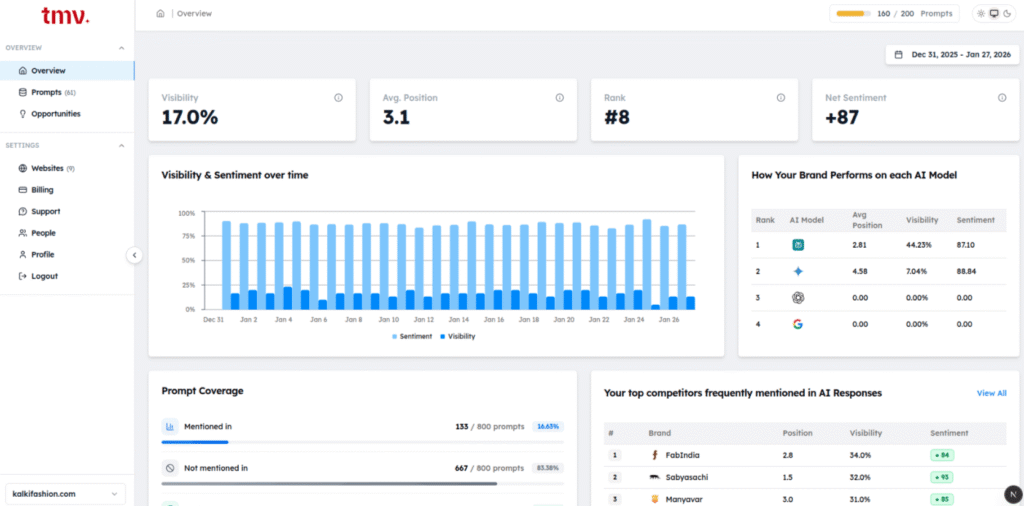
For brands, this means adapting content for clarity, structure, and topical authority to improve AI visibility across platforms. As this ecosystem evolves, monitoring and tracking AI visibility becomes essential. Tools like Track My Visibility help monitor where your brand appears in AI answers, track share of voice, and identify opportunities to improve presence across AI search systems.
Try our 7-day trial to know where you appear across AI platforms.
FAQs
SearchGPT is OpenAI’s conversational search technology that combines real-time web data with AI to deliver direct, synthesized answers instead of a list of links.
It uses retrieval-augmented generation (RAG) to pull live data from the web, combine it with trained knowledge, and generate a structured response with citations inside ChatGPT.
Yes, with integrated search capabilities, ChatGPT functions as an AI search engine by retrieving, synthesizing, and presenting information in a conversational format.
Google focuses on ranking and displaying links, while SearchGPT focuses on generating a single, contextual answer based on multiple sources.
Businesses should create answer-first content, publish original data, and build strong authority signals to increase citation chances. Tools like Track My Visibility help monitor where your brand appears in AI answers, track share of voice, and identify opportunities to improve AI visibility.