



AI search has completely changed the way websites compete for visibility. It’s no longer just about ranking on page one; now your content can be pulled apart, interpreted, and blended into AI-generated answers. If you’re trying to stay visible in this shift, you’ve probably realized how important content structure has become.
AI systems depend on clear signals to understand topics, entities, and relationships across a page. That’s why schema markup for AI gets recommended so often. But here’s the challenge: not all structured data actually helps AI systems understand your content better.
This guide breaks down what schema markup for AI genuinely helps with and what’s mostly assumption or hype.
TL;DR
- Schema markup helps AI systems understand content structure, entities, and relationships more clearly.
- Structured data supports AI visibility indirectly through better machine comprehension, not guaranteed citations.
- Article, FAQPage, Product, Organization, and Person schema provide the strongest AI parsing signals.
- Accurate and well-structured schema matters more than adding excessive markup.
- Schema works best alongside strong content, entity clarity, and clean site architecture.
What Is Schema Markup?
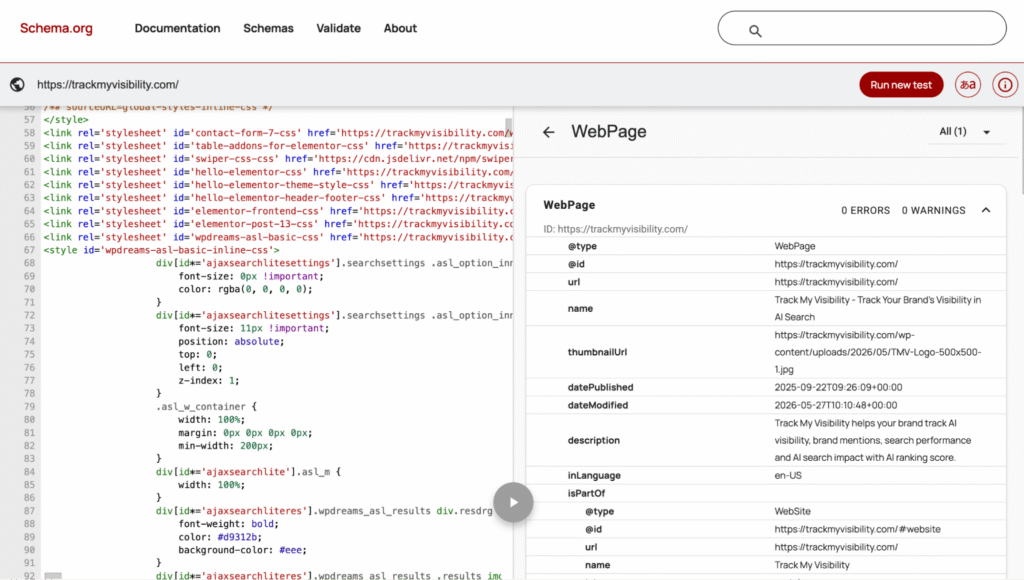
Schema markup is structured data that helps search engines and AI systems understand the meaning and context of webpage content. It uses a standardized vocabulary to define entities such as articles, products, organizations, author bios, FAQs, and reviews in a machine-readable format.
Instead of relying only on visible page content, systems can use schema markup to identify relationships, classify information, and interpret content more accurately.
Schema markup is based on the Schema.org framework, which was developed to standardize structured data across the web. It is commonly implemented using JSON-LD, a lightweight JavaScript Object Notation-based format recommended by Google because it is easier to maintain and scalable across websites.
Today, schema markup supports search features, knowledge graph associations, and structured content parsing across AI systems. JSON-LD is the practical standard for modern implementations, and the format Google recommends.
What Does Schema Markup Actually Do?
Schema markup adds machine-readable meaning to webpage content. It helps search engines and AI systems understand what the content represents, not just the words on the page. In simple terms, a schema explains what something is.
Its main role is to clarify entities and content types. Schema helps systems identify whether something is a person, company, product, organization, article, review, tutorial, video, or FAQs for AI search. It also maps relationships between entities, such as linking an article to its author, publisher, or related product.
Schema markup does not change the visible content on a page. It works in the background as structured metadata that helps machines interpret context more accurately.
 Pro Tip: Schema explains your content to machines, but how do you know if AI systems are actually getting the message? The free AI Visibility Checker reveals how a brand currently appears across the major AI platforms in minutes.
Does Schema Markup Improve AI Visibility?
Schema markup can support AI visibility, but not in the way many people assume. It does not directly make AI systems cite your content or guarantee inclusion in AI-generated answers. Instead, schema helps indirectly by improving how machines interpret entities, relationships, content types, and contextual meaning across a page.
When structured data is accurate and aligned with strong content, it can make information easier for AI systems to classify, retrieve, and understand during parsing and synthesis. In our Perplexity citation report, we found that pages using schema markup achieve 47% top-3 citation rates vs 28% without, a 19-percentage-point advantage.
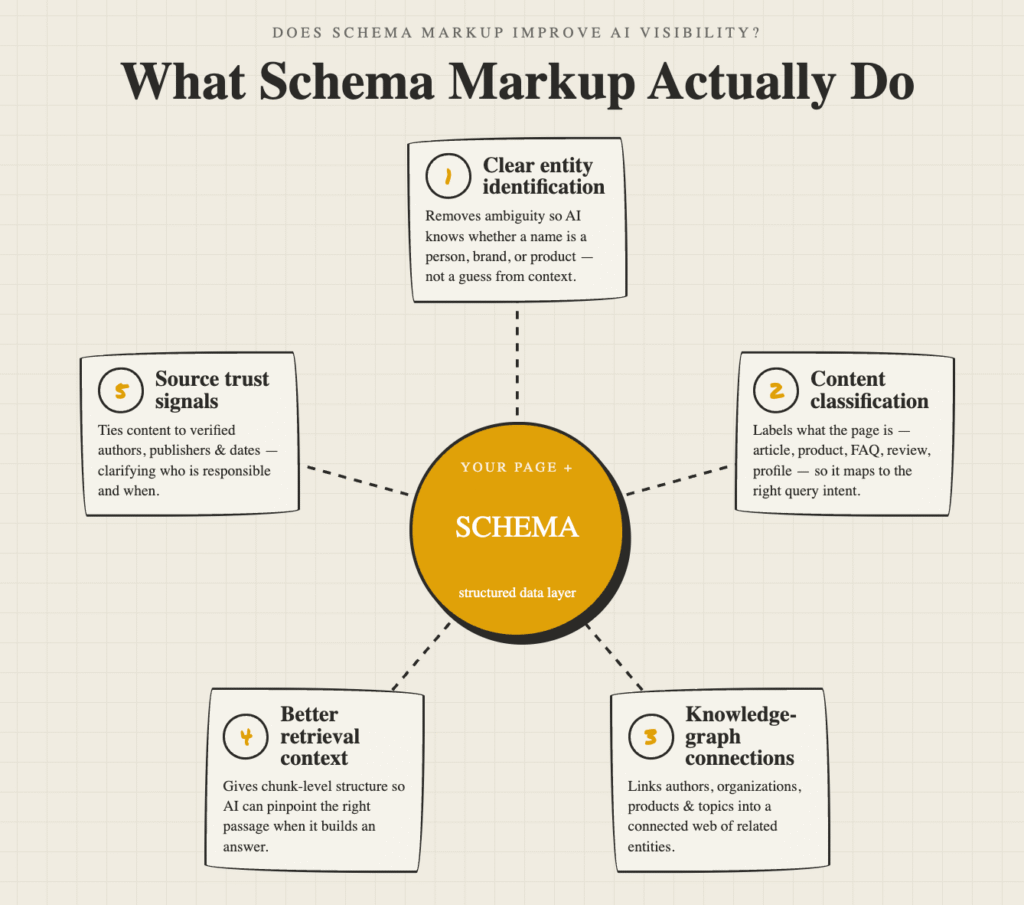
1. Clear Entity Identification
Ambiguity around names, brands, and products is a common parsing problem. Schema markup removes it by ambiguity around entities so AI systems can interpret them more accurately. For example, a name mentioned on a page could refer to a person, brand, product, or completely different entity depending on context. Structured data provides explicit labels that clarify what each entity represents.
By defining entities clearly and connecting them through structured relationships, a schema helps AI systems map content more reliably within Google’s knowledge graphs and retrieval systems.
2. Content Classification
Schema markup helps AI systems classify content more accurately by defining what kind of information a page contains from schema markup. Instead of interpreting content purely from headings and text patterns, systems can use structured data to identify whether a page is an article, product page, FAQ, tutorial, review, or organization profile.
This classification helps retrieval systems match content to user intent more effectively. FAQ schema may align better with conversational queries, while Product schema helps systems surface pricing, specifications, and availability-related information. Clear content categorization improves how machines organize, retrieve, and prioritize information during AI-generated responses.
3. Better Knowledge Graph Connections
Structured data also helps strengthen connections between related entities, which supports how knowledge graphs organize and interpret information. When a schema defines relationships between authors, organizations, products, webpages, and topics, AI systems can better understand how those entities connect across the web.
These connections help reinforce identity, topical relevance, and source attribution. Linking an article to its publisher and author through schema creates clearer entity associations. It improves how search engines see your brand and help AI systems contextualize the content within broader knowledge graphs and retrieval systems.
4. Improving Retrieval Context
Schema markup can also improve retrieval context by giving AI systems clearer structural signals around page content. Modern AI retrieval systems and AI crawlers often process webpages in smaller sections or chunks rather than interpreting an entire page at once. Structured data helps provide additional context about what those sections represent and how they relate to the broader topic.
When combined with strong heading structure and well-organized content, schema can make important information easier to identify, categorize, and retrieve. This improves how AI systems locate relevant passages during answer generation and content synthesis.
5. Supporting Source Trust Signals
Schema markup reinforces credibility and source attribution signals that AI systems evaluate during content interpretation. Structured data for authors, organizations, publishers, and publication details helps clarify who created the content and which entity is responsible for it.
A Person and Organization schema can connect articles to verified authors and brands, while publication dates and publisher markup provide additional context around freshness and ownership. These signals do not guarantee trust or site authority on their own, but they help AI systems process source identity and contextual credibility more consistently.
Pro Tip: Curious which trust signals AI systems actually rely on beyond schema? The Google EEAT checklist breaks down what builds real credibility in AI search.Which Schema Types Matter Most for AI Parsing?
The schema types that matter most are typically those used to identify articles, authors, organizations, FAQs, and product page structure. These provide clearer parsing signals for classification, retrieval, and contextual understanding.
| Schema Type | Where It Matters Most | What It Helps AI Systems Understand | Best Use Cases |
| Article | Blogs, news articles, guides, educational content | Content topic, headline, author, publishing dates, publisher attribution, editorial structure | Blog posts, tutorials, research content, industry guides |
| FAQPage | FAQ sections, support pages, informational guides | Direct question-answer relationships and concise response patterns | FAQs, troubleshooting pages, product support content |
| Product | E-commerce product pages | Product details, pricing, availability, reviews, specifications, brand relationships | Shopify stores, SaaS product pages, and physical product listings |
| Organization | Homepage, company pages, About pages | Brand identity, company relationships, official website ownership, trust signals | Business websites, SaaS platforms, agencies, publishers |
| Person | Author pages, team pages, expert profiles | Author identity, expertise, role associations, entity recognition | Author bios, editorial teams, expert contributors |
| HowTo | Step-by-step instructional content | Sequential actions, process structure, instructional intent | Tutorials, setup guides, DIY content, walkthroughs |
| BreadcrumbList | Websites with hierarchical navigation | Site structure, parent-child page relationships, contextual navigation | E-commerce categories, documentation sites, and blog archives |
| WebPage | General webpages | Primary page intent and contextual topic classification | Landing pages, informational pages, category pages |
| Review | Product and service review pages | User sentiment, evaluation signals, rating context | Product reviews, software comparisons, and testimonial pages |
| LocalBusiness | Local company websites | Business location, operating details, contact information | Restaurants, agencies, local stores, service providers |
| VideoObject | Video-based content pages | Video topic, duration, transcript context, media relationships | Tutorials, webinars, product demos, explainers |
| ImageObject | Visual-heavy pages | Image context, ownership, captions, media associations | Photography, e-commerce, infographics, and editorial media |
What Does Schema Markup Not Do?
Schema markup does not guarantee visibility in AI-generated answers or increase the chances of being cited by LLMs. It helps machines interpret content more clearly, but it is not a direct ranking or citation factor on its own.
Structured data also cannot compensate for weak content, poor topical authority, outdated information, or low trust signals. Adding more schema will not fix pages that lack depth, clarity, or relevance.
Schema works best as a supporting layer within a broader AI visibility strategy that includes strong content structure, entity clarity, internal linking, topical coverage, and overall site credibility.
Schema Best Practices for AI Optimization
- Prioritize Accuracy Over Volume: Clean and accurate schema markup is far more valuable than adding excessive structured data with incomplete or incorrect properties.
- Match Visible Content: Structured data should reflect the actual content users see on the page. Misleading or hidden schema can reduce trust and create parsing inconsistencies.
- Build Strong Entity Signals: Use Organization, Person, and sameAs properties to reinforce brand identity, authorship, and entity associations across platforms.
- Use Nested Relationships Properly: Connect related entities logically, such as linking articles to authors and publishers, instead of stacking disconnected schema types independently.
- Keep Structured Data Updated: Schema should evolve alongside your content, products, authors, and business information to maintain accuracy and relevance.
- Validate Regularly: Test structured data using validation tools like the Google Rich Results Test or third-party extensions like AI visibility checker to identify errors, missing properties, or implementation issues that could affect machine interpretation.
How is the Impact of Schema Markup Measured?
The impact of schema markup is usually measured through improvements in how AI systems understand and interpret your content, rather than through a single ranking or citation metric. Since AI platforms evaluate multiple signals together, structured data helps clarify entities, relationships, and content types across a page.
Some useful indicators to monitor include whether AI systems correctly identify your brand, how they describe your company or products in generated responses, and how often your content appears as a cited or referenced source across major AI platforms. Over time, stronger entity recognition and more consistent citations can indicate that your structured data and content structure are helping machines interpret your content more accurately.
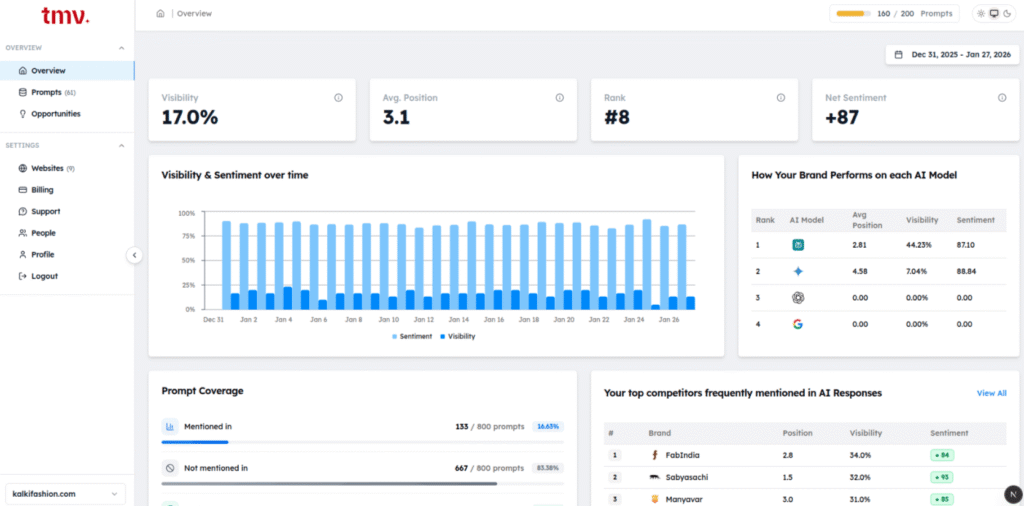
This is also where tracking AI share of voice becomes useful. Tools like Track My Visibility help monitor how AI systems surface and reference your brand across platforms like ChatGPT, Gemini, Claude, and Perplexity.
Track My Visibility helps with:
- Tracking AI brand mentions and citations
- Monitoring AI share of voice across competitors
- Identifying which platforms reference your content
- Measuring visibility trends over time
- Understanding how AI systems describe your brand
Instead of relying on assumptions, visibility tracking gives you measurable insights into how AI systems are interpreting and surfacing your brand.
Final Words
Schema markup is best viewed as a comprehension layer that helps AI systems interpret content more clearly, not as a shortcut to guaranteed citations or rankings. Its real value comes from improving entity clarity, contextual understanding, and structured relationships that support retrieval and AI parsing.
As AI search continues evolving, systems are increasingly relying on well-structured, machine-readable content to understand brands, topics, and source credibility more accurately. That makes structured data an important part of a long-term AI visibility strategy.
If you’re curious how AI systems currently interpret and surface your brand, monitoring those signals can reveal insights traditional analytics often miss. Tools like Track My Visibility help uncover AI citation patterns, brand mentions, and visibility trends across platforms that standard analytics often overlook.
Want to see how visible your brand really is in AI search? Start with our 7-day free trial.
FAQs
Schema markup can help AI systems understand content more clearly, which may support better retrieval and contextual interpretation.
Schema does not guarantee citations, but it can improve machine comprehension and entity clarity that support AI visibility.
Article, FAQPage, Product, Organization, and Person schema are among the most useful for AI understanding and content classification.
Not necessarily. Accurate and relevant structured data is more valuable than excessive or poorly implemented markup.
No. Structured data supports content understanding, but it cannot replace strong topical authority, relevance, or content quality.
Entity recognition helps AI platforms correctly identify brands, authors, products, and relationships across content and knowledge graphs.
Platforms like Track My Visibility help monitor AI citations, brand mentions, and visibility trends across systems like ChatGPT, Gemini, Claude, and Perplexity.