


If you have tried comparing LLM visibility tools lately, you have probably noticed how quickly the options start to blur together. Most platforms promise some version of AI visibility tracking, but the actual experience can be very different from one tool to another.
One platform might be great for checking brand mentions in ChatGPT and Gemini, while another is more useful for competitor research, citation tracking, or client reporting. So the best tool is not necessarily the one with the longest feature list but the one that fits what you actually need to track.
It really comes down to what you want from the tool. Maybe you just want to see whether your brand is showing up in AI answers. Maybe you care more about competitor visibility, citation opportunities, or improving your wider AI search optimization efforts.
We compared the leading LLM visibility tools for 2026 to make that choice a little easier. Below, you’ll see where each tool stands out, where it could be better, what it costs, and the kind of team it makes the most sense for.
TL;DR
- Track My Visibility is a good fit if you want to understand where your brand is missing from AI answers and what content you should work on next.
- AIClicks goes a step beyond tracking. It also helps teams decide what to create or improve once a visibility gap is found.
- Profound is better suited to larger companies that need detailed reporting, coverage across more AI platforms, and a closer look at how people search through AI.
- Otterly AI is easier to get started with and works well for smaller teams that mainly want to keep track of their brand’s presence in AI search.
- Peec AI is useful for keeping an eye on competitors, checking citations, and putting together clear reports, especially for agencies and growing marketing teams.
How We Evaluated These Tools
We did not rank these tools on features alone. We also considered how useful those features are once you start using the platform day-to-day, especially for teams trying to measure and improve AI search visibility.
- AI platform coverage: Which AI platforms can you actually track? We checked support for ChatGPT, Google AI Overviews, Claude, Gemini, Perplexity, and other major platforms.
- Visibility insights: We paid attention to the data each tool gives you, from prompt tracking and past performance to competitor visibility and citations.
- Ease of use: A tool may have plenty of features, but it still needs to be easy to work with. Setup, navigation, and how clearly the data is presented all mattered here.
- Pricing and value: We compared the cost with what is included, while also considering whether the pricing makes sense as your tracking needs grow.
- Best-fit use case: Not every tool is built for the same audience. We considered whether each platform makes more sense for smaller teams, agencies, growing brands, or enterprise companies.
Best LLM Visibility Tools at a Glance
| Tool | Best For | LLM Coverage | What Stands Out | Starting Price |
| Track My Visibility | SEO teams, agencies, SaaS, and eCommerce brands | ChatGPT, Google AI Overviews, Perplexity, Gemini, and more | Helps uncover citation gaps and shows which content opportunities to tackle first | $50/month |
| AIClicks | Marketers and agencies that want to turn insights into action | ChatGPT, Perplexity, Gemini, and other AI platforms | Brings AI visibility tracking, content creation, and recommendations together | $59/month |
| Profound | Large and enterprise brands | 11 AI surfaces, including ChatGPT, Claude, Gemini, Perplexity, Copilot, and Grok | Deep analytics, reporting, and data on what people are searching for through AI | $99/month |
| Otterly AI | Solo marketers and smaller businesses | ChatGPT, Google AI Overviews, Perplexity, and Copilot, with Gemini and AI Mode available as add-ons | Straightforward monitoring at a lower starting price, with historical visibility tracking | $29/month |
| Peec AI | Agencies and mid-sized marketing teams | 3 of 6 models per tier, including ChatGPT, Perplexity, and Gemini | Makes it easy to compare competitors and report on AI visibility | $95/month |
*Pricing can change, so check each company’s official pricing page for the latest information.
The 5 Best LLM Visibility Tools in 2026
LLM visibility tools can look quite similar when you compare their feature lists. You notice the real differences when you see how each tool handles the data, what actions it helps you take, and the type of team it is meant for.
Here are five LLM visibility tools to consider in 2026.
1. Track My Visibility
Track My Visibility is designed to show where a brand is appearing across AI search and where it is being left out. You can track how your brand shows up in AI-generated answers, which competitors appear alongside it, what sources AI platforms cite, and how visibility changes over time.
It supports ChatGPT, Gemini, Claude, Perplexity, Google AI Overviews, and other AI platforms.
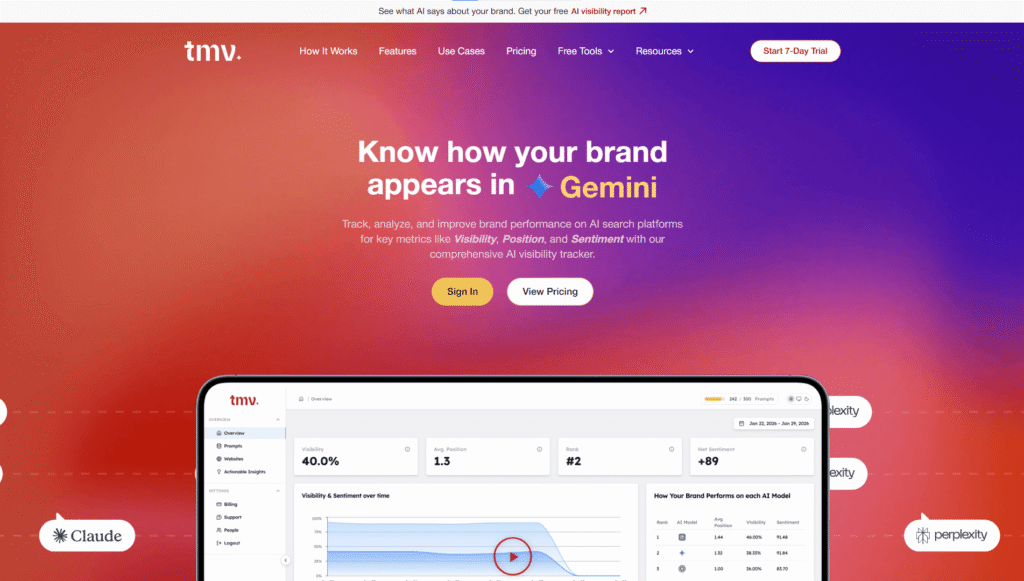
What makes it different: It is important to know what happens after you spot a gap. For example, you can see which prompts your competitors are winning, which sources are being cited, and which pages on your site may need work. As a result, it becomes easier to turn data into an actual SEO or content task.
Where it works well:
- AI search tracking: See brand mentions across several AI platforms in one place instead of checking them one by one.
- Prompt gap detection: Find prompts where your competitors are appear and your brand is not.
- Competitor benchmarking: Compare share of voice and see which competitors are getting mentioned or cited for the same searches.
- Page-level actions: Identify which pages may need updating when a visibility or citation gap appears.
Things to consider:
It is best for ongoing AI visibility tracking, so it may be more than you need if you only want to run a quick one-time check. Larger prompt volumes require the higher-priced plans.
Pricing:
Plans start at $50 per month. Growth plans start at $400 per month for teams with larger tracking needs. There is also a 7-day trial.
Who should choose it:
Track My Visibility is more suitable for SEO teams, agencies, and brands that want AI visibility data to decide what content to update, create, or prioritize next.
2. AIClicks
AIClicks brings monitoring and execution closer together. In addition to tracking AI visibility, it surfaces recommended actions and provides content tools, thereby helping teams act on the opportunities they uncover.
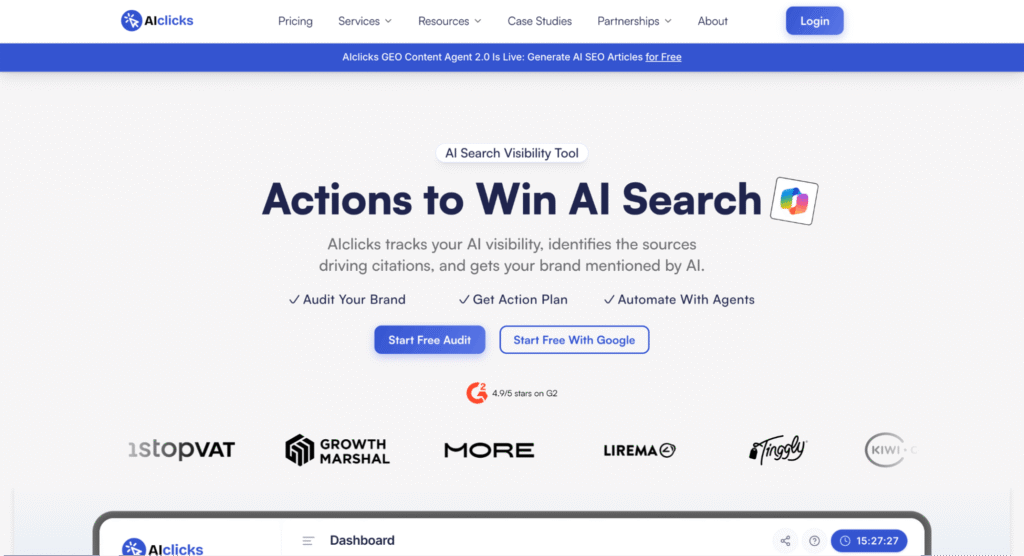
What makes it different: AIClicks pushes beyond monitoring by also connecting visibility gaps with content creation and recommended actions. As a result, it is useful for teams that want to move from finding an issue to working on it within the same workflow.
Where it works well:
- Recommendations: Rather than just pointing out where visibility is weak, it suggests what to work on next, such as improving a page, earning a citation, or getting mentioned by stronger sources.
- AI content tools: You can use it to draft blogs, guides, and product pages with AI search in mind.
- Competitor insights: It makes it easier to see where competing brands are getting mentioned and where your own brand is falling behind.
- Source and citation analysis: You can also see which websites are influencing AI answers, from review platforms to Reddit discussions.
Things to consider: The content tools can save time, but the drafts still need human editing and fact-checking before they go live.
Pricing: There are self-serve plans with different limits for prompts and platforms. Larger teams can choose custom enterprise or managed-service pricing.
Who should choose it: It suits teams that want to shorten the gap between LLM monitoring and content execution.
3. Profound
Profound goes deeper into AI search data, while also offering visibility tracking, search-demand insights, crawler analytics, and enterprise controls. As a result, it is designed for organizations that need a broader view of how their brand performs across AI platforms.
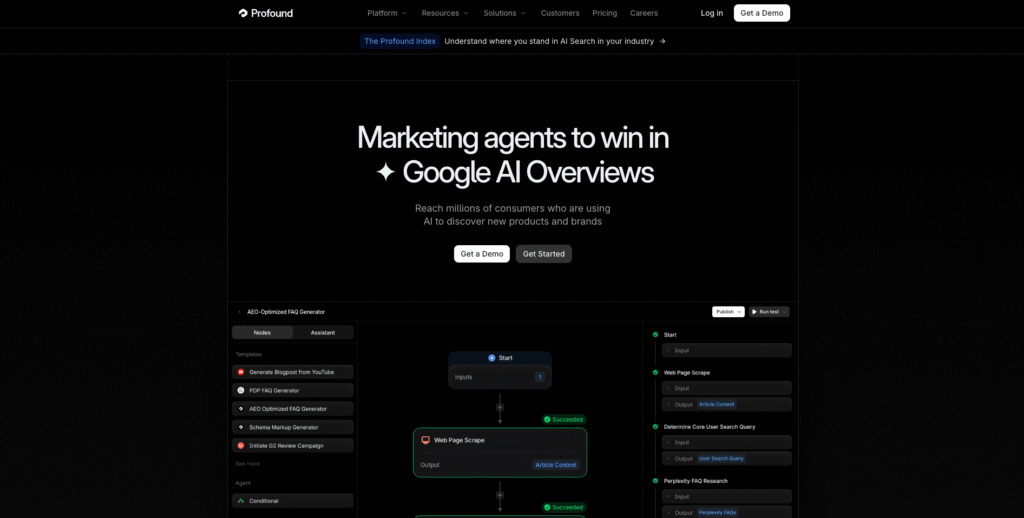
What makes it different: Profound is built with larger organizations in mind. Alongside visibility and citation tracking, it has AI search demand data, crawler analytics, automation, and enterprise-level governance features.
Where it works well:
- Answer Engine Insights: Monitors brand mentions, citations, sentiment, and competitive positioning across major AI platforms, with the proprietary Profound Index as a standardized visibility metric.
- Conversation Explorer and Prompt Volumes: Surfaces real AI-search demand data, showing how often topics are discussed across AI platforms.
- Agent Analytics: Connects to a CDN and reads server logs to reveal which AI crawlers hit which pages.
- Autonomous agents: Automate optimization and content tasks, credit-metered per tier.
- Enterprise security: SOC 2 Type II, SSO, and RBAC for compliance-heavy organizations.
Things to consider: The platform can be more complex than smaller teams need, and many of its additional capabilities require enterprise plans.
Pricing: Plans start at $99/month, with growth from $399/month. Enterprise pricing is custom.
Who should choose it: Best for large organizations that need deep analytics and enterprise controls.
4. Otterly AI
Otterly AI brings the key parts of AI search optimization into one place. It covers prompt research, visibility monitoring, content audits, and GEO optimization. Brands can also see how they appear across ChatGPT, Gemini, Perplexity, Google AI Overviews, AI Mode, Copilot, and Claude.
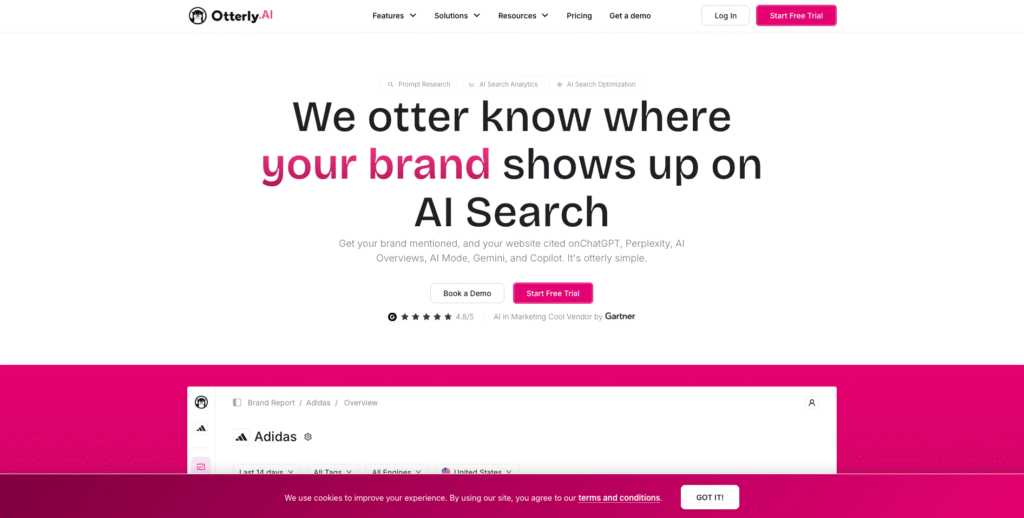
What makes it different: Otterly keeps AI visibility monitoring fairly approachable. It covers the essentials, including prompt tracking, citations, historical visibility, prompt research, and GEO audits, without requiring a heavy enterprise setup.
Where it works well:
- AI search monitoring: See where your brand shows up across ChatGPT, Google AI Overviews, Perplexity, and Microsoft Copilot, based on the prompts you are tracking.
- Citation tracking: Find out which websites AI engines are pulling information from when answering those prompts.
- AI Prompt Research: Get ideas for the types of searches your audience may be making, so you can choose more relevant prompts to track.
- GEO audits: Check whether technical or content-related issues on your site may be limiting how often it appears in AI-generated answers.
Things to consider: Otterly AI is good for monitoring your AI visibility, but it may not be suitable for deeper optimization workflows. You may need a higher plan if you want access to additional AI platforms.
Pricing: Starts at $29 a month, with higher tiers available as monitoring needs grow.
Who should choose it: It is a good starting point for smaller businesses or teams that want to see how they are performing in AI search without spending too much.
5. Peec AI
Peec AI focuses on understanding how brands perform inside AI-generated conversations. It looks at metrics such as visibility, position, and sentiment. Performance can be explored across prompts, sources, models, competitors, and markets.
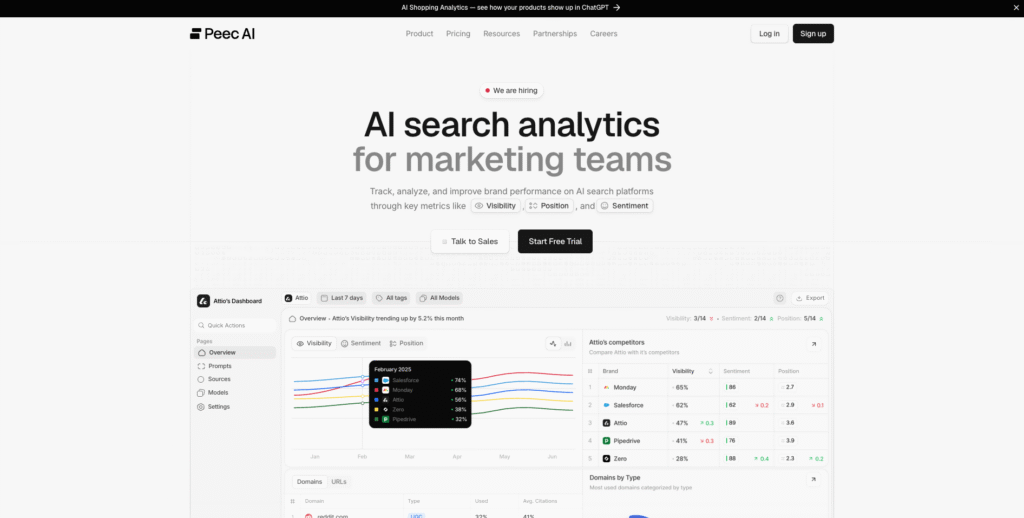
What makes it different: Peec AI stands out most when competitor and citation analysis matter. It shows where competitors are gaining visibility, how citations are being used, and where your brand may have opportunities to catch up.
Where it works well:
- Brand tracking: Monitors visibility share, average position, and sentiment across major AI search platforms.
- Citation analysis: Differentiates between content used to generate answers and URLs explicitly cited by AI models.
- Competitor benchmarking: Compares visibility against competitors and highlights prompts where they outperform your brand.
- Actions module: Recommends practical opportunities to improve AI visibility through content and digital PR.
Things to consider: Some advanced reporting features are limited to premium plans.
Pricing: Plans start at $95/month, with Pro and Advanced options for larger teams. A 7-day free trial is included.
Who should choose it: Best for agencies and marketing teams that value clear reporting and competitor insights.
How to Choose the Right LLM Visibility Tool
When you’re looking at LLM visibility tools, don’t just focus on the size of the feature list. A tool can do a lot and still be a poor fit for what you actually need. Prioritize a tool with your goals, workflows, and budget
- AI platform coverage: Make sure the tool monitors the AI search platforms that matter to your audience.
- Prompt tracking depth: Choose a platform that tracks a broad set of prompts over time instead of relying on a limited or static prompt list.
- Integrations and reporting: Consider whether the tool fits into your existing workflow through APIs, analytics integrations, exports, or CMS connections.
- Pricing and scalability: Select a platform that fits your current budget while offering room to grow as your prompt library, team, or reporting needs expand.
Final Take
The best LLM visibility tool depends on your business goals, team size, and workflow.
Otterly fits a tight budget, AIClicks suits teams tied directly to content execution, Profound serves enterprises needing demand data, and Peec AI is the value pick for agency reporting.
Before committing to any platform, confirm which AI engines matter for your audience and the prompt volume you need. Track My Visibility helps identify the right prompts, citation gaps, and actionable insights you need to improve your AI visibility.
Start with our 7-day trial to see where your brand appears across AI platforms.
FAQs
Not directly. They help you identify citation gaps, monitor brand visibility, and prioritize optimizations that can improve your presence across AI search engines over time.
LLM monitoring measures how your brand appears in AI-generated answers, while AI search optimization focuses on improving that visibility through better content, authority, and citations.
Weekly tracking is sufficient for most businesses, while competitive industries or active content campaigns may benefit from daily monitoring to spot changes sooner.
Focus on AI platform coverage, prompt tracking depth, competitor benchmarking, actionable insights, reporting capabilities, and pricing that fits your team’s needs.